ArtofLegendIndia.com, Biggest Online Store of Handicrafts Items, Paintings and Jewelry Accessories...

Handicrafts

Handicrafts are devices or works of art that are made completely by hand or by the use of relatively simple tools. Such goods are usually made in the traditional way of manufacturing goods. Therefore, the knowledge of the art of craft is usually passed down from one generation to another. The items made using these traditional methods of manufacturing are usually produced in smaller quantities and they often represent the culture or religious beliefs of the community that makes them. The goods are also handmade from natural materials that are found in the environment of the particular economy.

Read More!

Biggest Online Store of Handicrafts Items

Paintings

A painting is equal to thousand words, means a beautiful painting is equal to million of words. Paintings are one of the oldest art forms -- throughout history artists have played an important role in documenting social movements, spiritual beliefs and general life and culture.

History Of Paintings: The history of painting reaches back in time to artifacts from...

Read More!

Biggest Online Store of Unique Style Paintings
Showing posts with label Religion. Show all posts

Dharmapalas or Protectors of The Law

Posted by Art Of Legend India [dot] Com On 3:36 AM 0 comments
Mmahakala
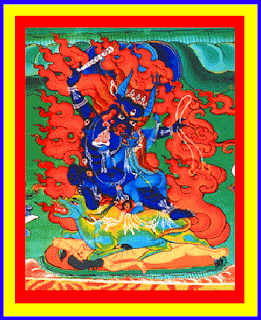
The Dharmapalas are the defenders of the Law of Buddhism who are entrusted with the work of destroying all enemies of Buddhism. They are also called the Drag-Ched or 'T he Eight Terrible Ones' and their ferocious forms are mainly to inspire evil spirits with fear. Each sect in Tibet has a terrible defender for protecting the devotees from the dangers of evil powers and restraining them from evil acts. The thankas depicting Dharmapalas belong to the group of mGon k' an. i.e., Lords' house which means the `Yi-dam' or the protecting deity of the sect and a number of ferocious aboriginal deities who were included in the Lamaistic pantheon as 'Terrible Keepers of the Law'. These thankas are characterized by dark or black figures of monstrous deities delineated against a dark background and surrounded by flames. The Dharmapalas are re-presented with crown of skulls, disheveled hair, triple eyes scowling eye brows, garment of tiger, elephant or human skin, garland of severed heads ornaments and aprons made of human bones and snakes, and trampling human beings or animals. These terrible Defenders of the Law exhibit their wrathful aspects out of compassion towards people to frighten evil forces so that they follow the path of Buddhism and attain liberation.

Mahakala, a prototype of Siva is one of the Hindu deities which has been incorporated into the Buddhist pantheon. The worship of Mafia-Lila is generally meant for Tantric rite of mantra.

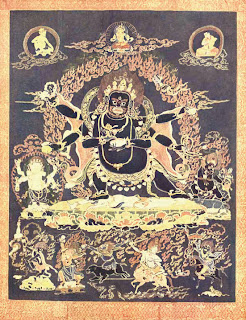
Mahfikala (Gur-gui-Gam-Po) as Lord of the tent and with his magic staff placed across his arms is also called Danda Mahakala in Tibet. He looks terrible with three rolling eyes, red gaping mouth, scowling eye brows, flaming hair, protruding belly and ornaments of snakes. His matted hair rises over the head surmounted by a vajra. The god is short, wearing tiger-skin and trampling upon a human corpse. He is decorated with a garland of severed heads and wears crown that consists of five skulls. Mahakala is here represented in his two-armed manifestation holding kartri in the right hand and kapala in the left hand.
Beg-tseAt the top, in the centre, is Adi Buddha Vajradhara holding vajra and ghanta across the chest in vajrahumkaramudra. On his right and left sides are portrayed Chogyal Phagpa, the preceptor of Sakyapapdita in meditating posture and Sakyapandita, one of the great teachers of the Sakya School wearing red cap and showing the vitarkamudra. Mahakala is encircled by three of the mahapancaraja namely, Pe-har, Cho-chyong, Dalha, all in militant attitude holding khadga, danda, pasa, kartri, khakkara, kaPala, etc. The one on his right, a seated figure holding ambrosia vase in two hands and decked in celestial dress and ornaments probably represents a form of Mahakala, while the other on his left is Lha-mo or SrIdevi riding a mule with an eye on its haunch and carrying in her four hands the khadga, kapala, Sula and trisula.

At the bottom of the thanka five messengers of Mahakala have been depicted, all in dancing pose holding sword, magic stick, skull cup and knife, etc.

In this thanka the whole composition is done in bold lines against a black background and the color plays an insignificant role.

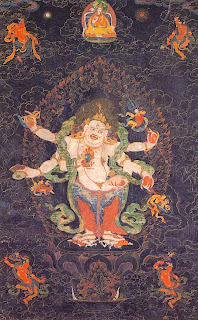
Begtse which literally means 'hidden sheet of mail' is a god of war and as a Dharmap5la he ruthlessly destroys the enemies of Buddhism. He is standing on lotus stepping his right leg on a blue horse and left leg on human being. Begtse is usually believed to be a Mongol god and a late incorporation in the Lamaistic pantheon. According to a Mongolian legend when the third Dalai Lama (1543-1589) was invited by the king Altan Khan to convert the Mongols, Begtse with an army of demons in the form of animals appeared before him. The Dalai Lama then assumed the form of Avalokitesvara and the hoofs of his horse left the imprints of the mantra 'om manipadme hum' and Begtse was converted to Buddhism. He is portrayed ferocious with three scowling eyes, copper helmet, cuirass, Mongolian boots and girdle of heads. With his right hand he brandishes a copper sword while his left hand holds the heart of the enemies to his mouth.
Yama with YamiBegtse is here shown in the company of his sister Rig pai Lha mo riding on a lion, who has a blue face, red body, and is holding sword and phur-bu in two hands, while on his right side is represented a warrior carrying lance and noose in two arms. Begtse is therefore usually called 'lcam srin' i.e., brother and sister.

At the top, in the centre, is represented Dhyani Buddha Amitabha flanked by great Guru Padmasambhava and Bodhisattva Vajrapani. At the bottom he is encircled by eight acolytes, all in an agitated mood and holding sword and kapala. Begtse is also said to reside in a cemetery. The figures of dakinis holding entrails, bones, torn out eyes, etc. along with flying vultures feasting with entrails and wild animals give an idea of charnel ground visualizing the old nomad god as Defender of the Law and a subject of meditation in the charnel field.

Yama, commonly known in Tibetan as Gsin rje or Chos-gyal, king and god of death, is represented with buffalo head, three rolling eyes, flaming eye brows and two arms. He is riding a buffalo on lotus in pratyalidha pose, the latter trampling a man. He wears naramundamala (garland of human heads) and a snake thread and on his breast is the emblem of wheel, a distinctive mark given by Tsong-kha-pa for appointing him as protector of the Ge-log-pa sect or Yellow Bonnets. The god wears a crown consisting of skulls and his hair with vajra rises in the shape of flame. In his right arm he holds sceptre topped by skull (yamadanda) while in his right arm he holds noose (pasa).

Yama is accompanied by his sister Yami holding trisula and kapala with blood in her right and left hands respectively.

At the bottom a separate piece of cloth representing skull heads is attached with the thanka.
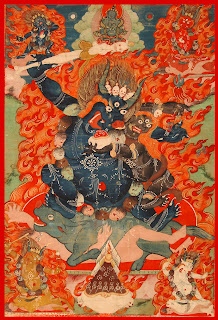
Yama
This large thanka represents Yama, the king and judge of the dead (Dharmaraja) with his sister Yami. Encircled by flames Yama in his exoteric form is portrayed with buffalo head, and standing in pratyalidha pose on his mount buffalo who is trampling a human figure in an agitated attitude. His three scowling eyes, flaming hair, curved long nails and his pratyalidha pose, all manifest an expression of great anger. He is nude and decked in ornaments of bones (sanmudra) and naramundamala and his diadem is decorated with skulls and jewels surmounted by a vajra. He is two armed. With his right arm he carries the command staff (dada) topped by skull and banner and with his left hand in tarjanimudra he holds pasa. On the left side of Yama, Yami, his sister is represented in the same terrific expression, offering blood in a kapala to his mouth and holding trident (trisula).

At the top, in the centre, is represented Adi Buddha Vajradhara and his sakti in yab-yum flanked by Atisa, the great Indian monk and founder of the Ka-dam-pa sect and Tsong-kha-pa, follower of Atisa and founder of the Ge-lug-pa sect. It was Tsong-kha-pa who appointed Yama as protector of the Yellow cap sect. In the lower section of the thanka is portrayed Lha-mo, the only feminine .divinity among the eight Dharmapalas who is regarded as the chief protectress of the Ge-lug-pa sect. She is accompanied by Pe-har, the chief of the Four Great Kings (mahapancaraja) riding a lion and wearing broad-brimmed hat on the right and Begtse riding a blue horse on the left. Both of them are worshipped as protectors of the faith by the Ge-lug-pa sect. Besides, two skull-cups have been depicted representing gruesome offering of five senses and offering of fat in two skull-cups placed on smaller skulls as tripod.
 Writer – Sipra Chakraverti
Read Also:

Goddess Lakshmi Paintings: Goddess of wealth 

Goddess kali Paintings

Salon Nam Shag (Description of different stages and path to nirvana)

Posted by Art Of Legend India [dot] Com On 6:29 AM 1 comments
Salon Nam Shag (Description of different stages and path to nirvana) Inscribed Technique: Gouache  Date: Late 19th century A.D.  Accession No.: 14587  Size: 107 cm x 86 cm (with border) 85 cm x 63 cm (painted portion) Acquired in 1927
This is a fortune-telling thanka and as a 'sort of game, 'the game of Rebirth', it is played with dice. Unlike other thankas this thanka is interesting for its subject-matter, which neither depicts a deity nor a monk but a sort of religious game a popular game of the Tibetan people. Though the subject is different the ultimate goal of the game as depicted in this painting, like other thankas is the same, i.e. nirvana or final liberation. Salam Nam Shag actually describes the path (marga) and the successive stages (bhumi) of spiritual progress for attaining nirvana. The game was invented by skyapandita, the great Sanskrit scholar and guru of the Sakya sect in the early 13th century A.D. The thanka shows seven horizontal and seven vertical rows representing seven squares in each row. These squares which symbolically represent the 'board' of the game and cosmic geography illustrate the paths to enlightenment and final liberation.

At the top are shown the figures of Amitayus in Sukhavati heaven, Vajradhara in yab-yum in vairahumkaramudra and Vajrayogini in this thanka, devaloka, daityaloka, manusyaloka, nagaloka, paSuloka and naraka have been illustrated with representations of deities, arhats. Sravakas, asuras, nagas, beasts and the sufferings in hell. The game is started from the human realm and with the cast of a dice one proceeds upward or down-ward either to devaloka or to the lower states of rebirth or naraka. The winner in the game of rebirth reaches the realm of Buddhahood and nirvana.

Writer – Sipra Chakraverti

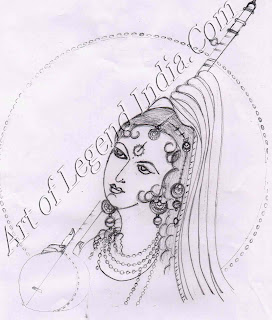
Religious Song of Mirabai

Posted by Art Of Legend India [dot] Com On 3:57 AM 0 comments

Without the Dear One, my home is

 Mirabhai
Without the Dear One, my home is
 a void,
Does there dwell some one who would take
me to my Lord?
On such a one, my body and soul I
shall bestow.

For His sake, I ‘wander from forest to
 forest,
Adopting the Yogi's dress.

The date of meeting is past, even today
 you are not come.

The very hairs on my head are grown grey.

Mira’s Lord, when will ‘He’ meet her,
Now that the town of the king she has
given up?

Pray, some one, convey to Him, my

Mirabhai


Pray, some one, convey to Him, my
message to come.

The glad tidings to come, the happy news
to come.

Neither comes He nor sendeth any news.

He hath acquired the habit to torment me.

Alack, howsoever I plead, these eyes came
not for my reproach.

Flow they as the streams in the rains.

What can I do, it is beyond me.

The wings I do not possess, wherewith to
fly o'er to Him.

Prays Mira, when will you meet her?
Fallen a victim is she to Thy snares.

Writer – Bankey Behari

The Epics of Hinduism - Mahabharata

Posted by Art Of Legend India [dot] Com On 3:21 AM 0 comments

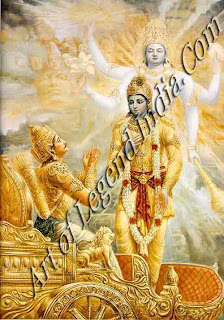
Krishna's advice to ArjunaThe Epics


However, since the ordinary people do not have the erudition to read and understand these books, there are a third set of books, the Itihasas or Epics, which serve the purpose. The profound philosophy of the Upanishads is presented in the form of parables and stories in these epics for the guidance of the common people.

The great epics of Hinduism are the Ramayana, the Mahabharata, the Yogavasishta and the Harivamsa. They are also called the Suhrit Samhitas or friendly compositions, as they teach the greatest of truths in an easy, friendly way without taxing the mind, as the language is simple and the contents easily understood.

Of these the Ramayana and the Mahabharata are known even to the most illiterate of Hindus as they have come down through the ages by word of mouth. They teach the ideals of Hinduism in a most understandable form and it is because of these books that the most illiterate of our peasants is not ignorant. On the other hand he carries within him the wisdom of the Upanishads which has been conveyed to him by these two major epics in story, ballad or dance form.

The more popular of these two epics is the Ramayana. Also known as the Adi Kavya or the first poetic composition of the world, it was written by the great sage, Rishi Valmiki. In this epic is given the story of Rama, believed to be an incarnation of Lord Vishnu, born on earth to show the path of righteousness.

Young Rama and Lakshmana accompany Sage Vishwamitra to the dwellings of ascetics.Dasaratha, king of Ayodhya, had four sons, Rama, born of his first queen, Kausalya. Lakshmana and Shatrughna, born of his second queen, Sumitra and Bharata, born of his favourite queen, Kaikeyi.

Rama was banished to the forest for 14 years at the behest of his step-mother, Kaikeyi, and left with his wife, Seeta, and brother, Lakshmana. In the forest Seeta was abducted by the demon-king, Ravana of Lanka. Rama, helped by an army of monkeys, and by Hanuman, the most loyal of them all, fought and destroyed Ravana and brought back Seeta. He was then crowned king and ruled over Ayodhya.

Rama Rajya, the reign of Rama, was one of idealism and 12 perfection, when no tear was shed nor sorrow experienced. It was a time of peace and joy, an idyllic era for all good people. Ayodhya became a land where tolerance and understanding governed the actions of everyone and even the King's actions were subject to the will of the people. Ideal behaviour of the rulers and ruled, of men and women, were shown by the actions of the characters in this epic, thereby teaching the people, subtly yet effectively, what ideal behaviour should be.

For example, to show the qualities of ideal queens, we have Dasaratha's queens, Kausalya and Sumitra, soft-spoken but strong, who placed the prestige of the king and the kingdom above their love of their sons. Dasaratha had earlier given two boons to Kaikeyi and she asked that Rama be sent to the forest for 14 years and her own son, Bharata, be crowned king. Rama, the ideal son, readily agreed to go and Lakshmana accompanied him. Their mothers, Kausalya and Sumitra, sent away their beloved sons to the forest so that king Dasaratha could keep his word. A second lesson learnt from this was the importance of the spoken word, especially the promises made by a ruler.

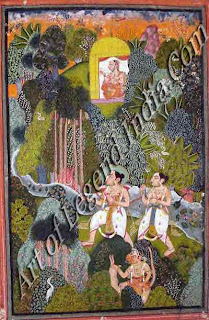
Rama, Seeta and Lakshmana in the forest Bundi miniature, Rajasthan
Also, the sacrifices of which Hindu women were capable were depicted by several such instances.

To delineate the qualities of a high-principled man, we have Bharata who, on his return from a visit to his uncle, found his brother banished to the forest by his mother and the kingdom his to be ruled, as his father had died of grief meanwhile. However he would not take over as king and, when Rama refused to come back till all 14 years of exile promised by him to his late father and step-mother were over, Bharata took his brother's paduka or wooden slippers, placed them on the throne and ruled as regent till his brother's return.

The qualities of the ideal man, prince and king are learnt by the ordinary people to this day from the character of Rama, of the ideal woman and wife from the strong but gentle character embodied in Seeta, and of the qualities of ideal brothers from the behaviour of Bharata, Lakshmana and Shatrughna.

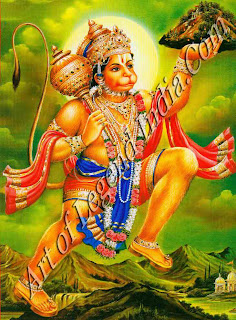
The ideal qualities of loyalty, unstinted devotion and love are depicted in the character of Hanuman, the monkey, who helped Rama cross over to Lanka and defeat Ravana. When Lakshmana was hit by a poison arrow and needed medicinal herbs from the Oshadhi Mountain in the Himalayas, Hanuman flew north all the way but found, on reaching there, that he could not identify the particular herb asked for. Knowing that his beloved Rama may not live if Lakshmana was not revived, he lifted the whole mountain and carried it all the way back to Lanka.

The potential for good and evil in all beings is brought out again and again. The destruction of evil by good either by oneself or by divine intervention is a constant theme of Hinduism.

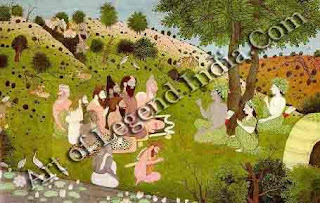
Rama, Seeta and Lakshmana in the hermitage of holy men 14 Kangra miniature, Himachal Pradesh Even the demons were not all bad and wicked and are shown as having good qualities also. Ravana, the demon-king of Lanka, was a great scholar. Even though he abducted Seeta to make her his queen, he treated her with respect and regard and never molested or harmed her but awaited her consent to marry her. Hanuman, in his attempt to locate Seeta, visits Lanka, and is greatly struck by Ravana and says, "What courage! What strength! What a combination of great qualities is Ravana!"

Ravana's brother, the demon Kumbhakarna, disapproved strongly of the abduction of Seeta. Yet because he had prospered under Ravana's patronage, and "eaten his salt", he refused to desert his brother in his hour of peril.

The great virtue of loyalty, even for a lost cause, was brought out by such instances.

Through the stories from the Ramayana which are recited to them, the ordinary people learn the difference between right and wrong, develop a high sense of values and understand what ideal behaviour is. The tremendous cultural heritage of the Vedas and Upanishads has reached and permeated to the most illiterate of our people through Sage Valmiki's priceless epic, the Ramayana. This is why our peasants, even those living in remote villages, know to this day what they can expect from the laws of the land and are not ignorant of their rights nor of what is due to the ruled by the rulers. The illiterate peasant trusts his rulers implicitly, expecting another Rama Rajya, and today uses the modern tool of the vote to express his feelings towards his rulers. The illiterate villager is therefore not ignorant as the city educated think him to be.

Hanuman flying with the mountain of herbs to cure Lakshmana The second great epic of the Hindus, the Mahabharata, was compiled by Sage Vyasa and revolves around the Great War between two princely families, the righteous five Pandava brothers and their evil cousins, the hundred Kauravas. The central character of the epic is Lord Krishna, an incarnation of Vishnu on earth, a man of action and statesman.

When poised on the battlefield ready for battle, Arjuna, the great warrior and one of the Pandava brothers, sees that the enemies that are arrayed before him are his close relations, cousins, uncles and grand-uncles, and refuses to fight or destroy them. Krishna, who acts as his charioteer, advises him on the importance of his dharma or duty as a warrior to fight for righteousness. The Kauravas, representing evil, have to be destroyed to restore Dharma or righteousness in the land.

Swami Vivekananda compares the Kurukshetra battlefield to the world we live in. The five Pandava brothers represent righteousness and the hundred Kauravas the myriad worldly attachments we have to fight against. Arjuna, the soul awakened by the teachings of Krishna, is the general who leads in this battle.

The teachings of Lord Krishna called the Bhagavad Gita, or the Song of the Lord, are part of the discourse between Lord Krishna and Arjuna at Kurukshetra during the great Mahabharata War. In this priceless scripture, Lord Krishna places emphasis on Nishkama Karma or action without desire or passion and without any worry about the fruits or results of one's actions. Through such scriptures the duties of the ideal man were laid down, showing him to be a Yogi, or one unattached to worldly desires, as far as his heart and mind are concerned, but also as a man of action setting right the wrongs of society.

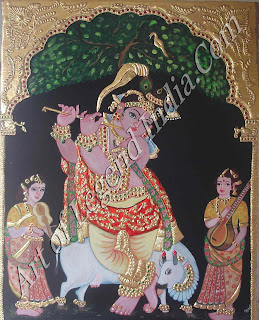
Venugopala Krishna, the protector of cattle, playing the flute An interesting allegory is the comparison of the Upanishads to a cow, the Bhagavad Gita to milk, Krishna to a cowherd and Arjuna to a calf. In other words, the essence of the Upanishads is milked by Krishna and the milk, the Bhagavad Gita, fed to Ariuna.

The Shantiparva of the Mahabharata contains the teachings of Bhishma Pitamaha, the grand-uncle of the family from which were descended both the Pandavas and the Kauravas. These words of wisdom were uttered while Bhishma was awaiting his death after being seriously wounded in the Great War. In his discourse, Bhishma instructs Yudhishtira, the oldest Pandava brother, on Dharma or righteous conduct and duty, on statecraft and the responsibilities of a ruler. These teachings on Hindu Dharma are without parallel.

From the Mahabharata, therefore, the people learnt the rules and the codes of ideal conduct laid down for man and woman, king and commoner.

Writer – Shakunthala Jagannathan

108 Names of Vishnu

Posted by Art Of Legend India [dot] Com On 3:26 AM 0 comments
God Narayana

108 Names of Vishnu


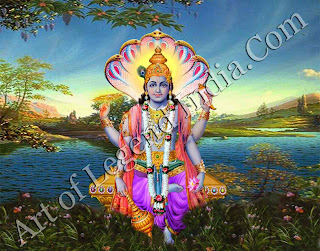
Devotees have tried to express Vishnu's divinity through 1008 names. Some of these names refer exclusively to particular incarnations. Others are shared with other divinities, like Shiva, for ultimately all gods are manifestations of the same godhead.

The following are 108 of the more popular ones:

Achyuta: restrained, unfallen.

Aditya: sun.

Adhoksaja: one who cannot be perceived by the senses.

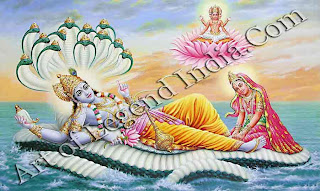
Anatashayin: he who sleeps on the serpents of eternity.

Aniruddha: unrestrained.

Balaji: eternal child.

Bhagavan: complete manifestation of godhead.

Bhargava: scion of the Bhargav clan (Parashurama).

Buddha: enlightend teacher.

Chakrapani: wielder of the discus, lord of life's cycle.

Chaturbhuja: lord with four arms.

Chiranjeeva: immortal.

Daityari: killer of demons.

Damodara: he whose stomach contains the whole cosmos.

Datta: divine gift.

Dhanajaya: winner of cosmic wealth.

Dharmadhikari: keeper of world order.

Dhata: support of all beings.

Ekatama: single soul of the cosmos.

Gahadhara: bearer of the mace.

Garudadhyama: dark as clouds (Krishna).

Ghanashyama: dark as lcouds (Krishna).

Gopala: cowhered (Krishna)

God vishnu snapGopika-Vallabha: lord of the cowgirls (Krishna).

Gopta: hidden by veils of delusion.

Govinda: protector of cows (Krishna).

Hari: tawny.

Hayagriva: horse-headed.

Hrishikesha: lord of the senses.

Indravaraja: Indra's brother.

Jagannnatha: lord of the world.

Jalashayin: he who sleeps on water.

Janardhana: beloved of the masses.

Ka: the reason for all things.

Kaitabhajit: killer of the demon Kaitabha.

Kalki: the final saviour.

Kamalanayana: lotus-eyed.

Kanhaiya: beloved of maidens (Krishna).

Keshava: long-haired.

Kiritin: he who wears a crown.

Kshetragna: lord of the field.

Krishna: dark one.

Lakshmikanta: lord of Lakshmi, goddess of wealth.

Lokanatha: god of the people.

Madana-Mohana: he who can charm Cupid.

Madhava: husband of the mother-goddess.

Madhusudhana: killer of the demon Madhu.

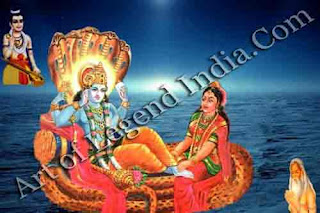
Lord Vishnu and Godesses LakshmiManmatha: pleasing the mind.

Manohara: one who captivates the mind.

Mayin: maker of illusions.

Medhavi: wise and intelligent.

Mohana: charmer.

Mukunda: deliverer, liberator.

Muramardana: he who killed the demon Mura.

Murlidhara: he who plays the flute.

Narayana: deliverer of mankind.

Naresh: lord of man.

Narkantaka: killer of the demon Naraka (Krishna).

Padmanabha: one with a lotus rising from his navel.

Panchayudha: bearer of five weapons.

Panduranga: radiant lord.

Parmatma: cosmic soul.

Parthasarathi: charioteer of Partha-Arjuna, the Pandava (Krishna).

Patitapavana: refuge of the helpless.

Pitambara: one who wears yellow garments.

Pradyumna: conqueror.

Prithu: leveller.

Pundarikaksha: lotus-eyed.

Purna-purusha: the primeval man.

Purushottama: the ideal being.

Radhanatha: lord of Radha (Krishna).

Raghava: descendent of Raghu (Rama).

Lord VishnuRaghuvamsi: scion of the Raghu dynasty (Rama).

Ramachandra: as serene as the moon.

Ranganatha: lord of colors.

Ranchor-Rai: the king who avoided war (Krishna).

Rishabha: bull amongst men.

Sankarshana: plougher (Balarama).

Sharangin: wielder of the blow, Saranga.

Shyam: dark one.

Shreedhara: guardian of the goddess Shree.

Shreenatha: lord of the goddess Shree.

Shreenivasa: he who lives with Shree.

Shreevastava: on whose chest resides fortune.

Subhanga: he with an alluring body.

Svabhu: he who created himself.

Tirupati: lord of godddess Shree i.e. Tiru.

Trivakrama: he who covered the cosmos with three steps (Vamana).

Upendra: younger brother of Indra.

Urugaya: one whose gait is wide (Vamama).

Urukrama: he with vast strides (Vamana).

Vasudeva: lord of elements.

Vaikuntha: lord of cohesion.
Murlidhara

Vallabha: beloved husband.

Vamana: dwarf.

Vanamali: he who wears garlands of wild flowers.

Varadaraja: the king who bestows boons.

Varaha: the boar who raised earth from the ocean floor.

Vatapatrashayin: Vishnu resting on the banyan leaf floating on the waters of doom.

Venkateshvara: god of the hills.

Vidhu: expert.

Virata-purusha: The cosmic being.

Vishnu: all pervasive.

Visvaksena: The defender of the cosmos.

Visvarupa: one with a cosmic form.

Vitthala: lord who stands of a brick.

Vyasa: compiler of knowledge.

Yagna-purusha: lord of the sacred rite.

Writer- Devdutt Pattanaik

Dear mother, The Lord did not even - Song of Mirabai

Posted by Art Of Legend India [dot] Com On 2:46 AM 2 comments

Dear mother, The Lord did not even


Mirabhai

Dear mother, The Lord did not even
care to enquire after my welfare.

Yet from this accursed body I know not
why the soul does not fly off.

The eyes remained closed, nor did this
tongue speak, the evening came and
then the dawn.

When without the tete-a-tete ages passed,
how could I then‘ know what comfort is
like.

The month of Srivana has approached,
yet no news is heard of his approach.
While dark is the night, and shines the
lightning, the nights in counting the
stars are passed.
 
When the Lord Hari in my dreams
appeared, little did I know He will pass off.
As opened I my eyes. the vision gone.
how luckless I felt at last.
 
Taking hold of the dagger, my heart I
shall tear and I will commit suicide.
Mira, the restless one, lies separated,
crying as a child.


Without a sight of Thee, even a moment's

 
Mirabhai
 
 
Without a sight of Thee, even a moment's
Rest
 
                                                                                                                                                    I know not.
Thou meals do not appeal to me, the eyes
know no sleep. the pangs of separation
trouble.
 
Like the wounded one, I roam about,
                                                                                                               none is acquainted with my pain.
    The day passed in eating, the night in
sleep is o'er.
 
The life is gone in agony of separation,
                                                                                                          The sight I have lost through tears. 
             Had I known that to love was to invite pain,
To the beat of drum in the city I would
have proclaimed, let none love.
 
I stand waiting, watching Thy course,
 'cleansing Thy path,
 
Mira’s Lord when will you meet her?
On meeting Thee she shall find peace.

Writer- Bankey Behari

Company Overview

Art of Legend India has the distinction of being one of the best in the Indian Handicraft Industry. We are about 75 years old handicrafts manufacturer & exporter. We are having team of more than 500 craftsman.

We are having our business offices in India, USA & Germany to ensure our best services.

Total Pageviews