BODHISATTVAS
Bodhisattvas
are the emanations of the Dhy'anti Buddha’s. They delayed their attainment of
nirvana and remained in the world to assist in the salvation of all living
beings. In Northern Buddhist pantheon Bodhisattvas receive the active power of
creation from Adi Buddha through the Dhyani Buddha’s. Of the group of eight
Bodhisattvas three are specially venerated throughout Tibet viz.,
Avalokitesvara, Manjusri, and Maitreya. Even some female Bodhisattvas like
Sitatapatra, Usnisavijaya, Prajnaparamita and Vasudhara are widely worshipped.
 Maitreya,
the future Buddha and the successor of A5kyamuni is said to reside in the
Tusita heaven before descending on earth. The god is represented in Bodhisattva
form with all the Bodhisattva ornaments and is seated on throne in bhadrasana
with feet resting on lotus. His long hair drawn up on the head forming the
usnisa is surmounted by a stupa-shaped ornament. He is two-armed holding the
stems of lotus flowers sup-porting his two attributes the vase and the wheel.
His right hand shows vitarkamudra. The lower section of the thanka represents a
kneeling devotee with folded hands at the left corner while at the centre a
bowl has been depicted containing five objects viz., mirror, fruit, cymbals,
conch-shell and a shawl. These five objects symbolise offering of five senses
to the deity, the mirror representing sight, the fruit signifying taste, the
in-cense-shell representing smell, the cymbals standing for hearing and the
shawl indicating the sense of touch. The back of the thanka contains four lines
of inscription in Tibetan script.
Maitreya,
the future Buddha and the successor of A5kyamuni is said to reside in the
Tusita heaven before descending on earth. The god is represented in Bodhisattva
form with all the Bodhisattva ornaments and is seated on throne in bhadrasana
with feet resting on lotus. His long hair drawn up on the head forming the
usnisa is surmounted by a stupa-shaped ornament. He is two-armed holding the
stems of lotus flowers sup-porting his two attributes the vase and the wheel.
His right hand shows vitarkamudra. The lower section of the thanka represents a
kneeling devotee with folded hands at the left corner while at the centre a
bowl has been depicted containing five objects viz., mirror, fruit, cymbals,
conch-shell and a shawl. These five objects symbolise offering of five senses
to the deity, the mirror representing sight, the fruit signifying taste, the
in-cense-shell representing smell, the cymbals standing for hearing and the
shawl indicating the sense of touch. The back of the thanka contains four lines
of inscription in Tibetan script.
The
goddess Sitatapatra Aparajita, "the invincible goddess with the white
parasol" seated in dhyanasana has three heads and eight arms. Her three
heads are of white, blue and red colour and the most distinctive emblem of the
goddess is her white parasol. She also bears third eye on her fore-head.
According to the Sadhanamala she is of white complexion, wears celestial
ornaments and garments and is an emanation of Dhyani Buddha Vairocana. Being a
deification of white parasol, Sitatapatra is believed to protect the devotees
from all sorts of evil spirits. In her right hands she holds atapatra
(umbrella), ankusa (elephant goad), Nina (arrow) and vajra (' (thunderbolt)
while the four left hands show atapatra, pasa (noose), dhanu (bow) and cakra
(wheel).
At the
top, the central figure is Dhyani Buddha Vairocana flanked by Buddha in
bhumispar`samundra and probably Asoka, the famous Maurya king. A group of monks
and disciples of the lineage of the Ka-dam-pa school like Rindag, Dagkar,
Rigzin Gyalpo, Chanchupa Bhawa, and Palden Dhondup along with Bodhisattva
Manjusri are portrayed at the right and left corners of the thanka. Sitatapatra
is accompanied by goddess Usnisavijaya to her right and Padmapani
Avalokitesvara (Chenrizig) to her left. The two female deities in the lower
right and left sides represent the two and six-armed manifestations of the
goddess Sitatapatra. In the centre, at the bottom is the standing figure of
eleven-headed, eight-armed Aryavalokitesvara with Sita Tara (white Tara) and.
syama Tara (green Tara) on either side. All the figures depicted in the thanka are
inscribed. Besides, the back of the thanka contains two lines of mantras of
Sitatapatra in Tibetan script.
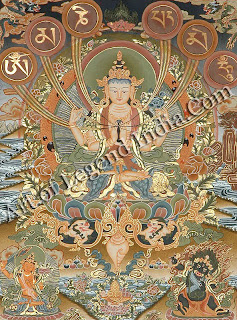
 The god
is standing on lotus with eleven heads and thousand arms. His principal pair of
hands are in anjalimudra holding cintamani. Other hands radiating around him
forming an aura have an eye in each palm. His other attributes are rosary,
lotus, cakra, bow, arrow, kalasa and varadamudra. The god is decked in all
sorts of Bodhisattva ornaments. This particular manitestation of Avalokitesvara
with eleven heads and thousand arms was conceived to emphasize his omniscience
and power which enabled him to look in every direction (samantamukha) and to
save the wretched and the distressed. He is also called the great compassionate
Bodhisattva who sacrificed his nirvana to serve the people. According to
legend, his head split into ten pieces from sorrow and grief in utter despair
of saving the mankind. Amitabha caused each piece to become a head on the body
of Avalokitesvara. The expression of his three heads in three lower tiers is
placid; the tenth head is fierce while the top most one is that of his
spiritual father Amitabha. The two standing bodhisattvas flanking him are
Bodhisattva Manjusri and Vajrapani.
The god
is standing on lotus with eleven heads and thousand arms. His principal pair of
hands are in anjalimudra holding cintamani. Other hands radiating around him
forming an aura have an eye in each palm. His other attributes are rosary,
lotus, cakra, bow, arrow, kalasa and varadamudra. The god is decked in all
sorts of Bodhisattva ornaments. This particular manitestation of Avalokitesvara
with eleven heads and thousand arms was conceived to emphasize his omniscience
and power which enabled him to look in every direction (samantamukha) and to
save the wretched and the distressed. He is also called the great compassionate
Bodhisattva who sacrificed his nirvana to serve the people. According to
legend, his head split into ten pieces from sorrow and grief in utter despair
of saving the mankind. Amitabha caused each piece to become a head on the body
of Avalokitesvara. The expression of his three heads in three lower tiers is
placid; the tenth head is fierce while the top most one is that of his
spiritual father Amitabha. The two standing bodhisattvas flanking him are
Bodhisattva Manjusri and Vajrapani.
At the
top of the thanka the central figure is Dhydni Buddha Amitabha seated in
meditation holding a bowl. At the left corner are portrayed the figures of
Amitayus, the Buddha of eternal life, holding ambrosia vase, goddess
Usnisavijaya and Tara, while at the right corner Tsong-kha-pa, the founder of
the Ge-lug-pa sect is shown with his two disciples. At the left side of the
thanka is the representation of seven jewels (sapta-ratna) viz., the wheel,
cintamani, the jewel of a wife, the gem of a minister, the white elephant, the
horse and the gem of a general.
At the
bottom are three Dharmapalas viz., Kuvera holding dhvaja with mongoose
vomitting jewels, Mahakala holding kartrika, kapala, and danda (staff) and
Lha-mo seated on a mule with khadga (sword) and kapala. The back-side of the
thanka contains four lines of Sanskrit inscription in Trib-tan script that
reads
Namah
RatnatrayayallNamaly, Namah Aryajnanasagara Vairocana Vyuharjays Tathagataya
aite Samyaksambuddhaya, Namah Sarvatathagatebhyah Samyaksanbuddhebhyah, Namah
Aryajnanasagara Bodhisattvaya mahakarunikaya.
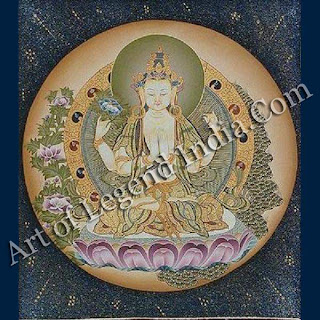
Sadaksari
Lokesvara decked in all sorts of ornaments is seated in
 Dhyanasana
on lotus throne. The god is four-armed holding aksamala (rosary) and padma
(lotus) in the right and left hands while his principal hands are joined
against the chest in anjalimudra holding jewel. The mantra om-ma-ni-pad-me-hum
consisting of six syllables is assigned to this form of Avalokitesvara and this
is the most popular mystic formula in Lamaism uttered by both lamas and laity.
His high usnisa adorned with jewels is topped by the head of Amitabha, his
spiritual father.
Dhyanasana
on lotus throne. The god is four-armed holding aksamala (rosary) and padma
(lotus) in the right and left hands while his principal hands are joined
against the chest in anjalimudra holding jewel. The mantra om-ma-ni-pad-me-hum
consisting of six syllables is assigned to this form of Avalokitesvara and this
is the most popular mystic formula in Lamaism uttered by both lamas and laity.
His high usnisa adorned with jewels is topped by the head of Amitabha, his
spiritual father.
The
upper part of the thanka represents the figure of Dhyani Buddha Amitabha at the
centre and Maitreya, the Future Buddha and Bhaisajya-guru, the Medicine Buddha
in the two corners. On either side of the central deity are portrayed
Tsong-kha-pa, the founder of the Yellow cap sect, Bodhisattva Manjusri, Dhyani
Buddha Aksobhya and Vajrapani. Below, at the centre is represented the great
Guru Padmasambhava with his two disciples or mystic consorts Mandrava
(Jnanasagara) and Yesho Khado (Cloud Fairy) on either side. The one on his
right carrying the umbrella is the goddess Sitatapatra while the other on his
left is Vajrasattva holding vajra and ghanta. An offering of five senses symbolised
by mirror, cymbals, in-cense shell, fruits and shawl is depicted in a bowl in
front of Guru Padmasambhava.
Writer
– Sipra Chakravarti