 Man and Woman
In
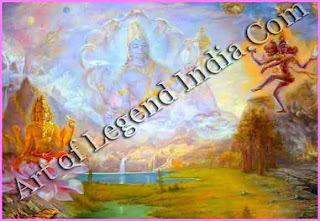
the beginning, all was calm. Time and space did not exist. Neither did the
gods. Nothing did.
Only
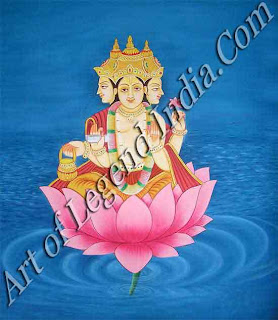
Brahma, the creator, slept peacefully within his golden lotus, the
hiranyagarbha. He was like a child in his mother's womb. Creation was yet to
begin.
The
lotus bloomed; Brahma awoke, ready to begin his work. He created the
prajapatis, fathers of all creatures who would populate the world. "Go
forth and multiply," Brahma told them. "How?" they asked.
How indeed? Brahma wasn't sure.
Suddenly
he heard a divine voice: "You have just created the fathers; what about
the mothers?" With that message came the image of the cosmic human being,
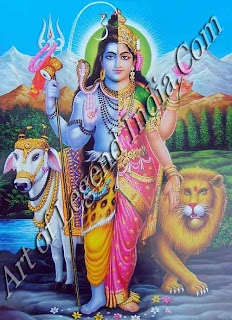
containing the whole world within itself. It was Ardhanaranari its left half
was a woman while its right half was a man.
Brahma
realised his mistake; he had produced just one half of creation. The other
half, the feminine side, had been totally ignored.
 Brahma created the first woman. She was
Ushas.
Brahma created the first woman. She was
Ushas.
All
the assembled prajapatis gazed at her. She was beautiful. Brahma's heart
fluttered with excitement and there arose a dark youth with curly hair and a
cheeky smile. "Who are you?" everyone asked.
"I
am Kama, the lord of desire," he said shooting arrows dripping with love
into the hearts of all the assembled men.
Birds and Beasts
Brahma
wounded by Kama's love-dart, desired Ushas. He tried to grab her but she fled
taking the form of a cow. Brahma chased Ushas in the shape of a bull. She then
turned into a mare and ran faster. Brahma turned into a stallion. So it came to
pass, Ushas became a goose flying in the air, a dolphin swimming in the sea, a
mosquito, a crab, a lioness.., and each time Brahma turned into the
corresponding male. Thus all animals of the world came to be, from the smallest
insect to the largest mammal.
Finally
in the shape of a doe, Ushas rose up into the heavens. Taking the form of a
buck Brahma continued to follow her.
The
prajapatis who witnessed all this were alarmed. The indiscipline displayed by
the creator was unforgivable. It would wreck the whole cosmic order, dharma.
"Somebody stop him," they cried. But who dared attack the cosmic
father?
Suddenly
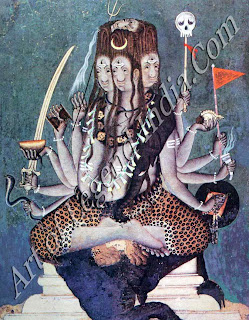
from Brahma's own brow arose a being, terrible in appearance, wild in
disposition. He was Rudra, the howler. With a menacing growl Rudra raised his
bow and let loose his fiery missile that struck Brahma and pinned him onto the
sky. Ushas was saved!
 "Who are you?" asked the
assembled fathers.
"Who are you?" asked the
assembled fathers.
"I
am Shiva," replied Rudra. Everybody recognised his voice: this Shiva was
none other than Ardhanaranari, the man-woman image that had earlier inspired
Brahma to create Ushas. They all bowed before Shiva, the bravest and wisest of
the gods.
Brahma
thanked Shiva for restraining him with his arrow. "As a sign of my gratitude,
I make you Pashupati, the lord of beasts, he who controls our beastly
passions."
And
to endorse this position, Brahma gave Shiva a mighty bull, Nandi, to serve as
his vehicle, vahana.
Shiva
as Pashupati is worshipped in Kathmandu, Nepal.
Plants and Trees
 Brahma,
restrained by Rudra's arrow, continued with creation; but this time with a
difference. He worked with Ushas, as partner, not master. She now called
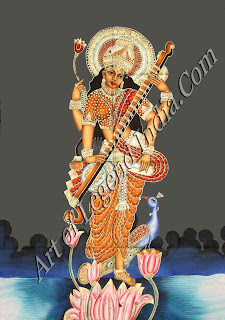
herself Saraswati and gave Brahma the wisdom needed to create the cosmos.
Brahma,
restrained by Rudra's arrow, continued with creation; but this time with a
difference. He worked with Ushas, as partner, not master. She now called
herself Saraswati and gave Brahma the wisdom needed to create the cosmos.
Together
they created every creature that wanders in the cosmos: gods, demons and
humans, even ghosts and goblins.
Suddenly
Brahma noticed that the beasts were becoming restless and violent. Some even
moved menacingly towards the prajapatis. What was wrong?
"They're
hungry," replied Saraswati, "They want food."
"Let
them eat each other and survive," said Brahma.
A few
of the animals, those with strong jaws and sharp claws, did just that.
The
gentler beasts were at their mercy. They turned towards their lord, the
Pashupati, for help. "Don't worry," he said, with a reassuring smile,
"I will find something for you too."
Shiva
meditated, and from the heat of his austerities, tapas, rose every herb, shrub,
grass, creeper and tree imaginable. Shiva became lord of all vegetation,
Vriksha-natha. The hungry animals ate the plants.
"And
what will the plants live on?" asked Brahma.
"They
will live on the five elements, the bhutas: earth, air, light, water and
ether," replied Shiva, who came to be known as Bhuteshvar, master of the
elements.
 Death and Rebirth
Having
satisfied their hunger, all creatures began to reproduce. Soon there were too
many of them.
"I
see the world filled with creatures who are eating and reproducing. They are
doing nothing else. The cosmos is choked with life. Where did I go wrong?"
wondered Brahma.
"You
forgot to create Death," said Saraswati. "Entry into the world must
be followed by an exit. That will give new life space to survive."
Brahma
realised his mistake. He created Mrityu, a maiden, dark in colour, dressed in
red robes.
"Go
forth and kill all creatures. Stifle their breath and take away their
life," he ordered her. Mrityu recoiled in horror. "Why should I do
that?" she asked.
"Without
death, life has no meaning," said Brahma. But Mrityu remained unsure. She
ran away.
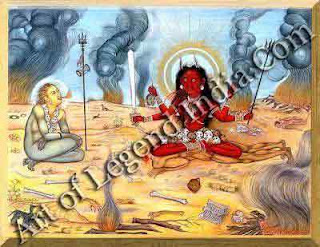
Shiva
found Mrityu crying in a desolate place. He consoled her saying, "Fear
not. I will see to it that all who die at your hands are reborn. Though a
killer, you will still be a mother. Death will not be the end of life; it will
be the gateway to a new one."
Mrityu
became Mahakali, devouring all life. Shiva became Mahakala, the lord of time,
the regenerator, transforming the sediments of destruction into the foundations
for another creation. Life thus became a wheel, rotated by Shiva. It became the
eternal cycle of births and rebirths, samsara.
Brahma's Fifth Head
Shiva
took a good look at the world created by Brahma: it was terrible.., he saw pain
and suffering, death and disease; he saw frustrations, unhappiness, misery. He
saw pettiness, viciousness and cruelty ... and had an occasional glimpse of
pleasure that beguiled all creatures into going through one life before moving
on to the next.
Shiva
wept and from his tears came the rudraksha beads.
"What
have you done, Brahma?" Shiva cried, tormented by the plight of the
living, "You haven't created a world, you have created a tantalising
mirage, maya, that ensnares man into an eternity of aspiration and
frustration."
Brahma
was in no mood to listen. Instead he sprouted four heads to survey all sides of
his creation. He was quite proud of it, so proud in fact that he popped a fifth
head to accommodate his pride.
The
sight of an uncaring creator, the pompous five headed Brahma, infuriated Shiva.
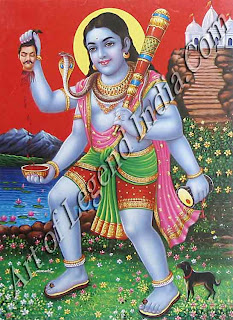
He became Bhairava, the furious one. With his sharp claws he attacked Brahma.
"How dare you attack me?" yelled Brahma. "For this act of
disrespect you will never be invited to any sacrifice or given any portion of
the sacred offerings."
 Unintimidated,
Bhairava wrenched out Brahma's fifth head. Brahma howled in agony and begged
for mercy, but there was none in Bhairava's glowering eyes. "Brahma, you
have created this world filled with misery. You are unworthy of reverence. You
shall never be worshipped. Few will bother to build temples for you or organise
festivals to your glory."
Unintimidated,
Bhairava wrenched out Brahma's fifth head. Brahma howled in agony and begged
for mercy, but there was none in Bhairava's glowering eyes. "Brahma, you
have created this world filled with misery. You are unworthy of reverence. You
shall never be worshipped. Few will bother to build temples for you or organise
festivals to your glory."
And
so it is that the cosmic creator is not worshipped in India except at two
shrines: Pushkar in Rajasthan and Kumbakonam in Tamil Nadu.
Brahma
said, "I just created the world, not the misery. The world is neither
beautiful nor ugly; neither joyful nor sorrowful; neither right nor wrong. It
just is! The rest are just perceptions of the mind ..."
"But
you created the mind too," interrupted Shiva.
"The
mind can be deluded by perceptions or it can be enlightened by the truth.
Whose
choice is it?" Whose choice? Who controlled the mind? The questions were
interesting.
 The Theory of Yoga
Shiva,
his hands smeared with Brahma's blood, his heart tainted with anger and sorrow,
went to Avimukta, at Kashi. There he brooded over the questions that plagued
his mind. He sought a way to control his mind, make it see the truth, beyond
the veils of illusion. Only that would make sainsara bearable.
Finally
he found the way. It was yoga: the means to yoke the individual's mind to the
way of the cosmos.
Sages,
gods and goblins, all who felt the frustrations of life and sought a release,
moksha, from samsara rushed to learn the secret of yoga from Shiva.
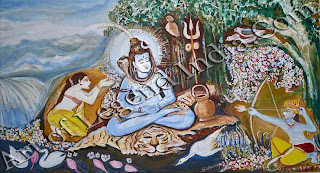
Under
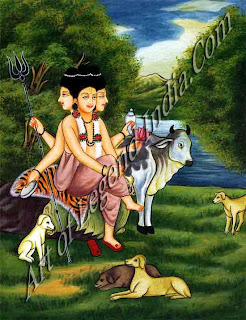
a great banyan tree, seated on a tiger skin, facing the south, dakshin, Shiva
revealed it all. He charged no fee, dakshina, and so his students called this
great cosmic teacher Dakshinamurti.
"Know
this," he said to his students, "there are two realities of
existence, both eternal, both distinct. One is the purusha, the serene cosmic
spirit that stands still, beyond the reach of time and space. Then there is
prakriti, matter, the cosmic substance, source of time and space, always in a
state of flux."
 "What
is born and reborn, what feels the pain and the pleasure is not the purusha, it
is your body and your mind, your prakriti.”
"What
is born and reborn, what feels the pain and the pleasure is not the purusha, it
is your body and your mind, your prakriti.”
You
are reborn because you are attached to the world by your actions, your karma.
Actions generate reactions that you are obliged to experience, if not in this
lifetime then in the next.
"You
cannot escape the material world as you are enchanted by the eternal
transformations of prakriti. It makes you act, react. You do not see its true
nature. You have lost touch with your purusha.
"Yoga
helps you see the world for what it is, clearly, wisely, dispassionately,
uncoloured by opinions, emotions and perceptions. It raises your level of
consciousness and gives you a more panoramic perspective. It gets rid of all
delusions, ignorance, attachments and fear, kleshas that trap you within
relative truths. Having done that, yoga stills the mind. It makes you serene,
aware, and undisturbed by the turbulence of the world around.
"Only
then will you trascend joys and sorrows, attractions and rejections, birth and
death. Only then will you move towards perfect bliss, kaivalya, and find mukti,
liberation, from the cycle of life."
 The Practice of Yoga
Having
explained the aim of yoga, Shiva elucidated the means to reach it:
"Restrain all your interactions with the material world through the
practice of yama: restrain yourself from violence, lies, greed, theft and sex.
Discipline yourself with the practice of niyama: be pure, content, tolerant,
observant and have faith.
Shiva
then manipulated his body in 8,40,000 ways, each representing a different bird
or beast. These postures, asanas, energised the body, revealing the pulsating
animal instincts within, the ones that have to be brought under control. He
also revealed the secret of breath-manipulation, pranayama, of controlling the
movement of life-giving-energy, prana, enabling the mind to expand beyond the
narrow confines of the body.
"Go
into yourself, just as a turtle goes into its shell. Do not react or respond to
the temptations and threats perceived by your five senses. This
internalisation, pratyahara, will help you focus on your mind, its activities,
its reflexes and responses, without external distractions.
"Then
through concentration and meditation, dharana and dhyana, you will finally
attain samadhi, the ability to be truly objective. You will rise beyond all
subjectivity, both physical and mental. You will transcend material temptations
and transformations. You will be a pure witness, one with the cosmic soul,
purusha; you will simply observe the seductive performance of prakriti.
"And
when that is done, you will be truly enlightened, aware of the eternal absolute
laws that govern the cosmos, sanatana dharma. The creation and destruction of
the body or the satisfaction and betrayal of the mind will cease to trouble
your being."
The
sages, gods and goblins, who sat around Shiva, rejoiced. Like him they became
aware of the transience of all thoughts, all actions, all events; they detached
themselves from the endless transformations of the world. They learned to let
go. They found salvation, moksha.
The
sage Patanjali compiled these profound teachings in a series of aphorisms known
as the Yogasutra.
Renunciation
Having
taught the essence of yoga, Shiva renounced the world. He detached himself from
everything, even his body. Shiva walked out of society with a strip of tiger
skin wrapped around his loins. Reptiles slithered across his limbs, dogs and
ghosts followed him.
 He
wandered in cremation grounds amidst the blazing pyres. Smearing his body with
ash, Ithasina, he became Bhasmeshvara, the lord of ash. "Every joy, every
sorrow, every birth, every death, every body, every mind, every event and every
achievement, every god and every cosmos, will end up in its own furneral pyre.
After every fire only ash will remain. Why then be excited, why then be
frustrated? Let me just be, exist in eternal equanimity, vairagya."
He
wandered in cremation grounds amidst the blazing pyres. Smearing his body with
ash, Ithasina, he became Bhasmeshvara, the lord of ash. "Every joy, every
sorrow, every birth, every death, every body, every mind, every event and every
achievement, every god and every cosmos, will end up in its own furneral pyre.
After every fire only ash will remain. Why then be excited, why then be
frustrated? Let me just be, exist in eternal equanimity, vairagya."
Shiva
moved around the world like a vagabond, unconscious of the way he looked or how
he was perceived. He was at peace.
Shiva,
Yogeshvara, the lord of yoga, the celestial ascetic, lost interest in worldly
things. Neither reacting nor responding, he transcended the world around him.
Writer – Devdutt Pattanaik


 Hinduism, as we have seen, has
a wealth of scriptures to guide both the initiate and the scholar. We now come
to some of the fundamental tenets of the religion, as given in these
scriptures.
Hinduism, as we have seen, has
a wealth of scriptures to guide both the initiate and the scholar. We now come
to some of the fundamental tenets of the religion, as given in these
scriptures.