ArtofLegendIndia.com, Biggest Online Store of Handicrafts Items, Paintings and Jewelry Accessories...

Handicrafts

Handicrafts are devices or works of art that are made completely by hand or by the use of relatively simple tools. Such goods are usually made in the traditional way of manufacturing goods. Therefore, the knowledge of the art of craft is usually passed down from one generation to another. The items made using these traditional methods of manufacturing are usually produced in smaller quantities and they often represent the culture or religious beliefs of the community that makes them. The goods are also handmade from natural materials that are found in the environment of the particular economy.

Read More!

Biggest Online Store of Handicrafts Items

Paintings

A painting is equal to thousand words, means a beautiful painting is equal to million of words. Paintings are one of the oldest art forms -- throughout history artists have played an important role in documenting social movements, spiritual beliefs and general life and culture.

History Of Paintings: The history of painting reaches back in time to artifacts from...

Read More!

Biggest Online Store of Unique Style Paintings
Showing posts with label Hindu Religion. Show all posts

Consort of Vishnu

Posted by Art Of Legend India [dot] Com On 5:36 AM 0 comments
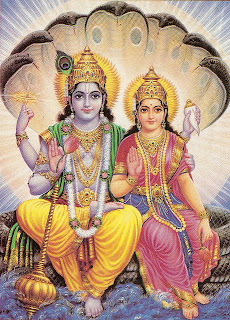
Lakshmi, goddess of wealth and fortune, who provides Vishnu with the wherewithal to preserve the world Modern calendar art
Vishnu's Shakti

On Vishnu's chest is a beautiful curl of golden hair called Shreevatsa. It is the symbol of Shree-Lakshmi, goddess of wealth and fortune, his consort.

When the goddess rose from the ocean of milk, she found only Vishnu the detached guardian of the cosmos, the upright keeper of dharma to be worthy of her affection. She became his Shakti, source of his strength and splendor, invigorating him with her presence. Vishnu became Shreenath, her lord.

Vishnu is the soul of the universe; Lakshmi its substance. He is the protector; she the provider. They are the divine couple who nurture life.

Lakshmi Leaves Vaikuntha

Whenever Vishnu returned to Vaikuntha, tired after his battles with demons, Lakshmi would invigorate him with her affectionate touch.

Once, while Vishnu was resting, the sage Bhrigu entered Vaikuntha. Neither Vishnu nor Lakshmi saw him arrive. Insulted, Bhrigu kicked Vishnu on his chest shouting, "How can you sleep when someone is calling on you?"

Bhrigu's insolence horrified Lakshmi. To her surprise, the lord placed his hand on Bhrigu's foot and asked, "Did you hurt yourself by kicking me?"

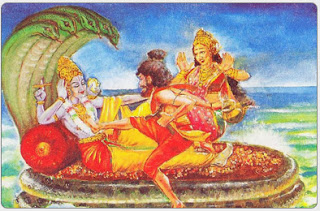
:- Bhrigu kicking Vishnu on his chest; Comic book illustration The sage was touched by the lord's concern. Lakshmi was not. "Bhrigu kicked you on your chest, on Shreevatsa, and by doing so kicked me. Avenge this insult." She demanded angrily.

"I cannot harm one who is my guest," said the lord. Considering this an affront to her dignity, Lakshmi disappeared from Vaikuntha.

The Separation

Without Lakshmi beside him, Vishnu could not bear to live in Vaikuntha. He descended upon earth and waited for her under a banyan tree, refusing to move until she returned.

As time passed termites built a hill round him, covering his body completely.

Birds and beasts were stunned by the lord's plight. Cows rushed to the banyan tree and began shedding milk over the termite hill to nourish the lord. Touched by their devotion, Vishnu promised them eternal grace.

The Reunion

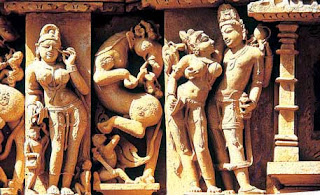
Vishnu and Lakshmi in loving embrace; Temple carving from Khajuraho, Madhya Pradesh
Bhrigu, the cause of Lakshmi's ire and Vishnu's anguish, was consumed by guilt. He took it upon himself to reunite the divine couple. He went near the termite hill and began kicking the cows.

The cows cried out and Vishnu rushed to their rescue, striking the offender with his mace.

"Ah, the lord has punished me for hurting Lakshmi whose spirit rests in every cow," shouted Bhrigu.

Hearing this, Lakshmi was pleased and she reappeared to join her husband in Vaikuntha.

Lakshmi's Promise

Lakshmi said to her lord, "Wherever you are in the three worlds, I shall always be by your side."

"Should anyone try to take you away from me, I shall fight and win you back," said Vishnu.

When Vishnu descended upon earth, Lakshmi joined him as Rama's Sita and as Krishna's Radha and his Rukmini. And when the lord was Yagna-purusha, the god of sacrifice, she was Dakshina, goddess of charity.

Shreedevi and Bhoodevi

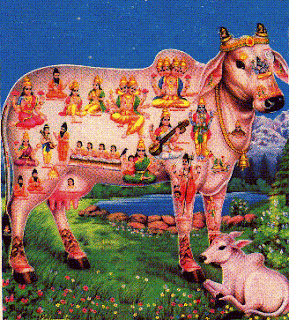
Go-Mata, the cow who nourishes the whole cosmos; Calendar print Vishnu's chief consort Shree-Lakshmi, goddess of power, fortune and splendor was fickle and demanding. In contrast, Vishnu's other consort, Bhoodevi, the earth-goddess, was faithful and submissive.

Both vied for Vishnu's attention.

When Indra gifted the parijata tree to Vishnu, both wanted it to be planted in their respective gardens, separated by a very high wall.

Bhoodevi, proud of her generative powers, argued that as she was the earth-goddess only she had the right to nurture the plant.

Vishnu gave her the celestial tree, but decreed that its flowers would always fall on the other side of the wall into Shreedevi's garden.

Shreedevi was delighted with her lord's decision. She taunted Bhoodevi, "The lord has given you the responsibility of the plant, while making sure it is I who derive real pleasure from it."

To humble Shreedevi, Vishnu said, "This plant will only bloom when I enter Bhoodevi's garden. Each time Shreedevi finds the parijata in bloom, she will have to endure the knowledge that her husband is with someone else."

Saraswati, Ganga and Yamuna

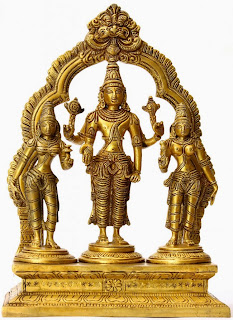
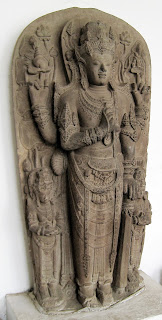
Vishnu, the benevolent lord, flanked by Shreedevi, goddess of heavenly fortune and Bhoodevi, goddess of earthly wealth; South Indian bronze idols
Saraswati, the goddess of knowledge, said, "Vishnu is Vidyapati, the patron of science, philosophy and the arts. Time and again he has rescued my children, the Vedas and the Shastras, from demons. Surely he cares for me more than anyone else."

Ganga and Yamuna, the river-goddesses, disagreed. "Vishnu is Jalashayin, the keeper of the cosmic waters. He loves us most."

Lakshmi said, "The whole world knows Vishnu as Madhava, consort of Ma, that is me, the mother of the three worlds. He may be your guardian, but he loves none but me."

The goddesses began arguing when the lord appeared before them and said, "Saraswati, the goddess of sound and speech, sits on the tip of my tongue. Ganga flows out of my right foot, Yamuna out of my left. Lakshmi resides in my heart."

Thus did Vishnu make peace with all the goddesses.

Abduction of Lakshmi

The demons once found Vishnu in deep meditation. "Let us carry Lakshmi away to Patala. With her by our side we will be rich and powerful," they said.

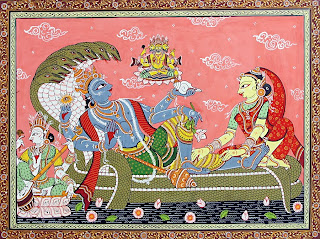
Vishnu and Lakshmi in Vaikuntha; Rajasthani haveli painting
But when they brought Lakshmi to the nether-world, she began to weep and the asuras began experiencing great sorrow.

"So long as there are tears in the eyes of Lakshmi, there will be misery in Patala," revealed Shukra, preceptor of the demons.

"Why is she crying?" asked the asuras.

"You have wrenched her away from her lord. She can give you all the material comfort you want, but without Vishnu, she cannot give you any peace of mind."

Realising their foolishness, the demons let Lakshmi return to Vaikuntha. As she went away, they lost their wealth and power, but there was joy in their hearts.

Those who seek both spiritual bliss and material delight, worship both the lord and his consort, taking her name before his: 'Sita-Rama, Radhe-Shyam, Lakshmi-Narayana'.

Writer Name:- Devdutt Pattanaik

Short Not on Marriage of Shiva

Posted by Art Of Legend India [dot] Com On 10:41 PM 0 comments
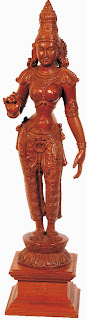
Parvati, princess of the mountains; South Indian wood carving.

Parvati, the Daughter of the Mountains


Along the northern borders of India stand the snow clad peaks of the Himalayas. Himavan was its king. His wife Mena gave birth to a beautiful daughter, Uma, also known as Parvati, daughter of the mountains.

Parvati was Sati reborn, the mother-goddess herself, determined to make Shiva a householder once again.

Each day, on her way back from her bath, she crossed the cold mountain valleys and went into Shiva's cave with gifts of fruits and flowers. She would sweep the floor and tend to the fire, hoping that he would take notice of her.

He never did.

Most of the time he meditated. Otherwise he smoked his pipe, the chilum, and lost himself in narcotic dreams. Parvati knew that she wanted Shiva for a husband. But how would she win his heart if he never even looked her way?

Kama shoots the Love Dart


The gods decided to give Parvati a helping hand. Indra, king of the gods, sent for Kama, god of desire. "Go, fill Shiva's heart with lust for Parvati. Force him to give up his tapas; let him embrace the mountain princess instead."

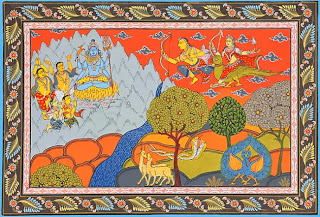
Kama, god of desire, with his consort, Rati, mistress of erotica, perched on a tree ready to shoot love-darts at Shiva Mewar school miniature.Accompanied by the most ravishing apsaras, divine damsels, Kama went to Kailas. On his arrival, spring breeze swept across the icy peaks, filling it with the fragrance of love. The snow melted, and amidst the mountain streams appeared fragrant bushes and flowers of every color. The stern wasteland became a pleasure garden.

Parrots whistled, bees buzzed, and mynahs sang songs of love as the nymphs danced in delight. Inspired, Kama raised his sugarcane bow and let loose a love dart capable of arousing passion in a thousand mortals. It ripped through Shiva's heart.

The apsaras clapped their hands and congratulated Kama. He had done what he had set out to do. So they thought.

Shiva's body that had forsaken desire once again felt a yearning for pleasure. But his still mind had no intention of dancing to the tunes of the flesh. He decided to quell the temptation, destroy its very source . . . cold-bloodedly, without anger.

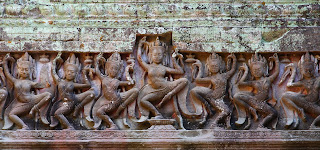
Dancing apsaras, divine damsels; South-East Asian temple carving Shiva awakened his ajna chakra, the centre of intellectual discrimination, to destroy desire. He turned his attention on Kama. The culprit had to be taught a lesson.

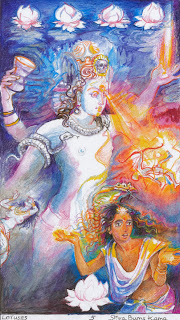
Shiva opened his third eye and let loose a fiery missile. It scorched Kama's beautiful body until all that remained of the love-god was a heap of ash.

With desire so brutally crushed, the cosmic sage returned to his meditation.

The Rise of Ananga


"What have you done?" cried Rati, Kama's beloved apsara, "Without desire, the bull will forsake the cow, the horse, the mare and the bees, the flowers. There will be no homes, no families, for men and women will not love each other. Society will collapse and life will be devoid of its very essence."

Shiva destroying Kama with one glance of his third eye; Bengal print Rati continued, "Desire may be the cause of suffering; but it is also the reason behind joy. What is life without it? An existence without flavor. So there is suffering. What is so terrible about that? After suffering, joy is bound to return. Everything passes in nature, everything is impermanent, including sorrow."

Rati's lamentations moved Shiva. He also saw the wisdom in her words.

"I destroyed Kama's body, but not his spirit. He will live on as Ananga, the bodiless god, in everyone's heart," declared Shiva. He also revealed to the world the secret of the discriminating eye — the tool with which to control desire.

Shiva realized that complete rejection of the world made little sense. Living had its price suffering; it also had its reward joy. One came with the other. Together they gave a reason for surviving.

Sati's departure brought sorrow. But now there was Parvati her arrival held the promise of joy. Perhaps he would marry the mountain princess, if her love for him was true. With her he would find the balance between yoga and bhoga.

Parvati's Penance


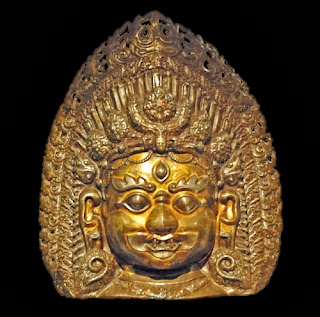
Trilochana, the three-eyed Shiva; North Indian mask Parvati realized that she had to prove the earnestness of her feelings if she wished to be Shiva's consort.

She focused her mind on Shiva. She thought of nothing but him. She ate nothing, drank nothing, she only chanted his name. She sat so still that ants began to crawl on her skin and lizards slithered over her limbs, taking her to be a rock. Sages were impressed by the determination of the mountain princess. They gathered around her and blessed her. "She is Aparna, the-girl-who-refuses-to-eat-even-a-leaf," they said.

Shiva appeared before Parvati as a youth and said, "Shiva is a coarse barbarian with rogues for friends. A beautiful girl like you needs a handsome man for her husband, someone like me perhaps." Parvati ignored him and continued to think about Shiva.

Shiva then appeared disguised as an old man. "Dear child, stop craving for Shiva. He is a yogi, a celibate ascetic, stern and boring. He will not make you happy; he will ignore you for days on end. He is not worthy of you. Marry someone clever like Vishnu or strong as Indra." Parvati ignored him and continued to think about Shiva.

Shiva then came in the form of a deformed dwarf. "If Shiva is good enough for you, you obviously aren't very choosy. Why don't you marry me instead? I won't be as demanding as Shiva; I will be at your beck and call." Parvati ignored him and continued to think about Shiva.

Tapasvini-Parvati, the hermitress, performing austere penance to impress upon Shiva the intensity of her love Rajasthani miniature Parvati's persistence was amazing. Shiva was impressed. He agreed to marry her.

"By traditional rites!" demanded the gods. Shiva agreed.

Shiva begs for Parvati's Hand


A beggar, accompanied by a dog, appeared in front of Himavan's palace with a rattle drum in hand. He began to dance to the rhythm of the drum. He danced so beautifully that the king and queen of the mountains were impressed. Everybody was. They had never seen anything like it.

They offered the beggar clothes and food. He refused them all. They offered him jewels but he refused that too.

"What do you seek?" asked the king. "Ask and it shall be yours."

"I want your daughter Parvati," said the beggar.

"What!"

Shiva, the beggar, Bhikshatan, accompanied by a dog; south Indian bronze "Yes, your daughter. You must let her marry Shiva, the great yogi."

Before Himavan could voice his protest, the beggar disappeared. He was none other than Shiva as

Bhikshatan, the supreme mendicant. In keeping with tradition he had asked for his bride's hand in marriage.

"We will take the marriage invitation to the groom," said Vishnu, Brahma and the seven cosmic sages, the sapta rishis smothering Himavan's protests. Before he could stop them, they were on their way to Kailas.

The Marriage Party


It was to be the grandest wedding of the era. Himavan spared no effort or expense to make the wedding ceremony a success.

Sacred diagrams were placed on the floor and the walls. Priests chanted the prayers according to the guidelines in sacred texts, the Grihasutras. Every traditional rite was observed in minute detail.

Parvati preparing herself for her wedding; Mural from Kerala Parvati was anointed with fragrant oils and bathed in perfumed water. Auspicious marks were placed on her body and she was bedecked with love charms. She looked beautiful, a beaming bride, happy at the thought of marrying the man she wanted.

News came that the groom's party had reached the royal hill and was on its way up to the palace. Parvati's mother,

Mena and her handmaids stood at the gates with garlands and incense to welcome the groom. There was excitement all around. Nobody had ever seen Shiva. They all wondered what he looked like.
He was hideous.

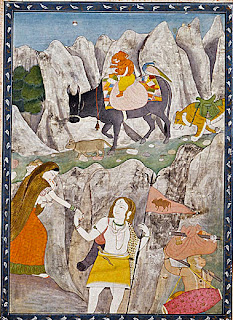
Matted hair, ash smeared face, snakes around his neck and for clothes, a strip of elephant hide across his loins: Shiva looked positively repulsive. He carried a trident in one hand, a drum in another and rode a bull. He seemed to be in a state of inebriation.

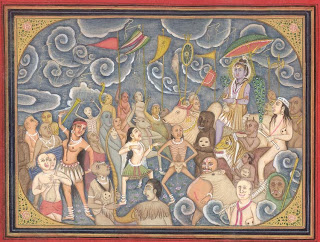
Around him were his friends, the ganas, a bunch of foulmouthed hooligans. They were beating drums and blowing trumpets, creating a terrible cacophony of sounds. The groom's party seemed to comprise of the most deadly, bloodthirsty, fiendish creatures imaginable: all the gypsies, gnomes, genii, ghosts and goblins that haunted hill slopes and crossroads. The procession was led by witches and vampires, sorcerors and conjurers, phantoms and spirits.

Shiva's marriage party comprising of gods, ghouls, ghosts and goblins Like Shiva, all the ganas were drinking bhang and becoming more unruly by the minute. They screamed and shrieked, danced and jumped about the place. "Glory to Shiva, glory to Shiva," they shouted throwing, instead of flowers, skulls, bones and the most venomous reptiles imaginable.

The sh6ck was too much to bear. Mena fainted.

The Marriage called off


"Who is this freak?" asked Himavan. "He is Shiva," said Vishnu. "That can't be him. He looks like a demon."

"I assure you he is the greatest of gods, Maheshvar, himself."

"He may be a great god, but he will not marry my daughter. I will not let him."

Shiva in his charming form, sundara, bedecked in jewels Mena supported her husband completely. "Lock the palace gates. Keep that man and his rowdy companions out," she told the guards. "No mother in her right mind will give her dear child to such a madman."

Parvati was shocked by her parent's decision. They promised to find her a better groom.

"No, I want only Shiva."

Mena couldn't believe her ears: "I think that yogi, that sorceror, has cast a spell on our child. 0 how terrible!"

She began to cry. Parvati cried too as did the other women of the palace.

The marriage had been called off.

Shiva transforms himself


Parvati prayed to Shiva. "For me lord, for me, show them what they want to see, not what you really are."

Shiva heard her prayers. Society was not interested in the bitter truth; it preferred being entertained with sweet illusions. So be it.

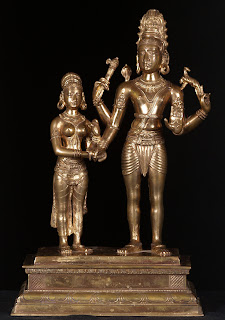
Shiva taking Parvati's hand in marriage;  South Indian bronze The palace gates flung open and the groom entered Himavan's palace. Bathed in mountain springs, wearing a garland of fragrant flowers, he was the most handsome man anyone had ever seen: fair skin, dark eyes, long silky hair, broad shoulders, narrow hips, lithe limbs. . . he was the personification of beauty, Sundaramurti.

"I have come for my bride," Shiva announced standing before Himavan. "Where is she?"

Mena couldn't believe her eyes. "Is it the same man who sat on the bull outside the palace gates?"

"The same," assured Vishnu.

"And who are those handsome boys and girls standing behind him?"

"They are the ganas, the groom's party."

"Oh. . . But. . . then who? . . . "

"The auspicious hour for the union may pass as we seek answers." Vishnu urged the queen and king of the Himalayas to get on with the proceedings.

Fine tunes of love and desire filled the air as priests chanted the hymns of union. Then before the holy fire Shiva held Parvati's hand and took the vows that made them husband and wife.

With that Shiva and Parvati became two halves of the whole.

The cosmos rejoiced.
Writer Name: Devdutt Pattanaik
Read Also:

The Cultural Background 

On Initaion 

Marriage of Shiva

Posted by Art Of Legend India [dot] Com On 6:15 AM 0 comments
Brahma, the creator, conversing with Vishnu, the sustainer; Pahari painting.

Three Faces of Cosmos


The cosmos revolved around Mount Mandara. On its peak sat Shiva in serene meditation, unconcerned with the world, transcending samsara.

In his hand was Brahma's skull, serving as his drinking-bowl. With it he confronted the world, the body and the mind, with its mortality. He was Kapalin, the skull-bearer.

Shiva was glad to be out of the cycle of life.

Brahma was not.

 "If every creature on earth renounces the world like Shiva, the universe will cease to exist. This must be stopped. But how? " Brahma turned to Vishnu, the cosmic savior, for help.

"We must get him a wife," replied Vishnu, "One who will bring him back into the ways of the world.

"For the survival of society the quest for moksha, spiritual liberation, must be supplemented with the fulfillment of dharma, material duty.

"The path of restraint, yoga must be balanced with the delights of pleasure, bhoga. Together, Shiva with his consort will generate the middle path between participation, bhukti and renunciation, mukti."

Brahma agreed.
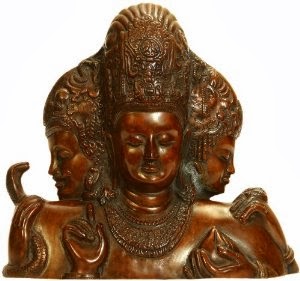
Trimurti, a fusion of Brahma, Vishnu and Shiva, personifying union of the forces of creation, sustenance and destruction Elephanta cave sculpture. Suddenly the antagonism between Brahma and Shiva became clear to the gods Brahma was rajasic, active and energetic while Shiva was tamasic, passive and inert. What Brahma created srishthi, Shiva destroyed, samhara what Shiva destroyed, Brahma recreated. The two justified each other's existence. While Brahma was passionately involved in the creation of the world, Shiva was equally dispassionate about it, preferring to transcend its wiles and become an ascetic. Now that he had, it was time to recreate the cosmic tension by seducing him back into the ways of the world.

Between Shiva and Brahma stood Vishnu, the cosmic savior, always ensuring survival of the prevailing order, sthithi. He was totally sattvic, constantly trying to create a balance between the aggressiveness of the creator and the aggressiveness of the destroyer.

"But where will we find a woman who will match Shiva in spirit and strength?" wondered Brahma. "I have already found one the mother-goddess herself," said Vishnu.

"Yes, yes. Who better than her! She is the personification of prakriti, embodiment of Nature's elements and energies. But will she agree?"

"She already has ... look, she has already taken birth in the house of the prajapati Daksha as his youngest daughter, Sati."

Daksha's Daughter
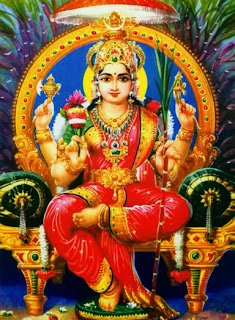

The mother-goddess, personification of matter and energy, shakti modern calendar image Daksha, the prajapati, was the master of civilization, samaj. He formulated the rules of society and ensured the survival of the traditional order. His daughters were wives of the gods and their children had gone on to populate the whole world.

His youngest child, Sati, was something very special, a manifestation of the mother-goddess herself. She would make the perfect wife for Shiva, thought Vishnu. Brahma agreed.

But there was one problem Daksha himself.

Prajapati Daksha never liked Shiva. Shiva was Ekavratya, an unorthodox hermit, who lived by his own rules, not always acceptable to traditional society. He refused to conform to the ways of the world. As guardian of civilization, Daksha found that subversive.

"Shiva wanders in cremation grounds with a rowdy bunch of renegades consuming intoxicants that are forbidden in decent society. He sings and dances wherever he wants to, with little heed to decorum and protocol. He has no home, no possessions, no family, no vocation; he is a no good drifter, ritually impure, unsuitable for any of my daughters, especially Sati," he said.

These were of course excuses. There was a very simple reason why Daksha couldn't stand Shiva: Shiva refused to indulge Daksha's ego.

Daksha made the laws, defined codes of conduct, formulated the rules of society. He naturally considered himself to be someone special, someone more important than others. He expected everyone to bow before him. Shiva refused. He refused to indulge any social rules that promoted pomposity in the name of respect.

Above the bowed heads of the gods, Daksha saw Shiva. "He does not respect me; nor does he disrespect me. It is as if I don't exist, that I don't matter!" thought Daksha.

Daksha Curses the Moon
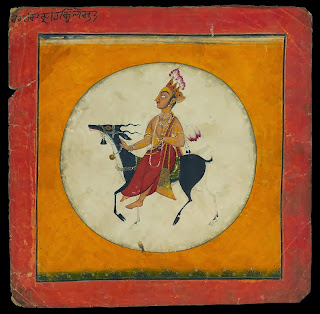

The moon-god, Chandra, who carries a sprig of some and rides an antelope Pahari painting Once, Shiva saved the moon. By doing so, he incurred Daksha's wrath.

Chandra, the moon-god, had married twenty seven of Daksha's daughters the nakshatras, lunar asterisms. But he preferred only one of them, the charming Rohini. He ignored the rest, angering Daksha who cursed him, "May your radiant body, of which you are so proud, wither away and disappear."

As the curse took effect, Chandra became weak and dim. With each passing day his lustre waned. Terrified, he went to the gods seeking a cure. But there was none forthcoming. Vishnu suggested, "Go to Shiva. He is Somnath, keeper of the sacred herb soma that might cure you."

Sure enough Vaidyanath, the supreme physician, helped restore his lustre.

But in time Daksha's accursed disease returned, once again gnawing into Chandra's flesh. The moon-god ran to Shiva for help and again sought the magical soma. Even this cure was followed by a relapse. This went on for some time curse followed by cure followed by curse. Daksha's terrible malady wouldn't go away. Finally Shiva said, "Come and stay within the locks of my hair. Here you will find all the soma you need. Each time the disease troubles you, you can rejuvenate yourself with my grace."

Shiva's blessing went against Daksha's curse. While Daksha caused the moon to wane, Shiva by placing the moon on his head helped it to wax again. Shiva, the saviour of the moon, came to be known as Chandrashekhara. Thanks to him, moonlight came to be filled with the magic of soma and the moon came to be known as Soma.
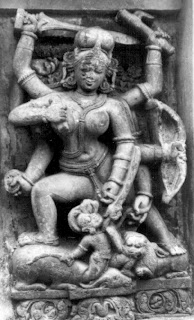
The mother goddess bedecked as a princess Ancient terracotta Daksha considered Shiva's action an insult to his authority. He definitely did not want this maverick for a son-in-law.

But the matter was out of his hands. Sati was already in love with Shiva and had made up her mind to marry him.

Shiva and Sati


"How can I marry her?" cried Shiva, when Vishnu made the suggestion. "I have renounced the world," he said. But he could not ignore the intensity of Sati's love for him.

The prajapati's daughter had abandoned the pleasures of society to be with him. She lived like a hermit, alone, deep in the forest, surviving on fruits and roots, performing terrible austerities, tapas, demanding an audience with the hermit-lord.

"Why do you want to marry me?" Shiva asked her.

"Because you are incomplete without me and I am incomplete without you."

"But I have nothing to offer you?"

"I do not ask for anything, but you."

"I have neither property nor a lineage, kula, nor do I desire any."

"I accept you for what you are, not for what you have."

"I only observe society; I do not participate in it."

"I would like to observe it with you."

Sati's determination impressed Shiva. He accepted her as his wife.
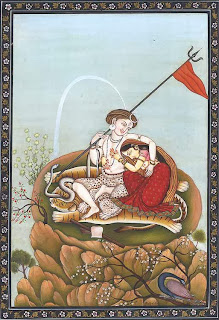
Sati and Shiva in the city of pleasure, Bhogya Pahari miniature Brahma and Vishnu rejoiced. The circle of life was complete as Shiva became yet another cog in the wheel of existence.

Only Daksha was unhappy.

Daksha's Great Sacrifice


Sati walked out of Daksha's palace. She followed Shiva wherever he went: over lonely hills, across desolate plains and dense forests, through cremation grounds. In Shiva's company she did not miss her father or his home or his society.

Shiva at first ignored Sati. He barely acknowledged her presence. Sati didn't mind. She followed him selflessly, content to be by his side. Her fortitude and patience, her serene determination to be his consort, her giving nature and radiant personality everything about her pleased Shiva. He fell in love.

Daksha meanwhile organized a great yagna.

Everyone was invited except Shiva.

"I think it is an oversight. Let's go anyway," said Sati.

"No Sati, don't be an uninvited guest."

Sati Kills Herself
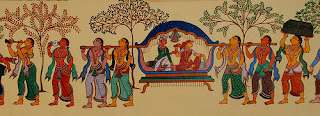

Sati on her way to Daksha's great yagna; Palm-leaf painting from Orissa"I will go to my father's house, with or without you, whether you like it or not," said Sati firmly.

Dressed in her finest robes with a garland of lotuses round her neck, Shiva's headstrong wife went to Daksha's yagna. She walked right into the sacrificial hall. Around the sacred fire sat all the gods, the sages, deities from every plane of existence. None rose to greet her. To her surprise, even her father did not seem particularly pleased to see her.

"You weren't invited. Why did you come? Have you had enough of your vagabond husband?" Daksha asked. His words hit Sati like poisoned barbs. The assembled gods and sages chose to ignore Daksha's remarks. Unlike them, Sati stood up for Shiva. "My husband is no vagabond. He is a yogi, aware of the ways of the cosmos."

Surprised by his daughter's retort, Daksha said, "If he is such a wise man, how come he does not know the basic rules of society. Look at the way he lives, the clothes he wears, the company he keeps."

Daksha prajapati; Kerala wood carving "Society is an artificial creation of man. My lord is one with Nature, he is lord of the plants, lord of the beasts."

"Lord of the beasts! He is a beast himself: no home, no family, no decency, no decorum. I am ashamed to introduce him as my daughter's husband." The gods laughed. Sati wept.

Suddenly it all became clear; Sati realized that the sacrifice was an elaborate ritual aimed at insulting her lord. The humiliation was too much to bear. Death seemed a better alternative to the shame.

Sati sat on the ground, her mind fixed on Shiva. She controlled her breath and stoked her inner fire, prana-agni, until it consumed her.

The fire she created is the dreaded Jwala-mukhi that is now found in Himachal Pradesh.

Shiva loses his Temper


News of Sati's death shocked Shiva. Then came the pain.
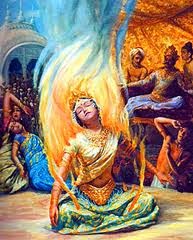
Sati immolating herself to the horror of the gods; modern comic-book illustration Shiva experienced the pangs of separation viraha, the anguish of loneliness. From that suffering, dukkha, came anger, krodha. With the anger came the monsters of fever: the germs that inflame the body and fill it with purulent fluids. Shiva became Jvareshvara, lord of fevers. His indignation contorted his features and turned him into the savage Virupaksha, the malignant-eyed.

Shiva plucked out his hair and lashed it on the ground to create the grim Virabhadra and the fierce Bhadrakali. "Go ravish the sacrifice violate the fire, poison the waters, pollute the air and kill the gods. They deprived me of Sati, let them be deprived of their lives," ordered Shiva.

Virabhadra picked up his trident and summoned an army, a cackling horde of ghosts, goblins, ghouls, genii, monsters, demons, dragons, freaks, fiends and spirits the ganas of Shiva. They marched towards Daksha's sacrificial halls cheered by the shrill cries of Bhadrakali.

Evil omens had begun to appear at Daksha's palace. Vultures circled above the sacrificial altar, wolves howled.

Fear arose in the very heart of the cosmos.

Destruction of the Sacrifice


A hundred thousand rabid dogs rushed into Daksha's precinct carrying on their backs the monsters of fever. These fiends leapt on the gods and struck them with such fury that they all began to convulse and vomit blood.

Shiva creating Virabhadra from the locks of his hair; Pahari painting
Then with a virulent war-cry Virabhadra and his savage entourage descended on the scene. They wrecked the place: sacred vessels were kicked, tapestries were ripped and pavilions burnt.

As the gods took flight, the demons seized and massacred them all... Bhadrakali drank their blood.

The sage Bhrigu used his magical powers and tried to conjure up spirits who would save the
sacrifice. But the spirits refused to emerge when they heard Bhadrakali howl. Those that did were dismembered by Shiva's gams.

Finally Bhadrakali dragged Daksha by his feet towards the fire-altar. Virabhadra raised his axe and beheaded the prajapati. The severed head was tossed into the flames.

Then, Virabhadra laughed and Bhadrakali danced. She used the heads of the gods as beads for her garland while he decorated his body with their entrails. The ganas joined in the gory revelry. The sacrificial hall was now claimed by Shiva. He became known as Hara, the ravisher.

With that, Shiva's fury subsided. Only the sorrow remained.

Shiva forgives Daksha


Bhadrakali, the ferocious killer goddess Madhubani painting from Bihar
Shiva walked into Daksha's sacrificial hall and was confronted with the aftermath of the bloodbath a feast for wolves, vultures and vampires. He was filled with pity, karuna.

The survivors of the carnage fell at his feet and begged for mercy. He smiled. Instantly a fragrant breeze swept across the scene. The fevers subsided. The dead gods arose as if waking from a deep slumber. Their wounds had healed, the broken bones had been mended, the missing limbs restored.

Shiva found Daksha's headless body and brought it back to life, replacing his head with that of a goat.

Shiva then gave him the city of Bhogya, "This is a city of uninhibited pleasure. I created it for Sati. Here I indulged in every pleasure imaginable and became a bhogi. But now Sati is no more. I have no use for Bhogya. I gift it to you."

Daksha was overwhelmed by Shiva's generosity. The goat headed prajapati began to sing Shiva's praises. "You are Shankar, the benevolent one, a kind god," he said. Daksha completed his sacrifice. This time he gave Shiva his rightful share. Shiva ceased being a rejected god, an outsider. He was accepted, adored, held in awe. He became part of the celestial pantheon.

Only Sati was dead.

Sati's Corpse is Destroyed
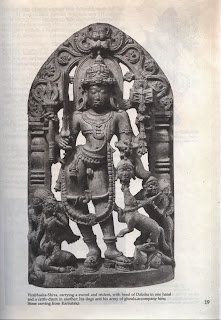

Virabhadra-Shiva, carrying a sword and trident, with head of Daksha in one hand and a rattle-drum in another his dogs and his army of ghouls accompany him; Stone carving from Karnataka Shiva picked up Sati's lifeless body and walked out of the sacrificial hall. He could not bring himself to cremate it. The body was all that he had to remind him of his beloved. He refused to part with it.

Distraught, he wandered across the cosmos with Sati's corpse in his arms, tears rolling down his cheeks. His ganas followed him silently, not knowing how to console their lord. His mournful cry rent the galaxies and stunned the gods. "This must stop," said Brahma, "Otherwise the whole cosmos will be submerged by Shiva's agony."

Vishnu raised his finger to spin his mighty discus, sudarshan chakra, and let it fly. Its sharp edges ripped Sati's corpse into 108 pieces. These fell in different parts of Jambudvipa, the rose apple continent of India, and became shaktipithas, the shrines of Sati.

With the body gone, there was nothing left to remind Shiva of Sati, except memories. And memories fade.

Sati had taught Shiva all about pleasure, Kama. Her departure had taught him about anger, krodha. Together Kama-krodha trap man in samsara.

Shiva had had enough of life. He isolated himself in the icy caves of the Himalayas. He became a recluse once more.

The mother-goddess, embodiment of all matter, is never stable. She is constantly in a state of flux. Her death was just a transformation; Sati would return in another form. The gods knew that. Shiva did too.

Company Overview

Art of Legend India has the distinction of being one of the best in the Indian Handicraft Industry. We are about 75 years old handicrafts manufacturer & exporter. We are having team of more than 500 craftsman.

We are having our business offices in India, USA & Germany to ensure our best services.

Total Pageviews