ArtofLegendIndia.com, Biggest Online Store of Handicrafts Items, Paintings and Jewelry Accessories...

Handicrafts

Handicrafts are devices or works of art that are made completely by hand or by the use of relatively simple tools. Such goods are usually made in the traditional way of manufacturing goods. Therefore, the knowledge of the art of craft is usually passed down from one generation to another. The items made using these traditional methods of manufacturing are usually produced in smaller quantities and they often represent the culture or religious beliefs of the community that makes them. The goods are also handmade from natural materials that are found in the environment of the particular economy.

Read More!

Biggest Online Store of Handicrafts Items

Paintings

A painting is equal to thousand words, means a beautiful painting is equal to million of words. Paintings are one of the oldest art forms -- throughout history artists have played an important role in documenting social movements, spiritual beliefs and general life and culture.

History Of Paintings: The history of painting reaches back in time to artifacts from...

Read More!

Biggest Online Store of Unique Style Paintings
Showing posts with label Hindu Goddess. Show all posts

Short Not on Marriage of Shiva

Posted by Art Of Legend India [dot] Com On 10:41 PM 0 comments
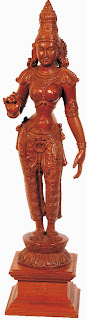
Parvati, princess of the mountains; South Indian wood carving.

Parvati, the Daughter of the Mountains


Along the northern borders of India stand the snow clad peaks of the Himalayas. Himavan was its king. His wife Mena gave birth to a beautiful daughter, Uma, also known as Parvati, daughter of the mountains.

Parvati was Sati reborn, the mother-goddess herself, determined to make Shiva a householder once again.

Each day, on her way back from her bath, she crossed the cold mountain valleys and went into Shiva's cave with gifts of fruits and flowers. She would sweep the floor and tend to the fire, hoping that he would take notice of her.

He never did.

Most of the time he meditated. Otherwise he smoked his pipe, the chilum, and lost himself in narcotic dreams. Parvati knew that she wanted Shiva for a husband. But how would she win his heart if he never even looked her way?

Kama shoots the Love Dart


The gods decided to give Parvati a helping hand. Indra, king of the gods, sent for Kama, god of desire. "Go, fill Shiva's heart with lust for Parvati. Force him to give up his tapas; let him embrace the mountain princess instead."
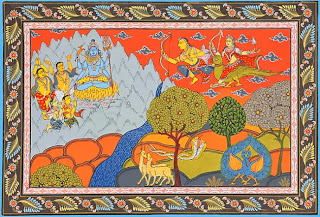
Kama, god of desire, with his consort, Rati, mistress of erotica, perched on a tree ready to shoot love-darts at Shiva Mewar school miniature.Accompanied by the most ravishing apsaras, divine damsels, Kama went to Kailas. On his arrival, spring breeze swept across the icy peaks, filling it with the fragrance of love. The snow melted, and amidst the mountain streams appeared fragrant bushes and flowers of every color. The stern wasteland became a pleasure garden.

Parrots whistled, bees buzzed, and mynahs sang songs of love as the nymphs danced in delight. Inspired, Kama raised his sugarcane bow and let loose a love dart capable of arousing passion in a thousand mortals. It ripped through Shiva's heart.

The apsaras clapped their hands and congratulated Kama. He had done what he had set out to do. So they thought.

Shiva's body that had forsaken desire once again felt a yearning for pleasure. But his still mind had no intention of dancing to the tunes of the flesh. He decided to quell the temptation, destroy its very source . . . cold-bloodedly, without anger.
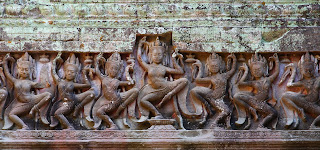
Dancing apsaras, divine damsels; South-East Asian temple carving Shiva awakened his ajna chakra, the centre of intellectual discrimination, to destroy desire. He turned his attention on Kama. The culprit had to be taught a lesson.

Shiva opened his third eye and let loose a fiery missile. It scorched Kama's beautiful body until all that remained of the love-god was a heap of ash.

With desire so brutally crushed, the cosmic sage returned to his meditation.

The Rise of Ananga


"What have you done?" cried Rati, Kama's beloved apsara, "Without desire, the bull will forsake the cow, the horse, the mare and the bees, the flowers. There will be no homes, no families, for men and women will not love each other. Society will collapse and life will be devoid of its very essence."
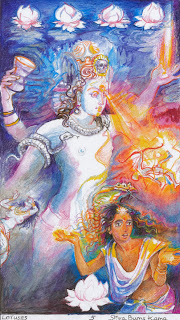
Shiva destroying Kama with one glance of his third eye; Bengal print Rati continued, "Desire may be the cause of suffering; but it is also the reason behind joy. What is life without it? An existence without flavor. So there is suffering. What is so terrible about that? After suffering, joy is bound to return. Everything passes in nature, everything is impermanent, including sorrow."

Rati's lamentations moved Shiva. He also saw the wisdom in her words.

"I destroyed Kama's body, but not his spirit. He will live on as Ananga, the bodiless god, in everyone's heart," declared Shiva. He also revealed to the world the secret of the discriminating eye — the tool with which to control desire.

Shiva realized that complete rejection of the world made little sense. Living had its price suffering; it also had its reward joy. One came with the other. Together they gave a reason for surviving.

Sati's departure brought sorrow. But now there was Parvati her arrival held the promise of joy. Perhaps he would marry the mountain princess, if her love for him was true. With her he would find the balance between yoga and bhoga.

Parvati's Penance
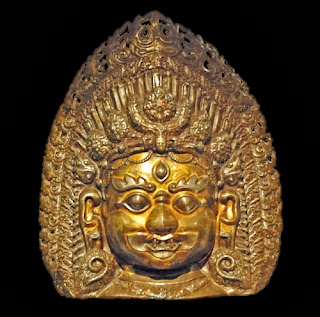

Trilochana, the three-eyed Shiva; North Indian mask Parvati realized that she had to prove the earnestness of her feelings if she wished to be Shiva's consort.

She focused her mind on Shiva. She thought of nothing but him. She ate nothing, drank nothing, she only chanted his name. She sat so still that ants began to crawl on her skin and lizards slithered over her limbs, taking her to be a rock. Sages were impressed by the determination of the mountain princess. They gathered around her and blessed her. "She is Aparna, the-girl-who-refuses-to-eat-even-a-leaf," they said.

Shiva appeared before Parvati as a youth and said, "Shiva is a coarse barbarian with rogues for friends. A beautiful girl like you needs a handsome man for her husband, someone like me perhaps." Parvati ignored him and continued to think about Shiva.

Shiva then appeared disguised as an old man. "Dear child, stop craving for Shiva. He is a yogi, a celibate ascetic, stern and boring. He will not make you happy; he will ignore you for days on end. He is not worthy of you. Marry someone clever like Vishnu or strong as Indra." Parvati ignored him and continued to think about Shiva.

Shiva then came in the form of a deformed dwarf. "If Shiva is good enough for you, you obviously aren't very choosy. Why don't you marry me instead? I won't be as demanding as Shiva; I will be at your beck and call." Parvati ignored him and continued to think about Shiva.
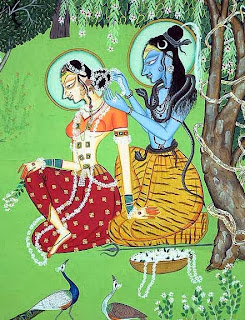
Tapasvini-Parvati, the hermitress, performing austere penance to impress upon Shiva the intensity of her love Rajasthani miniature Parvati's persistence was amazing. Shiva was impressed. He agreed to marry her.

"By traditional rites!" demanded the gods. Shiva agreed.

Shiva begs for Parvati's Hand


A beggar, accompanied by a dog, appeared in front of Himavan's palace with a rattle drum in hand. He began to dance to the rhythm of the drum. He danced so beautifully that the king and queen of the mountains were impressed. Everybody was. They had never seen anything like it.

They offered the beggar clothes and food. He refused them all. They offered him jewels but he refused that too.

"What do you seek?" asked the king. "Ask and it shall be yours."

"I want your daughter Parvati," said the beggar.

"What!"

Shiva, the beggar, Bhikshatan, accompanied by a dog; south Indian bronze "Yes, your daughter. You must let her marry Shiva, the great yogi."

Before Himavan could voice his protest, the beggar disappeared. He was none other than Shiva as

Bhikshatan, the supreme mendicant. In keeping with tradition he had asked for his bride's hand in marriage.

"We will take the marriage invitation to the groom," said Vishnu, Brahma and the seven cosmic sages, the sapta rishis smothering Himavan's protests. Before he could stop them, they were on their way to Kailas.

The Marriage Party


It was to be the grandest wedding of the era. Himavan spared no effort or expense to make the wedding ceremony a success.

Sacred diagrams were placed on the floor and the walls. Priests chanted the prayers according to the guidelines in sacred texts, the Grihasutras. Every traditional rite was observed in minute detail.
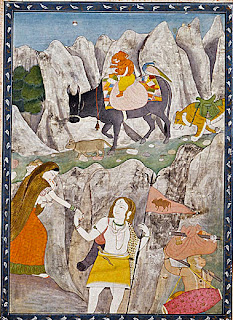
Parvati preparing herself for her wedding; Mural from Kerala Parvati was anointed with fragrant oils and bathed in perfumed water. Auspicious marks were placed on her body and she was bedecked with love charms. She looked beautiful, a beaming bride, happy at the thought of marrying the man she wanted.

News came that the groom's party had reached the royal hill and was on its way up to the palace. Parvati's mother,

Mena and her handmaids stood at the gates with garlands and incense to welcome the groom. There was excitement all around. Nobody had ever seen Shiva. They all wondered what he looked like.
He was hideous.

Matted hair, ash smeared face, snakes around his neck and for clothes, a strip of elephant hide across his loins: Shiva looked positively repulsive. He carried a trident in one hand, a drum in another and rode a bull. He seemed to be in a state of inebriation.

Around him were his friends, the ganas, a bunch of foulmouthed hooligans. They were beating drums and blowing trumpets, creating a terrible cacophony of sounds. The groom's party seemed to comprise of the most deadly, bloodthirsty, fiendish creatures imaginable: all the gypsies, gnomes, genii, ghosts and goblins that haunted hill slopes and crossroads. The procession was led by witches and vampires, sorcerors and conjurers, phantoms and spirits.
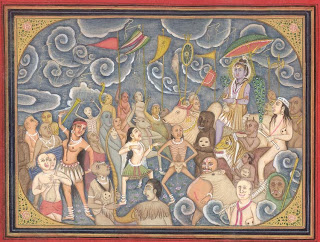
Shiva's marriage party comprising of gods, ghouls, ghosts and goblins Like Shiva, all the ganas were drinking bhang and becoming more unruly by the minute. They screamed and shrieked, danced and jumped about the place. "Glory to Shiva, glory to Shiva," they shouted throwing, instead of flowers, skulls, bones and the most venomous reptiles imaginable.

The sh6ck was too much to bear. Mena fainted.

The Marriage called off


"Who is this freak?" asked Himavan. "He is Shiva," said Vishnu. "That can't be him. He looks like a demon."

"I assure you he is the greatest of gods, Maheshvar, himself."

"He may be a great god, but he will not marry my daughter. I will not let him."
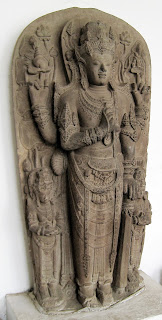
Shiva in his charming form, sundara, bedecked in jewels Mena supported her husband completely. "Lock the palace gates. Keep that man and his rowdy companions out," she told the guards. "No mother in her right mind will give her dear child to such a madman."

Parvati was shocked by her parent's decision. They promised to find her a better groom.

"No, I want only Shiva."

Mena couldn't believe her ears: "I think that yogi, that sorceror, has cast a spell on our child. 0 how terrible!"

She began to cry. Parvati cried too as did the other women of the palace.

The marriage had been called off.

Shiva transforms himself


Parvati prayed to Shiva. "For me lord, for me, show them what they want to see, not what you really are."

Shiva heard her prayers. Society was not interested in the bitter truth; it preferred being entertained with sweet illusions. So be it.
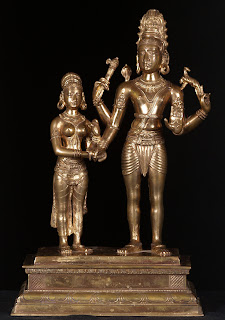
Shiva taking Parvati's hand in marriage;  South Indian bronze The palace gates flung open and the groom entered Himavan's palace. Bathed in mountain springs, wearing a garland of fragrant flowers, he was the most handsome man anyone had ever seen: fair skin, dark eyes, long silky hair, broad shoulders, narrow hips, lithe limbs. . . he was the personification of beauty, Sundaramurti.

"I have come for my bride," Shiva announced standing before Himavan. "Where is she?"

Mena couldn't believe her eyes. "Is it the same man who sat on the bull outside the palace gates?"

"The same," assured Vishnu.

"And who are those handsome boys and girls standing behind him?"

"They are the ganas, the groom's party."

"Oh. . . But. . . then who? . . . "

"The auspicious hour for the union may pass as we seek answers." Vishnu urged the queen and king of the Himalayas to get on with the proceedings.

Fine tunes of love and desire filled the air as priests chanted the hymns of union. Then before the holy fire Shiva held Parvati's hand and took the vows that made them husband and wife.

With that Shiva and Parvati became two halves of the whole.

The cosmos rejoiced.
Writer Name: Devdutt Pattanaik
Read Also:

The Cultural Background 

On Initaion 

Goddess Jagadhatri: A Form of Goddess Durga

Posted by Art Of Legend India [dot] Com On 2:56 AM 0 comments
 Goddess Jagadhatri is another manifestation of Goddess Durga (Shakti). In ancient Hindu Texts, Tantras and Puranas, this form of the goddess Durga is depicted as a symbol of Shakti (Power). She is depicted having three eyes and four arms holding conch, discus, bow and arrow respectively. She is depicted with red clothes and bright jewels. She is represented with garland of snake around her neck and body. Riding on a lion over the dead body of Karindrasura, the Elephant Demon, she also symbolizes the victory of divine powers upon the demonic powers.

Goddess Jagaddhatri or Jagadhatri is the protector of the world, who is also known as Karindrasuranisudini (the slayer of the elephant demon), Maheshwari (the Great Goddess), Shaktacharpriya (the Goddess who loves to be worshipped as according to the practices of the Shakta sect of Hinduism or Shaktism) and Adharabhuta (the Bearer of the World) etc. She is the savior of the universe who protected the world from the cruel demons.

Goddess Durga is one of the most religiously worshipped deities in West Bengal and many festivals are celebrated in the state in praise of her only. Jagaddhatri or Jagadhatri puja is one of the great festivals celebrated in West Bengal by the devotees of goddess Durga with great enthusiasm and zest. It is essentially the worship of Shakti and a major Hindu festival in Kolkata, after Durga Puja and Kali Puja. According to the Hindi calendar, Jagadhatri Puja is celebrated on Karthik Shukla Navami, the ninth day during Karthik month, in West Bengal. This festival signifies the ending of evil or darkness and arrival of light or happiness. Though, Goddess Jagadhatri is worshipped all over West Bengal, the celebrations in Chandannagar, Hoogly and Krishnanagar are very special in terms of their grandeur and popularity.All paintings are courtesy of Art of Legend India.

Goddess Annapurna: The Goddess of Food and Nourishment

Posted by Art Of Legend India [dot] Com On 4:03 AM 0 comments
Goddess Annapurna is the Hindu Goddess of food and nourishment. In Sanskrit 'Anna' means food and 'purna' means complete and perfect; together the term Annapurna signifies nourishing with food to the fullest. She is a form of goddess Parvati, the consort of Lord Shiva. She is considered as the sustainer of prosperity. She is believed to be the one who fills the stomachs of the hungry with her noble powers. In Hindu beliefs, she is the one endowed with the powers to supply food in a limitless quantity. It is believed that by worshipping her, one will never be out of food anytime in life.

Goddess Annapurna is the Supreme Goddess and Queen of Kashi (Varanasi). She is the Goddess for the fourth day of Durga Navratri. She is depicted with a jeweled pot containing food in one hand and a ladle in the other to distribute the food to her devotees. In some depictions, she is depicted in sitting posture and Lord Shiva is usually depicted as begging for food to her with his skull begging bowl. She symbolizes the divine aspect of nourishing care. The images of goddess Annapurna are also placed in kitchens, restaurants and near dinner tables, where the food is prepared and served only after getting the blessings of the goddess Annapurna.


In Hindu households if people waste food, it is said that they in turn make goddess Annapurna angry. Therefore grains of food are not wasted after taking food. Goddess Annapurna is also referred to as the goddess of fertility and agriculture, who is also reasonably popular in South India with separate shrines dedicated to her. The most renowned temple dedicated to goddess Annapurna is in Kashi (India). She is regarded as the queen of Kashi alongside her husband Vishweshwara (Lord Shiva), the King of Kashi. The idol of goddess Annapurna is always depicted with a bowl which is always filled with food grain, representing the abundant of food she has to offer to the devotees.

The Annapurna Sahashtranam presents her one thousand names and the Annapurna Shatnama Stotram contains 108 of her names. She is worshipped through the recitation of her thousand names and her one hundred and eight names. The Sri Annapurna Ashtakam composed by Shankaracharya is chanted by several devout Hindus as a prayer for nourishment, wisdom and renunciation. She is variously described as the goddess:

1. who is full, complete and perfect with food and grains
2. who nourishes world
3. who is the grantor of knowledge
4. who is the Supreme welfare
5. who manifests truth and efficiency
The origin of Goddess Annapurna

Once, Lord Brahma and Vishnu being became worried about the extinction of food from earth resulting in perishing of many human beings. They decided to awaken Lord Shiva from his ritual sleep, who invited the goddess Annapurna to earth and begged for food from her. Lord Shiva distributed the food received from the goddess Annapurna and since then promised her that she should continue to nourish the people of earth and in turn he would give salvation (moksha) to the people of Kashi where the goddess resides.All paintings are courtesy of Art of Legend India

Goddess Shashti: The Protector of the Children

Posted by Art Of Legend India [dot] Com On 9:43 PM 0 comments
Shashti is a feline goddess, who is depicted riding a cat. Like goddess Manasa, she is of Bengali origin and little worshipped in other parts of India. Goddess Shashti is said to be the goddess of fertility, the one who blesses people with children. Black cats are believed to be goddess Shasti’s vehicle (vahana). Goddess Shashti holds a child and is generally depicted in yellow color. It is believed that goddess Shashti protects the new born from the evil powers, diseases etc.

In the Brahma Vaivarta Purana, Goddess Shashthi has been depicted as the sixth aspect of the Parama Prakriti (universal female energy). She is the goddess of fertility and the protector of children. In eastern India (particularly Bengal), Shashti is a folk-goddess and protector of children. Her worship is held on the sixth (shashti) day following a child's birth. She is considered an aspect of goddess Durga and is also called Skandamata and is worshipped by women desiring offspring. Women observe a partial fast on the day and perform pujas in a forest or under Kadamba tree. Goddess Shashti is worshipped on the day and offerings are made on a traditional hand-fan. Women only eat fruits on the day. A cat along with goddess Shashti is worshipped on the day.

Legend of worship of goddess Shashti along with a cat
Once upon a time there lived a prosperous farmer, who had seven sons. They all married to nice and beautiful girls. But the wife of the youngest son was very greedy. She used to steal food and other delicious sweets and blamed it on a cat. To take revenge, the cat stole all the children that the women gave birth and placed them in a temple dedicated to goddess Shashti. Finally, she prayed to the goddess and she was advised to make an image of cat and worship along with the Goddess Shashti for getting back her babies.All paintings are courtesy of Art of Legend India.

Rati: The Goddess of Love and Passion

Posted by Art Of Legend India [dot] Com On 2:48 AM 1 comments
Goddess Rati is the Hindu goddess of love, carnal desire, lust, passion and sexual pleasure. She is the daughter of Prajapati Daksha and consort of Kamadeva (the god of love). A constant companion of Kamadeva, she is often depicted with him in legend and temple sculpture. She also enjoys worship along with Kamadva. Rati is often associated with the arousal and delight of sexual activity, and many sex techniques and positions derive their Sanskrit names from hers. The Hindu mythology describes her beauty and sensuality. She is depicted as a maiden who has the power to enchant the god of love. The name Rati in Sanskrit means ‘the pleasure of love, sexual passion or union and amorous enjoyment’, all of which Rati personifies.

Rebirth of Rati as Mayavati

The demon Tarakasura created havoc in the universe. He obtained a boon that he would be killed by only Shiva’s son, but lord Shiva had gone to meditate after the death of his first wife Sati. Kamadeva was instructed by the gods to make lord Shiva fall in love again. Kamadeva went to Mount Kailash with his consort Rati and Vasanta (spring), and shot his love-arrows at lord Shiva and invoked desire. Wounded by Kamadeva's arrows, lord Shiva becomes attracted to Parvati, the reincarnation of Sati, but he (lord Shiva) opened his third eye, the gaze of which was so powerful that Kamadeva's body was reduced to ashes. For the sake of Kamadeva's wife Rati, Shiva restored him, but only as a mental image, representing the true emotional and mental state of love rather than physical lust. 

The grief-stricken Rati did severe penance and lord Shiva assured her that Kamadeva would be reborn as Pradyumna, as the son of lord Krishna and Rukmini on earth. On advice of lord Shiva, Rati assumed the form of demon Sambrasura's kitchen-maid Mayavati and awaited her husband's arrival in Sambrasura's house. Sambrasura is foretold that he was killed by Pradyumna. Sambrasura found out that Kamadeva was born as Pradyumna, the son of Krishna and his wife Rukmini. He stole the child and threw him in the ocean, where the child was swallowed by a fish. This fish was caught by fishermen and sent to Sambrasura's kitchen. When the fish was cut, the child is found by Mayavati, who decided to nurture him. The sage Narada revealed to Mayavati that she was Rati and the child was Kamadeva and she was to nurture him. As the child grew up, the motherly love of Mayavati changed to the passionate love of a wife. Mayavati told him the secret of their previous births as narrated by sage Narada and that he was not her son, but that of lord Krishna and Rukmini. Mayavati trained Pradyumna in magic and war and advised him to kill Sambrasura. Pradyumna killed him. He returned to Dwaraka with Mayavati as his wife. 

Goddess Rati stands for sexual pleasure, carnal desire and sexuality. Goddess Rati represents only the pleasure aspect of sexual activity and does not relate to child-birth or motherhood. Rati is not only Kamadeva’s consort, but she is also his assistant and constant companion, who arouses sexual feelings. Kamadeva is usually depicted with Rati along his side. Rati also enjoys worship with Kamadeva in some festival rites dedicated to him. all paintings are of courtesy of Art of Legend India.

Goddess Shitala: The Goddess of Small Pox and Measles

Posted by Art Of Legend India [dot] Com On 1:07 AM 0 comments

Goddess Shitala literally means the ‘Cool Goddess’, is a Hindu goddess. She is the goddess who is invoked for protection against the evil she causes. She is the goddess of small pox, who roams the country side, riding an ass and searches for victims. She is widely worshipped in North India, Nepal, Bangladesh and Pakistan as the pox-goddess. In Hinduism, goddess Shitala is considered an aspect of goddess Durga or Shakti. Popularly she is the Hindu goddess of small pox in North India and is known to spread the dreaded disease and cure it. The occurrence of the disease is believed to be a manifestation of the goddess Shitala. According to the Hindu devotees, the disease is medium by which the goddess enters one’s body and becomes one with the devotee. She is undoubtedly one of the most popular rural deities.

Goddess Shitala is depicted wearing red robes dress and rides around the villages in North India on a donkey (ass) and inflicting people with the dreaded pox like small pox, chicken pox etc. Symbolically, she represents Nature’s power of generating viruses causing disease and nature’s healing powers. She is depicted having four hands. In her four hands she carries a silver broom, winnow fan, small bowl and a pitcher with Gangajal (the holy water from River Ganga). Occasionally, she is depicted with two hands carrying a broom and pitcher.

Shitala Satam popularly known as Shitala Shasti, is observed on the seventh day of the Krishna Paksha (waning phase of moon) in Shravan month in Gujarat. Shitala Satam is dedicated to Goddess Shitala, the goddess of pox and measles. It is observed for the welfare of children and others to escape from measles and small pox. The most important festival dedicated to her takes place in Chaitra month, the Ashtami day after Purnima (full moon) in the month is observed as Shitala Ashtami. Goddess Shitala is worshipped as the Goddess of Chicken-Pox and Chicken Pox. On the day of Shitala Saptami, devotees worship her with devotion and they let their children to worship the Goddess. There are famous temples dedicated to Shitala Devi in Haryana, Punjab, Rajasthan, Himachal Pradesh, Uttarakhand, Uttar Pradesh and Bihar.

The Puranas describe that goddess Shitala was created by Lord Brahma. She was promised by Lord Brahma that she will be worshipped as a Goddess on earth. She asked for a companion, then lord Shiva created Jvara Asura (the fever demon) from his sweat as her companion. Goddess Shitala and Jvara Asura came down to earth and started hunting for a place to stay. They went to the court of king Birat, a dedicated devotee of lord Shiva. He agreed to worship her and give a place in his kingdom but she would not get the respect given to lord Shiva. So, goddess Shitala demanded supremacy over all other gods and when king Birat did not budge. She spread different kinds of pox on the land and finally, the king had to agree to her wishes. Soon the disease and all its after effects were amazingly cured.

The smallpox disease is thought to be eradicated the worship of goddess Shitala still continues and this is seen as the reason why, in some regions, she has taken on different personalities that depict her as not only the goddess of disease but also the protector of children and giver of good fortune. She is worshipped by all classes but she tends to get the most patronage from the poor. She is especially worshipped to avoid her wrath. All paintings are courtesy of Art of Legend India.

Goddess Manasa: The Goddess of Snakes

Posted by Art Of Legend India [dot] Com On 11:57 PM 0 comments
Goddess Manasa is a Hindu folk goddess of snakes, worshipped mainly in Bengal and other parts of northeastern India, chiefly for the prevention and cure of snakebite and also for fertility and prosperity. Goddess Manasa is said to be the daughter of sage Kashyapa and Kadru and sister of the serpent king Shesha; alternatively she is said to be the daughter of Lord Shiva and a mortal woman. She is very powerful and worshipped in different forms and with different names throughout India. She is worshipped mainly during the rainy season, when the snakes are most active. There is a belief that Manasa protects the people from snake bite. Goddess Manasa enjoys a widespread cult as a deity, mostly in Bengal, where she is invoked for protection against snake bites and bringer of wealth. She is also linked with fertility and worshipped for the revival and protection from several incurable diseases.

The Puranas described that sage Kashyapa married goddess Manasa to sage Jaratkaru, who agreed to marry her on the condition that he would leave her if she disobeyed him. Once, when Jaratkaru was awakened by Manasa, he became upset with her because she awakened him too late for worship, and so he deserted her. On the request of the great Hindu gods, Jaratkaru returned to Manasa and she gave birth to Astika.

 Legend of Goddess Manasa

Goddess Manasa was the daughter of Lord Shiva by a beautiful mortal woman. She was not liked by her step-mother, Parvati; so she took up her abode on earth with another daughter of Lord Shiva, named Neta. The daughter of Lord Shiva liked to be worshipped by human beings as other gods and goddesses and she knew that her desire would be fulfilled if she could once secure the devotion of a very prosperous and powerful merchant-prince of Champaka Nagar, by the name of Chand Saudagar. He was a widower and had six sons. She tried for long to persuade Chand to worship her, but he was a stout devotee of Lord Shiva and he would not desert his Lord for a goddess of the snakes. So, goddess Manasa destroyed Chand’s beautiful garden. Many times she destroyed his garden and every time Chand used to restore the beauty to his garden by the help of his magic power, which he received from Lord Shiva.

Then Manasa appeared to Chand in the form of a beautiful girl. He fell madly in love with her, but she would not hear a word till he promised to bestow his magic power upon her; and when he did so, she appeared in the sky in her own form and told to Chand to worship her. But Chand did not obey her instructions. Then she destroyed the garden again and his six sons were killed by snake bites with the instructions of Manasa. Chand remarried and got a son and named him Lakshmindara. Lakshmindara grew up to be a handsome boy and Chand selected a beautiful girl Behula to be married with him. The couple was engaged and wedding date was fixed. It was predicted that Lakshmidhara would die of a snake bite on his wedding night. In those years Manasa did not give up her hope and appeared again with her resolve to subdue Chand by killing Lakshmidhara. Goddess Manasa killed Lakshmidhara and at last, due to the love and devotion of Behula Lakshmidhara was brought back to life and Behula convinced her father-in-law to worship the Goddess Manasa and thus Chand agreed and promised to worship Manasa by using his left hand to perform the rites. This was accepted by Manasa and Chand worshipped Manasa with all his devotion. She was satisfied, and bestowed on him wealth and prosperity and happiness.

Goddess Manasa is depicted as a graceful woman covered with snakes, sitting on a lotus or standing upon a snake. She is sheltered by the canopy of the hoods of the seven cobras. Sometime she is also depicted with a child on her lap.All paintings are courtesy of Art of Legend India.

Goddess Parvati: The Divine Consort of Lord Shiva

Posted by Art Of Legend India [dot] Com On 3:31 AM 0 comments
Goddess Parvati is the consort of Lord Shiva and the mother of Ganesha and Kartikeya. She is a well known goddess in the Hindu mythology, who is considered as a representation of Shakti. She is beautifully presented in the Hindu scriptures as being beautiful. She has a charming personality. She is worshipped by married women for a happy married life. The word Parvati has been derived from a Sanskrit word "Parvat", which means mountain. So, the name Parvati suggests that she is the daughter of Himavan and Mena.

Goddess Parvati is believed to be one of the many forms of the ‘Divine Shakti’. She is also known as goddess Kali, Lakshmi, Saraswati, Durga etc. Goddess Durga and goddess Kali are the two fierce but very powerful forms of Parvati. Goddess Parvati symbolizes noble virtues admired by the Hinduism. She married Lord Shiva, the most innocent and the fiercest lord in Hinduism. There are legends behind the marriage of Lord Shiva and Parvati, being a great devotee of Lord Shiva, goddess Parvati did a long penance in order to get Lord Shiva as her husband. Her dedication was really true which made Lord Shiva to marry her.

Origin of Goddess Parvati
According to the Puranas, Lord Brahma created a beautiful maiden Sati who was born to a king called Daksha. Lord Shiva married her. One day, however, Sati heard that a major religious function was being celebrated in her father’s house. King Daksha did not like Lord Shiva therefore, he did not invite Shiva and Sati. She was a little upset that her parents had not invited her or her husband. So, she decided that she would go to his father’s religious function even if she was uninvited. Shiva did not want her to go uninvited. There, in her father’s home, Sati was insulted and Daksha also insulted Shiva. She could not bear the insult and jumped into the sacred fire of yagna. Lord Shiva was enraged after the death of Sati. He just could not bear the loss. As he carried her body across the country, different parts of her body are believed to have fallen off in many places and even today these places are sacred in Hindu mythology. 

After the death of Sati, Lord Shiva renounced the world and went into deep meditation in the snow-covered peaks of the Himalayas. Meanwhile, the demons lead by Taraka, a powerful demon, rose from the netherworld, defeated the gods and took the heaven under his control. The gods wanted a warrior who would help them to regain the heaven. Lord Brahma advised them, only Shiva can father such a warrior, but he is unaware of the world. At the persistence of the gods, Sati agreed to take a rebirth as Parvati, the daughter of Himavan (the King of the Himalayas) and his wife Mena. It was only after performing intense austerities that Goddess Parvati succeeded in pleasing Lord Shiva and making him accept her again as his consort. Later, she became the mother of Lord Ganesha and Kartikeya. Kartikeya killed the demon Taraka and restored the heaven to the gods. 

 The divine motherly love of Parvati is visible with her two children Ganesha and Kartikaya. She is usually represented as a fair and beautiful woman. The color of her clothes is milk-white, the color of enlightenment and knowledge. She is generally depicted with Lord Shiva and two of her children Ganehsa and Kartikeya. The family of Lord Shiva, Parvati and their sons Ganesha and Kartikeya is an ideal example of family unity and love.

Goddess Parvati - Other Names
The word Parvati has been derived from a Sanskrit word "Parvat" meaning mountain. So, "Parvati" means "she of the mountains" and suggests that Parvati is the daughter of Himavan (the personification of the Himalayas) and the apsara (fairy) Mena. Lalita, Uma, Gauri, Kali, Durga, Haimavati etc are the other names for Parvati. Amba is the other name of Parvati being the mother of the universe and Ambika, being the 'mother'. As Lalita, she represents the aspect of beauty and magnificence. Lalita Sahastranama contains a thousand of her names.

Parvati - Her Symbolism
Goddess Parvati symbolizes noble virtues admired by the Hindu religion. Parvati is the better half of Lord Shiva, the most innocent and the fiercest god in Hindu tradition. The couple together symbolizes both power of renunciation and asceticism and the blessings of marital felicity. There are legends behind the marriage of Lord Shiva and Parvati, being a devotee of Shiv-Shambhu. Parvati did a lot of tap in order to get Shiva as her soul mate. Parvati's dedication was really true which made Lord Shiva to marry her.

Fertility, marital felicity, devotion to the spouse, asceticism and power are different virtues symbolized by Parvati. These virtues are highly valued by the Hindu tradition. As per a famous literary work on the goddess, Saundarya Lahiri, Parvati is the source of all the power in this universe and Lord Shiva gets all his powers from her.All paintings are courtesy of Art of Legend india.

Goddess Kamala: The Goddess of Wealth and Prosperity

Posted by Art Of Legend India [dot] Com On 3:20 AM 0 comments
Goddess Kamala is the tenth and last Mahavidya. She is considered the Hindu Goddess of consciousness, prosperity, generosity and creation. She is depicted as a beautiful woman with golden skin, seated or standing on a lotus. Her four hands represent four spiritual virtues. She sits on a fully blossomed lotus, a seat of the divine truth. Her personal charm is considered par excellence. An atmosphere of divine happiness, mental and spiritual satisfaction, and prosperity always exists around her. Her palm is always extended to bless people. She wears a resplendent crown and a silken dress. As a Mahavidya, she represents the unfolding of inner consciousness into the fullness of creation. Her greatest power is the removal of poverty, both material and spiritual. 

The name Kamala means "she of the lotus" and is a common epithet of Goddess Lakshmi. Indeed, Kamala is none other than the goddess Lakshmi. Though listed as the last of the Mahavidyas, she is the best known and most popular. She sits on the lotus. The lotus symbolizes a number of things. Kamala literally means ‘lotus’ in Sanskrit, and spiritually it denotes purity, auspiciousness and piety. Goddess Kamala is also considered the most beautiful Mahavidya and is the creative force, the power to create beauty and wealth around us. As the creative force, goddess Kamala blesses families with children. 

Goddess Kamala’s other names and epithets include, Mahashakti, Mahamaya, Durga, Gauri, Sati etc. The form of Goddess Kamla is similar to Goddess Lakshmi. As the goddess of material and spiritual wealth and beauty, goddess Kamala is worshipped for her most revered power, the power to eliminate poverty. In tough economic times, goddess Kamala or Lakshmi is worshipped in order to bring material wealth and prosperity. The elephants pouring nectar onto her are symbols of sovereignty and fertility.All paintings are courtesy of Art of Legend India.

Goddess Shodashi: The Goddess who is Sixteen Years Old

Posted by Art Of Legend India [dot] Com On 6:23 AM 1 comments
Goddess Shodashi or Tripura Sundari is represented as a sixteen-year-old girl, and is believed to actualize sixteen types of desire. She is one of the Dasha Mahavidyas. The word Shodashi literally means sixteen in Sanskrit. She is thus visualized as a sweet girl of sixteen. She has four hands and three eyes. She is seated on the lotus, which is placed on the body of Shiva who is lying in a peaceful posture. She holds a noose, a hook, a bow and an arrow in each of her hands. Her appearance is completely sober and gentle and her heart is full of compassion. A devotee who takes her refuge achieves great divinity like the deities. Even the Vedas are incapable of describing her greatness. Being pleased with her devotee she gives more than he demands. Goddess Shodashi is shown seated on a lotus that rests on the supine body of Lord Shiva, who in turn lies on a throne whose legs are the Lord Brahma, Vishnu, Shiva and Rudra.

There is interesting story behind her supreme beauty. According to that story, Once Lord Shiva referred to Kali (his consort) by her name in front of some heavenly damsels who had come to visit, calling her "Kali, Kali" (Blackie, Blackie) in jest. This she took to be a slur against her dark complexion. She left Lord Shiva and resolved to rid herself of her dark complexion, through asceticism. Later, the sage Narada, seeing Shiva alone, asked where his wife was. Shiva complained that she had abandoned him and vanished. With his yogic powers Narada discovered Kali is living north of Mount Sumeru and went there to see if he could convince her to return to Shiva. He told her that Shiva was thinking of marrying another goddess and that she should return at once to prevent this. By now Kali had rid herself of her dark complexion but did not yet realize it. Arriving in the presence of Lord Shiva, she saw a reflection of herself with a light complexion in Shiva's heart. Thinking, that this was another goddess, she became jealous and angry. Shiva advised her to look more carefully, with the eye of knowledge, telling her that what she saw in his heart was herself. The story ends with Shiva saying to the transformed Kali: "As you have assumed a very beautiful form, beautiful in the three worlds, your name will be Tripura Sundari. You shall always remain sixteen years old and be called by the name Shodashi."

One of Goddess Shodashi’s epithets is 'Tripura-Sundari,' which means 'One who is beautiful in the three realms.' Her other name 'Lalita' implies softness. These two qualities give rise to images that depict her as ravishingly beautiful and of unsurpassed splendor. All paintings are courtesy of Art of Legend India.

Goddess Matangi: The fifth Mahavidya

Posted by Art Of Legend India [dot] Com On 4:19 AM 0 comments
Goddess Matangi is a primary form of the all-powerful Goddess known in Hinduism as Devi. She appeared most prominently as one of the Dasha Mahavidyas of Tantric Hinduism. She is worshipped for the attainment of great powers, power of speech, happiness in family life etc. She is the goddess of the Spoken Word, outward articulation of inner knowledge, all forms of art, music and dance. Thus, she is closely associated with goddess Saraswati. In certain interpretations, goddess Mathangi may be understood as something of a left-hand Saraswati Saraswati being is the patroness of the arts, sciences, literature and speech, music and dance. Mathangi also governs the same areas. So, she is invoked to achieve command over speech, creativity and knowledge, among others.

Goddess Matangi has three eyes and either a dark emerald or dark blue complexion. She is considered the daughter of the sage Matanga. She is said to be born as a chandala. Matanga was from the lowest caste known as Chandal, but did not believe in the orthodox caste system and achieved Brahmin hood through his karma. This likely suggests her origin as a tribal or non-Vedic deity. Generally, she is depicted as dark, very beautiful, sensuous with very large breasts, slender waist and long, flowing hair. She holds a goad, a noose, a sword and a sarod. She is an advisor of Tripur Sundari. Matangi resides in the throat chakra and is radiant like the Moon. 

Goddess Matangi possesses a moon on her forehead. The three-eyed goddess is seated on the crown decorated with jewels. Her luster is like a blue lotus and is destroyer of the demons by enchanting them first with her beauty and a fulfiller of every desire of her devotees. Being a goddess of the Tantra system, the crescent moon on goddess Matangi's forehead reminds the aspirant on the path of Tantra of the sacrifices, the devotees will have to make to obtain siddhis (supernatural powers).All paintings are courtesy of Art of Legend India.

Chhinnamasta: A Unique Form of the Divine Mother

Posted by Art Of Legend India [dot] Com On 4:08 AM 0 comments
Goddess Chhinnamasta is one of the Mahavidyas, ten Tantric goddesses and a ferocious form of the Divine Mother. She is the most mysterious and the most rewarding of the ten Mahavidyas. Chhinnamasta means the goddess who has beheaded herself. Like other mahavidyas, goddess Chhinnamasta, too, has a unique and fearsome appearance. She blesses her devotees with happiness, victory, success, health, wealth and knowledge. She is traditionally portrayed as a naked or scantily dressed woman, holding her own severed head. She is considered the goddess of courage and discernment and sexual energy. Traditionally, she is portrayed as a naked woman in the standing position. 

Once upon a time, goddess Parvati went to bathe in the river Mandakini with her two attendants Jaya and Vijaya. After having their bath all of them became hungry. Jaya and Vijaya asked for something to eat. Goddess Parvati told both of them to wait. Unable to control their hunger, they politely said to Parvati: "Mother gives food to her hungry children as soon as it is demanded. She was very pleased by their innocence as well as recognizing her as the Mother of all. She severed her head by her own hand and held the severed head in her left hand, three streams of blood started to squirt out from her neck. All of them satisfied their hunger by drinking the blood from the three streams of blood respectively. She is called Chhinnamasta because of her severed head. She is another form of the goddess Kali. She represents a higher state of consciousness and personal sacrifice for the sake of her loved ones. 

Goddess Chhinnamasta is popular in Tantric and Tibetan Buddhism, where she is called Chinnamunda. She is not as popular as an individual goddess. Her individual temples as well as her public worship are rare. Her hundred-name hymn and thousand-name hymn describe her fierce nature. She is pleased by human blood, human flesh and meat and worshipped by body hair, flesh and fierce mantras. Tantric practitioners worship her for acquiring supernatural powers (siddhis). The Tantric texts Tantrasara, Shakta-pramoda and Mantra-mahodadhih contain details about the worship of goddess Chhinnamasta and other Mahavidyas. There are two different interpretations of this aspect of Chinnamasta's iconography. One understands it as a symbol of control of sexual desire, the other as a symbol of the goddess's embodiment of sexual energy. She conveys reality as an amalgamation of sex, death, creation, destruction and regeneration.

Baglamukhi: The Eighth Mahavidya

Posted by Art Of Legend India [dot] Com On 3:37 AM 0 comments
Baglamukhi devi also known as Valgamukhi or Bagulamukhi mean yellow or crane faced goddess. She is the ultimate weapon to destroy all the enemies of universe. Baglamukhi is the super power which paralyses the evil forces. She has a golden complexion and her dress is yellow. She sits in a golden throne in the midst of an ocean of nectar full of yellow lotuses. A crescent moon adorns her head. She is the controller of the speech, movement and knowledge. 

Goddess Bagalamukhi is the eighth Mahavidya in the famous series of the 10 Mahavidyas. It is believed that to win over enemies, Baglamukhi can act as a perfect weapon. She paralyzes enemy's speech. She has the power to remove of the effect of Black Magic. It is believed that worship of goddess Baglamukhi acts like a weapon to stop your enemy from doing harm against you. Goddess Baglamukhi also has the power of turning things into its opposite. She can turn silence into speech, ignorance into knowledge, defeat into a victory, ugliness into beauty and poverty into wealth.

Goddess Bagalamukhi temple is situated at Guma in Mandi, in the state of Himachal Pradesh in North India. Large numbers of devotees come here to worship the goddess. She is worshipped according to Vedic ritual to defeat enemies. Generally, she is depicted holding a club in her right hand with which she beats a demon, while pulling his tongue out with her left hand.

Goddess Bagalamukhi emerged from the 'Haridra Sarovara'. There is one legend behind the origin of Goddess Bagalamukhi. Once upon a time, a huge storm erupted over the Earth. As it threatened to destroy whole of the creation, all the gods assembled in the Saurashtra region. There goddess Bagala emerged from the `Haridra sarovara`. Appeased by the prayers of the gods, she calmed down the storm. Thus she helped the gods.All paintings are courtesy of Art of Legend India.

Goddess Bhuvaneshvari: The Queen of the Universe

Posted by Art Of Legend India [dot] Com On 1:56 AM 0 comments
Goddess Bhuvaneshvari is the queen or ruler of the universe (Bhuvana). She is the Divine Mother and the queen of all the worlds. She is the fourth of the ten Mahavidyas. she is considered as the supreme goddesses who creates everything and destroys all the unnecessary evils of world. She is also considered as the Mother goddess of Kali, Lakshmi, and Saraswati. She is also known as Om Shakti or Adi Shakti. According to the Hindu mythology, she is considered as the most powerful goddess in the universe. The whole universe is considered her body. She resides at Manidweepam, which was created out of her own thought.

Worshipping her promotes a cosmic vision and absolves us from the narrowness of opinion and belief. She gives us world vision, a global understanding and a sense of the infinite. There are numerous legends associated with her. In all forms she played the role of creator and protector. She is mainly associated with lord Shiva and some consider her as an incarnation of the goddess Parvati. Goddess Bhuvaneswari is a symbol of beauty and grace. She represents knowledge and intelligence. She is the giver of wealth, health and happiness. Scriptures describe her brighter than thousand of Suns. She is also worshipped by Lord Brahma, Vishnu and Shiva.

Goddess Bhuvaneshwari is the preeminent and a nurturer of the whole humanity. Her appearance is somber and her complexion is red. She blesses her devotees by making them fearless. Her complexion is red like a rising Sun and has three eyes. She possesses moon in her crown. Her soft smile gives information about her favor and kindness. A hook and a noose in her hand exhibit her controlling power over the universe. She is capable of turning situations according to her wish. It is considered that even the navagrahas cannot stop her from doing anything. She is always depicted with a smiling face. Her smiling face is meant to cheer-up devotees for happiness. She has the four hands; two of which bless the devotees. Bhuvaneshvari Jayanti is believed to be the day when Goddess Bhuvaneshvari incarnated on earth. On this day, she is worshipped throughout India and special worships are performed in her honor. All paintings are courtesy of Art of Legend India.

Goddess Chamunda: The Terrifying Aspect of Goddess Durga

Posted by Art Of Legend India [dot] Com On 1:40 AM 0 comments
Goddess Chamunda is the terrifying and fearsome aspect of the Divine Mother. She is considered as the furious form of goddess Durga, but she is kind to her true devotees. She is also known as Chamundi and Chamundeshwari. The word 'Chamunda' has been derived from two words, 'Chanda' and 'Munda'. Chanda and Munda were the two powerful generals of Shumbha and Nishumbha, who were killed by goddess Chamunda. She is closely associated with goddess Kali, another fierce aspect of Shakti.

The black or red colored goddess Chamunda is described as wearing a garland of severed heads or skulls of demons. She is described as having four, eight, ten or twelve arms, holding a Damaru (a small musical instrument), trident, sword, a snake, skull-mace, thunderbolt, a severed demon head and wine cup, filled with blood. She is also described as having a skeletal body with three eyes, a terrifying face, protruding teeth and long nails, who is depicted adorned by ornaments of bones, skulls, serpents and scorpions. Sometimes, a crescent moon is seen on her head. She is worshipped by ritual animal sacrifices along with offerings of wine and in the ancient times, human sacrifices were offered too. 

The Emergence of Goddess Chamunda
According to Hindu mythology, a terrifying goddess, who is known as Kali, emerged from the goddess Durga to kill the demons Chanda and Munda. She fought a fierce battle with the demons and with her immense power, the goddess killed the demons. After killing them, Kali offered the heads of Chanda and Munda to the goddess Durga, who became immensely pleased with the slaughter and blessed the goddess Kali that she would be known and worshipped as the goddess Chamunda.

According to another legend, goddess Chamunda appeared from the frown of the goddess Parvati to kill Chanda and Munda. As per this story, goddess Chamunda is viewed as a form of mother Parvati.

Temple of the goddess Chamunda is a renowned holy shrine of the Hindus, which is located in Kangra district of Himachal Pradesh, on the bank of Baner River. The temple is nearly seven hundred year old and is dedicated to the goddess Chamunda. It is believed to be the abode of lord Shiva and Shakti. Therefore, it is also known as Chamunda Nandikeshwar Dham. There are statues of other Hindu god and goddesses as well. The place is full of natural beauty, peace and bliss. All paintings are courtesy of Art of Legend India.

Company Overview

Art of Legend India has the distinction of being one of the best in the Indian Handicraft Industry. We are about 75 years old handicrafts manufacturer & exporter. We are having team of more than 500 craftsman.

We are having our business offices in India, USA & Germany to ensure our best services.

Total Pageviews