ArtofLegendIndia.com, Biggest Online Store of Handicrafts Items, Paintings and Jewelry Accessories...

Handicrafts

Handicrafts are devices or works of art that are made completely by hand or by the use of relatively simple tools. Such goods are usually made in the traditional way of manufacturing goods. Therefore, the knowledge of the art of craft is usually passed down from one generation to another. The items made using these traditional methods of manufacturing are usually produced in smaller quantities and they often represent the culture or religious beliefs of the community that makes them. The goods are also handmade from natural materials that are found in the environment of the particular economy.

Read More!

Biggest Online Store of Handicrafts Items

Paintings

A painting is equal to thousand words, means a beautiful painting is equal to million of words. Paintings are one of the oldest art forms -- throughout history artists have played an important role in documenting social movements, spiritual beliefs and general life and culture.

History Of Paintings: The history of painting reaches back in time to artifacts from...

Read More!

Biggest Online Store of Unique Style Paintings
Showing posts with label Paintings. Show all posts

Punyaki Ragini, Harsha Ragaputra and Madhu Ragaputra

Posted by Art Of Legend India [dot] Com On 10:52 PM 0 comments
Punyaki Ragini

Punyaki Ragini

On the reverse of this painting are inscribed in the Takri and Devanagari scripts, respectively, Punyaki Ragini and Purvi Ragini. Analysis of the painting's iconography resolves the disparity and corroborates the former identification. Both inscriptions label it correctly as the wife of Bhairava Raga, number 4. Punyaki Ragini is a wife of Bhairava Raga according to the Kshemakarna system, in which the melody is compared to the .sound of rushing water. The term punya means the earning of religious merit through charity. Consequently, as Indian religious ceremonies often involve the pouring of consecrated water over a holy man's hands, representations of Punyaki Ragini frequently portray the ablution of a mendicant's hands by the lady of a house or palace.

This illustration of Punyaki Ragini differs in that the lady is shown giving alms in the form of coins to a Saiva mendicant rather than pouring water over his hands. Nevertheless, the underlying rationale is the same, as it is still a meritorious act that is being stressed in the painting. Indeed, other iconographic variations are known, including the offering to the mendicant of a piece of jewelry or even a sheaf of barley.

Ragamalas were a particularly popular subject in Bilaspur painting between 1650 and 1780, a period coinciding with the political and cultural zenith of the court. At least twenty-one Ragamala sets were produced by the workshops of Bilaspur. Out of these sets, two other representations of Punyaki Ragini are known to have survived: one from about 1690-95 and the other from about 1750. The three examples differ somewhat in composition and expression, with the example of about 1690-95 and the present painting being the closest in style. A number of Bilaspur stylistic features are common to these two paintings, including a long spiraling lock of hair in place of a sideburn for the mendicants, somewhat short figures, substantial depictions of brickwork, and a distinctive, sultry palette.

Harsha Ragaputra

Harsha Ragaputra In the upper border are rather indistinct Takri and Devanagari inscriptions that both identify the painting as Harsha Ragaputra, a son of Bhairava Raga. Kshemakarna's classification likens the melody to the sound of running water and pictures the hero as an impetuous, fair-skinned adolescent wearing a blue garment and a pearl necklace. The name Harsha means rapture, especially that of a sexual nature. Pahari paintings of the melody apparently take their inspiration from the description of the personified hero and the lustful connotations of the name. They typically portray the young hero seated or standing with a woman, usually in a bedchamber. Often the couple are shown enjoying betel nut.

This representation of Harsha Ragaputra generally accords with the above iconographic description. A hero and heroine are seated in a pavilion bedchamber. He wears a long strand of pearls and rubies over his shoulder and a blue-striped purple garment, thus basically agreeing with his prescribed adornment and garb. In place of sharing betel-nut delicacies, however, the couple is shown gesticulating dramatically, and each figure inexplicably holds a handkerchief. Another unusual feature of this painting and the series to which it belongs, common to "only a few early Pahari ragamalas", is that within the set the colors of the borders and the backgrounds are coordinated for each raga's family. Hence, for this series of the Bhairava family the borders are yellow and within them the backgrounds are flaming orange.

This painting is from an important Basohli series known generally as the Tandan Ragamala after the name of the author who first published it. The set once belonged to the family of the former court astrologer of Basohli. With sixty-five extant folios, it is the most extensive of the early Pahari Ragamalas known to have survived. The paintings were executed during the reign of Dhiraj Pal, who was a scholar and patron of the arts. It has been dated to about 1700 by Tandan and to about 1707-15 by Khandalavala, either of which would place it in the middle of the four other known Basohli Ragamalas ranging in date from about 1675 to about 1720. Stylistically, the present painting exhibits a number of characteristic Basohli motifs and features. The most significant of these are the brilliant palette, the distinctive elongated facial types with sloped foreheads, the single tall cypress tree, the presence of small sections of iridescent beetle thorax casing used to imitate emeralds, and the distinctive bejeweled golden pendant worn by the hero, which is found only in Basohli portraits.

Madhu Ragaputra
Madhu Ragaputra
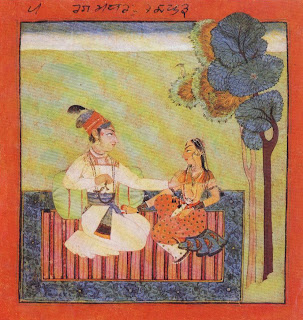
The Takri inscription in the border above this painting states it to be Madhu Ragaputra, a son of Bhairava Raga. According to Kshemakarna, whose verse 20 describes the personification of the melody, the protagonist is a handsome and knowledgeable man dressed in red garments. In contrast, however, most Pahari representations of the melody, including the present example, show a hero fondling his beloved's breasts. Alternatively, the couple are depicted as drinking, with or without-a female attendant.

This Chamba painting of about 1715 exhibits strong stylistic influence from contemporary Basohli works. Figural and facial types are similar, and coloration schemes of deep intense hues and monochromatic backgrounds are analogous. In contrast, in contemporary Chamba painting figures are generally somewhat less stylized, drapery and fauna conventions differ, the palette is generally more subdued, and small sections of beetle thorax casing arc never used for decoration as they are in the Basohli tradition. The Ragamala set of which this painting was once a part originally belonged to the Chamba royal family. It is now in the Bhuri Singh Museum of Chamba except for some twelve dispersed pages. At least three other Ragamala sets, all later than that of the present work, were also painted by the Chamba ateliers.

Writer Name:- Pratapaditya Pal

Folio from a Baramasa Series: Krishna and Radha on a Terrace

Posted by Art Of Legend India [dot] Com On 12:29 AM 0 comments
Folio from a Baramasa Series: Krishna and Radha on a Terrace
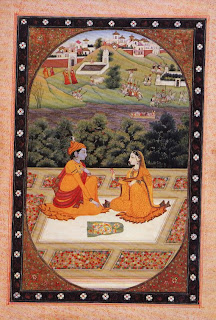
According to the text on its reverse (see Appendix), this painting is an illustration from a Baramasa (The twelve months) series of the month of Chaitra (March-April), which is the first month of the traditional Indian calendar. The verses describe the splendor of the blossoming spring landscape and the sexually exhilarating effect of the season on peacocks and maidens. The painting depicts Krishna sitting on a garden terrace with Radha, who is trying to persuade the blue-skinned lord to stay with her rather than go traveling during the month. In the background of the painting are a landscape) and a river that is rendered with fine, parallel lines reminiscent of Western engraving techniques. There is also a town, temple tank, and walled compound, as well as numerous inhabitants portrayed in an impressionistic manner. A mid-nineteenth-century date for the painting is suggested by the background features as well as the figural and clothing style of Krishna and the distinctive zigzag hemline of Radha's garment (cf. Leach, p. 301, no. 129).

The Baramasa literature of medieval northern India consists of various cycles of oral and written celebrations of the seasonal varieties of the behavior and feelings of lovers over the course of the twelve lunar months of the year. Verses devoted to the twelve months survive from at least as far back as the twelfth century and were particularly popular during the fourteenth through sixteenth centuries in Bengal, Gujarat, and Rajasthan (Vaudeville). Ancient Sanskrit verses glorifying the seasons exist, such as the Ritusamhara (Collection of the seasons) by the great poet and playwright Kalidasa (c. 365-c. 455), but these are specifically concerned with the traditional six Indian seasons of spring, summer, the rains, autumn, winter, and the cool season rather than with the twelve months of the year. The majority of Baramasa verses composed primarily of village women's folk songs or literary poems written in the various regional vernacular languages emphasize the pain of a young wife's separation from her beloved. Descriptions of the different seasons are paired with diverse feelings of longing to evoke the individual mood of each month. Greater emphasis is given to the four months of the rainy season (June through September) than to the remainder of the year, and a select grouping of songs and poems, the Caumasa (Four months), even evolved to celebrate the especially emotive rainy season, which is traditionally connected with the laments of lovers in separation.

Among the best known of the poetic expressions of the Baramasa are those contained in the tenth chapter of the Kavipriya (The poet's breviary), a work on rhetoric written in 1601 by Kesavadas for his patron Indrajit Shah's favorite courtesan, Pravinaraye. The Baramasa verses in the Kavipriya describe the monthly climates and activities of Indian life and relate them to the joys and sorrows of lovers. It was these poems by Kesavadas, rather than the village Baramasa folk songs, that were favored and illustrated by Pahari painters.

Writer Name: - Pratapaditya Pal
Folio from a Manuscript of the Satsai of Bihari Lal: Krishna Talks to Radha's Maidservant
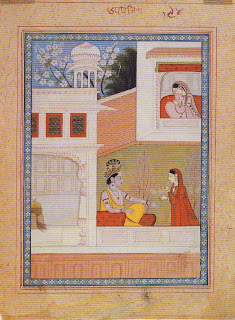
This painting depicts Krishna seated in a palace courtyard talking to a handmaid of Radha, who is shown beyond them in a bedchamber. Behind Krishna is a room with a large brass pot heating over a fire. A label in the upper border identifies the scene as "Upapati! Paramour! no. 194," and the text on the reverse of the painting (see Appendix) describes the demure eye contact of the divine lovers and mentions the fire in both the hearth and Krishna's heart.

The painting is thought to illustrate a passage from the Satsai (Seven hundred I verses!), one of the four great jewels of Hindi literature. Intriguingly, however, the inscribed verse does not correspond to the one given in the standard edition of the Satsai, which varies from other known versions of the text in the number and content of the verses (Holland, PP- 4-5).

The standard Salsa; consists 01 713 poetic verses, primarily in celebration of the romance of Radha and Krishna. The remaining verses describe nayakas and nayikas and the romantic sentiments associated with the six seasons of the Indian climate (sec no. 30). It was written by Bihari Lal Chaube (1595-1664), who was born in Govindpur, near Gwalior in Madhya Pradesh, into the mixed caste of Rays, which also produced several other well-known Hindi poets (Randhawa 1966, p. 15). As a child Bihari Lal moved with his family to Orchha and later to Mathura. It was in the latter city that Bihari Lal must have learnt "Braj-Bhasha," the dialect of Hindi in which the Satsai is written and which was current around Mathura, the homeland of Krishna, and was frequently used for the deity's devotional poetry and song lyrics. Bihari Lal enjoyed a profitable tenure at the court of Amber under jai Singh I (r. 1625-67), for whom the Satsai was reportedly composed in 1662 (Grierson, pp. 4-5; and Leach, p. 271). Illustrations of the Satsai were particularly popular in Pahari painting, especially in Kangra during the reign of Sansar Chand (r. 1775-1823), under whose lavish patronage this work was produced.

Stylistically, this painting is a good example of the refined almost overly so expression found in Kangra painting. The soft palette and delicate ambience are the hallmark of the realm's workshops and are particularly adept at conveying the romantic connotations of the popular theme of love.

Writer Name: - Pratapaditya Pal

Heroine Braving a Stormy Night to Meet Her Lover

Posted by Art Of Legend India [dot] Com On 12:06 AM 0 comments
Heroine Braving a Stormy Night to Meet Her Lover
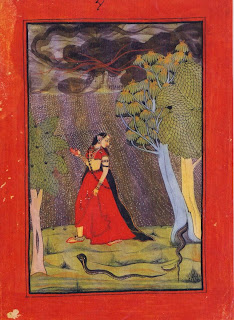
The heroine of this painting represents the type who braves a fierce night storm in order to keep her rendezvous with her lover (abhisarika). Steadfast in her determination and quest, the heroine is heedless of the danger of the raging storm's lightning and blinding rain. She ignores the cobras slithering by her feet as well as the loss of gold ornaments in her haste. Indeed, her ardor burns like an ascetic's penanc9 In the Rasikapriya, Kesavadas tells of the wives of the goblins of the forest commonly represented in paintings of this type but oddly absent here who ask the heroine, "Whence have you learnt this yoga? Oh Abhisarika, how marvellous this trysting!". The imagery of the impetuous heroine in theft storm was the most popular of all the nayikas to be portrayed in the painting of the Panjab Hills. It is conceptually related to the theme of Sohni braving the river's raging currents to meet her lover Mahinwal.

A mixture of styles is present in this painting. The figure follows Garhwal conventions and, in fact, is based on earlier Garhwal nayikas from about 1770-8o. In contrast, the landscape and sky are more akin to Kulu pictorial traditions in their treatment and palette. This stylistic plurality apparently caused even a leading scholar of Pahari painting, Karl Khandalavala, to attribute it to an "unidentified" workshop. Pigment analysis and a technical examination support a date in the early nineteenth century for the painting, so the possibility of a modern stylistic pastiche can be ruled out.

The most likely solution to the question of the painting's origin, suggested by Roy Craven (personal communication) and followed here, is that it was executed by the well-known poet and painter of Garhwal, Mola Ram, whose literary skills are generally considered to have exceeded his pictorial ones. Indeed, certain details, such as the distinctive earring, exaggerated curve of the bangles, treatment of the storm clouds, and the lackluster draftsmanship of the figure, all accord with Mola Ram's known works.

Writer Name:- Pratapaditya Pal

Jilted Heroine in Moonlight

Posted by Art Of Legend India [dot] Com On 10:52 PM 1 comments
Jilted Heroine in Moonlight
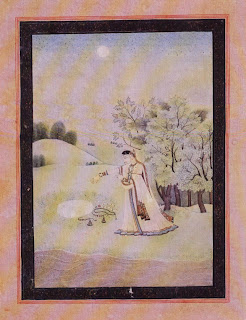
This ethereal painting portrays a disappointed heroine who has gone in vain to rendezvous with her lover for a tryst in a forest clearing at night under a full moon. The frustrated paramour waits by an unused bed of leaves and throws her jewelry to the ground in anger over being jilted. Her distress has inflamed her sensitivity. As the poet Kesavadas says in his, Rasikapriya, "the moon-rays burn her body as though with fever, . . . every jewel burns like a firebrand".

The subdued palette used to express the moonlit scene aptly conveys the cool, dreamlike luminosity of such a night. The use of shimmering moonlight was particularly favored in Guler painting of the period and, along with the mannered figure type and landscape features, was especially effective in conveying the underlying romantic mood of the genre.

The personifications of love play, nayikas (female lovers) and nayakas (male lovers), were especially favored in the painting of Kangra and those Pahari ateliers heavily influenced by the Kangra idiom: Guler, Garhwal, Nurpur, and Mandi in its later phases. Paintings depicting the individual types of female lovers, such as the present example, she who has made an appointment and is disappointed (labdhavipra), were frequently produced in sets. These sets and the majority of devotional literature often emphasized the theme and ethos of unrequited love, which was expressed through the many varieties and nuances of lovers in separation. In addition to portrayals of forlorn nayikas, the Guler artists also depicted various other love-sick couples including Sohni and Mahinwal as well as Sassi and Punnu.

Writer Name:- Pratapaditya Pal

Krishna and Radha Enjoying a Feast and Fireworks

Posted by Art Of Legend India [dot] Com On 10:27 PM 0 comments
Krishna and Radha Enjoying a Feast and Fireworks
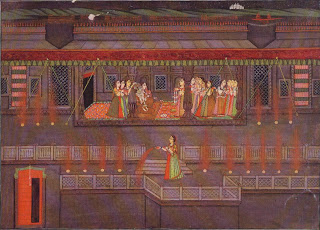
This painting presents Krishna and Radha in a Mughal-style palace pavilion enjoying a feast and night fireworks. In addition to the sparklers in the foreground, the numerous flames along the roofline and those outlining the five palaces rising out of the lake in the background suggest that the scene is taking place during the popular Dipwali Festival of Lights. A song verse inscribed on the back of the painting describes the feast and the participants, but fails to mention the reason for the festivities (see Appendix).

The chronology of Kishangarh painting is controversial, but it is generally considered to have begun by about 1700 with an emphasis on secular portraits. The production of the atelier flourished between about 1735 and about 1770, during which time images of Radha and Krishna were the favorite theme. The leading artist of Kishangarh, Nihal Chand, is known from inscriptional and archival evidence to have worked from at least 1757 to 1773. His son, Sitaram, continued to paint in his father's dramatically stylized manner (see Leach, pp. 185-88, no. 71). A less inspired, stereotyped version of Nihal Chand's style was continued into the early nineteenth century by the succeeding artists, of the Kishangarh workshop. The shorter figures, schematic landscape, and awkward treatment of the architecture in this painting suggest a date of execution during this late phase.

Writer Name:- Pratapaditya Pal

Company Overview

Art of Legend India has the distinction of being one of the best in the Indian Handicraft Industry. We are about 75 years old handicrafts manufacturer & exporter. We are having team of more than 500 craftsman.

We are having our business offices in India, USA & Germany to ensure our best services.

Total Pageviews