Punyaki Ragini
On the reverse of this painting are
inscribed in the Takri and Devanagari scripts, respectively, Punyaki Ragini and
Purvi Ragini. Analysis of the painting's iconography resolves the disparity and
corroborates the former identification. Both inscriptions label it correctly as
the wife of Bhairava Raga, number 4. Punyaki Ragini is a wife of Bhairava Raga
according to the Kshemakarna system, in which the melody is compared to the
.sound of rushing water. The term punya means the earning of religious merit
through charity. Consequently, as Indian religious ceremonies often involve the
pouring of consecrated water over a holy man's hands, representations of
Punyaki Ragini frequently portray the ablution of a mendicant's hands by the
lady of a house or palace.
This illustration of Punyaki Ragini
differs in that the lady is shown giving alms in the form of coins to a Saiva
mendicant rather than pouring water over his hands. Nevertheless, the
underlying rationale is the same, as it is still a meritorious act that is
being stressed in the painting. Indeed, other iconographic variations are
known, including the offering to the mendicant of a piece of jewelry or even a
sheaf of barley.
Ragamalas were a particularly popular
subject in Bilaspur painting between 1650 and 1780, a period coinciding with
the political and cultural zenith of the court. At least twenty-one Ragamala
sets were produced by the workshops of Bilaspur. Out of these sets, two other
representations of Punyaki Ragini are known to have survived: one from about
1690-95 and the other from about 1750. The three examples differ somewhat in
composition and expression, with the example of about 1690-95 and the present
painting being the closest in style. A number of Bilaspur stylistic features
are common to these two paintings, including a long spiraling lock of hair in
place of a sideburn for the mendicants, somewhat short figures, substantial
depictions of brickwork, and a distinctive, sultry palette.
Harsha Ragaputra
 In the upper border are rather indistinct
Takri and Devanagari inscriptions that both identify the painting as Harsha
Ragaputra, a son of Bhairava Raga. Kshemakarna's classification likens the
melody to the sound of running water and pictures the hero as an impetuous,
fair-skinned adolescent wearing a blue garment and a pearl necklace. The name
Harsha means rapture, especially that of a sexual nature. Pahari paintings of
the melody apparently take their inspiration from the description of the
personified hero and the lustful connotations of the name. They typically
portray the young hero seated or standing with a woman, usually in a bedchamber.
Often the couple are shown enjoying betel nut.
In the upper border are rather indistinct
Takri and Devanagari inscriptions that both identify the painting as Harsha
Ragaputra, a son of Bhairava Raga. Kshemakarna's classification likens the
melody to the sound of running water and pictures the hero as an impetuous,
fair-skinned adolescent wearing a blue garment and a pearl necklace. The name
Harsha means rapture, especially that of a sexual nature. Pahari paintings of
the melody apparently take their inspiration from the description of the
personified hero and the lustful connotations of the name. They typically
portray the young hero seated or standing with a woman, usually in a bedchamber.
Often the couple are shown enjoying betel nut.
This representation of Harsha Ragaputra
generally accords with the above iconographic description. A hero and heroine
are seated in a pavilion bedchamber. He wears a long strand of pearls and
rubies over his shoulder and a blue-striped purple garment, thus basically
agreeing with his prescribed adornment and garb. In place of sharing betel-nut
delicacies, however, the couple is shown gesticulating dramatically, and each
figure inexplicably holds a handkerchief. Another unusual feature of this
painting and the series to which it belongs, common to "only a few early
Pahari ragamalas", is that within the set the colors of the borders and
the backgrounds are coordinated for each raga's family. Hence, for this series
of the Bhairava family the borders are yellow and within them the backgrounds
are flaming orange.
This painting is from an important
Basohli series known generally as the Tandan Ragamala after the name of the
author who first published it. The set once belonged to the family of the
former court astrologer of Basohli. With sixty-five extant folios, it is the
most extensive of the early Pahari Ragamalas known to have survived. The
paintings were executed during the reign of Dhiraj Pal, who was a scholar and
patron of the arts. It has been dated to about 1700 by Tandan and to about
1707-15 by Khandalavala, either of which would place it in the middle of the
four other known Basohli Ragamalas ranging in date from about 1675 to about
1720. Stylistically, the present painting exhibits a number of characteristic
Basohli motifs and features. The most significant of these are the brilliant
palette, the distinctive elongated facial types with sloped foreheads, the
single tall cypress tree, the presence of small sections of iridescent beetle
thorax casing used to imitate emeralds, and the distinctive bejeweled golden
pendant worn by the hero, which is found only in Basohli portraits.
Madhu Ragaputra
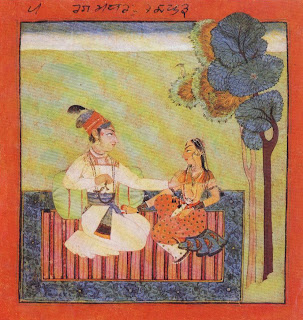
The Takri inscription in the border above
this painting states it to be Madhu Ragaputra, a son of Bhairava Raga.
According to Kshemakarna, whose verse 20 describes the personification of the
melody, the protagonist is a handsome and knowledgeable man dressed in red
garments. In contrast, however, most Pahari representations of the melody,
including the present example, show a hero fondling his beloved's breasts.
Alternatively, the couple are depicted as drinking, with or without-a female
attendant.
This Chamba painting of about 1715 exhibits
strong stylistic influence from contemporary Basohli works. Figural and facial
types are similar, and coloration schemes of deep intense hues and
monochromatic backgrounds are analogous. In contrast, in contemporary Chamba
painting figures are generally somewhat less stylized, drapery and fauna
conventions differ, the palette is generally more subdued, and small sections
of beetle thorax casing arc never used for decoration as they are in the
Basohli tradition. The Ragamala set of which this painting was once a part
originally belonged to the Chamba royal family. It is now in the Bhuri Singh
Museum of Chamba except for some twelve dispersed pages. At least three other
Ragamala sets, all later than that of the present work, were also painted by
the Chamba ateliers.
Writer
Name:- Pratapaditya Pal