ArtofLegendIndia.com, Biggest Online Store of Handicrafts Items, Paintings and Jewelry Accessories...

Handicrafts

Handicrafts are devices or works of art that are made completely by hand or by the use of relatively simple tools. Such goods are usually made in the traditional way of manufacturing goods. Therefore, the knowledge of the art of craft is usually passed down from one generation to another. The items made using these traditional methods of manufacturing are usually produced in smaller quantities and they often represent the culture or religious beliefs of the community that makes them. The goods are also handmade from natural materials that are found in the environment of the particular economy.

Read More!

Biggest Online Store of Handicrafts Items

Paintings

A painting is equal to thousand words, means a beautiful painting is equal to million of words. Paintings are one of the oldest art forms -- throughout history artists have played an important role in documenting social movements, spiritual beliefs and general life and culture.

History Of Paintings: The history of painting reaches back in time to artifacts from...

Read More!

Biggest Online Store of Unique Style Paintings
Showing posts with label Indian Painting. Show all posts

Embrace of Shiva

Posted by Art Of Legend India [dot] Com On 12:02 AM 0 comments
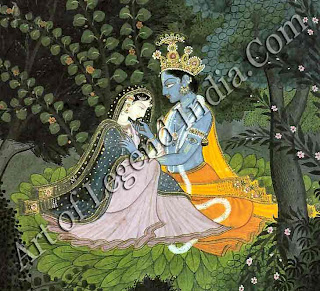
lying on a leopard skin with his beloved, Uma-Parvati; Pahari painting.

Cosmic Couple

Kama, lord of desire, catalyst of all creative processes, was reborn the moment Parvati embraced Shiva. She softened the stern hermit with sweet words; her smile stirred love in his austere heart. The twang of the love-god's bow and the fragrance of spring filled the air. Everyone cheered this divine union.

Parvati made Kailas her home, close to lake Manasarovar. Its snowy peaks served as her courtyard, its caves became her mansion. There she domesticated Shiva, turned him into a householder, much to the satisfaction of the gods. In the chilly waters of Manasarovar, amidst the blooming lotuses and the beautiful swans, she sported with him. On its shores they danced and sang, captivating the attention of forest spirits and divine beings. The two complemented each other perfectly. She was gentle and graceful; he was wild and forceful. Her subtle lasya tempered his energetic tandav and created perfect harmony, encapsulating the vibrations of the universe, capturing the music of the spheres.

On the hill slopes she conversed with Shiva. She asked him questions about the cosmos, about Nature, about society, life and marriage. Each time he replied, she asked him a thousand other questions. Skillfully Parvati enticed Shiva into the ways of the world, arousing his concern for society. Thus his great wisdom, acquired through aeons of meditating and brooding, was revealed for the good of the cosmos.

Parvati was the perfect student, Shiva the perfect teacher. Ultimately the world was enriched by these sacred conversations; through them was revealed the secrets of the Vedas, the splendours of the Shaastras and the mysteries of the Tantras.

Shiva and Parvati in conversation; Central Indian bronze.With Parvati by his side, Shiva made a declaration: "Let it be known, no worship or sacrifice will be accepted by the gods until a man has his wife by his side." And so it is that no yagna or puja is conducted without the wife sitting to the left of the husband. Since then the wife is called vamangi, she-who-sits-to-the-left.

He said, "He who escapes from life's joys and sorrows, rather than dealing with them, is a fool. He is running away from the Truth."

She said, "He who is obsessed with the pleasures and pains of life, unable to look at the serenity beyond them, is a fool. Even he is running away from the Truth."

They said, "Truth lies in harmony, harmony between matter and spirit, between the body, mind and soul, between the individual and society, between society and Nature, in purusha and prakriti."

Above the Clouds

Shiva and Parvati travelled across the cosmos on the bull Nandi. In winter, they wrapped themselves with soft tiger skins to keep out the cold. In summer, they sought refuge from the harsh glare of the sun in the shade of trees. And when dark rain-bearing clouds made their way towards the mountains, Shiva took Parvati in his arms and carried her above the clouds, above the rain.

Parvati was pleased with Shiva. She gave him a new name, jimutavahana, he-who-rides-the-clouds.

Shiva's Dance

Shiva as urdhva-nataraja; South Indian mural. Parvati's beauty inspired Shiva to create music and dance. From his melodious voice came the musical notes and tunes that enchanted the entire cosmos. He created the various dance elements gait, gestures, expression and posture that best expressed human emotion. Shiva became lord of the arts, Kaleshvar.

One day, as Shiva danced, Parvati said, "Whatever he can do, I can do beter." She imitated all his movements and her performance won the praise of the gods. But then Shiva raised one of his legs and took the pose known as urdhva-nataraja. Parvati refused to take this stance which she felt outraged feminine modesty.

Shiva brust out laughing and Parvati realised that he was just teasing her.

Game of Dice

Shiva and Parvati often played dice atop Mount Kailas.

Once, to make the game more exciting, Shiva offered to wager his trident, if Parvati wagered her jewels. She did, but he lost. Then Shiva wagered his serpent, he lost that too. Soon he had lost everything he possessed: his skull-bowl, his rudraksha beads, his ash, his drum, his smoking pipe . . . and finally even his loin cloth.

Humiliated by this defeat, Shiva went into the deodar forest. Vishnu, feeling sorry for Shiva, offered to help him out. "Play another game. This time I promise you will win," he told Shiva.

And that was exactly what happened. Shiva won back all that he had lost in earlier games, even the loin cloth.
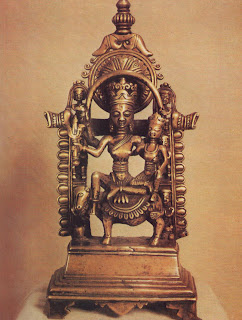
Uma-Maheshvar riding across the cosmos on the Nandi bull; Bronze image from Himachal Pradesh.Parvati, suspicious of Shiva's sudden success, called him a cheat. Shiva, outraged by the accusation, demanded an apology. Words were exchanged, insults were hurled . . .

To pacify them both, Vishnu appeared on the scene and revealed to Parvati the secret of Shiva's victories. "My spirit entered the die. The dice moved not according to your moves but according to my wish. So neither has Shiva really won nor have you really lost. The game was an illusion; your quarrel a product of delusion."

On hearing Vishnu, Parvati and Shiva realised that life was like their game of dice totally unpredictable and beyond control. They said, "Let the gods bless all those who play dice on this day and realise this cosmic truth." That day is Diwali, the festival of lights.

Annapoorna

Shiva once told Parvati, "The world is an illusion. Nature is an illusion. Matter is just a mirage, here one moment, gone the next. Even food is just maya."

Parvati, mother of all material things including food, lost her temper. "If I am just an illusion, let's see how you and the rest of the world get along without me," she said and disappeared from the world.

The disappearance of Parvati caused havoc in the cosmos. Time stood still, seasons did not change, the earth became barren ... there was a terrible drought. There was no food to be found anywhere in the three worlds. Gods, demons and humans suffered the pangs of hunger. They wept like children who seek their mothers. "Salvation makes no sense to an empty stomach," cried the sages.

Shiva and Parvati playing dice; Pahari painting.News reached Shiva that Parvati had reappeared at Kashi and had set up a kitchen there for the benefit of the world. He ran there as fast as he could, along with every other hungry creature in the world. As he presented his bowl to her he said, "Now I realise that the material world, like the spirit, cannot be dismissed as an illusion."
Parvati smiled and fed Shiva with her own hands.

Since then Parvati has come to be known as Annapoorna, the goddess of food. The image of her serving food to her hermit-husband Train worshipped at Kashi, Varanasi, in Uttar Pradesh. It is said she does not eat a morsel unless all her devotees have been fed.

The Tribal Woman

Shiva once got bored of married life. He went into the deodar forest to resume his austerities. Unable to bear this separation, Parvati followed him there. But Shiva took no notice of her.

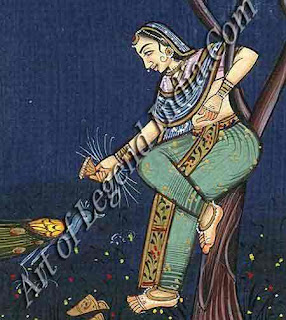
Parvati assisting Shiva put on his loin cloth; Pahari painting."What do I do now?" wondered Parvati. Vishnu whispered a solution in her ears. Accordingly Parvati dressed up like a tribal-woman, bright beads round her neck, peacock feathers in her hair. She sang and danced until Shiva could no more ignore her.

Distracted, he followed Parvati back to the romantic shores of lake Manasarovar. There, inspired by Parvati's beauty, he picked up his lute, the rudra-vina and created the most enchanting tunes ever heard in the cosmos.

Kali or Gauri

Once, as sunlight streamed into their cave, Shiva looked at Parvati and laughed. "You are so dark. You are Kali, the black one, black as coal, black as the night sky, black as a crow, black as the pit of death."

Hurt by Shiva's cruel words Parvati walked out of Kailas and moved into the deodar forest. There she performed rigorous tapas. By the strength of her austerities she shed her dark colour, which it is said percolated into the river Kalindi. She became the radiant Gauri, as bright as a full moon and returned to Kailas.

Parvati, as mother of the world and source of life, is called Gauri, bright and radiant, full of hope. But when she becomes death, the final devourer of all things, she is called Kali, the dark one from whom there is no escape.

Adi's Embrace

Annapoorna-Parvati serving her hermit-husband, Shiva, food at Kashi, Benares.Shiva never brought any gifts or food for Parvati. Sometimes he smoked narcotic drugs in his chilum and ignored her for days on end. Once, tired of his callous attitude, she ran into the deodar forest.

Taking advantage of her absence, a demon called Adi entered Kailas and walked right into Shiva's cave. The ganas did not stop him for he looked just like Parvati. The demon had used his magic powers to bring about this transformation.

Adi wanted to dupe Shiva. He was envious of the cosmic couple; he wanted to make a fool of the great lord, humiliate him, mock his love for Parvati, and perhaps even kill him at a vulnerable moment.

When Shiva saw his beloved entering the cave he was delighted. He rushed to greet her. But he soon divined the true identity and intention of this 'Parvati'.

Infuriated by this deception Shiva became Ashani, the thunderbolt. His love turned into rage, more terrible than lightning. He caught hold of Adi and sapped the demon's life with his embrace. The gods cheered the destruction of the demon.

Days passed. Parvati showed no sign of returning to Kailas. Her absence drove Shiva mad. He began to dance wildly. The heavens trembled and the earth shook. Cracks appeared on the foundations of the seas. Fearing the worst, the gods begged Parvati to restrain her husband. Only she had the power to do that.

Parvati returned to Kailas. As she walked up the hill singing songs of love, Shiva's dance of sorrow turned into the dance of joy.

The cosmos regained its balance, the world was safe and the gods were happy.

Parvati becomes a Fisherwoman
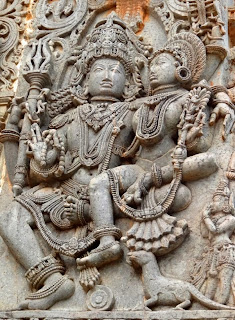
Shiva-Parvati, the cosmic couple ancient stone carving Shiva and Parvati often discussed the secrets of the universe. Together they explored the wonders of the cosmos.

But one day, as Shiva spoke to Parvati, he found her attention wavering. She was looking at the fish swimming in the lake Manasarovar. "If fish is more interesting than my words, I would rather you become a fisherwoman."

Parvati obeyed Shiva and instantly took birth as a fisherman's daughter. She grew up to be a strong and beautiful maiden. She oared her father's boat, mended his nets and cleaned all the fish he caught. He was proud of her; his only worry was to find a husband good enough for her.

Shiva meanwhile, regretted his harsh words. From Kailas he looked at Parvati running along the seashore and wondered how he could win her back. Manibhadra, Shiva's faithful gana, saw his master's plight. He decided to do something to reunite the lord with his beloved.

Taking the form of a huge shark, Manibhadra began terrorising the sea coast near Parvati's village. The fishermen didn't dare venture out into the sea. "It broke our boats and tore up our nets. We are lucky to return alive," said the men who survived its many attacks.

"He who captures the shark will marry my daughter," declared Parvati's fisherman father. Shiva immediately disguised himself as a young fisherman. Net in hand, he sailed into the sea and captured the shark with ease.

Shiva and Parvati were reunited. The fisherfolk celebrated their wedding in pomp and style.

Parvati and Shiva isolate themselves

Shiva crushing the demon Adi in his embrace;
"I don't understand," said Brahma looking at Shiva and Parvati, "At times they are the loving couple, locked in embrace for seveal aeons, happy to be with each other. Then, they fight, for as long and with the same intensity. What is this great mystery?"

Vishnu smiled. "You see the quarrels and the reconciliations between husband and wife. I see the interactions between the cosmic spirit, purusha, and the cosmic substance, prakriti. The relations of that divine couple reflect the ways of the world; it oscillates the universe into life."

Once Shiva and Parvati did not step out of their cave for a thousand years. Impatient to meet their lord, the seven cosmic sages, the sapta rishis, walked in without announcing themselves.

Parvati, who was caught unawares, was so embarrassed that she picked up a lotus and covered her face. The image of Parvati with a lotus over her face came to be known as Lajjagauri, the-shy-Parvati.

Irritated by this intrusion, Shiva and Parvati decided to isolate themselves. They moved far into the inaccessible caves of the Himalayas. Some say, it was the cave at Amarnath, Kashmir.

Here, away from all interruptions and distractions, they explored the limits of ecstasy. For the first time sensual pleasure, bhukti, became the tool of spiritual emancipation, mukti.

Arousal of Kundalini

Lajjagauri, the shy Parvati, with a lotus covering her face; Central Indian terracotta In isolation, Shiva and Parvati let loose their full potential. Shiva stood on the right as the fiery pingala. Parvati lay on the left as the frigid ida. By various physical postures, asanas, mental exercises, dhyana and breath control, pranayama, they balanced each other's energy until they were both in perfect harmony, in a state of sushumna.

Parvati was like a coiled serpent, kundalini, forming the base of the sushumna passage, seeking union with Shiva. To that end, she began arousing herself with the five makara tools: Bold diagrams, mandalas, appeared before her eyes. The sound of chants, mantras, filled her ears. On her tongue was the rich taste of spiced meat, mansa. Her nose was filled with the overwhelming scent of perfumes and alcohol, madya. Her skin was stretched and awakened by many positions, mudra. She was soon ready to rise.

Shiva waited for her at the other end of the cosmos, at the complementary pole of existence. While her senses were being excited, he stood beyond sensual stimulations.

They were two extremes of the cosmos she was water, he was fire; she was matter, he was the spirit; she was the flesh, he was the soul; she was the senses, he was the consciousness. She was in a state of agitation, he was calm; she was Shakti, all the manifestations of energy, he was Shiva, pure, unadulterated by any form or shape.

He was Bhava, the eternal being; she was Bhavani, the eternal transformation. They were ready to become one.
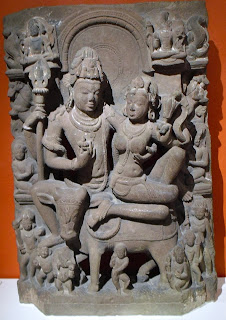
Uma-Maheshwar; stone carving from Karnataka.
Parvati uncoiled herself and rose through the sushumna, the very axis of existence. She was like a dart, let loose by a strong bow. Her rise was spectacular: she pierced six great cosmic nodes to reach her lord, it was the great shat-chakra-bheda. She pierced the centres of fear, desire, hunger, emotion, communication, introspection located in the body. These were the six chakras which govern life: Muladhar, Svadhistana, Manipur, Anahata, Vishuddha and Ajna.

As she pierced them, they bloomed like flowers, reaching their full potential. She rose beyond the needs and demands of her physical existence. She crossed every level of being and then joined her lord, the pure cosmic consciousness, in the form of the thousand petaled lotus, the Saharsrapadma. He was the seed, the jewel, mani, that she enclosed within her petals, padma.

Together they returned to the time between creation, Om, and destruction, Hum. In that state of dissolution, laya, beyond all opposites, there was just perfect bliss. Man and woman became one, ardhanaranari, as the lotus of matter enclosed the seed of the spirit.

Om Mani Padamane Hum

Writer Name: Devdutt Pattanaik

Mughal Emperor Sixteenth to Eighteenth Century A.D.

Posted by Art Of Legend India [dot] Com On 3:58 AM 0 comments
Jahangir Enthroned on an Hourglass
To understand this school in its proper perspective, the traditions in which it has its roots should be considered. The source of Mughal painting was Persian. The art of Persia was greatly influenced by Mongolian art. The art of Central Asia is almost reflected in pre-Timurid and Timurid art. It is this blend of the art of Chinese Turkistan and Persia that travelled to India and in ideal surroundings softened and mellowed, acquired the best elements of the indigenous traditions in the country and flowered into a great and noble art, which has its own distinctive character not only as a great court art but also as a distinct development closely associated with the land where it blossomed.

Mughal painting is distinctive but Indian. It has the flavour of the Persian but the inborn charm of Indian tradition. Babar, the fifth descendant from Timur, was aware of the great and remarkable ability of Bihzad, the famous artist of his time; but engaged as he was in the establishment of his kingdom, having proved unsuccessful in his attempt at securing Kandahar, the old capital of his ancestors, and turning his eyes from Kabul to India to secure at least an eastern expansion from his little rocky kingdom, he could not devote that attention to art which his son Humayun could. That painting flourished in his time is clearly seen from the Alwar manuscript of the Persian version of his Memoirs where the illustrations show the style of painting during his day.

 A mughal princess Humayun's misfortunes drove him to Persia as an exile and Sher Shah's triumph saw Humayun looking for refuge with Shah Tahmasp of Persia. This was indeed a godsend for the artistic inclination of Humayun, as the Shah was a great patron of art, and among his court painters were Bihzad, Mirak and others.

Akbar, who was very young when he succeeded his father, was an illiterate but possessed a rare flair for appreciation of learning and art, and probably was more alert with his ears and eyes than any scholar or connoisseur of his time. He had an enormous passion for learning and built up a marvellous library of Arabic, Persian and Sanskrit books. He had the famous books from these languages translated into others and learnt by listening more than by studies. Having been himself an artist in his youth, Akbar zealously patronised art and held the view that the artist who drew with accuracy could only realise the superiority of the Creator who could even infuse life into the objects that the artist could just draw so faithfully. Akbar was equally at home in all the fine arts, and painting flourished at his court. The Akbar Nama, the Razm Nona and other works were profusely illustrated at his command. The Persian artists who flocked to his court taught the new technique to the Indian artists and themselves benefited by absorbing the best elements of indigenous traditions, with the result that a rare blend of a wonderful new school came into existence. The names of Manohar, Farukchela, Basawan and Madhu, to mention a few, were famous during Akbar's days.

The surpriseThe story of Mughal painting in India may be said to have begun with Khwaja Abdus Samad of Shiraz who was patronised by Humayun and continued in the time of Akbar. Daswant, the poor son of a palanquin-bearer whom the emperor Akbar discovered and apprenticed to Abdus Samad, is a symbol of other Hindu artists who practised the Persian way and created a new efflorescence of art. Another great name at Akbar's court amongst the Hindu masters is Basawan. The practice of signing pictures in this period of art history gives us names of artists at Akbar's court of which a large number is given in the Ain-e-Akbari like Mukund, Madhu, Khemkaran, Harbans, Kesavlal and others. The illustrated Babar Nama, Akbar Nama, Hamza Nama, Razm Nama and other beautifully illustrated manuscripts of the period are a great artistic achievement. Still in this period, the Persian treatment of the background and the landscape is obvious, though slowly this influence, diminishes in the successive periods. The building of Fatehpur Sikri, the emperor's chase of wild animals and, particularly, the birth of his second son Murad at Fatehpur Sikri are splendid illustrations in which the Akbar Nama abounds.

Jehangir, who had an intelligent wife to manage state-craft, was left with sufficient leisure to enjoy wine and appreciate art. Probably this was the greatest period of the renaissance of Mughal art. He was a great patron and maintained a bevy of painters at his court. In his Memoirs he prides himself on his connoisseurship, how he could discriminate the work of one artist from that of another and single out the painting of any individual artist even to the point of distinguishing any touches added by a subsequent painter on an original by another. The emperor delighted in beautiful portraits of his and had groups painted of himself, his lovely queen and his family. Some of the most beautiful animal and flower patterns were drawn and painted during his day. Portraiture was so developed that there was a great element of realism during Jehangir's reign. Mansur and Bishandas amongst several others ranked as very famous painters of his day. Sir Thomas Roe has left anecdotes throwing light on the emperor's keen enthusiasm in portrait-painting. It is no wonder that the admirable portraits of this period evoked the appreciation of the great British painter, Sir Joshua Reynolds.

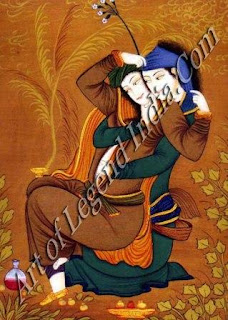
 Youthful Lovers Jehangir's son Shah Jahan was, though a connoisseur, more a builder of great monuments and a pattern of architecture. Painting flourished, no doubt, during his day, but its heyday was reached during the time of his father. The puritan Aurangzeb, who imprisoned his father Shah Jahan and came to the throne, could not probably provide encouragement to the art that he considered against the tenets of his religion, and the disappointed artists of the Mughal court had slowly to find a better atmosphere for survival elsewhere. Thus from this time onwards not only music was buried deep but art also was driven away to different homes and the provincial schools in Amritsar, Lahore, Lucknow, Oudh, Murshidabad, Golconda, and other places absorbed the painters of the Moghal court who were driven to seek a home elsewhere.

Mughal art, which started as an art of illustration and excelled in portraiture in the succeeding period, which was the best, became at last a rather weak expression of life around in pictorial terms. Starting with a strong Persian bias, it slowly assimilated a blend of the indigenous with an efflorescence in which the foreign flavour was finally eliminated almost completely.

No description of Mughal painting would be complete without a reference to the delicate treatment of birds, animals and plants which rank among some of the greatest masterpieces of this period.

Writer – C.Sivaramamurti

Introduction to Vakataka

Posted by Art Of Legend India [dot] Com On 4:00 AM 0 comments
The Vakatakas succeeded the Satavahanas in the Deccan. They were powerful rulers and had matrimonial alliances with the Bharasivas and the Guptas. The Vakatakas are first mentioned in inscriptions of the second century A.D. from Amaravati. They thus appear to have migrated from the Krishna valley and established a kingdom that grew slowly in the later centuries. The Vakataka ruler Pravarasena appears to have been not only highly literary but also a patron of art and beauty in all its forms. Some of the caves at Ajanta have inscriptions of the Vakataka period and can be definitely dated and attributed to the time of these rulers.

While the early caves show the earlier features of architecture of the Satavahana period, with typical pillars, facade decoration with railing and chaitya window pattern, etc., and with the uddesika stupa, devoid of any human representation of Buddha, when such anthropomorphic representation was considered disrespectful to the Master, the later caves have the more elaborate pillars and capitals of the Gupta-Vakataka period, the more developed chaitya window type and sculptural embellishment, with the uddesika stupa in the chailya, clearly showing the Master in human form on the sides.

The sculptures at Ajanta, especially in the later caves, show the high watermark of perfection during the age of the Vakatakas. There can be no better examples than these for a study of Vakataka art in the Deccan, coeval with Gupta art in the north. The paintings completely cover the walls, pillars and ceilings at Ajanta. They constitute a great gallery of Buddhist art illustrating scenes from the life of the Master, his previous lives comprising the jatakas and avadanas and floral and animal motifs. These last are cleverly woven into diverse designs of great originality.

From an inscription in Cave 16, it is learnt that it was dedicated to the monks by Varahadeva, the minister of the Vakataka king Harishena, in the latter half of the fifth century A.D. In Cave 26 there is another inscription which records the gift of the temple of Sugata by the monk Biddhabhadra, a friend of Bhaviraja, the minister of the king of Asmaka. Its date, paleographically, seems to be the same. A contemporary fragmentary inscription records the gift of the hall by Upendra in Cave 20. These inscriptions are all in the box-headed letters of the Vakatakas and help us to understand their date. The art here is thus of the Vakatakas, just as the earlier phase illustrates Satavahana art.

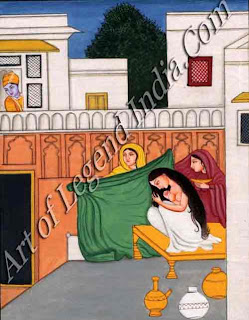
Choli Art
The mode of painting at Ajanta is the tempera and the materials used are very simple. The five colours usually described in all the silpa texts are found here red ochre, yellow ochre, lamp black, lapis lazuli and white. The first coating on the surface of the rock was of clay mixed with rice husk and gum. A coat of lime was applied over this, carefully smoothed and polished. On this ground the paintings were created. The outline drawing was in dark brown or black and subsequently colours were added. Effects of light and shade were achieved by the process of streaks and dots illustrating the methods of pat ravartana, stippling and hatching mentioned in the silpa texts. The lines composing the figures painted at Ajanta are sure, sinuous, rich in form and depth and recall the lines in praise of the effective line drawing in the Viddhasalabhanfika, api, laghu hkhiteyam drisyate purnamurtih, where by a few lines sketched, the maximum effect of form is produced. The masters at Ajanta have thus demonstrated the superiority of line drawing as given in the Vishudharrnottara, rekham prasamsantyacharyah, the masters praise effective line drawing as the highest in art.

The painter at Ajanta has studied life around him and natural scenes of great beauty with intense sympathy and appreciation. Plant and animal life has interested him considerably. He has lovingly treated such themes of flora and fauna as he has chosen to depict. The elephants under the banyan tree in Cave 10, the geese in the Hamsa Jataka from Cave 17, the dear in the Miga Jataka, also from the same cave, may be cited as a few examples of the tender approach of the painter to the themes of animals and birds. He has been equally at home in ably representing the dazzling magnificence of the royal court, the simplicity of rural life and the hermit's tranquil life amidst sylvan surroundings. The Vessantara Jataka illustrates the prince as the very picture of magnificence, as also the simplicity of the hermit and the poor Brahmin as an inexorable beggar. 

The scene in Cave 27 of prince Vessantara, with his consort, driving on the main road, depicting different merchants in pursuit of their trade, is a beautiful picture of economic life in ancient India. The landing in Ceylon is a splendid representation of royal glory in Cave 17. The interior of the palace giving a glimpse of the king and the queen in the harem or in the garden reveals that nothing was hidden from the gaze of the court painter. He could portray the charm of a close embrace, the arm entwining the neck in kanthaslesha or the sidelong glances of a loving damsel. The toilet of the princess is another example of a similar theme. Th imagination of the painter in portraying the celestials has probably no better examples to proclaim its eminence as the divine musicians floating in the air from Cave 17. 

Indian PaintingThe gay theme of dampati, or loving couples, has excellent examples at Ajanta. Of this a whole row is above the entrance doorway of Cave 17. The versatility of the Vakataka painter in creating diverse poses is here evident in the several seated dampatis. The artists could so elevate themselves mentally as to be able to depict magnificently such noble themes as Maraciharshana in Cave 1, Buddha's descent from heaven at Sankisa in Cave 17, and prince Siddhartha and Yasodhara in Cave 1, all magnificent representations of the Master in different attitudes. The long panels and borders from the ceilings of swans and birds, Vidyadhara couples, auspicious conches and lotuses as well as sinuous rhizomes and stalks, with lotuses in bud and bloom, and leaves covering large areas reveal the capacity of the artist to create diverse patterns of great artistic value.

The Vakataka traditions as seen at Ajanta are derived from the earlier Satavahana. This can be clearly seen in several echoes of the painted figures here from those of Amaravati. It is mainly the decorative element, chiefly composed of pearls and ribbons, so characteristic of the Gupta-Vakataka age that distinguishes them from the simpler but nobler art of the Satavahanas.

The Vakataka traditions continued in later sculpture. This can be seen in figures in identical poses found at Mahabalipuram inspired by those at Ajanta which them-selves in turn recall the earlier ones from Amaravati. The identical twist of the right leg put forward in exactly the same pose as at Ajanta and at Mahabalipuram cannot be a chance coincidence. The beautiful paintings in colour at Ajanta help us to conjecture and fully comprehend the glory of earlier Amaravati sculpture and the culture it represents. At Amaravati, the lack of colour precludes the comprehension of the rich jewellery, colourful gems, gay and glamorous drapery, rich furniture, imposing architecture and pageantry in the absence of colour.

Vasanta Ragini
There are excellent illustrations in these paintings at Ajanta of the six limbs of painting, shadanga, composed of rupabheda, variety of form, pramana, proper proportion, bhava, depiction of emotion, lavanya yojana, infusion of grace, sadrisya, likeness and varnikabhanga, mixing of colours to produce an effect of modelling. The diversity of form at Ajanta is indeed incredible. The painters here mastered the vast complex of human, animal and plant form in addition to giving free scope to their imagination and were creating designs galore. The master at Ajanta has control over not only the proportions of individual figures but also has the ability to group them and he has designed excellent compositions. Emotion is at its best in the narration of scenes from the legends; the grace in some of the figures bespeaks lavanyayojana. While figures are repeated as the Vessantara Jataka, the element of portraiture is clearly made manifest and sadrisya is very obvious. The painter's colour technique easily helps us to pay him a tribute for his capacity in varnikabhanga.

As a narrator of the legends, the painter as well as the sculptor at Ajanta has deviated from the normal course as in other monuments occasionally, but always the effect has been greater.

Irandati is shown on a swing in the Vibhurapandita lataka at Ajanta. This enhances the charm of the Naga princess, the desire to marry whom made the Yaksha Punnaka play the game of dice, win, and bring the wise Vidhurapandita to the palace of the Naga queen. It is thus here more beautiful than even at Bharhut or Amaravati or Borobudur.

The version of the Chhaddanta Jataka at Ajanta heightens the pathos by the noble act of the elephant who not only offered his tusks to the wicked hunter but also helped him even in pulling them out. But this is from the early Satavahana series in Cave 10 and probably the Vakataka painter followed this earlier tradition deviating from the normal representation for producing greater effect.

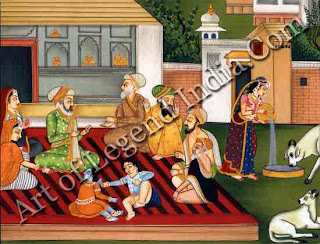
Scene of Gokul
The Hatnsa Jataka is probably more vivid at Ajanta in painting than even at Amaravati in sculpture.

But the detailed and touching story of the Sarna Jataka is probably nowhere better presented than here in the paintings at Ajanta. There is an elaboration here of the Vessantara Jataka which makes it probably the best narrative of this story excelling even that at Goli or at Sanchi.

The story of Mahakapi Jataka or Sarabhamiga Jataka is different from the stories usually chosen and depicted in other monuments. The Matiposaka Jataka is again elaborated here and is different from the simple single scene at Goli.

The Mahisha Jataka, represented at Borobudur, is a rare one in India and is found here. The Valahassa Jataka which is represented on a Kushana rail pillar is better elaborated at Ajanta following the Divyavadana story.

The Sibi Jataka at Ajanta presents a different version from the one of Kshemendra in the Avandana kalpalata, the source of which has inspired the scenes at Amaravati, Nagarjunakonda and other places.

Even in the scenes from Buddha's life, the master at Ajanta has excelled. The story of Nalagiri is probably more effectively presented at Ajanta than even at Amaravati Goli. The same is the case with the presentation of Rahula to Buddha which is a greater masterpiece at Ajanta than the one at Amaravati though probably the medallion in the British Museum can stand comparison with any depiction of this scene from any Buddhist monument in the world.

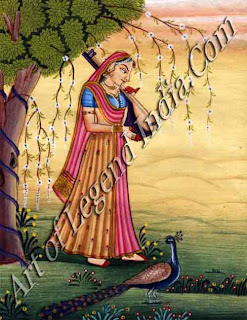
The Surprised Maiden
The descent of Buddha from heaven and the elaborate Maradharshana scene are unrivalled and probably form the greatest attraction in the scenes from Buddha's life from the Ajanta caves.

Cave 1 contains great masterpieces illustrating scenes from Buddha's life. A large panel shows prince Siddhartha and Yasodhara, another Bodhisattva Vajrapani, Maradharshana, the miracle of Sravasti and the story of Nanda.

The Master, seated under the Bodhi tree in the Maradharshana episode, is shown determined to be the enlightened one, unaffected by the temptation of Mara and his beautiful daughters, and unruffled though attacked and frightened by the mighty hosts of his opponents.

In the miracle of Sravasti, Buddha is shown simultaneously in innumerable forms before a large gathering headed by king Prasenajit. This was to confuse the heretics.

The story of Nanda gives how, converted, unwillingly, by Buddha, Nanda still longed for his tear-eyed beautiful wife, Sundari, who pined for him in her palace. The painting here gives a side picture of Sundari in grief. The jatakas in this cave include Sibi jataka, Samkhapala fataka, Mahajanaka Jataka and Champeyya fataka.

The first narrates how the Boddhisattva offered his own flesh to a hawk to protect a pigeon that it was after. The Samkhapala Jataka is the story of a Naga prince who patiently allowed himself to be worried by a troop of wicked men and rescued by a merciful passerby, gratefully took the latter and entertained him in his magnificent underground abode. The painting depicts both the happy situation of the Naga king and his gratitude to his benefactor.

The Mahajanaka fat aka depicts the story of Mahajanaka who married the princess Sivali and, in spite of her at-tempts to retain him in worldly pleasures, made up his mind to be an ascetic, resulting in Sivali following her husband's path.

Peepal Leaf Painting
The Champeyya Jataka is the story of the Bodhisattva, born as a Naga prince, Champeyya, who allowed himself to be caught by a snake-charmer and was rescued by his queen Sumana, by requesting the king of Banaras to inter-cede on her behalf.

Cave 2 contains a large-size painting of Bodhisattva, the dream of Maya and its interpretation, the descent from heaven, the birth and the seven steps. The jatakas depicted here are Hatnsa Jataka, Vidhurapandita jataka, Runt Jataka and Puma Avadana. There are fragments of painted inscriptions mentioning the donation of a thousand painted Buddhas as also some verses from the Kshanti jataka from the jatakantala.

The Hamsa jataka relates the story of the queen, Khema, who dreamt of a golden goose preaching the law. She prevailed on her husband the king to get the golden goose and his companion to be caught by a fowler and brought to her to give her a discourse on the law. The painting shows the golden goose enthroned and admonishing the queen. Earlier the capture of the bird by the fowler is shown. The lotus-lake, the abode of the golden goose, is picturesquely portrayed.

The Vidhurapandita jataka is the story of the Naga, queen, who desired to listen to the learned discourse of Vidhurapandita, the wise minister of the king Indraprastha. According to the story, the beautiful Naga princess Irandati was promised in marriage to whomsoever brought the heart of Vidhurapandita. The Yaksha Punnaka won Vidhurapandita as a stake, by defeating his royal master in a game of dice, brought him to the Naga queen, and thus won the hand of the Naga princess. The story is elaborately shown here presenting the beautiful princess Irandati on a swing, the game of dice, Vidhurapandita's discourse in the Naga palace and the happy union of Punnaka and Irandati.

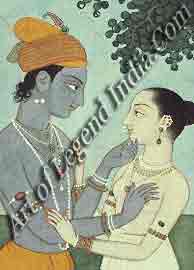
Radha and Krishna
The Runt Jataka is the story from the Divyavadana of the conversion of Puma by Buddha and the miraculous rescue of his brother, Bhavila.

The Kshanti Jataka is the story of a prince who was patience incarnate and put up with all the persecution he was subjected to by the King of Banaras.

Cave 16 is one of the most beautiful viharas of Ajanta. The inscription in this cave mentions it as dedicated by Varahadeva, the minister of the Vakataka king, Harishena, towards the end of the fifth century A.D. The picture given of this dwelling in this inscription that it was adorned with windows, doors, beautiful picture-galleries (vithis), carvings of celestial nymphs, ornamental pillars and stairs and a shrine chaityamandira, and a large reservoir and shrine of the lord of the Nagas is all borne out quite correctly.

The paintings here represent the story of Nanda, the miracle of Sravasti, Sujata's offering, the incident of Trapusha and Bhallika, the incident of the ploughing festival, the visit of Asita, the prince at school and the dream of Maya.

The story of Nanda relates to his conversion. When he returned to Kapilavastu, Buddha visited Nanda's mansion. He was then helping his beautiful wife Sundari at her toilet. Nanda rose to greet the Master, but Buddha gave him his begging bowl and bade him to follow him to the monastery. Here he was converted against his will. However, to make Nanda steadfast in his vows as a monk, Buddha showed him the most lovely nymphs in heaven, where he conducted him. These he promised him if he was true to monkhood. Nanda soon became a devoted monk, and realising the truth of religious life, no more thought of the heavenly damsels. The scenes here depict Nanda's conversion and his journey to heaven with Buddha to see the celestial nymphs. This is comparable to the sculptural presentation of the same theme at Nagarjunakonda. Among the jatakas painted in this cave are the Hasti Jataka, Mahaummagga Jataka and Sutasoma fat aka.

Radha and Krishna
The Hasti Jataka from the Jatakamala is the story of a noble elephant who killed himself by falling from a great height to feed a number of hungry travellers. The Mahaummagga Jataka is a very lengthy one from which an episode is chosen here for depiction. It is the riddle of the 'son'. Mahosada acted as a judge to settle a dispute between an ogress and the real mother of the child as both claimed the little one as their own. Mahosada asked them both to pull the child. He discovered the real mother in the one who readily gave in when she could not bear to see the child experiencing such severe pain on that account. Other riddles like that of the 'chariot' and of the 'cotton thread' from the same story are narrated further on.

The Sutasoma Jataka, also from the Jatakamala, narrates how a lioness was infatuated with a charming prince Sudasa who came hunting to the forest. She licked the feet of the sleeping prince and conceived a child. When born, this freak became a cannibal prince, but was finally converted into prince Sutasoma. The painting shows the lioness licking the feet of the somnolent prince.

As given in an inscription incised on the wall of the verandah, Cave 17 was excavated by a feudatory of the Vakataka king, Harishena. It has an elaborately carved doorway, with a fine floral design. The carvings of Ganga and Yamuna on the door-jambs are most pleasing.

Noteworthy among the paintings here are the seven earlier Buddhas, Vipasyi, Sikhi, Visvabhu, Krakuchchanda, Kanakamuni, Kasyapa and Sakyamuni as well as Maitreya, the Buddha. to come, the subjugation of Nalagiri, the descent at Sankisa, the miracle of Sravasti and the meeting of Rahula.

The jatakas represented here are the Chhaddanta jataka, Mahakapi Jataka I, Hasti jataka, Hamsa Jataka, Vessantara jataka, Mahakapi jataka II, Sutasoma jataka, Sarabhamiga Jataka, Machchha Jataka, Matiposaka Jataka, Sama jataka, Mahisha Jataka and the story of Simhala from Divyavadana with details from Valahassa jataka, Sibi jataka, Ruru jataka, and Nigrodamiga jataka.

Rajasthani Paintings
The Mahakapi jataka I narrates the story of the Bodhisattva, who was born as the leader of a troop of monkeys. Once, while tasting sweet mangoes on the banks of the river, the monkeys were suddenly attacked by the archers of Brahmadatta of Banaras. To save the animals, the Bodhisattva hurriedly stretched out a bamboo to form a bridge to help them cross over. Finding it, however, slightly short, he stretched his own body to complete the bridge. The king was touched by the noble spirit of the animal, honoured him greatly and listened to his discourse on dharina. The river, the orchard of trees laden with mangoes, the strange bridge and the sermon of the monkey are all painted.

The Vessantara jataka has for its theme the life of the noble prince who never stinted gifting anything begged of him. In fact, he gave away even the precious elephant, responsible for the prosperity of his realm, which caused him banishment from his own kingdom along with his wife and children. Finally, he gave away all that he had, including his chariot and horses and even his children and wife. The panels here show the banishment, Vessantara leaving the city in his chariot, his wife in the forest, his gift of his children to wicked Brahman Jujaka, the restoration of the children to their grandfather and the happy return of the prince and the princess.

The Mahakapi Jataka II recounts the tale of the monkey who rescued an ungrateful man from a deep pit. In spite of the latter's attempt to kill him, the monkey with a most magnanimous spirit, showed him the way out of the forest. The scenes depict the animal helping the man out of the pit and the ingratitude of the latter.

The Sarabhamiga Jataka gives the story of the king of Banaras helped out of a pit by a stag.

The Machchha Jataka narrates the legend of the Bodhisattva, who saved his kin from death by drought by making a solemn asseveration to bring down rain.

The Matiposhaka Jataka gives the story of the filial affection of the elephant who took care of his blind mother. Captured by the king of Banaras, he refused to touch food till the king, out of compassion, got him to return to his blind parent. The scenes painted depict the refusal of the elephant to touch food, his release and happy reunion with his mother.

The Mahisha Jataka is the story of the Bodhisattva, who patiently put up with the antics of a monkey.


The Simhala Avadana narrates the story of Simhala, who accompanied by several merchants, was shipwrecked on a strange island of demonesses, who in the guise of beautiful nymphs, lured those unfortunately stranded there and gobbled them up. The Bodhisattva, born as a horse, offered to rescue the shipwrecked merchants, but those who stayed behind were destroyed by the ogresses. One of the latter followed Simhala in the guise of a beautiful woman, with a child in her arms, and claimed his as her husband before the king, who, struck by her beauty, made her his queen despite the advice of his ministers. This resulted in the gradual annihilation of the palace folk that were devoured by the demonesses. Simhala drove them out, set out with an army to reach their island, defeated them and became the ruler there.

The Sibi Jataka gives the story of a king who gladly gave away his eyes to a blind Brahman at his request, little knowing that it was Sakra himself in disguise. The panel has a short inscription Sibiraja painted in Vakataka letters.

The Ruru Jataka gives the story of the capture of the deer to preach the law to the king.

The Nigrodhamiga Jataka is the story of the Bodhisattva born as a compassionate deer, who offered himself to be killed in place of a pregnant doe to feed the king of Banaras. The ruler was so touched by this act of kindness that he adored the animal and listened to his sermon on karuna.

Cave 19 has panels representing Buddha with his begging-bowl before his son Rahula and Yasodhara.


Writer- C. Sivaramamurti

Company Overview

Art of Legend India has the distinction of being one of the best in the Indian Handicraft Industry. We are about 75 years old handicrafts manufacturer & exporter. We are having team of more than 500 craftsman.

We are having our business offices in India, USA & Germany to ensure our best services.

Total Pageviews