ArtofLegendIndia.com, Biggest Online Store of Handicrafts Items, Paintings and Jewelry Accessories...

Handicrafts

Handicrafts are devices or works of art that are made completely by hand or by the use of relatively simple tools. Such goods are usually made in the traditional way of manufacturing goods. Therefore, the knowledge of the art of craft is usually passed down from one generation to another. The items made using these traditional methods of manufacturing are usually produced in smaller quantities and they often represent the culture or religious beliefs of the community that makes them. The goods are also handmade from natural materials that are found in the environment of the particular economy.

Read More!

Biggest Online Store of Handicrafts Items

Paintings

A painting is equal to thousand words, means a beautiful painting is equal to million of words. Paintings are one of the oldest art forms -- throughout history artists have played an important role in documenting social movements, spiritual beliefs and general life and culture.

History Of Paintings: The history of painting reaches back in time to artifacts from...

Read More!

Biggest Online Store of Unique Style Paintings
Showing posts with label Mughal paintings. Show all posts

Mughal Emperor Sixteenth to Eighteenth Century A.D.

Posted by Art Of Legend India [dot] Com On 3:58 AM 0 comments
Jahangir Enthroned on an Hourglass
To understand this school in its proper perspective, the traditions in which it has its roots should be considered. The source of Mughal painting was Persian. The art of Persia was greatly influenced by Mongolian art. The art of Central Asia is almost reflected in pre-Timurid and Timurid art. It is this blend of the art of Chinese Turkistan and Persia that travelled to India and in ideal surroundings softened and mellowed, acquired the best elements of the indigenous traditions in the country and flowered into a great and noble art, which has its own distinctive character not only as a great court art but also as a distinct development closely associated with the land where it blossomed.

Mughal painting is distinctive but Indian. It has the flavour of the Persian but the inborn charm of Indian tradition. Babar, the fifth descendant from Timur, was aware of the great and remarkable ability of Bihzad, the famous artist of his time; but engaged as he was in the establishment of his kingdom, having proved unsuccessful in his attempt at securing Kandahar, the old capital of his ancestors, and turning his eyes from Kabul to India to secure at least an eastern expansion from his little rocky kingdom, he could not devote that attention to art which his son Humayun could. That painting flourished in his time is clearly seen from the Alwar manuscript of the Persian version of his Memoirs where the illustrations show the style of painting during his day.
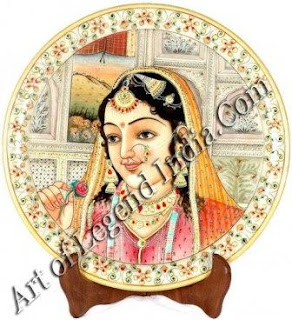
 A mughal princess Humayun's misfortunes drove him to Persia as an exile and Sher Shah's triumph saw Humayun looking for refuge with Shah Tahmasp of Persia. This was indeed a godsend for the artistic inclination of Humayun, as the Shah was a great patron of art, and among his court painters were Bihzad, Mirak and others.

Akbar, who was very young when he succeeded his father, was an illiterate but possessed a rare flair for appreciation of learning and art, and probably was more alert with his ears and eyes than any scholar or connoisseur of his time. He had an enormous passion for learning and built up a marvellous library of Arabic, Persian and Sanskrit books. He had the famous books from these languages translated into others and learnt by listening more than by studies. Having been himself an artist in his youth, Akbar zealously patronised art and held the view that the artist who drew with accuracy could only realise the superiority of the Creator who could even infuse life into the objects that the artist could just draw so faithfully. Akbar was equally at home in all the fine arts, and painting flourished at his court. The Akbar Nama, the Razm Nona and other works were profusely illustrated at his command. The Persian artists who flocked to his court taught the new technique to the Indian artists and themselves benefited by absorbing the best elements of indigenous traditions, with the result that a rare blend of a wonderful new school came into existence. The names of Manohar, Farukchela, Basawan and Madhu, to mention a few, were famous during Akbar's days.

The surpriseThe story of Mughal painting in India may be said to have begun with Khwaja Abdus Samad of Shiraz who was patronised by Humayun and continued in the time of Akbar. Daswant, the poor son of a palanquin-bearer whom the emperor Akbar discovered and apprenticed to Abdus Samad, is a symbol of other Hindu artists who practised the Persian way and created a new efflorescence of art. Another great name at Akbar's court amongst the Hindu masters is Basawan. The practice of signing pictures in this period of art history gives us names of artists at Akbar's court of which a large number is given in the Ain-e-Akbari like Mukund, Madhu, Khemkaran, Harbans, Kesavlal and others. The illustrated Babar Nama, Akbar Nama, Hamza Nama, Razm Nama and other beautifully illustrated manuscripts of the period are a great artistic achievement. Still in this period, the Persian treatment of the background and the landscape is obvious, though slowly this influence, diminishes in the successive periods. The building of Fatehpur Sikri, the emperor's chase of wild animals and, particularly, the birth of his second son Murad at Fatehpur Sikri are splendid illustrations in which the Akbar Nama abounds.

Jehangir, who had an intelligent wife to manage state-craft, was left with sufficient leisure to enjoy wine and appreciate art. Probably this was the greatest period of the renaissance of Mughal art. He was a great patron and maintained a bevy of painters at his court. In his Memoirs he prides himself on his connoisseurship, how he could discriminate the work of one artist from that of another and single out the painting of any individual artist even to the point of distinguishing any touches added by a subsequent painter on an original by another. The emperor delighted in beautiful portraits of his and had groups painted of himself, his lovely queen and his family. Some of the most beautiful animal and flower patterns were drawn and painted during his day. Portraiture was so developed that there was a great element of realism during Jehangir's reign. Mansur and Bishandas amongst several others ranked as very famous painters of his day. Sir Thomas Roe has left anecdotes throwing light on the emperor's keen enthusiasm in portrait-painting. It is no wonder that the admirable portraits of this period evoked the appreciation of the great British painter, Sir Joshua Reynolds.
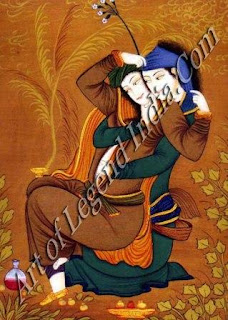
 Youthful Lovers Jehangir's son Shah Jahan was, though a connoisseur, more a builder of great monuments and a pattern of architecture. Painting flourished, no doubt, during his day, but its heyday was reached during the time of his father. The puritan Aurangzeb, who imprisoned his father Shah Jahan and came to the throne, could not probably provide encouragement to the art that he considered against the tenets of his religion, and the disappointed artists of the Mughal court had slowly to find a better atmosphere for survival elsewhere. Thus from this time onwards not only music was buried deep but art also was driven away to different homes and the provincial schools in Amritsar, Lahore, Lucknow, Oudh, Murshidabad, Golconda, and other places absorbed the painters of the Moghal court who were driven to seek a home elsewhere.

Mughal art, which started as an art of illustration and excelled in portraiture in the succeeding period, which was the best, became at last a rather weak expression of life around in pictorial terms. Starting with a strong Persian bias, it slowly assimilated a blend of the indigenous with an efflorescence in which the foreign flavour was finally eliminated almost completely.

No description of Mughal painting would be complete without a reference to the delicate treatment of birds, animals and plants which rank among some of the greatest masterpieces of this period.

Writer – C.Sivaramamurti

Mughal Paintings - Imperial Atelier of Mughals

Posted by Art Of Legend India [dot] Com On 1:25 AM 0 comments
Mughal court scene paintings
Mughal paintings achieved new delicacy and romatic flavour during the reign of Shah Jahan. Love, romance, portraits and court scenes became the common themes for the mughal paintings. In the mughal court scene paintings, the court scenes are depicted in grandeur and they were rich in variety which included portraits, events and court scenes from the court life. They depict the emperor sitting on a high throne and subjects offering him their valuable things. The rich and colorful miniature paintings produced under Mughals had strong Persian influence. The paintings were aristocratic, individualistic and strong in portraiture where the plush court scenes and hunting expedition of royalty were depicted. The fascinating Mughal paintings portrays the scene of Mughal court, which are skillfully created by using multiple luscious colors. Dresses of busy emperors, courtiers, servants and architectural designs make the observers familiar with the reign of Mughal emperors. 

After Humayun, subsequent rulers like Akbar, Jahangir and Shah Jahan were great patrons of the mughal paintings. The incredible miniature paintings in Mughal India during the sixteenth and seventeenth centuries, during the reigns of the three most renowned emperors of the Mughal dynasty Akbar (1556-1605), Jahangir (1605-1627) and Shahjahan (1628-1658) are acclaimed for their beautiful and evocative work. These paintings speak about the daily life of imperial court. Akbar, who was known for his love for art and culture, was liberal enough to let thousands of the mughal painters depict scenes from the Hindu epics Ramayana and Mahabharata.

The painters of Akbar`s court like Manohar and Mansur depicted the episodes from Babur`s campaigns, his visits to his relatives, his feasts, his hunts etc. Moreover, a number of paintings of court and hunting scenes and portraits were also executed during the period of Akbar. He collected artists from India and Persia and employed more than a hundred painters, most of whom were Hindus from Gujarat, Gwalior and Kashmir. They worked under the two Persian master-artists Abdus Samad and Mir Sayyid Ali, but they were encouraged and inspired by Akbar. After him, Jehangir encouraged artists to paint portraits and court scenes. His most talented portrait painters were Abul Hasan and Bishan Das. Bahadur Shah I (1707-1712 AD.) also tried to restore the court patronize of paintings. 

Mughal Court paintings provides very useful information about the life and times of rulers of the period. These paintings also reflect the contemporary social and political condition of the people. Social customs and courtly customs as depicted in these paintings. Presence of the foreign ambassadors tells that Mughal rulers had active trade connections with foreign countries. Thus it can be said that these paintings are great story tellers and informative.

Mughal love paintings
Mughal love paintings are one of the important sub-kinds of Mughal paintings and they are wonderful illustration of the Mughal era. These paintings are greatly admired and praised for their richness, styles and innovativeness. They had splendid themes and unique styles. They reflect the rich culture of mughal period in their own imaginative way and give us a glimpse of what that period was all about. The cultures, art, concept of love etc. portrayed in these paintings are true specimen of that period. In these paintings, imagination and creativity played a much bigger role than realism. These love paintings are loved and appreciated all over the world. The tasteful sensuousness of these paintings have found admirers in art connoisseurs of the West. These paintings reflect the grandeur of the mughal rulres and their glamorous lifestyles together with their queens and wives.

What makes Mughal love paintings even more outstanding is the unique blend of Indian and Persian style. The themes of these paintings are informative, revealing and provocative. Some of the most general themes of love paintings were, love, lovers, courtly lovers in intimate positions, lovers in a state of despair etc. Mughal love paintings are full of luxurious world of physical beauty, colorful themes and sensuality. These paintings took their inspiration from colorful life styles of Mughal rulers. Rulers’ love lives are depicted in these love paintings. Some of the mughal love paintings contain scenes where in a prince or an emperor is sitting with his lover. She may be his wife or one of the wives, as the Mughal and Rajaput rulers kept many wives, but the simple scene of two lovers sitting side by side illustrates much more than what we see. Other important paintings include the depiction of a Royal couple spending their leisure time together.

Mughal love paintings capture ones imagination because of their unique style and choice of themes. Emperor Jahangir, who had a keen artistic sense, encouraged and helped in the development of Mughal love paintings. His contribution in encouraging love paintings is greatly acknowledged. ‘Jahangirnama’ had some of the most amazing paintings reflecting the wonderful art taste of the ruler. He encouraged the depiction of his life in Jahangirnama. He also patronized many great painters of the time including Mansoor, Abul Hasan, Daswant and Basawan. He loved fine arts and encouraged the growth the poetry, paintings, dance, music etc. He was also a good writer and lover of nature. There were renowned Mughal painters who were expert in making love paintings. Govardhan and Ustad Mansur were the most famous artists of that era. Ustad Mansur created huge impact as a Mughal painter during the 17th Century. 

Mughal Nature paintings
Nature is a very important part of Indian life, art and culture. Therefore, nature has always been essential to Indian imagination. The mountains and hills, river and lakes, plants and tress are still regarded as the natural abodes of deities and auspicious places for meditation. The beauty of nature in the form of plants, birds, flowers, animals etc. form an important subject for the Mughal paintings during the reign of Jahangir. Trees, plants, rivers, mountains etc. were painted in the Mugal paintings. Rivers, mountains and natural scenes are painted with accuracy. In hunting scenes also there was great reality and beauty in the forest scenes.

Ustad Mansoor was the best painter of Birds. His portraits of birds, animals and flowers set in their natural habitat can be seen as one of the earliest scientific studies of the animal world. One of the matchless and lively paintings was of the Falcon with an expression of cruelty and violence in his eyes among birds partridge, squirrels, hen, pigeon, peacock, duck etc. have been painted beautifully. 

Mughal artists began to look at nature with a keen eye when they were called upon to illustrate the Babarnama. As it has already been stressed Babar was a passionate naturalist and in his memoirs described flowers and plants with the accuracy of a scientist and the feeling of a poet. Thus, the painter too had to be both an acute observer and an imaginative poet to represent in line and color what the sensitive emperor had described in elegant prose.

Hunting scene paintings
Hunting paintings depict the hunting scenes. Hunting can be called the practice of pursuing animals (normally wildlife) for food, amusement or trade. In the past, hunting was famous among the kings and became a sport in medieval Europe. India’s tradition of hunting as a royal sport is ancient. Hunting enjoyed a prominent role in the imperial courts and this is evident from the Indian epics, Puranas, poems and plays from ancient India. Mughal painting was rich in variety and included portraits, events and scenes from court life, wild life and hunting scenes and illustrations of battles. 

Most of the Mughal paintings portray the scenes from the battlefields, court scenes and hunting scenes. Hunting was a favorite pastime of the Mughals, lions being declared royal game to which only the emperor could permit access. Accounts of lion hunts were preserved for posterity in a number of texts, including Jahangir's biography, as well as in the miniature paintings rendered faithfully by court artists who accompanied the royal hunting party on its expeditions. It was during Akbar’s reign when hunting is illustrated and recorded in details never before in history. He was a keen hunter.

Mughal Portrait Paintings
Mughal Paintings form a blend of the Persian and Indian style. The paintings of the Mughal era depicted several themes. The paintings of that period were rich in their range and included events, portraits, hunting scenes, wild life, instances of battles etc. Most early Mughal portraits are of male courtiers, since females were rarely permitted to appear in open courts. It was due perhaps to the influence of Noor Jahan, the favourite queen of Jahangir, that women became more popular as the subject matter of painting. Bichitra was one of the most brilliant Mughal portrait painters, who was active under both Jahangir and Shah Jahan. Bichitra's portraits are admirable for their refinement as well as their subtle characterizations and these two sensitively rendered miniatures are among his finest works. 

After Akbar, Jahangir encouraged artists to paint portraits and durbar scenes. His most talented portrait painters were Ustad Mansur, Abul Hasan and Bishandas. The painter Mansur received an imperial title for his depictions of animals and flowers. Others were known for their portrait work, allegorical pictures or beautiful illuminated borders. In the 1700, scenes featuring pretty women at various activities became fashionable.

Essence of Mughal paintings
Mughal paintings prospered and developed during the reigns of Akbar, Jahangir and Shah Jahan. Mughal Paintings form a blend of the Persian and Indian style. The paintings of the Mughal era depicted several themes. The paintings of that period were rich in their range and included events, portraits and scenes of life of the courts, hunting scenes and wild life and instances of battles. 

Mughal painting was essentially a court art; it developed under the patronage of the ruling Mughal emperors and began to decline when the rulers lost interest. The subjects treated were generally secular, consisting of illustrations to historical works and Persian and Indian literature, portraits of the emperor and his court, studies of natural life etc. The paintings in the period of Shah Jahan (1628-1658 A.D.) evince the pomp and grandeur of Mughal court. Indian Mughal paintings originated during the rule of Mughal Emperor, Humayun (1530-1540). When he came back to India from the exile, he also brought with him two excellent Persian artists, Mir-Sayyid Ali and Abd-us-samad.All paintings are courtesy of Art of Legend India.

Company Overview

Art of Legend India has the distinction of being one of the best in the Indian Handicraft Industry. We are about 75 years old handicrafts manufacturer & exporter. We are having team of more than 500 craftsman.

We are having our business offices in India, USA & Germany to ensure our best services.

Total Pageviews