ArtofLegendIndia.com, Biggest Online Store of Handicrafts Items, Paintings and Jewelry Accessories...

Handicrafts

Handicrafts are devices or works of art that are made completely by hand or by the use of relatively simple tools. Such goods are usually made in the traditional way of manufacturing goods. Therefore, the knowledge of the art of craft is usually passed down from one generation to another. The items made using these traditional methods of manufacturing are usually produced in smaller quantities and they often represent the culture or religious beliefs of the community that makes them. The goods are also handmade from natural materials that are found in the environment of the particular economy.

Read More!

Biggest Online Store of Handicrafts Items

Paintings

A painting is equal to thousand words, means a beautiful painting is equal to million of words. Paintings are one of the oldest art forms -- throughout history artists have played an important role in documenting social movements, spiritual beliefs and general life and culture.

History Of Paintings: The history of painting reaches back in time to artifacts from...

Read More!

Biggest Online Store of Unique Style Paintings
Showing posts with label Arts and crafts. Show all posts

Introduction to Vakataka

Posted by Art Of Legend India [dot] Com On 4:00 AM 0 comments
The Vakatakas succeeded the Satavahanas in the Deccan. They were powerful rulers and had matrimonial alliances with the Bharasivas and the Guptas. The Vakatakas are first mentioned in inscriptions of the second century A.D. from Amaravati. They thus appear to have migrated from the Krishna valley and established a kingdom that grew slowly in the later centuries. The Vakataka ruler Pravarasena appears to have been not only highly literary but also a patron of art and beauty in all its forms. Some of the caves at Ajanta have inscriptions of the Vakataka period and can be definitely dated and attributed to the time of these rulers.

While the early caves show the earlier features of architecture of the Satavahana period, with typical pillars, facade decoration with railing and chaitya window pattern, etc., and with the uddesika stupa, devoid of any human representation of Buddha, when such anthropomorphic representation was considered disrespectful to the Master, the later caves have the more elaborate pillars and capitals of the Gupta-Vakataka period, the more developed chaitya window type and sculptural embellishment, with the uddesika stupa in the chailya, clearly showing the Master in human form on the sides.

The sculptures at Ajanta, especially in the later caves, show the high watermark of perfection during the age of the Vakatakas. There can be no better examples than these for a study of Vakataka art in the Deccan, coeval with Gupta art in the north. The paintings completely cover the walls, pillars and ceilings at Ajanta. They constitute a great gallery of Buddhist art illustrating scenes from the life of the Master, his previous lives comprising the jatakas and avadanas and floral and animal motifs. These last are cleverly woven into diverse designs of great originality.

From an inscription in Cave 16, it is learnt that it was dedicated to the monks by Varahadeva, the minister of the Vakataka king Harishena, in the latter half of the fifth century A.D. In Cave 26 there is another inscription which records the gift of the temple of Sugata by the monk Biddhabhadra, a friend of Bhaviraja, the minister of the king of Asmaka. Its date, paleographically, seems to be the same. A contemporary fragmentary inscription records the gift of the hall by Upendra in Cave 20. These inscriptions are all in the box-headed letters of the Vakatakas and help us to understand their date. The art here is thus of the Vakatakas, just as the earlier phase illustrates Satavahana art.
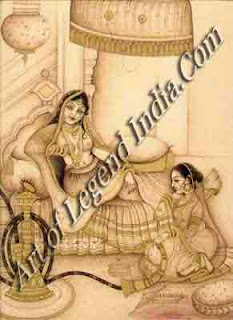
Choli Art
The mode of painting at Ajanta is the tempera and the materials used are very simple. The five colours usually described in all the silpa texts are found here red ochre, yellow ochre, lamp black, lapis lazuli and white. The first coating on the surface of the rock was of clay mixed with rice husk and gum. A coat of lime was applied over this, carefully smoothed and polished. On this ground the paintings were created. The outline drawing was in dark brown or black and subsequently colours were added. Effects of light and shade were achieved by the process of streaks and dots illustrating the methods of pat ravartana, stippling and hatching mentioned in the silpa texts. The lines composing the figures painted at Ajanta are sure, sinuous, rich in form and depth and recall the lines in praise of the effective line drawing in the Viddhasalabhanfika, api, laghu hkhiteyam drisyate purnamurtih, where by a few lines sketched, the maximum effect of form is produced. The masters at Ajanta have thus demonstrated the superiority of line drawing as given in the Vishudharrnottara, rekham prasamsantyacharyah, the masters praise effective line drawing as the highest in art.

The painter at Ajanta has studied life around him and natural scenes of great beauty with intense sympathy and appreciation. Plant and animal life has interested him considerably. He has lovingly treated such themes of flora and fauna as he has chosen to depict. The elephants under the banyan tree in Cave 10, the geese in the Hamsa Jataka from Cave 17, the dear in the Miga Jataka, also from the same cave, may be cited as a few examples of the tender approach of the painter to the themes of animals and birds. He has been equally at home in ably representing the dazzling magnificence of the royal court, the simplicity of rural life and the hermit's tranquil life amidst sylvan surroundings. The Vessantara Jataka illustrates the prince as the very picture of magnificence, as also the simplicity of the hermit and the poor Brahmin as an inexorable beggar. 

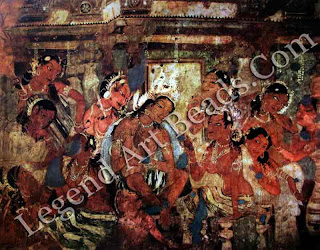
The scene in Cave 27 of prince Vessantara, with his consort, driving on the main road, depicting different merchants in pursuit of their trade, is a beautiful picture of economic life in ancient India. The landing in Ceylon is a splendid representation of royal glory in Cave 17. The interior of the palace giving a glimpse of the king and the queen in the harem or in the garden reveals that nothing was hidden from the gaze of the court painter. He could portray the charm of a close embrace, the arm entwining the neck in kanthaslesha or the sidelong glances of a loving damsel. The toilet of the princess is another example of a similar theme. Th imagination of the painter in portraying the celestials has probably no better examples to proclaim its eminence as the divine musicians floating in the air from Cave 17. 
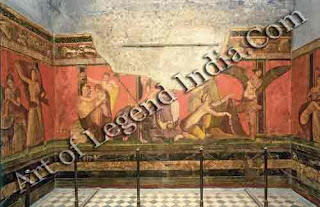
Indian PaintingThe gay theme of dampati, or loving couples, has excellent examples at Ajanta. Of this a whole row is above the entrance doorway of Cave 17. The versatility of the Vakataka painter in creating diverse poses is here evident in the several seated dampatis. The artists could so elevate themselves mentally as to be able to depict magnificently such noble themes as Maraciharshana in Cave 1, Buddha's descent from heaven at Sankisa in Cave 17, and prince Siddhartha and Yasodhara in Cave 1, all magnificent representations of the Master in different attitudes. The long panels and borders from the ceilings of swans and birds, Vidyadhara couples, auspicious conches and lotuses as well as sinuous rhizomes and stalks, with lotuses in bud and bloom, and leaves covering large areas reveal the capacity of the artist to create diverse patterns of great artistic value.

The Vakataka traditions as seen at Ajanta are derived from the earlier Satavahana. This can be clearly seen in several echoes of the painted figures here from those of Amaravati. It is mainly the decorative element, chiefly composed of pearls and ribbons, so characteristic of the Gupta-Vakataka age that distinguishes them from the simpler but nobler art of the Satavahanas.

The Vakataka traditions continued in later sculpture. This can be seen in figures in identical poses found at Mahabalipuram inspired by those at Ajanta which them-selves in turn recall the earlier ones from Amaravati. The identical twist of the right leg put forward in exactly the same pose as at Ajanta and at Mahabalipuram cannot be a chance coincidence. The beautiful paintings in colour at Ajanta help us to conjecture and fully comprehend the glory of earlier Amaravati sculpture and the culture it represents. At Amaravati, the lack of colour precludes the comprehension of the rich jewellery, colourful gems, gay and glamorous drapery, rich furniture, imposing architecture and pageantry in the absence of colour.
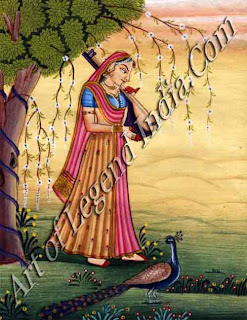
Vasanta Ragini
There are excellent illustrations in these paintings at Ajanta of the six limbs of painting, shadanga, composed of rupabheda, variety of form, pramana, proper proportion, bhava, depiction of emotion, lavanya yojana, infusion of grace, sadrisya, likeness and varnikabhanga, mixing of colours to produce an effect of modelling. The diversity of form at Ajanta is indeed incredible. The painters here mastered the vast complex of human, animal and plant form in addition to giving free scope to their imagination and were creating designs galore. The master at Ajanta has control over not only the proportions of individual figures but also has the ability to group them and he has designed excellent compositions. Emotion is at its best in the narration of scenes from the legends; the grace in some of the figures bespeaks lavanyayojana. While figures are repeated as the Vessantara Jataka, the element of portraiture is clearly made manifest and sadrisya is very obvious. The painter's colour technique easily helps us to pay him a tribute for his capacity in varnikabhanga.

As a narrator of the legends, the painter as well as the sculptor at Ajanta has deviated from the normal course as in other monuments occasionally, but always the effect has been greater.

Irandati is shown on a swing in the Vibhurapandita lataka at Ajanta. This enhances the charm of the Naga princess, the desire to marry whom made the Yaksha Punnaka play the game of dice, win, and bring the wise Vidhurapandita to the palace of the Naga queen. It is thus here more beautiful than even at Bharhut or Amaravati or Borobudur.

The version of the Chhaddanta Jataka at Ajanta heightens the pathos by the noble act of the elephant who not only offered his tusks to the wicked hunter but also helped him even in pulling them out. But this is from the early Satavahana series in Cave 10 and probably the Vakataka painter followed this earlier tradition deviating from the normal representation for producing greater effect.
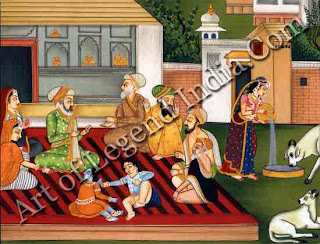
Scene of Gokul
The Hatnsa Jataka is probably more vivid at Ajanta in painting than even at Amaravati in sculpture.

But the detailed and touching story of the Sarna Jataka is probably nowhere better presented than here in the paintings at Ajanta. There is an elaboration here of the Vessantara Jataka which makes it probably the best narrative of this story excelling even that at Goli or at Sanchi.

The story of Mahakapi Jataka or Sarabhamiga Jataka is different from the stories usually chosen and depicted in other monuments. The Matiposaka Jataka is again elaborated here and is different from the simple single scene at Goli.

The Mahisha Jataka, represented at Borobudur, is a rare one in India and is found here. The Valahassa Jataka which is represented on a Kushana rail pillar is better elaborated at Ajanta following the Divyavadana story.

The Sibi Jataka at Ajanta presents a different version from the one of Kshemendra in the Avandana kalpalata, the source of which has inspired the scenes at Amaravati, Nagarjunakonda and other places.

Even in the scenes from Buddha's life, the master at Ajanta has excelled. The story of Nalagiri is probably more effectively presented at Ajanta than even at Amaravati Goli. The same is the case with the presentation of Rahula to Buddha which is a greater masterpiece at Ajanta than the one at Amaravati though probably the medallion in the British Museum can stand comparison with any depiction of this scene from any Buddhist monument in the world.
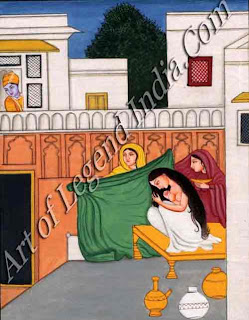
The Surprised Maiden
The descent of Buddha from heaven and the elaborate Maradharshana scene are unrivalled and probably form the greatest attraction in the scenes from Buddha's life from the Ajanta caves.

Cave 1 contains great masterpieces illustrating scenes from Buddha's life. A large panel shows prince Siddhartha and Yasodhara, another Bodhisattva Vajrapani, Maradharshana, the miracle of Sravasti and the story of Nanda.

The Master, seated under the Bodhi tree in the Maradharshana episode, is shown determined to be the enlightened one, unaffected by the temptation of Mara and his beautiful daughters, and unruffled though attacked and frightened by the mighty hosts of his opponents.

In the miracle of Sravasti, Buddha is shown simultaneously in innumerable forms before a large gathering headed by king Prasenajit. This was to confuse the heretics.

The story of Nanda gives how, converted, unwillingly, by Buddha, Nanda still longed for his tear-eyed beautiful wife, Sundari, who pined for him in her palace. The painting here gives a side picture of Sundari in grief. The jatakas in this cave include Sibi jataka, Samkhapala fataka, Mahajanaka Jataka and Champeyya fataka.

The first narrates how the Boddhisattva offered his own flesh to a hawk to protect a pigeon that it was after. The Samkhapala Jataka is the story of a Naga prince who patiently allowed himself to be worried by a troop of wicked men and rescued by a merciful passerby, gratefully took the latter and entertained him in his magnificent underground abode. The painting depicts both the happy situation of the Naga king and his gratitude to his benefactor.

The Mahajanaka fat aka depicts the story of Mahajanaka who married the princess Sivali and, in spite of her at-tempts to retain him in worldly pleasures, made up his mind to be an ascetic, resulting in Sivali following her husband's path.

Peepal Leaf Painting
The Champeyya Jataka is the story of the Bodhisattva, born as a Naga prince, Champeyya, who allowed himself to be caught by a snake-charmer and was rescued by his queen Sumana, by requesting the king of Banaras to inter-cede on her behalf.

Cave 2 contains a large-size painting of Bodhisattva, the dream of Maya and its interpretation, the descent from heaven, the birth and the seven steps. The jatakas depicted here are Hatnsa Jataka, Vidhurapandita jataka, Runt Jataka and Puma Avadana. There are fragments of painted inscriptions mentioning the donation of a thousand painted Buddhas as also some verses from the Kshanti jataka from the jatakantala.

The Hamsa jataka relates the story of the queen, Khema, who dreamt of a golden goose preaching the law. She prevailed on her husband the king to get the golden goose and his companion to be caught by a fowler and brought to her to give her a discourse on the law. The painting shows the golden goose enthroned and admonishing the queen. Earlier the capture of the bird by the fowler is shown. The lotus-lake, the abode of the golden goose, is picturesquely portrayed.

The Vidhurapandita jataka is the story of the Naga, queen, who desired to listen to the learned discourse of Vidhurapandita, the wise minister of the king Indraprastha. According to the story, the beautiful Naga princess Irandati was promised in marriage to whomsoever brought the heart of Vidhurapandita. The Yaksha Punnaka won Vidhurapandita as a stake, by defeating his royal master in a game of dice, brought him to the Naga queen, and thus won the hand of the Naga princess. The story is elaborately shown here presenting the beautiful princess Irandati on a swing, the game of dice, Vidhurapandita's discourse in the Naga palace and the happy union of Punnaka and Irandati.
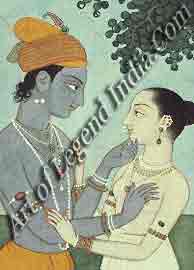
Radha and Krishna
The Runt Jataka is the story from the Divyavadana of the conversion of Puma by Buddha and the miraculous rescue of his brother, Bhavila.

The Kshanti Jataka is the story of a prince who was patience incarnate and put up with all the persecution he was subjected to by the King of Banaras.

Cave 16 is one of the most beautiful viharas of Ajanta. The inscription in this cave mentions it as dedicated by Varahadeva, the minister of the Vakataka king, Harishena, towards the end of the fifth century A.D. The picture given of this dwelling in this inscription that it was adorned with windows, doors, beautiful picture-galleries (vithis), carvings of celestial nymphs, ornamental pillars and stairs and a shrine chaityamandira, and a large reservoir and shrine of the lord of the Nagas is all borne out quite correctly.

The paintings here represent the story of Nanda, the miracle of Sravasti, Sujata's offering, the incident of Trapusha and Bhallika, the incident of the ploughing festival, the visit of Asita, the prince at school and the dream of Maya.

The story of Nanda relates to his conversion. When he returned to Kapilavastu, Buddha visited Nanda's mansion. He was then helping his beautiful wife Sundari at her toilet. Nanda rose to greet the Master, but Buddha gave him his begging bowl and bade him to follow him to the monastery. Here he was converted against his will. However, to make Nanda steadfast in his vows as a monk, Buddha showed him the most lovely nymphs in heaven, where he conducted him. These he promised him if he was true to monkhood. Nanda soon became a devoted monk, and realising the truth of religious life, no more thought of the heavenly damsels. The scenes here depict Nanda's conversion and his journey to heaven with Buddha to see the celestial nymphs. This is comparable to the sculptural presentation of the same theme at Nagarjunakonda. Among the jatakas painted in this cave are the Hasti Jataka, Mahaummagga Jataka and Sutasoma fat aka.
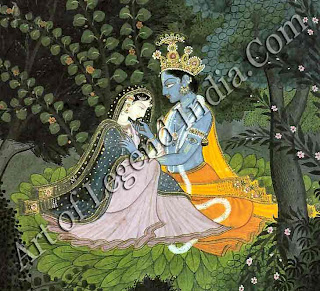
Radha and Krishna
The Hasti Jataka from the Jatakamala is the story of a noble elephant who killed himself by falling from a great height to feed a number of hungry travellers. The Mahaummagga Jataka is a very lengthy one from which an episode is chosen here for depiction. It is the riddle of the 'son'. Mahosada acted as a judge to settle a dispute between an ogress and the real mother of the child as both claimed the little one as their own. Mahosada asked them both to pull the child. He discovered the real mother in the one who readily gave in when she could not bear to see the child experiencing such severe pain on that account. Other riddles like that of the 'chariot' and of the 'cotton thread' from the same story are narrated further on.

The Sutasoma Jataka, also from the Jatakamala, narrates how a lioness was infatuated with a charming prince Sudasa who came hunting to the forest. She licked the feet of the sleeping prince and conceived a child. When born, this freak became a cannibal prince, but was finally converted into prince Sutasoma. The painting shows the lioness licking the feet of the somnolent prince.

As given in an inscription incised on the wall of the verandah, Cave 17 was excavated by a feudatory of the Vakataka king, Harishena. It has an elaborately carved doorway, with a fine floral design. The carvings of Ganga and Yamuna on the door-jambs are most pleasing.

Noteworthy among the paintings here are the seven earlier Buddhas, Vipasyi, Sikhi, Visvabhu, Krakuchchanda, Kanakamuni, Kasyapa and Sakyamuni as well as Maitreya, the Buddha. to come, the subjugation of Nalagiri, the descent at Sankisa, the miracle of Sravasti and the meeting of Rahula.

The jatakas represented here are the Chhaddanta jataka, Mahakapi Jataka I, Hasti jataka, Hamsa Jataka, Vessantara jataka, Mahakapi jataka II, Sutasoma jataka, Sarabhamiga Jataka, Machchha Jataka, Matiposaka Jataka, Sama jataka, Mahisha Jataka and the story of Simhala from Divyavadana with details from Valahassa jataka, Sibi jataka, Ruru jataka, and Nigrodamiga jataka.
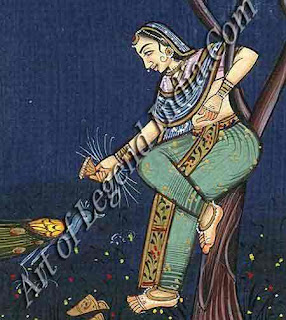
Rajasthani Paintings
The Mahakapi jataka I narrates the story of the Bodhisattva, who was born as the leader of a troop of monkeys. Once, while tasting sweet mangoes on the banks of the river, the monkeys were suddenly attacked by the archers of Brahmadatta of Banaras. To save the animals, the Bodhisattva hurriedly stretched out a bamboo to form a bridge to help them cross over. Finding it, however, slightly short, he stretched his own body to complete the bridge. The king was touched by the noble spirit of the animal, honoured him greatly and listened to his discourse on dharina. The river, the orchard of trees laden with mangoes, the strange bridge and the sermon of the monkey are all painted.

The Vessantara jataka has for its theme the life of the noble prince who never stinted gifting anything begged of him. In fact, he gave away even the precious elephant, responsible for the prosperity of his realm, which caused him banishment from his own kingdom along with his wife and children. Finally, he gave away all that he had, including his chariot and horses and even his children and wife. The panels here show the banishment, Vessantara leaving the city in his chariot, his wife in the forest, his gift of his children to wicked Brahman Jujaka, the restoration of the children to their grandfather and the happy return of the prince and the princess.

The Mahakapi Jataka II recounts the tale of the monkey who rescued an ungrateful man from a deep pit. In spite of the latter's attempt to kill him, the monkey with a most magnanimous spirit, showed him the way out of the forest. The scenes depict the animal helping the man out of the pit and the ingratitude of the latter.

The Sarabhamiga Jataka gives the story of the king of Banaras helped out of a pit by a stag.

The Machchha Jataka narrates the legend of the Bodhisattva, who saved his kin from death by drought by making a solemn asseveration to bring down rain.

The Matiposhaka Jataka gives the story of the filial affection of the elephant who took care of his blind mother. Captured by the king of Banaras, he refused to touch food till the king, out of compassion, got him to return to his blind parent. The scenes painted depict the refusal of the elephant to touch food, his release and happy reunion with his mother.

The Mahisha Jataka is the story of the Bodhisattva, who patiently put up with the antics of a monkey.


The Simhala Avadana narrates the story of Simhala, who accompanied by several merchants, was shipwrecked on a strange island of demonesses, who in the guise of beautiful nymphs, lured those unfortunately stranded there and gobbled them up. The Bodhisattva, born as a horse, offered to rescue the shipwrecked merchants, but those who stayed behind were destroyed by the ogresses. One of the latter followed Simhala in the guise of a beautiful woman, with a child in her arms, and claimed his as her husband before the king, who, struck by her beauty, made her his queen despite the advice of his ministers. This resulted in the gradual annihilation of the palace folk that were devoured by the demonesses. Simhala drove them out, set out with an army to reach their island, defeated them and became the ruler there.

The Sibi Jataka gives the story of a king who gladly gave away his eyes to a blind Brahman at his request, little knowing that it was Sakra himself in disguise. The panel has a short inscription Sibiraja painted in Vakataka letters.

The Ruru Jataka gives the story of the capture of the deer to preach the law to the king.

The Nigrodhamiga Jataka is the story of the Bodhisattva born as a compassionate deer, who offered himself to be killed in place of a pregnant doe to feed the king of Banaras. The ruler was so touched by this act of kindness that he adored the animal and listened to his sermon on karuna.

Cave 19 has panels representing Buddha with his begging-bowl before his son Rahula and Yasodhara.


Writer- C. Sivaramamurti

Introduction to Kushana - Indian Painting

Posted by Art Of Legend India [dot] Com On 4:42 AM 0 comments
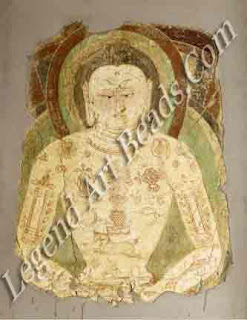
Buddha from Balawaste

Kushana 


First to Third Century A.D.

The Kushanas were the most powerful rulers after the Sungas in North India. Their empire extended far beyond the normal known frontiers of India. In fact, having moved on to India from Central Asia, they had their empire extending from Central Asia through the modern territory of Afghanistan and Pakistan to beyond Mathura in India. That is how there was a distinct school in the North-Western Frontier, with a commingling of Indian, Graeco-Roman and Iranian elements, which with Chinese influences made up a strange and interesting school of art, offering fascinating facets of culture for studies. It is amazing how various Indian motifs have found excellent expression and interpretation in Central Asian sculpture and painting.

Halisalasya danceThis painting from Central Asia, in the absence of paintings of this period in India proper, forms the only source for study of the painter's art of the Kushana period. A painting from Dandan Oiliq of a woman rising from the lotus pool after her bath, with a child close to her, closely following similar Indian representations, also recalls the expression of poets like Kalidasa, of greater length of stalk of lotus, visible in summer, with the dwindling level of water just reaching the waist of damsels, uddandapadmam grihadirghikanam narinitambadvayasam babhuva. The painting of Siva with three heads one fearful, the central one calm, and the other feminine reminds us at once of similar figures of the Gupta-Vakataka and early medieval age from India, the tradition itself however being far earlier. 

A painting of Buddha from Balawaste, now in the National Museum Collection of Central Asian Antiquities, is the most interesting of all representations of Buddha from anywhere in the world. This is a painting of the Kushana period with a clear srivatsa mark on the Master's chest. We know that as a mahapUrusha Buddha has also this mark but always covered by the cloak. It has never been presented in any of the Indian representations of Buddha. The mountain Meru with the serpent Vasuki wound round it in a pool is symbol of the churning of the ocean by the gods and demons to bring out ambrosia. Chandrama, according to the Vedas, is ambrosia that arose from the mind of the Viratpurusha, chandrama manaso jatah. Buddha is here represented as Viratpurusha in the Visvarupa aspect.

Mahajananaka JatakaBut the most important of the symbols here shown on his body are the two on the arms, a flaming pillar or a lotus, topped by three flames. The flames are shown as leaves, as in the case also of the vajra symbol shown on Buddha's forearms. If we recall the identical symbols of the flaming pillar on lotus from Amaravati in the Krishna valley representing standing Buddha and the significance of the superiority of Buddha, dharma and sangha over Brahma represented as lotus, and pillar represented as Siva combining Agni, seen in the flames, we should really wonder how the thoughts spread to such great distances. Only here we do not have the solar wheel and the feet on the top and bottom of the flaming pillar to suggest Vishnu and Surya, respectively.

The garland-bearers with a floral rhizome resting on the shoulder as in the case of similar figures from Mathura and Amaravati of a contemporary date remind us of how closely the motif of a style of the Kushana period resembles contemporary Indian patterns elsewhere also in India.

Writer- C. Sivaramamurti
Introduction to Satavahana - Indian Painting

Posted by Art Of Legend India [dot] Com On 10:51 PM 0 comments

Satavahana

  
The earliest historical paintings in India belong to the Satavahana period. The Satavahanas were the most dominant power in the Deccan from the second century B.C. to the second century A.D. During the time of these monarchs, some of the most glorious Buddhist caves were excavated in the living rock, many of them in western India; the Nasik, Bedsa, Bhaja, Karla, Kondane caves are famous. The earliest caves at Ajanta are also of the Satavahana period. Paintings closely resembling the early sculpture of the Satavahanas at Bhaja, Amaravati and Sanchi are found in Ajanta. These paintings are concentrated in Caves 9 to 10.

The paintings cover the walls, pillars and ceilings and illustrate scenes from the life of the Master and his previous lives, comprising the jatakas and avadanas. There are also floral and animal motifs dexterously created.

Inscriptions in Caves 9 to 10 reveal to us the early date of the paintings here, which is already confirmed by the features and characteristics that bring them close to Bhaja, Sanchi, Jaggayyapeta and the early phases of Amaravati. It is interesting to compare Satavahana sculptures in the first two centuries B.C. with paintings from Ajanta in these two caves. The script of the inscriptions is early Brahmi of the second century B.C. The paintings may, therefore, be assigned to the early phase of the Satavahana rule, probably the time of Satakarni, to whose time the Sanchi gateway carved by the ivory carvers of Vidisa, as recorded in an inscription thereon, may be assigned. These paintings thus form the predecessors of all the Gupta, Vakataka and medieval paintings all over India.

Early art in India has almost a similar form all over the land. The Sungas and Kushanas in the north, the Kalingas in the east and the Satavahanas in the Deccan were the inheritors of common traditions from the Mauryas, and striking similarities in the Sunga, Satavahana, Kalinga and Kushana art cannot but strike the eye of connoisseurs. Common motifs with striking resemblance in distant parts of the land do arrest attention. It is interesting to compare the earlier figures from Bharhut, Amaravati and Cave 10 of Ajanta. Turbans, necklaces, earrings, facial features and the position of the hands joined in adoration may be noted. The fan-shaped headgear of the toranasalabhanjika at Sanchi has its counterpart in Mathura and Amaravati. There are other figures from Amaravati that agree with those at Karla. The traditions of the Satavahanas are great, but these are the result of the development of art all over the land for some centuries, and the unity of Indian art accounts for such similitude of details in concept.

Cave 9 is a chaitya hall with a fine facade, its nave, apse and aisles composed by a colonnade of pillars running the entire length. Towards the apsidal end is an uddesika stupa. The pillars and other parts composing the chaitya present the early characteristics of the sculptural art of the second century B.C. The cave has two layers of paintings, the earlier contemporary with the structure and the later of the fifth century A.D.

Cave 10 is the earliest chaitya hall here, with a votive stupa towards the apse end. It has an inscription of the second century B.C. mentioning one Vasithiputa Katahadi as the donor of the facade. The paintings here show the worship of the Bad hi tree, the Sama Jataka and the Chhaddanta lataka.

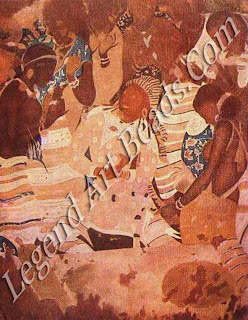
The Sama Jataka is briefly this; the Bodhisattva, born of blind parents, living as hermits in the forest, supported them, and was known as Sama. Once when filling his pot in the river, the boy was shot by the king Banaras, who was out hunting. Too late, the king learnt of the sad mistake he had commmitted, and coming to know of the helpless parents of Sama from the dying boy, he offered himself to them to take the place of their beloved son. A goddess, moved by the intense grief of the helpless parents, not only restored their eye-sight, but also their son to life. The painting represents the hunter-king, Sama hurt by an arrow, the king in a penitent mood, the grieving parents of Sama and the hermit-boy restored to life.

The Chhaddanta Jataka, which is often repeated in Buddhist monuments, narrates the story of the Bodhisattva, who, born as a noble elephant, lived in great state as the leader of the herd, along with his two queens, Mahasubhadda and Chullasubhadda, in a lotus lake near the Himalayas. Chullasubhadda envied Mahasubhadda as the favourite of her lord, and died with a prayer on her lips, to be born as the queen of Banaras, to wreak vengeance on the six-tusked elephant who was partial to his co-wife. When born princess, she pretended illness, and demanded the tusks of Chhaddanta, to be cured of her malady. The hunter Sonuttara, who was sent for this purpose, wounded the animal who, however, forgave the wicked man and willingly gave away his tusks. The queen, however, fainted at the sight of the tusks. Filled with remorse, she collapsed and died.

The paintings show the happy life of the six-tusked elephant and his queens in the lotus lake, near the huge banyan tree, the queen of Banaras pretending illness, the hunter sent to fetch the tusks, his cutting and bringing them to the queen, and her fainting at their sight.

Fragments of painting resembling late Satavahana sculpture towards the end of the second century A.D. were discovered in the Bedsa cave by Professor Jouveau Dubreuil. The figure of a damsel here is a lovely one. She wears an eicavali and stands in graceful flexion recalling similar figures in sculptures from Amaravati and Karla. It is interesting to compare this with the picture of a girl in a lotus pool from Dandan Oiliq in Chinese Turkestan, where Indian ideals in art had spread early in the Christian era.

Writer – C.Sivaramamurti

Religion and History - Indian Mythology

Posted by Art Of Legend India [dot] Com On 1:45 AM 0 comments

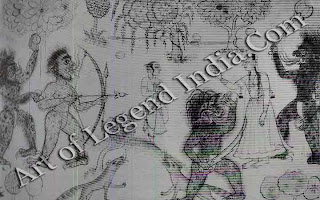
A young yogi seeking union with the divine through ascetic exercises stands immune from the attacks of demons. Among the ranks of demons are the grotesque rakshasas with their backward-turning feet and the asuras, ancient deities supplanted by lndra and the later Hindu gods. Pahari school, from Basohli, c. 1710.

India's recorded civilization is one of the longest in the course of world history and its mythology spans the whole of that time and more. For some periods, indeed, since Hindu scholarship traditionally has little interest in history as such, mythology and sacred lore constitute the sole record, and the changes that may be noted in such traditional materials are thus vital clues to our knowledge of social and political change. Further-more the mythology is distinguished from that of most other lands, and certainly those of the West, by the fact that it is still part of the living culture of every level of society.

Illustrations from the Buddhist text 'The Transcendental Wisdom of the Further Shore', painted on palm leaf with Sanskrit text. Bengal. After the twelfth century Buddhism largely died out in India proper, but it made a permanent mark upon Hindu thought, while Hindu and notably Tantric influence can be seen in the proliferation in later Buddhism of Bodhisattvas, many represented with multiple arms, whose role is to help devotees attain worldly as well as spiritual desires.The Indians have always tended to retain their early beliefs and mould them sometimes perhaps distorting them in such a way as to mirror new social conditions, to adapt to the customs or beliefs of new rulers, or to fit into a new philosophical scheme. Over the millennia invaders with superior military techniques have entered the subcontinent in a steady stream, mostly from the north-west, and with the exception of the Muslims from the eleventh century onwards have been assimilated into but at the same time have influenced the more advanced and deep-rooted culture of the peoples they conquered. Deities and the myths attached to them have thus multiplied. The major synthesis of the Aryan or Vedic gods and the native Dravidian deities took shape as the roots of Hinduism. Because this happened under the guidance of the hereditary class of priests and philosophers, the Brahmins, it reinforced the status of the priests, stressing the value of their prerogative, the performance of sacrifice, in men's relations with the gods.

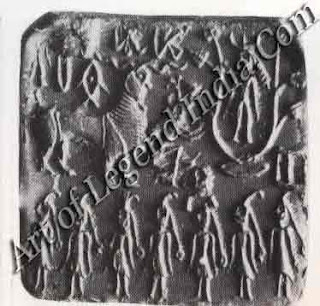
The Lord of the Beasts. Wearing the bull's horns characteristic of pre-Vedic deities and later of Shiva, this three-faced ithyphallic deity sits in yogic position surrounded by votive gazelles, an elephant, a tiger, a rhinoceros and a buffalo. The parallel with Shiva is not the only one: headdress and posture are also reminiscent of Buddha's sermon in the Deer Park. Seal found at Mohenjodaro. c. 2000 B.C. Buddhism was a reform movement rejecting some of the extremes of the Brahmins' doctrine and practice. It arose in the fifth century B.C. and held sway among the educated and powerful in northern India from the time of the Maurya emperor Ashoka in the third century B.C. until its waning in India in the seventh century A.D. Though Buddhism and the parallel movement of Jainism were originally ethical systems whereby the individual through personal effort could attain union with a universal Absolute beyond all gods, in time they too acquired mythology and borrowed some of the Hindu and pre-Aryan deities. This in turn affected classical Hindu mythology and Hindu philosophy of the Golden Age under the Guptas (fourth to sixth centuries A.D.), which was in part a defensive reaction to Buddhism. By the ninth century A.D. Hinduism was showing a tendency to monotheism by putting far greater emphasis on Shiva and Vishnu as high gods of universal cosmic significance, with worship by bhakti (devotion to a personal god) rather than by sacrifice performed by priests. After some two and a half millennia as prime intermediaries with the gods, however, the priestly caste was by then secure in its preeminence.

Goddess standing between the parted branches of a sacred pipal tree (the tree of Buddha's enlightenment). Half-kneeling before her is a suppliant god, leading a mythical animal, part human, part bull and part ram, apparently to be sacrificed. The horned crowns worn by goddess and suppliant indicate their divine nature. In the foreground are seven maidservants. At times the influence exerted by the priesthood in India has succeeded, at least among the educated, in trans-forming the pattern of beliefs. In some cases the changes advocated were no more than a response to the natural evolution of India's mythology as a consequence of historical circumstances: dynastic changes, invasions, economic conditions and the resultant social setting of the Indian peoples. Thus, for example, the name`asura', originally applied to Aryan deities such as Varuna, came by the Brahmanic age to refer to demons, albeit powerful ones. Such changes were particularly apt to alter mythological beliefs, for Indian myths as well as the religions around which they have grown up are closely tied to the social structure. It may be said that this is true of all mythologies but Indian mythology, through its persistence beyond the primitive levels of civilization and into a highly developed and stratified culture, has been able, for instance, to reinforce the doctrines of caste, so that even government disapproval cannot banish it from society.

Caste was first evolved in the late Epic or Brahmanic age, about 800-550 B.C., as the Aryans expanded over northern India and found it necessary to integrate majority indigenous populations into their social framework, and it seems from evidence in the great epics composed in that period that at first change of caste was possible. The rigidity and complexity of the caste structure as it developed later seems almost entirely due to Brahmin influence, and through it Brahmins maintained by right of birth a position as the highest caste. Not all Brahmins at any time were priests, but nevertheless Brahmin-imposed doctrine held that each Brahmin had to maintain the purity of the caste as a whole, and contact with the lower castes, especially as regards food, might pollute and was strictly regulated.

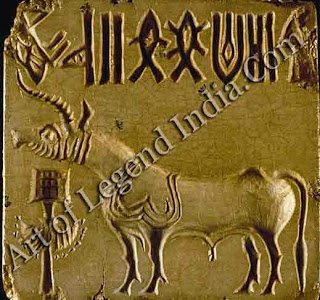
A bull standing before a censer. The most common symbol on Indus civilization seals, it suggests the connection with Iranian religionIn asserting their own status as exclusive repositories of the sacred, and specifically oral, Vedic traditions that they recited, and as masters of ritual and sacrifice, sole intermediaries with the gods, Brahmins claimed the right to respect and to alms. They distanced themselves from the lower castes by defining the others' functions and duties. Thus the Kshatriya caste among whom were kings and warriors had the duty of ruling by maintaining efficient and just administration, conducting warfare to expand and defend the state, and contracting external alliances; the Vaisya (merchant and artisan) caste had a duty to further the economic life of society; while the Sudra (peasant or cultivator) caste was set apart as the lowest caste since its members were not considered 'twice-born', could not be initiated and so wear the sacred thread, and were forbidden to study or teach the Vedas, their only permissible contact with the other castes being as servants. Beyond the castes were the outcastes, who under-took the menial 'unclean' tasks that polluted the individual; and beyond all these were the Dravidian aborigines with their tribal gods, who in the Vedic and Epic ages, until about 600 B.C., were by far the most numerous in the subcontinent as a whole.

Others of the priests' innovations were inspired by philosophical developments understood only by the few in general only the priests them-selves but affecting all. Just as in other cultures, such as those of the ancient Near East and Egypt, where mythology began by explaining natural phenomena, then served to bolster the status of the ruler, and finally be-came a symbolic language expressing the ideas of philosphers, so in India the esoteric cults treated the great body of accumulated myths as a source of symbols with which to ex-press philosophical ideas. Inevitably the myths themselves were sometimes moulded to conform to the ideas that they were made to represent.

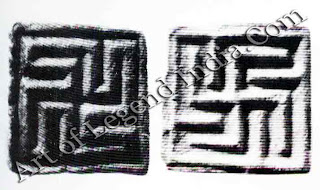
A symbol of fortune, bringer of good luck. The swastika, whose arms could be turned in either direction, became associated in Hinduism with the sun and also with Ganesa, the pathfinder whose image is often found where two roads cross. Changes in the social and philosophical backgrounds may be termed the natural causes of mythological evolution. They were not the only factors; less openly admitted but of equal importance were the various efforts on the part of the priests to maintain their own power and influence with the masses by accepting their more primitive beliefs and dei-ties and weaving them into the new system by means of myth. Equally the Brahmins consolidated their position of trust with rulers by securing the allegiance of the people throughout the period when Buddhism was the faith of the educated and powerful, and when a succession of dynasties, some foreign, dominated northern and central India (roughly ZOO B.C. to A.D. 800). By the twelfth century the last remaining centres of Buddhist teaching, the monasteries of Bengal and Bihar in eastern India which had enjoyed the patronage of the Pala dynasty of the eighth to twelfth centuries, had declined. With the Turkish Muslim conquest of eastern India soon after f zoo, Buddhism was con-fined to peripheral countries such as Nepal, Tibet, Assam, Burma, Sri Lanka and South-East Asia. (A resurgence of interest in Buddhism in its native India did not occur till the twentieth century, largely among those considered Untouchables by Hindus.)
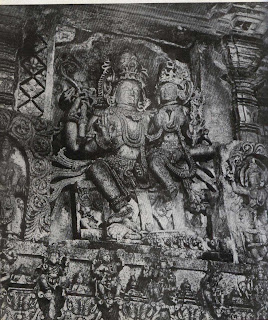
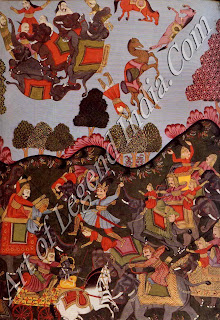
Drona and Karna fighting Arjuna and Bhima. Bhima, son of the wind god Vayu, throws camels, elephants, horses and men up into the air so that they are smashed as they fall back to earth. Episode from the epic Mahabharata. The epics, incorporating mythological material, were composed about the fifth century B.C. but were not written down for nearly a thousand years, and illuminated manuscripts became common only after the fourteenth century A.D. Persian manuscript A.D. 1761-63. Muslim incursions into northern India had begun in the early eleventh century and Mahmud of Ghazni ordered the destruction of Hindu and Jain temple art. Although effective Muslim rule was not to come until the early thirteenth century and many shrines were rebuilt, enormous dam-age was done. Nevertheless Hindu traditions, with the appeal of syncretistic deities, were well enough established thanks to the Brahmins to survive both in the north and in the south of India, where Muslim influence reached only much later. Jainism survived too, largely in Gujerat and southern Rajasthan, where its appeal was to artisans and to wealthy mercants with the means to patronise it generously; where necessary it became an underground cult whose artists, turning to easily concealed manuscript painting, maintained iconographic traditions despite Muslim rule. Paradoxically Muslim persecution also prompted Hindus to set down their scriptural traditions in more permanent form. Whereas before they had valued and relied chiefly on oral tradition a factor which in itself encouraged the proliferation of mythology now they set down the scriptures in illustrated manuscripts. The language used was Sanskrit, the classical Aryan language of the Brahmins (whereas Buddhist texts were also written in a range of vernacular languages). This reinforced the myths contained within the scriptures.

That no one trend was completely dominant is attested by the extreme complexity of Hindu mythology as it exists today, and even more by the numerous contradictions and inconsistencies in the stories concerning practically every deity in the Indian pantheon. There is also a thread of overt anti-Brahmanism that runs through some myths. It mirrors the reaction voiced in the Upanishads of the fifth century B.C. and brought to a head by the reform movements of Buddhism and Jainism against the self-proclaimed superior position of Brahmins, against caste, deities, ritual, sacrifice, and the doctrine which the Brahmins put forward of samsara, the transmigration of souls, implying endless rebirth into a harsh life. Instead of a religious life based on sacrifice that sought riches, health and long life from the divine power, asceticism or meditation was advocated, with the aim of detachment from the illusions of worldly life and union with the cosmic spirit.

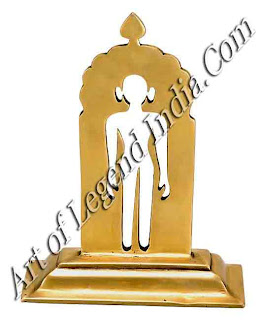
Jain image of the released spirit. Detachment from the illusions of earthly life and the individual search for absolute truth, independently of priesthood and ritual, were the aim of both Buddhist and Jain teaching. Some of the contradictions and in part the great differences that today exist between the beliefs held by the educated and the common people may be traced to the overcomplicated systems evolved. Some of these differences could not be bridged by mythological ingenuity. The philosophical preoccupations of the Brahmins with the growing intricacies of their rituals, and on the other hand the heroic austerities of sages who relied on discipline, not the support of the gods, led to the exclusion of the common people, who were thus thrown back in some cases on earlier beliefs, whose attendant ritual had more bearing on their own lives. There are in India innumerable deities of purely local significance alongside the great gods. Often they are closely identified with a specific tract of land, its soil and the life it sustains. Some-times they are worshipped only in a particular village, or even by a section only of the village, or as domestic gods. The priests of these village dei-ties are commonly non-Brahmins, and they may prepare themselves for their priestly role not by purification or scriptural learning but by trance or possession, thus harking back to the intoxication sought by early Aryan priests from soma. Their function may often be to cast out evil spirits causing sickness or misfortune from the sufferer and transfer them to the deity. Needless to say, myths that may have grown up about such local deities cannot be covered in a general work. But in fact, since the position of these local deities is unchallenged by the status of the great gods of the Hindu pantheon, there has not been the spur to the elaboration of a mythology to defend them against rival claims of other deities or to adapt to a changing social order, which is often the background to developed myths about the major gods.

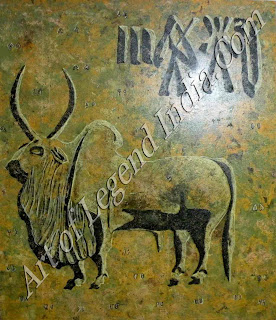
An idealized representation of the bull of the Indus Valley, civilization, with the as yet undeciphered characters which date back over 4,000 years. As for the major gods, the people came to accept new introductions by identifying them with old gods, and thus reconciling all beliefs. This trend was helped by the evolving ideas of the Brahmins. The idea of reincarnation, which was unknown to the Aryan invaders and is never mentioned in the Vedas, appeared about the year 700 B.C. and was developed to the point where any deity, hero, spirit or human being might be an incarnation of any other. By applying this principle to the old and the new gods it became possible to claim that the priests were really worshipping the same deity as the common people under another name and in another in-carnation or avatar. Alternatively the Brahmins might contrive that resurgent old traditions or new practices be justified on the basis of their sup-posed proclamation in the past, preferably by one of the major gods. Thus the pre-Aryan worship of cobras is incorporated into the Shiva cult in the Shivala festival of Maharashtra be-cause Shiva is said to have told the people to worship cobras in order to make them safe. A mythological family relationship is also introduced: Shiva is said to be the father of the snake-mother Manasa.

Despite this apparent confusion and variety, one of the remarkable features of India's mythology is precisely its homogeneity over the whole country, with the exception of myths current among the few isolated hill tribes still existing. And because of the various factors outlined above, the complexity of the pantheon is common to all. However strictly attached sectarian Hindus may be to one particular deity, they have always felt the need and ability to fit the others into their own system. Hence the continued importance of mythology, which it is best to approach historically.

Writer – Veronica Ions

Indian Painting - Hindola Raga

Posted by Art Of Legend India [dot] Com On 11:17 PM 0 comments
Hindola Raga,RagmalaHindola Raga

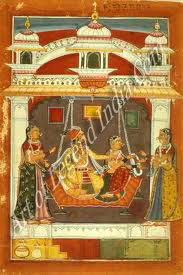
An inscription in the upper yellow panel of this painting identities it as Hindola Raga and states that it is the third (raga in the iconographic system). There is a lengthy passage on the back oldie painting that describes the gem-encrusted swing and the beauty and ornaments of the Lord Hindola. Hindola Raga is unique insofar as it is the only musical mode represented by the same basic visual imagery regardless of the iconographic or geographic system. The iconography used for the raga is derived from its name, Hindola, meaning "swing," which is the predominant visual feature of the paintings. It is a morning melody associated with the rainy season, especially the Indian month of Chaitra. Accordingly, burgeoning rain clouds and storms are often portrayed in the literary and pictorial illustrations of Hindola Raga. 


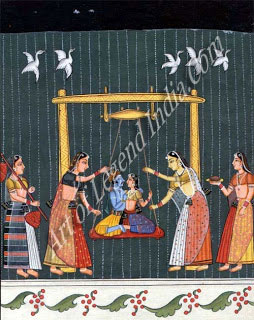
Raga HindolaBesides the set motif of a swing, there are varying numbers of participants in the scene. Typically, a hero or Krishna is shown seated on the swing, usually with a heroine but sometimes alone. Also present are several musicians and attendants, mainly female, one of whom waves a flywhisk over the protagonist(s). This example shows Krishna holding a vina and seated on the swing with a lady while being attended by tbur hand-maidens, one of whom holds a tambura. A row of dark storm clouds fills the sky, and rains are cascading. 

Stylistically this painting is a good example of a mid-seventeenth-century Malwa workshop. Contemporary Mughal works and the pre-Mughal Islamic manuscripts produced at Manch', the capital of Malwa, had little if any lasting influence. Rather. Malwa painting of the period is conservative and almost primitive in appearance. Strong relationships with Jain and early Hindu pictorial traditions are evident. The coloration and the composition are simple yet powerful. Abstract shapes serve for representational forms. The painting is conceived two-dimensionally, with the only indication of depth being the overlapping of physical forms.

Writer -  Pratapaditya Pal

Hoysala Temples - Belur, Halebid and Somnathpur

Posted by Art Of Legend India [dot] Com On 10:44 PM 0 comments
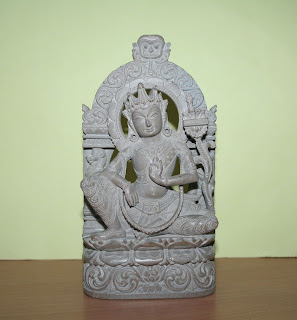
Lord Krishna Stone Statue
UNDER THE INFLUENCE of the Jain Tirthankaras many of the South Indian rulers accepted the Jaina religion and patronized the erection of a large number of Jaina images and Jaina-Bastis in the Deccan plateau. But, due to the efforts of Kumarilabhatta, Sankaracharya, Ramanuja (Ramanujacharya) and others, Hinduism regained its lost position in the South, and quite a large number of Shiva and Vishnu temples were built by the South Indian rulers. Such was the case with the Hoysalas of the Karnataka and they are one of the greatest builders of Hindu temples and Jaina-Bastis. They constructed as many as fifty-three temples and seven Jaina-Bastis in different parts of Karnataka. Let us therefore turn our attention to the art-treasures of Belur Halebid and Somnathpur.

BELUR

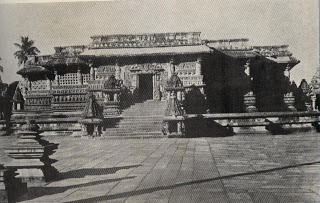
Belur (Beluhut or Velapura) is in the Hassan district of the old Mysore State (now Kama taka). It was the capital city of Ballala I and his younger brother Vishnuvardhana. In the epigraphs this city is recorded as earthly Vaikuntha and Dakshina-Varanasi. The Chenna Kesava temple at Belur is one of the most exquisite specimens of Hoysala art. It appears from the inscription of the east wall near the entrance that king Vishnu-vardhana constructed the temple and installed Vijaya-Narayana there in A.D. 1117. He did this after his conversion to Vaishnavism from the Jaina faith by the celebrated Ramanuja. Again, according to tradition he installed five Narayana images (Pancha-Narayana-Pratishtha) at Belur, Talkad, Melkote, Tonnur and Gagag (Gundlupet).

Belur Temple Wall (Outside)
The Chenna Kesava temple is situated in a court measuring 135.18 by 120.70 m. (443' 6" by 396') with a high enclosure wall, and there are two other temples, Mandapas and lesser shrines. There are two gates, one on the east (Elephant's Gate) and the other on the north side with a very lofty tower (Gopuram) which was added later on by the successors of Vishnuvardhana, under the influence of the Chola-Chalukya style. The temple stands on a raised platform 0.91 m. (3ft.) in height, measuring 54.26 by 47.55m. (178' by 156'). The shrine consists of a Garbha-griha (Adytum), a Sukhanasi (vestibule) and a Navaranga (central hall) which has entrances from the east, south and north. The east entrance is for the priests and devotees, the south for the "Friday entrance" (Shukra-vara-bagilu) and the north is, "the Heavenly entrance" (Svargada-bagilu). Manmatha and Rati are sculptured on the eastern doorway, Hanu-mana and Garuda on the southern and female chauri-bearers on the northern. The pediments have projected panels with Garuda flanked by Makaras and the sculpture of Narasimha killing Hiranyakashipu (demon) on the east, Varaha killing Hiranyaksha on the south, and Kesava on the north.

TEMPLE WALL (OUTSIDE)

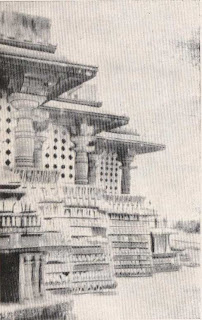
The temple wall from the eastern doorway up to the north and the south entrances has a railed parapet (Jagati) having beautiful friezes of elephants, a cornice with beadwork surmounted by lion heads (Simha-lalatas) at intervals, and scroll work with figures in every convolution. Another cornice is decorated with beadwork, and small figures mostly of females. The projecting ornamental niches have beautiful seated figures of Yakshas and Yakshinis. The eaves are decorated with beadwork and thick creepers running along the edge of the upper slope having miniature turrets, lions and many other small images. The rail also contains figures; some are Maithuna figures (amorous couples) in panels and with ornamental bands. But the elephant frieze is strangely enough left blank throughout the temple. The rail to the right of the east entrance beautifully illustrates episodes from the Mahabbarata.

Belur Temple StatueBhima is seen worshipping Ganapati and Duryodhana falls unwillingly at the feet of Krishna who presses his foot against the earth in order to tumble his throne. Further on the creeper frieze different scenes from the Ramayana have been carefully sculptured along with tiny seated musicians: Above the rail there are twenty pierced stone windows (perforated screens) surmounted by the eaves, ten on the right and ten on the left of the cast doorway, covering the whole temple. Ten of them are decorated with Puranic scenes and the rest with geometrical designs. Among them five on the right and five on the left of the east doorway are especially noteworthy. On the top panel is Kesava in the centre flanked by Chauri-bearers, Hanuman and Garuda. Just below this, King Vishnuvardhana, the founder of this temple, holds a Darbar (royal court). He has a sword in his right hand and a flower in the left. Mahadevi Shantaladevi, the chief queen is' seen seated on his left, with her female attendant standing by her side. To his right, a little in front, two religious teachers (Gurus) are seated with two disciples behind them. One of them is apparently preaching something to the king.

There are also several royal officers and attendants at his beck and call. The king and queen have many pieces of jewellery on their persons, especially unusually large earnings. Then comes a tine scroll and below it a lion with a rider and another standing vigorously facing the visitors, signifying the vigorous rule of Vishnuvardhana.

Belur Temple Wall (Outside)
The next stone screen depicts the story of King Bali making a gift  to Vamana (Vishnu) and on the top of it Lakshmi-Narayana are flanked by Hanuman and Garuda. In the middle panel, Trivikrama (Vishnu) is in the centre with his uplifted foot which is being carefully washed by Brahma; Bali is seen standing on the right with folded hands. Garuda stands with folded hands and another drags away Sukracharya, the preceptor and minister of Bali. On the lower panel Bali's Darbar (royal court) is open to receive gifts.

At the top of the next panel, Lakshmi-Narayana are depicted along with their attendants. In the middle panel, Lord Krishna breaks the pride of the serpent Kaliya (Kaliyadamana) and the lower one depicts a band of musicians. The next screen re-presents Vishnu flanked by Garuda and Hanuman. Below this panel, Shiva sits on his bull vehicle Nandi, attended by Garuda and Kartikeya who in his turn is accompanied by a band of soldiers with flags, swords, spears and shields. Next to this ten Dikpalakas, including Kubera, are seen, and the rear panel represents a battle scene.

The next screen illustrates the story of Prahlada. On the upper panel, Lakshmi-Narayana with Garuda and perhaps Hanuman can be seen. On the middle panel, Narasimha kills Hiranykashipu accompanied by Garuda and Hanuman. Just below it Prahlada with folded hands is meditating on the deity in different poses; he has Tenkala-namam on his forehead, which is the significant mark of the Vaishnava faith. The Vaishnava faith and movement became more .active in the South and the perforated screens were added by Ballala II (A.D. 1173-1220), the grandson of Vishnuvardhana.

Statue of Goddess TaraWe must now discuss the sculptured beauty of the screens on the left of the eastern doorway. The first screen is the same as the first on the right. Here, Narasimha I, the son of Vishnuvardhana, is shown seated in the centre, with his chief queen on his left. He is in his Durbar (court) and holds a sword in his right hand and a flower in the left. On their left are three officers with folded hands along with a group of royal attendants. At the bottom, two lions can be seen. In the top panel Narasimha is in meditation along with Chauri-bearers, Garuda and Hanuman.

The fourth screen is rather interesting; here is the seated figure of Vishnu; the next panel illustrates the story of the Churning of the Milk Ocean (Samudramanthana). Again, on the seventh screen, Vishnu is flanked by Garuda and Hanuman. The next panel depicts the killing of Kamsa by Krishna; and on the next are seen his killing of the elephant-demon Kuvalayapeda and his contest with the wrestler, Chanura. Again on the next screen, Lord Krishna is playing on his flute and the cows and wild beasts, seem enchanted by the magic of his music. The ninth and the tenth screens are rather interesting; Ranganatha is seen reclining on the beautifully carved serpent. And' on the last Lakshmi-Narayana is flanked by Chauri-bearers. In the next screen Hanuman fights with Garuda for the possession of a Linga-like object. Both of them have placed their hands on it. It is finally split up into two halves by the discus (Chakra)of Vishnu seated above. In the midst of the fighting, Hanuman wears the crown of Garuda and vice versa.

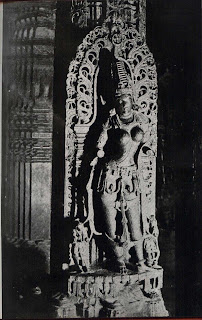
The pillars at the side of every screen have on their capitals mostly standing female figures supporting the eaves. They are the masterpieces of Hoysala art. Once there were forty of them around and inside the temple; two or three are now missing. 'Ili Kannada they are known as Madanikas. Most of the bracket figures are shown either lancing or playing on musical instruments or dressing themselves. Two of them represent Durga and three are huntresses, one carrying a bow and the other shooting birds with arrows. Some of them are seen with breeches. It is interesting to note hat on the pedestals of eighteen bracket figures the names of the artists are inscribed :carefully. These Madanikas are again represented in miniature form in the sixth frieze of the railed parapet.

Belur Temple Statue
As it is traditionally believed, King Vishnuvardhana married one of the most beautiful of singing and dancing girls, Shantaladevi, for the second time. She had overwhelming influence over her royal husband. Under her direction the chief architect Daknacharia, along with many able craftsmen, beautified the temple with so many Dancing and singing girls (Madanikas). Further, she had mastery over contemporary ndian singing and dancing and hence there are so many different Bharat-Natyam poses f the dancing girls on the walls of the temple. But at Halebid, almost all the beautiful Madanikas have been removed by human agencies. I have seen many of these beautiful Sculptures in different museums and private houses of Europe and America. As a :suit, Halebid temple has lost much of its former glory.

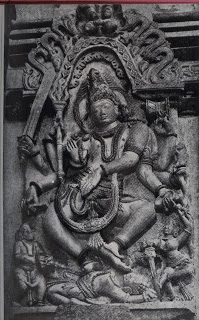
Beyond the railed parapet (Jagati) there are eighty large images of gods and goddesses of which only nineteen are female. They are in a continuous row as Halebid, Kedareshvara and Somnathpur. Among the gods and goddesses are thirty-two images of Vishnu, two of Lakshmi-Narayana, one of Vamana, two of Narasimha, two of Varaha, one each of Ranganatha, Balarama, and Hara-Parvati tree of Shiva as the destroyer of Andhakasura and Gajasura, two of Hari-Hara, four of Surya, five of Durga and Mahisasuramardini, two of Bhairava, one of Man-matha and Rati, one each of Ganesha, Brahma, 'Sarasvati, Garuda and Chandra .. .sides these, there are images of Ravana, Daksha, Arjuna, Bali, and Shukracharya. The large images of Narasimha on the south-west wall and of Ranganatha on the north-east one add to the beauty of the temple. The artists, however, did not ignore e basic concept of life; some small erotic sculptures, can be seen on the outer wall d they do not mar the beauty of the temple. Moreover, on the third, fifth, and :th friezes of the railed parapet there are many Hindu divinities.

Belur Temple Outside
On the outer walls of the Garbha-griha (Sanctum). there are three elegantly executed :-like niches on two storey’s and in three directions. Each storey is decorated with ailed parapet. On the niches are sculptured friezes of elephants, lions, horsemen, turreted pilasters and rail with figures, mostly female. On the south niche there is effigy of Sarasvati with Vishnu below; and on their right wall again Vishnu is seen 1 a sixteen-armed Narayana seated on a lotus upheld by a four-armed Garuda. Again, see Vishnu on the west niche and above him, Bhima is seen fighting against Bhaga-datta's elephant; on the right wall a female devotee holds a vessel in her left hand and a flower in the right hand. Once again, Vishnu, Garuda and Sarasvati are sculptured above the devotee. Moreover, on the left wall on the north niche, a female figure holds two children, apparently representing Krishna and Balaram. On the right is a female figure and a child who holds a young lion with rope. He may represent Shakuntala's son Bharata. On the right wall of the same niche, Durga and her female attendant are seen.

Special attention must be drawn to some interesting sculptures, for instance, Balarama with a discus (Chakra) in his left hand and a plough in the right; Chandra holding Kumudas (water-lilies) in both hands; a sixteen-armed Narasimha slaying Hiranyakashipu; Kayadhu (Prahlad's mother) and Garuda are artistic and story-telling. Then there is a Madanika (Kirati) as a huntress to the left of the north doorway with two small female attendants, one with a bamboo lathi (rod) carrying a dead deer and a crane apparently shot in the chase. Another small figure is trying to remove a thorn with the help of a needle from the leg of one of the female attendants. This is almost a lyrical ballad in stone. Another Madanika in an amorous mood holds a betel leaf apparently for her lover, while her playful attendant squirts scented water with a syringe. Other Madanika to the left of the south entrance is dancing under a creeper canopy. The sculptor has a poetic vision; on the top near her head are a lizard, a Ely, and a ripe fruit (may be a jack-fruit); the lizard is preparing to pounce on the fly.

Belur Temple Outside
To the right of the north doorway, on the rail, the king and queen in a relaxed mood are witnessing a wrestling match and six Shaiva (or Vaishnava) devotees are also shown sitting nearby in a pensive mood. Just on the left of the same doorway a man with a long coat, hood and belt is about to cut off his head before a sitting Goddess (Durga) who at once prevents him from doing so. On the north-east wall, a story of a chain of destruction is beautifully carved out. A double-headed eagle attacks a Sarabha (mythical animal) which attacks a lion that in turns attacks an elephant who is about to destroy a snake that is trying to swallow up a rat before the ponderous gaze of a mendicant. Similarly, on the right of the north doorway one Madanika is stripping off her clothes on finding a scorpion in its fold; the scorpion is again shown on the base. Again, in the fifth frieze to the left of the south door, a lady is sketching a picture on a board.

At the sides, in front of all the three entrances, there are two fine pavilions with two more opposite to them at some distance and on a lower level. Vishnu, Bhairava, and Mahisasuramardini are on the upper level; and they have a frieze of elephants. There are likewise three more pavilions on a lower level opposite to the three car-like niches around the Garbha-griha. They have elephant, lion and horse friezes on the base and all the nine lower pavilions have both religious and secular figures. Here, it is important to note that each doorway has at the sides the Hoysala crest-Sala, the founder of the family, with a sword in hand ready to kill a lion (or tiger).

NAVARANGA (CENTRAL HALL)

NAVARANGA (CENTRAL HALL)
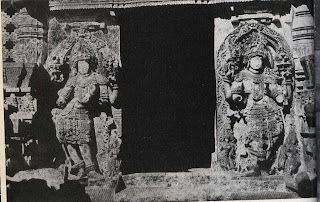
The Navaranga (main hall) of the Chenna Keshava temple appears to have been originally left open as at the Halebid, Kedaresvara, Somnathpur, and other places, without door-frames and perforated screens. The door-frames of the Navaranga were added later on, for the side pillars are mutilated and inscriptions on them arc mostly concealed. The door-frames, doors, and perforated screens were added to the temple by Ballala II (1173-1220), the grandson of Vishnuvardhana. The worksmanship is far superior to that of the outer walls of the temple. The image of Keshava (Vijaya-Narayana) is a handsome figure of 1.83 metres (six feet) in height with a halo (Prabha), standing on a 0.91 metre (three feet) high pedestal, with his consort, Iakshmi. He has four hands; in the upper hands he holds a discus (Chakra) and a conch; a lotus and a mace are in his lower hands. On the Prabha (halo), the ten incarnations (Avataras) of Vishnu are represented; the door-keepers (Dvarapalas) are elegantly executed on the Sukhanasi (vestibule) doorway. Its pediment with a fine figure of Lakshmi-Narayana in the centre has excellent filigree work. The Makaras at the side bear Varuna and his consort on the back. The four pillars were added to the Sukhanasi in A.D. 1381 to support the dilapidated roof, by the order of the Vijayanagar king Harihara II by his minister Kampanna.

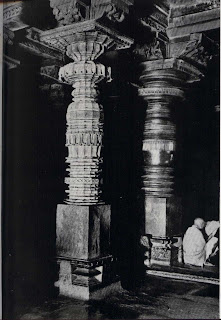
The Navaranga has raised verandahs on both sides of the three entrances. All the pillars are artistically executed and are different from one another in design and the arrangement enhances the beauty of the Navaranga. Sufficient space has been left out in the central hall (Navaranga) for musical performances and Puja (worship) ceremonies by large numbers of devotees and others. The well-known Narsimha pillars are carved out with minute figures all round from the top to the bottom. A tiny bull (Kadali-basava) is in the size of a seed of the Bengal gram (Kadal). A small space on the south face of the pillar is said to have been left blank by the artist who prepared the pillar as a challenge to any artist who can appropriately fill it up. Another pillar, right of the Sukhanasi doorway, has the same marvelous filigree work. It is carved with a female figure in front and has eight vertical bands with fine scroll work the convolutions of which are made up of delicately executed figures representing the Hindu minor gods of the eight directions and others. Besides, the lions with faces of other animals add further to the beauty of the pillar; it is certainly one of the most beautiful pillars in the whole temple.

Navranga Central HallThe four central pillars support a large domed ceiling of about 3.05 meters (ten feet) in diameter, 1.83 meters (six feet) deep. It is a remarkable piece of artistic workmanship famous for the richness of ornamentation and elaboration of details. Brahma, Vishnu and Mahesvara are shown on a lotus bud and the bottom frieze of Madanikas, standing on the capitals of the four central pillars, add much to the grace and charm of the Navaranga. Three of them are signed by the sculptors. The Tribhanga (triple bends) pose is really fascinating and a lovely parrot playfully sitting on the hand. The sculptor is so very skilful that the bracelets moved up and down. Another Madanika in a dancing pose on the south-east pillar represents "Dancing Sarasvati". Just to express the ingenuity of the artist, here head-ornaments can be moved. The third figure on the north-cast pillar is far more life-like. She has just finished her bath and is carefully dressing her hair by squeezing out the water from her hair. The last figure on the north-west pillar is simply dancing before the deity, expressing an exquisite dramatic pose in stone. Here, the artists have bestowed far greater attention and care than on the other Madanika. There is no denying the fact that most magnificent specimens of Hoysala sculpture are the Madanikas. For the sheer beauty of form, delicacy of worksmanship and perfection of finish, they are without parallel and may be called "poetry in stone." They have elicited un-qualified approbation from the art-critics of the world and to the temple, they have added great grace and charm.

Each one of Madanika figures here may be taken as a representative illustration of the rhythm and grace of which an ideal female form is capable. The workmanlike finish given to every one of them and the remarkable delicacy and skill with which details of decoration and ornamentation have been executed, have placed on them an exceptionally high value as pure works of creative art. Moreover, "the beauty and mirror" is another popular figure of Belur. A dancing girl, on completing her toilet, looks in the mirror with an air of supreme satisfaction and fully conscious of her own beauty. She is profusely ornamented. Her broad forehead, aquiline noze, well-formed lips suggesting a smile, large and almond shaped eyes with bow-like eyebrows and thick locks of hair tied into a large knot behind her head, represent the perfection of feminine charm. The slender waist and round breasts conform to the Indian ideal of feminine beauty.

Engraved Designed WallThe graceful curves of the tribhanga (triple bends) figure add rhythm to her pose. Another favorite theme of the artist is represented in the two Madanikas with their favorite parrot in hand; one is teaching her bird and the other is gracefully looking at hers. They too stand in Tribhangapose displaying the full charm of their well-formed limbs. Another figure depicts a monkey pulling at the dress of the modest lady. In her right hand she holds a small branch of a tree with wheel to strike her mischievous pet. A maiden arranging her coiffure, another with a lyre (Veena), another singing or beating a tune on a drum, others depicting well-known poses of the classical dance, another a huntress (Kirati) are the objects that caught the imagination of Hoysala artist into a matchless performance of technical skill. The secular nature of the subject matter gave them freedom of action; it enabled them to modify and even over-look the rigid rules of religious convention.

The Hoysala artists, like the ancient Greek sculptors, took poetic delight in depicting the female form; and they conceived beauty as an attribute of divinity and employed their skill to embellish temples. And to them any pretext was sufficient to display their skill. They displayed a keen sense of realism regarding the human form especially the female.

Temple Hall The remaining ceiling in the Navaranga is mostly flat and oblong in shape. In the front of the entrance, Ashta-Dikpalakas (guardians of the eight directions) are carved out on three panels; and on the east Narashimha is shown killing Hiranyakashipu. The figure of Varaha and Keshava are on the southern and northern entrances respectively. But the ceilings over the verandah show better workmanship of carving; the west verandah at the south entrance has a frieze depicting stories from the Ramayana. Moreover, one magnificent Gopuram and an elegant standing Garuda were subsequently added to enhance the beauty of the temple.

TECHNICAL EXPERTS (ARTISTS AND TECHNICIANS)

It may well be presumed that during the construction period each temple was left under the fostering care of one master artist-cum-technician who would dictate and guide each and every part of construction and decoration. It was, of course, assisted by a good number of able artists to complete the work. It may be that different sections of the temple were left to the care of a different artist; and thus, they were able to complete them in a specified period of time. This view was rather cofirmed when I visited the temples of Belur, Halebid, Kedareshvara, Somnathpur, and others. Here I should like to refer to a legend current in Karnataka; it is about the great Jakana-chari and his son Dakanachari. Jakanachari being suspicious about the fidelity of his wife, secretly left his home and took service under the Hoysala ruler, Vishnuvardhana.

Belur TempleHe was engaged to construct the Chenna Keshava temple at Belur. After its completion, when the king was about to install the Mula-Vigraha (main deity), a youth of eighteen years protested against the proposed installation. He argued that the Mula-Vigraha was unfit to be installed, since it was a Garbha-shila, i .e., it contained something within it. To prove his point he was allowed to break the image. To everybody's surprise, a living frog and a little quantity of sand and water were found within the image. Thus according to the Shilpa-Shastra the deity could not be installed. That youth was no other than the son of Jakanachari whose son was known as Dakanachari. He was much pleased to see his son well-versed in the Shilpa-Shastra and other religious texts and they both constructed many temples in Karnataka. Many other well-trained sculptors also assisted them in their work.

On the pedestals of the eighteen Madanikas on the outer-walls of the temple and the three inside the Navaranga and Vishnu on the west wall, the names of the sculptors are inscribed. I have seen many such in the Halebid, Somnathpur and Kedareshvar temples. Among the sculptors of the Keshava temple at Belur mention may be made of Dasoja, his son Chavana, Chikka Hampa, Malliyana, Padari Malloja, Kencha Malliyanna, Masada and Nagoja. Some of the lebels give details about their native places, parentage and qualifications.

Belur Temple WallBalligrame (Belgame) in the Shikarpur Taluk of the Shimoga district was the native place of Dasoja and his son Chavana. Dasoja had the title of "smiter of the crowd of titled sculptors" and his son was a "Shiva to the cupid titled sculptors". Again, Chavana is said to have "done his work at the instance of Keshavadeva". Chikka Hampa was the royal artist of Tribhuvanamalla-Deva and had "prepares some images in the Mandapa (hall) of Vijaya - Narayana built by Vishnuvardhana." He was the son of Ineja and had the title of" Champion over rivaj sculptors." Milliyana was the artist of Maha-Mandaleshvara Tribhuvanamalla and had the title of "a tiger among sculptors." Again, Padari Malloja had earned the title of "a pair of large scissors to the necks of titled sculptors." Moreover, Magoja is claimed to be the artist of god Shvayabhu-Trikuteshvara of Gadugu (Gadag): one of them had claimed to be the "Vishvakarma of the Kali age." The names of the sculptors on their artistic creation are a significant departure from medieval and early modern tradition of India, and the inscribed names have given us an important clue to the artists of more remote periods.

Belur Temple Statue
Now, it is better to sum up the structural beauty of the temple in James Fergusson's own words. "The arrangement of the pillars have much of that pleasing subordination and variety of spacing which is found in those of the Jams, but we miss here the octagonal dome, which gives such poetry and meaning to the arrangements they adopted. It is not, however, either to its dimensions or the disposition of its plan, that this temple owes its pre-eminence among others of its class, but to the marvellous elaboration and beauty of its details.” And "the amount of labour, indeed, which each facet of this porch displays is such as, I believe, never, was bestowed on surface of squal extent in any building in the world; and though the design is not of the highest order of art, it is elegant and appropriate and never offends against good taste.”

HALEBID

The Halebid village is (eighteen miles) from Banavar railway station, about 16 kilo-meters (ten miles) north-east of Belur. It has a direct bus service from Hasan via Belur. In the ninth century the Rashtrakuta rulers constructed a large lake, called Dorasamudra, but in the twelveth century the Hoysalas made it their capital city. Over a century and half they had a large kingdom south of the Krishna river. In A.D. 1311, Malik Kafur ransacked the city and took "camel-loads of gold, silver and precious stones" It was pillaged again in A.D. 1326 by Muhammad-bin-Tughluq. But in its heyday, Dora-samudra was a great city extending to the south and west of the present village of Halebid.

Halebid TempleRound about A.D. 1121 Ketamalla, an officer of Vishnuvardhana, undertook this great work of building the temple in the name of the king and the queen; and the whole structure was completed sometime after A.D. 1141. The temple contains two different sanctums, each with a vestibule. The Navaranga (Central hall) and bull Manda-pa (hall) and in fact two complete temples are joined by short corridors, both standing on a common plinth. As at Belur, the sanctum is star-shaped. The Linga in the south shrine bears the name Vishnuvardhana Hoysaleshvara (or Hoysaleshvara) and the one in the north has the name of Shantaleshvara'1° two Nandi Mandapas with two gigantic bulls are on the east. In the later period pierced stone (jali) windows and doors were attached to the temple.

FRIEZES

Halebid Temple WallAmong the temples of the Chalukyan style, none can compare in magnitude, exuberance of carving, and artistic majesty with the Halebid temple. On its outer walls thousands of figures are sculptured which gave the artists enough scope for imagination. The temple itself is 48.77 meters (160 feet) north and south by 37 meters (122 feet) cast and west. From the basement of the platform the temple is elaborately decorated by horizontal friezes. The first one represents a march of war elephants, and then between the two bands of scrollwork is a row of charging horsemen, which is again followed by episodes from the Ramayana, the Mahabharata, the Bhagavata, and the Puranas. Just above them are mythical crocodiles (Makaras) with long ornamental tails, tusks, riders, and a beautiful row of swans (or peacocks).

ROOFS AND TOWERS

On the eastern side, just under the eaves, there were many bracket figures on the pillars; most of them have now disappeared from there. Consequently, the structural beauty of the temple has suffered considerably. There is a great deal of controversy among art-critics regarding spires over the temple. James Fergusson states, "it was intended to raise two great pyramidal spires over the sanctuaries, four lower ones in front of these, and two more, as roofs-one over each of the two central pavilions.”

Halebid Temple Outside
NANDI – MANDAPA

 On the east of the each Linga as mentioned above, there are two multi-pillared pavilions, side by side with two colossal bulls which are really majestic in appearance and beautiful in composition. The bull in the south pavilion is largest and behind it in a small shrine there is a beautiful standing figure of Surya (Sun-god) with his consorts shooting arrows, and his car drawn by seven horses. The Nandi-Mandapa is further graced by beautiful images of Lakshmi-Narayana and a female drummer.

WALL  IMAGES

The upper part of the walls have perforated stone windows on the east side with the images of gods, goddesses, and Epic and Puranic heroes on the west wall. Most of them are about 0.91 metres (three feet) height, standing or sitting on a pedestal with ornamental canopies (or arches). They are usually in high relief and thus a great multitude of Hindu gods and goddesses in different poses and thus have given a deeper significance to iconographic studies. The majestic figure of Shiva as “Dvarapala (door-Keeper), Vishnu, Shakti and other deities of the Hindu pantheon arc well represented. Thus, the outer wall of the Halebid temple may be rightly called a museum of the Hindu gods and goddesses.

MYTHOLOGICAL FRIEZES

Halebid TempleThere are five important images on the north-east wall. It begings with the figure of king Vishnuvardhana or his officer Kitamalla sitting in his Durbar (Court). In the next panel the gods and the demons churn the milky ocean for nectar with Vasuki (great mythical serpent) as the rope, the mount Mandara as the rod supported on the back of Vishnu as tortoise. Unfortunately, many of the figures are mutilated. One after another we have the images of Sukracharya with a pot of liquor (Toddy) the Durbar of Hara and Parvati attended by gods, Joshada and Krishna, Lakshmi-Narayana, the Ganas and Dikpalas, and king Bali offering the world as a gift to Vishnu (Vamana), and Chandesh-vara-Shiva. But the east wall is blessed with eleven images; they are Shiva in his court (Durbar), a fight between Krishna and Indra for the Parijata tree, Shiva and Vishnu standing close together, and Krishna in his boyhood.
The south-eastern door is gracefully decorated by six images. Shiva is on the lintel of the doorway and the arches are fine examples of stone filigree work; the door-keepers are heavily be-jewelled. Major battles of the Mahabharata war are carefully depicted and the eighteen days of the conflict can also be identified. Each warrior hero is shown fighting from his chariot driven by a charioteer. One panel in the south-cast presents the appointment of aged Bhisma as the Commander-in-Chief of the Kauravas. And Arjuna's victory over Drona is celebrated by the soldiers, dancers, and musicians.

On the lintel of the south door, Shiva is dancing on the body of Andhakasura; his eight hands are more or less engaged and his beautiful face is beaming with a benign smile after his victory over the demon. But the fallen demon still looks at him and Nandi. The dancing god is also accompanied by musicians and drummers and above his head there is a five-hooded snake with a towering canopy. Brahma and Vishnu are on his right and left. The arches above are carefully decorated and are supported on each side by a mythic al Makara with a warrior in its mouth. Varuna (the Indian Neptune) and his consort are on the Makara's back and are followed by their attendants. At each end a lion is fighting with an elephant or with Sala, the progenitor of the Hoysala family. Just above this a group of heavenly musicians and the guardians of the quarters are assembled. Thus, the whole complexity of the panels enhances the grace and charm of the south door.

Helebid Temple GateThe south-west wall is further graced by seven images. They are seen dancing Ganesa, Brahma, Karna with his chariot and standard, Hara-Parvati sitting gracefully terrible Bhairava, Mohini's nude dance with Bhasmasura, Arjuna shooting an arrow at the eye of a fish, cowboy Krishna playing on his flute, dancing Sarasvati, Parijata-Sarasvati, Indra and Indrani on their elephant, Krishna lifting the Govardhana hill, terrible Bairava, Shiva as the slayer of Gajasura (elephant demon), Karttikeya (the god of war), Varaha (Vishnu) as the savior of the Earth goddess, Uma's marriage with Shiva, Durga fighting Mahisasura and Darpana Sundari.

The west wall is further decorated by fifteen images from the Mababharata, Rama-yana and the Puranas. There are the stories of Prahalad, Narashimha, Manmatha and Rati, Brahma, battle between Rama and Ravana, vengeance of Draupadi, Vishnu as Trivikrama, Gajendra Moksha, Parijat-harana, Keshava standing before dancing Lakshmi, Nritya-Sarasvati, Shiva-Nataraja, Kali, Shiva's war with Arjuna, Rama and the Vali-Sugriva story, his quest for Sita, and Shakti. Again, the north-west wall is graced by four Brahmanical images Mohini with a parrot, the killing of Abhimanyu, dancing Ganesha and the Earth goddess (Bhudevi) and Vasudeva, a dancer, one Gandharva (heavenly Musician) and a Kaunchuki (eunuch door-keeper of the heavenly harem). Moreover, the northern wall is similarly decorated with Epic and Puranic images, such as, Varaha Avatara of Vishnu, Gandharvas, Ravana lifting Mount Kailasa, Mahisasuramardini, Durga, a Huntress, Gandharva-Kanya and many others.

NAVARANGA HALLS

Designed Wall
The square-shaped Navaranga halls are joined together by a corridor. Among the two the southern part is better designed, for it contains finer pillars and more elaborately carved ceilings showing different gods, goddesses and floral motifs. The huge lathe-turned pillars once supported many bracket figures as at Belur; but most of them are no longer extant. In the niches stand the beautiful tiny images of Vishnu, Shiva, Ganesha, Sanmukha, Sarada, Durga, Lakshmi, etc. The canopy and the tower of the central niche are for more decorative.

SANCTUMS

 The doors of the sanctums and the vestibules arc of different designs and each door has its own beauty; the door-keepers, Shiva as Dvarapala, and a chauri-bearer and attend-ants are far more beautiful. In each sanctum there is a huge pedestal and a large flat-headed Linga placed by the royal builder and his queen for their religious merit. Although they were devotees of Vishnu and disciples of Ramanujacharya, they dedicated this great temple to Lord Shiva.

OTHER OBJECTS OF INTEREST

In the southern compound of the temple and near the royal gateway there is a colossal stone image of Ganesha, and in the north-west corner over a Linga there was formerly a small temple which is now totally destroyed. Between the main temple and the Linga is a round pillar with a Kannada inscription recording a tragic story of Hoysal a chivalry. In olden times, when a Hindu King was crowned, the princes and his body guards (Garudas) took a terrible oath that they would not live after their royal master. Thus, when Ballala H died, his bodyguards, headed by prince Lakshmana, kept their vows and slew themselves. A relief sculpture on the pillar shows Lakshinana seated like a Yogi waiting to be beheaded, when his followers turned their daggers and swords upon themselves. Our study of Halebid temple would not be complete if we do not mention here the words of James Fergusson about the mythological friezes. "This frieze, which is about 5 to 6 inches in height, is continued all around the westren front of the building and castends to some 400 feet in length. Shiva with his consort Parvati seated on his knee, is repeated at least fourteen times; Vishnu in his various Avataras even oftener, Brahma occurs several times and every great god of Hindu pantheon finds his place. Some of these are carved with a minute elaboration of details which can only be reproduced by photography, and may probably be considered as one of the most marvellous exhibitions of human labour to be found even in the patient East....

Fine Wall Sculpture
If the frieze of gods were spread along a plain surface it would lose more than half its effect, while the vertical angles, without interfering with the continuity of the frieze, give height and strength to the whole composition. The disposition of the horizontal lines of the lower friezes is equally effective. Here again the artistic combination of horizontal with vertical line and the play of outline and of light and shade for surpass anything in Gothic art. The effect are just what the medieval architects were often aiming at, but which they never attained so perfectly as was done in Halebid.” Again, "No two canopies in the whole building are alike, and every part exhibits a joyous exuberance of fancy scorninge very mechanical restraint. All this is wild in human faith or warm in human feeling is found portrayed on these walls!" Here, again, we have the names of some of the sculptors, such as Demoja, Kalidasi, Kedaroja and Talagundura Hari. Unlike Somnathpur, this is a dead temple, for the daily worship of the deity is not held here. The temple is now looked after by the Archaeological Survey of India. In the compound of the temple there is an excellent and a very good library, museum containing some good examples of Halebid sculpture both of which are quite helpful to scholars; and the Curator and the Care-taker have done a lot for me.

SOMNATHPUR

Somnathpur TempleSomnathpur is a small village in the Tarumakudalu Narasipur Taluk of the Karnataka district and is situated about 0.8 kilometre (half a mile) from the Kaveri river. It is about 32 kilometres (twenty miles) from Sirangapatnam. According to epigraphical records, Somnath (Soma), an officer under Narasimha III (A.D. 1254-1291), built the Kesava temple in A.D. 1268. The temple is situated in a courtyard measuring 65.53 by 53.95 metres (215 by 177 feet) the main structure is placed on a metre (three feet) high stone platform. It is a three-celled structure (Trikutachala), the main cell facing the cast and the other two facing the north and south; they are surmounted by three elegantly carved towers which are identical in design and execution.

OUTER WALL

Temple of SomnathpurOn both sides of the entrance, there runs around the front hall a railed parapet (Jagati) and from the bottom upwards horizontal friezes of elephants, horsemen, scroll - work scenes from the Epics and the Puranas, turretted pillars, miniature erotic sculpture, and lions intervening between them, and a rail divided into panels by double columns with tiny figures, have enhanced the beauty of the temple. Above them are perforated stone windows (Jali); they are also beautifully decorated with filigree work and images. From the corners on both sides of the entrance, where the rail parapet ends, there begins a row of large images with different types of ornamental canopies. Just below these images there are six horizontal friezes the first four are identical with the railed parapet design but the fifth and sixth have a frieze of mythical beasts (Makaras) surmounted by' a row of swans (or peacocks).

Somnathpur Temple Wall OutSideWe can easily sum up the number of large images on the walls as one hundred and ninety-four. There are fifty-four in the south cell; in the corner between the west and north cells there are only fourteen figures, and there are fifty-four images round the north cell. The Brahmanical deities represented by the above images are Vishnu and his different incarnations (i.e., Narasimha, Varaha, Hayagriva, Venugopal and Parasurama), Brahma, Shiva, Ganapati, Indra-Indrani, Hara-Parvati, Manmatha, Surya, Garuda, Shakti, Mahishasura-mardini, Karttikeya, Lakshmi, Sarasvati and a Gandharva. Moreover, apart from the friezes of the Epics and the Puranas the portions running round the south cell presents scenes from the Ramayana; the west cell has scenes from the Bhagavata-Purana and the north has representatives Mahabharata stories.

INTERNAL ARRANGEMENT

As the temple contains three cells, each cell consists of a Garbha-griha (Adytum) and a Sukhanasi (vestibule). On the chief cell (Garbha-griha), just opposite to the main entrance, there was a Vishnu (Keshava) image about 1 .52 meters (5 feet) high, but it has been stolen. As a result, it is absolutely a dead temple; nobody cares to offer puja (worship) here. However, the authorities have replaced the lost Vishnu image by another of the same size. The temple is now under the exclusive control of the Archaeological Survey of India.

Somnathpur Temple
The north cell has a beautiful image of Janardana, of about 1.88 meters (6 feet) height, and Venugopala (Krishna) of the same height breaks the monotony of the southern cell. With a great amount of ecstasy VenugopaIa is playing his flute before his rapt listeners, including men and animals. And this panel is really a magnificent specimen of medieval Indian art. Thus, judging from the figures here the lost image of Keshava (Krishna) must have been a piece of wonderful worksmanship. The lintels of both the Garbha-griha and the Sukhanasi doorways of all the cells are carefully decorated.

The chief cell of the Garbha-griha doorway depicts a seated figure of Vishnu at the top, an image of Lakshmi-Narayana in the centre and the ten incarnations of Vishnu at the bottom. As the base there is a tiny elephant over the Sukhanasi doorway, Paravasudeva and Keshava are also seen, apparently Vishnu as a Dvarapala (door-keeper) is on the jambs of both the doorways.

Temple of SomnathpurThe Navaranga (central hall) has six ceiling panels and the Mukha-mandapa (front hall) has nine. All of them are 0.91 meter (three feet) deep and are artistically executed with the plantain flower (Kadali-Pushpa) design; and formerly difficult colors were painted on them. Four bell-shaped pillars support the Navaraga and fourteen of them hold the Mukha-mandapa; they are all artistically-designed.

Like many other Hoysala temples, some names of the scupltors are engraved on the pedestals of different images. They are Mallitamma (Malli), Baleya, Chaudeya, Bamaya, Masanitamma, Bharmaya, Nanjaya and Yalamasay. Thus, the sculptor Mallitamma played a very significant role in the decoration of the Keshave temple at Somnathpur. Most probably he was the artist mainly responsible for the magnificent work to be seen there. In A.D. 1249, he also worked in the Lakshmi-Narasinha temple at Nuggihalli in the Channarayapatna Taluk of Hassan district, and we necessarily must attach great historical value to three temples for their unique contribution to Indian plastic art. In this connection, we should discuss the role of the legendary sculptor, Jakanachari, who is believed to have constructed many temples of the Hoysalas. But no such name has been found in any temple of Karnataka. It may be a corruption of the Sanskrit word Dashinacharya, that is, a sculptor of the South school" and perhaps does not denote any particular artist. There is another possibility that he was the chief architect and sculptor of many Hoysala temples; and unlike an ordinary artist he did not like to inscribe his name on them.

Somnathpur Temple HallThere are many temples and Jain-bastis which were embellished with same amount of skill. Among them Lakshmidevi, Kappe-Channigarah, Kirtinarayana, Trimurti, Kedareshvara, Harihara, Someshvara, and many others, are of great artistic value and they were built during the heyday of the Hoysalas. “Whether we look at these temples as disinterested historians or art critics or engineers interested in the details of their structure and beauty, one fundamental truth stands out for all time, that from faith springs devotion and from devotion the virtues of courage, patience, sacrifice and intelligence. For otherwise it is hard to explain the enormous amount of labour and skill that hosts of masons and sculptors poured for centuries into the construction of these exquisite temples. To modern generations, they have become a legend. But still many devotees of Hindu culture who seek inspiration and enlightenment from a knowledge of the past will not be disappointed by a pilgrimage to these centre’s of ancient art of Mysore.”


Writer - S.K. MAITY

Read also - 

Company Overview

Art of Legend India has the distinction of being one of the best in the Indian Handicraft Industry. We are about 75 years old handicrafts manufacturer & exporter. We are having team of more than 500 craftsman.

We are having our business offices in India, USA & Germany to ensure our best services.

Total Pageviews