Showing posts with label Water Color Paintings. Show all posts
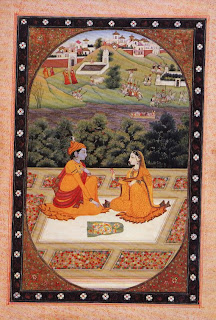
According to the text on its reverse (see
Appendix), this painting is an illustration from a Baramasa (The twelve months)
series of the month of Chaitra (March-April), which is the first month of the
traditional Indian calendar. The verses describe the splendor of the blossoming
spring landscape and the sexually exhilarating effect of the season on peacocks
and maidens. The painting depicts Krishna sitting on a garden terrace with
Radha, who is trying to persuade the blue-skinned lord to stay with her rather
than go traveling during the month. In the background of the painting are a
landscape) and a river that is rendered with fine, parallel lines reminiscent
of Western engraving techniques. There is also a town, temple tank, and walled
compound, as well as numerous inhabitants portrayed in an impressionistic
manner. A mid-nineteenth-century date for the painting is suggested by the
background features as well as the figural and clothing style of Krishna and
the distinctive zigzag hemline of Radha's garment (cf. Leach, p. 301, no. 129).
The Baramasa literature of medieval
northern India consists of various cycles of oral and written celebrations of
the seasonal varieties of the behavior and feelings of lovers over the course
of the twelve lunar months of the year. Verses devoted to the twelve months
survive from at least as far back as the twelfth century and were particularly
popular during the fourteenth through sixteenth centuries in Bengal, Gujarat,
and Rajasthan (Vaudeville). Ancient Sanskrit verses glorifying the seasons
exist, such as the Ritusamhara (Collection of the seasons) by the great poet
and playwright Kalidasa (c. 365-c. 455), but these are specifically concerned
with the traditional six Indian seasons of spring, summer, the rains, autumn,
winter, and the cool season rather than with the twelve months of the year. The
majority of Baramasa verses composed primarily of village women's folk songs or
literary poems written in the various regional vernacular languages emphasize
the pain of a young wife's separation from her beloved. Descriptions of the
different seasons are paired with diverse feelings of longing to evoke the
individual mood of each month. Greater emphasis is given to the four months of
the rainy season (June through September) than to the remainder of the year,
and a select grouping of songs and poems, the Caumasa (Four months), even
evolved to celebrate the especially emotive rainy season, which is
traditionally connected with the laments of lovers in separation.
Among the best known of the poetic
expressions of the Baramasa are those contained in the tenth chapter of the
Kavipriya (The poet's breviary), a work on rhetoric written in 1601 by
Kesavadas for his patron Indrajit Shah's favorite courtesan, Pravinaraye. The
Baramasa verses in the Kavipriya describe the monthly climates and activities
of Indian life and relate them to the joys and sorrows of lovers. It was these
poems by Kesavadas, rather than the village Baramasa folk songs, that were
favored and illustrated by Pahari painters.
Writer
Name: - Pratapaditya Pal
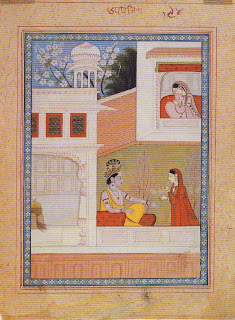
This painting depicts Krishna seated in a
palace courtyard talking to a handmaid of Radha, who is shown beyond them in a
bedchamber. Behind Krishna is a room with a large brass pot heating over a
fire. A label in the upper border identifies the scene as "Upapati!
Paramour! no. 194," and the text on the reverse of the painting (see
Appendix) describes the demure eye contact of the divine lovers and mentions
the fire in both the hearth and Krishna's heart.
The painting is thought to illustrate a
passage from the Satsai (Seven hundred I verses!), one of the four great jewels
of Hindi literature. Intriguingly, however, the inscribed verse does not
correspond to the one given in the standard edition of the Satsai, which varies
from other known versions of the text in the number and content of the verses
(Holland, PP- 4-5).
The standard Salsa; consists 01 713
poetic verses, primarily in celebration of the romance of Radha and Krishna.
The remaining verses describe nayakas and nayikas and the romantic sentiments
associated with the six seasons of the Indian climate (sec no. 30). It was written
by Bihari Lal Chaube (1595-1664), who was born in Govindpur, near Gwalior in
Madhya Pradesh, into the mixed caste of Rays, which also produced several other
well-known Hindi poets (Randhawa 1966, p. 15). As a child Bihari Lal moved with
his family to Orchha and later to Mathura. It was in the latter city that Bihari
Lal must have learnt "Braj-Bhasha," the dialect of Hindi in which the
Satsai is written and which was current around Mathura, the homeland of
Krishna, and was frequently used for the deity's devotional poetry and song
lyrics. Bihari Lal enjoyed a profitable tenure at the court of Amber under jai
Singh I (r. 1625-67), for whom the Satsai was reportedly composed in 1662
(Grierson, pp. 4-5; and Leach, p. 271). Illustrations of the Satsai were
particularly popular in Pahari painting, especially in Kangra during the reign
of Sansar Chand (r. 1775-1823), under whose lavish patronage this work was
produced.
Stylistically, this painting is a good
example of the refined almost overly so expression found in Kangra painting.
The soft palette and delicate ambience are the hallmark of the realm's
workshops and are particularly adept at conveying the romantic connotations of
the popular theme of love.
Writer
Name: - Pratapaditya Pal
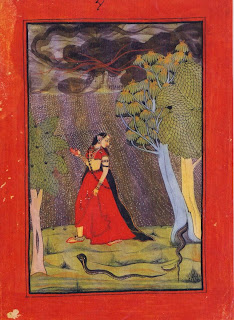
The
heroine of this painting represents the type who braves a fierce night storm in
order to keep her rendezvous with her lover (abhisarika). Steadfast in her
determination and quest, the heroine is heedless of the danger of the raging
storm's lightning and blinding rain. She ignores the cobras slithering by her
feet as well as the loss of gold ornaments in her haste. Indeed, her ardor
burns like an ascetic's penanc9 In the Rasikapriya, Kesavadas tells of the
wives of the goblins of the forest commonly represented in paintings of this
type but oddly absent here who ask the heroine, "Whence have you learnt
this yoga? Oh Abhisarika, how marvellous this trysting!". The imagery of
the impetuous heroine in theft storm was the most popular of all the nayikas to
be portrayed in the painting of the Panjab Hills. It is conceptually related to
the theme of Sohni braving the river's raging currents to meet her lover
Mahinwal.
A
mixture of styles is present in this painting. The figure follows Garhwal
conventions and, in fact, is based on earlier Garhwal nayikas from about
1770-8o. In contrast, the landscape and sky are more akin to Kulu pictorial
traditions in their treatment and palette. This stylistic plurality apparently
caused even a leading scholar of Pahari painting, Karl Khandalavala, to
attribute it to an "unidentified" workshop. Pigment analysis and a
technical examination support a date in the early nineteenth century for the
painting, so the possibility of a modern stylistic pastiche can be ruled out.
The
most likely solution to the question of the painting's origin, suggested by Roy
Craven (personal communication) and followed here, is that it was executed by
the well-known poet and painter of Garhwal, Mola Ram, whose literary skills are
generally considered to have exceeded his pictorial ones. Indeed, certain
details, such as the distinctive earring, exaggerated curve of the bangles,
treatment of the storm clouds, and the lackluster draftsmanship of the figure,
all accord with Mola Ram's known works.
Writer Name:- Pratapaditya Pal
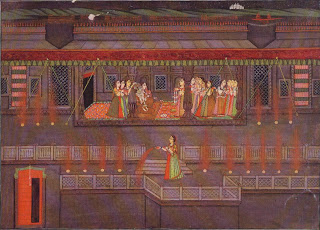
This painting presents Krishna and Radha
in a Mughal-style palace pavilion enjoying a feast and night fireworks. In
addition to the sparklers in the foreground, the numerous flames along the
roofline and those outlining the five palaces rising out of the lake in the
background suggest that the scene is taking place during the popular Dipwali
Festival of Lights. A song verse inscribed on the back of the painting
describes the feast and the participants, but fails to mention the reason for
the festivities (see Appendix).
The chronology of Kishangarh painting is
controversial, but it is generally considered to have begun by about 1700 with
an emphasis on secular portraits. The production of the atelier flourished
between about 1735 and about 1770, during which time images of Radha and
Krishna were the favorite theme. The leading artist of Kishangarh, Nihal Chand,
is known from inscriptional and archival evidence to have worked from at least
1757 to 1773. His son, Sitaram, continued to paint in his father's dramatically
stylized manner (see Leach, pp. 185-88, no. 71). A less inspired, stereotyped
version of Nihal Chand's style was continued into the early nineteenth century
by the succeeding artists, of the Kishangarh workshop. The shorter figures,
schematic landscape, and awkward treatment of the architecture in this painting
suggest a date of execution during this late phase.
Writer
Name:- Pratapaditya Pal
Kishangarh
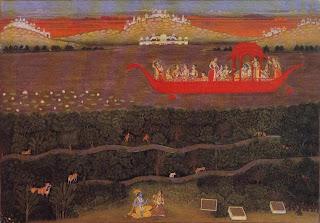
painting, in addition to its distinctive facial style, is also renowned for its
spectacular sunsets and panoramic landscapes. Epitomizing that tradition, this
painting features a brilliant, fiery sunset in dramatic counterpoint to its
rolling green hills, white palaces, and the prominent Lake Gundalao. The grand
vistas shown in Kishangarh paintings must, however, be viewed with a deeper
symbolic meaning than mere landscape. For, just as Krishna and Radha roamed the
fields and forests of Brindavan, so too did Savant Singh and Bani Thani in
their devotional emulation of the divine couple. In place of the rural terrain
of Brindavan, the Kishangarh artists depicted the palaces and pleasure gardens
of their own court as a setting for the lovers.
Although
the ostensible subject of most Kishangarh paintings is the romance of Radha and
Krishna, on another level of interpretation the paintings can be seen as
allegories for the love of Savant Singh and Bani Thani, as well as symbolic
equations of the divine and secular lovers. Although never explicitly
expressed, this metaphorical identification is intimated by the presence of
Savant Singh/ Nagari Das's poetry on the back of a number of the works.
Radha
and Krishna are portrayed twice in this painting: once surrounded by female
attendants in the prominent royal barge and again at the bottom, alone in a
forest grove. This scene of continuous narration may illustrate a poem by
Savant Singh that describes the ideal couple as first boating on the Jamuna
River in Brindavan and subsequently trysting in a forest glen.
Writer Name:- Pratapaditya Pal
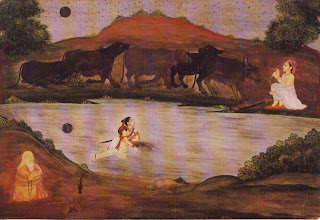
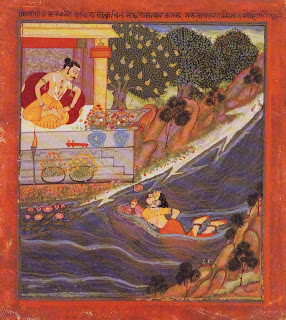
These two paintings illustrate the tragic
tale of Sohni and Mahinwal, two young lovers who are said to have lived during
the early seventeenth century in a small village in the Panjab, an area famous
for its association with great lovers. Both paintings feature the key
identifying motif of Sohni floating across a river on an overturned earthenware
pot for her nightly tryst with her lover. The set imagery used to illustrate
the romance usually includes Mahinwal tending his buffaloes on the far bank and
his ascetic companion seated by the river's near edge, as in the Oudh example
(A), but these features are curiously absent in the Mewar painting (a) where,
uniquely, Mahinwal is represented as waiting for his nightly tryst in a small
thatched pavilion decorated as an elegant bed chamber. The text above painting
a conveys Sohni's apprehension about attempting the perilous river crossing. In
painting A both Sohni and Mahinwal are portrayed with sheathed swords graced
with golden hilts. Although not explained by any literary narrative, this
feature is typical of most paintings of the lovers and may pictorially suggest
their popular elevation to noble heroes in their ultimately futile struggle
against rigid social mores.
According to the legend, Mahinwal, whose
given name was Mirza Izzat Beg, was the son of a wealthy merchant-ruler in
Turkestan who was returning home with a merchant caravan after traveling
throughout northern India. After passing Lahore, the caravan stopped near the
town of Gujrat, where Izzat Beg chanced upon a radiant young beauty tending her
father's pottery shop. Her name was Sohni, meaning "beautiful." Izzat
Beg was so overwhelmed by her loveliness that he abandoned the caravan to
remain with Sohni, who soon came to reciprocate his ardor. Izzat Beg then
managed to be hired by Sohni's father and was put to work tending the family's
buffaloes across the river. Thus he acquired his more popular name, Mahinwal,
meaning "buffalo herder."
Sohni and Mahinwal's clandestine affair
continued until it was discovered by her mother and Mahinwal was ordered to
never again see Sohni, who was quickly married to another potter's son and sent
to her husband's family home. The distraught Mahinwal went to live with an
ascetic near the river, but after accidentally meeting one day, the couple
decided to resume their illicit relationship. Every night thereafter Sohni swam
across the river using a large baked earthenware pot as a float. But Sohni's
sister-in-law soon discovered the lovers and switched an unfired pot for the
one used by Sohni to cross the river. That night a fierce storm hit, yet Sohni
ignored the danger and jumped into the raging river with the deadly pot. The
pot dissolved in midstream and Mahinwal leapt into the river to save his
beloved, but the current was too strong and the lovers sank into legend.
Sohni and Mahinwal's clandestine affair
continued until it was discovered by her mother and Mahinwal was ordered to
never again see Sohni, who was quickly married to another potter's son and sent
to her husband's family home. The distraught Mahinwal went to live with an
ascetic near the river, but after accidentally meeting one day, the couple
decided to resume their illicit relationship. Every night thereafter Sohni swam
across the river using a large baked earthenware pot as a float. But Sohni's
sister-in-law soon discovered the lovers and switched an unfired pot for the
one used by Sohni to cross the river. That night a fierce storm hit, yet Sohni
ignored the danger and jumped into the raging river with the deadly pot. The
pot dissolved in midstream and Mahinwal leapt into the river to save his
beloved, but the current was too strong and the lovers sank into legend.
Contrary to the illustrations of literary
romantic themes and the loves of Krishna, which are all of Hindu cultural
origin, paintings depicting Sohni and Mahinwal are based on a supposedly
historical incident and are primarily associated with various Muslim and Sikh
literary traditions that narrate the tragic fates bf hapless lovers. These
often repeated love stories, especially those from the Panjab, typically
involve couples whose affairs of the heart generated universal appeal and
ennobled them with a poetic and courtly stature. Sohni's act is analogous to
that of the heroine who braves the perils of the forest on a stormy night to be
with her lover, and the same emotional charge of heedless desire must be
understood as underlying the legend and its representations.
The romance of Sohni and Mahinwal was
popular at most of the major courts across northern India, with the majority of
the tale's illustrations dating from the third quarter of the eighteenth
century. In the nineteenth century some illustrations of Sohni and Mahinwal
achieved a new level of cultural relevance with the sudden trans-formation of
Mahinwal and his associated imagery into that of Krishna. This socio-logical
and artistic phenomenon demonstrates Krishna's immense appeal and is another
example of his cult's assimilation of diverse religious and romantic legends.
Writer
Name:- Pratapaditya Pal