ArtofLegendIndia.com, Biggest Online Store of Handicrafts Items, Paintings and Jewelry Accessories...

Handicrafts

Handicrafts are devices or works of art that are made completely by hand or by the use of relatively simple tools. Such goods are usually made in the traditional way of manufacturing goods. Therefore, the knowledge of the art of craft is usually passed down from one generation to another. The items made using these traditional methods of manufacturing are usually produced in smaller quantities and they often represent the culture or religious beliefs of the community that makes them. The goods are also handmade from natural materials that are found in the environment of the particular economy.

Read More!

Biggest Online Store of Handicrafts Items

Paintings

A painting is equal to thousand words, means a beautiful painting is equal to million of words. Paintings are one of the oldest art forms -- throughout history artists have played an important role in documenting social movements, spiritual beliefs and general life and culture.

History Of Paintings: The history of painting reaches back in time to artifacts from...

Read More!

Biggest Online Store of Unique Style Paintings
Showing posts with label Paul Cezanne. Show all posts

French Great Artist Paul C'ezanne - The Landscape of Provence

Posted by Art Of Legend India [dot] Com On 10:22 PM 0 comments
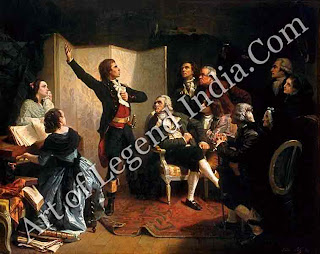
The Marseillaise, The people of Provence were enthusiastic supporters of the French Revolution. Indeed, the national anthem a revolutionary marching song was first used by troops setting out from Marseilles.

The Landscape of Provence

Unlike the Impressionists, who painted numerous scenes of city life, Cezanne never felt at home in Paris. He returned to his native Provence to find the inspiration which eluded him in the capital.

Paul Cezanne began his painting career at a time when the artistic world was firmly focused on Paris. The early Impressionists all studied there, and even when they travelled into outlying villages, or to the coast of Normandy, they still returned repeatedly to the capital to exhibit and attempt to sell their paintings. But Cezanne, shy and socially inept, was never really suited to Parisian life. During the eight years he spent there, from 1863 to 1870, he was happier wandering alone in the hills outside the capital than drinking and debating with the urbane, avant-garde artists of the Café Guerbois.

THE MOUNTAINS AND THE SEA 
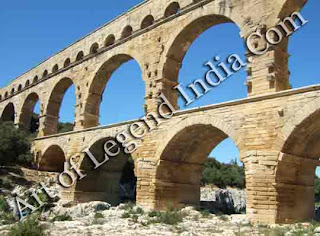
A Roman province Provence derives its name from the days of the Roman Empire, when the region was known as Provincia Romana. Among the many classical remains is this magnificent aqueduct, the Pont du Gard, which was built in about 19BC.When the Prussian army invaded France in 1870, Cezanne returned south to his home town of Aix-en-Provence partly to avoid conscription. The environment he found there was not only more familiar, but offered an atmosphere totally opposite to the metropolitan sophistications of Paris. Instead of the grey chill of the northern winter there was dazzling sunlight and warmth for most of the year; instead of narrow cobbled streets there were massive granite mountains, fast-flowing rivers and the blue Mediterranean Sea; instead of jostling crowds and short-lived fashions there was solitude, a slow pace of life and a reassuring sense of timelessness.
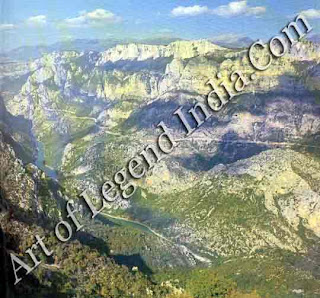
The rugged landscape, The barren countryside of Provence provided continual inspiration to Cezanne, who emphasized the underlying geological forms of the mountains and the coastline in his drawings and paintings.
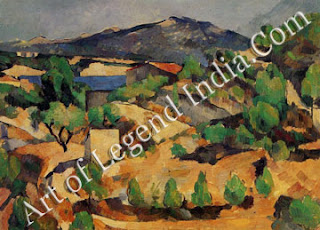
The landscape of Provence became one of the principal inspirations of Cezanne's work. He painted it with a relentless intensity that few artists have devoted to any subject, creating dozens of images of favourite motifs, above all the Mont Sainte-Victoire. In 1886 he wrote to the collector Victor Chocquet, 'there are treasures to be taken away from this country, which has not yet found an interpreter equal to the abundance of riches which it displays', and 30 years later, a few weeks before his death, he was still so entranced with the landscape that he wrote to his son: 'I think I could occupy myself for months without changing my place, simply bending a little more to left or right.' Yet the hundreds of paintings and drawings Cezanne produced of Provence tell us little about the region. He concentrated on the underlying, unchanging structure of the landscape, and did not usually represent a particular time of day or even a particular season. There is nothing anecdotal about his pictures and they usually contain no figures or other evidence of human activity. Houses are often included, but they are treated as part of the landscape, and he never painted the town of Aix itself.

AN INDEPENDENT PEOPLE
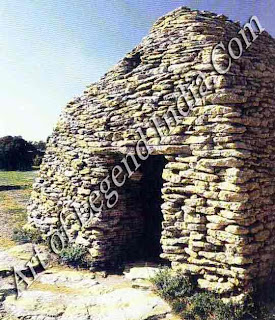
Ancient relics, These drystone huts, or 'bories', found in the highlands of Provence, testify to the antiquity of human settlement in the region. Some 400 miles from Paris, isolated from the north by the Alps and the rugged plateau of the Massif Central, Provence was like a separate country in Cezanne's day. Rail links with the north, only recently completed, had done little to break down an attitude of sturdy independence that dated back to Roman times, when the region first earned its name as 'Provincia Romana'. Nor had the lifestyle of its inhabitants changed greatly over the centuries a description by the Roman fl historian Posidonius remained as true in the 19th century as the day it was written in the 1st century BC: The country is wild and arid. The soil is so stony that you cannot plant anything without striking a rock.' The population had remained largely rural, with peasant agriculture the mainstay of the economy.

Provence's stormy history had, if anything strengthened its differences from the rest of France. After the Romans, the Barbarians, Franks, Saracens and Normans all left their bloody mark upon the region, attracted by its strategic position between Spain and Italy at the mouth of the River Rhone. Right up until the time of the French Revolution it was rare for Provence to enjoy long periods of peace or stability. But the Revolution was welcomed by the southerners, who believed it would lead to more independence from the 'Parigots', as they contemptuously called those from the capital. It was in Marseilles that the French national anthem the Marseillaise first rang out in 1792. Three years before, the red, white and blue national flag known as the tricolour was raised in the small Provencal town of Meringues.
Even in Cezanne’s time, the inhabitants of Provence maintained a strong sense of regional pride, underpinned by the local dialect, impenetrable to outsiders. Cezanne sometimes used it in the Café Guerbois when he wished to be pointedly anti-social. However, this traditional language was diminishing in use, as the 'standard' Parisian dialect became obligatory for those engaged in commerce. To try to stop the decline, a poet called Frederic Mistral, with seven other Provencal literary figures, formed a society in 1854 'to rise up, honour and defend the mother tongue, now so sadly despised and neglected'. The campaign was enthusiastically received and the society's review L' Armana Prouvencau (the Provencal Almanac) became fashionable reading, but it could not reverse the steady decline in everyday use of the language.
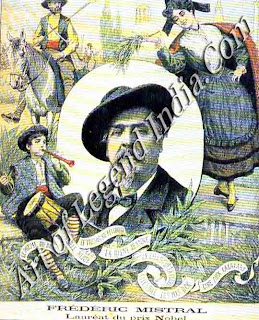
The Provencal language, In the 19th century, Provencal declined rapidly as a spoken language, but in 1854 the local poet Frederic Mistral formed a society to revive its use.
Although time seemed to have stood still in many parts of Cezanne's Provence, changes were occurring on the coast that was to transform the region's image, as the Riviera became a luxurious holiday playground. The fashion for staying there was started by Lord Brougham, Lord Chancellor of England, who had to stay in Cannes in 1834 during a cholera outbreak which delayed his intended journey into Italy. He liked it so much that he returned regularly for the next 30 years. Monte Carlo became probably the most famous of the resorts associated with conspicuous high-living, and its celebrated casino opened in 1861.

A HAVEN FOR ARTISTS 

Although the railway linked Aix with Cannes and Nice, Cezanne was more attracted to the coastline nearer home especially the village of L'Estaque, of which he painted some memorable pictures. The scenery around L'Estaque was renowned for its beauty, as Zola's description testifies: 'A village just outside of Marseilles, in the centre of an alley of rocks which close the bay. . . The country is superb. The arms of rock stretch out on either side of the gulf, while the islands, extending in width, seem to bar the horizon, and the sea is but a vast basin, a lake of brilliant blue when the weather is fine.
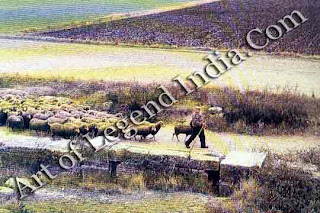
The farming tradition In Cezanne's time, most of the population still lived in the countryside, eking out a living as peasant farmers. Here a Provencal shepherd leads his flock past the ruins of a Roman watermill in the countryside near Although Cezanne was the first painter to make the Provencal landscape a major subject of his work, he was not the only great artist of his period to be attracted to the region. Van Gogh lived at Arles from 1888 to 1890, and was visited .f there by Gauguin in 1888. Van Gogh had intended forming an artists' colony at Arles, and although this came to nothing, the fact that he and the other two founding figures of modern art worked in Provence has, from the early 20th century, played a part in luring other artists there. Most of the major figures who have worked there have been drawn to the Cote d'Azur in the east of the region. Matisse is particularly associated with Nice, and Picasso with Antibes; Renoir built a villa at Cagnes towards the end of his long life.
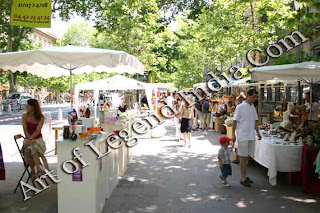
Aix-en-Provence The Cours Mirabeau a wide avenue with majestic plane trees which runs through the centre of Aix was a familiar sight for Cezanne. It had been the peal point of the town since the trees were first planted in the 17th century.
Provence today is proud of its artistic heritage. Antibes has a Picasso museum, for example, and Nice has museums devoted to both Chagall and Matisse. Yet the home town of Provence's greatest artist cannot boast any important examples of his work. Cezanne's studio in Aix (in a street that has been renamed the Avenue Paul Cezanne) is open to the public, but the Musk. Granet in Aix has only a few minor paintings and drawings among its predominantly classical collection of paintings from the 16th to the 19th centuries. The director in Cezanne's day was an arch-conservative who vowed that no Cezanne would ever hang there so long as he had power to prevent it.

Auguste Henri Pointier kept his word until his death in 1926, by which time Cezanne's master-pieces had been dispersed around the globe. Yet in one way this is not inappropriate, for Cezanne was committed to the enduring and universal values of his landscape rather than its topographical details. His genius belongs to the world, not just one particular place.

Writer – Marshall Cavendish

French Great Artist Paul C'ezanne - A Year in the Life 1900

Posted by Art Of Legend India [dot] Com On 12:34 AM 0 comments

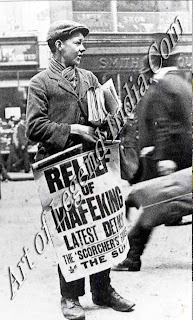
Mifeking relieved The defence of Mafeking besieged by the Boers from 12 October 1899 to 17 May 1900 became a symbol of Britain's struggle against the Boers. Crowds celebrated in the streets when news reached London that the isolated garrison had finally been relieved. A Year in the Life 1900

As France celebrated her imperial prestige with a huge exhibition in Paris, Europe's colonial powers reaped a bitter harvest abroad. In Peking, Chinese nationalists rose against the foreigners and in South Africa, Britain was locked in a vicious struggle with the Boers. The South African War brought the dawning century two hideous innovations: guerilla combat and concentration camps.

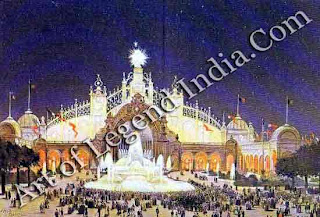
On 14 April 1900, M. Loubet, the President of the French Republic, opened the greatest international exhibition the world had ever seen. Total attendance at the Exposition Universelle de Paris, which ran until 11 November, numbered 50 million an average daily attendance of 24,000. Visitors toured the site on an electrically-powered moving platform with three tiers, each rolling at a different speed. And for the first time the public saw X-ray photography, wireless telegraphy and cars.

DELIGHTS OF THE EAST 

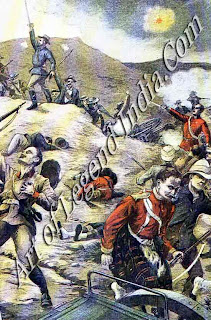
Victories for the Boers In the first months of the South African War (1899-1902) the Boers shown here in their distinctive, broad-brimmed hats inflicted stinging defeats on British forces. They had invaded the Cape Province in a desperate attempt to prevent Britain from annexing the Transvaal.In contrast to these technological achievements there was the exotic exhibition of the colonies, housed near the Eiffel Tower. This included French colonies and protectorates and those of other nations, though the term 'colony' was somewhat loosely defined: alongside the Tunisian pavilion, and those for Madagascar, Algeria, Senegal, the French Congo and India, were pavilions dedicated to Siberia, Egypt, China and Japan.

Life in the colonies was reconstructed with mosques, temples and entire villages, to show how the indigenous population might live. There were Cambodian and Indian dance theatres, a 'diorama' painted with desert scenes flanked by an Arab quarter where visitors could sample the delights of North Africa, and a 'stereorama' composed of a revolving circular backdrop painted to give the impression of travelling by ship along the coast of Algeria.

If colonial adventures were a success in Paris, they were a disaster in London. Since the beginning of the year, the Boer

War in South Africa a bitter struggle between Dutch and British colonists for control of the Transvaal had cost thousands of lives. Gold had been discovered there in 1886, transforming the poor agricultural region farmed by the Boers into one of the wealthiest in Africa, and tension had mounted steadily. In October 1899, the High Commissioner Sir Alfred Milner rejected an ultimatum from the Boer leader Paul Kruger to withdraw British troops.

BRITISH UNDER SIEGE 

Paris Universal Exhibition, The Palace of Electricity, with its illuminated fountains, was a centerpiece of the vast 1900 exhibition, which extended over 267 acres along the Champs Elysees and both banks of the River Seine.
The Boers attacked British positions and in one 'black week' of December 1899 the three divisions of the British Army under Sir Redvers Buller (subsequently known as Sir Reverse Buller), were defeated and holed up in Ladysmith, Kimberley and Mafeking. Boer forces outnumbered their adversaries by three to one; they were all mounted, familiar with the terrain, and excellent marksmen armed with German Krupps rifles.

In January, Buller failed disastrously to relieve Ladysmith, losing 1,700 men at Spion Kop, and Lord Roberts was sent from England to take overall command. The tide soon turned. Roberts reformed the army and outmaneuvered General Cronje, the Boer military leader, before relieving Kimberley on 15 February; 12 days later Cronje was forced to surrender. On 28 February, Buller's fifth attempt to relieve Ladysmith succeeded, and from March until June Roberts continued his Advance through Bloemfontein, Johannesburg and Pretoria. On 17 May, Mafeking was relieved, ending a 215 day siege for Robert Baden-Powell (founder of the Boy Scout movement) and his soldiers. The Daily Express, Britain's jingoistic newspaper founded the previous month, blazoned the news 'History's most heroic defence ends in triumph', and when the news was announced from the stage in London's theatres, wildly enthusiastic crowds rushed out to celebrate in the street.

By September the last of the Boer army in the field had been defeated, all British prisoners of
war had been released, Kruger had fled to Portuguese territory, and the Transvaal had finally been annexed to Britain. Roberts handed over command to General Kitchener for what was assumed to be a simple mopping-up operation. But the war was far from over. In fact, the period from September 1900 until May 1902 proved the most bitter of all, for it was the first time a European power experienced a guerilla resistance movement. Kitchener fought back with a drastic scorched earth policy, even introducing his notorious 'concentration camps', where rebels including women and children were coralled in such atrocious conditions that over 20,000 died.

REBELLION IN CHINA

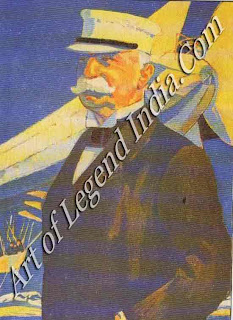
Count Zeppelin, Ferdinand von Zeppelin (1838-1917) was a German soldier and airship designer, who fought in three wars including the American Civil War before retiring as a lieutenant-general in 1891. In 1900 his famous g airship made its maiden flight above Lake Constance, in southern Germany. In the autumn, Kruger travelled to Europe to seek help for the Boers. The continent was generally pro-Boer but even his most likely supporter, Kaiser Wilhelm II of Germany, refused to see him. Events far away in China had signalled an urgent need for European co-operation, with the first stirrings of the 'Boxer' rebellion its name deriving from 'the fist of righteous harmony'. The rebels were pledged to rid China of foreigners.

On 20 June the Boxers had murdered the German consul in Peking, as a prelude to a siege of foreign legations. In their xenophobic zeal, they also destroyed much of their own heritage an arson attack on a foreign warehouse inadvertently burnt the business quarter of Tientsin to the ground, and also destroyed the Chinese equivalent of the British Museum.

END OF THE MANCHUS 

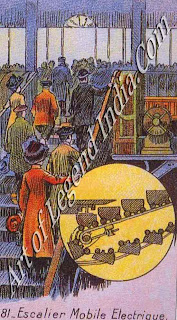
The first escalator, The electrically-driven moving staircase, patented in the United States during the 1890s, was developed by the Otis Elevator Company and first installed at the Paris Universal Exhibition in 1900.
The revolt was short-lived, for in August an international force, which included American, Japanese and European troops, seized Peking and hanged the rebels' heads in cages from the city walls. The rising spelt the end for the Manchu dynasty.

For Europe's royalty too, 1900 was an ominous year. Queen Victoria was reaching the end of her long reign she died the following year, aged 82. On 4 April there was an assassination attempt on the Prince of Wales; on 29 July King Humbert I of Italy was shot dead by an anarchist named Bresci; and on 16 November a woman threw a hatchet at the German Kaiser, though she succeeded only in damaging his carriage.

Other developments in Germany were more ominous still. On 6 June the Reichstag passed the Germany Navy Bill a 20 year plan to build 19 battleships, 8 large and 15 small cruisers, at a cost of 861,000,000 marks. And Count Ferdinand von Zeppelin's enormous airship, which was to become such a dominant feature of the First World War, had its maiden flight, rising to a height of 1,000 feet with its inventor on board.

Writer – Marshall Cavendish
Frenchish Great Artist Paul C'ezanne - The Geometry of Nature

Posted by Art Of Legend India [dot] Com On 3:19 AM 0 comments

The Geometry of Nature

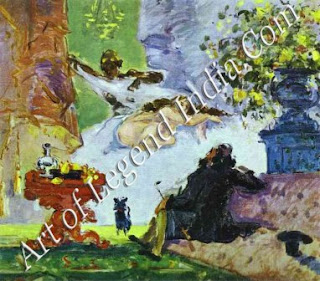
A Modern Olympia (1872-73),This parody of Manet's Olympia provoked a storm of abuse at the 1874 Impressionist exhibition: critics described Cezanne as a drug-crazed lunatic.
Toiling alone on the hillsides of Provence, Cezanne developed a new way of painting the natural world. He sought beneath the surface for the essential elements of nature's geometry.

'In all the history of art, there has seldom been a painter whose early style differed so greatly from that of his maturity', wrote the critic Rene Huyghe. Indeed, it is hard to see any resemblance between the subtle, deliberately balanced canvases of Cezanne's mature years, and the morbidly violent and erotic pictures of his twenties, which often give the impression of having been created in frenzy. For a time Cezanne abandoned the brush for a palette knife, slapping on the paint. And as if to emphasize his personal involvement with these fantasies, he often included a picture of himself within the painting: he appears as the balding onlooker in A Modern Olympia.

Gradually, Cezanne turned to the outside world for inspiration. As early as October 1866, he wrote to his friend Emile Zola that 'pictures painted inside, in the studio, will never be as good as those done outside'. But, oddly enough, it was not until the 1870s that he followed up this insight. By that time, Pissarro and his friends Monet and Renoir had discovered most of the techniques of Impressionism, which Cezanne was to learn during his association with Pissarro at Pontoise.

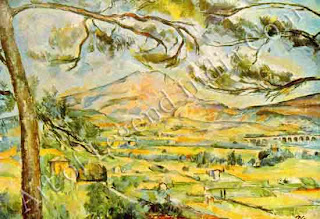
Mont Sainte-Victoire (1885-87), This rugged mountain near his family home held strong emotional associations for Cezanne. He described it to Zola in 1878 as a 'stunning motif and painted it obsessively for the next three decades. In 7 this version, the contours of the distant mountain are echoed by the branches a' of the pine tree.
Impressionism turned Cezanne into an outdoor painter a dusty, weather-beaten figure with a broad-brimmed hat and heavy boots who tramped the countryside every day with his pack slung across his shoulders. But though Cezanne never abandoned this way of working, he soon became dissatisfied with some aspects of Impressionism. He had a stronger sense of construction than his contemporaries, whose paintings tended to dissolve objects in a play of dazzling light. He wanted to retain the brightness and freshness of Impressionism but make of it 'something solid and durable, like the art of the museum'.


BEYOND IMPRESSIONISM 

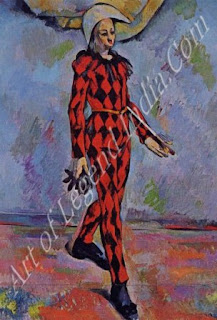
Harlequin (1888-90) Cezanne's son Paul modelled for this painting, but his features have been simplified beyond recognition into a haunting image of the lonely clown.
He adapted the distinct, blocky dash-like strokes, which broke up forms in Impressionist paintings, using them instead to construct form. In the late 1870s, they became a repeated pattern of regular oblongs of paint, arranged in parallel across his pictures, as in the Chateau at Medan. As well as giving solidity to the forms in the picture, the repetition and regularity of these paint marks emphasized the painting's surface unity.

Indeed, as his personal style developed, Cezanne became determined that the flat, two-dimensional nature of the painting should not be denied. He was not interested in imitating the real world: he called his paintings 'constructions after nature', in which essential elements from the three-dimensional world were reassembled on a flat canvas. And to represent the real spatial relationships between objects without breaking up the flatness of the canvas, he devised his own method: the so-called 'flat-depth', which has been called 'one of the miracles of art'.

Cezanne achieved his aim in various ways: by overlapping patches of paint so that one appears to be in front of the other, by depicting objects from several angles at once, apparently pulling them towards the surface, and by exploiting the visual phenomenon whereby warm colours (reds and yellows) appear to come towards us, while cold colours (blues and greens) seem to recede. And instead of modeling his subjects with light and shade, Cezanne 'modulated' form with colour.

Patches of paint, In late works such as The Turn in the Road (1900-6) Cezamie developed a freer system of painting, using a sequence of squarish paint marks, often set against bare patches of canvas.
This unique system of painting did not come to Cezanne in a flash of inspiration: he developed it slowly and laboriously the same way, in fact, that he painted each picture. He would work on a painting for months, sometimes years, always addressing the entire canvas simultaneously, not painting it section by section. A dab of colour here would be balanced by another colour there, and so on, building up the painting as a coherent whole. This painstaking process was at the opposite extreme to his early emotional outpourings.

A NEW FREEDOM 

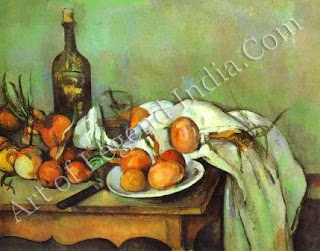
Still-life with Onions, Cezanne painted almost 200 still-lives. Making repeated use of  small set of household objects, along with everyday fruit and vegetables, he created an infinitely varied series of compositions.
Yet in Cezanne's later pictures, from the 1880s onwards, a new kind of expressive freedom emerged. Where his first paintings had been overstated and clumsily executed, these late paintings show the economy and subtlety that comes only when an artist has mastered his medium. His paint became thinner, his colours richer, and the rigidly regular strokes of paint became more loosely painted patches of colour often set beside patches of bare canvas, as in The Turn in the Road. It was a revolutionary way of painting, which laid the foundations for the major art movements of the 20th century, from Cubism to abstract art. Perhaps because of his strong desire to organize nature, Cezanne became one of the great masters of a type of painting that had largely fallen into neglect the still-life. He could choose and arrange natural elements himself, not hesitating to wedge them or prop them up to secure exactly the arrangement he wanted.

Human beings were irritatingly more difficult to arrange. 'Apples don't move!' Cezanne once snapped at a weary sitter. Impatient and uneasy with people, until late in life he could only tolerate his own family or close friends as portrait models.

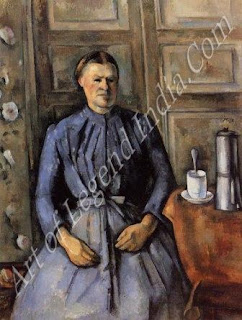
Woman with a Coffee Pot (1890-94) Cezanne treats this portrait in the same way as a still-life. The woman his housekeeper is as angular and impersonal as the cup beside her, with its unnaturally upright spoon. He once wrote that 'Painting stands for no other end than itself. The artist paints an apple or a head: it is simply a pretext for line and colour, nothing more'.
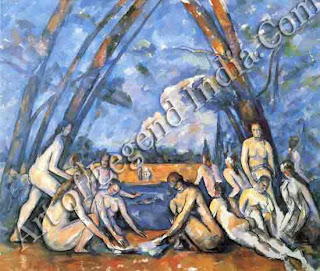
Cezanne was even less able to cope with nude models, and his bathing scenes were painted with the aid of photographs. These scenes represent a more openly emotional strain in his work, probably related to the painted orgies and violence of his youth. But as an artist, at least, Cezanne had tamed his demons, and in a picture such as The Great Bathers the figures have become part of the landscape, sharing its beauty and order.

Particular places were important to Cezanne. He painted almost exclusively in the environs of Paris and in his native South. The hard outlines of the Provencal landscape encouraged his quest for a 'solid and durable' art: 'I am passionately fond of the contours of this country,' he wrote. He painted certain places many times above all Mont Sainte-Victoire, the mountain that dominates some 60 of Cezanne's paintings.

Even at the end of his life, Cezanne was still advancing yet he still grumbled. 'I am beginning to glimpse the Promised Land,' he wrote 'but why so late and with such difficulty?'

Writer – Marshall Cavendish
French Great Artist- P.C'ezanne Painting Gallery

Posted by Art Of Legend India [dot] Com On 2:33 AM 0 comments
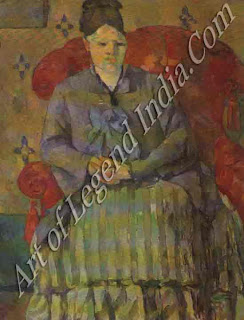
Cezanne's distinctive style, which imposed a new kind of order on nature, establishes him as one of the founders of modern art. His painting reached maturity in the 1870s: the portrait of Madame Cezanne shows him simplifying and distorting her image in the interests of artistic unity. Boy in a Red Waistcoat continues the same trend.

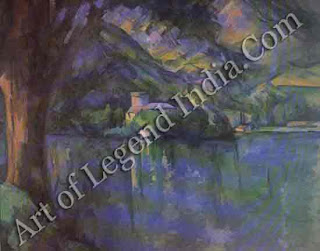
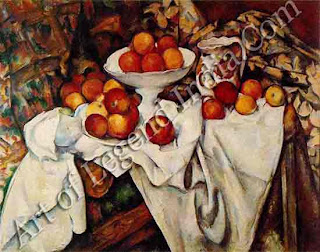
Cezanne was happiest painting people and places he knew well: the sturdy Provencal Card Players, for example, and The Great Pine. He was less productive away from his home ground, although paintings such as the Lake at Annecy bear his unmistakable stamp. And he produced numerous works in his studio, where he was free to organize the natural elements   for still-life such as Apples and Oranges.

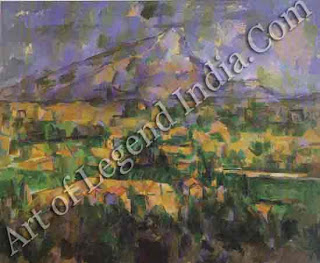
Around the turn of the century, Cezanne's painting became freer, more fluid and even more simplified. This can be seen in The Great Bathers and Mont Sainte-Victoire, where his system of painting with patches of pure colour paves the way for abstract art.

The Great Artist Paul Cezanne “Madame Cezanne in a Red Armchair” 1877 28 ½ " x 22" Museum of Fine Arts, Boston Painted nine years before they married, Cezanne's portrait of Hortense is remarkably impersonal. He was less concerned with revealing his mistress's character than with the way the cool tones and flattened stripes of the dress are enveloped by the warm pinks and rounded shapes of the armchair.


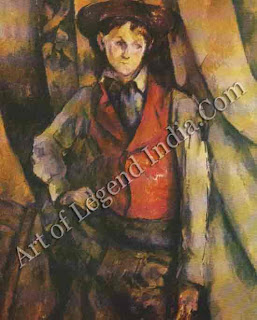
The Great Artist Paul Cezanne “Boy in a Re Waistcoat” 1890-1895 36 ¼" x 28 3/4" Collection of Mr. and Mrs. Paul Mellon, Upperville, Virginia
Although he rarely used professional sitters, Cezanne made four oil portraits of this young Italian model, Michelangelo di Rosa. The boy stands with hand on hip, in the classic pose of the life-class nude, the curve of his body counterbalanced by the swinging drapery.


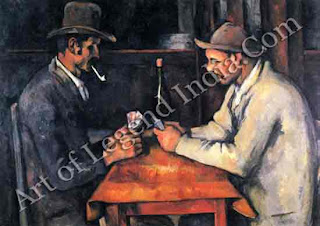
 The Great Artist Paul Cezanne “The Card Players” 1890-1892 22 ¼" x 27” Courtauld Institute Galleries, London
Cezanne's paintings of local Provencal men quietly concentrating on a game of cards are among his most popular works. He has stripped the scene to its bare essentials two men facing each other across a table. Yet, quiet and provincial as it first appears, this is a revolutionary painting. For the sake of artistic unity, Cezanne has abandoned traditional perspective for example; the table appears irregularly shaped as it is seen from several angles at once. Its top is tilted forwards, while the men's bent knees appear flattened one above the other against the front of the picture. And although the painting seems to be made up of grays and browns, rough patches of blue, red and green, as well as areas of bare canvas, give the picture a subtle vitality.
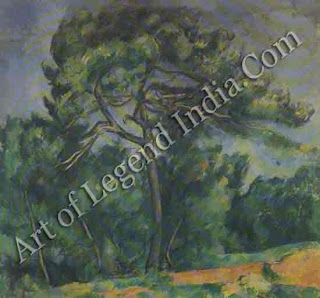
The Great Artist Paul Cezanne “The Great Pine” 1892-96 33" x 36 ¼" Museu de Arte, Sao Paulo, Brazil
                                                                                  This romantic image of a great tree buffeted by the forces of nature, yet rising above them, originates from a poem which Cezanne wrote in his youth about 'The tree shaken by the fury of the winds. The apparently simple composition, centring on the tree's buckled trunk, evokes a powerful sense of tension.


The Great Artist Paul Cezanne “Lake at Annecy” 1896 25 ¼" x 32” Courtauld institute Galleries, London Cezanne painted this alpine lake near the Swiss frontier to 'divert' himself during one of the rare trips he made during his last years. Although he found the mountainous scenery claustrophobic, he created a memorable image, particularly striking because of the apparent solidity of the water.


The Great Artist Paul Cezanne “Apples and Oranges” 1895- 1900 28 ¾” X 36 ¼” Musee d'Orsay, Paris 'This is one of the most sumptuous of all Cezanne’s still-life. The complex arrangement of fruit, dishes, jug out dreggy on a table which slops dramatically upwards from the left is given, stability by the bold zigzag line created by the edges of the white cloth. It was painting in Aix: some of the objects in the imbuing are served there, in his Chemin des Lances mho.


The Great Artist Paul Cezanne “The Great Bathers” 1898-1905 82”x98" Philadelphia Museum of Art: W. P. W Istach Collection Nearly seven feet high and over eight feet long, this is the largest of a late series of paintings in which Cezanne attempted to integrate nude figures with landscape. He achieved his aim: figures and landscape   almost merge as the arch of the trees soars up from the simplified curves of the wormer’s bodies. 


The Great Artist Paul Cezanne “Monte Sainte-Victoire 28 7/8 " x 35 3/4" Philadelphia Museum of Art: George W. Eikins Collection
Cezanne was obsessed with this huge limestone mountain, which stands some 10 miles from Aix, and painted it over 60 times with increasing freedom. In this late work, the sequence of fluid paint patches, which are used to suggest the natural elements of the landscape, become an almost abstract mosaic of colour.


Writer – Marshall Cavendish
Company Overview

Art of Legend India has the distinction of being one of the best in the Indian Handicraft Industry. We are about 75 years old handicrafts manufacturer & exporter. We are having team of more than 500 craftsman.

We are having our business offices in India, USA & Germany to ensure our best services.

Total Pageviews