Showing posts with label Life of Paul Gauguin. Show all posts
The
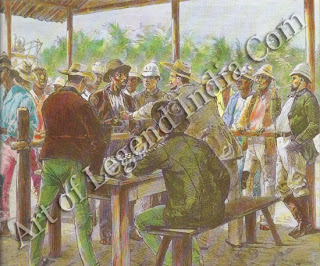
collapse of the Panama Canal scheme, on which Gauguin himself had worked as a
labourer, was the worst financial scandal to hit France for centuries. Austria
too was rocked by scandal, when the Crown Prince committed suicide with his
lover. And in London, dock workers made history with a famous strike for wages
of sixpence an hour.
For the
Vicomte Ferdinand Marie de Lesseps promoter of the Suez Canal, diplomat,
entrepreneur and a distinguished member of the French establishment 1889 was a
disastrous year. His latest scheme, to build a sea-level canal across the
Isthmus of Panama from the Atlantic to the Pacific, had collapsed around his
ears. In February, the Panama Canal Company revealed debts of more than
£60,000,000 and an official investigation exposed a vast scandal.
To keep
the work going at all, it had been essential to find more money, and such was
De Lesseps' reputation that thousands of small investor’s cab drivers,
shop-keepers, and peasants had poured their savings into the venture. But the
problems continued to grow. Despite the importance of the enterprise for French
prestige, the government refused any financial support until December 1888,
when an issue of lottery bonds was finally authorized. And when these proved
undersubscribed, the company had no choice but to go bankrupt in February 1889.
It was the greatest financial disaster in France for 200 years.
The
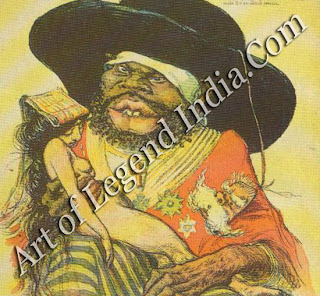
government tried to hush up the scandal, but eventually De Lesseps and some of
his associates were put on trial. The enquiry revealed that financial control
of the company was exercised by two Jews with dubious reputations but high
political connections. These revelations caused the government grave
embarrassment and fuelled the flames of anti-serenities in France. De Lesseps
was arrested, convicted of misappropriating funds, and sentenced to five years
in jail. But in the event, his punishment was restricted to public humiliation
as the verdict was later quashed.
The
same year the doomed Habsburg Empire of Austria and Hungary was also rocked by
scandal. Crown Prince Rudolph, heir to Emperor Franz Joseph, shot himself
through the head with a revolver on 29 January at Mayerling, a shooting lodge
in the wooded hills some 20 miles from Vienna. Next to his body was found that
of 17-year-old Baroness Marie Vetsera, the niece of a rich Levantine banker and
a ravishing 'oriental' beauty. It was a suicide pact. But what was the motive?
Rumours
of a family conflict were rife throughout Europe. The Prince, though a dreamer,
was known to be at odds with his father's policy of appeasing Russia, their
powerful neighbor. Moreover, Rudolph's marriage to Stephanie, daughter of
Leopold II of Belgium, was not a success. It had been arranged by the Emperor
and Rudolph took refuge in drink, drugs and love affairs.
The
Prince wrote farewell letters to his wife and mother, but not a word to his
father. Their contents have never been revealed, but it seems that Rudolph was
mentally unbalanced, seized by a romantic vision of death. 1-le probably felt
himself to be a failure, unable to translate his vision into political action
when he saw his father's character and policy leading the Empire to disaster.

But
1889 saw triumphs as well as tragedies. Gustave Eiffel, who designed the locks
for the Panama Canal, had his greatest success on 31 March when he saw his
1,000 foot cast-iron tower inaugurated in Paris. The tower cost some £240,000
to build and weighed 7,000 tons. A spiral iron staircase of 1,600 steps ran up
the centre of the tower, but most visitors found this too vertigo-inducing and
preferred to take the lift, which took seven minutes to reach the summit.
The
Eiffel Tower was to prove the principal attraction of the Paris International
Exhibition opened by the President of the Republic, Sadi Carnot, on 6 May. The
Exhibition ran until 6 November, displaying the industrial and commercial
wealth of France, and attracted 2,500,000 visitors. But 1889 was also the
centenary of the French Revolution and the spirit of rebellion was aroused.
When the President left his official residence at the Elysee Palace to drive by
carriage to the Palace of Versailles, a disaffected, anti-Republican
storekeeper named M. Perrin fired a revolver at him. But the cartridges were
blank and the President was able to proceed to Versailles unharmed.
In
London, political events were less flamboyant, but their influence was
longer-lasting. In August and September, Ben Tillet led the London Dockers in
their famous strike to demand 'the docker's tanner' a wage of just 6d an hour.
The docker’s leaders were skilful in stirring up popular opinion and £4,500 was
raised by general subscription. By the end of the year, their union numbered
30,000 members: evidence of the now rapid growth of unionism among semi-skilled
and unskilled workers.
Not far
from the docks, in the East End streets around Whitechapel, 'Jack the Ripper'
continued his grisly business. In July the body of a woman called Mackenzie was
found brutally murdered and, at dawn on 10 September, a policeman found a
mutilated female torso under a railway arch in Whitechapel. In December, the
year ended in triumph for the explorer Henry Morton Stanley who finally reached
Zanzibar. But for Charles Parnell, the hero of Irish nationalism, 1889 ended in
despair. He was cited in divorce proceedings by Captain O'Shea, the husband of
his mistress Katherine. In Catholic Ireland, the disgrace finished Parnell's
career, and the campaign for Irish Home Rule lost its most valuable leader.
Writer
– Marshall Cavendish
The Lure of Tahiti
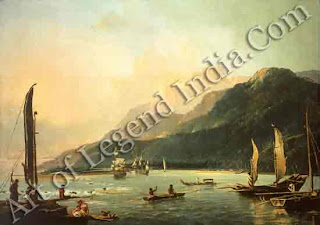
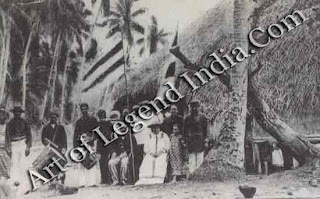
The
jewel of the vast Pacific Ocean, Tahiti was famed as a paradise
on
earth long before Gauguin visited its shores. European sailors
had
savoured the island's pleasures since the days of Captain Cook.
In
1890, Gauguin wrote to a friend 'I am leaving for Tahiti, where I shall hope to
end my days.' His decision was influenced partly by the fact that Tahiti was as
far away from Paris as it was possible to get,, but also by the stream of
enthusiastic reports reaching Europe from travellers who had visited the
hauntingly beautiful island.
The
unspoiled paradise of Gauguin's dreams, however, had vanished long before he
reached the capital Papeete in 1891. There were church bells and gendarmes
awaiting him as well as lovely garlanded maidens, stolid French housewives
preparing old-fashioned country meals as well as carefree islanders living free
off taro, yam and breadfruit. The 'mysterious beings' he had imagined before
his arrival managed to consume 45,000 gallons of island rum and 65,000 gallons
of imported claret each year.
But the
place itself was too lovely and the people too resilient for either to be
spoiled completely. Communications were so bad that Europeanized Papeete could
not make much of an impression on the rest of the island. Even today the only
real road follows the coast, and in the 1890s, the interior was largely
trackless. In rural districts, people lived much as they always had, by fishing
or small-scale farming.
AN EXTINCT VOLCANO
Tahiti
had a mesmerizing effect on Gauguin, as it had on other European visitors since
its discovery by Britain's Captain Samuel Wallis in 1767. An extinct volcano
lost in the immensity of the South Pacific, its lush, green slopes rise to a
7,349-foot peak, high above a shoreline ringed by coral reefs that enclose
lagoons swarming with fish. But it was the island's inhabitants who made the
greatest impression on the early explorers. They were handsome and easy-going
people, Polynesians whose ancestors had settled around 4,000 years ago. In
Tahiti they had evolved a lifestyle that Westerners, accustomed to the drudgery
g. of their own societies, saw as a kind of paradise. The climate, though a
little damp, was balmy and reasonably cool by tropical standards. Fish and
shellfish, breadfruit and bananas seemed to be had for the asking, without
labour. There was little need for clothing. And as Wallis and his crew
discovered to the captain's horror and the men's delight the languid young
women of the island were only too willing to exchange their favors’ for some
trifling gift. Iron nails were the favoured currency: by the time Wallis sailed
for home after a F month's sojourn, the fixed bayonets of his Royal Marines
were barely enough to stop his men prising out every iron fastening in the ship.
While
Wallis, a tough but unimaginative officer, was preparing his report for the
Admiralty, an explorer with a more philosophical turn of mind 5 was making his
landfall on Tahiti. Louis Antoine de Bougainville was not only a soldier and a
navigator. He was also steeped in the new ideas sweeping 18th-century Europe.
And in Tahiti he found a reality to match philosopher Jean-Jacques Rousseau's
ideal of the noble savage of man at peace with nature.
Bougainville
and his crew were welcomed as Wallis had been. 'They pressed us to choose a
woman and to come on shore with her,' he wrote, 'and their gestures, which were
unmistakably clear, denoted in what manner we should form an acquaintance with
her.' His naturalist, Philibert Commerson, enthused about 'natural man, who is
born essentially good, free of every prejudice, and who follows, without
defiance and without remorse, the gentle impulses of instinct not yet corrupted
by reason.'
WARRIOR SOCIETY
Commerson's
was a notion that endured until Gauguin's time and after. But although it
contained a germ of truth, it was largely illusion born out of wishful
thinking. For life on Tahiti was no idyll. The islanders did not use the
leisure time granted by their comfortable environment to live the kind of
rapturous, untrammelled existence dreamed of by European philosophers. Instead,
with or without assistance from 'the gentle impulses of instinct', they had
created a fierce warrior society that indulged in slavery and human sacrifice.
Nor did
the blithe promiscuity of many young Tahitian women mean that they were
devotees of free love. In fact, the Tahitians had a complex set of rules for
sexual behavior inside and outside marriage, which even today anthropologists
have not fully elucidated. a European who made an enthusiastic grab for the
wrong woman could and often did pay for it with his life.
Nevertheless,
the island never lost its seductive fascination. Captain James Cook, who
visited it in 1769, was reduced to holding Tahitian chiefs hostage to obtain
the return of deserters from his ship and Cook was a well-loved leader. In
1789, the contrast between Tahitian life and Royal Naval discipline was enough
to provoke the celebrated mutiny on HMS Bounty. Regardless of its flaws,
paradise Tahiti-style was better than life on ship.
But the
coming of the Europeans was itself enough to put an end to the old way of life.
The newcomers brought syphilis, a poor return for the island women's
affections. They brought measles and smallpox and a host of other diseases to
which the Polynesians had little or no resistance. They brought rum. And
unscrupulous and well-armed Europeans took sides for their own advantage in the
island's internal quarrels, which were bloody enough already without their
help.
DESTRUCTION OF A PEOPLE
The
results were quite devastating. According to some estimates, Tahiti's 402
square miles supported as many as 150,000 people before the Europeans came. By
the end of the century the population had crashed to 15,000; by 1830 it had
fallen to 8,000.
Missionaries
did their own kind of damage. Their first settlement was established in 1797,
and although they did their best to protect their flocks from the ravages of
drink and disease, they eventually succeeded in undermining the local
traditions that any society needs in order to keep its self-respect. The
islanders were told of the evils of nakedness and fornication, and introduced
to the doctrinal distinctions between Calvinists and Catholics and all the
other Christian sects.
Outright
colonization followed. Anglo-French rivalry ended with a half-hearted French
Protectorate established in 1843; the last Tahitian king with any pretence at
independence abdicated in 1880 and in that year the island became a full French
colony.
Tahiti's
fate could have been much worse. By 19th-century standards, the colonial
administration was efficient and humane. Outside the capital of Papeete, French
was seldom spoken, and disputes were more likely to be settled by ancient
tribal law than official regulations. Christianity had successfully driven out
the old pagan worship, and even the names of ancient gods had been forgotten;
but although Tahitians had become regular church-goers, traditional festivals
of song and dance had survived.
A cold
observer would see that imported, factory-woven cloth had replaced native
products, that there was much hymn-singing, that bit by bit the population was
beginning to drift towards the modestly bright lights of Papeete. But a painter
would see what his mind wanted to see. Paradise, like beauty, was in the eye of
the beholder.
Writer
– Marshall Cavendish
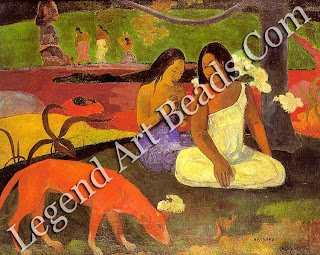
The exotic culture of the South
Sea Islands held a powerful fascinatio for Gauguin, who
chose strange, vivid colours to express the beauty and the
mystery he experienced there.
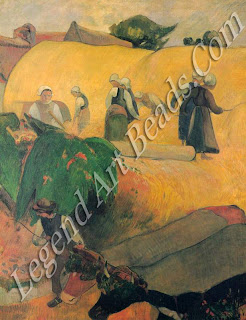
Paul Gauguin was in his early twenties when he took up painting. At first art was no more than a hobby, but he admired and bought the work of the early Impressionists, and based his own style on theirs. As his dedication grew, however, Gauguin soon realized that although these artists, with their bright colours and bold technique, had freed painting from traditional bonds, Impressionism too was limited in scope. Gradually he moved forward to develop the ideas that made him with Van Gogh and Cezanne one of the greatest of the Post-Impressionist artists.
The Impressionists had painted
the natural world with vividness and directness. But Gauguin was fascinated by
ideas more than appearance and wanted his art to express strong emotions:
'Where does the execution of a picture start, where does it end? At the moment
when intense feelings are found in the depth of one's being, when they erupt,
and thought flows forth like lava from a volcano. Cold and rational calculation
have nothing to do with this eruption, for who knows when, in the depths of his
being, the work was begun, perhaps unconsciously?' To express such intensity of
feeling, Gauguin had to develop a radically new style of painting.
He rejected the idea that a
painting had to represent something we can see in the real world, and drew
fresh inspiration from non-European art Gauguin was one of the first artists to
take a serious interest in 'primitive' cultures. He spoke of his own 'savage
blood', and, perhaps recalling his childhood in Peru, he felt a strong affinity
for the vigour of prehistoric Central and South American art. He saw numerous
examples of this type of work at the Paris World's Fair of 1889. REVOLUTIONARY COLOUR
Gauguin also looked for
inspiration to Egyptian and Cambodian sculpture, to medieval art and to
Japanese prints. He collected postcards of painting and sculpture in a way that
is now commonplace among artists and students, but which at the time was novel.
In the expressive power of his colour, however, Gauguin went beyond any of his
sources. The Vision after the Sermon, one of his most revolutionary
paintings, used bright red completely unnaturalistically to set the emotional
tone of the painting one of visionary intensity.
The Vision after the Sermon was
painted at Pont-Aven, where Gauguin briefly inspired a group of like-minded
artists. But his personal style reached its fullest flowering in Tahiti.
Gauguin's taste for religious and symbolic themes was richly sustained by the
native traditions; the bright light produced the strong colours he loved; and
the exotic beauty of the islanders made an over-whelming impact on him. He
thought that his native models 'possessed something mysterious and penetrating,
not beauty in the strict sense of the word. They move with all the suppleness
and grace of a sleek animal, giving off that smell which is a mixture of animal
odour and the scents of sandalwood and gardenia.'
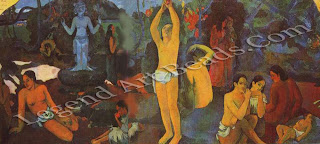
One of the most characteristic
features of Gauguin's work in Tahiti is his use of flat, frieze-like
compositions, in which he was perhaps influenced by Egyptian art. This kind of
corn-position, in which Gauguin's imposing figures 'indescribably august and
religious in the rhythm of their gestures' are arranged across the foreground,
with little sense of depth, creates a mood of solemn majesty.
Gauguin's technique in the
Tahiti paintings was no less distinctive than his composition. Materials were
not easily available, so he often had to use coarse sacking rather than proper
canvas, spreading his paint thinly to make it go further. From adversity he
extracted inspiration, for the limitations of his materials forced him to paint
with a rough vigour appropriate to his bold vision.
When Gauguin died in 1903, very
few people would have agreed with his words in a letter to his wife: `I am a
great artist and I know it. It is because I am, that I have endured such
suffering.' Three years after his death, however, 227 of his works were shown
in a major exhibition in Paris; this firmly established his reputation among
more progressive artists and his subsequent influence on 20th-century art has
been immense. The emotional impact of his work and his complete dedication to
art whatever the cost in personal suffering have made him, like his friend Van
Gogh, one of the cult heroes of modern times. Writer – Marshall Cavendish