ArtofLegendIndia.com, Biggest Online Store of Handicrafts Items, Paintings and Jewelry Accessories...

Handicrafts

Handicrafts are devices or works of art that are made completely by hand or by the use of relatively simple tools. Such goods are usually made in the traditional way of manufacturing goods. Therefore, the knowledge of the art of craft is usually passed down from one generation to another. The items made using these traditional methods of manufacturing are usually produced in smaller quantities and they often represent the culture or religious beliefs of the community that makes them. The goods are also handmade from natural materials that are found in the environment of the particular economy.

Read More!

Biggest Online Store of Handicrafts Items

Paintings

A painting is equal to thousand words, means a beautiful painting is equal to million of words. Paintings are one of the oldest art forms -- throughout history artists have played an important role in documenting social movements, spiritual beliefs and general life and culture.

History Of Paintings: The history of painting reaches back in time to artifacts from...

Read More!

Biggest Online Store of Unique Style Paintings
Showing posts with label Hans Holbein. Show all posts

German Great Artist Hans Holbein - A Perfect Likeness

Posted by Art Of Legend India [dot] Com On 11:51 PM 0 comments

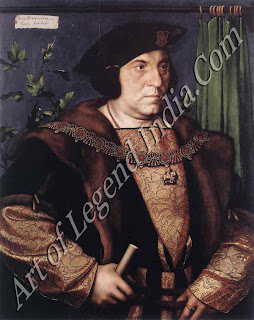
Sir Henry Guildford (1527) Guildford commissioned this portrait to commemorate his election to the Order of the Garter. He wears the collar of St George and the Dragon to indicate his membership of the Order, and holds the staff that shows his official position as Comptroller of the Royal Household. Guildford was a favourite of the king: his pose is suitably self-confident, while the way in which his bulky figure fills the picture space gives the portrait an impressive sense of authority.

A Perfect Likeness 

Holbein's ability to achieve almost photographic realism in his painting made his reputation as a portrait painter, and has given posterity an invaluable record of the members of the Tudor court.

Holbein's reputation is based on the brilliantly observed portraits which he painted in England during the reign of Henry VIII. Their realism is astonishing even today, and it is easy to understand the reaction of Holbein's friend, the great scholar Erasmus, when he received the artist's drawing of Sir Thomas More and his family: 'It is so completely successful, that I should scarcely be able to see you better if I were with you'.

Yet Holbein did not start his career as a portrait painter. He trained in his father's workshop in Augsburg and that of Hans Herbster in Basel, where he not only learnt the techniques of oil painting, but also those of book illustration and the decorative arts. Holbein's early paintings were mainly monumental and religious works, stylistically in the Northern tradition of Darer and Grunewald. By the late 1520s, a new influence can be seen. In The Meyer Madonna (1526), the Northern emphasis on sharply observed realism and incisive line is evident, but the classical motifs, calm symmetry and use of sfumato to soften the Madonna's features show a debt to Italian Renaissance art particularly that of Leonardo.

Many of Holbein's early religious works were probably lost during the violent iconoclasm (destruction of holy images) of the Reformation. This movement also put paid to a major source of potential income church commissions which is why Holbein was forced to leave Basel in search of work in England.


MORE AND HIS CIRCLE 

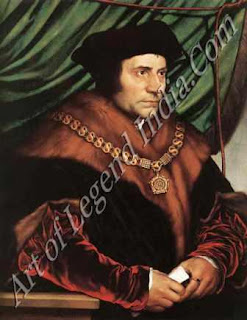
The Oberreid Altarpiece (1521-22) Holbein painted the central panels of this altarpiece during his early years as an independent painter in Basel. It was commissioned by Hans Oberreid, a leading citizen of the town,, who had recently married. His coat of arms and that of his new wife's family appear at the bottom of the painting, along with individual portraits of the family members. The panel or: the left shows the Adoration of the Shepherds, set among classical ruins symbolizing the Old Testament religion which was replaced by the new era of Christianity. To the right is the Adoration of the Magi set in less grandiose ruins. Holbein already had quite a reputation for portraiture in England, since his portrait of Erasmus had been presented to Archbishop Warham. And most of his first visit to England (1526-1528) was spent mainly in the production of portraits of More and his circle most of whom knew Erasmus. These are among the most astonishing likenesses in the history of art, and would certainly have astounded their Tudor sitters who had never seen anything like them before. Sir Thomas More is perfect in both its draughtsmanship and its apparent solidity in Holbein's art, line defines form. More's face has been scrutinized and reproduced with an almost photographic accuracy even down to the silver-tinged stubble on his chin. And Holbein's vision is so penetrating that his realism is not only skin deep: the slightly tensed brow above the tranquil eyes reveals More's thoughtful character.
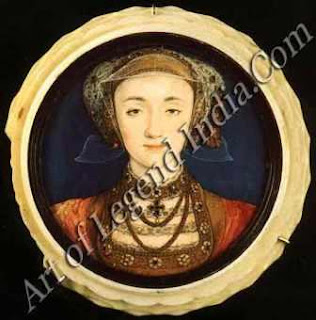
Miniature portraits, Holbein was a skilled miniature painter as this portrait of Anne of Cleves attests. But whereas contemporary miniaturists such as Lucas' Hornebolte worked in the tradition of medieval manuscript Holbein's miniatures were scaled-down Renaissance portraits.
Holbein's painting depended upon his phenomenal drawing ability. And it seems that, for him, drawing could be an end in itself, not merely a preliminary to painting. At first, his drawings were executed in chalks, which were sometimes heightened with water-colour. But after his return to England in 1532, the delicacy of this technique was replaced by the more vigorous and emphatic medium of ink. The collections of drawings at Windsor are among Holbein's most popular works.

Part of Holbein's assured mastery of line was his ability to capture a likeness very quickly. It is known, for example, that he was only granted a sitting of three hours for his portrait of the Duchess of Milan. This was enough for him to make a 'very perfect likeness'. During his first English visit, he was not inundated by commissions, and could presumably take longer, but once he entered royal service, such swiftness of execution would have been necessary to supply increased demand.


A MECHANICAL AID 
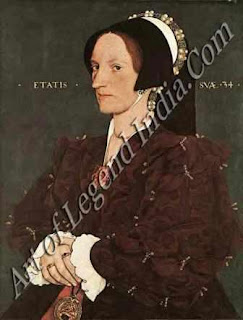
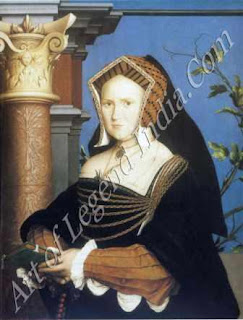
Margaret Wyatt, Lady Lee (c.1540) This portrait shows the sister of the Tudor poet Sir Thomas Wyatt aged 34 as the Latin inscription behind her indicates. It is typical of Holbein's late works in its three-quarter view, half-length pose, flat background and Latin inscription. It has been suggested that Holbein may have made use of some sort of mechanical aid to allow him to record the outline of the sitter's face as fast as possible. Again, this would presumably only have been necessary during his second visit to England. If he did use a mechanical aid, it may have been a kind of tracing apparatus, of the type other artists such as Darer and Leonardo are known to have used. This consisted of a peep-hole and a pane of glass. The artist looked through the peep-hole and glass directly at the sitter rather in the way that the sights of a rifle are used to ensure a perfect line of vision and traced the outline of the sitters' features on to the glass with an oil crayon. The outlines would then be transferred on to paper.

The paintings themselves were executed on wooden panels, to which Holbein would transfer his drawings using a grey wash. He then worked up the painted surface with meticulous accuracy, often using notes on colour and jewellery details to help him attain a perfect reproduction of what he had originally observed.

In the first years of Holbein's second visit to England, when he was still hoping to attract royal favour, he often made a point of showing off his ability to record stunning likenesses not only of faces, but also of surface textures. In his portrait of the German merchant George Gisze the lush folds of pink velvet are set against the woven intricacies of the Turkish rug with an almost tangible realism. And as if to hammer home the point, Holbein has placed a bunch of carnations in a thin glass vase which is painted with exquisite accuracy, and through which is seen the stems of the flowers and the woven threads of the rug.

A CHANGE IN STYLE 
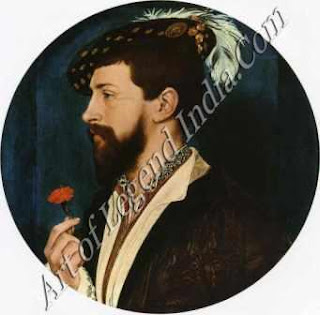
Simon George (1534-35) This portrait is unusual for Holbein because the sitter is shown in profile an appropriate view for the circular, medallic shape of the painting. It differs from the preparatory drawing in two main ways: in the drawing George has just started to grow a beard, while in the painting, is fully grown. And in the panning he holds a flower.
George Gisze is also characteristic of this particular phase in Holbein's art in the abundance of props which surround the sitter as attributes of his profession. About three years after this particularly 'flashy' painting, Holbein's portraits altered in a most dramatic way. The compositions themselves became simpler, with the sitters placed against plain backgrounds of blue or green. The lack of depth in these backdrops is often accentuated by Latin inscriptions, placed on either side of the sitter's head, usually indicating the date and his or her age.

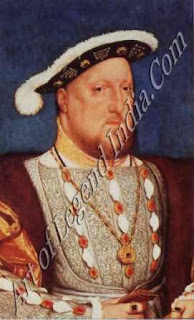
The plain backgrounds serve to heighten the impact of the portraits themselves. The flatness of composition became particularly pronounced in many of the half-length portraits which Holbein executed of and for Henry VIII, where it was accompanied by an increased emphasis on linear patterning. In his portrait of Henry VIII, for example, the predominance of line is still evident, but it is put to a more decorative purpose. The sumptuous patterns of Henry's doublet and jewels, the flattened arms, and the head and hat almost cut out against the blue background all combine to create an icon-like image appropriate for a monarch who was also the Supreme Head of the Church of England. Although the face is as individualized as that of Sir Thomas More painted nine years previously, the effect of the painting is entirely different. Sir Thomas More is a portrait of a man, Henry VIII is an image of god-like majesty.
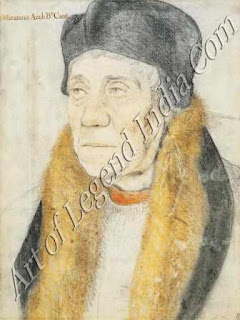
William Warham, Archbishop of Canterbury (1527), This drawing in coloured chalks dates from Holbein's first stay in England, and is one of his most penetrating character studies. Like all of his drawings, it was made for a practical purpose as a preparatory sketch for a portrait which the Archbishop sent to his friend, Erasmus. The freedom of the handling and the delicate use of soft crumbling chalk on white paper, are typical of Holbein's early style. It was Holbein's ability to create such spectacles of power that won him the chance to paint his most prestigious work, the Whitehall fresco. For the king did not want a family portrait, he wanted an image of absolute authority that combined physical might with symbolic legitimacy.

It is an irony that Holbein's consummate achievement has not existed for nearly 300 years it was destroyed in a fire in 1698. But the surviving copies and cartoon leave no doubt that the bloated, bulging, pig-eyed figure of Henry VIII must have been awe-inspiring. Visitors to the palace were said to be 'abashed' and 'annihilated' and many believed they were in the presence of the king himself.

In his cartoon for Henry's portrait, Holbein shows him turning slightly towards the queen, Jane Seymour; in the final painting, however, the king confronts the spectator directly. Obviously, Holbein's rendering of him was not designed to flatter, it was designed to glorify and magnify. The impression of raw power and indomitable energy is created partly by the sheer bulk of the figure, and partly by the contrast of Henry's challenging, virile pose with the more spiritual calm of the other three figures, whose eyes do not engage the spectator's.
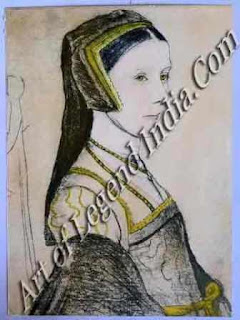
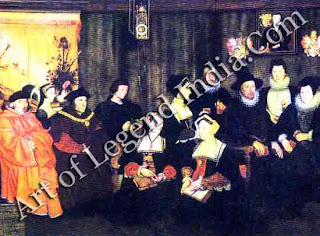
Anne Cresacre (1526-8), Holbein's drawing of Thomas More's elegant ward is one of several beautiful portrait studies made for his destroyed masterpiece The More Family Group. A free variant on Holbein's original composition shows Anne standing second from the left.

ART AND PROPAGANDA 

Holbein achieved these effects by using a whole range of artistic devices, but most of all he drew on the recognizable vocabulary of religious painting. '['he way in which the group is posed, for example, is reminiscent of the standard Renaissance arrangement for a Madonna and child flanked by saints. Holbein translated the language of religion into that of politics, and for the Holy Family he substituted the royal family. In this way he was able to create an image which simultaneously demonstrated the political supremacy of the Tudor dynasty, and the supremacy of Henry himself as head of the Church in England. In the process, Holbein had combined art and propaganda.


Writer – Marshall Cavendish

German Great Artist - Hans Holbein Painting Gallery

Posted by Art Of Legend India [dot] Com On 3:28 AM 0 comments
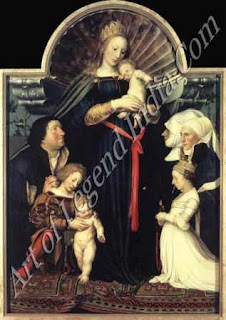
The clarity and precision of Holbein's art make him one of the most powerful portrait painters of all time. Even his early religious works such as The Meyer Madonna are characterized by minutely observed realism. This altarpiece is also typical of Holbein's painting in its cool colours and sharply defined outlines.

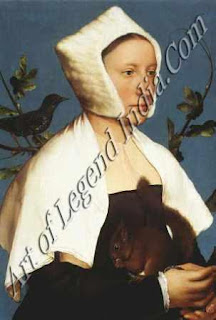
Lady Guildford was one of the first portraits that Holbein painted during his first visit to England. His most brilliant achievement of this period is the sensitive portrait of Sir Thomas More. The charmingly informal Unknown Woman with a Squirrel was also painted during these years.

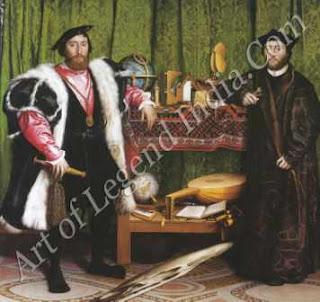
The masterpiece of Holbein's second English visit is the stunning double portrait known as The Ambassadors, painted before Holbein entered royal service. When he did, his style changed dramatically: Henry VIII and Queen Jane Seymour are hieratic images set against plain backgrounds. A similarly bold simplicity of design also distinguishes Christina of Denmark and Unknown Lady. 

The Great Artist Hans Holbein Painting “The Meyer Madonna” 1526-30 57½” x 40” Schlossmuseum, Darmstadt
Jakob Meyer probably commissioned this altarpiece in the year his two sons (who appear with him to the left of the Madonna) died in childhood. Kneeling opposite are Meyer's daughter Anna, his wife Dorothea and his dead first wife Magdalen Baer (shown behind Dorothea). Holbein's mistress Magdalena Offenburg probably posed for the Virgin. The painting has both German and Italian features: the cool realism and linear precision are in the German tradition, while the symmetrical 'Madonna of Mercy' composition, the classical motifs and the softened features of the Madonna t originate from Italian Renaissance t painting. 


The Great Artist Hans Holbein Painting “Mary Wotton, Lady Guildford” 1527 31½" x 25½" St Louis Art Museum
This is a companion portrait to Sir Henry Guildford. The date of the painting and the sitter's age (she is in her 27th summer, so is either 26 or 27) appear as if cut in stone above the ornate pillar beside her. This placing of the figure beside classical architecture is typical of Holbein's early portraits. The artist has paid meticulous attention to detail, particularly in the dress, but has created a bold composition, with clear outlines, strong colour contrasts and an impressive sense of bulk. A preparatory drawing exists which shows Lady Guildford smiling, with a vivacious sideways glance.
The Great Artist Hans Holbein Painting “Sir; Thomas More” 1527 29'’x 23" Frick Collection, New York
This superb portrait of Holbein`s friend, host and patron shows More in his late 4os, wearing the ‘Ss’ collar that signified his position as Lord Chancellor accurate in detail, the composition has a monumentality and simple grandeur appropriate to the sitter’s status and strength of character.


The Great Artist Hans Holbein Painting “Unknown Lady with a Squirrel” c. 1526-28 17 ¼" X 15" National Gallery, London
This lady was probably painted during Holbein's first visit to England: she is shown in the same half-length, three-quarter view as Sir Thomas More, while the twisting foliage is similar to that behind Lady Guildford. The painting's charm derives mainly from the bird, and the little pet squirrel which sits on her arm.


The Great Artist Hans Holbein Painting “The Ambassadors” 1533 8½" x 82½” National Gallery, London
This magnificent, life-size double portrait shows Jean de Dinteville, a French aristocrat and ambassador to London and his friend and fellow-diplomat Georges de Selve, the young bishop of Lavour. The two men stand either side of a 'whatnot' on which lies an immaculately painted still-life display which symbolizes their intellectual and spiritual accomplishments. At first the painting appears to be a glorification of man's achievements, but it takes on another meaning when the distorted object which hangs between their feet is recognized as a skull. One of the several references to death in the painting, it makes the portrait a momenta mori (a reminder of death): its message is that despite man's wordly achievements, we all must die.

The Great Artist Hans Holbein Painting “King Henry VIII” 1536-37 10¾" x 7½" Fundacion Thyssen-Bornezmisza, Madrid
The only portrait from life of the king that is undoubtedly by Holbein, this picture may have formed a pair with a portrait of Henry's third queen, Jane Seymour. In this icon-like image, the body is flattened up against the picture plane, and the emphasis is on decoration: the gold thread, chain and buttons are painted in real gold.


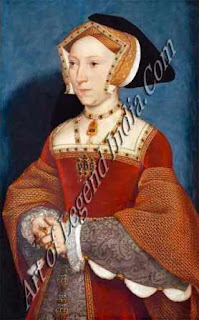
The Great Artist Hans Holbein Painting “Queen Jane Seymour” 1536-37 25½” x 15¾" Kunsthistorisches Museum, Vienna
This timid-looking ex-lady-in-waiting had only become queen in the year that this portrait was begun. The next year, size fulfilled Henry's dream by bearing him an on (Edward VI), hut died in childbirth. Like the king, she is set against a plain blue background wink her dress is painted in exquisite and precise detail.


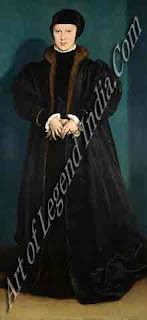
The Great Artist Hans Holbein Painting “Christina of Denmark, Duchess of Milan” 1538 70½” x 32½” National Gallery, London
A prospective bride for the king, following Jane Seymour's death, the widowed duchess sat for Holbein in Brussels on the afternoon of 12 March 1538, when the artist drew her likeness in a three-hour sitting. In this impressive full-length portrait, the young woman's fresh and delicate beauty is highlighted by her austere mourning clothes.


The Great Artist Hans Holbein Painting “Unknown Lady” c.1540 29" x 20" Museum of Art, Toledo, Ohio
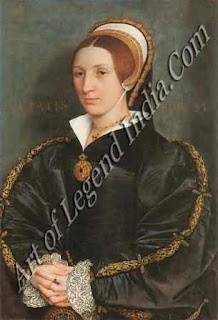
This young woman used to be identified as Henry's fifth queen, Catherine Howard, but she was probably a member of the Cromwell family. Like the Duchess of Milan, she is placed against a plain greenish background, on which she throws a shadow. The gold inscription indicating her age echoes the gold details of her dress.


Writer – Marshall Cavendish
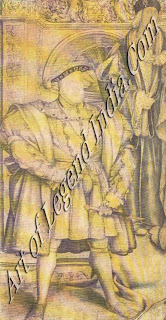
German Great Artist Hans Holbein - The Legend of Henry VIII

Posted by Art Of Legend India [dot] Com On 12:01 AM 0 comments
An image for posterity, The archetypal image of Henry VIII was created in Holbein's dynastic portrait. The painting is destroyed, but part of the majestic cartoon survives. The formidable frontal pose was repeated in endless copies and variants.

The Legend of Henry VIII

Henry VIII inherited from his father a country that was prosperous and stable after decades of civil war. He made his own image a crucial factor in strengthening still further the power of the monarchy.

During the reign of King Henry VIII (1509-47), Englishmen had their first significant contacts with the Renaissance, the new outlook in life and art that had first appeared in Italy and was gradually spreading throughout Europe. Henry himself welcomed Renaissance artists such as Holbein and the Italian sculptor Pietro Torrigiano, and patronised the 'New Learning' of scholar-writers such as the Dutchman Erasmus and England's own Sir Thomas More. In the early part of his reign Henry enjoyed playing the part of the ideal Renaissance monarch handsome, cultivated, extravagant, warlike, and above all the absolute monarch of his realm. With age, corpulence and ulcers, much of the King's glamour disappeared, but his mastery in the state had become greater than ever. Henry, the man of many wives and many executions, was the first 'Tudor despot'.

Henry was the second of the Tudor monarchs. His father, Henry VII (1457-1509), founded the dynasty by defeating Richard III at the Battle of Bosworth in 1485. This brought to an end the thirty-year Wars of the Roses, during which aristocratic factions had made and unmade kings with alarming frequency. Henry VII was not a colourful figure like his son and other descendants, but he commanded respect and succeeded in restoring royal authority. Astute, persistent, hardworking and a first-rate businessman, he made his nobles keep the peace and greatly enriched the royal coffers.

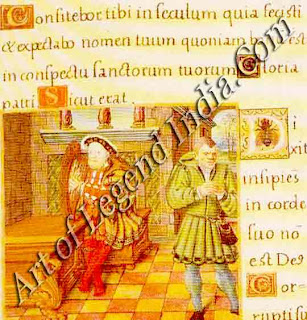
Domestic pleasures, This informal view shows the king playing the harp to his jester. Henry loved music, and tradition has it that he composed the famous song Greensleeves. Henry VIII was more erratic and lavish in his spending than his father, whose carefully accumulated fortune he soon frittered away. But he maintained the policy of strengthening the Crown, both practically and symbolically. Like his father, he employed 'new men' from outside the nobility men whose loyalty could be relied on, since they owed everything to him. At the same time, Henry made the court a magnet for the nobility, encouraging them to compete for decorative offices and signs of the king's favour, SO that they became psychologically dependent on him and spent less time on the estates which constituted their bases of power. Splendid ceremonies emphasized the special character of the king; and a small but significant fact Henry ceased to be addressed as 'Your Grace', like previous monarchs, and became the first to be called 'Your Majesty'.

MOCKING THE POPE 

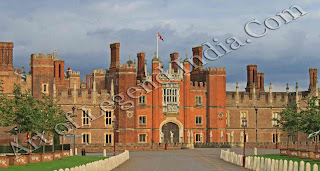
Hampton Court, Cardinal Wolsey began this magnificent building in about 1515. Henry was angered at being outdone by one of his subjects, and Wolsey gave him the palace hoping to appease him.
Hampton Court became Henry's favourite residence and he lavished money on it. His additions included the majestic Great Hall and a court for the game of 'real tennis' (that is, 'royal tennis'), a forerunner of the modern game. The palace was the scene of two of his weddings (to Catherine Howard and Catherine Parr) and his son Edward was born there in 1537.

The minister who organized all this for Henry was Thomas Cromwell, another 'new man', the son of a brewer and blacksmith. He developed the Tudor administration into something that resembled a permanent and specialized civil service. Wales was integrated into the English system in the mid-1530s, and later on Henry promoted himself from 'Lord' to King of Ireland.

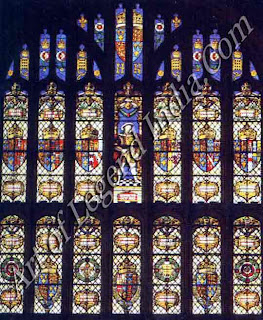
Centre of a dynasty, This window at Hampton Court shows Henry like a religious image. He is flanked by the coats of arms of his six wives and stands above those of three of his children.
But the king or his advisers knew that the drastic religious changes he had introduced when he separated England from the Church of Rome were bound to confuse and alienate many people. To counteract this, they launched a large-scale propaganda campaign in the 1530s that was clearly intended to reach all classes. Plays and pageants explained the changes, mocked the pope and played on popular anti-clericalism; there was even a mock-battle on the Thames between papal and royal barges which ended with the 'pope' and his 'cardinals' getting a good ducking. Lawyers and moralists published pamphlets and books that exploited the rising tide of nationalism, making loyalty to England and the king the supreme value. And efforts were made to raise the status of kingship even further.

A PASSION FOR BUILDING 

Now head of the Church, Henry was presented as, in effect, a semi-divine being. When Holbein, normally so perceptive and realistic, was called on to paint the King's portrait, he represented him as a cold and fearful icon rather than a man; or, as a contemporary put it, 'not only a king to be obeyed, but an idol to be worshipped'. In another of Holbein's works a miniature Henry appears as Solomon under an inscription reading 'Blessed be the Lord thy God, which delighted in thee to set thee on his throne, to be King for the Lord thy God.' And, for more popular consumption, Henry was shown on the engraved titlepage of Cranmer's Great Bible, enthroned like a divinity while he distributed 'the word of God' and multitudes below shouted 'Vivat Rex'! (Long live the King!).

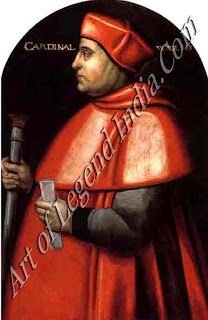
The king's minister, Cardinal Wolsey was the dominant figure in English government from 1515 to 1529. His failure to secure Henry's divorce sealed his downfall, and he died while under arrest. The royal idol also advertised his greatness by building on a large and lavish scale. Wolsey's suinptous houses at Hampton Court and York Place (later Whitehall) were taken over and expanded into great royal palaces, and in Surrey a palace with a fairytale skyline, Nonsuch, was built from scratch to rival the famous French Renaissance château of Chambord. Nonsuch and York Place are now destroyed, but Henry's portions of Hampton Court remain among the glories of English architecture.

THE BREAK WITH ROME 

During Holbein's first visit to England (1526- 28), Henry was in his mid thirties but still had something of the playboy about him. Tall and powerfully built, he revelled in his athletic skills, and was also an accomplished musician. Effective power was exercised by Cardinal Wolsey, a 'new man' (reputedly the son of a butcher) who ran the government while the King jousted and hunted.

The Dissolution of the Monasteries, The monasteries were one of the great bulwarks of the papal system, so they represented a threat to Henry's authority after he had declared himself head of the English church. He appointed his chief minister Thomas Cromwell to carry out a programme of suppression and confiscation that left manly monasteries to fall into ruin. By the time Holbein returned in 1532, every-thing had changed. Wolsey was dead, and the king involved himself far more closely with policy. Wolsey was doomed mainly because he failed to obtain a divorce for the king. After many years of marriage to Catherine of Aragon, Henry had only a single child, the Princess Mary. This seemed to threaten the entire Tudor achievement, since everybody knew that no woman could govern properly, and that chaos, civil war or foreign occupation would inevitably result. (Of course Mary, and later Queen Elizabeth, were to show that 'everybody' was quite wrong).

Desperate for a male heir, Henry convinced himself that his marriage was invalid (for Catherine had been the wife of his dead brother), and put his case to Pope Clement VII. The situation was complicated by politics as well as theology (the Pope played for time, since he was a virtual prisoner of Catherine's nephew, the Emperor Charles V), and by Henry's love for Anne Boleyn,. who insisted that he prove it by marrying her. Eventually Henry took matters into his own hands, breaking with the Pope, making himself Supreme Head of the English Church, and marrying Anne.

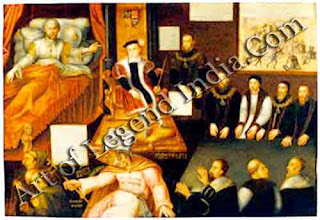
The Tudor triumph, This allegorical painting shows Henry VIII on his deathbed handing over the succession to his son Edward VI. The pope lies crushed and beaten at young Edward's feet, symbolizing the Tudor triumph over Rome.
Ironically, then, the weakness in the Tudors' political system the succession brought about a series of events that tremendously enhanced the royal authority. In effect, Henry became pope as well as king; and the Royal Supremacy which excluded papal power from England also ended the independence of the English Church, whose courts at last became answerable to the civil power. Furthermore, the vast wealth of the medieval church restored the royal finances when Henry dissolved (that is, closed down and took over) the thousand or so English monasteries, confiscating their accumulated wealth and extensive lands.

 A GODLIKE FIGURE

Henry's reign was far from an unqualified success. He had six wives, executed two of them, and had still not produced a healthy male heir. When invasion threatened, possible claimants to the throne were removed by judicial murder. Ill-judged wars bankrupted the Crown, and tampering with the currency seriously damaged the economy. Yet Henry's propaganda campaign worked. We still see the King through Holbein's eyes, as a splendid, godlike figure; and the strengthened Tudor state bequeathed by Henry to his successors stood the test of revolutions and § counter-revolutions over the three turbulent a reigns that followed.

Writer – Marshall Cavendish
German Great Artist Hans Holbein - A Year in the Life 1533

Posted by Art Of Legend India [dot] Com On 1:44 AM 0 comments
Elizabeth I born, The future Queen Elizabeth I was born on Sunday 7 September 1533. She was not the son and heir whom Henry Viii so desperately wanted and for whom he divorced Catherine of Aragon, married Anne Boleyn, and split England from the rest of Europe. But Elizabeth was later to become one of England's greatest monarchs. A Year in the Life 1533
The year was dominated by the events surrounding King Henry VIII's quest for a male heir. Convinced that Catherine of Aragon was incapable of producing a son that would survive, Henry set about securing a divorce that would free him to marry Anne Boleyn. To do so, he had to split England from the Church of Rome.

By the beginning of 1533, Anne Boleyn was pregnant, a fact which precipitated a crisis in Henry VIII's matrimonial affairs. He had for some years been anxious to obtain a divorce from his first wife, Catherine of Aragon. His brother's widow, and six years older than Henry, Catherine had given birth to six children, but only Henry's daughter Mary had survived.

Henry desperately wanted to produce a male heir and convinced himself that the deaths of Catherine's children were God's punishment for an improper marriage. Under normal circumstances, Pope Clement VII would probably have obliged Henry's request for a divorce the papacy understood in such cases and especially when they involved matters of state. But Catherine was the aunt of Charles V. Holy Roman Emperor, who, quite apart from feelings of family loyalty, had very high moral standards and would not hear of a divorce. The sanctions which the emperor could bring to bear on the papacy far outweighed any pressure that the king could exert.

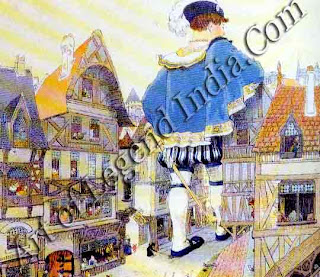
Gargantua visits Paris, The French author Francois Rabelais wrote his daring satires on politics and religion Gargantua and Pantagruel in the 1530s: the Sorbonne, the University of Paris, condemned Pantagruel in October 1533. So the solution to his problem lay in the king's own hands. He had in any case fallen in love with Anne Boleyn and, knowing her to be pregnant, married her secretly on 25 January, thus ensuring that his son would be legitimate and the acknowledged heir to the throne.

THE QUESTION OF MARRIAGE 

But the question of Henry's marriage to Catherine remained unresolved. There was no hope of obtaining a divorce from Rome, so it had to be achieved through the Archbishop of Canterbury. As luck would have it, the archbishop's chair was vacant: Archbishop Warham had died only the previous year. The king appointed Thomas Cranmer, a brilliant young Cambridge scholar of divinity who had, as one of the king's chaplains, been canvassing support for a divorce.

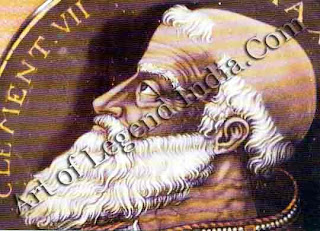
Pope Clement VII, In September 1533, the pope gave into pressure from the Emperor Charles and threatened to excommunicate Henry from the Church four months after Henry's marriage to Anne Boleyn.
On 30 March, the new archbishop was formally consecrated. Although he took the usual oath of obedience to the pope, he qualified it by a formal assertion that he was not bound to do anything contrary to the law of God or to the king, realm, laws, and prerogatives of England. This, together with the hurriedly passed Act of Appeals, which recognized the English primate as the ultimate authority for English ecclesiastical law without reference to Rome, cleared the way for Henry's divorce.

The death of Ariosto, The poem Orlando Furioso was written by the Italian author, Ludovico Ariosto, who died in 1533. The poem is regarded as the perfect example of Renaissance thought and classicism and had a great influence on European literature. This illustration shows a scene from Furioso.
Immediately after his consecration, Cranmer presided over meeting which decided that Henry's marriage to Catherine was contrary to divine law, and on 10 May he opened his court at Dunstable. Catherine refused to recognize Cranmer's authority to try a cause that was before the papal court and did not attend. On 23 May, the archbishop passed sentence, pronouncing that the pope had no power to license marriages such as Henry's, and that the king and Catherine had never been husband and wife.

Five days later, Cranmer declared Henry and Anne Boleyn lawfully married, and on 1 June Anne was crowned queen in Westminster Abbey. On 11 July, in a belated effort to protect the dignity of the Church, the pope prepared the sentence of excommunication which was delivered in September. Henry had, in effect, broken any remaining links with Rome: the Reformation in England was under way.


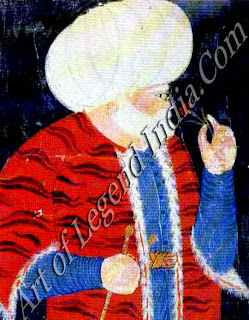
Redbeard the pirate, Redbeard was a famous pirate who, in 1533, became admiral in chief of the Turkish Ottoman fleet. He made the North African coast a centre for piracy and united Algeria and Tunisia under Ottoman rule.
The king's personal desires in this matter were, coincidentally, in accordance with the aspirations of his people who, in a wave of nationalism and disillusionment with the Church, were keen to rid themselves of the influence of Rome. In other matters there was no such accordance. Catherine's humiliation was deeply resented by the people, Europe was shocked, and pope and emperor had been insulted.

But the final irony of this tale did not become apparent until three months after Anne's coronation. In the afternoon of Sunday 7 September, Queen Anne gave birth to a daughter. On the following Wednesday, the child was christened Elizabeth the future Queen Elizabeth I of England.


Writer – Marshall Cavendish
German Great Artist - Hans Holbein Life

Posted by Art Of Legend India [dot] Com On 3:33 AM 0 comments
 Hans HolbeinGerman Great Artist - Hans Holbein Life

The son of a successful German artist, Hans Holbein worked in Switzerland before the religious turmoil of the Reformation caused him to leave for England in search of work. His first stay in London was spent among the circle of the great scholar and statesman Sir Thomas More. After a period back in Switzerland with his wife and family, Holbein returned to England, where he remained based until his death from the plague.

Holbein's phenomenal skill particularly at portrait painting was exploited by Henry VIII's secretary, Thomas Cromwell, who drew him into the king's employ. Soon, Holbein became Henry VIII's chief image-maker. Though little is known about his character, Holbein seems to have been a cultivated but cold man, who could switch his allegiance from More to Cromwell the man who ordered More's untimely death.

A German at the English Court

Hans Holbein moved to London permanently from his native Germany in 1532. His work

soon found favour at court and he was appointed King's Painter. Holbein died in 1543 of the plague.

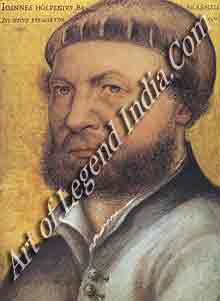
Swiss master Hans Herbster ran a workshop in Basel, Switzerland. In 1514, the two Holbein sons were sent to him to serve their apprenticeships. Very little is known about the life of Hans Holbein the Younger. Only a few dated documents and Holbein's works themselves - including some enigmatic selfportraits provide us with clues to the personality of the man who became King Henry Vu's favourite painter.

Holbein was born in 1497/8 in Augsburg in Southern Germany. His father, Hans Holbein the Elder, was a gifted painter and had already carved quite a reputation for himself. Together with his elder brother, Ambrosius, the young Holbein trained for a while in his father's studio, and in 1514 the two boys were sent to Basel in Switzerland to serve their apprenticeships with the painter Hans Herbster.

In Basel, Holbein also worked for the publisher, Froben, producing book illustrations and a set of marginal drawings for Desiderius Erasmus's book Praise of Folly. This very important commission put him in touch with Basel's humanist circle, of which the scholar Erasmus was the leading light.


THE HUMANISTS 


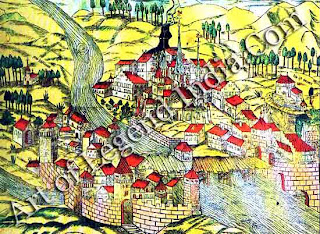
Early training Augsburg in southern Germany, where Hans Holbein the younger was born. From an early age, he and his elder brother Ambrosius worked together in their father's studio. The humanists placed paramount importance on the intellectual pursuits, potential and wellbeing of mankind. Whereas medieval Christianity had taught the insignificance of man's earthly existence, the humanists believed in the value of human endeavours. They found the basis for their ideas in the literature and philosophy of the ancient Greeks and Romans, where the virtues of liberality, eloquence and wisdom were especially prized. Holbein seems to have gradually formed close friendships with some of the northern humanists, particularly Erasmus. Early on in his career his own humanistic interests were reflected in the sophisticated classical details he introduced into his designs and decorative schemes.

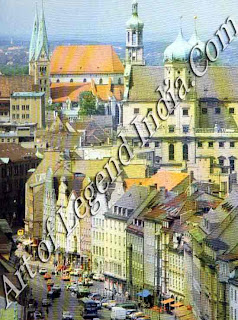
In 1517, and again in 1519, Holbein travelled to Lucerne, Switzerland, where he decorated the house of the town's chief magistrate in a splendid illusionistic style. At some point, probably in 1518, Holbein made a short trip to Italy where the work of the Renaissance painters Andrea Mantegna and Leonardo da Vinci made a profound impression on him. Once back in Basel, he soon showed Himself to be a painter of great talent. He was extremely prolific, too, turning out portraits, altarpieces and designs for stained glass, as well as a series of huge frescoes.


Key Dates

C.1487 born in Augsburg, southern Germany
1519 marries Elsbeth Binsenstock
1526 first visit to England; introduction to Sir Thomas More
1528 returns to Basel
1533 paints The Ambassadors
1534 Henry VIII becomes Supreme Head of the Church; Thomas More imprisoned; Holbein paints Thomas Cromwell
1537 appointed King's Painter 1543 dies of the plague in London

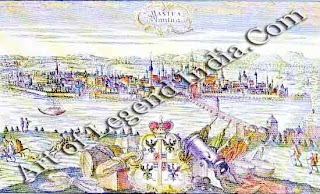
Italian influence Holbein visited northern Italy around 1518 and probably stayed at Mantua. After this trip, the influence of Italian artists such as Leonardo is evident in Holbein's painting.
In 1519 Holbein joined the painters' guild and rapidly achieved the status of chamber master. At this time he married Elsbeth Binsenstock, the widow of a tanner, who already had one son. In time they had two sons of their own, who became goldsmiths, and two daughters. It is assumed that He also had a mistress, a certain Magdalena Offenburg, whom he painted in the appropriate guise of Lais the mistress of the legendary Greek painter, Apelles. Magdalena probably also modeled somewhat less appropriately for the Virgin in The Meyer Madonna.

In an astonishingly short time Holbein had become the foremost artist of the northern humanist movement. Among his finest works of this period are the three portraits he painted of Erasmus and a series of anti-clerical woodcuts illustrating the Dance of Death. In 1524 he visited France and expanded his artistic horizons. But two years later the violent impact of the Reformation brought religious painting in Basel to an abrupt halt and he was forced to seek prestigious commissions elsewhere.

INTRODUCTION TO THOMAS MORE

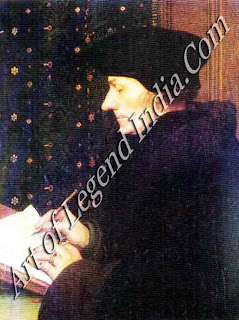
Helpful admirer, Erasmus, painted in 1523 by Holbein. Erasmus was a leading light of the humanist movement and became one of Holbein's greatest admirers.
Armed with a letter of introduction from Erasmus to none other than Sir Thomas More and Arch-bishop Warham, Holbein left for England 'to pick up some angels' (coins), as Erasmus put it. He was welcomed by more in London and it is believed that he stayed at his Chelsea house for the remainder of his visit. Henry VIII had not yet begun his great program me of art patronage and so Holbein did not work for the Crown at this time, but he probably met the king, who was then in the habit of rowing down the Thames in his barge and calling on his close friend More without warning. More was then approaching the height of his political influence: the king relied on him both for company and advice, and he was soon to be made Lord Chancellor.

Thus, at a single bound, Holbein vaulted into the centre of political and intellectual life in England. He exploited his opportunity to the hilt. His sitters, all drawn from More's circle, included the king's astronomer and the Archbishop, who had him painted in the same pose as Erasmus. The finest portrait of this period, and perhaps of all Holbein's English output, was that of more himself, conveying the man's aura of power as well as the sensitivity of his intellect. Still more impressive perhaps would have been his group portrait of the More family, but it has since been destroyed by fire.

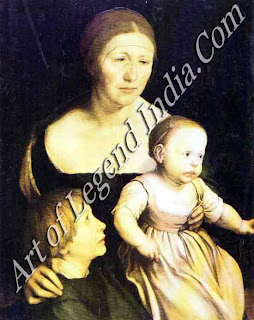
In 1528, Holbein returned to Basel; he had only been granted a two-year leave of absence and a longer stay would have cost him his citizenship. Also, the Council had work for him. He bought two adjoining houses overlooking the Rhine and settled down to paint frescoes for the Town Hall. During this period he painted a sympathetic and intimate portrait of his wife and two of their children.


A RETURN TO LONDON 

Like father, like son Hans Holbein the Elder was a successful artist working in Augsburg. He painted this Baptism of St Paul (1503-04) for a local convent. On the far right are the artist and his two sons, Ambrosius and Hans.
Meanwhile, the situation in Basel was rapidly worsening. The Lutheran faction was at its most extreme: Erasmus was forced to flee and iconoclasts destroyed nearly all the city's religious paintings in a single day. Holbein obtained some minor commissions decorating a tower clock in the city and designing patterns for goldsmiths, jewelers and glassmakers; he even made some costume designs. But the atmosphere was highly unfavorable to art of all sorts, and Holbein although he supported the principles of the Reformation decided to return to London.

He arrived late in 1532 to discover that events were moving very fast there too. Archbishop Warham had died and Thomas More, having refused to endorse the king's marriage to Anne Boleyn, had petitioned to resign the chancellorship. He was now trying to live in Unobtrusive privacy and Holbein was obliged to turn to another source of patronage. This he found among the German merchants at the Steelyard, which was the London trading office of the Hanseatic League. At this time he painted a magnificent full-length double portrait The Ambassadors, and the virtuoso George Gisze, both designed to attract the attention of Tudor court.

The status of his patrons rose quickly. By 1534 he was painting the king's secretary, Thomas Cromwell. In this same year more refused to swear the Oath of Supremacy, declaring that 'no parliament could make a law that God should not be God'. The king, who was now Supreme Head of the Church of England, had him cruelly Imprisoned in the Tower, where he languished for another year while the Crown's agents, directed by Cromwell, prepared their case against him.


Powerful friend this is a copy of Holbein's portrait of Thomas More's family. In 1526, Holbein used a letter of introduction from Erasmus to meet more who was then about to reach the peak of his political influence. Though Cromwell was repulsive in appearance and character, qualities which are not shirked in Holbein's portrait, he was the most important patron Holbein could have acquired. During the next five years he not only filled the royal coffers with monastic gold, but orchestrated the most lavish propaganda campaign in the arts ever undertaken for the benefit of the Crown. One of the first jobs he gave Holbein was to design a woodcut for the title page of the Coverdale Bible, the first complete edition of the Bible in English. This showed Henry VIII delivering the Word to the bishops.

In July 1535 Thomas More was executed and in the following year Anne Boleyn was the first of Henry VIII's wives to lose her head. Holbein was now on the royal payroll, and in 1537 he was appointed the King's Painter. For an annual income of about £30, he performed a great variety of commissions for his royal master from the design of his state robes to that of his book bindings. But he was chiefly valued for being 'very excellent in making Physiognomies'. By this time, the King had banned all religious painting.

Holbein's home in Switzerland Holbein’s wife and children remand in Basel while the artist sought work in England. He returned there in 1528, but only stayed for four years.Though he was a genius as a painter, as a man Holbein seems to have been shrewd, ambitious, ruthless and quite unscrupulous. Admittedly, the turbulent and bloody politics of those days made compromise and sudden switches of loyalty a virtual necessity for anyone close to the throne, even artists. But for all that, it is difficult not to be surprised by someone who was able to sell his talent to Cromwell, the man responsible for the death of more, his onetime friend, patron, host and sponsor.
A rare insight into Holbein's character (or his reputed character) comes from an anecdote told by The Flemish artist and art historian Karel van Mander. The story goes that Holbein was painting a portrait of a lady for King Henry, when a nobleman appeared in the room unannounced. The artist was so angered by the interruption that he flung the offending intruder downstairs then hurried to offer his apologies to the king.


PAINTING THE KING 

In the year 1537, Holbein was given his most momentous task when he was asked to paint a commemorative group portrait of Henry VIII, his new Queen, Jane Seymour, and the king's parents Henry VII and Elizabeth of York, which was to adorn the wall of the Privy Chamber above the throne itself. In the event, Jane Seymour died before the fresco was completed, having given birth to Henry's only and long awaited son. 1537 was in every respect a year of shattering triumph for the Tudor dynasty. Henry managed decisively to crush the most serious rebellion of his reign, the so-called Pilgrimage of Grace, and showed the Pope to be powerless to challenge his position as Supreme Head, next to Christ, of the Church of England. The great fresco was therefore conceived as a celebration of victory, peace and dynastic unity. Holbein had the job of enshrining in paint the official Tudor view of the immediate past.

We can only guess at the visual effect of his fresco, though every contemporary reference testifies to its awesome power. For in 1698 the negligence of a chamber maid caused the palace of Whitehall to be burnt to the ground.

Having completed the Whitehall wall painting, Holbein was sent abroad with the delicate task of painting likenesses of Henry's possible future wives. He visited Brussels where he painted a portrait of the delightful Christina of Denmark, which 'singularly pleased the king' and put him in a fine humour. However, political negotiations broke down, and Henry never married her. For a similar reason Holbein also painted a bland but pretty portrait of Anne of Cleves, whom the King decided to marry (though he later described her as 'the Flanders Mare').

Family group  Holbein's wife, Elsbeth Binsenstock, who he had married in 1519, and two of their children, Philip and Katharine. He painted this work in 1528 on his return to Basel. In September 1538 Holbein returned once more to Basel and his family. A banquet was held in his honour and the city offered him a pension and other privileges in the hope of tempting him to stay permanently. But he did not linger. Though he was never naturalized, London had become his home as well as the centre of his career.

In his last years, Holbein painted less for the king, but there is no evidence that he fell out of favour. Indeed, his last, unfinished work was a large painting of Henry VIII granting the charter to the Barber-Surgeons' company. He also continued to work for the Crown by travelling abroad on diplomatic missions about which little are known.

DEATH FROM THE PLAGUE

Holbein's life was cut short by the plague which raged through London in 1543. The will he made in that year reveals that he was a resident in the parish of St Andrew Undershaft in the City of London, and that he left two illegitimate 'chylder which be at nurse'. But despite Holbein's illustrious career, his will contains no mention of any property: only small items such as clothing and a horse. In fact he left several debts. But the debt which English art owes to the foreigner from Germany is far greater: he influenced the direction of English art for centuries to come.

Writer- A Marshall Cavendish
Company Overview

Art of Legend India has the distinction of being one of the best in the Indian Handicraft Industry. We are about 75 years old handicrafts manufacturer & exporter. We are having team of more than 500 craftsman.

We are having our business offices in India, USA & Germany to ensure our best services.

Total Pageviews