ArtofLegendIndia.com, Biggest Online Store of Handicrafts Items, Paintings and Jewelry Accessories...

Handicrafts

Handicrafts are devices or works of art that are made completely by hand or by the use of relatively simple tools. Such goods are usually made in the traditional way of manufacturing goods. Therefore, the knowledge of the art of craft is usually passed down from one generation to another. The items made using these traditional methods of manufacturing are usually produced in smaller quantities and they often represent the culture or religious beliefs of the community that makes them. The goods are also handmade from natural materials that are found in the environment of the particular economy.

Read More!

Biggest Online Store of Handicrafts Items

Paintings

A painting is equal to thousand words, means a beautiful painting is equal to million of words. Paintings are one of the oldest art forms -- throughout history artists have played an important role in documenting social movements, spiritual beliefs and general life and culture.

History Of Paintings: The history of painting reaches back in time to artifacts from...

Read More!

Biggest Online Store of Unique Style Paintings
Showing posts with label Biography of Gustave Courbet. Show all posts

French Great Artist Gustave Courbet - A Year in the Life 1848

Posted by Art Of Legend India [dot] Com On 1:51 AM 0 comments
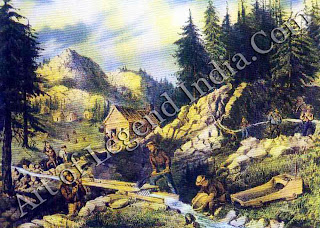
The Great American Gold Rush, In February, shortly after Mexico ceded California to the United States, traces of gold were found at Slitter's Mill on the American river. By November, men were rushing from all over the world to seek their fortunes. Indians hunted gold in return for beads. A Year in the Life 1848
As Courbet watched the mob mount the barricades in Paris, the shock waves of revolution reverberated throughout Europe. In Germany and Italy there was a series of violent uprisings, and in England there were ugly scenes in Trafalgar Square. Meanwhile, King Louis Philippe had fled France and, more sensationally, a gigantic sea serpent had been sighted off the African coast.

Everyone agreed that it was a most dramatic year. Popular writers vied with each other to find words grand enough to describe it. 'The year 1848', declared one, 'will be hereafter known as that of the great and general revolt of nations against their rulers.' A more cynical observer was heartily relieved when it was over. 'One cannot but feel glad,' he noted in his diary, 'at getting rid of a year which has been so pregnant with every sort of mischief.'


THE COMMUNIST MANIFESTO
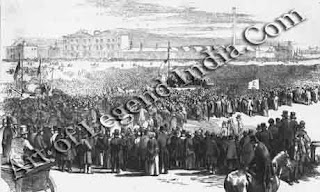
Chartists of the Common On 10 April 1848, more than a quarter of a million people met on Kennington Common in London to support the Chartist movement, campaign for representation in parliament for working people. In spite of massive support and a just cause, the movement was harshly repressed, and participants were jailed or deported.But the real words of power for 1848 had already been written when the year began and were in the hands of a London printer. 'Workers of the world, unite!' they ran, 'You have nothing to lose but your chains. You have a world to win.' The printer's client was a German refugee called Karl Marx and his commission was The Communist Manifesto.

The first rumblings of revolution came from Sicily in January, but they were not taken very seriously for Sicily was a notoriously volatile and lawless region. Then on 24 February the moderate middle-class monarchy of King Louis Philippe in France fell with startling suddenness. In the early hours of the morning, during a large demonstration outside the Ministry of Foreign Affairs in Paris, a man from the crowd walked up to the officer in command of the guard and shot him dead.

This had the intended effect of making the soldiers fire on the demonstrators, several of whom were killed. Their bodies were paraded through the streets in a cart to the accompaniment of revolutionary songs remembered from the 1790s. Barricades were set up, some 1,500 altogether, and by daybreak the mob was in complete control of the city centre.
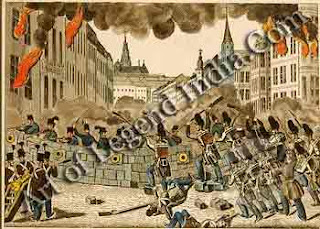
Storming the Barricades in Vienna 1848 was a year of tumult for Austria. On 13 March, the repressive chancellor Metternich was deposed after a battle between people and military. In May, barricades were erected when the government tried to deny the reforms earlier ceded. And the year ended with the abdication of the imbecile emperor, Ferdinand I.
Louis Philippe abdicated in favour of his grandson, a boy of 10, but the leaders of the revolution brushed aside the boy's claims and proclaimed a republic. Courbet did a drawing of a man at the barricade, to serve as a cover design for a revolutionary journal. 'Without 1848,' he said later, painting would not have happened.'

The first reaction came early in March from Hungary, where nationalist leaders demanded and obtained concessions from their Austrian rulers in Vienna. Then there was an uprising in Vienna itself, which forced the Emperor of Austria-Hungary to grant a new and liberal constitution to his people. The King of Prussia made similar concessions after an uprising in Berlin which left hundreds of demonstrators and troops dead. Revolutions followed in other German kingdoms and a national assembly for the whole of Germany was convened at Frankfurt, dedicated to sweeping away the existing petty principalities and creating a united Germany.

UPRISINGS IN ITALY 
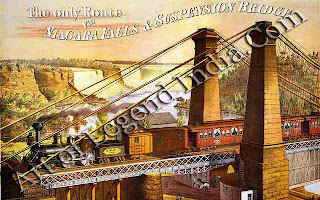
Niagara Falls Suspension Bridge Completed on 14 July, the bridge spanned 800 feet across the Niagara river and weighed 650 tons. The first cord was carried across the river on the tail of a kite. In Italy, too, a series of revolutions led to a movement for national unity. After popular uprisings had driven the Austrian occupying forces out of Milan and Venice, the King of Sardinia later to be joined by the Grand Duke of Tuscany embarked on a war to unify the country. The declaration of war came on 24 March. It had taken just a month for the shock waves from Paris to bring down the European state system from the Baltic to the southernmost tip of Italy.

From all over Europe refugees streamed into Britain, some of them conservatives who had been toppled and others revolutionaries who had been too extreme. The first to arrive was Louis Philippe, who landed at Newhaven in the early hours of the morning on 3 March. He wore a jacket borrowed from the captain of the ship that had brought him, and he had a week's growth of beard on his face. The Queen was muffled in a large plaid cloak, with a heavy veil to hide her face.
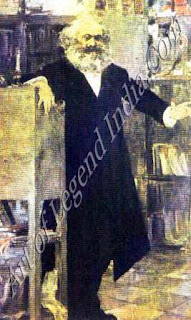
Karl Marx February 1848 saw the publication of The Communist Manifesto, written by Karl Marx (1818-83) in collaboration with Friedrich Engels (1820-95). It was the first charter for an exclusively working-class party and exhorted the proletariat to seize political power, and stamp out the system whereby the few became wealthy by the labour of the impoverished many. The publication was timely, and Marx's ideas were adopted by revolutionary movements all over Europe and, later, the world.
One Mr. Stone,' the newspapers reported, 'signalized himself by recognizing the King from afar off in the boat that brought him ashore.' Mr. Stone welcomed the deposed monarch, assuring him that the British would protect him from his enemies, and Louis Philippe, 'much agitated', gave him grateful thanks. The King then took refuge in coincidence, observing that he had travelled as 'Mr. Smith' and that he now found the landlady of the inn at which he stayed, as well as the Rector of Newhaven, had the same reassuring name.

PROTESTS IN TRAFALGAR SQUARE 

Three days later the British had their own first taste of revolutionary activity, when a certain Mr. Cochrane organized a demonstration in Trafalgar Square to protest against the income tax. Since only the rich paid the tax, it was not a very popular cause; and it became even less popular when Cochrane was scared off by a government ban on the meeting.

His supporters amused themselves by tearing down the fences around the column being erected to the memory of Lord Nelson. On the same day there were uglier troubles further north and cries of 'Vive la Republique!' were heard.
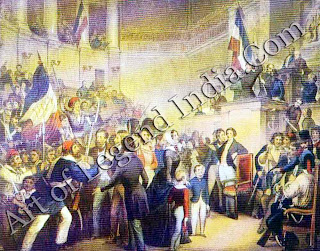
The Revolution in France, The wave of popular revolutions that spread across Europe during 1848 started in Paris where people took to the streets in a show of defiance. On 24 February, King Louis Philippe abdicated and nominated his 10 year-old grandson Louis Philippe Albert as his heir. But on the same day, revolutionaries invaded the Chamber of Deputies the invasion is shown in this engraving. The rebels swept aside the claims of the 'boy king', and proclaimed a republic. The authorities took fright and began to enrol special constables to deal with an enormous demonstration due to take place in London in April, when hundreds of thousands of radicals would present a petition for the reform of Parliament. One of the constables was Louis-Napoleon Bonaparte, nephew of the Napoleon Bonaparte who had once sought to invade Britain. He was responsible for the area between Park Lane and Dover Street, but in the event he had little to do. The demonstration came to nothing and its petition was rejected.

In August there came news sufficiently sensational to crowd out revolutions and radicals. The officers of a ship sailing off the African coast reported the sighting of a sea serpent over 100 feet long. Scientists said they were deluded and a fierce public controversy ensued, in the course of which most of the European revolutions collapsed without a great deal of attention being paid to them.

In the autumn Louis-Napoleon slipped across to France and was elected President of the French Republic. He might have had little to do in London, but in Paris he meant to maintain law and order. Courbet read the signs and began work on his great picture The Burial at Ornans. Its real subject, he insisted, was the death of romantic idealism and the acceptance of reality. The heady days of 1848 were over.

Writer – Marshall Cavendish

French Great Artist Gustave Courbet - Politics of the People

Posted by Art Of Legend India [dot] Com On 4:12 AM 0 comments
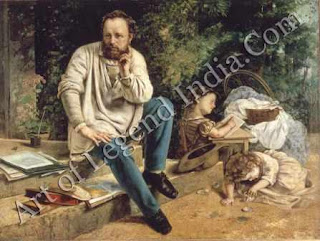
Proudhon remembered, Courbet could never persuade Proudhon to sit for his portrait, so he painted this 'historical portrait' in 1865, after his friend's death. Proudhon is shown as he was in 1853, sitting on the steps of his Paris home, with two of his children playing.

Politics of the People 

Born of peasant stock, the political philosopher Pierre-Joseph Proudhon dreamed of creating a utopian workers' state. But when the revolution came, it brought a bloodbath, not an earthly paradise.

'In 1848', claimed Courbet long afterwards, 'there were only two men ready: me and Proudhon.' In that year the people of Paris had risen against the government of Louis Philippe, only to replace him with Louis-Napoleon, the adventurer nephew of Bonaparte himself. Implicit in Courbet's boast was a view of himself as a shrewd and committed revolutionary, whose social ideas were ahead of his time. But he in fact was no more than a spectator in those turbulent February days. It was Proudhon alone. Courbet's friend and compatriot from the Jura hills who could really claim to have anticipated the events and sought to shape them.

A founding father of the international anarchist movement, Pierre-Joseph Proudhon had been born in 1809 in the provincial city of Besancon, just a few miles from Courbet's birthplace at Ornans. Proudhon's parents were both of peasant stock. His father was a cooper-brewer, his mother a cook, and he himself was apprenticed to a printer. This trade provided him with his education, for it was as a corrector of texts that he acquired knowledge of grammar, ancient languages and theology. His gift for learning so impressed the Academy of Besancon that in 1838 he was awarded a scholarship, which allowed him to move to Paris and undertake a regular course of study. But the fruits of this learning did not please Proudhon's sponsors. In 1840, the year Courbet himself arrived in Paris, the unruly young printer produced What is Property?, a sensational tract whose well-known answer 'property is theft' made him famous overnight.

The ideas put forward in this and subsequent books reflected Proudhon's peasant-craftsman background and appealed most to those radical Frenchmen who had also moved from the countryside to the growing industrial cities. Proudhon's philosophy, which is often called 'mutualism', sought an economic solution to the injustices of commercial exploitation. Dismissing the revolutionary overhaul of the state urged by other radical thinkers, Proudhon wished to dispense with the state altogether. Instead he called for 'anarchy', a harmonious society where an all-powerful, law-enforcing government would be unnecessary.

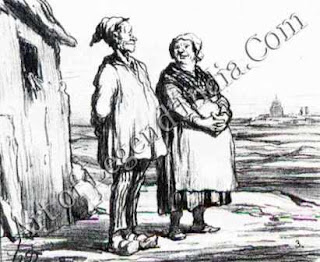
Leaving the land, In Proudhon's day, three-quarters of the population of France worked on the land. But a drift to the cities (here Paris is seen in the background) was characteristic of the industrialization that all major European cowl it went through in the 19th century, and as the peasants became less tied to the land they were seen as a threat by the middle classes. Proudhon's perfect society was an idealized version of Besancon and its environs, a network of small communities of producers who would exchange their surplus goods for the things they could not produce themselves, aided by a system of free monetary credit. By cutting out the middleman, this 'mutualist' barter would eliminate the abuses of property. Proudhon was it advocating self-help rather than state intervention: for him, big was bad, and he had no time for revolutionary theories based on parliamentary struggles or the strength of the masses.

In the early 1840s Proudhon divided his time between a job with a water-transport firm in Lyon and literary activities in Paris. In the capital, Proudhon was often found in the Brasserie Andler, where Courbet was also a regular and soon became a disciple.

THE RADICAL POLITICIAN 

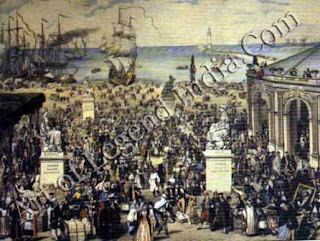
Proudhon's dream, Proudhon's vision of a workers' state is seen in this imaginative view. In the foreground people are bartering goods, and on the right is the People's Bank. Proudhon's attempt to set up such a bank was one of the factors that led to his imprisonment. In 1847 Proudhon settled down in Paris more permanently in order to devote himself to his newspaper, Le Representant du Peuple. And despite his well-aired misgivings about the value of parliamentary struggles he allowed himself to be elected to the new National Assembly when the monarchy of Louis Philippe was overthrown in February 1848. Predictably, he took his seat on the far left of this Assembly and soon identified himself with those militant workers who were agitating for a radical reconstruction of society. But when Louis-Napoleon seized power, Proudhon paid for his activities with three years in prison.

Soon after his release, Proudhon went to live in Belgium, but in 1862 he returned to Paris. He was now in his fifties, and an acknowledged leader of the French radicals, but his authority was slight. Many of his most fervent supporters had rejected his insistence on abstention from parliamentary politics, and several Proudhonists stood for election in 1863. The master himself fulminated against such political developments, but in his last years he also found time for lengthy commentaries upon art. In 1865 he sent regrets to Courbet from his deathbed for not having completed Du Principes de l' Art (On the Principles of Art), which he had started as a defence of Courbet's paintings; Proudhon's literary executors undertook the task of preparing it for posthumous publication. And Proudhon was overjoyed to see his followers prominent in the 'First International' the Inter-national Workingmen's Association.

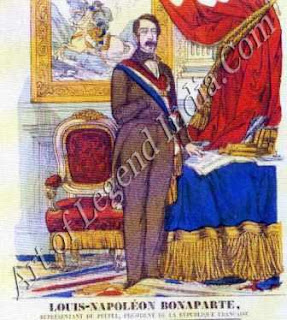
Emperor of the French Louis-Napolem Bonaparte, nephew of the great Napoleon, was the central political figure during Proudhon's career. After two unsuccessful attempts at coups, he became president of France in 1848 and proclaimed himself Emperor in 1852. He was deposed in 1871, after the disasters of the Franco-Prussian War. The Association had begun as a combination of stolid British trade unionists, fiercely anti-intellectual Frenchmen, and an assortment of revolutionary veterans. It was dominated by Karl Marx, a formidable German Jew of bourgeois background, whom Proudhon had met briefly in 1844. They had even corresponded for a time. But their political differences had soon overwhelmed initial comradely etiquette, especially after Marx responded to Proudhon's The Philosophy of Poverty with a scathing critique entitled The Poverty of Philosophy.

INSTANT REVOLUTION 

After Proudhon's death in 1865, the mantle of leading anarchist fell on Mikhail Bakunin, a Russian disciple and roaming revolutionary, whose power-base was among the impoverished peasant watchmakers of the Swiss Jura classic Proudhon territory. Bakunin was committed to instant revolution: the underprivileged should rise as one and annihilate capitalism in a single destructive swoop. Bakunin infuriated Marx, who believed that socialism was only possible as a development from a fully industrialized capitalist society, and whose patient strategy was based on industrial workers in the big cities rather than peasant-craftsmen in small towns and villages. So when Marx found himself unable to control the First International because of the cloak-and-dagger machinations of Bakunin, he decided to write it off. In 1872, Marx transferred its headquarters to New York, allowing it to collapse by 1874.

Workers on the barricades, Between 18 March and 28 May 1871, Paris was thrown into chaos by an insurrection which became known as the Paris Commune. Coining in tile wake of France's defeat by Prussia, this was perhaps the first organized revolt of the proletariat against the forces of capitalism. The revolutionary government that was set up called for social reforms, including a ten-hour working day and the end of night work for bakers. However, the insurgents were not well-organized militarily and the Commune was put down amid dreadful carnage. An estimated 20,000 people were killed in the street fighting and thousands more were punished. Karl Marx wrote a book on the Commune, which became a symbol of the social revolution that the middle classes dreaded and the workers desired.
Meanwhile, fate dealt a crushing blow to France's revolutionaries with the defeat of the Paris Commune in 1871. Courbet himself was a wholehearted Communard, just as Proudhon would have been, and dedicated his energies to this historic attempt to create an independent, workers' Paris. But the Commune drowned in blood. After atrocities on both sides, the official French government wrested the capital from the revolutionaries street by street.

A DREAM OF FREEDOM 

In the traditions of socialism, however, the bravery of the Communards won them the status of heroes, and Courbet earned a reputation as a true revolutionary artist. Even Marx, usually so scathing about the anarchist dream of a rapid transformation of society, acknowledged that 'Working-man's Paris, with its Commune, will be celebrated for ever as the glorious harbinger of a new society.' In truth, the accolade belonged less to Courbet than to Pierre-Joseph Proudhon, the self-taught peasant who founded no party but whose ideas inspired a lasting dream of freedom.

Writer – Marshall Cavendish

French Great Artist Gustave Courbet - The Shock of Reality

Posted by Art Of Legend India [dot] Com On 10:29 PM 0 comments
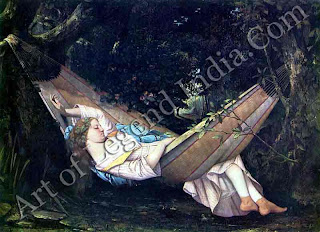
The Hammock (1844) Courbet painted this delightful picture during his early years in Paris. The languid pose, cool tones and graceful lines show a great debt to the Neo-Classical master Ingres. Yet the sleeping girl's Grecian profile is coarsened by a double-chin a hint of the 'unideal' which became Courbet's trademark

The Shock of Reality

Courbet insisted that it was the artist's job to paint only the world he knew. And his uncompromising images of contemporary rural society rocked the complacent attitudes of Parisian observers.

Courbet's fame today rests on his reputation as the leader of the Realist movement. But despite the fact that he called his 1855 one-man show the 'Pavilion of Realism', it was not necessarily a label he relished. In the preface to his exhibition catalogue, he declared that the title of 'realist had been thrust upon him. And in the remainder of his manifesto, he endeavoured to remove the misconceptions about his art and to put forward his own aims: 'to record the manners, ideas and aspects of the age as I myself saw them, to be a man as well as a painter to create a living art.'

POPULAR PRINTS 

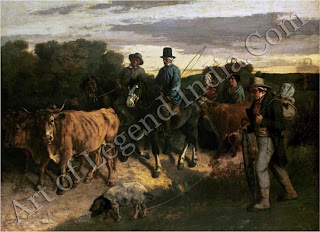
The Peasants of Flagey Returning from the Fair, Ornans (1850-55) This is a second version of one of the 'peasant' canvases which caused a scandal at the 1850-1 Salon. Instead of presenting peasants as part of a distant rural idyll, Courbet showed them as he knew them: the central figure is his father a peasant, but also the mayor of Flagey.Yet the methods that Courbet used to create his 'living art' were in some ways derived from the art of the past. In many of his most famous canvases, he made traditional use of secondary sources. For Burial at Ornans, for example, he incorporated elements borrowed from popular prints of the day with portraits of his family and neighbours; the model in The Studio was taken from a photograph, and some of his landscapes were composites, built up from separate studies.

In his work pattern, too, Courbet adhered to the conventional method: sketching during the summer and working up exhibition pieces in the studio during the winter. But in his insistence on painting only contemporary subjects, and in his presentation, Courbet's art was revolutionary.

Still-life with Apples and Pomegranate (1871) When Courbet was imprisoned in 1871, he could only paint still-life’s. The thickly applied paint, and earthy colours of the fruit which loom out of the shadows imbue this still-life with a sense of solid reality.
Even the size of his canvases was the subject of much concern and comment. There was an accepted convention in Salon painting that only lofty subject matter usually historical, Biblical or mythological scenes was appropriate for large-scale depiction. For peasant paintings such as Courbet's, a more moderate size was expected. But Courbet rejected this convention. His huge paintings of peasants baffled shocked and even threatened many city-dwelling observers, who searched in vain for some symbolic content.

Courbet was also criticized for his perverse liking for ugly subjects. But the 'ugliness' of his art worked on more than one level. While the fat, dimpled nude in The Bathers was simply seen as physically repulsive, the discordant composition and stiff, unattractive figures of The Peasants of Flagey were more unsettling. In this uneasy composition, Courbet evoked in the most direct manner, the uneasy social situation of the peasant-bourgeois characters in the scene.

But in his disrespect for 'beauty', Courbet was reacting against the strictures of academic painting, where there was a tendency to idealize. In Courbees view, it was not the business of the artist to depict historical or imaginary scenes, but to paint only what he knew the contemporary world. As for the art of the Old Masters, that was to be learnt from, not mimicked.

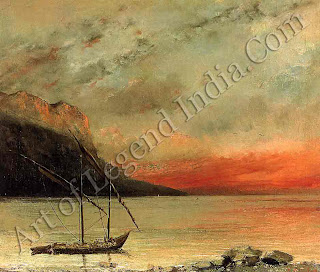
Sunset on Lake Geneva Painted in 1874, during his exile, this quiet evening scene is one of many views of Lake Geneva which Courbet executed in his final years. On the far shore is France forbidden territory. It was partly for this reason that Courbet was so reticent about his own conventional training and probably why he was so reluctant to take on students of his own. When, for a very brief period in 1862, he was persuaded to run a studio, he was determined that his pupils should not be tempted by their life-classes into painting only nudes in heroic poses. Hence the spectacle which greeted one visitor of a red and white bull, wild-eyed and flicking its tail, serving as the artists' model.

This freshness of approach was evident not only in Courbet's choice of subject-matter, but also in his use of paint. Even his sternest critics did not dispute his technical skill and, in particular, his ability to capture the richness of material surfaces. Courbet painted rapidly and with extraordinary dexterity. And he pioneered the use of a trowel-shaped palette knife, called a couteati anglais (English knife), which was long and flexible, allowing a surprising delicacy of touch. He employed coarse paints, often mixed with sand to stress their materiality, and applied very thickly on to the canvas. Because of this, his pictures contrasted dramatically with the smooth, highly finished paintings usually shown at the Salon. In his landscapes, Courbet opted for a blunt, non-picturesque approach, in defiance of the popular style, where a well-ordered collection of natural features, each carefully linked to the next, would draw the spectator into the scene. By contrast, Courbet sought to produce a single, powerful image on the surface of the canvas. He built his forest scenes around a dense, screen-like core, which prevented the eye from penetrating inwards and forced it to linger on the surface.

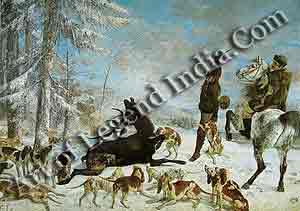
The Kill (1867) Courbet painted many landscapes and hunting scenes during the snowy winter of 1866-7 which he spent at Ornans. In this gruesome drama, the raised arm of the hunter and the anguished posture of the dying stag are silhouetted against the luminous whiteness of snow and sky.
This shallow picture space is also used to great effect in group portraits like the Burial where the figures run right across the surface of the vast canvas, with a direct visual impact that was too powerful to be ignored.

Even outside the act of painting, Courbet asserted his artistic independence by taking the revolutionary step of exhibiting his own show, under his own terms and by his reluctance to accept the role of teacher. In an open letter to his students, he set out this philosophy, declaring that sincerity to oneself was the key to all art and that with the aid of tradition and personal inspiration, every artist had to be his own master.

Writer – Marshall Cavendish

French Great Artist - Gustave Courbet Painting Gallery

Posted by Art Of Legend India [dot] Com On 3:17 AM 0 comments
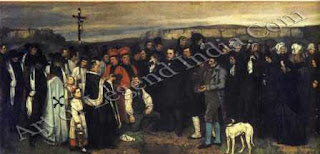
Burial at Ornans was the focus of attention and criticism at the Paris Salon of 1850-1. One of Courbet's first Realist paintings, it treated an ordinary event on the vast scale usually confined to 'history painting'.

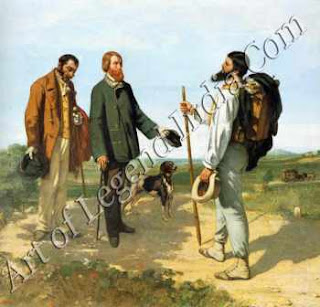
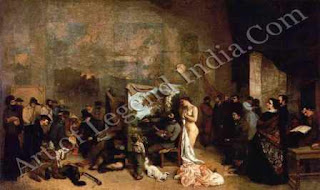
Its autobiographical content is typical of Courbet's work. The Meeting commemorates the artist's first visit to his patron Alfred Bruyas, while The Winnowers shows his sisters sifting corn at the family I farm. In The Painter's Studio, Courbet himself occupies the centre of a vast allegorical composition.

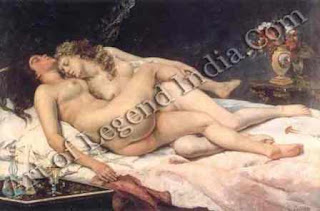
Young Ladies on the Banks of the Seine shows a lazy Sunday afternoon in Paris. It provoked another scandal: one of the girls is dressed only in her underwear. The Sleepers is even more risqué, but it was a private commission, and caused no public outcry.

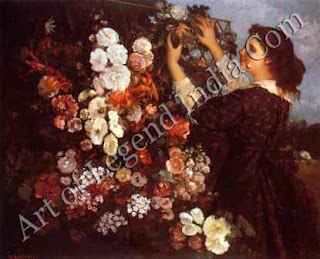
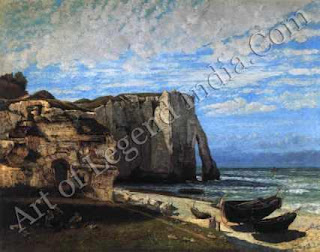
The Trellis shows a less controversial response to the natural world, as does Cliffs at Etretat, where the large scale and fresh approach create a powerful impression of the raw grandeur of nature. 

 
The Great Artist Gustave Courbet Painting “Burial at Ornans” 1849-50 124" x 263" Musee d'Orsay, Paris This huge painting contains nearly 60 life-size figures, the townsfolk of Ornans, gathered together for a funeral with male and female mourners separated according to Catholic custom.

It caused a tumult at the Salon. By painting on such a vast scale, Courbet turned an everyday incident into a historic event. It is this monumental treatment of contemporary daily life which makes this work one of Courbet's major Realist paintings.

City-dwelling observers saw it a 'glorification of vulgarity', and were threatened by the uncomfortably life-like portrayal of a rural community: these were no homely peasants, but real individuals with a complex class structure of their own The painting is steeped in Courbet's own experience: it shows his family, friends, local dignitaries and country people, and is set in the newly-consecrated cemetery on a hill outside his home town.

The Great Artist Gustave Courbet Painting “The Meeting or Bonjour, Monsieur Courbet” 1854-50 ¾" X 58 ¾” Musée Fabre, Montpellier,
This painting Commemorates Courbet`s arrival outside Montpellier in May 1354 on the occasion of his first visit to the home of his patron Alfred Bruyas. It depicts a specific moment, ‘but the frozen gestures of the characters seem to have great significance. The painting is almost an emblematic of the social relationships between the three men. His “head held high, the artist meets his patron as an equal (perhaps as a superior), while Bruyas’ servant stand by with his head been in deference and humility. Indeed, one critic even described it as ‘Fortune bowing to Genius’. The composition is derived from a popular print of the Wandering law, the 19th-century personification of the ‘outside of with whom Courbet liked to identify himself.

The Great Artist Gustave Courbet Painting “The Winnowers” 1855-51 ½" X 65 ¾" Musée des Beaux Arts, Nantes The major inspirations for Courbet’s art were the activities and customs of the people he knew in his remote, rural homeland. In this striking image he shows the working life of the women at Ornans. The strapping robust young woman sifting grain has her back turned to the viewer, but she has been identified as Zoe Courbet, the artist's sister. The other figures in the bolting-room may be his youngest sister Juliette and his son Desire Courbet who would have been about six years old when the picture was painted. Although the artist has paid his usual attention to the physical objects in the scene, the derived from Japanese prints.

The Great Artist Gustave Courbet Painting “The Painter's Studio: A Real Allegory Summing up Seven Years of my Artistic and Moral Life” 1855 142" x 235 ¾" Musee d'Orsay, Paris
Courbet's subtitle suggests that this painting sums up his artistic life from 1848 and 1855 the years between the Revolutions mid the World Exhibition for which the painting was intended. He calls it a 'real allegory a seeming contradiction in terms, and one which indicates the complex nature of Courbet's art. For though his paintings are called, 'Realist' they are often symbolic in content.


Courbet described the 'allegory' in a letter to his friend Champfleury, stating that the figures on the left were those who 'live on death', while those on the right 'live on life'. Champfleury is portrayed in this right-hand group, along with other friends such as Proudhon and Baudelaire. Courbet, of course, occupies centre stage.


While the figures on the right are recognizable portraits of Courbet's colleagues, those on the left whom the artist originally described as 'types' have only recently been given individual identifications by the art historian Helene Toussaint. They include a disguised portrait of the Emperor Napoleon III and various ex-Republican turncoats, along with European freedom fighters, whom Napoleon and his ministers were supporting perhaps sun ply to consolidate their power. The selection committee of the World Exhibition did not recognize any such subversive message in the painting, but they rejected it even so. It became the centre-piece of Courbet's one-man show, the 'Pavilion of Realism'.  

The Great Artist Gustave Courbet Painting “Young Ladies on the Banks of the Seine” 1856-7 68 ½" x 78 ¾" Petit Palais, Paris
Begun in Ornans in 1856 and finished in Paris in time for the 1857 Salon, this painting of two young women resting in the shade after a Sunday walk along the river shocked polite Parisian society. While the girl in the background leans against a tree-trunk, resting her chin in her lace-mittened hand, her friend has stripped off her dress and sprawled out on the grass: she lies on the warm riverbank in her chemise, corset and petticoats. Her eyes are half-closed in a suggestive sideways gaze which implies the presence of an observer presumably a male. Proudhon interpreted the painting as a comment on the loose morals of 'kept women', but it seems more likely that Courbet simply delighted in the lazy sensuousness of the weekend scene, and the delicate textures of the girls' fashionable clothes.

The Great Artist Gustave Courbet Painting “The Trellis” 1863 43 ¼" x 53" Museum of Art, Toledo, Ohio
In 1862 Courbet began a year-long visit to his friend Etienne Baudry at his chateau near Saintes in France. Perhaps inspired by his friend's interest in botany, he painted a great number of flower pictures during his stay. This is one of the most delightful examples. Divided into two distinct sections, it shows a gorgeous display of blooms being tended by a young woman, whose floral-print dress echoes the flowers on the trellis. It recalls the symbolic flower paintings of the 17th century Dutch Masters which glorified love and youth. Grouped together on the trellis are flowers which bloom in spring, summer and autumn symbolizing the stages of life and love? But Courbet's typical shallow picture space has left little room for the girl herself; with her darkly outlined face, she appears like a cut-out. 

The Great Artist Gustave Courbet Painting “The Sleepers” 1866 53" x 78 ¾" Petit Palais, Paris
Courbet painted this sensuous picture of lesbian love for Kahlil Bey, a wealthy Turk with an extravagant taste for erotica. Whistler's mistress Jo Heffernan modelled for one of the lovers, whose lost innocence is symbolized by the broken string of pearls.


The Great Artist Gustave Courbet Painting “Cliffs at Etretat after the Storm” 1869 52 ¼" x 63 ¾" Musee d'Orsay, Paris
The dramatic shoreline at Etretat in Normandy attracted painters throughout the 19th century. Courbet painted this magnificent, delicately balanced composition during the summer of 1869, but dated it 70'.


Writer – Marshall Cavendish
Company Overview

Art of Legend India has the distinction of being one of the best in the Indian Handicraft Industry. We are about 75 years old handicrafts manufacturer & exporter. We are having team of more than 500 craftsman.

We are having our business offices in India, USA & Germany to ensure our best services.

Total Pageviews