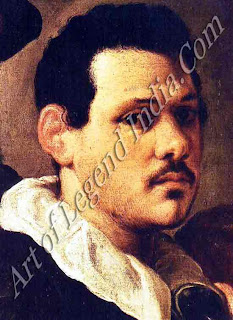
Annibale Carracci – Italian Great Artist
Annibale
Carracci was the most brilliant member of a family of artists who played an
outstanding part in the revival of Italian painting at the end of the 16th
century. To combat the prevailing artificiality of Italian ad, Annibale,
together with his brother and cousin, founded an academy in his native Bologna.
Their teaching bore fruit in the work of some of the finest artists of the next
generation who studied there.
When he
was 35, Annibale left Bologna for Rome, where he undertook his greatest work the
superb fresco decoration of the Farnese Gallery, which was hailed as the
successor to the masterworks of Michelangelo and Raphael. Annibale was a
warm-hearted and popular man, totally absorbed in his art, but he had a streak
of melancholia in him and in the last five years of his life he succumbed to a
depressive illness.
THE ANNIBALE CARRACCI'S LIFE
The Kindly Melancholic
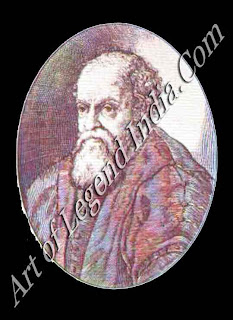
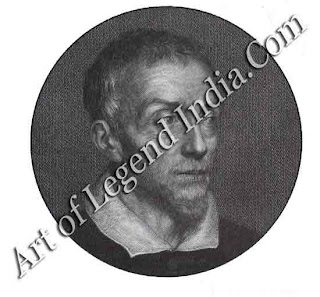
 Annibale
was the outstanding artist of the Carracci family. He combined intellect with a
great sense of fun but in later life suffered debilitating periods of illness
and depression.
Annibale
was the outstanding artist of the Carracci family. He combined intellect with a
great sense of fun but in later life suffered debilitating periods of illness
and depression.
There
have been many outstanding families of painters in the long history of Italian
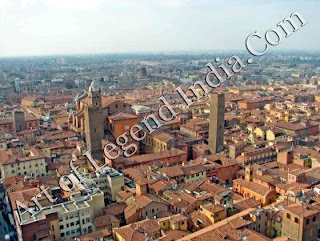
art, but none more remarkable than the Carracci family of Bologna, who
transformed their native city from something of an artistic backwater to the
centre of the most distinctive tradition in 17th-century Italian painting.
Annibale and Agostino Carracci were brothers and Ludovico Carracci was their
cousin. They were born within five years of each other and in their early
careers worked closely together, but Annibale eventually emerged as the great
genius of the family.
Annibale
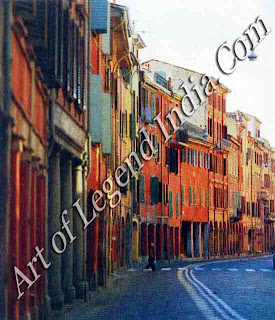
was born in the city of Bologna in 1560; he was three years younger than his
brother Agostino. They came from a fairly humble family (their father was a
tailor), while their cousin Ludovico (born in 1555) was the son of a butcher.
We know
little about Annibale's early life, and the two main sources of information on
him, both published by Italian biographers in the 1670s, are in disagreement
about his initial training: Carlo Malvasia says that Annibale learned the
tailor's trade in his father's shop, whereas Giovanni Pietro Bellori asserts
that Annibale was 'placed in the goldsmith's craft'. However, they both agree
that Annibale later trained with his older cousin Ludovico, although the style
of his early work suggests that at some time he probably worked in the studio
of the Bolognese painter Bartolomeo Passerotti (1529-92).
A USEFUL SKILL
Throughout
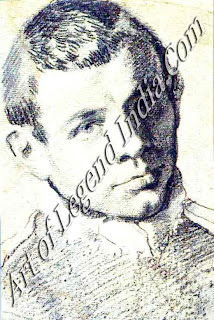
his career Annibale was to show prodigious skill as a draughtsman, and Bellori
tells a story that shows this was true even in his early years. 'His father,
Antonio, on returning to Bologna from a trip to Cremona, was robbed by peasants
with the loss of the modest sum he was bringing back. Annibale, who was with
his father, was able to sketch the appearance of those rapacious ruffians so
realistically and accurately that they were recognized by everyone with
astonishment, and what had been stolen from his father was easily recovered.'
 Annibale
probably became an assistant (or perhaps a junior partner) in Ludovico's
workshop around 1580, and all three Carracci were working together by 1584,
when they collaborated on a series of mythological frescoes in the Palazzo Fava
in Bologna. At this stage of their career it was - and still is difficult to
distinguish between their hands, and Malvasia writes that when they were asked
to explain who was responsible for the different parts of another joint venture
a fresco cycle in the Palazzo Magnani in Bologna they replied: 'It is by the
Carracci - we have all made it.'
Annibale
probably became an assistant (or perhaps a junior partner) in Ludovico's
workshop around 1580, and all three Carracci were working together by 1584,
when they collaborated on a series of mythological frescoes in the Palazzo Fava
in Bologna. At this stage of their career it was - and still is difficult to
distinguish between their hands, and Malvasia writes that when they were asked
to explain who was responsible for the different parts of another joint venture
a fresco cycle in the Palazzo Magnani in Bologna they replied: 'It is by the
Carracci - we have all made it.'
The
Carracci collaborated not only on paintings, but also in setting up a teaching
academy, probably in 1582. It was known originally as the Accademia dei
Desiderosi (the Academy of those desirous of fame and learning), and later
changed its name to the Accademia degli lncamminati (which may be translated as
the Academy of the Progressives), and aimed to revitalize what the Carracci
considered to be the moribund state of Italian painting.
Key Dates
1560 born in Bologna
C.1580 enters cousin
Ludovico's workshop
C.1582 founds Academy with his
brother Agostino and cousin Ludovico
1584 the Carracci's first fresco
collaboration
C.1585 visits Parma
C.1587 visits Venice
1595 moves to Rome
1597 begins decoration of Farnese
Gallery
1601 paints altar-piece for
Cerasi Chapel
1604 completes Farnese
Gallery
C.1604 paints landscapes for
the Palazzo Aldobrandini chapel
1605 onset of illness
1609 dies in Rome - buried in
Pantheon
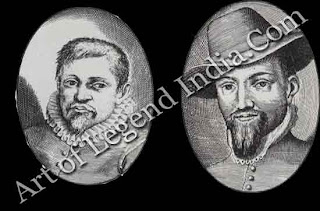
The
basis of the Carracci approach towards a more solid and naturalistic kind of
art was drawing from the life (the artists against whom they reacted took other
paintings, rather than nature, as their models). The artists who studied in the
Academy benefited greatly from this devotion to drawing particularly of the
human figure and clear firm draughtsmanship became one of the hallmarks of the
Bolognese School of painting. Domenichino (Annibale's favourite pupil) and
Guido Reni were the two most famous painters who trained with the Carracci.
PARIVLA AND VENICE
Annibale
strove to cultivate his skills not only by ceaseless drawing but also by
studying the great masters of the recent past. At some time in the 1580s
(probably around 1585), he went with Agostino to Parma, where he was greatly
impressed with the paintings of Correggio, who had worked there in the 1520s
and 1530s. Perhaps a year or so later (again the date is uncertain) Annibale
went to Venice, where he studied the work of Titian and met Tintoretto and
Veronese, the two contemporary giants of Venetian painting. He also met another
distinguished artist, Jacopo Bassano, who was evidently a man after Annibale's
own heart in that he was a keen observer of everyday life.
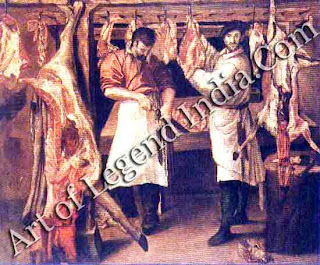 Annibale's
first dated painting is a Crucifixion with Saints of 1583 in the church of S.M.
Della Carib, Bologna, and during the next 12 years he painted a series of grand
altarpieces in which he revealed himself as an artist of commanding stature.
But the great turning point in Annibale's life came in 1595, when he was 35. In
that year he went to Rome to carry out decorations for Cardinal Odoardo Farnese
in his family palace, and this great commission gave Annibale his first real
opportunity to display his full powers. He lived in Rome for the rest of his
life and was never to see Bologna again.
Annibale's
first dated painting is a Crucifixion with Saints of 1583 in the church of S.M.
Della Carib, Bologna, and during the next 12 years he painted a series of grand
altarpieces in which he revealed himself as an artist of commanding stature.
But the great turning point in Annibale's life came in 1595, when he was 35. In
that year he went to Rome to carry out decorations for Cardinal Odoardo Farnese
in his family palace, and this great commission gave Annibale his first real
opportunity to display his full powers. He lived in Rome for the rest of his
life and was never to see Bologna again. THE FARNESE PALACE
Odoardo
Farnese, who was made a cardinal in 1591, when he was 18, came from one of the
most important families of patrons and collectors in the history of Italian
art. The Farnese Palace was one of the most imposing buildings' in Rome (Michelangelo
was among the architects who had a hand in its design), and Odoardo wanted the
decoration of his apartments to match the grandeur of the exterior. In
particular he wanted a suitable setting for the superb collection of classical
statues (now in the Archaeological Museum in Naples) that he had inherited from
his great-uncle, Cardinal Alessandro Farnese. Annibale was first required to
decorate a small room called the Camerino that Odoardo used as a study, mainly
with scenes from the legend of Hercules, and in 1597 he moved on to the
Gallery, the work from which his fame is inseparable.
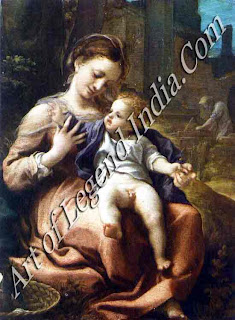 The
subject-matter of the decorative scheme seems a surprising choice for a
clergyman, as it represents the loves of the gods, or as Bellon described it
'human love governed by celestial love'. Cardinal Farnese's former tutor, the
eminent antiquarian Fulvio Orsini, was probably responsible for the elaborate
and learned 'programme.'
The
subject-matter of the decorative scheme seems a surprising choice for a
clergyman, as it represents the loves of the gods, or as Bellon described it
'human love governed by celestial love'. Cardinal Farnese's former tutor, the
eminent antiquarian Fulvio Orsini, was probably responsible for the elaborate
and learned 'programme.'
The
vaulted ceiling of the Gallery was painted between 1597 and 1600. Annibale had
some help from Agostino, who joined him in Rome in 1597, but the conception and
the bulk of the execution was his own. However, in 1600 the brothers parted
company after a quarrel. They differed greatly in temperament whereas Annibale
lived for his work and cared nothing for his appearance, Agostino was inclined
to put on airs and graces and sought the company of courtiers, whom Annibale
tried his best to avoid. According to Bellori, the rift occurred when Annibale,
who was 'untidy from painting', one day saw his brother in the street 'walking
with several cavaliers', called him aside and said to him: 'Remember, Agostino,
that you are the son of a tailor.' Soon after, Agostino left Rome for Parma
where he died two years later. Ludovico, who had remained in Bologna, now ran
the Academy on his own.
After
the completion of the vaulted ceiling, increasing demands prompted Annibale to
expand his studio and he had considerable help with the frescoes on the walls
of the Gallery from his assistants including Domenichino, who arrived in Rome
in 1602. Annibale was devoted to his pupils as well as to his own work. 'He
taught them not so much with words', says Bellori, 'as with example and
demonstration, and he treated .5 them with so much kindness that he often
neglected his own works. Without saying a word § he would go from one to the
other, and taking the brush from their hands would show them the rule by
example.' He also 'went through the streets and the churches with his pupils to
observe bad as well as good paintings. He would say to them "Thus one
should paint, thus one must not." His outspokenness could get him into
trouble, for when the Cavaliere d'Arpino, at the time one of the most renowned
artists in Italy, heard that Annibale had abused one of his paintings he
challenged him to a duel. Annibale's witty response was to pick up his brush
and say 'I challenge you!'
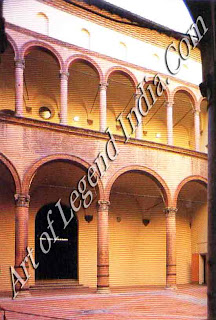 The
powerful, heroic style of figure painting that Annibale brought to maturity in
the Farnese Gallery reveals his study of Michelangelo, Raphael and classical
sculpture, but his frescoes have an exuberance that is completely personal.
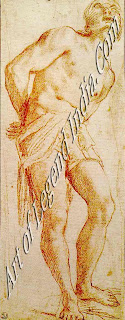
Annibale planned his work with unstinting labour, making hundreds of
preparatory drawings, and his skill in working out every detail to perfection
while still keeping an overall sense of buoyant freshness is truly astonishing.
The Gallery was immediately hailed as a great work, and for the next two
centuries it was ranked with the Sistine Ceiling and Raphael's frescoes in the
Vatican as one of the world's supreme masterpieces of painting.
The
powerful, heroic style of figure painting that Annibale brought to maturity in
the Farnese Gallery reveals his study of Michelangelo, Raphael and classical
sculpture, but his frescoes have an exuberance that is completely personal.
Annibale planned his work with unstinting labour, making hundreds of
preparatory drawings, and his skill in working out every detail to perfection
while still keeping an overall sense of buoyant freshness is truly astonishing.
The Gallery was immediately hailed as a great work, and for the next two
centuries it was ranked with the Sistine Ceiling and Raphael's frescoes in the
Vatican as one of the world's supreme masterpieces of painting.
Annibale
was poorly rewarded for his long and concentrated efforts. He was paid an
allowance as he worked, but it was traditional for the patron to give the
artist a lump sum at the end of the commission. According to Bellori, 'the evil
guidance of a favourite courtier, Don Juan de Castro, a Spaniard, convinced the
Cardinal to reward him with only 500 gold scudi' which were 'brought in a
saucer to Annibale in his room'. Annibale was disdainful of wealth and
possessions 'he despised ostentation in people as well as in painting' said
Bellori 'but he was "struck dumb" at the ingratitude of one he had
served so well'. Bellori tells many stories of Annibale's kind nature and good
fellowship, which makes Cardinal Farnese's stinginess all the more deplorable.
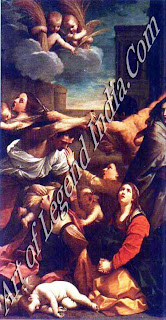
 Annibale
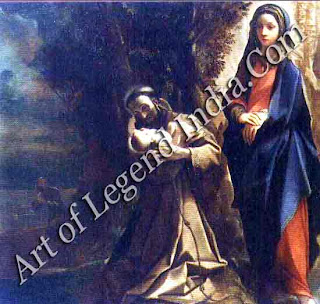
completed many other important works in Rome. He was in great demand as a
painter of altarpieces (in 1601 he worked on the same commission as Caravaggio
for paintings for the Cerasi Chapel in Santa Maria del Popolo), but the most
remarkable and original of his later works are his landscapes. In about 1604 he
and his pupils painted a series of landscapes with sacred subjects for the
chapel of the Palazzo Aldobrandini, one of the paintings The Flight into Egypt
being entirely from Annibale's own hand: With these pictures he created the
type known as the ideal landscape grand, formal, stately and suitable as a
setting for serious mythological or religious subjects.
Annibale
completed many other important works in Rome. He was in great demand as a
painter of altarpieces (in 1601 he worked on the same commission as Caravaggio
for paintings for the Cerasi Chapel in Santa Maria del Popolo), but the most
remarkable and original of his later works are his landscapes. In about 1604 he
and his pupils painted a series of landscapes with sacred subjects for the
chapel of the Palazzo Aldobrandini, one of the paintings The Flight into Egypt
being entirely from Annibale's own hand: With these pictures he created the
type known as the ideal landscape grand, formal, stately and suitable as a
setting for serious mythological or religious subjects. OVERWHELMING MELANCHOLY
 Despite
his success, the sorry conclusion to his labours in the Farnese Gallery sent
Annibale into a deep depression. Bellori says 'He was struck by apoplexy, which
impaired his speech and disturbed his intellect for some time.' He seems to
have had intervals of improvement, but during the last five years he hardly
painted at all, most of the work that issued from his studio being done by
assistants from his drawings. Bellori recounts that 'he went to Naples, where
he endeavoured to amuse himself and lighten his mind', but soon decided to
return to Rome and 'started back during the hot season, which generally is
dangerous'.
Despite
his success, the sorry conclusion to his labours in the Farnese Gallery sent
Annibale into a deep depression. Bellori says 'He was struck by apoplexy, which
impaired his speech and disturbed his intellect for some time.' He seems to
have had intervals of improvement, but during the last five years he hardly
painted at all, most of the work that issued from his studio being done by
assistants from his drawings. Bellori recounts that 'he went to Naples, where
he endeavoured to amuse himself and lighten his mind', but soon decided to
return to Rome and 'started back during the hot season, which generally is
dangerous'.
On 15
July 1609, soon after his return to Rome, Annibale died from a fever which was
worsened, according to Bellori, by 'amorous maladies'. He was 49. In accordance
with his last wishes Annibale was buried in the Pantheon, the last resting
place of Raphael, his greatest artistic hero. Bellori records the grief that
accompanied his funeral, 'almost as if it was Raphael again lying on the bier',
and expressed the hope that their two 'great souls are joined to God in
Heaven'.
Writer
– Marshall Cavendish