ArtofLegendIndia.com, Biggest Online Store of Handicrafts Items, Paintings and Jewelry Accessories...

Handicrafts

Handicrafts are devices or works of art that are made completely by hand or by the use of relatively simple tools. Such goods are usually made in the traditional way of manufacturing goods. Therefore, the knowledge of the art of craft is usually passed down from one generation to another. The items made using these traditional methods of manufacturing are usually produced in smaller quantities and they often represent the culture or religious beliefs of the community that makes them. The goods are also handmade from natural materials that are found in the environment of the particular economy.

Read More!

Biggest Online Store of Handicrafts Items

Paintings

A painting is equal to thousand words, means a beautiful painting is equal to million of words. Paintings are one of the oldest art forms -- throughout history artists have played an important role in documenting social movements, spiritual beliefs and general life and culture.

History Of Paintings: The history of painting reaches back in time to artifacts from...

Read More!

Biggest Online Store of Unique Style Paintings
Showing posts with label About Annibale Carracci. Show all posts

Italian Great Artist Annibale Carracci - Annibale`s Bologna

Posted by Art Of Legend India [dot] Com On 3:58 AM 0 comments
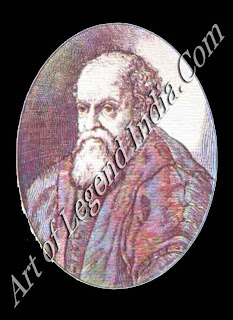
A centre of learning, Ulisse Aldrovandi (1522-1605) was one of the most distinguished scholars at the University of Bologna, which was founded in the 12th century. Appointed professor of natural history and logic in 1560, he employed numerous artists and engravers to illustrate his learned treatises. Annibale`s Bologna
A flourishing centre for the arts, Bologna was renowned for its colourful festivals and gastronomic excellence. But underlying this 'prosperity' there was widespread poverty and public unrest.

During the last three decades of the 16th century, when the Carracci were at the height of their activity, the busy and populous city of Bologna was one of the most important cultural and economic centres in Europe. In 1587, the city's population numbered 72,000, a level which was not reached again until 1791; industry and commerce were slowly expanding and the ancient university continued to prosper, attracting such influential scholars as Ulisse Aldrovandi. In 1582, the city's importance as a centre of religious life was formally acknowledged when Pope Gregory XIII created Bologna an archbishopric.
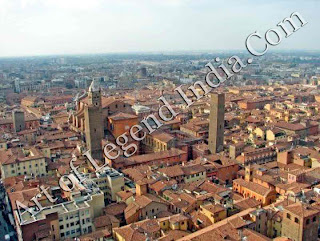
An ancient capital, The capital of the Emilia-Romagna region of Italy, Bologna lies some 60 miles north of Florence and 130 miles south-east of Milan. It is an ancient city, dating back to the ninth century BC, and the regular street plan of the city centre is a reminder of its days as a Roman settlement in the second century. Most important of all, the late 16th century saw an unprecedented flowering of activity in the arts. The Carracci's Accademia degli Incamminati, which established Bologna as a leading centre of painting in Europe was just one among a host of cultural and scientific societies which sprang up in the city. Bologna's church of San Petronio, one of the largest in the world, was renowned as a centre of musical activity. Its unusual size and superb acoustics encouraged the employment of massive groups of musicians, whose activities were to play an important part in the development of the Baroque concerto form. At the same time, the cappella musicale, or music academy, saw the emergence of a stream of talented composers.
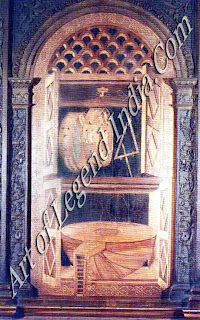
Musical inspiration, Until the time of the Carracci, Bologna was much more famous for its musical life than for its tradition in painting. This beautiful intarsia (inlaid wood) still-life is in the magnificent church of Sail Pet ronio, which was one of the most important centres of the cities varied and extensive musical activity. The city's prosperity was largely the result of a long period of internal peace. In 1512, Pope Julius II had finally expelled from the city the ruling family of Bentivoglio, and reclaimed Bologna as part of the Papal States. From that time onwards, the city was governed jointly by an elected Senate of 40 men, drawn from the local nobility, and a resident papal legate, or Legato. This unusual form of government had its drawbacks, but it ensured a state of relative tranquillity, and contributed to the distinctive character of the city's public life.

In reality, the power of the Senate was considerably restricted by the presence and authority of the Legato. Outwardly however, the senators attempted to create the impression that they were successfully protecting the autonomy of the Bolognese republic from the tyranny of Papalrule. The Carracci's frescoes of the story of Romulus and Remus in the Palazzo Magnani, painted at the time when the Magnani family were readmitted to the Senate after their exclusion by Pope Leo X, can be seen as one expression of this republican spirit.

In public, the senators surrounded themselves with all the trappings of status and power, living lives of ostentatious luxuiy. Despite the passing of numerous sumptuary laws, they dressed in the finest clothes and held endless banquets. To reinforce their image, they organized festivals, tournaments and jousts. The two-monthly election of the Gonfaloitiere di Giustizia (standard-bearer of justice) was marked by an elaborate ceremony, accompanied by regular processions and feasts. These sumptuous festivities, surpassed in extravagance by few cities in Europe, combined with other religious celebrations to give Bologna an unusually active and colourful public life.


GASTRONOMIC INDULGENCE
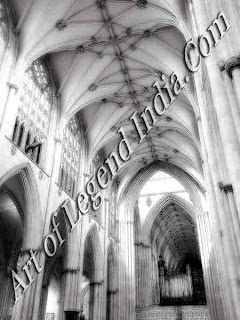
Medieval splendour, San Pet ronio is Bologna's greatest church and one of the finest Gothic buildings in Italy. Named after the city's patron saint, who was the first bishop of Bologna in the 5th century, it was begun in 1390. The love of luxury and good living, and particularly of good food, was not confined to the nobility. According to contemporary historians, the common people were also given to bouts of over-indulgence, and feasted extensively at the end of the week 'consuming in one day alone what they had earned with the sweat of six'.

Bologna has long been renowned as a centre of fine cuisine, and even today is known as the gastronomic centre of Italy. Located in one of the most fertile regions of the country, Bologna produces a cuisine which is rich in dairy products and high quality meats. Best known for the invention of rapt, the rich meat sauce which forms the basis of spaghetti bolognaise, the city can also claim to have invented a number of other pasta dishes, such as lasagne and tortellini.

The prosperity of Bologna was perhaps most dearly reflected in the extensive building boom which began around the second decade of the century, and which transformed the city into one of the most beautiful and richly varied in Italy. The bustling medieval streets, with their distinctive covered arcades, became punctuated by elegant new churches and palaces, based largely on contemporary Roman models. 1562 saw the beginning of the Archiginnasio, an imposing new building designed to bring together the scattered faculties of the University. Two years later, the medieval Piazza Maggiore, the heart of city life, was embellished by the construction of the adjacent Piazza del Nettuno, with its spectacular bronze fountain by the sculptor Giambologna. Senators vied with each other in constructing magnificent palaces with elaborate facades, as concrete symbols of their power. And new areas of the city were built up within the 13th-century walls, to accommodate the growing population.

ENLIGHTENED REFORM 

Shaded arcades, Many of the medieval streets in the old walled town are characterized by covered arcades a distinctive feature of Bologna, and one of the city's great attractions. The richness of the architecture, and the many churches and ornate palaces are a testimony to the city's wealth in medieval and Renaissance times. During the years of the Carracci, Bologna was an important centre of religious reform. Under the enlightened direction of its bishop, Cardinal Gabriele Paleotti, the proposals of the Council of Trent for the reinvigoration of the Catholic Church were given new impetus. Paleotti founded a seminary for the training of priests, insisting on the importance of the clergy in setting an example in moral and religious behaviour. He also founded a number of charitable institutions, including the Magistrato della Concordia, a committee of lay and religious people designed to give free legal advice and assistance to citizens of limited means.
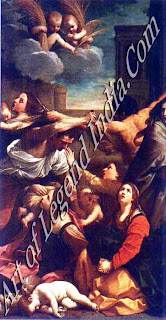
Annibale's successor, A pupil of the Carracci brothers, Guido Reni became one of the greatest artists of the Bolognese school. The Massacre of the Innocents is one of the artist's many religious works now housed in the Pinacoteca in Bologna. Despite the surface festivity however, city life in Bologna had strong undercurrents of violence and unrest. While the senators prospered, life for the common folk was unremittingly harsh. The stagnating economy of the country as a whole, exorbitant taxation and a series of poor harvests brought widespread poverty and outbreaks of crime. 1588 saw the beginning of a series of food shortages which left innumerable people dying of hunger in the city's streets. The same year, a rise in the price of bread lead to riots in the city, culminating in the arrest of over 100 bakers, butchers and rebels. Between 1587 and 1595 the population fell by 13,000.

Public order was also a serious problem. Although organized protest against conditions was rare, theft and murder were common in the city, and contemporary chronicles record each day's events as a bizzare combination of high festivities, ghastly murders and public executions. The problem was most severe in the surrounding countryside, where unemployed soldiers formed groups of bandits who looted, raped and murdered. Often these bandits were sheltered by the nobility, who used them to protect their own family and territorial interests. In 1585, the Pope ordered the murder of the count and senator Giovanni Pepoli, who refused to hand over a notorious bandit found on his territory; in deference to his aristocratic status, the count was strangled with a silk noose. Among other things, the count's execution was intended to serve as a warning to the nobility, who tried to exert their authority in defiance of Rome.

By the time Annibale Carracci died, the golden years of Bologna were over. The 17th century witnessed the city's gradual decline, exacerbated by the calamitous outbreak of plague in 1630, which left one quarter of the population dead. But for Annibale, the city must have provided a sympathetic and stimulating environment, with rich and varied patronage, active intellectual debate, and a feast of luxurious spectacle.

Writer – Marshall Cavendish

Great Italilian Artist Annibale Carracci - A Year in the life 1605

Posted by Art Of Legend India [dot] Com On 10:08 PM 0 comments

A Year in the life 1605  


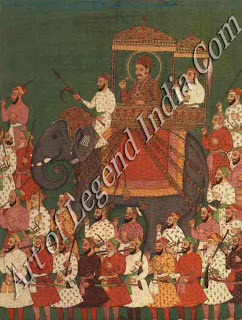
Empire builder, The great Moghul Emperor Akbar died in 1605, master of an empire that included most of India and Afghanistan. Unlike his predecessors, he had secured his conquests by creating a centralized administration and winning support through religious toleration. 2142
Illness virtually ended Annibale Carracci's career in 1605; the year Guy Fawkes attempted to blow up Parliament, Russia was plunged into her 'Time of Troubles' with the advent of the False Dmitri, and a Spaniard wrote a tragic-comic story that became an immediate and enduring best-seller.

The master-mind of the 'Powder Plot' was not Guy Fawkes but Robert Catesby, a gentleman in his early thirties who had already been active in several Catholic conspiracies against the Protestant English state. For his most ambitious plan, Catesby recruited three other reckless young men and brought over from the Netherlands a tough Yorkshireman who had served for some years with the Spanish army Guy, or Guido, Fawkes. The plotters rented a house in Westminster whose cellar extended below the House of Lords into which Fawkes carried 20 or 30 barrels of gunpowder, placing iron bars over them to make the intended explosion more lethal and covering them with faggots. When King James I opened Parliament on the 5th of November, the royal family, the King's ministers, the great peers and many of the English 'establishment' would be eliminated at a single stroke. In the ensuing confusion, a well-armed force of Catholics ostensibly assembled for a hunting party at a house in Warwickshire, would take power.

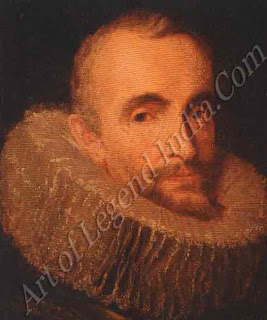
Genoese Commander-In-Chief, Spain was fortunate to have the financial and military services of the millionaire banker Ambrogio Spinola in the struggle against the Dutch. A born general, he had captured Ostend in 1604 and the next year, as overall commander took three important Dutch fortresses.
To carry out and finance this second part of their plan, the circle of conspirators was widened and it was one of the new adherents, Francis Tresham, who betrayed the secret. Ten days before Parliament was to meet, Tresham contacted his brother-in-law, Lord Monteagle, a Catholic peer who would be present at the opening. Tresham wrote: 'I would advise you, as you tender your life, to devise some excuse to shift of your attendance at this Parliament . . . for though there be no appearance of any stir, yet I say they shall receive a terrible blow this Parliament and yet they shall not see who hurts them.' Monteagle immediately reported this obscurely worded message to the chief minister, the Earl of Salisbury. On the night of November 4th the cellar was searched and Guy Fawkes arrested. He eventually broke down under torture and revealed the names of his fellow-conspirators who were hunted down and either killed or captured.


LITERARY LANDMARKS 


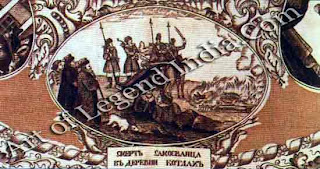
Shortlived triumph, The first of three pretenders, the so-called 'false Dmitri' had led a Russo-Polish army into Russia and then seized power after the death of Boris Godunov in 1605. The following year he was murdered and his ashes, fired from cannon, were aimed in the direction of Poland.
James I was a Scot, a fact that Englishmen viewed with a mixture of interest and centuries old prejudice. In 1605 Shakespeare was shrewdly exploiting the interest in things Scottish by writing Macbeth, inserting suitably admiring tableaux of the King's Stuart ancestors. During this year he also made his last recorded appearance as an actor in Ben Jonson's new tragedy, Sejanus.

Another notable literary event was the publication in Spain of the novel Don Quixote (part one). Its author, Miguel Cervantes de Saavedra, had a career even more chequered than his hero, the 'Knight of the Doleful Countenance'; he had fought at the great battle of Lepanto against the Turks, been captured and worked as a slave in the galleys of Algiers, and had more recently got into serious trouble in government employ when his accounts proved unsatisfactory. Don Quixote won immediate popularity inside Spain and was very quickly translated into several European languages.

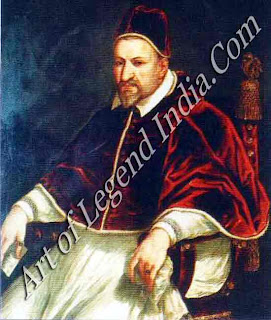
Pope Paul V, St Peter's Basilica was completed during the pontificate of Camillo Borghese (1605-1621). His lavish expenditure on building projects, artworks and his family increased papal debt.
In the East, power changed hands smoothly in two empires. In India, the Mogul Emperor Akbar died and was succeeded by his son Jehangir and in Japan, the Shogun leyasu retired in favour of his son Hidetada. But Russia hardly part of Europe during this period was plunged into her 'Time of Troubles' by the death of Tsar Boris Godunov in April 1605. Boris may have been poisoned, or may even have committed suicide, since his position had become critical; Russia was stricken by famine, and men were flocking to the banners of a pretender who claimed to be Dmitri, the son of a former Tsar, a boy who had in fact been murdered 14 years earlier. Within a few weeks of Boris's death, his son and successor, Fyodor II, was assassinated and 'the false Dmitri' began an inglorious eleven-month rule as Tsar. Civil wars and foreign invasions continued during the 'Time of Troubles' until 1613, when Mikhail Romanov became the first Tsar of a dynasty that was to rule Russia right down to 1917.

Writer – Marshall Cavendish

Company Overview

Art of Legend India has the distinction of being one of the best in the Indian Handicraft Industry. We are about 75 years old handicrafts manufacturer & exporter. We are having team of more than 500 craftsman.

We are having our business offices in India, USA & Germany to ensure our best services.

Total Pageviews