ArtofLegendIndia.com, Biggest Online Store of Handicrafts Items, Paintings and Jewelry Accessories...

Handicrafts

Handicrafts are devices or works of art that are made completely by hand or by the use of relatively simple tools. Such goods are usually made in the traditional way of manufacturing goods. Therefore, the knowledge of the art of craft is usually passed down from one generation to another. The items made using these traditional methods of manufacturing are usually produced in smaller quantities and they often represent the culture or religious beliefs of the community that makes them. The goods are also handmade from natural materials that are found in the environment of the particular economy.

Read More!

Biggest Online Store of Handicrafts Items

Paintings

A painting is equal to thousand words, means a beautiful painting is equal to million of words. Paintings are one of the oldest art forms -- throughout history artists have played an important role in documenting social movements, spiritual beliefs and general life and culture.

History Of Paintings: The history of painting reaches back in time to artifacts from...

Read More!

Biggest Online Store of Unique Style Paintings
Showing posts with label Van Gogh. Show all posts

Netherlandish Great Artist Vincent Van Gogh - The Impressionists in Paris
Posted by Art Of Legend India [dot] Com On 2:42 AM 0 comments
The Impressionists in Paris
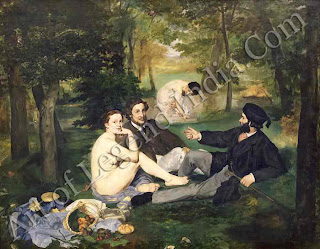
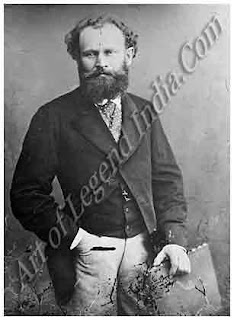
Edouard Manet, The 'Father of Impressionism', Manet was a fashionable man-about-town a most unlikely revolutionary.
When Van Gogh visited Paris in 1874, the Impressionists had just shocked the art world with their first exhibition. He returned 10 years later to form a 'second wave', with Gauguin and Lautrec.

Vincent van Gogh first visited Paris at the age of 21, when he stayed with his brother Theo. Obsessed by the failure of a love affair, he spent much of his free time sitting indoors, brooding over the Bible. Vincent had not yet decided to become a painter, and though both he and Theo worked for a firm of art dealers he was scarcely aware that a revolution in painting was fomenting in the city.

In April 1874, just before he arrived, a group of painters known as the Impressionists had held their first exhibition at a shop owned by the photographer Nadar, in the Boulevard des Capucines. A mixed band of individualists, they included the buoyant, self-confident Claude Monet and the day-dreaming Auguste Renoir, the anarchist Camille Pissarro and the elegant Edgar Degas.

Manet's outrageous painting, The Luncheon on the Grass (1863) broke art's most sacred convention: nudes should be goddesses, not real women sitting with fully-dressed gentlemen.
The group had come together in 1863, when their father figure, Edouard Manet, outraged the Paris art world with his Luncheon on the Grass a painting of a naked woman picnicking with two fully-clothed men. The subject was an affront to bourgeois taste, and it was turned down by the selection panel of the Academie des Beaux Arts as unsuitable for showing at the annual exhibition of the Salon.

In previous years such a picture would never have reached the public eye. But that same year, the Emperor Napoleon III had given a new opportunity to rejected artists by opening a second exhibition, the Salon des refuses especially for them. Over 1,000 painters showed their works, and Manet's Luncheon caused a sensation. The academic critics savaged the painting as 'a shameful, open sore,' but Manet quickly became a hero for the young radicals. They flocked to his studio for advice and encouragement. And their sense of common purpose was cemented by meetings in the nearby Café Guerbois.

NIGHTS IN THE CAFE GUERBOIS

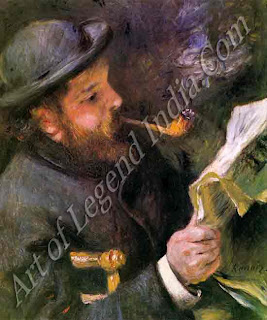
Claude Monet, The son of a grocer in Le Havre, Monet became the central figure of Impressionism and a regular visitor to Manet's favourite haunt, the Cafe Guerbois. The closeness of the two artists' names often caused confusion. Manet was once furious to read a good review of Monet's work, believing the critic to have mistaken his identity.
Every Thursday, as the light faded in the evening, the painters would meet up to discuss their ideas with other leaders of the avant-garde novelists such as Emile Zola and poets such as Charles Baudelaire and Theophile Gautier. Over numerous glasses of wine or absinthe, the popular but lethal anise-flavored drink of the time, they would engage in fierce debate about their artistic aims. Sometimes the arguments would get out of hand Manet himself was once almost provoked into fighting a duel there.

For all but a few of the younger artists, there were two overriding goals to paint the everyday world around them, and to work in the open air. It was Monet who was initially most interested in painting landscapes. Others soon followed his example, for working in the countryside was cheap, and it was stimulating to have company. The Impressionists would often work together at Bougival and Argenteuil on the Seine, in the Forest of Fontainebleau, or on the coast of Normandy.

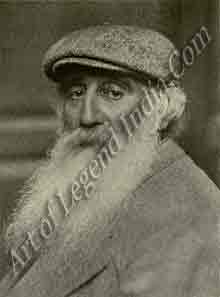
Camille Pissarro, The oldest of the Impressionists, Pissarro joined the 'gang' at the Cafe Guerbois. He encouraged many younger artists, including Van Gogh, Gauguin and Cezanne who once described him as 'humble and colossal, something like God the Father.
While the artists spent much of their time in these tranquil settings, they would regularly travel to Paris to try to sell some paintings. They found it hard to make a living. Not only was their work still barred from the official Salon, where professional artists could attract commissions, but the expensive galleries of the 'grands boulevards' also re-fused to stock their paintings. Buyers were hard to find, even with prices as low as 20 to 40 francs.

The Impressionists were not without minor patrons, such as Pissarro's friends Murer the confectioner and Dr de Bellio; the singer Faure who collected Mallet; the civil servant Chocquet who supported Renoir and Cezanne; or the anarchist Pere Tanguy, a supplier of art materials who gave them all generous credit as well as paint and canvas in return for their paintings.

But it was against a background of 'penury, obscurity and growing frustration that the artists had conceived the idea of a group exhibition, in an attempt to bring their work directly to the attention of the buying public. Only Manet refused to exhibit with them: he was exhausted by the ten-year barrage of criticisms and personal abuse, and no longer wished to expose his work to ridicule.

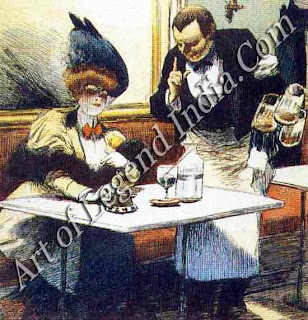
The cafes of Paris, Manet's painting The Waitress (1878) shows an artist in his blue smock drinking at a café. The Impressionists met weekly in such places to debate their work.
The first exhibition, which took place just before Vincent arrived in Paris, proved a financial failure, and was predictably slammed by the critics as in-decent 'filth'. But it represented the first stage in an outbreak of artistic defiance which would soon transform the French art world. When Vincent arrived back in Paris in 1886, the Impressionists were on their way to commercial success.

Eight exhibitions in 12 years had generated a growing momentum of critical approval. Renoir had even won approval from the academic establishment, with a painting prominently displayed at the 1879 Salon, after which Pissarro wrote, 'I do believe Renoir is launched. So much the better! It's so hard to be poor.' And if the other Impressionists were still not entirely accepted by the art-buying clientele, their paintings were now selling in reasonable quantities through more progressive dealers such as Durand-Ruel who, in 1886, staged a most successful exhibition in New York.

Theo himself stocked works by Monet, Degas, Renoir and Pissarro in his Montmartre gallery and the two brothers would often discuss the new developments. Vincent was now committed to a painting career, and in a much more receptive frame of mind altogether. He quickly realized that the Impressionist painters were a force to be reckoned with.

VAN GOGH MEETS PISSARRO 

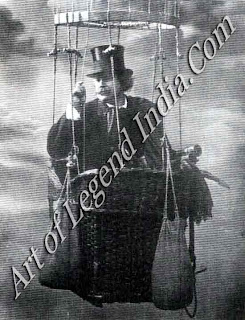
The photographer Nadar Gaspard Felix Tournachon, known as Nadar, was a photographer and balloonist. This portrait was taken at his studio in Boulevard des Capucines, which he lent to the Impressionists for their first exhibition in 1874.
Shortly after Vincent's arrival, Theo introduced his brother to Pissarro, who was known for being sensitive and encouraging to young artists. Vincent had great respect for Pissarro's judgment. On one occasion, dressed in his characteristic blue work-man's smock, he stopped his mentor in a busy street and insisted on showing him his latest can-vases, in full view of mocking passers-by. Pissarro said later he felt Vincent would either 'go mad or leave the Impressionists far behind', not realizing that both of these predictions would be entirely fulfilled.

In fact, Impressionism had already passed its peak as a dynamic movement. The leaders had argued with each other, and begun to go in different directions. With no progressive schools available, Vincent was forced to enrol at an 'official' studio, run by Fernand Cormon, a man who detested Impressionism. There he made friends with other students including Emile Bernard and Louis Anquetin, the Australian John Russell and an engaging, rather ugly aristocrat, Henri de Toulouse-Lautrec. This group, with Paul Gauguin and Georges Seurat, would soon form a new wave in the Paris art world.

Van Gogh at Le Tambourin Toulouse-Lautrec painted this portrait of his friend in their favourite cafe, Le Tambourin in Montmartre. Gauguin described the place as real cut-throat's den', but it had much to recommend it: cheap drink, a lively cabaret and a colourful, if argumentative, clientele. After a few months, Vincent and Toulouse-Lautrec left the Cormon studio in frustration. They had already met other more stimulating painters at Pere Tanguy's art supplies shop in the back streets of Montmartre. The generous Tanguy, who still displayed Impressionist works in his shop, one day introduced Vincent to Cezanne, who also had a reputation for being furiously emotional. It was not an encouraging meeting. After studying Vin-cent's recent work, Cezanne said bluntly, 'You certainly paint like a madman.'
The volatile circle of artists around Van Gogh styled themselves as the groupe du petit boulevard', in ironic contrast to the Impressionists who had now made their way into the galleries of the 'grands boulevards.' Their output was feverishly prolific, the subjects for paintings often being drawn from the picturesque Montmartre environment with its windmills and quiet lanes.

Women of Montmartre, Many of the cafes in Montmartre were shabby and run-down places where no respectable lady would be seen. The women who frequented them were generally prostitutes, who often modelled for artists.
Like the Impressionists before them, these 'Post-Impressionists' spent long hours in cafés arguing over glasses of absinthe particularly Vincent, his outspoken friend Gauguin and the urbane Toulouse-Lautrec. One of their favourite haunts was the tavern Le Tambourin on the Boulevard de Clichy, described by Gauguin as 'a real cut-throat's den.' Its owner, Agostina Segatori, even agreed to display some of her clients' paintings.

But while the artists harangued each other in the Café Tambourin till on one occasion an exasperated customer hit Vincent over the head with a still life they found it very difficult to get exhibited. Without sales, the group could not me in the expensive capital. Soon Gauguin and Bernard left Paris for Brittany, and in 1888 Van Gogh took the train to Arles. It would take almost a decade for Paris to discover its loss.

Writer – Marshall Cavendish 

Netherlandish Great Artist Van Gogh - A Year in the Life 1888

Posted by Art Of Legend India [dot] Com On 11:38 PM 0 comments

A Year in the Life 1888

Dunlop's new invention, The pneumatic tyre was introduced in 1888 by John Boyd Dunlop, a Belfast vet. This, combined with the improved safety bicycle, suddenly made bicycling a very popular pastime not least because it brought a change in fashion and women could show their legs for the .first time.
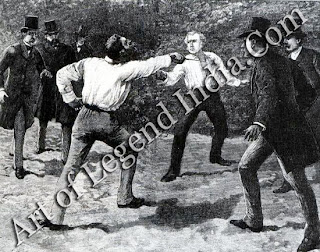
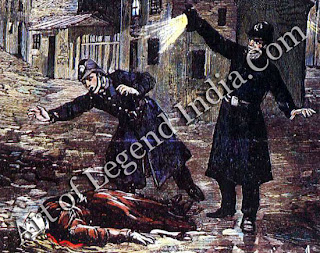
While Van Gogh was furnishing his Yellow House in Arles, France was shaken by political strife. In Paris, the ex-War Minister General Boulanger was wounded in a duel with Prime Minister Flocquet, while Kaiser Wilhelm of Germany made ominous threats of war. In Britain, Jack the Ripper stalked the streets of London and heavy snow fell in mid-summer.

An American astrologer predicted that this year would see the world's last days, with the sun turning to blood and one universal carnage of death'. It started badly: in January and February, deep snow and ferocious frosts brought most of Europe to a standstill. The French astronomer Camille Flammarion, a recognized authority on the end of the world, warned that the cold spell defied normal explanation. In Birmingham, word went round that the Day of Judgement had arrived. And in London, Edward Maitland wrote that the world had ended and another was being born.

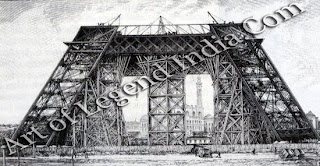
Eiffel tower in progress Alexandre Gustave Eiffel was a French engineer whose name was made famous by the tower he designed for the Paris Exhibition of 1889. This tower was a feat of 19th century engineering which revealed the potential of steel construction and stands today as one of the wonders of the modern world.
This was right in one sense. The comforting edifice of nineteenth-century science had begun to crumble. Michelson and Morley, experimenting in Berlin on the speed of light, were destroying the idea of a fixed universe and paving the way for Einstein's theory of relativity. In Vienna Ernst Mach, whose excellent work on the speed of sound would give a new word to the language, insisted that it was no longer possible to believe in absolute space or absolute time.

FICTION TRUER THAN FACT 

Boulanger's Duel In 1888, General Boulanger insulted Floquet, Prime Minister of France, who responded with a challenge. Boulanger had choice of weapons and chose swords. Being a soldier, 10 years younger than his opponent, it looked as though odds were on his side. But he was badly wounded in the throat: Floquet was the victor. The British presses were scathing about the duel, as duelling had been outlawed in England about 50 years beforehand.
Men of imagination, artists and writers, stepped into the breach, claiming their insights were more valuable than those of the scientists. Fiction, declared Robert Louis Stevenson, was closer to truth than 'the dazzle and confusion of reality'. The German philosopher Friedrich Nietzsche summed the matter up more pithily: 'The old God has abdicated, and from now on I shall rule the world.

Like Van Gogh, Nietzsche felt threatened by approaching insanity. Yet there was much to suggest the world around them was at least as mad as they were. When Van Gogh arrived in Arles early in 1888 he found a city torn by violence and by wild racial hatreds. Italian workmen were attacked by angry crowds and half-strangled before local contractors were finally persuaded to stop employing them. Throughout France, people became impatient with their dull Republican government, and looked for something less rational, more flamboyant. General Boulanger, until recently Minister for War, seemed ready to take over.

Fridtjof Nansen Nansen's imagination was fired by his first sight of Greenland's mighty ice cap, and he determined to cross it. His expedition of six left Norway in May 1888. After enduring intense cold they reached the summit in September. Nansen was also a scientist and, later, a statesman, winning the Nobel peace prize in 1922 for work with refugees.
On 15 March, the day after the troubles in Arles had come to a head, Boulanger was stripped of his army commission. For-bidden to go to Paris because of his suspected intrigues against the Republic, he had dared to go there in disguise, 'wearing dark spectacles and affecting lameness'. The attempt to disgrace him only made him more popular and he was elected to the Chamber of Deputies by two separate constituencies for one of 'which he had not even been a candidate.

BOULANGER'S DUEL 

Boulanger then tried to sweep away the Republic by getting the Chamber to dissolve itself and challenged the Prime Minister, Charles Floquet, to a duel. When the duel was fought Boulanger 'with blind impetuosity spitted himself on Monsieur Floquet's sword', receiving a severe wound in the throat, while Floquet sustained only minor injuries. Three days later a group of shocked and peaceable deputies tried to get duelling banned, but were overwhelmingly defeated. Boulanger's popularity continued to grow.

Jack the Ripper Jack the Ripper was the name given to the unknown murderer of seven prostitutes, late in 1888. His nickname came from the terrible multilation of their bodies.
Colourful swashbucklers, however impetuous, were more to French taste than the frock-coated politicians of the Republic. This was partly because the Republic no longer seemed respect-able. A deputy called Daniel Wilson, who had married the President's daughter, had used his position to further his own interest as a newspaper proprietor. There were other scandals in the offing, as politicians became more and more enmeshed in the shady dealings of the company which had been formed to build the Panama Canal.

Paris was hit by a wave of strikes, as well as other forms of violence: anarchists and communists waged an open gun battle in Pere la Chaise cemetery and an artist, Eugene Dupuis, was killed by another artist in a duel about their paintings. The bloodletting fell a long way short of the universal carnage fore-cast by astrologers, but continued the collapse of the solid values of the Republic.

THE BELLIGERENT KAISER


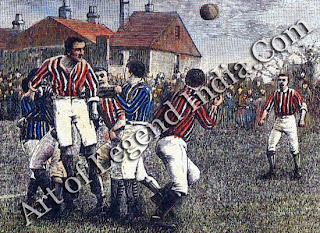
The Football League, The Football League was formed in 1888 to stimulate interest in the game. There were 12 founder clubs, including Everton and Aston Villa still amongst the strongest in England.
One man who did talk about carnage was the new German Emperor, Wilhelm II, who came to the throne in June. Within a week of his accession he had two French newspaper correspondents thrown out of Berlin, and embarked on a series of official visits to countries that might be Germany's allies in any future war with France.

In August, the Kaiser made an uncompromising speech, saying that if France tried to recover the German provinces of Alsace and Lorraine, more than 40 million Germans would rather 'be left dead on the battlefield than see one stone taken from them'. A few weeks later the imperial coat of arms above the German consulate in Le Havre was torn down. The French government made hasty apologies, but the Boulangists exulted.

Meanwhile, Britain stood aloof. She refused to take sides, even when Germany challenged her naval supremacy by laying down 28 new battleships. Instead she turned to such dull matters as the establishment of County Councils and floating a new issue of government stock.

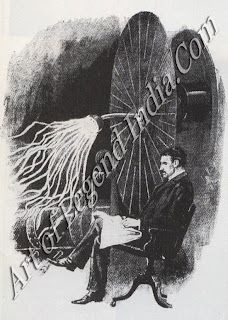
Tesla's electrical machine, The Croatian scientist Nikola Tesla developed alternating current machinery in America, competing with Edison's direct current system. In 1888 he was conducting experiments which three years later led to the Tesla coil still used today in radios and televisions.
Britain's own favourite prophet, the mediaeval wise woman known as Mother Shipton, had said the world would come to an end when summer turned into winter; this happened in 1888, with snow in June and July, but the British remained un-perturbed. Yet they did see their own brand of sadistic violence, with Jack the Ripper's murders in the East End of London.

As the tension mounted, and Boulanger won election after election in an atmosphere charged with anti-German delirium, his advent to power seemed inevitable. But January 1889 saw a farcical anti-climax. Cheering crowds in Paris tried to install him in the Presidential Palace, but Boulanger refused to budge. His opportunity passed and the French Republic was saved, along with the peace of Europe. The end of the old world, the predicted 'universal carnage of death', was put off for 25 years, until the terrible days of August 1914.

Writer – Marshall Cavendish
Netherland Great Artist Van Gogh at Work

Posted by Art Of Legend India [dot] Com On 4:13 AM 0 comments

A Race against Time


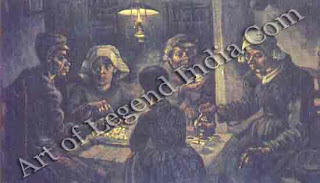
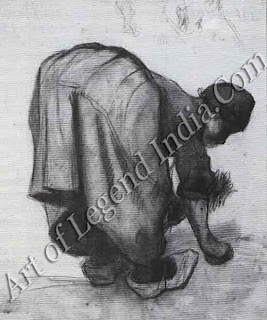
Dutch peasants, The dark masterpiece of Van Gogh's early period, The Potato Eaters (left) is coloured 'like a dusty potato'. It shows Vincent's concern for the hard life of the Dutch peasant, and his respect for the dignity of labour which is also shown in Peasant.
Van Gogh only painted for the last few years of his life, but his output was enormous. He produced more than 800 canvases- working day and night, as if aware of the short time allotted to him.

When Van Gogh took the fateful decision to devote himself to art, in the bleak coal-mining district of the Borinage in Belgium, he was already 27. He had enjoyed sketching since childhood, especially views of the flat Dutch countryside, with peasants labouring in the fields. But he had never learned to paint in oils.

Woman, drawn in the same year 1885, When Vincent went to Paris a year later his painting changed completely, influenced by the Impressionists.
At first he concentrated on drawing, employing a teach-yourself method of the time known as the Bargues technique. He was very conscious of his deficiencies, and eagerly associated with other painters, among them his relative Anton Mauve, whom he visited in the Hague. But Vincent's fierce independence and stormy temperament made it impossible for him to be a pupil he invariably argued with his mentors.

WORKING OUT OF DOORS 


In Paris, he was inspired by the works of the Impressionists and their followers, who had abandoned the methods of traditional art. Working out of doors instead of in the studio, they ignored the idea of a 'finished' painting, in which all colours were mixed on the palette to the correct shade, then laid down smoothly on the canvas and finally varnished. Instead they used pure, bright colours reds and blues, yellows, whites and greens and put down their paint in rough brush strokes which gave the impression of light being reflected from natural surfaces.

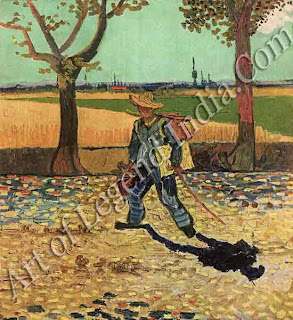
The Painter on his Way to Work 1888, Van Gogh sets out with his easel, canvas and paints to work in the blazing sunshine of southern France. He often completed a picture in a single day.
The Impressionist method suited Vincent's purposes like them, he liked to work fast and out-of-doors and he soon abandoned the sombre browns and blacks he had used in Holland for paintings such as The Potato Eaters. In Paris, too, he was inspired by Japanese art, which had recently become popular: hundreds of wood-cut prints were readily available at a couple of francs apiece.

Vincent saw Arles as a French version of Japan, and he travelled south in 1888 as if on a personal mission to create a new movement in art. For over a year he worked himself to breaking point, painting up to 16 hours a day. He had always worked in frenzied bursts of activity, heedless of his deteriorating health, but now he scarcely stopped to eat or drink, almost as if aware of the short lifespan allotted to him.

EXAGGERATING THE COLOUR


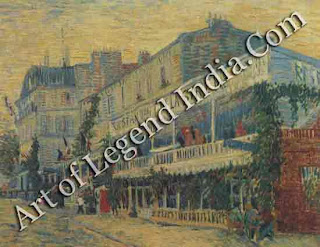
Parisian street scenes, In Paris, Vincent began painting pictures of the city in the bright colours and blocky brushstrokes which were used by the Impressionists. The Restaurant de la Sirene (1887) shows a view near Emile Bernard's studio.
Every day, through the blazing heat of the sum-mer, he would march out and set up his easel. In the autumn he tried unsuccessfully to defy the fierce southern wind, the Mistral, by pinning his canvas to the ground with heavy boulders. He would paint all night, if necessary. To give himself enough light to paint The Café Terrace, he stuck candles round his broad-brimmed hat and along the top of his easel, and as the bemused Arlesiens looked on, he began to paint, 'absolutely piling on, exaggerating the colour'.

Vincent had always painted with thick layers of colour. Even for some of the Dutch pictures he had applied paint so liberally that individual brushmarks were ineffective, and he resorted to squeezing paint straight from the tube on to the canvas, then modeling it 'a little' with his brush. Though he subsequently learned to texture his surfaces with great sensitivity, this thickly-applied paint known as impasto remained a hallmark of Van Gogh's art.

Expressive colour In this late watercolour of Stone Steps in the Hospital Garden (1889), the blue leaves and purple tree trunk reveal Vincent's aim to 'express myself forcibly' through the use of colour.
By 'exaggerating the colour', he explained to his brother Theo, he wished 'to express myself forcibly'. Colours for Van Gogh did not merely describe objects, but gave them meaning; and no colour meant more to him than yellow. In Japan it symbolized friendship. It represented the glory of the sun and the golden wheat in short; it was the colour of creation. Even in his night pictures yellow plays a surprisingly important part. And in his famous painting Sunflowers he created a whole painting with little colour other than yellow, a technical feat almost without parallel.

THE POWER OF YELLOW 


Letters to Theo requesting paint highlight Vin-cent's preference. They always start with demands for large tubes of yellow and white paint. And the other colours he used heavily, especially purples and blues, serve to accentuate the power of yellow. His concern for colour extended to the framing of each work, and it was not uncommon for him to give very explicit instructions to ensure the right effect: on one occasion he asked for a royal blue and gold frame to be designed especially for his canvas.

In the months before his breakdown, Vincent produced some 200 paintings, including about 50 portraits of his friends in Arles. Frequently he completed a painting in a single day an amazing work-rate, even by the standards of the Impressionists. 'I was right,' he wrote to Theo, 'to work at white heat as long as it was fine.' And when his brother once hinted that his enormous output might adversely affect the quality of his work, he retorted that 'Quick work does not mean less serious work, it depends on one's self-confidence and experience.

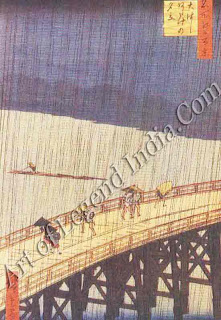
Utagawa Hiroshige (1797-1858) Ohashi Bridge in the Rain, Van Gogh made a copy of this wood-cut, which was one of the many Japanese prints he collected. It shows the bright colour and simplicity of design which typified Japanese art, and appealed so strongly to Van Gogh and his contemporaries.
Under the crushing weight of mental collapse, Van Gogh's self-confidence became badly bruised. The swirling lines which distinguish all his late paintings seem to echo the torment in his mind. Yet in this final phase of his career, Vincent still worked at a punishing pace, producing a further 200 paintings in the last year of his life. Among them was one of his greatest masterpieces the Self-Portrait of 1890. One in a series of self-portraits equalled only by Rembrandt's for their candour and penetration, it is a painting almost without colour, dominated by pale, icy colours; warmed only by the orange-brown of the artist's hair and beard.

THE MAKING OF A MASTERPIECE

 The Bedroom at Arles 


Van Gogh painted this bedroom in his 'Yellow House' at Arles in the autumn of 1888, while awaiting Gauguin's arrival. It was one of a series of pictures he made to decorate the house and he hoped impress his friend. He had been living alone in Arles for months, and now he hoped the house would become the headquarters of an artists' colony, with Gauguin as its leader.

He painted the room as simply as possible, with pure, harmonious colours and strongly outlined shapes. The room is shown empty of people, but with an air of expectancy: every-thing is painted in pairs. The two pairs of pictures, two pillows, and especially the two chairs may well reflect Vincent's excitement that his solitude was about to end.

Writer – Marshall Cavendish
Company Overview

Art of Legend India has the distinction of being one of the best in the Indian Handicraft Industry. We are about 75 years old handicrafts manufacturer & exporter. We are having team of more than 500 craftsman.

We are having our business offices in India, USA & Germany to ensure our best services.

Total Pageviews