ArtofLegendIndia.com, Biggest Online Store of Handicrafts Items, Paintings and Jewelry Accessories...

Handicrafts

Handicrafts are devices or works of art that are made completely by hand or by the use of relatively simple tools. Such goods are usually made in the traditional way of manufacturing goods. Therefore, the knowledge of the art of craft is usually passed down from one generation to another. The items made using these traditional methods of manufacturing are usually produced in smaller quantities and they often represent the culture or religious beliefs of the community that makes them. The goods are also handmade from natural materials that are found in the environment of the particular economy.

Read More!

Biggest Online Store of Handicrafts Items

Paintings

A painting is equal to thousand words, means a beautiful painting is equal to million of words. Paintings are one of the oldest art forms -- throughout history artists have played an important role in documenting social movements, spiritual beliefs and general life and culture.

History Of Paintings: The history of painting reaches back in time to artifacts from...

Read More!

Biggest Online Store of Unique Style Paintings
Showing posts with label Religion.. Show all posts

Vishnu Establishes the Law

Posted by Art Of Legend India [dot] Com On 11:24 PM 0 comments
Bhoopati: Vishnu-Varaha, the guardian of the earth-goddess Bhoodevi

Varaha Saves Bhoodevi 


The earth-goddess Bhoodevi floated on the sea, warmed by the sun, cooled by the rain. She always looked towards the sky, her back to the demons, and smiled at the gods. Feeling slighted, Hiranyaksha, lord of the netherworld, dragged her down to his infernal kingdom under the sea and sought to make her his queen. To rescue her, Vishnu turned into Varaha, a gigantic boar. Tail raised, hairs erect, he plunged into the sea and ripped through the waters until he reached the ocean floor where he found the earth-goddess in the clutches of the demon-king. Varaha gored Hiranyaksha to death. Then with a triumphant snort, he placed Bhoodevi on his mighty tusks and carried her back to the surface of the sea. Bhoodevi accepted Vishnu as her consort: trees and plants were their children. Vishnu became the guardian of earth.

Vena's Ingratitude Man and woman found food, clothing and shelter in the bountiful arms of Bhoodevi and expressed their gratitude through rituals, yagnas, vratas and pujas. But many saw no point in thanking the earth. "The earth is man's servant," said Vena under whose leadership mankind abandoned all rituals and began wrenching out the wealth of the earth-goddess

Death of Vena
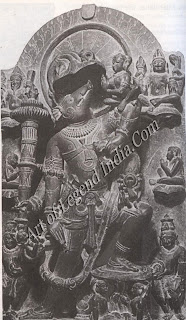
 
Varaha: Vishnu as the mighty boar raising the earth-goddess Bhoodevi from the ocean floorWise men decried this ingratitude. They begged Vena and his followers to change their ways. "Beware the wrath of Vishnu," said the sages. "What Vishnu? Who is he? Where is he? There is no Vishnu, there is no god. There is only man who worships himself with offerings of pleasure," said Vena. Unable to tolerate Vena's callousness, the sages rose in revolt. They cursed and killed Vena.

Bhoodevi's Wrath

 
Despite Vena's death, the exploitation of earth continued.

Disgusted by the impudence of man and his insatiable greed Bhoodevi withheld her bounty: seeds did not sprout, plants did not grow, trees bore no flower or fruit. The earth became barren.

With no offerings or sacrifices, even the gods and the demons faced starvation. There was misery in the three worlds.

Purification of Vena's Body


Without food, there was despair and anarchy.

 A leader was needed, someone who would make peace with Bhoodevi and restore order.

Everyone wondered where such a man could be found. "In Vena himself," informed the sapta-rishis, the seven celestial seers.

The seers procured Vena's lifeless body and began rubbing its thigh vigorously till Vena's corrupt nature emerged from within in the form of a fierce demonic being that was driven into the darkness.

From the purified corpse the seers hoped to create the perfect king.

Birth of Prithu
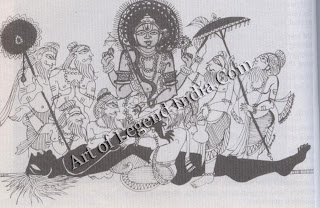
 
Sages draw Prithu out of Vena's corpse
From the arms of Vena's dead body, the sapta-rishis drew out a strong and handsome youth called Prithu. Celestial spirits, gods, demons, birds and beasts gathered around to witness this unique birth. In Prithu, they saw the spirit of Vishnu. The celestial bow Sharanga fell from the heavens into Prithu's hand as soon as he was born, investing him with universal dominion.

Prithu Chases Bhoodevi

 
Prithu, the first consecrated king of mankind, found his subjects hungry and miserable.

Moved by their plight, Prithu begged Bhoodevi to have pity on them and give them food. She refused. Prithu threatened the earth-goddess with dire consequences if she did not release her wealth.

Bhoodevi did not give in. Instead, taking the form of a cow, she ran away.

Enraged by her defiance, Prithu mounted his chariot and followed Bhoodevi, pursuing her to the four corners of the world, determined to subjugate her.

Cowherd of the Cosmic Cow
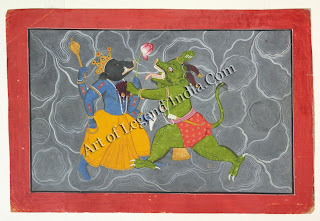
Varaha fighting Hiranyaksha 
Prithu raised his celestial bow to shoot a deadly missile at the stubborn earth-cow.

"I am the cosmic cow; my udders nourish life. If you kill me, you will destroy everything that exists," said Bhoodevi.
"I do not wish to kill you," explained Prithu. "I only want you to feed mankind."

"Why should I feed those who abuse me?"

"No one will abuse you ever again. I will make sure everyone treats you with respect," promised Prithu. "I will be your guardian, your cowherd, Gopala."

Milking of the Earth

 
Prithu taught mankind agriculture, cattle rearing, mining and trade. He instituted the principle of prudent economics, artha, that supports human society without harming Nature.

Under Prithu's watchful eye, the wealth of the earth was milked wisely by man, gods, demons, sages, nagas, gandharvas, yakshas and every other celestial spirit.

In the earth-cow, mankind found sustenance, artists found inspiration, scholars found wisdom, priests found sacred chants, mystics found insights. The devas procured energising potions, the asuras obtained intoxicating drinks. Gandharvas found music, apsaras found beauty, vidyadharas found magic. Cattle got grass snakes got venom bees got honey.

Bhoodevi satisfied everyone's needs. She was worshipped and adored by all as Prithvi: the beloved of Prithu.

Bhoodevi's Fear
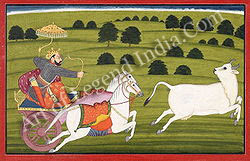
 
Prithu chasing the earth-cowThe three worlds thanked Vishnu for making peace with Bhoodevi.

But there was fear in the heart of the earth-goddess. "What if there is another Vena in the future?" she asked the lord.

"Fear not," said Vishnu. "I will institute dharma: laws that will guarantee your well being. Whenever these laws are broken I will descend upon earth to punish the transgressor."

Bull of Dharma


 From Vishnu's chest rose a bull. "Behold, the bull of dharma. Love, truth, discipline and compassion are its four limbs. So long as it stands upright, the world will survive," said the lord.

Brahma revealed, "Every time this bull of dharma loses a leg, an age will come to an end. The first age to come to an end will be the age of perfection, Krita-yuga. After this will come Treta and Dvapara yugas, periods of increasing corruption. Finally, when the bull stands on only one foot it will be the age of Kali, the age of materialism and spiritual blindness, at the end of which the floods of doom will engulf the earth."

Birth of Mandhata

 
In Krita-yuga, Vishnu descended upon earth as Mandhata, to teach mankind the ways of dharma.

Yuvanashva, king of the world, had many wives but no children. So the sages of earth gave him a pot of holy water, potent enough to give anyone a child. "Keep the pot under your bed for one night; at dawn let your favourite queen drink the water," said the sages.

The king kept the pot of water under his bed as he was told. But in the middle of the night, he woke up feeling thirsty and accidentally drank the sacred water.

As a result he became pregnant.

Nine months later, Yuvanashva experienced the pangs of labour. The gods descended from the heavens to deliver the child. They cut open the king's side and pulled it out.

"How will I, a man, nurse this child?" wondered Yuvanashva.

"I will feed it," said Indra, king of the gods, placing his divine finger that oozed milk in the child's mouth.

This child, born of a man, nursed by a god, was Mandhata — the best of kings.

Duties of Man
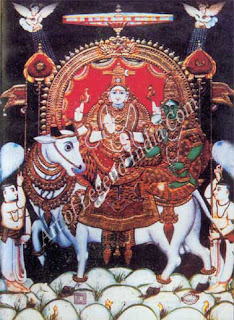
 
The Bull of DharmaMandhata defined the duties of every member of society based on dharma: brahmanas looked after the spiritual and intellectual needs of society; kshatriyas took care of its defence and administration; vaishyas ensured its material welfare; shudras through service and skill, supported its very foundations. No group, varna, dominated the world.

Said Mandhata, "Without dharma, etonomics and politics is corrupt, pleasure is vulgar, and the quest for salvation, escapism."

During Mandhata's reign every man performed his duty. Mankind respected the laws of society and the cycles of Nature to live in harmony with the world around.

It was a golden age.

Mandhata's Penance

 
Mandhata's virtue inspired the people of earth to lead virtuous lives filled with love, truth, discipline and compassion. Man's virtue pleased the gods who sprinkled rain and made the earth fertile.

One year the rains did not come. Indra, lord of the celestial realm, told Mandhata, "Someone in your land is not respecting dharma. I will let the rains fall only if you kill the culprit."
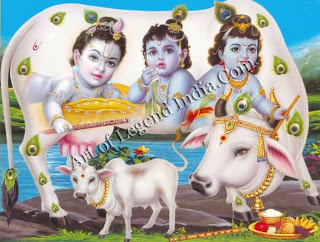
Gopala: keeper of the cosmic-cowMandhata refused to kill anyone. He said, "If one of my subjects is breaking the sacred law, it means that I, as king, have failed in my duty."

Mandhata punished himself: he fasted, walked on fire, slept on ice. Watching Mandhata suffer for their sake, those who had broken the sacred laws mended their ways.

Indra let the rains fall on earth.

Stages of Life

 
Having completed his duties as king and householder, Mandhata decided to renounce the world. "As part of samsara, I have fulfilled all my obligations. I have made good use of wealth and power and have enjoyed all the pleasures of life. Now, it is time to go beyond these material things. I seek moksha."

"Why now?" asked his people.

"In the first part of my life, as a bra hmachari, I prepared myself to live in this world; then I became a grihast hi, a householder and a responsible member of society. Now it is time to become a vanaprasthi, a forest-dweller, renounce the world to make way for the next generation. Only then can I become a sanyasi, free to liberate the spirit from the confines of the body, the limitations of the mind and the domination of the ego."

After crowning a worthy successor, Mandhata abandoned all contact with human society and returned whence he had come — to the heart of Vishnu.

Writer –Devdutt Pattanaik

Radharani: The Supreme Goddess

Posted by Art Of Legend India [dot] Com On 4:09 AM 0 comments
Radharani is the Supreme Goddess and a well-known deity in Hindu Mythology. According to the Bhagavata Purana, and the Gita Govinda of the Vaisnava traditions of Hinduism, Radharani is the childhood friend and lover of Krishna. She is usually depicted with lord Krishna. She is considered as the incarnation of Goddess Lakshmi, the consort of Lord Vishnu. She is the feminine aspect of Lord, who is the chief associate and devotee of lord Krishna and topmost of all the Goddesses. Without Radha Rani there is no meaning of lord Krishna and without Krishna there is no meaning of Radha Rani. She is also an expansion of the Lord's energy. Lord Vishnu and Rama are expansions of the one Supreme Lord, Krishna, and similarly Lakshmi, Sita and even Durga are all expansions of this Supreme Feminine form of God, Radharani. She is also called Radhika in the Puranas. Her beauty, power and aura create the ethics of love.

Radharani was born in Vrindavana. Five thousand years ago, when lord Krishna descended in his original form, as a cowherd boy in Vrindavana, Radharani accompanied him in her original form. She appeared exactly two weeks after the appearance of lord Krishna. She was found on a lotus flower by Vrishabhanu and his wife Kirtida near the village of Barsana. It is said that Radharani first opened her eyes only when lord Krishna appeared before her.
The spiritual exchange of divine love between Radha and Krishna is very confidential and difficult to understand. No materialist can begin to understand this topic of the relationship between Radharani and Lord Krishna. In the Vaishnava devotional or bhakti traditions of Hinduism that focus on Krishna, Radha is Krishna's friend and advisor. Krishna means 'all attractive', since lord Krishna attracts every one towards him. But Radharani attracts even Krishna. She is considered to be his original Shakti, the supreme goddess in both the Nimbarka Sampradaya and following the advent of Chaitanya Mahaprabhu also within the Gaudiya Vaishnava tradition. Her worship is especially prominent in Vrindavan. Radha's love for Krishna is held within Gaudiya Vaishnavism as the most perfect primarily because of its endless and unconditional nature. In Vaishnava tradition we always pay respects first to the Lord's internal energy in the form of Radha, and then to the Lord. Thus they are referred as Radha-Krishna, Sita-Rama and Lakshmi-Narayana.
Radharani has many names according to her qualities and characteristics.

Some of the names that Radharani is known by include:
1. Govinda-anandini--She who gives pleasure to Govinda Krishna);
2. Govinda-mohini--She who mystifies Govinda;
3. Govinda-sarvasa--the all-in-all of Lord Govinda;
4. Shiromani Sarva-kanta--the crown jewel of all the Lord's consorts;
5. Krishnamayi--the one who sees Krishna both within and without.
6. Gandharvi - Expert singer
7. Radharani – Radha the queen
8. Vrshabhanu-nandini - Daughter of Vrishabanu
9. Vrindavaneshvari - Queen of Vrindavana etc.

Radharani is as spiritual as the Lord himself. Being the personification of the Hladini-Shakti, the pleasure giving energy of the Lord, She is the only source of enjoyment for Lord Krishna. She is also known as Sarva-kanti, which indicates that all beauty and luster rest in her body. Sarva-kanti also means that all the desires of Lord Krishna rest in Radharani. As Lord Krishna enchants the world with his beauty and charm, Radha enchants him. Therefore she is considered the Supreme Goddess. She is the full power, and Lord Krishna is the possessor of full power. The legends of Radha-Krishna have become immortal.

There are numerous legends and stories of Radha and Krishna depicting their true, eternal and divine love. Radha's devotion and dedication towards lord Krishna is the most sincere one. Radha and Krishna are celestial beings and their love is eternal that made them united for ever. Intense love of Radha for Krishna symbolizes each devotee's passionate longing for ultimate unification with God. With her utmost devotion towards her lord, she became the supreme devotee of Lord Krishna. Lord Krishna (to whom the trinity bows) himself bows to Radha’s feet where the trinity resides.All paintings are courtesy of Art of Legend India.

Lakshmana: Lord Rama’s Younger Brother

Posted by Art Of Legend India [dot] Com On 4:49 AM 0 comments
Lakshmana was lord Rama’s younger brother, who is, according to the Hindu mythology, considered an incarnation of Sheshnaga. Sheshnaga is the thousand headed serpent upon whom Lord Vishnu rests in the Ksheerasagara. Lakshmana is said to be an eternal companion of lord Vishnu in all incarnations. He was the twin brother of Shatrughna, born in Ayodhya to Sumitra, the second wife of the king Dasharatha. He married with Urmila, Sita’s sister. Lord Rama was the eldest, Bharata was the second, Lakshmana was the third, and Shatrughna was the youngest of the four brothers. In the images of lord Rama, he is also depicted with Rama and Sita. Lakshmana's life is a symbol of duties performed by a man towards his elders and also depicts the nature of selflessness in a man's character. Lakshmana would not sleep for a moment when Rama was not present. Lakshmana would not eat, if Rama was not present. Devotion to Rama was so intense in Lakshmana that he filled his heart with a feeling that everything that was present belonged to Rama.

Lakshmana is worshipped for his absolute devotion to Rama. For example, when lord Rama was exiled for 14 years, Lakshmana followed him to the forest instead of staying back in the palace and enjoying life. He served lord Rama throughout his whole life and loved, respected and obeyed Rama completely. In the forest, he spent all his energy and time in taking care of and serving Rama and Sita. He followed Rama’s instructions promptly. In the forest, he helped Rama in killing the demons. He is generally considered to be rather short-tempered when compared to Rama. They both went with the sage Vishvamitra to kill demons; who disturbed yagnas of the sages. He also played a very important role in the great epic Ramayana. He killed Kumbhakarna and other powerful demons.All paintings are courtesy of Art of Legend India.

Lord Sheshnag: The King of Serpent Race

Posted by Art Of Legend India [dot] Com On 4:38 AM 0 comments
Lord Sheshnag is an important part of Hindu mythology. He is called the king of serpent race and ruler of the infernal regions called Patal (nadir). He is the divine serpent with a thousand heads. According to Hindu mythology, the world rests on the hoods of Lord Sheshnaga, and when he shakes his head, there are earthquakes. He is worshipped in Hindu mythology for maintaining the balance of the earth on his hood and preventing it from sinking into the Patal.

Lord Vishnu reclines on the coils of Lord Sheshnag in the Ksheersagar and Goddess Lakshmi serves him. Sheshnag is always with them and guards them. Lord Sheshnag is also known as Ananta (Eternal and Endless) since he is immortal and is not affected by death even during the destruction of the whole Universe.

In the Puranas, Sheshanag is said to hold all the planets of the universe on his hoods. He is generally depicted with a massive form that floats coiled in space, or on the universal ocean, to form the bed on which lord Vishnu sleeps. Sheshnag also incarnated himself with lord Vishnu. He incarnated himself as Lakshmana and BalaRama. Lakshmana was younger brother of Rama, whereas BalaRama was elder brother of Krishna.All paintings are courtesy of Art of Legend India.

Om: The Most Sacred Symbol of Hinduism

Posted by Art Of Legend India [dot] Com On 3:46 AM 0 comments
Aum also written as ‘Om’ is the most sacred syllable in Hinduism. Om is of supreme importance in Hinduism. It is also sacred for Buddhists and Jains. This symbol represents Brahman, the impersonal Absolute of Hinduism omnipotent, omnipresent and the source of all manifest existence. It is the sound of the infinite, which is said to be the essence of all mantras, the highest of all mantras or divine word (shabda), Brahman (ultimate reality) itself. Most of the mantras begin with it and it is the essence of the Vedas. It is the signifier of the ultimate truth that all is one. Lord Ganesha is sometimes identified with the Aum (Om).

Om symbolizes the deepest concepts of Hindu beliefs. Hindus begin their day, journey, work by uttering Om. Many Hindus, as an expression of spiritual perfection, wear the sign of Om as a pendant. This symbol is enshrined in every Hindu temple. It is the representative of the Trinity of Gods in Hinduism, Brahma- the creator, Vishnu- the preserver and Shiva- the destroyer. It is also considered that in the word ‘AUM’, A stands for Creation, U stands for Preservation and M stands for Destruction or dissolution. The three portions of AUM also relate to the states of waking, dream and deep sleep and the three gunas (Rajas, Satva and Tamas).

Om is said to be the original sound that contains all other sounds, all words, all languages and all mantras. Om mystically embodies the essence of the entire universe. This meaning is further deepened by the Indian philosophical belief that God first created sound and the universe arose from it. It is the root of the universe and everything that exists and it continues to hold everything together. According to Upanishads, OM is god in the form of sound, thus it is the first part of the most important mantras in both Buddhism and Hinduism.All paintings are courtesy of Art of Legend India.

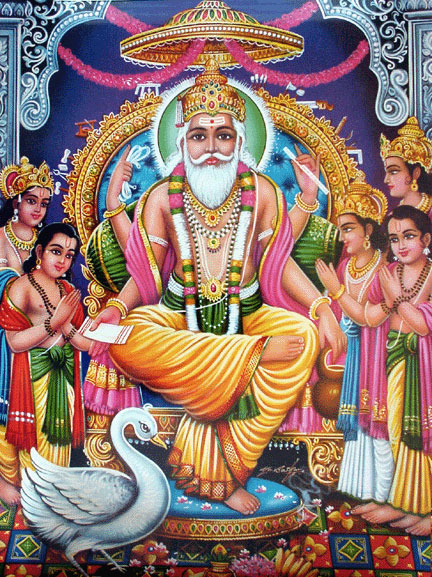
Lord VishwaKarma: The Divine Carpenter and Engineer

Posted by Art Of Legend India [dot] Com On 1:50 AM 1 comments
Lord Vishwakarma is the divine carpenter and architect of the universe and the master of all machinery equipments of gods. He is the seventh son of Lord Brahma, who is gifted with a unique creativity. He is also known as the lord of craftsmen and architects. Hindus worship Lord Vishwakarma as the god of engineering and architecture. He is specially worshipped by goldsmiths, blacksmiths, carpenters and masons. Hindus celebrate Vishwakarma Jayanti or Vishwakarma Day on 17th September every year in India. Indians craftsmen celebrate Vishwakarma day by performing rituals and offering prayers to Lord Vishwakarma, within the promise of their workplaces. On this day, industrialists make a resolution to increase the production and also make changes in their way of working. As a mark of reverence he is not only worshipped by the engineering and architectural community but also by all professionals. 

The name VishwaKarma, which means omnificent, was at first the title any strong god, such as Indra or Surya; it gradually came to refer to the divine artificer, honored not for only the creation of the universe but also for having initiated sacrifice and then given the example by sacrificing himself. In his capacity VishwaKarma built the heavens of all the gods and their palaces, such as Indra’s Vaijayanta, Kubera’s and then Ravana’s Lanka, and the Pandavas palace at Indraprashtha. He created many chariots, including Kubera’s Pushpaka; he also produced animals, such as Indra’s wonderful horses. His most famous artifacts were the gods’ weapons, such as Indra’s thunderbolt, Kartikeya’s lance and Shiva’s trident, all of which, according to the Hindu version of the myth, were fashioned from the fragments of Surya’s substance which blazing to earth when VishwaKarma put Surya on his lathe to reduce effulgence. He also made weapons for the epic heroes. 

The Mahabharta describes Vishwakarma as “The lord of the arts, executor of a thousand handicrafts, and the carpenter of the gods and the most eminent of artisans.” He is pictured with four hands holding a book, a vessel, a noose and craftsmen tools. Hindu scriptures are full of stories of his glorious contributions to mankind. He was the only architect who was imbued with all the qualities of Fine Art, which was necessary for the creation of the Universe. Hindu mythology believes that, everything in this world we see like the dams, the reservoirs, bridges, skyscrapers, and all sorts of mechanics around which our life revolves are the product of Hammer and Chisel, which represent, Lord Vishwakarma. He is also known to have built great cities like Dwarka, Yamapuri and Lanka. Hastinapura was also built by lord Vishwakarma.

Lord Vishwakarma is regarded as the supreme power according to Rig Veda, the very essence of excellence and quality in creation. He is the embodiment of the original power that welds world and heaven jointly. Vishwakarma is the lord who is responsible for all the beautiful designs.All art paintings are courtesy of Art of Legend India.

Kamadeva: The God of Love

Posted by Art Of Legend India [dot] Com On 11:55 PM 0 comments
Kama or Kamadeva is the Hindu deity of love, who is usually represented as a handsome and beautiful man. Kama Deva literally means 'divine love' or 'god of love'. He is known by several names like Ragavrinta, Ananga, Kandarpa, Manmatha, Manasija, Madana, Ratikanta, Pushpavan, Pushpadhanva or simply Kama. In a hymn in the Atharva Veda, he is described as the god of sexual love. The story of the birth of Kamadeva is told differently in several mythological Puranas. In some stories, Kamadeva is said to be the son of lord Vishnu and Goddess Lakshmi and in others he is said to be the mind born son of Lord Brahma. He is also the husband of Rati, the Goddess of Beauty, and is also said to be an incarnation of Pradyumna, a son of Krishna by Rukmini. The vaishnavites believe that he is Krishna himself. The basis of the story is that after Kamadeva was burned to ashes by Shiva because of his anger the cupid god merged into the body of Vasudeva Krishna and in order to get his body again he was placed in the womb of Rukmini.


Kamadeva is the most handsome and ever youthful god, who rides on a parrot. He carries a bow made of sugar-cane and strung with a line of humming-bees, and with it shoots five shafts of desire, which are tipped with flowers. He is accompanied by his wife, Rati (passion) and friend, Vasanta (spring), who strings his bow and selects for him the shaft tipped with the flower considered suitable for the current victim. He is surrounded beautiful nymphs (Apsaras) of whom he is lord.

Kamadeva loves to roam abroad amuse himself by inspiring passion in those he sees about him, and he is quite frivolous in the use he makes of his powers. According to one account, which makes him the son of Brahma, he had no sooner been than he shot one of his arrows at his father, thus causing him to co incest with his daughter and incidentally to lose one of his heads at the hand of lord Shiva. Gods as well as mortals have been victims of Kama. He loves to wander about, especially in spring time. Kamadeva himself suffered most on one occasion when he hesitated to use his power. Shiva burnt him to ashes as a punishment for interrupting his deep meditation but, despite Shiva's protests, the shaft had done its work and Shiva was unable to obtain peace until he married Parvati. During all this time Kama lay dead and love disappeared from the earth, which became an arid desert. At length the gods approached Shiva, who agreed to allow Kama to be reborn as Pradyumna, son of Krishna and Rukmini, and he was ultimately reunited with Rati, who had pleaded for him through Parvati. All paintings are courtesy of Art of Legend India.

Soma: The Lord of the Night

Posted by Art Of Legend India [dot] Com On 11:43 PM 0 comments
Soma is also known as Chandra, Rajanipati and Kshuparaka (one who illuminates the night). According to the ‘Srimad Bhagawat’ Moon-god is the son of Maharishi Atri and Anasuya. He is considered to be all pervading. In Hindu Mythology, Lord Shiva is called Chandra Shekara, which literally refers to the 'Person who wears the moon'. Lord Shiva wears the moon in his matted locks, Chandrama is considered by some to be a one-eighth the incarnation of the Destroyer. He is dazzlingly fair and youthful in appearance. He is wise, peaceable and auspicious, who has a slim but curvy body with lovely limbs. He wears white apparel and white flowers. Lord of the night, Soma (Chandrama) is responsible for scheduling rituals. He holds a mace in one hand and generally represented seated on a lotus which is carried by a shining white chariot pulled by seven powerful white horses. All the horses are divine, incomparable and are quick as the mind. The eyes and ears of the horses are white. According to the ‘Matsyapurana’ the horses are as white as a conch.

Soma or Chandra is entirely identified in Hindu belief with the moon, though one of the explanations of his origin still equates him with amrita, for it claims that he was produced from the churning of the milk ocean. More common accounts of his lineage say that he was the son of Dharma; or that he was the son of Varuna, lord of the ocean from which the moon arises. Yet another account links Soma with Surya, though it is not clear whether Surya is the father of Soma; or, taking Surya as female, Soma is said to be married to Surya. More certain is the belief that Surya nourishes the moon with water from the ocean when Soma is exhausted by the many beings who feed upon his substance. For during half the month thirty-six thousand three hundred divinities feed upon Soma and thus assure their immortality, while during the remaining half of the month the Pitris feed upon Soma; Soma also nourishes humans, animals and insects; not only does the moon give them pleasure, but the watery nectar of its light also sustains the vegetable life on which mortal creatures feed. This account neatly combines the two aspects of Soma; as the amrita or nectar from which the gods derive their strength; and as the moon, whose substance waxes and wanes according to the calendar.

God Soma or Chandra was married to the twenty seven daughters of the sage Daksha, who were personifications of the lunar asterisms. But Daksha had as much trouble with this son-in-law, Shiva. Soma showed such a preference for one of his wives, Rohini (Hyades), that the others became wildly jealous, and went to their father to complain. Daksha's remonstrances were of no avail, so the sage pronounced a curse on Soma which afflicted him with consumption and childlessness. Despite their earlier anger, however, Daksha's daughters soon grew sorry for their husband and went back to their father for advice. Daksha was unable to retract the curse completely but he succeeded in modifying it, so that Soma should suffer from consumption only periodically, for fifteen days at a time. He soon proved himself to be free of the curse of childlessness. He performed the great horse sacrifice, which both demonstrated and procured universal dominion and fertility. Protected by the influence of the sacrifice, Soma became arrogant and daring and one day abducted Tara, wife of Brihaspati. Brihaspati was the sage and preceptor of the gods and often associated with the planet Jupiter. Despite Brihaspati's great occult power he was unable to do anything. None of his entreaties or the sermons of the other sages in any way affected Soma, who with his assurance of universal dominion felt himself quite secure. Brihaspati appealed to Brahma but not even he could persuade Soma to return Tara. Brihaspati then turned to Indra, who decided that the only way would be to take Tara by force. But Soma heard of these plans and promptly made an alliance with the demons (asuras). He was also supported by the sage Usanas, who had an ancient feud with Brihaspati. Brihaspati commanded the support of most of the other gods, under the leadership of Indra. Though the war produced many fierce clashes, during one of which Soma was cut in two by Shiva's trident, it was inconclusive. 

Brahma then made another appeal to reason, and again asked for the return of Tara. By this time Soma had become bored with her and to every one's surprise agreed to send her back to Brihaspati. But it was then seen that she was pregnant. Brihaspati refused to accept her back until the child was born, so Brahma, in order to have done with the affair, commanded this to happen at once. When the gods beheld the infant they were dazzled by its great beauty, and both Soma and Brihaspati at once claimed parentage. Only Tara could say who was the true father but she was reluctant to speak out. Finally, after a great deal of coaxing, she admitted that the child was Soma's. He was named Budha, and was to become the ancestor of the lunar race. Brihaspati, naturally, was enraged with his wife and cursed her to be reduced to ashes but Brahma felt the punishment to be too severe and revived Tara. Varuna punished Soma for his behavior, disinheriting him. But Lakshmi, who since she also was born out of the milk ocean was Soma's sister, decided to campaign on his behalf. She approached Parvati, and asked her to enlist Shiva's support. Shiva agreed and to honor Soma he wore the crescent moon on his forehead. But when Brihaspati caught sight of Shiva thus arrayed at the next assembly of the gods, he declared that Shiva was dishonouring the company by his presence. A great dispute arose between them which had to be referred to Brahma for settlement. Brahma declared in favor of Brihaspati and Soma was thereafter relegated to the outer atmosphere and forbidden entry into heaven. As Soma travels about in the atmosphere, he is represented as a copper-colored man, trailing a red pennant behind his three-wheeled chariot. He is also the master of the world's water and is hence responsible for controlling fecundity.All paintings are courtesy of Art of Legend India.

Goddess Kali: The Ferocious Form of Goddess Durga

Posted by Art Of Legend India [dot] Com On 10:47 PM 0 comments
Goddess Kali is a ferocious and fiercest form of the divine mother Durga. Goddess Kali is Durga's darker aspect, who is represented as the consort of the lord Shiva, on whose body she is often seen standing. She is the goddess of time and of the transformation that is death. Lord Shiva and Mother Gauri in their destructive form are known as Mahakala and Mahakali or Kali. Goddess Kali or the Dark Mother is the goddess with whom devotees have a very loving bond, in spite of her fearful appearance. In this relationship, the worshipper becomes a child and Kali assumes the form of the caring mother. She is sometimes referred as the goddess of death, but actually Kali brings the death of the ego. She is the all pervading divine mother of the universe and her name in Sanskrit is derived from the word Kal which means time. She is also not associated with Yama (the Hindu God of Death). She is also known as Kalikamata and Kalaratri (black night), who is worshipped particularly in Bengal. Her best-known temples are in Kalighat and Dakshineshvara. 

Goddess Kali is the most compassionate of all the forms of goddesses and she provides salvation to the devotees. She is considered equivalent to lord Shiva because both of them are the destroyers of evils and demonic powers. Goddess Kali’s appearance is fearsome and dangerous, baleful eyes, a protruding tongue and four arms are fearful. In her two arms, she holds a bloody sword and a severed head of a demon. With her upper right hand she blesses her devotees. She wears a garland made of skulls and a belt made of dismembered arms of demons. As the Divine Mother she is often represented standing or dancing on Shiva with numerous hands and legs. 

Goddess Kali and Lord Shiva, both are considered to inhabit cremation grounds. Devotees go to these places to meditate with the purpose of overcoming the ego. The cremation grounds emphasize the idea that the body is temporary. The way people look and worship goddess Kali depends on the form of their sense of self. She most famously appears in the sixth century Devi Mahatmyam as one of the Shaktis of the divine mother, who killed the demon Raktabija. The tale of Raktabija can be found in the eight chapter of the Devi Maytram. Raktabija was a powerful demon, who got a boon from Lord Brahma, whenever a drop of his blood fell on the ground; a duplicate Raktabija would be born at that spot. Raktabija was wounded, but drops of blood falling on the ground created innumerable other Raktabijas, and Durga was in difficulty. At this point, the goddess Durga created Kali, who made her tongue onto the earth, and sucked off the blood of Raktabija, thus Raktabija was killed. 

The tenth century Kalika Purana venerates Kali as the ultimate reality or Brahman. The Tantric approach to Kali is to display courage by confronting her on cremation grounds in the dead of night, despite her terrible appearance. She is often regarded as the Shakti of Shiva, and is closely associated with him in various Puranas. The Kalika Purana depicts her as Adi Shakt. She is free from the illusory covering and beyond the all maya or false consciousness. Kali's garland of fifty human heads stands for the fifty letters in the Sanskrit alphabet. The common images of goddess Kali shows her, standing with one foot on Shiva's chest, with her enormous tongue stuck out. Goddess Kali is commonly associated with death, violence, sexuality and paradoxically with motherly love. Her appearance and ornaments has special significance and meaning. The garland of 52 skulls and her skirt made of dismembered arms symbolizes the destruction of the body and hence the ego attached with the body.All paintings are courtesy of Art of legend India.

Goddess Durga: The Divine Mother

Posted by Art Of Legend India [dot] Com On 5:08 AM 0 comments
Goddess Durga is the embodiment of the divine force of the Almighty. She symbolizes the power of the Supreme Being that maintains righteousness in the universe. In images she is generally depicted with eighteen arms holding Trident, Chakra, Snake, Conch shell, Mace, Bow, Long sword and Thunderbolt. Her different weapons suggest the idea that she can face any evil force. She is the divine mother, who protects people from evil forces. She is known by many other names such as Parvati, Ambika, Bhagwati and Kali. Durga's darker aspect Kali is represented as the consort of the god Shiva, on whose body she is often seen standing. In the form of Parvati, she is known as the divine spouse of Lord Shiva and is the mother of two sons, Ganesha and Karttikeya. Worship of the goddess Shakti is very popular among the Hindus. Her nine forms are Skandamata, Kusumanda, Shailaputri, Kaalratri, Brahmacharini, Maha Gauri, Katyayani, Chandraghanta and Siddhidatri.

Goddess Durga manifested when evil forces threathened the very existance of the Gods. To destroy these demons, all gods offered their radiance to her creation and each formed part of Durga's body. Durga also obtained very powerful weapons from different gods. She is the warrior aspect of the Divine Mother. Durga killed the powerful demon Mahishasura and all his great commanders. Therefore, she is also known as Mahishasurmardini (the destroyer or killer of Mahishasur). 

According to legends, goddess Durga was created as a warrior goddess to fight a powerful and cruel demon, Mahishasura. He worshipped Lord Brahma and performed severe penance for a boon. Brahma was pleased and appeared before him. Mahishasura obtained a boon from Brahma by which no male could kill him. He could not even conceive of a situation in which a female would challenge him. After getting the boon, he began to expand his reign of terror on earth, heaven and the nether worlds. After defeating from Mahishasura, all gods went to Brahma, Vishnu and Shiva, who were aware that only a woman could kill Mahishasura. They decided to create a Goddess out of the collective powers of all the god's, thus goddess Durga was born. She was given various weapons a trident from Shiva, Chakra from Vishnu, a Lion from Himalayas and bows and arrows from Vayu. The Goddess filled with combined powers of all gods. She rode on her vehicle (vahana) lion to the top of a mountain to meet Mahishasura. A battle of nine days and nine nights took place, during which goddess Durga decimated Mahishasura's armies using lesser Goddesses produced from her own body. At last, a fierce battle took place between goddess Durga and Mahishasura and Mahishasura was killed thus, she saved the world from the demonic powers. 
Goddess Durga is the goddess of “Shakti” or power. There are nine forms of Goddess Durga which are worshiped over the nine days and nights in Navratri. Navaratri is the biggest Hindu festival celebrated throughout India with great enthusiasm. There are nine forms of Goddess Durga, which are explained below-

1. Shailaputri: ‘Shail’ means mountains, Parvati, the daughter of king of Mountains Himavana, is known as "Shailputri". She is also known from various names such as Sati, Bhavani, Parvati or Hemavati, the daughter of Hemavana (the king of the Himalayas). In this form, the divine Mother holds a trident in her right hand and a lotus in her left hand. Sailaputri is believed to be the rebirth of Sati, the daughter of Daksha and the wife of Lord Shiva. Once Daksha organized a big Yagna and did not invit Shiva, but Sati reached there. Thereupon Daksha insulted Shiva. Sati could not tolerate the insult of husband and burnt herself in the sacred fire of Yagna. In other birth she became the daughter of Himalaya named Parvati and married with Shiva. Shailaputri is worshipped on the first day of Navaratri. Her veihicle (vahana) is a bull.

2. Bharmacharini: Bharmacharini is worshipped on the second day of Navaratri and is the second form of Goddess Durga. She is also known as Tapasyacharini. Her name ‘Bharmacharini’ is derived from Brahma which means penance. Bharmacharini means one who practices pious austerity. In this form, the divine Mother is two armed and carries a rosary in her right and holy water pot (Kamandalu) in the left hand. One day when she was playing with her friends, sage Narad came and told her that you would marry with Shiva, who was with you in the form of Sati. But now you have to do penance for him. On hearing this, she vowed that she would marry with Shiva only. After a long penace, she finally got married with Shiva. 

3. Chandraghanta: Chandraghanta is the third form of goddess Durga, who is worshipped on the third day of Navaratri. In this form, she has three eyes and ten arms holding different weapons such as a trident, disc, mace, bow, arrow and sword. She also holds a lotus, water pot and rosary. This is a terrible aspect of the goddess, who rides on a lion. There is a half circular moon in her forehead in the shape of a ‘ghanta’ or bell, therefore she is known as ‘Chandraghanta’. The sound of her bell terrifies demons as well as evil powers and she possesses great powers to fight battles against demons. 

4. Kushmanda: Kushmanda is the fourth form of the divine mother Durga, who is worshipped on the fourth day of Navaratri. In this form goddess Durga created solar system by liberating her power to Lord Sun, so Kushmanda is considered the creator of the entire universe. She shines brightly in all the directions. She has eight arms, in which she holds different weapons, rosary and sacred water pot. She rides on a tiger. It is believed that the eternal darkness ended when she smiled. 

5. Skanda Mata: Skanda Mata is the fifth form of the mother goddess. She is the mother of Skanda or Kartikeya; she is who is worshipped on the fifth day of Navratri. Lord Kartikeya was chosen by gods as their commander in chief war against the demons. Skanda Mata has four arms and three eyes, she holds her infant Skanda with her right upper arm in her lap and a lotus in her right hand. Her one hand is in blessing posture. Her complexion is very bright and often depicted as seated on a lotus. This the motherly form of Durga, so she is generous and kind.

6. Katyayani: The sixth incarnation of the goddess Durga is known as Katyayani, who is worshipped on the six day of Navaratri. According to a legend, Once upon a time, a sage Katyayan was the son of the great sage Kata. He did rigorous penance and worshipped Mother Goddess with a desire to get Mother Goddess as his daughter. His wish was granted and Katyayani was born to Katyayan as an incarnation of Durga. Her vehicle is lion. In this form the goddess has four arms, holds a sword, shield and lotus. One arm is depicted as giving blessings to the devotees.

7. Kalratri: Kalratri is the violent and dark side and the seventh form of the goddess Durga. Kalratri literally means 'dark night'. Her skin color is black as night. She is worshipped on seventh day of Navaratri. She rides on a donkey. She has long, unmated hair and three large eyes that are shiny and bright. She put on necklaces shining like lightening. Thousands of flames of fire come out while she respires from nose. Kalratri form encourages her devotees to be fearless. Sometimes she is also referred as Shubhamkari. She has four hands; her right hand holds a sharp sword, while her lower hand is in blessing mood. Her raised right hand always seems to grant boons to all the devotees.

8. Maha Gauri: This is the eighth form of the goddess Durga, who is worshipped on the eighth day of Navratri. She wears pure white clothes and her skin color is also white. As a result of her worship, all sins get washed away and devotees get purified in all aspects of life. She is intelligent, peaceful and calm, who rides on a bull. She has four arms. She holds a trident and damaru (a music instrument) in her hands. Her one hand is always in the position of granting boons to all the devotees. It is said that when her body became dirty due to the dust, Shiva used the water of the Ganges to clean the dust from her body. After that she became extremely white as a conch and moon therefore, she is known as Maha Gauri. Her power is unfailing and instantly fruitful. 

9. Siddhidatri: The ninth form of Goddess Durga is known as Siddhidatri, who is worshipped on the ninth day of Navaratri. She is worshipped by all the gods, saints, yogis, Gandharvas, Yakshas and devotees to achieve spiritual elevation. She has four arms and holds a mace, discus, lotus and book. She rides on a lion, but she is also depicted sitting on lotus. According to ‘Devi Bhagvata Purana’, lord Shiva worshipped Siddhidatri and received all the eight Siddhis (supernatural powers). By goddess’s blessings half body of lord Shiva became female, hence he is called 'Ardhanarishwara'. Anima, Mahima, Garima, Laghima, Prapti, Prakamya, Lishitya and Vashitva are the eight Sidhis. All paintings are courtesy of Art of Legend India.

Lakshmi: The Goddess of Wealth and Prosperity

Posted by Art Of Legend India [dot] Com On 4:36 AM 0 comments
Goddess Lakshmi is the goddess of prosperity, purity, chastity and fortune, both material and spiritual. She is the consort of Lord Vishnu. The word ‘Lakshmi’ has been derived from the Sanskrit word Lakshay, meaning ‘aim’. Therefore she suggests the aim of life, which includes all worldly and spiritual success. She is generally depicted as a beautiful lady in the standing or sitting posture with golden complexion, dressed in red color attire and adorned with precious jewels. Her four hands represent four spiritual virtues. She sometimes is also depicted sitting on a fully blossomed lotus. An atmosphere of divine happiness, mental and spiritual satisfaction and prosperity always exist around her. Goddess Lakshmi is one of the most popular goddesses among the Hindus, who is worshipped to attain wealth, beauty and good luck. Her palm is always extended to bless people with wealth. She is specially worshipped on auspicious occasion of Diwali.

Goddess Lakshmi’s Emergence
Goddess Lakshmi, also known as Shri, attained importance as the consort of Vishnu. Her previous existences, described in the Vedas, make her the wife of Varuna or of the sun. Alternatively, like Saraswati, she is said to have issued from Prajapati. In the early times she is associated with both good and bad fortune. Lakshmi is now generally thought to have existed first as the daughter of the sage Bhrigu and to have taken refuge in the ocean of milk during a period when the gods were exiled from their kingdom as a result of a sage's curse. She was reborn during the churning of the milk ocean as Lakshmi, one of the fourteen precious things. She emerged from the ocean. As the gods saw her each of them wanted her as his wife. Lakshmi’s hand was given to Vishnu, whom, Lakshmi herself preferred. When goddess Lakshmi rose from the ocean of milk, She found Vishnu, the detached guardian of the cosmos, to be worthy of her. She became his shakti, source of his strength and splendor. Lord Vishnu is the soul of the universe; Lakshmi its substance. He is the protector; she is the provider. They are the divine couple who look after life. She is worshipped in conjunction with her husband, when she is portrayed as exhibiting her devotion to him by massaging his feet as he lies on the coils of the serpent Shesha or seated beside him on a lotus or riding with him on Garuda. 

Goddess Lakshmi Leaves Vaikuntha
Whenever Vishnu returned to Vaikuntha, tired after his wars with demons, Lakshmi would strengthen him with her affectionate touch. Once, while Lord Vishnu was resting, the sage Bhrigu entered Vaikuntha. Neither Vishnu nor Lakshmi saw and welcome him. Insulted, Bhrigu kicked Vishnu on his chest. Sage Bhrigu's insolence horrified Lakshmi. Lakshmi said to Vishnu Bhrigu kicked you on your chest, on Shreevatsa, and by doing so kicked me. Avenge this insult. She demanded angrily. But Vishnu said that I cannot harm one who is my guest. Considering this an affront to her dignity, Lakshrni disappeared from Vaikuntha. Without Lakshmi, Vishnu could not live in Vaikuntha. He descended upon earth and waited for her under a banyan tree, refusing to move until she returned. 

As time passed termites built a hill round him, covering his body completely. Birds and beasts were stunned by the lord's plight. Sage Bhrigu, the cause of Laksmi's anger and Vishnu's agony, was consumed by guilt. He took it upon himself to reunite the divine couple. He went near the termite hill and began kicking the cows. The cows cried out and Vishnu rushed to their rescue, striking the offender with his mace. "Ah, the lord has punished me for hurting Lakshmi whose spirit rests in every cow," shouted Bhrigu. Hearing this, Lakshmi was pleased and she reappeared to join her husband in Vaikuntha. 

Abduction of Goddess Lakshmi
The demons once found Vishnu in deep meditation, the demons carried Lakshmi away to Patala (Nadir). With her by our side we will be rich and powerful," they said. "Why is she crying?" asked the asuras. "You have taken her away from her lord. She give you all the material comfort you want, but without Vishnu, she cannot give you any peace of mind." Said Shukra, the preceptor of the demons. Realizing their foolishness, the demons let Lakshmi return to Vaikuntha. As she went away, they lost their wealth and power, but there was joy in their hearts. Those who seek both spiritual bliss and material delight, worship both the lord and his consort. All paintings are courtesy of Art of Legend India.

Company Overview

Art of Legend India has the distinction of being one of the best in the Indian Handicraft Industry. We are about 75 years old handicrafts manufacturer & exporter. We are having team of more than 500 craftsman.

We are having our business offices in India, USA & Germany to ensure our best services.

Total Pageviews