Showing posts with label Religion Paintings. Show all posts
Among the most distinctive and appealing
representations of divine couple Radha and Krishna are those painted at
Kishangarh in Rajasthan during the eighteenth century. The often unusually
large portraits and narrative scenes are graced with a unique facial and
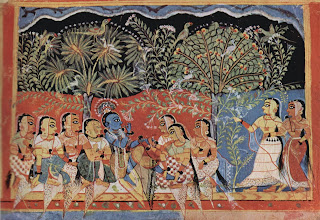
figural style, which is immediately striking in this moonlit painting of
Krishna gathering lotus blossoms for Radha, who is seated on a lake-edge
terrace. The characteristic almond-shaped, upturned eyes; long, pointed noses;
and graceful, elongated figures are the hallmark of Kishangarh painting. This
lyrical, "sloe-eyed" portrait style was probably devised by Nihal
Chand (c. 1715-8o), the royal atelier's master artist, and may have originally
been intended for portraits of Radha and Krishna exclusively. Attendant figures
in Kishangarh paintings also exhibit the distinctive facial features, but
sometimes in a slightly less stylized manner, as is the case here.
This representation of Krishna is also
notable in that it shows his long locks of hair flowing down his shoulders and
into the water. One of Krishna's epithets is Kesava, "long-haired,"
but the rationale for the name is usually not so readily apparent as most
portraits of the deity show his hair covered by a crown or turban.
Scenes of Krishna gathering lotuses for
Radha are thought to illustrate a poem by fir Savant Singh (see Randhawa &
Galbraith, pp. 108-9, pl. 23). Under the nom de plume of Nagari Das, he
composed a number of devotional works, including the Manoratha Manjari (1723),
Rasika Ratnavali (1725), Bihari Chandrika 0730, and Braj Sar (1742). Savant
Singh's beloved courtesan, Bani Thani, was also a poet and, as did her lover,
wrote under a pseudonym: Raskia Bihari.
Writer
Name:- Pratapaditya Pal
Churning of the World Poison
The
gods once decided to churn out amrita from the primeval waters. Amrita is
celestial nectar, containing the essence of all life. Anyone who drinks it
becomes Immortal, living as long the cosmos itself. The gods wanted it
desperately.
The
waters stretched into infinity; to churn it, the gods erected a fabulous
machine. Its base was Akupara, the divine turtle. On its back was placed Mount
Mandara, the celestial axis which was used as the churning staff around which
Sesha, the serpent of eternity, coiled itself.
The
Adityas and Daityas, gods of light and darkness, pulled the serpent's tail and
neck and spun the churning staff, first one way, then the other. As a result,
the waters began to twist and twirl, slowly at first but then faster and
faster. Foam gathered at the base of the mountain, and the waters began to
curdle.
The
gods checked the waters for the first signs of amrita. But to their dismay what
first appeared on the froth-laden surface was dark and sticky, a viscid scum
emitting caustic fumes; it was the dreaded poison: halahal! The poison began to
spread all around, contaminating the waters and polluting the air. Sesha began
to retch; Akupara lost control of his bowels. All the gods became sick, too
weak even to cry for help; the very existence of the cosmos was at stake.
Just
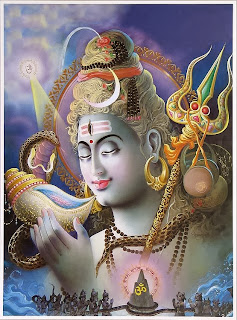
then Shiva appeared on the scene. He scooped up the lethal fluid and drank it
as if it were sweet wine.
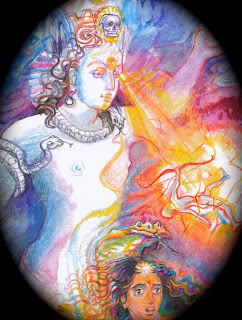
Parvati,
fearing for Shiva, caught hold of his neck and stopped the poison from entering
his body. The poison remained within Shiva's throat. It seeped into the skin of
his neck, turning it blue.
Shiva's
actions had saved the cosmos. With the poison gone, the air became fresh and
the ocean became clear. The gods recovered their strength and resumed the
churning.
When
the amrita finally appeared, the gods drank it greedily. Then they remembered
the terrible halahal. It dawned on them how their desire for eternal life had
very nearly destroyed the cosmos.
They
thanked Shiva for his timely help. To commemorate this great event, Vishnu gave
Shiva a new name: Neelakantha, he-who-has-a-blue-neck.
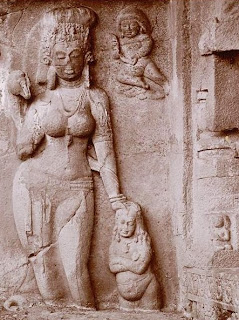
The Third Eye
Once,
Parvati in the spirit of play covered Shiva's eyes with her hands. The moment
she did this, the whole world was plunged in darkness. Shiva's eyes contained
the power of the sun. They had been shut out by Parvati.
"Save
us!" cried the gods, the demons, the humans. Without the sun, the cosmos
was doomed.
So
Shiva opened his third eye, and through it released his energies.
The
sun shone bright once more.
Descent of the Ganges
Bhagirath,
prince of the Ikshavaku clan, came across a heap of ash. From it arose the
lamentations of 60,000 youths. Their mournful sobs disturbed the gentle prince.
"Who are these people?" he asked his grandfather, the wise Anshuman.
Anshuman
told him the tragic tale of Sagar's 60,000 sons. "Long ago my grandfather,
king Sagar, ruled this land. Envious of his growing power, Indra, king of the
heavens, stole his horse. My uncles found it in the hermitage of the sage
Kapila. They accused the hermit of theft, just as lndra hoped they would.
Outraged by this accusation, Kapila conjured up his magical powers and burnt my
uncles to death. As they were killed before their time, their souls were
trapped in the twilight zone between life and after life."
"Is
there any hope for them at all?" asked Bhagirath.
"Yes,
but an impossible one. If their ashes can be cast in the Ganga, the heavenly
river, they can move on to their next life. But Indra will not let us ascend
into the heavens and Ganga will never come down to earth. So our ancestors are
doomed to suffer for eternity."
"Not
if I can help it. I will make Ganga come down," swore Bhagirath
Bhagirath
walked out of his palace and became an ascetic. He tried to appease the gods
with the practice of terrible austerities. His tapas, which included a hundred
years of starvation and abstinence, forced Indra to let Ganga descend from the
heavens.
When
Ganga heard about this she laughed contemptuously. "My fall from the
heavens will break the very foundations of earth," she said, "The
cities, the jungles, even the hills will be washed away by the force of my
waters."
Disturbed
by Ganga's pride, Brahma told Bhagirath to approach Shiva. "He is the
great Kapardin-Jatadhari, bearer-of-a-dense-coiffure. With his locks, matted
with banyan juice, he will capture this great river just as a cowherd ropes in
an errant bull."
Bhagirath
prayed to Shiva. "Can you help, great lord?"
Shiva
said, "Let the vain Ganga leap from the heavens. I will stem her flow, and
crush her pride."
Shiva
stood on Mount Mandara, the cosmic axis, arms akimbo. He looked towards the
heavens, ready to capture its river. Everybody gathered round him to witness
the spectacle: gods, demons, humans, birds and beasts.
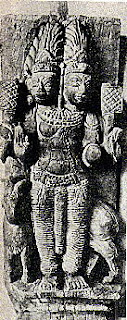
Ganga
dived from her celestial abode with the force of a hundred thousand ocean
currents. The sound was deafening. It seemed that Ganga planned to wash away
the whole earth. The world trembled in anticipation . . .
Ganga
fell right on top of Shiva's head. She hoped to split his skull with her fall.
Instead she found herself getting entangled in his thick hair. The matted curls
and dense knots trapped her waters, firmly restraining her flow. Chained by
Shiva's tresses, the river-shrew Ganga finally emerged out of Shiva's topknot,
not as a gush but as a mere trickle that gently moved towards the sea,
fertilizing the earth on its way.
Bhagirath
cast the ashes of his ancestors in the heavenly river. They arose as spirits
and before moving on to their next life they gave Shiva the suitable name of
Gangadhar, he-who-holds-the-mighty-Ganges.
Ganga
became Shiva's second wife.
Even
today people cast the ashes of their ancestors in the Ganga in the hope of
making a safe journey into the next life.
A Blade of Grass
The
gods once sat before Brahma boasting of their prowess. "I can burn the
ocean with my flames," said Agni, the fire-god. "I can blow away the
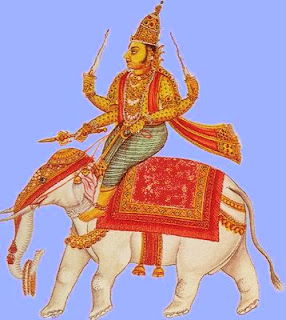
mountains with my gales," said Vayu, the wind-god. And Indra, king of the
gods, wielder of the thunderbolt said, "I can crush all the demons with my
weapon, the vajra."
Brahma
was dismayed by the arrogance of his sons.
Suddenly
there appeared on the scene a yaksha. He held a blade of grass in his hand.
"Can any of you get rid of this blade of grass?" he asked. Agni spat
fire; he hissed and crackled, but found to his astonishment that the grass
remained unsigned. Vayu huffed and puffed, and generated a blizzard, but the
blade of grass refused to budge. Indra swung his vajra and hurled his
thunderbolt, but the blade of grass remained as it was. 54 "What is
meaning of this?" asked the gods.
‘"It
means that beyond every great power there is one greater," replied the
yaksha.
'Who
says so?"
"Shiva."
The
yaksha disappeared and there was silence. Agni and Vayu, humbled by the event,
hung their heads in shame. But Indra was not amused. "Who does this Shiva
think he is?" Indra grabbed his vajra and moved to Kailas to teach Shiva a
lesson.
He
saw before him a naked ascetic, an avadhut. "Where is Shiva?" asked
Indra.
"I
am he," replied the ascetic calmly.
"You
have the impertinence to teach me, the king of the gods, a lesson."
Shiva
didn't reply.
His
silence enraged Indra. He raised his vajra to strike him. Shiva opened his
third eye. Brahma realised what was about to happen. "Stop!" he
cried, begging Shiva not to harm Indra. "Don't kill Indra. He is leader of
the gods; without him the balance of the cosmos will be lost."
So
Shiva cast his fire into the ocean.
"Indra
will soon meet his match and his pride will be crushed, said Shiva. He will
realise that bragging doesn't win battles."
Jalandhara The Demon From the Sea
No
sooner was he born than he became leader of the demons. He led them in battle
against the gods and won a great victory. Indra was totally humiliated, beaten
and bruised into submission and driven out of the heavens. He was deprived of
his throne, his palace, his wealth, his power and his vajra was snatched away.
Indra
went to Brahma for help. "How can I defeat Jalandhara?" he asked.
"You
can't. Only Shiva can, "replied the wise creator.
Indra
remembered and regretted the arrogance he had displayed not long ago.
"Will Shiva help someone who insulted him?" he wondered.
"Shiva
never bears a grudge."
Jalandhara,
like Indra before him, declared, "I am the greatest warrior of the world."
"No,
you are not. Not until you defeat Shiva," said Indra.
"Who
is this Shiva?" asked Jalandhara.
"A
hermit."
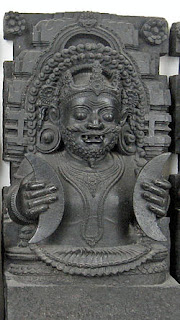
"Yes!
I can," boasted Jalandhara. He ripped out that ground marked by Shiva and
placed it on his head. "See, I can do it."
Suddenly
the circular piece of earth on Jalandhara's head began to whir like a discus
and grow in size. Before he could say another word it became so big and spun so
violently that it cracked his skull and broke his spine.
As
Jalandhara gasped for his last breath he heard Shiva say, "I carry the
moon on my head, and you cannot even carry a small piece of earth. Whatever
made you think you are the strongest being in the cosmos?"
Bhasmaka's Touch
Shiva
once consumed pots of bhang and lost his good sense to intoxicated dreams. In
that state he gave a demon called Bhasmaka the power to kill any creature by
his mere touch.
The
demon decided to test this power on Shiva himself. He moved his hands
menacingly towards Shiva.
Shiva,
shaken out of his drunken state, got up and ran. The whole cosmos witnessed the
spectacle: Shiva being chased by Bhasmaka. They would have laughed had they not
realised the seriousness of the situation: Shiva's destruction would lead to
cosmic annihilation.
Shiva
rushed to Vishnu. "Help me!" he cried.
"I
will," promised the cosmic saviour. Taking the form of the ravishing
damsel, Mohini, Vishnu appeared before Bhasmaka. Looking at her, the demon
forgot about Shiva. "May I embrace you?" he asked.
Mohini
looked into his eyes and said, "Only if you dance with me."
Mohini
started to dance and Bhasmaka imitated all her movements.
When
she put her left foot forward, he did the same. Then she placed her right hand
on her navel, he did the same. Finally when she placed her hands on top of her
head, he did the same. With that Bhasmaka's own body burst into flames.
Vishnu
had saved Shiva's life; for that Shiva was most grateful.
Science of Rejuvenation
Shukra
practised terrible austerities to learn the science of immortality.
"There
is no such science. All that is born must die," said Shiva.
"Then
teach me the science of rejuvenation, Sanjivani Vidya, that can cure any
disease and treat any wound."
Shiva,
master of all herbs, lord of every medicine, taught the science to Shukra.
Shukra
became the preceptor of the demons. Using his knowledge he was able to revive
and restore to health all those who were wounded in battle against the gods.
Consequently, the demons never suffered any casualties in war.
Brahma
complained to Shiva, "Shukra disturbs the cosmic balance by reviving
demons who have fallen in celestial battles. Do something. Stop him! Kill
him!"
"I
will stop him, there is no need to kill him," said Shiva.
The
next time the gods and demons fought, a strange creature appeared on the
horizon. It was an ogress called Kritya, a Shiva-gana. She sucked Shukra into
her body. There he remained in an unborn state, unable to use his magic in
favour of the demons. As a result, the battle of the gods and demons was fought
fairly.
Brahma
looked at Shukra locked in Kritya's womb and smiled at Shiva's ingenuity . . .
only Mahakala could deprive a creature of life without actually killing him!
Three Flying Cities
Three
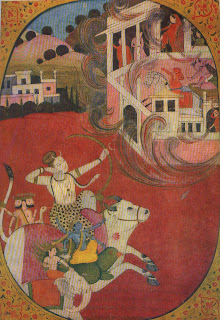
demons once built three flying cities, tripura. On their flying cities the
demons went everywhere, with their armies and their families; no mountain was
too high, no ocean was too vast. Like falcons they swooped down upon cities to
rape, plunder and terrorise the cosmos. They seemed unstoppable.
"They
must be destroyed," said the gods.
"But
how?" wondered Indra.
"Only
with a single arrow!" informed Brahma, repository of all knowledge.
"But
that is impossible," they complained, "No hunter can ever shoot two
birds with a single arrow, let alone three flying cities?"
"It
is not impossible if one has the right archer, wielding the right bow and
arrow, riding the right chariot," said Vishnu. Everybody knew he was
talking about Shiva, who is also known as Sharva, the cosmic archer.
"He
can do it," they all agreed.
"But
only if the three cities align themselves in a straight path," reminded
Indra.
"Don't
worry," said Vishnu reassuringly, "I have charted the course of the
three cities and I know that very soon they will fall in a single line, but
only for a moment. If at that exact moment, Shiva shoots the arrow, they will
surely be destroyed."
"If
anyone can do it, he can," said Brahma.
The
gods rejoiced and got to work instantly.
First
they used all their energies to assemble an appropriate war chariot: the earth
itself, with the sun and moon serving as its wheels. Brahma was its charioteer
and the stars its horses.
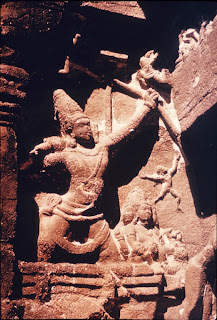
They
then made the bow: Meru, king of the mountains, served as the shaft while
Vasuki, king of the serpents, became the string. Its twang resounded across the
cosmos.
"But
we don't have a suitable arrow," said the gods.
"Yes,
we do," said Vishnu who turned himself into a fiery missile, a blazing
shastra.
Shiva
took the form of Ugra, the fierce warlord and mounted the cosmic chariot. He
grabbed the celestial bow and chased the three cities across the galaxies. He
followed them up into the bright firmament and down into the murky waters of
the nether world. He waited for the moment when the three flying cities were
aligned. And when it happened, after a thousand years of chase, Shiva shot the
lethal dart the Vishnu-shastra.
The
missile ripped through the foundations of the three flying cities. Instantly
they burst into flames and came tumbling down. The cries of the demons, their
women and children, rent the air. All were killed. The remains of the cities
turned into cosmic debris: comets, asteroids and meteors. After the massacre,
Shiva came to be known as Tripurantaka, destroyer of the three cities.
The
gods cheered Shiva's feat. But he did not smile. "I cannot celebrate the
death of any creature, howsoever corrupt." Shiva's face was stern; tears
ran down his cheeks. The painful cries of the demons echoed in his ears.
"Know
this," Shiva said to all those who gathered around him, "A day will come
when the whole cosmos, every atom within it, will be corrupt. At that time I
shall wield my bow once again and destroy the three worlds." And to remind
everyone of this fearsome premonition, he marked out on his forehead three
lines, horizontal as a corpse, using the charred remains of the three flying
cities.
Writer Name:-Devdutt Pattanaik
ALTHOUGH
pilgrimage figures importantly in the religions of India, it never had any
canonical status in non-tantric traditions. In tantric literature and practice,
however, both Hindu and Buddhist, pilgrimage and its corollaries especially
circumambulatory rites which are central to the pilgrims progress have a much
higher prestige, so much so that it might almost be called canonical, if that
term could be properly applied to tantrism.
In
making a survey of Indian centres of pilgrimage, one thing emerges most
forcefully: at places which are not officially linked with the tantric
tradition, tantric elements become evident at every step. And although we have
to concentrate on shrines which are traditionally linked with tantric
literature and precept, we have to bear in mind that local traditions in almost
all shrines in India their number is legion have strong tantric elements,
whether this is conscious to the priesthood and the laity visiting those
shrines or not.
One
tends to identify pilgrim centres as tantric which have the flavour of extreme,
bizarre and esoteric austerity. But such painful prostrations,
self-humiliations, and disciplines bordering on the masochistic as I described
in another place1 are not necessarily tantric. And yet, such somewhat elusive
elements as the sprinkling of wine on the prasada (food offerings distributed
among the votaries) at jagannath, Puri, the shaving ritual for boys of certain
castes at such widely disparate places as Jvalamukhi in the Panjab, and Palni
in Madras State are definitely tantric in origin and connotation.
The
local lore at the shrines of India is one of the most direct means of telling
whether the place is fundamentally tantric or not. This takes us into the most
important mythological complex connected with tantric shrines and tantric
worship. The story of Daksa's sacrifice and of the subsequent events is pivotal
to tantric sanctuary-topography, as is the mythology ascribed to each
individual place of pilgrimage.
The
most important myth of tantric relevance is, then, no doubt, the story of
Daksa's sacrifice; it is told, in many minor and major variations, in all the
Puranas, and in the Epic. It is imperative to pursue this particular myth in
some detail; valuable information about its development has been furnished by
D. C. Sircar. In the tantric tradition, a centre of pilgrimage is called a
`pitha', a 'scat' of the goddess; tantric literature rarely uses the more
general word `tirtha'; probably the distinction itself depends on the
mythological relevance of the centre: shrines of the goddess are pithas,
sanctuaries of gods, or mixed shrines (i.e. where a god and a goddess are
worshipped), are called tirthas just as non-tantric worshippers would call
them. Pitha' seems to be a purely tantric term in the first place, although it
has gained currency in other, not necessarily religious, contexts in the last
two centuries; thus, several colleges teaching classical subjects in the Indian
tradition are called pithas, quite literally `seats of learning', as for instance
the Kashi Vidya pitha, one of the best institutes of higher education at
Banaras.
As
Professor Sircar's treatment can hardly be improved upon, I shall reproduce it
in portions, so far as it is relevant to our survey.
…The
earliest form of the legend of Daksa-yajna-nasa is probably to be traced in the
Mahabharata (XII, chapters 282-3; cf. Brahma Purana, ch. 39) and a slightly
modified form of the same story is found in many of the Puranas (Matsya, ch.
12; Padma, Srstikhanda, ch. 5; Karma, I, ch. 15; Brahmanda, ch. 31, etc.) as
well as in the Kumarasambhava (I, 2!) of Kalidasa who flourished in the fourth
and fifth centuries and adorned the court of the Gupta Vikramadityas. According
to this modified version of the legend, the mother-goddess, who was the wife of
Siva, was in the form of Sati one of the daughters of Daksa Prajapati. Daksa
was celebrating a great sacrifice to which neither Sati nor Siva was invited.
Sati, however, went to her father's sacrifice uninvited, but was greatly
insulted by Daksa. As a result of this ill-treatment, Sati is said to have died
by yoga or of a broken heart, or, as Kalidasa says, she immolated herself and
perished. . . . When the news of Sati's death reached her husband, Siva is said
to have become furious and hastened to the scene with his numerous attendants.
The sacrifice of Prajapati Daksa was completely destroyed. Siva, according to
some of the sources, decapitated Daksa, who was afterwards restored to life and
thenceforward acknowledged the superiority of Siva to all gods. . . .
In
still later times, probably about the earlier part of the medieval period, a
new legend was engrafted to the old story simply for the sake of explaining the
origin of the Pithas. According to certain later Puranas and Tantras (Devibhagavata,
VII, ch. 30; Kalika Purana, ch. 18 ; etc.), Siva became inconsolable at the
death of his beloved Sati, and after the destruction of Daksa's sacrifice he
wandered over the earth dancing madly with Sati's dead body on his shoulder
(or, head). The gods now became anxious to free Siva from his infatuation and
conspired to deprive him of his wife's dead body. Thereupon Brahma, Vishnu and
Sani entered the dead body by yoga and disposed of it gradually. The places
where pieces of Sati's dead body fell arc said to have become Pithas, i.e. holy
scats or resorts of the mother-goddess, in all of which she is represented to
be constantly living in some form together with Bhairava, i.e. a form of her
husband Siva. According to a modified version of this story, it was Vishnu who,
while following Siva, cut Sati's dead body on Siva's shoulder or head piece by
piece. The story of the association of particular limbs of the mother-goddess
with the Sakta tirthas, which may have some relation with the Tantric ritual
called Vithanyasa,4 belongs, as already pointed out, to the latest stage in the
development of an ancient talc. But the story may have some connection with
Buddhist legends regarding the worship of Buddha's bodily relics and the
construction of Stupas in order to enshrine them as well as with those
concerning the various manifestations of Buddha in the Jambudvipa.
The
tantric tradition of four pithas was not known to occidental scholars until
recently. Monier Williams seems to have had a vague idea about four shrines
dedicated to the goddess. He wrote: 'There are also four celebrated shrines of
goddesses: Mahalaksmi at Kolapur, Bhavani near Sholapur, Renuka at Matapura,
Yogesvari about 8o miles from Ahmednagar.'
Most
of the early tantras, both Buddhist and Hindu, refer to four pit has. Sircar
thinks that the conception of the four pithas may have been associated with the
Buddhist tantric notion according to which the adept can rise to mahasukha
('the great bliss') through the esoteric practices involving sex.6 He quotes a
Buddhist tantric text called Catuspithantantra (the tantra of the four pithas)
and its commentaries, one of which was copied in A.D. 1145. This text speaks of
four pithas as `atmapitha' (the 'shrine of the self' strange-sounding Buddhism
indeed, but not infrequent in Sanskrit Buddhist terminology), para-pitha (the
shrine of the supreme), yoga-pitha (which is self-explanatory), and guhya-pitha
(the secret, esoteric shrine), and it deals with the various kinds of
Vajrasattvas and their intercourse with the Yoginis, with Prajnaparamita and
others. `This philosophical concept,' D. C. Sircar avers (p. 11), 'of the
Catuspitha was either the cause or the effect of the early recognition of four
holy places as pithas.' He adds in a footnote (ibid.), `it is difficult to
determine what relation the Catuspitha could have with the Catuspitha Mountain
near Jajpur in Orissa, and with other Sahajayana conceptions of
"four", e.g. the Caturananda, the four-fold bliss'. The Hevajra
Tantra, composed around ,10 690 A.D. enumerates the four pit has, and to my
knowledge this is the earliest enumeration: (1) Jalandhara (definitely near the
present .Jullundar, East Panjab); (2) Oddiyana (or Uddiyana), Urgyan in
Tibetan, misspelt `Udyana', viz. 'garden' in the Bengali DohaKola (ed.
Shahidullah) in the Swat Valley; (3) Purnagiri (the location is doubtful), and
(4) Kamarapa (Kamrup in Assam at present the only pitha 'in action').
The
same tradition is followed by the Kalika Purana (ch. 64, 43-5), which calls
them (1) Odra, 'seat of the goddess Katyayani and the god jagannatha, (2)
Jalasaila, seat of the goddess Candi and the god Mahadeva, (3) Puma or
Purnasaila, seat of the goddess Purnesvari and the god Mahanatha, and finally
(4) Kamarupa, seat of the deities Kamesvari and Kamesvara. These four 'pithas'
are allocated to the four directions, but this is pure theory, and stands in
accordance with the tradition to allocate every ritualistic locale to a
direction of the compass, and hence to group them either in fours or in tens,
sometimes in groups of eight (i.e. omitting the zenith and the nadir). In
geographical reality, however, the distribution of the four main pithas is very
irregular indeed: Oddiyana, in the Swat Valley, is the only far-western site
Kamarupa and possibly Purnagiri are in the extreme east and Jalandhara again in
the middle north-west (Panjab). None of the four pit has is situated in the
south, in spite of the fact that the Kerala region has a strong Salta and
tantric element in its culture; in some form or another Sakti is the tutelary
deity of Kerala." I shall now present a token topography of tantric
sanctuaries.
The
canonical tantric text listing the `pithas' is the Pithanirnaya (description of
tantric seats'), also called the Mahapithapurana; the latter name indicates
that the work has a sort of mongrel position it is a tantra by virtue of its
dealing with properly tantric material, and a purana by courtesy, as it were,
probably because it can be said to describe its objects satisfying the `pancalaksana-s,'
i.e. the five criteria of a purana. The text lists io8 pithas following the
tradition of the sacred number 108, on which there has been much speculation;
the author does not seem to have been worried about the lack of choice there
are no repetitions of any place name, not even under the guise of a
topographical synonym. Other tantric texts list pithas not mentioned in this
text, but it can hardly be established with complete certainty whether or not a
pitha mentioned in one text is or is not identical with one of the same name in
another. Thus, the Kubjika Tantra lists a pitha `Mayavati,' and so does the
Pithanirnaya; they may be identical, but their respective juxtaposition with
other pithas of established location would indicate that they are not. Very
often a general epithet is given to a proper name or a place name, and it is
customary to use the epithet in lieu of the proper name, it being understood
that the people who read the text are familiar with the nomenclature. But
Mayavati, i.e. 'full of Maya' or 'like Maya'', (cosmic illusion or enticement)
applies to at least three great shrines Banaras, Ayodhya, and Brindavan and
once an epithet like this has been used for any location by a popular teacher
or author, the epithet comes to stay.
It
does not become directly clear from the texts why the four pithas (Oddiyana,
Srihatta, Purnagiri, Jalandhara) were almost unanimously accepted as the most
outstanding in all tantric tradition, Buddhist and Hindu alike. I would hazard
the guess that the high esteem for these four places might have something to do
with the mythological eminence of the sites: a pitha, by mythological
definition, is a site where a limb of the goddess fell to earth when her body
was being chopped up by the gods (after the Daksa episode); at these four
pithas, however (though unfortunately not only at these four), the magically
most potent limbs of Sati descended: her pudenda, her nipples, and her tongue.
The
most important phenomenon of tantric pilgrimage, both as a concept and as a set
of observances, is the hypostasization of pilgrim-sites and shrines: the
geographical site is homologized with some entity in the esoteric discipline,
usually with a region or an 'organ' in the mystical body of the tantric
devotee. This sort of homologizing and hypostasy began early." It became
ubiquitous in the tantric tradition. Centres of pilgrimage fell well into this
pattern and Hindu and Buddhist literature abound in examples of such
hypostasization. Professor Eliade, who was the first to formulate it, put it
thus:
All
'contacts' with the Buddha are homologized; whether one assimilates the
Awakened One's message that is, his 'theoretical body' (the dharma) or his
'physical body', present in the stupas, or his 'architectonic body' symbolized
in temples, or his 'oral body' actualized by certain formulas each of those
paths is valid, for each leads to transcending the plane of the profane. The
'philosophers' who 'relativized' and destroyed the immediate 'reality' of the
world, no less than the mystics who sought to transcend it by a paradoxical
leap beyond time and experience, contributed equally toward homologizing the
most difficult paths (gnosis, asceticism, yoga) with the easiest (pilgrimages,
prayers, mantras). For in the 'composite' and conditioned world, one thing is
as good as another; the unconditioned, the Absolute, nirvana, is as distant
from perfect wisdom and the strictest asceticism as it is from . . . homage to
relics, etc. . . .
The
Mantramahodadhi has a section entitled `the nyasa of the pit has
(pitha-nyasa-kathanam). Literally, nyasa is the process of charging a part of
the body, or any organ of another living body, with a specified power through
touch. For instance, by placing the fire-mudra on the heart-region uttering the
fire-mantra 'ram', the adept's heart is made into the cosmic fire; and by
meditating on a specific pitha with the mantra of its presiding Sakti', the
very region (for instance the heart, or the navel, or the throat) wherein the
Sakti is thus visualized is hypostasized or trans-substantiated, into that
pitha. The tantric formulation would be: Meditating on the pilgrim-centre
through visualizing its presiding deity in the prescribed manner, the locus of
concentration in the yogi's body is charged with the spiritual efficacy of that
very place. With the Buddhist tantrics, the pattern is transparent even on a
purely doctrinal basis for no `place of pilgrimage' exist in an ontological
sense.
Going
back for a moment to the Mantramahodadhi, the section says: `He should meditate
on his body as the "pitha" by doing "nyasa" of the
tutelary. Pitha-deity. He should make "nyasa" of the Namduka flower
(Clerodendrum Syphonantum) in his base-centre (adhara); in the heart, there are
all the pithas of the earth, the ocean, the jewel island, and of the snowy
palace (i.e. the Himalayas), if he can pull up the Adhara-Sakti there:'
The
Buddhist tantric Caryapadas, all of which are contained in the Tanjur and many
of which are extant in their old Bengali originals, are replete with
hypostases. An example: `The path along which the boat is to sail is the
middle-most one in which both the right and left are combined, that is located
between the Ganges and the Yamuna, and along this path which is beset with
dangers the boat has to proceed against the current.' All this is Sandhabhasa
(intentional language) and is easily understood once the terminology is known.
The 'Ganges' and `Yamuna' are the left and the right ducts in the yogic body,
the middle-most is the `avadhuti' or the central duct which has to be opened by
the controls created through meditation.
The
Hevajra Tantra gives a beautiful instance of hypostasis: Vajragarbha said:
What, O Lord, are these places of meeting? The Lord replied: They are the pitha
and the upapitha, the ksetra and upaksetra, the chandoha and the upachandoha .
. . etc. These correspond with the twelve stages of a Bodhisattva. It is
because of these that he receives the title of Lord of the ten stages and as
Guardian Lord. Vajragarbha asked: What are these pithas? The Lord said: They
are Jalandhara, Oddiyana, Purnagiri, Kamarupa.' He then lists a further 32
places.
A
Doha by Saraha illustrates the hypostasis in a poetical manner:
'When the mind goes to rest, the bonds of the body are
destroyed,
And when the one flavour of the Innate pours forth,
There is neither
outcaste nor Brahmin.
Here is the sacred Yamuna and here the River Ganges,
Here are Prayaga and Banaras, here are Sun and Moon.
Here I have visited in my wanderings shrines and such places
of pilgrimage.
For I have not seen another shrine blissful like my own body.’
In a
treatment of non-tantric pilgrimage, the circumambulation-pattern which now
follows would perhaps not have to be included. However, in tantrism it is so
much a part of the process of pilgrimage that it must form the concluding, if
not the most important, section of this chapter.
We
do not know if circumambulation was a custom in pre-Vedic India; aboriginal
tribes all over India (especially the Santhals of Bihar) circumambulate their
houses and shrines rather more frequently than the neighbouring caste-Hindu
groups; but it is hard to say whether these autochthonous groups are preserving
a pre-Aryan custom or whether they have simply taken it over from the Hindu
ritual.
Tantric
literature contains elaborate instruction about circum-ambulation, pradaksina
('walking clockwise'), and there is hardly a tantric text or manual lacking
such instruction. Scanning the tables of contents of a dozen tantric texts at
random, I found only one (the Mantramahodadhi, ed. Khemraj Srikrisnadass,
Bombay) whose table of contents did not list pradaksina as a section though
this popular manual does contain such instructions under different headings. I
shall quote an example from the large Mantramaharnava'. The section is
captioned 'pradaksina nirnaya', 'definition' or 'description of pradaksina',
and it is listed among other nirnaya-s' preceding and following it, i.e.
neither more nor less important than these: description of incense
(gandha-nirnaya), of fruit and flowers to be offered (phala-puspanirnaya), of
raiments to be worn (vastranirnaya), then comes our pradaksina-nirnaya, and
others follow. These nirnayas usually stand at the beginning of the text. It
says 'now then the description of pradaksina: according to the Lingarcanacandrika
("the moon-rays of Linga-worship" an extant but hitherto unpublished
text) one pradaksina for (the goddess) Candi, seven for the Sun, three (are to
be done) for Ganesa; four for Hari (Vishnu), for Siva half a pradaksina'. This
may seem strange in a tantric work, Siva being the tutelary deity of all the
tantras; however, the implication seems to be that because so many other bits
of ritual arc performed for Siva and listed in other parts of the manual there
was no need felt for more than the minimum pradaksina which is half a circum-ambulation.
This also seems negatively implied by the great number of pradaksinas to the
Sun, a Vedic deity not very close to the tantrics; apart from the
water-oblation (tarpana) offered to the
Sun,
there is only this sevenfold pradaksina mentioned in the manual. I surmise that
the feeling of some tantrics has been that pradaksina was something essentially
Vedic, and then the unspoken formula might be something like 'more (Vedic)
pradaksina, less tantric ritual; more tantric ritual, fewer pradaksinas'. If we
test this hypothesis by the verse quoted here and by numerous similar passages
it is certainly corroborated. Siva has the greatest number of typically tantric
rituals, Candi (identical with Camundi, Kali the Vajrayana Buddhist goddesses,
and the non-Aryan autochthonous goddesses in general) very many indeed as a
typically tantric goddess and as the many-splendored spouse of Siva; Vishnu and
Ganesa have some very few purely tantric rituals, the Sun none, although the
Vedic tarpana or water offering has been taken over into the tantric tradition
without any change.
The
next two verses are captioned 'the greatness of pradaksina for Siva', and they
run 'he who has performed formal worship and who does not do pradaksina for Sambhu
(Siva), his worship is fruitless, and the worshipper is a cheat (dambhika);
(but) he who performs just only this one correct pradaksina with devotion (to Siva),
all worship has been done by such a man, and he is a true devotee of Siva'.
In
the Dravidian south, pradaksina seems to be particularly popular in the worship
of indigenous deities. The Naga deities represented by snake-idols of various
shapes and sizes on a plinth usually at some distance from the shrines of the
main (Brahmin) deities, or under specific trees in the villages are chiefly
deities of fertility and the life-cycle. They are also installed on the
viriksa-vivaka-manthapam (Sanskrit vrksa-vivaha-mandapam, i.e.
'tree-marriage-platform' a platform erected around two intertwined trees which
are fairly frequent all over India; such trees are said to be `married'), which
women circumambulate 'on Mondays in order to remove Carppa Tosam (Sanskrit
Sarpa-dosa), the curse of barrenness, a curse incurred by harming a snake
either directly or indirectly as by some relative, ancestor, etc."
However, pradaksina is the regular procedure on any temple visit, especially in
the south, where the temples have spacious pradaksinas i.e. ambulatories. The
pradaksina is done immediately after the worship in the shrine, sometimes before
and after. Also the idol or rather, a small, portable replica of the idol in
the shrine is carried around those pradaksinas every day by the temple priests,
with nadasvaram (south Indian reed-horns, somewhat like a shawm) accompanying
the procession. The musicians walk some distance ahead, the pious follow the
image, several times on festive occasions.
Although
`pirataksinam' (Tamil for pradaksina) is known to most Dravidians who visit
Brahmin temples, the indigenous Dravidian word is `valttu', from the Tamil root
`var, to salute. The Akkoracivacariyar, a manual for Tamilian temple-officials,
prescribes 'The Acariyar (head priest) comes to the temple 3 and 3/4 nalikai
(i.e. about an hour and a half) before sunrise; after having completed his
anusthanam (the initial observances), he washes his hands and feet, makes
pirataksinam by walking round the sanctum turning his right side towards it,
salutes the (guardians of the gate) tuvarapalakar, Sanskrit dvarapalaka, the
figures placed at each side of the entrance), and reaching the place in front
of the sacred bull (Nandi his image is found in every Siva temple, facing the
deity), pronounces the basic mantra and offers flowers.'
At
the Somasundara Temple in Madurai (Tamilnad), some devotees circumambulate the
shrine nine times, while a pattar (a sort of auxiliary priest) throws a flower
on one each of the nine idols representing the navagrahas (the nine
constellations) on their behalf. A monk or some other religious mendicant
usually stands at hand who, for a small fee, will throw incense on a charcoal
fire as an offering as the visitors perform their pradaksina. There are dozens
of variations in the pradaksina-routine in different shrines, and there is much
more heterogeneity in the south than in the north.
The
more tortuous kinds of pradaksina are well known to tourists and photographers;
on Mount Abu the famous Jaina sanctuary in Gujarat I witnessed a group of
pilgrims in June 1955 who measured the entire ambiance of the sacred mount,
roughly two miles, by constant prostrations in what they call the ‘dehamap'
method in Gujarati (i.e. the 'measure of the body') facing the direction of the pradaksina they
prostrate, then stand up, placing their feet exactly on the spot where they had
touched the ground with their foreheads, then prostrate again and repeating the
process until the pradaksina is complete or until they pass out. That particular
pradaksina, I was told, takes an average of thirty hours; the pilgrims do rest
in between, however, but they do not take any solid food until they have
completed it.
I
have not seen any texts, however, which would prescribe these painful kinds of
religious observance. If there are, they would belong to the category of
pilgrim's-pamphlets such as are distributed at the various shrines all over
India; they are always in the vernacular, and have none but purely local
status. No widely accepted instruction manual would recommend self-inflicted
hardship of this sort.
A
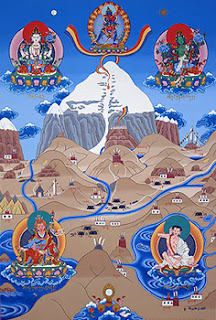
word must be said about the pradaksina of Mt. Kailasa in Tibet. In 1951 over
six hundred Indian pilgrims undertook the pilgrimage on the route Almora,
Pituragarh, Garbiang, Lipulek, Taghlakot. The Hindus regard Mt. Kailasa as the
abode of Siva and Parvati, ‘Kailasanatha', ‘Kailasapati’, etc., being frequent
names of Siva, and common male proper names. The mythology Tibetan legend has
woven round the mountain is unknown to the Hindu pilgrims, and although the
number of Tibetan pilgrims circumambulating Mt. Kailasa and Manasarovar must be
many times that of Hindu pilgrims, their mythological background and the
sectarian motives are totally unrelated to each other though the general
purpose for both, as goes without saying, is the acquisition of punya,
spiritual merit. The Hindu pilgrims perform this observance in three parts:
first, they circumambulate Lake Manasarovar, and some of the more heroic among
them even take a bath in its chilly waters; the ascent to the ambiance of the
Kailasa Mountain proper begins immediately at the completion of the pradaksina
of the Manasarovar, i.e. the latter's starting point to which the pilgrims
return after this first circumambulation, is situated right at the foot of the
mountain. The circumambulation of Mount Kailasa takes about three days, that of
Manasarovar a day and a half, so the total pradaksina lasts four and a half
days. On the other side of Mount Kailasa there is another lake only slightly
smaller than Manasarovar; it is called Rakkastal by the Hindu pilgrims, and I
think it is a local Kumaoni variety of Raksastala, 'lake of the raksasas' or
demons; the pilgrims do not go near that lake, as its water is thought to be
inauspicious (hence the name?); they only cast a glance bandani nazar,' the
glance of veneration', and fold their hands; they are advised not to look at it
more often than just that one instant.
There
is no built-in theory, in tantric written tradition or in tantric oral lore,
which would establish a hierarchy of thematic importance: these decisions seem
to be left to the individual tantric. The scholar, I believe, cannot do much
more than rely on some sort of intuition by analogy: in most Indian religious
traditions there is such a hierarchy in the gamut of religious exercise
(Sadhana). Meditation first, belief in the theological framework with the
devotional (bhakti) schools this might stand first then ancillary exercises,
then perhaps charity, then study and reading. The Upanisad enjoins 'listening,
cogitating, meditating' srotavyam mantavyam nididhyasitavyam in this order, and
the general under-standing is that 'listening' is the least important,
'meditation' the most important step. It is by no means certain that this
orthodox hierarchy holds for tantrism. Ritual of all sorts seems so much more
important in tantrism than it does in non-tantric literature of the same level
of sophistication, that it seems quite possible that tantric masters did regard
activities like pilgrimage and circum-ambulation to be as nuclear to the
process as, say, deep meditation. If the proportion of textual injunction can
be a guide, these activities, which may be regarded at the most as accessories
to the religious life, by non-tantrics, have not been given any shorter shrift
than meditation proper. Just how central these activities are to the practising
and succeeding tantric we are in no position to say; yet, we cannot omit them
in a survey of the tantric tradition just because most modernistically oriented
or 'philosophically' inclined students and votaries of a religion may regard
them as marginal, or even inferior, pursuits.
Writer Name: Agehananda Bharati