ArtofLegendIndia.com, Biggest Online Store of Handicrafts Items, Paintings and Jewelry Accessories...

Handicrafts

Handicrafts are devices or works of art that are made completely by hand or by the use of relatively simple tools. Such goods are usually made in the traditional way of manufacturing goods. Therefore, the knowledge of the art of craft is usually passed down from one generation to another. The items made using these traditional methods of manufacturing are usually produced in smaller quantities and they often represent the culture or religious beliefs of the community that makes them. The goods are also handmade from natural materials that are found in the environment of the particular economy.

Read More!

Biggest Online Store of Handicrafts Items

Paintings

A painting is equal to thousand words, means a beautiful painting is equal to million of words. Paintings are one of the oldest art forms -- throughout history artists have played an important role in documenting social movements, spiritual beliefs and general life and culture.

History Of Paintings: The history of painting reaches back in time to artifacts from...

Read More!

Biggest Online Store of Unique Style Paintings
Showing posts with label Krishna and Radha Paintings. Show all posts

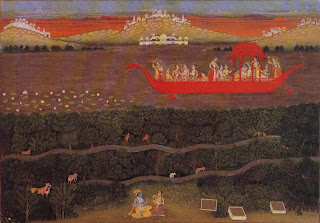
Krishna and Radha Cruising on Lake Gundalao in a Royal Barge

Posted by Art Of Legend India [dot] Com On 9:20 PM 1 comments
Krishna and Radha Cruising on Lake Gundalao in a Royal Barge
Kishangarh painting, in addition to its distinctive facial style, is also renowned for its spectacular sunsets and panoramic landscapes. Epitomizing that tradition, this painting features a brilliant, fiery sunset in dramatic counterpoint to its rolling green hills, white palaces, and the prominent Lake Gundalao. The grand vistas shown in Kishangarh paintings must, however, be viewed with a deeper symbolic meaning than mere landscape. For, just as Krishna and Radha roamed the fields and forests of Brindavan, so too did Savant Singh and Bani Thani in their devotional emulation of the divine couple. In place of the rural terrain of Brindavan, the Kishangarh artists depicted the palaces and pleasure gardens of their own court as a setting for the lovers.

Although the ostensible subject of most Kishangarh paintings is the romance of Radha and Krishna, on another level of interpretation the paintings can be seen as allegories for the love of Savant Singh and Bani Thani, as well as symbolic equations of the divine and secular lovers. Although never explicitly expressed, this metaphorical identification is intimated by the presence of Savant Singh/ Nagari Das's poetry on the back of a number of the works.

Radha and Krishna are portrayed twice in this painting: once surrounded by female attendants in the prominent royal barge and again at the bottom, alone in a forest grove. This scene of continuous narration may illustrate a poem by Savant Singh that describes the ideal couple as first boating on the Jamuna River in Brindavan and subsequently trysting in a forest glen.

Writer Name:- Pratapaditya Pal

Krishna Gathering Lotus Blossoms for Radha

Posted by Art Of Legend India [dot] Com On 2:54 AM 0 comments
Krishna Gathering Lotus Blossoms for Radha
Among the most distinctive and appealing representations of divine couple Radha and Krishna are those painted at Kishangarh in Rajasthan during the eighteenth century. The often unusually large portraits and narrative scenes are graced with a unique facial and figural style, which is immediately striking in this moonlit painting of Krishna gathering lotus blossoms for Radha, who is seated on a lake-edge terrace. The characteristic almond-shaped, upturned eyes; long, pointed noses; and graceful, elongated figures are the hallmark of Kishangarh painting. This lyrical, "sloe-eyed" portrait style was probably devised by Nihal Chand (c. 1715-8o), the royal atelier's master artist, and may have originally been intended for portraits of Radha and Krishna exclusively. Attendant figures in Kishangarh paintings also exhibit the distinctive facial features, but sometimes in a slightly less stylized manner, as is the case here.

This representation of Krishna is also notable in that it shows his long locks of hair flowing down his shoulders and into the water. One of Krishna's epithets is Kesava, "long-haired," but the rationale for the name is usually not so readily apparent as most portraits of the deity show his hair covered by a crown or turban.

Scenes of Krishna gathering lotuses for Radha are thought to illustrate a poem by fir Savant Singh (see Randhawa & Galbraith, pp. 108-9, pl. 23). Under the nom de plume of Nagari Das, he composed a number of devotional works, including the Manoratha Manjari (1723), Rasika Ratnavali (1725), Bihari Chandrika 0730, and Braj Sar (1742). Savant Singh's beloved courtesan, Bani Thani, was also a poet and, as did her lover, wrote under a pseudonym: Raskia Bihari.

Writer Name:- Pratapaditya Pal

Folio from a Manuscript of the Gitagovinda of Jayadeva: Krishna and Radha in a Bower The Gitagovinda is among the most frequently illustrated of all the devotional texts sacred to Krishna. Although the majority of extant Gitagovinda illustrations hail from northern India, this particular example may have been made at Aurangabad in the Deccan as it is stylistically similar to a manuscript of the Rasamanjari (Posy of delights) bound with an unillustrated nayaka-nayika manuscript by the same scribe that has a colophon stating that the portion of the text with the Rasamanjari paintings was made there in t6so (Doshi).

Despite this seemingly incontrovertible evidence of that manuscript's origin, the two manuscripts and a related Ragamala set have proved to be one of the most controversial and often discussed stylistic groups within Indian painting, with suggested dates ranging from 1630 to 1700 and attributions including Aurangabad, Mewar, Ghanerao, Bikaner, and Nagaur (see Doshi; Topsfield 199oa; and Vatsyayan 1978). The controversy lies in the fact that there are a number of Rajasthani, specifically Mewar, stylistic features present in the thirty-one paintings of the now-dispersed Gitagovinda manuscript. Although there are minor variations within it, the Rajasthani-style aspects generally include the figural types especially the moustache, long sideburns, and ornaments of Krishna as well as certain landscape, architectural, and compositional conventions.

These stylistic anomalies can, however, be explained by the cosmopolitan nature of the court culture of Aurangabad during the period when the paintings were executed (Leach 1986, p. 15o). During the many years of Mughal-Deccani warfare in the seventeenth century, large numbers of Mughal and Rajasthani troops were quartered in the city and region. These troops were led by high-ranking Rajasthani nobles, including Mohan Singh of Mewar, who commissioned the Rasamanjari and nayaka-nayika manuscripts of 165o. Since several illuminated manuscripts • in the same style were made at Mewar immediately following 165o, it seems likely that Rajasthani artists accompanying their nobles to the Deccan were exposed to and influenced by Deccani styles.

Writer Name:- Pratapaditya Pal

Company Overview

Art of Legend India has the distinction of being one of the best in the Indian Handicraft Industry. We are about 75 years old handicrafts manufacturer & exporter. We are having team of more than 500 craftsman.

We are having our business offices in India, USA & Germany to ensure our best services.

Total Pageviews