ArtofLegendIndia.com, Biggest Online Store of Handicrafts Items, Paintings and Jewelry Accessories...

Handicrafts

Handicrafts are devices or works of art that are made completely by hand or by the use of relatively simple tools. Such goods are usually made in the traditional way of manufacturing goods. Therefore, the knowledge of the art of craft is usually passed down from one generation to another. The items made using these traditional methods of manufacturing are usually produced in smaller quantities and they often represent the culture or religious beliefs of the community that makes them. The goods are also handmade from natural materials that are found in the environment of the particular economy.

Read More!

Biggest Online Store of Handicrafts Items

Paintings

A painting is equal to thousand words, means a beautiful painting is equal to million of words. Paintings are one of the oldest art forms -- throughout history artists have played an important role in documenting social movements, spiritual beliefs and general life and culture.

History Of Paintings: The history of painting reaches back in time to artifacts from...

Read More!

Biggest Online Store of Unique Style Paintings
Showing posts with label Life of Claude Monet. Show all posts

French Great Artist Cloud Monet - The Fleeting Impression

Posted by Art Of Legend India [dot] Com On 3:58 AM 0 comments
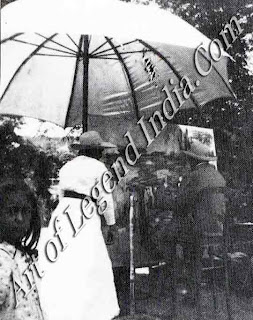
Monet at work Under a huge white parasol, Monet works on one of his waterlily paintings in the garden at Giverny. Beside him stands his step-daughter Blanche Hoschede-Monet, ready to change the canvas on his easel.

The Fleeting Impression

Monet painted in the open air with a speed and fervour no earlier artist had approached. But as he grew older, he saw the need to work more in his studio, to refine and perfect his paintings.

Monet is often considered the greatest and most typical of the Impressionists. This judgment reflects not only the quality of his work, but also his wholehearted dedication to the ideals of Impressionism throughout his mature -fife. In particular, he was committed to the Impressionist practice of painting out of doors. This in itself was not new, but Monet made it an article of faith.

None of his predecessors had worked out-of-doors to the same ambitious scale. In the early 19th century, for example, John Constable had often made sketches in oils outdoors, but only as preparatory studies for larger paintings. And Boudin and Jongkind, the two artists who had the most important influence on Monet's early work, also worked on a fairly small scale. Monet differed from these painters both in his conviction and in his ambitions. He made outdoor painting not just a basis for further elaboration, but the central feature of his huge output.
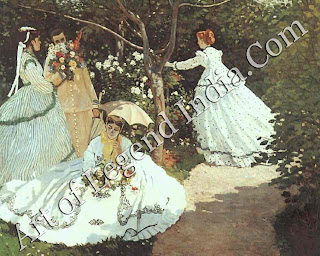
Women in the Garden Monet painted this eight-foot high canvas entirely out-of-doors in 1866-7. According to the painter Gustave Courbet, who visited him, Monet would not paint even the leaves in the background unless the light was just right. Monet's declared aim was to catch the passing impressions of light and atmosphere, 'the most fleeting effects', as he called them, and in his dedication to this goal he took measures that often had an element of farce about them. In 1866-7 he painted one of his most famous works, Women in the Garden, a canvas more than eight feet high, and to enable him to paint all the picture out-of-doors, he had a trench dug so the canvas could be raised or lowered by pulleys to the required height.

Much later in his career, when he was working on a series of paintings such as his Haystacks, his step-daughter Blanche Hoschede-Monet used a wheelbarrow to carry his unfinished paintings around the fields with him; when the light changed perceptibly, Monet would switch to another canvas that matched the new conditions.


BRAVING THE ELEMENTS



Lady with a Parasol, This brisk and vigorous painting, dating from 1886, conveys the atmosphere of a blustery day the rough brushstrokes of the sky suggest the scudding motion of the clouds. Monet had to work quickly to capture such fast-changing conditions in the weather. Bad weather did not weaken his determination to capture the effects he wanted. One observer described him working on the Normandy coast in 1885: With water streaming under his cape, he painted the storm amid the swirl of the salt water. He had between his knees two or three canvases, which took their place on his easel one after another, each for a few minutes at a time. On the stormy sea different light effects appeared. The painter watched for each of these effects, a slave to the comings and goings of the light, laying down his brush when the effect was gone, placing at his feet the unfinished canvas, ready to resume work upon the return of a vanished impression.

Such accounts of Monet at work part-heroic, part-absurd illustrate what he and the other Impressionists found was the greatest drawback to their new approach to painting: the effects in nature change so quickly that the more sensitive air artist is to them, the less time he can spend on a picture before any particular effect has gone. Referring to his haystack series in October 1890, Monet wrote: 'I really am working terribly hard, struggling with a series of different effects, but at this time of year the sun sets so quickly that I can't keep up with it.' To overcome this problem Monet began to work more and more in the studio to re-touch or revise his paintings. But publicly he liked to maintain his image as an outdoor painter.


PAINTING AT SPEED 

Pictures in series, In 1891, Monet exhibited his first major series of paintings The Haystacks. These two, from the series of 15, illustrate his fascination with the varied colours produced by natural Monet developed a free and spontaneous painting technique which enabled him to work at speed. His brushwork is remarkably flexible and varied, sometimes broad and sweeping, sometimes fragmented and sparkling. Occasionally he used the handle of the brush to scratch through the paint surface and create a more broken, textured effect. His last paintings, the great series representing the waterlilies in his garden at Givemy, were executed more slowly than his earlier works and many of them have a richly encrusted surface, the paint dragged and superimposed, layer upon shimmering layer.

Paul Cezanne, a landscape painter of equal stature, declared that Monet was 'only an eye, but, my God, what an eye!' Many of Monet's own observations seem to bear out that this was the way he thought of himself. He told a pupil that 'he wished he had been born blind and then suddenly regained his sight, so that he would have begun to paint without knowing what the objects were that he saw before him'. And he advised 'When you go out to paint, try to forget what objects you have in front of you, a tree, a field,.. Merely think, here is a little square of blue, here an oblong of pink, here a streak of yellow, and paint it just as it looks to you, the exact colour and shape, until it gives your own naive impression of the scene.'

But no artist simply reproduces what he sees in front of him, and although Monet might strive to be objective, he was never impersonal. His increasing reliance on studio work shows that he realized that his art consisted not merely in observing and recording, but in finding a pictorial equivalent in opaque paint on a two-dimensional surface for the infinitely varied effects of light. And as with all great art, there is a dimension to Monet's work that ultimately evades analysis or explanation. His great series of waterlily paintings, in particular, are the product not simply of an exceptionally keen eye and an unerring hand, but also of a poetic spirit.

Writer – Marshall Cavendish

Introduction to Claude monet – The Great French Artist

Posted by Art Of Legend India [dot] Com On 3:58 AM 0 comments

Introduction to Claude monet – The Great French Artist

Claude Monet

Claude Monet was the most dedicated and single-minded of the French Impressionists. He was brought up on the Normandy coast, and the beautiful scenery there inspired him to devote his life to landscape painting. Fired with a desire to capture nature's most fleeting effects, he painted out-of-doors in all weathers. When he moved to Paris he worked with the other great artists of his circle  Renoir, Manet and Pissarro.

Today Monet is almost universally admired, but at first he was misunderstood and mocked. Estranged from his wealthy family, he endured misery and poverty in his early career, and was in his forties before his work began to I ell. By the end of Monet's long life he was a wealthy man and a revered artist, but success never spoiled him. Even in his 80s he still worked tirelessly, despite his failing eyesight.

The Pioneer from Normandy

The struggling artist at the age of 28, a year after he painted the scene on the right, Monet was still struggling to make his living as an artist. He had a young son by his mistress Camille but. Remained dependent on his father, who prevented their marriage until 1870? At the age of 18, Monet left a prosperous family home in Le Havre for a bohemian life in Paris. His willingness to sacrifice everything for his art had set the pattern for his career.

Claude-Oscar Monet was born in Paris on 14 November 1840, the elder son of a grocer and former sailor, Adolphe Monet. In 1845 Adolphe took over his family's flourishing grocery and ship-chandlering business in Le Havre, and it was in this busy port at the mouth of the River Seine that Claude (or Oscar, as his family called him) spent most of his happy childhood and youth.

His aunt, Sophie Lecadre, was an amateur painter and she no doubt encouraged the talent for drawing he showed as a boy. When he should have been attending to his lessons, Monet was often filling his books with caricatures, and by the time he was 15 such drawings had won him a local reputation and his first earnings as an artist.

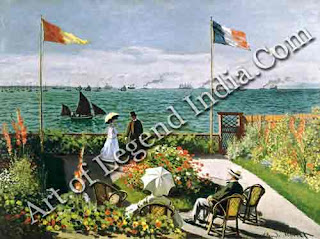
A prosperous background Monet's father was a successful grocer with a seaside property at Sainte Addressee, near Le Havre. He is seen there in The Terrace (1866), sitting in a basket chair. Monet's mother had died 10 years earlier.Monet's drawings were displayed in the window of a local picture-framer's shop, and this led to the great turning point in his life. The landscape painter Eugene Boudin, a native of nearby Honfleur, also showed his work there, and when he met Monet he took the young man (16 years his junior) under his wing and encouraged him to paint alongside him. At this time most landscape paintings were produced in the studio, but Boudin, a specialist in sea and beach scenes, liked to paint in the open air, saying Everything that is painted directly and on the spot always has a force, a power, a vivacity of touch that is not to be found in studio work.'

Monet at first found Boudin's painting 'distasteful', but he was soon converted to his friend's way of thinking, and in the summer of 1858, at the age of 17 he found that landscape painting from nature was his true vocation. 'Suddenly a veil was torn away. I had understood - I had realized what painting could be. By the single example of this painter devoted to his art with such independence, my destiny as a painter opened out to me.


A STUDENT IN PARIS 

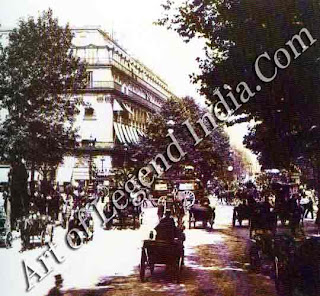
The capital of art in 1859, when Monet moved to Paris, the city dominated the international art world painters flocked there from all over Europe. The population at the time was about 11/2 million. The superb scenery of his Normandy home and the rapidly changing weather typical of coastal areas provided ideal material for Monet's new-found love. But Paris - the artistic capital not just of France but of the whole world was a lure for all aspiring artists, and in 1859 Monet went there to pursue his studies, armed with letters of introduction from Boudin and his aunt. His father wanted him to study at the Ecole des Beaux-Arts, the official state school of art, but Monet was always strongminded and self-confident and (3 preferred to study at the Atelier Suisse. Named a; after its founder Charles Suisse, this was an g independent academy where models were provided but there were no examinations and no formal tuition. Monet's father cut off his allowance because of his disobedience.

At the Atelier Suisse, Monet met Camille Pissarro, who was to become one of the central figures of the Impressionist movement, and he frequented the Brasserie des Martyrs in Montmartre, a favourite meeting place of Gustave Courbet, Edoulard Manet and other avant-garde A artists. Monet's growing involvement in the agcultural life of Paris was halted when he was conscripted into the army, and in 1861-62 he Served in Algeria. He developed anaemia and went to convalesce at home, where his family offered to buy him out of the army if he would undertake to study with an established painter.

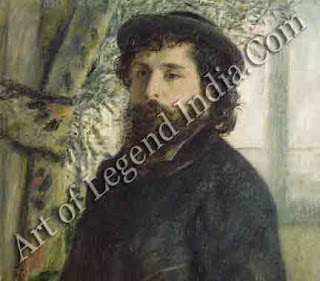
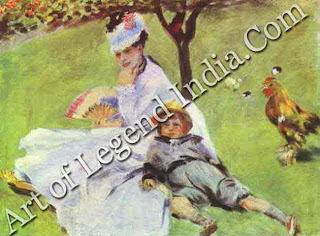
Wife and son Monet's lifelong friend Auguste Renoir painted this picture of Madame Monet and her son lean in their garden at Argenteuil in 1874. This was one of the happiest periods of Monet's life. Monet agreed, but before returning to Paris he met the Dutch painter Johan Barth°Id Jongkind, who was working at Le Havre and who with Boudin was to be the great mentor of Monet's early career. The novelist and critic Emile Zola wrote in 1868 of the astonishing breadth' and 'masterly simplifications of Jon kind’s paintings, 'rapidly brushed for fear of losing the first impression', and in 1900 Monet said that he owed to him 'the definitive education of my eye'.

Key Dates 

1840 born in Paris
1845 family moves to Le Havre
 1858 meets Eugene Boudin who encourages him to paint in the open air
1859 moves to’ Paris
1863 meets Renoir, Sisley and Bazille
1867 his son Jean born to Camille Doncieux
1870 marries Camille. Visits England
1871 moves to Argenteuil
1874 first Impressionist exhibition in Paris
1879 Camille dies
1883 settles at Giverny
1892 begins Rouen Cathedral series. Marries Alice Hoschede
1900 enlarges waterlily pond in his garden
1908 begins to suffer from cataracts on eye
1911 Alice dies 1914 builds studio for series of Waterlilies
1926 dies at Giverny


FINANCIAL PROBLEMS 

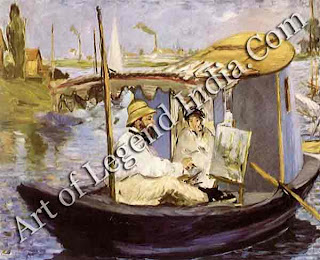
A floating studio When Monet moved to Argenteuil on the Seine in 1871 he built a special floating studio so he could work on the river. This painting, made by Edouard Manet in 1874, shows Monet on the boat with his wife Camille. In 1862 Monet began to study at the Paris studio of Charles Gleyre, a successful painter of conventional portraits and figure compositions. Monet was not happy following the normal academic training of painting from the nude model, but as his fellow-student Pierre-Auguste Renoir remarked, if Gleyre was 'of no help to his pupils', he at least had the merit 'of leaving them pretty much to their own devices'. Other students included Frederic Bazille and Alfred Sisley, who with Monet and Renoir would evolve the Impressionist style of painting. They painted together in the Forest of Fontainebleau, and Bazille, who came from a wealthy family, helped Monet finandaily until his death in 1870.

Gleyre was forced to close his studio in 1864 because of an eye ailment and Monet's family, dismayed at his bohemian lifestyle, again cut off his allowance. His financial problems continued to be acute throughout the 1860s and even led to a half-hearted attempt at suicide. In 1867 his mistress Camille, of whom his family disapproved, gave birth to his son, and Monet, who was staying at SainteAdresse near Le Havre, was so abjectly poor that he could not even raise the money to go to Paris to see them.

Paul DurandRuel DurandRuel was the earliest and most important of the Impressionists' dealers. After his death in 1922, Monet told his son 'I shall never forget all that my friends and I owe to your father.' In 1870 Monet married Camille, but when war broke out between France and Prussia in the same year, he left her with his son and went to England to avoid having to fight. In London, where his family joined him later, Monet studied the work of Constable and Turner and painted some views of parks and the River Thames, but the most important aspect of his stay was meeting the French picture-dealer Paul DurandRuel, who was the first dealer consistently to support the Impressionists. Although Monet would still know poverty after DurandRuel began buying his pictures, his life was no longer the tale of unremitting destitution it had been through so much of the 1860s.

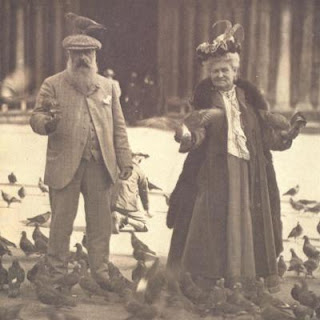
Visits to Venice Monet visited Venice in 1908 with his second wife Alice and they returned the following year. He worked hard during these visits, but is seen here with Alice in lighter mood, feeding the pigeons in St Mark's Square. In 1871 Monet returned to France via Holland and rented a house at Argenteuil, a village on the Seine a few miles from Paris. This was one of the most fruitful periods in Monet's life: he was happily married and comparatively prosperous (Camille inherited some money in 1873), and the pleasures of life on the river and along its banks provided him with an abundance of subjects. His friends often visited him, and the bridges and boats of Argenteuil appear again and again in the Impressionist paintings of Renoir and Sisley.

CAMILLE'S DEATH 

It was at this period that the Impressionists were most united and in 1874 they held their first exhibition as a group. The show was a commercial failure, as was a group sale in the following year, and when debts began to mount, Monet's idyllic Argenteuil period drew to a close. In 1878 he moved to Vetheuil, still on the Seine, but farther from Paris, and in 1879 Camille died after a long illness. Monet's burden of grief and responsibility (by now he had a second son) was eased by a woman called Alice Hoschede, the wife of a collector of Impressionist paintings, with whom Monet had begun an affair in 1876. She nursed Camille, looked after the children and assumed Monet's debts. Monet eventually married her in 1892 after she had become a widow.

In the next few years Monet moved to various places, including Dieppe, Pourville and Varengeville, all on the Normandy coast. Then in 1883 he finally settled at Giverny, about 40 miles from Paris, on the River Epte, with Madame Hoschede, his children and her children. By this time the original Impressionist group had virtually broken up, and only Monet continued to pursue the Impressionist ideal the acute scrutiny of nature.


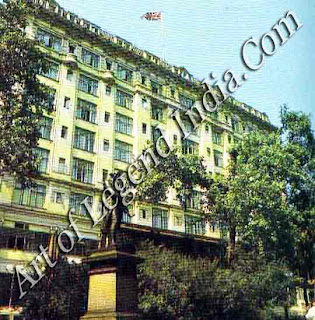
The Savoy Hotel On his later visits to London, Monet stayed at the Savoy, one of the grandest hotels in the capital, from which he had a good view of the river. When the American painter John Singer Sargent visited Monet there, he found him 'surrounded by some 90 canvases'. Monet did not have time to finish the paintings in London, hut shipped them back to France and completed them in his Giverny studio.
Monet now had a settled home, but his tremendous energy led him to travel widely in search of subjects, and in the 1880s he worked extensively on the Mediterranean coast as well as in Brittany and Normandy; he also visited Holland and Italy. In the same decade his reputation began to grow and his fortunes to prosper, thanks in great measure to the efforts of DurandRuel, who in 1883 alone organized exhibitions of Impressionist paintings in Berlin, Boston, London and Rotterdam. By 1890 Monet was secure enough financially to buy the house at Giverny he had previously rented, and in 1891 an exhibition of his paintings at DurandRuel's gallery in Paris sold out only three days after opening. All the paintings at this exhibition were of haystacks, and this marked the beginning of the most original feature of Monet's later career the production of several series of paintings in which he represented the same subject d't different times of the day under different lighting conditions. Monet spent much of his time in his studio developing these series for although he still loved painting out of doors, he now realized that he could more easily obtain the effects he wanted when he had time to reflect away from the subject.


MONET THE GARDENER 

As he advanced in years, Monet continued to travel; he visited Norway in 1895 as the guest ofQueen Christiana, London three times between 1899 and 1904, Madrid in 1904 and Venice in 1908 and 1909. However, his attention was focused mainly on Give my, and particularly on one part of his home the water garden that he had developed during the 1890s on a strip of marshland next to his house. Monet had diverted a stream through it and created an exotic world of weeping willows, bamboo and floating lilies. He began painting the garden in about 1899, and from about 1906 it became the centre of his artistic life, for in the water lilies, with their ever-changing patterns of colour and light, he had found an inexhaustible subject: 'my pond had become enchanted'. The first paintings of the garden were about three feet square, but they became larger as Monet's absorption increased, and in 1914 he had a special studio built so he could work on a huge scale. His wife had died three years earlier, but he had the love of his devoted step-daughter, Blanche Hoschede-Monet, herself a painter, to support him, and he worked with unflagging energy.

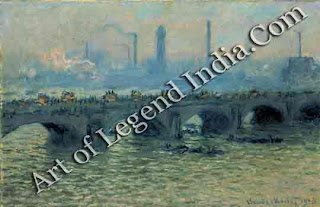
Waterloo Bridge (1903) Waterloo Bridge was among Monet's favourite subjects in London. In 1904 he exhibited 37 views of the Thames at DurandRuel's gallery in Paris 18 were of this bridge. The exhibition catalogue said the paintings were the result of 'four years of reflective observation, strenuous effort, prodigious labor'. Monet obtained the high viewpoint from a balcony (no longer in existence) at the Savoy Hotel. By this time Monet was the grand old man of French painting, and it was at the suggestion of the Prime Minister, Georges Clemenceau, one of the many distinguished visitors to Give my, that he decided to present several of his waterlily paintings to the nation in the form of an enormous decorative scheme. Monet's sight was failing, his work on the paintings was delayed while he had a cataract operation, and he did not live to see their unveiling in the Orangerie in Paris (part of the Louvre complex) on 17 May 1927. He died aged 86, on 5 December 1926 at Give my and was buried beside the small village church. In the last year of his life, Monet described his aim as being `to render my impressions in front of the most fleeting effects', words he could equally have used at any stage during more than half a century of ceaseless creativity.

Writer-A Marshall Cavendish

Frenchish Great Artist Claude Monet - Monet`s Garden

Posted by Art Of Legend India [dot] Com On 10:16 PM 0 comments

Monet`s Garden

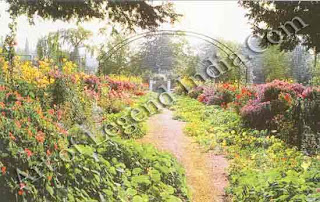
The central path, The view from the back door of the house looked down between the two yew trees along a broad central path overgrown by trailing nasturtiums. The trellises supported roses and clematis.
The magnificent garden at Giverny took Monet almost 20 years to create, and demanded all his artistic skills and imagination. For the rest of his life, it provided endless subjects for his paintings.

Rarely has an artist left behind such a complete record of his inspiration as did Monet at Givemy. There, in the garden on which he lavished care and attention for over 40 years, view after view conjures up his paintings: the lily pond, the footbridge, the rose trellises. The garden was really an extension of his art.

Givemy lies some 40 miles north-west of Paris, in the rolling countryside of Normandy, where two small tributaries, the Epte and the Ru, flow into the Seine. The village nestles against wooded hills, overlooking a broad panorama of fields dotted with lines of willow and poplar.

THE HOUSE AT GIVERNY 

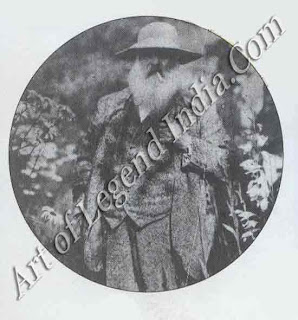
Monet the gardener, Monet lavished care on his garden and toured it several times each day. A visitor commented that: 'Monet is perhaps seen at his best, and certainly in his most genial mood, when cigar at full blast he strolls around his propriete at Giverny.
The property which Monet rented for his large household in 1883 stood at the foot of these hills a long, pink house with shutters. Two acres of orchard sloped gently towards a narrow road, beyond which lush water meadows stretched down to the river. The garden then was formal and uninspired. A broad, tree-lined central walk led up to the house, flanked by two long flowerbeds edged with clipped box hedges. At that time, there was little to excite the eye.

Wherever he had lived before, Monet had always created gardens, but Giverny provided scope for his most ambitious plans. It was late spring when the family moved in. Monet immediately reorganized the kitchen garden to ensure a supply of vegetables, then set to work on the house and flower garden. Trellises were erected against the house to support clematis, climbing roses and Virginia creeper. He chose the same shade of green to paint the shutters, doors and porch of the house as he would later use for the arches and trellises in the garden and for the Japanese bridge.

The fruit trees in the orchard were uprooted and replaced with lawns, shaded by ornamental cherries and japonicas and edged with a brilliant profusion of flowering plants. New flower beds were dug, intersected by neat gravel paths in straight lines and rectangles, which soon disappeared under the dense carpet of flowers.

Early summer, Poppies and irises made a dazzling display of colour, set off against dark green foliage. Monet preferred flowers with
The clipped box hedges were removed and the spruce and cypress trees lining the central walk were cut down only two yews were left. By the 1890s a series of curving arches spanned the walk, draped with climbing roses and clematis. Masses of irises, poppies, asters, pansies and peonies bordered the walk beneath the arches, while trailing nasturtiums spread over the path.

Monet had approached the garden much as he would a canvas, using the same principles that governed his palette. Flowers with light, bright blooms were planted in clumps of contrasting colours, set off against green foliage no coloured or variegated leaves were used. Monet avoided flowers with large blossoms, preferring festoons of small-headed flowers clustering together to produce a mass of colour.

FLOWERS FOR ALL SEASONS


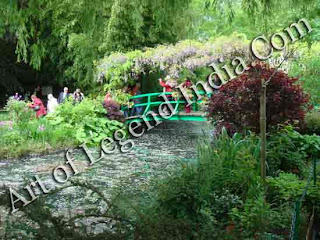
The Japanese bridge, Just inside the water garden Monet built a hog-backed wooden footbridge, based on one in a Japanese print that hung in the dining room. The bridge was draped with clusters of white and mauve wisteria.
In the early spring, yellow jasmine and Christmas roses gave way to crocuses, narcissi, tulips, azaleas, rhododendrons and flowering cherries, with dense carpets of forget-me-nots. Later peonies, poppies and banks of irises would appear with clematis and climbing roses clambering round trellis and arch. At the height of summer the garden was a blaze of saffron, vermilion and blue aubrietia covered the ground, while geraniums, daisies, zinnias, marigolds, lilies, pinks and cannas flowered in abundance.

Monet's garden included several hundred varieties of native and imported plants and up to the end of his life the artist took delight in adding to his collection the rare tree peonies in the water garden, for instance, and bulbs of lilies quite unknown in France were given to him by his friends the Kurokis, who were influential Japanese art collectors.

He also encouraged his children to study botany, and in the early years at Giverny, experiments in cross-breeding made by his son Michel and step-son Jean-Pierre accidentally resulted in a new type of poppy, which they named Papaver Moneti.

'My garden is a slow work, pursued by love,'

Monet once said, 'and I do not deny that I am proud of it. I dug, planted, weeded myself; in the evenings the children watered.' By 1890, Monet was wealthy enough to buy the house and make still more improvements: in 1892 three greenhouses were built and stocked with exotic orchids, begonias, figs and tropical ferns. Now Monet took on a team of six gardeners who worked under his close supervision. With the head gardener, he inspected the garden every day, ordering all dead flowerheads to be removed.


THE WATER GARDEN 

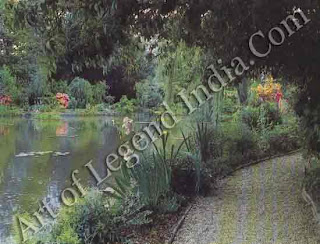
The water garden, At the foot of the gently sloping flower garden, Monet created a beautiful water garden in the Japanese style. He enlarged a small pond by diverting the tiny River Ru into the garden, then filled the pool with aquatic plants and waterlilies. In 1893 Monet bought another plot of land across the road at the bottom of his garden, intending to enlarge a tiny pond already there and to create a water garden. To do this, it was necessary to divert the River Ru.

Monet was not liked by the villagers, and they bitterly resented his plan. Monet himself was judged to be aloof, and his family seemed to have no clear-cut social status. The villagers had already claimed compensation for alleged damage to their fields, through which the Monet family frequently trekked to where their boats were moored.

Now Monet's plans for a pond stocked with rare plants met with suspicion. The women, who I washed their linen in the Ru, claimed it would be a health hazard. And local peasants feared that their cows would be poisoned by drinking river water 'contaminated' by strange plants. Finally, with many conditions, permission was granted.

Purple irises Monet loved irises, and planted them all round the fringes of the waterlily pond; they appear in many of his later paintings. 'I perhaps owe having become a painter to flowers', he once said. The mood and atmosphere of the water garden was very different from the exuberance of the flower garden. Here all was cool and tranquil. The pool was strewn with exotic varieties of waterlily white, yellow, mauve and rose with clumps of bamboo, weeping willows, irises and tamarisk smothering the banks. Monet added the Japanese footbridge, a simple wooden arch with no supporting piers, painted in his favourite brilliant green. To this, some years later, trellises were added to support masses of wisteria.


In 1901 Monet received permission to extend the pond further, since the size and shape had become too restricting to him as he painted it more and more. By deepening the curve and extending its length, he achieved a greater sense of space, creating marvelous vistas from all round the pond. More species of lilies were introduced and soon it was the sole task of a gardener to care for the pool, for which he used a small boat permanently moored at the edge.

Just as his flower garden had gradually become a recurrent theme of his painting, so the waterlily pond and footbridge had begun to absorb Monet. As he grew older he turned almost exclusively to his garden for ideas and right up to the very end of his life he remained fascinated by the pool, with its beautiful, shimmering reflections.

Writer – Marshall Cavendish
French Great Artist - Claude Monet Painting Gallery

Posted by Art Of Legend India [dot] Com On 11:51 PM 0 comments

From the start of his long career Monet worked mostly in the open air, concentrating on scenes that he knew well. Wild Poppies was painted at Argenteuil, a pretty riverside village just outside Paris, where the artist and his family settled in 1871. Monet loved to paint the boats on the Seine with their sails reflected in the river's rippling waters like those in The Bridge at Argenteuil.

Such tranquil, rural scenes contrast strikingly with the crowded streets of Paris shown in his paintings of the Boulevard des Capucines and the Rue Montorgueil. But the effects of light and atmosphere gradually became more important to Monet than the objects in his paintings. In the Gare St-Lazare, for example, it was the smoke not the train which most fascinated the artist.

In later life, when Monet moved to Giverny, he developed the unique format of pictorial series numerous versions of the same view seen under different lighting conditions. These were designed to be exhibited as a group, and since each canvas captured a particular instant, together they recorded time passing. Poplars and Rouen Cathedral each form part of a series, but the most spectacular of all is the series devoted to Waterlilies. Monet's exotic water garden was virtually his only subject during the last 20 years of his life, inspiring some of his most hauntingly beautiful works. 

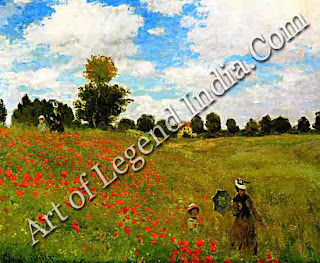
The Great Artist Claude Monet Painting “Wild Poppies” 1873 19 5/8” x 25 5/8” Musee d'Orsay, Paris This little painting of Monet's wife Camille and son Jean walking through a field of poppies was shown at the first Impressionist exhibition in 1874. Camille and Jean appear twice in the painting, a device which draws the eye repeatedly to the triangular hillside of bright red poppies.


The Great Artist Claude Monet Painting “Boulevard des Capucines” 1873 31 ½" x 23 5/8" Atkins Museum, Kansas City, Missouri

Monet may have worked from a photograph when painting this wintry scene. On the right, a top-hatted figure looks down from a window; below, a dash of pink may represent a cluster of balloons.


The Great Artist Claude Monet Painting “The Bridge at Argenteuil” 1874 23 5/3" x 311/2" Musee d'Orsay, Paris
Monet lived at Argenteuil, near Paris, for seven years and made several paintings of sailing boats on the Seine. In this tranquil scene, the impression of broken reflections on the shimmering water is conveyed by well-defined brushstrokes of pure colour. 


The Great Artist Claude Monet Painting “Gare St-Lazare” 1877 291/2" x 391/2" Musee d'Orsay, Paris This railway station was the Paris terminus of the line from Argenteuil and Monet painted it several times. He captured its atmosphere with clouds of steam and smoke rising from the engine, and shadows thrown by the glass roof rather than a precise, detailed likeness.


The Great Artist Claude Monet Painting “The Rue Montorgueil Decked with Flags” 1878 235/8" x 311/2 Musee des Beaux-Arts, Rouen This bird's-eye view of a Parisian street, decked out in celebration of a national holiday, was painted rapidly on a balcony overlooking the scene. The red, white and blue stripes of the French flags form vibrant patches of colour, and in the centre of the picture a slogan in blue reads 'Vive la France'.
The Great Artist Claude Monet Painting “Poplars” 7891 321/4" x 321/4" Metropolitan Museum of Art, New York
A row of tall poplars lining the River Epte near Monet's home in Giverny fascinated the artist, and he painted them many times from his boat. In this late stage of his career Monet's Impressionist style grew increasingly abstract and decorative.


The Great Artist Claude Monet Painting “Rouen Cathedral in Full Sunlight” 1894 421/4" x 283/4" Musee d'Orsay, Paris
Like Poplars, this painting formed part of a series: Monet painted the same view over and over again, under changing light conditions. The year after this version was completed, 20 different canvases were exhibited together, covering the whole day from dawn to dusk. 
The Great Artist Claude Monet Painting “Waterlilies” 1916-1926 781/4" x 1671/4" St Louis Art Museum, Missouri
Art Museum, Missouri
Monet painted the waterlily pond at the bottom of his garden hundreds of times: it became virtually his only 'model' for the last 20 years of his life. He focused increasingly on this small area, painting ever larger pictures. This 14-foot long canvas was originally the central panel of three, forming a massive 40-foot painting. The lilies themselves are not immediately recognizable they dissolve into a magical mixture of delicate colours.

Writer - Marshall Cavendish

Company Overview

Art of Legend India has the distinction of being one of the best in the Indian Handicraft Industry. We are about 75 years old handicrafts manufacturer & exporter. We are having team of more than 500 craftsman.

We are having our business offices in India, USA & Germany to ensure our best services.

Total Pageviews