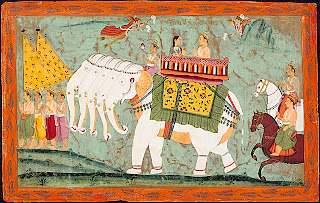
Not
all the dead were permitted to remain in Yama's heaven. As a form of Mitra, and
associated with Varuna, Yama was a judge of the dead, known as Dharmaraja.
Dharma, truth or righteousness, by which Yama judged mortals who approached his
heaven, was a development of Varuna's rta, the inscrutable law. As Varuna
formerly bound the guilty with their sins against rta, so Yatna consigned the
wicked or unbelievers either to annihilation or to a realm of darkness called
Put. He was assisted in the task of judgment by Varuna, who sat with him
beneath a tree in the land of the fathers. Like a shepherd, Yama played his
flute and drank soma with the other gods. As the dead approached him he gave
the faithful draughts of the soma, thereby making them immortal. He was helped
in this task by his messengers, a pigeon and an owl, as well as two brindled
watch dogs, each with four eyes. In later times his assistant was said to be
Chitragupta, and he had other 'court recorders'.
At
first the emphasis was on the pleasures of Yama's heaven, a realm of light
where life had no sorrows, nature was sweet and the air full of laughter and
celestial music. The splendors of Yama's assembly house, built by Tvashtri from
burnished gold, were equal to those of the sun. There Yama, as Pitripati (king
of the fathers), was waited upon by servants who measured out the life span of
mortals, and was surrounded and worshipped by rishis and Pitris, clad in white
and decked with golden ornaments. The assembly house was filled with sweet
sounds, perfumes and brilliant flowers.
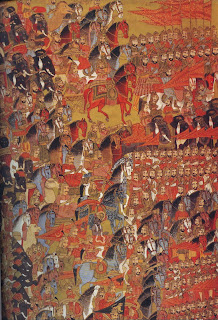 Yama's
heaven was not without rivals, and in particular it was challenged by the
splendors and delights of the heavens of Varuna and Indra. Varuna in his heaven
was no longer judge of the dead, as he had been when seated beside Yama; he was
already lord of the ocean. The heaven, which was constructed within the sea by
Tvashtri or Visvakarma, had walls and arches of pure white, surrounded by
celestial trees made of brilliant jewels which always bore blossom and fruit
birds sang everywhere. In the white assembly house Varuna sat enthroned with
his queen, both decked with jewels, ornaments of gold, and flowers. They were
attended by the minor deities the Adityas, the Nagas (serpents), the Daityas
and Danavas (ocean demons), the spirits of the rivers, seas and other waters,
and the personified forms of the cardinal points and the mountains.
Yama's
heaven was not without rivals, and in particular it was challenged by the
splendors and delights of the heavens of Varuna and Indra. Varuna in his heaven
was no longer judge of the dead, as he had been when seated beside Yama; he was
already lord of the ocean. The heaven, which was constructed within the sea by
Tvashtri or Visvakarma, had walls and arches of pure white, surrounded by
celestial trees made of brilliant jewels which always bore blossom and fruit
birds sang everywhere. In the white assembly house Varuna sat enthroned with
his queen, both decked with jewels, ornaments of gold, and flowers. They were
attended by the minor deities the Adityas, the Nagas (serpents), the Daityas
and Danavas (ocean demons), the spirits of the rivers, seas and other waters,
and the personified forms of the cardinal points and the mountains.
Indra's
heaven, also built by Tvashtri, was called Swarga and was situated on Mount
Meru, but could be moved anywhere like a chariot. Like the other heavens it was
adorned with celestial trees and filled with birdsong and the scent of flowers.
Indra enthroned in glory in the assembly house, wearing white robes, garlanded
with flowers and wearing gleaming bracelets and his crown. He was accompanied
by his queen, and attended by the Maruts, by the major gods and by sages and
saints, whole pure souls without sin were resplendent as fire. This concept of
lndra’s heaven is the one still held today. In it there is no sorrow, suffering
or fear for it is inhabited by the spirits of prosperity, religion, joy, faith
and intelligence. Also in lndra's heaven are found the spirits of the natural
world wind, thunder, fire, water clouds, plants, stars and planets. Recreation
is provided by the singing and dancing of the Apsaras and Gandharvas, celestial
spirits; heroes or divine warriors perform feats of skill and holy rites are
performed. Divine messengers pass to and fro in their celestial chariots. The
heaven presided over by the warrior god was thought to be especially the abode,
permanent or temporary, of warriors. Thus in the Mahabharata Indra receives his
son Arjuna, who is exceptionally skilled in military arts, and keeps him for
several years on Mount Meru and he welcomes the fallen heroes both sides to his
heaven, all those who have performed their warrior’s duty being admitted. Some
of those who enter receive special privileges, such as Bhishma, who resumed his
place as one of the Vasus, Indra’s advisers.
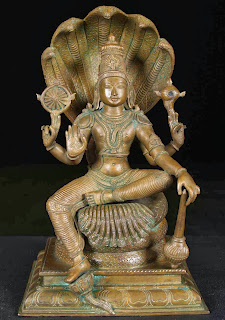
Yama's
role changed with the growth of these other heavens and the idea that heaven
was the reward for virtue, rather than a place where most of the dead were
received unless they had the misfortune of having no children to perform the
proper sacrifices for them. At first the idea of going to the abode of the
fathers was simply less desirable than that of being received with special honors
by the gods later this developed into the notion that Yama's kingdom was not
heaven but hell, where the tortures were pictured with growing elaboration, and
Yama himself became a figure of terror. Opinions differ as to how many hells
there are in his abode some say hundreds of thousands others say twenty-eight,
or only seven. The tortures meted out are peculiarly suited to the sinner's
offence. Thus cruel men are boiled in oil those who are unnecessarily cruel to
animals are consigned to a place where a monster tears them to pieces without
ever killing them those who kill Brahmins to a hell where the bottom is a
furnace and the top a frying pan oppressive kings are crushed between two
rollers; those who kill mosquitoes are tortured by sleeplessness the
inhospitable are turned into worms and cast into a hell where they eat each
other those who marry out-side their caste are forced to embrace red hot human
forms rulers and ministers who provoke religious dissension are thrown into a
river full of the most horrible impurities where they are boiled and fed upon
by aquatic animals.
Just
as the vulgar had personalized the concept of Brahma as creator, so they
misunderstood the Brahmanic philosophers' growing belief in metempsychosis or
transmigration of souls, samsara, and the possibility of ultimate release from
the eternal cycle of rebirths by identification of the individual soul with the
universal spirit.
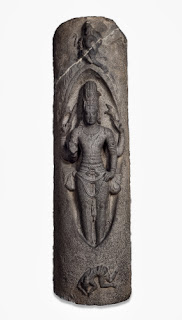 The
common belief was that the wicked went south to one of Yama's hells, or were
reborn as worms, moths or biting serpents, while the good were sent either to
the abode of the fathers on a path which passed south-east through the moon, or
they went north-west, in the direction of the gods, to the sun. But
distinctions were made between different sorts of the virtuous just as they
were made among the wicked. Yama ceased to preside over the abode of the
fathers and the gods no longer inhabited that region, having moved to one of
the various heavens. Those who now followed the path to the abode of the
fathers had dutifully obeyed their dharma they had offered sacrifices, given
alms generously and performed austerities in other words they had followed
tradition. Such ones pass first into smoke, then into night, then arrive at the
abode of the fathers, and finally pass on to the moon. There (by association of
Soma, moon, and soma, ambrosia) they become the food of the gods but they are
given out from the gods into space, and from air pass successively into clouds,
into rain, and so return to earth where, becoming food, they give rise to the
principle of life in man and woman and so emerge into the world again. Akin to
these beliefs were those that the stars were the souls of the dead
(particularly of saints and heroes) or else that they were the souls of dead
women.
The
common belief was that the wicked went south to one of Yama's hells, or were
reborn as worms, moths or biting serpents, while the good were sent either to
the abode of the fathers on a path which passed south-east through the moon, or
they went north-west, in the direction of the gods, to the sun. But
distinctions were made between different sorts of the virtuous just as they
were made among the wicked. Yama ceased to preside over the abode of the
fathers and the gods no longer inhabited that region, having moved to one of
the various heavens. Those who now followed the path to the abode of the
fathers had dutifully obeyed their dharma they had offered sacrifices, given
alms generously and performed austerities in other words they had followed
tradition. Such ones pass first into smoke, then into night, then arrive at the
abode of the fathers, and finally pass on to the moon. There (by association of
Soma, moon, and soma, ambrosia) they become the food of the gods but they are
given out from the gods into space, and from air pass successively into clouds,
into rain, and so return to earth where, becoming food, they give rise to the
principle of life in man and woman and so emerge into the world again. Akin to
these beliefs were those that the stars were the souls of the dead
(particularly of saints and heroes) or else that they were the souls of dead
women.
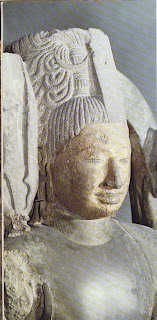
Those
virtuous deceased who were allowed to follow the 'path of the gods' were those
who in their lifetime had faith who, in other words, had attained fusion with
the universal spirit and so won release from samsara. The stages of their
journey into the after-life are as follows: the fire of their funeral pyre purifies
their earthly natures, which then become flames themselves they pass next into
day, into the world of the gods and into lightning. They are then con-ducted by
the Supreme Being into the realm of Brahman, the universal divine spirit which
is without beginning or end and is without decay. From this realm there is no
return, and here they achieve immortal bliss.
 Among
people clinging to ideas of an after-life spent in the presence of the Vedic
gods, the so-called 'path of the gods' was easily misunderstood. Despite the
general acceptance of the idea of metempsychosis, or rebirth according to karma
(destiny created by actions in former lives), the older beliefs still crept in.
Thus it was held that those who had led virtuous lives were permitted a break
in the cycle of their rebirths by staying some time in lndra's heaven. Some
still held to the old view that they were allowed to reap the benefit of their
good action in Indra's heaven before serving their allotted time in hell.
Alternatively like Yudhisthira in the Mahabharata and like all kings who by
nature of their calling cannot fail to commit some injustice they suffer a vision
of hell before being led to heaven.
Among
people clinging to ideas of an after-life spent in the presence of the Vedic
gods, the so-called 'path of the gods' was easily misunderstood. Despite the
general acceptance of the idea of metempsychosis, or rebirth according to karma
(destiny created by actions in former lives), the older beliefs still crept in.
Thus it was held that those who had led virtuous lives were permitted a break
in the cycle of their rebirths by staying some time in lndra's heaven. Some
still held to the old view that they were allowed to reap the benefit of their
good action in Indra's heaven before serving their allotted time in hell.
Alternatively like Yudhisthira in the Mahabharata and like all kings who by
nature of their calling cannot fail to commit some injustice they suffer a vision
of hell before being led to heaven. Pantheism and Polytheism
Paradoxically
in an age preoccupied with systematizing beliefs, the Brahmanic period and its
aftermath was a time of religious confusion. New systems were constantly evolved
while the old were retained, and myths had to be elaborated to explain both the
trend to pantheism spearheaded by the priesthood's abstractions and the struggles
for supremacy within the old Vedic pantheon of deities such as Vanilla, Indra,
Mitra, Agni and Soma. As a compromise between these trends Varuna was most
often given the role of a pantheistic god, though Brahma was considered to be
the All-god or universal spirit behind him. Thus Brahma the creator had become
identical with Brahman the world spirit. Other deities were subdivided and
given special names for each of their functions, a process aided by the
converse trend of absorption of lesser deities by the greater ones. For
example, Surya was given supplementary names meaning `nourisher' (Savitri),
'the brilliant' (Vivasvat), 'light-maker', 'day-maker', 'lord of day', 'eye of
the world', 'witness of the deeds of men', 'king of the constellations',
'possessed of rays', 'having a thousand rays', 'shorn of his beams' (a
reference to a myth involving Visvakarma).
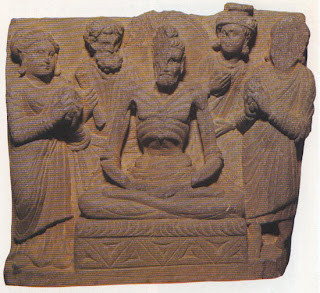 A
revival of early trends in the growth of Indian beliefs further complicated the
pattern. Thus the early Aryan influences were brought to the fore, as is shown
by the attention paid to Agni (though he was probably of Indian origin), and to
the Sun and the Moon, as well as the significance attached to the opposition of
light and dark, which symbolize gods and demons, heaven and hell. Dravidian
trends can be discerned in the rise to importance of female deities as powers
in their own right rather than as passive consorts to their divine husbands and
behind this the growing concern with sacrifice and fertility cults. Most
important of all was the appearance of Shiva and the rise of Vishnu. While
Shiva is partly a development from Rudra, he is equally reminiscent of the
pre-Aryan, yogic Lord of the Beasts deity, while his consorts resemble the
sacrifice-exacting mother-goddesses of the same r period. Vishnu is less like
his Vedic namesake than like another deity of non-Aryan origin, Varuna.
A
revival of early trends in the growth of Indian beliefs further complicated the
pattern. Thus the early Aryan influences were brought to the fore, as is shown
by the attention paid to Agni (though he was probably of Indian origin), and to
the Sun and the Moon, as well as the significance attached to the opposition of
light and dark, which symbolize gods and demons, heaven and hell. Dravidian
trends can be discerned in the rise to importance of female deities as powers
in their own right rather than as passive consorts to their divine husbands and
behind this the growing concern with sacrifice and fertility cults. Most
important of all was the appearance of Shiva and the rise of Vishnu. While
Shiva is partly a development from Rudra, he is equally reminiscent of the
pre-Aryan, yogic Lord of the Beasts deity, while his consorts resemble the
sacrifice-exacting mother-goddesses of the same r period. Vishnu is less like
his Vedic namesake than like another deity of non-Aryan origin, Varuna.
Popular
and priestly ideas on all these deities differed widely. Confusion fostered the
rampant growth of explanatory mythology, some of which seems to be scholarly
and philosophical, though much of it must have sprung from the popular
imagination.
Meanwhile
the priests continued to enhance their status by the development of new ideas
on the subject of sacrifice. Sacrifices, usually in the form of offerings of
soma or, later, of milk or curds, were held to be essential for the maintenance
of the gods' strength and for the continued progression of the universe on its
appointed cycle. The priests therefore gained ascendancy over the gods, who
depended upon them for their sustenance, and while they grew relatively weaker
the priests grew in power until, finally, they were openly said to have greater
eminence than the gods they served.
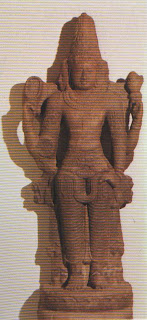 So
the priests, with their mastery of sacrifice, were the first to emancipate
themselves from the dominion of the gods. The sages carried this trend one
stage further, for by austerities and the acquisition of knowledge they could
become identified with the world soul even before death and, as we have seen
with Manu, could survive even the periodic cataclysms and act as creator, thus
surpassing even the reward of release from the pattern of rebirth.
So
the priests, with their mastery of sacrifice, were the first to emancipate
themselves from the dominion of the gods. The sages carried this trend one
stage further, for by austerities and the acquisition of knowledge they could
become identified with the world soul even before death and, as we have seen
with Manu, could survive even the periodic cataclysms and act as creator, thus
surpassing even the reward of release from the pattern of rebirth.
The
priests reconciled the two approaches by declaring that worship of deities and
ritual sacrifice were appropriate for the active stages of a man's life, while
the attempt to loosen the bonds of worldly illusion through detachment and
self-enlightenment might be made at the end of life. The inconsistency between
priestly cults and the mystical beliefs of the Upanishadic philosophers was one
of the factors leading to the growth of many heresies.
Among
these were the Jain movement, with its concentration on personal salvation
through austerities and ahimsa (harmlessness), its belief that the gods of the
old pantheon were unable to reach the spiritual heights attainable by holy men,
and its rejection of the idea of a supreme deity in favour of an Absolute consisting
of a plurality of souls.
Buddhism,
another heretical movement of the fifth century B.C., similarly rejected the priesthood
(Buddha was a member of the warrior caste, a Kshatriya, like Mahavira), and
caste in general. Buddhism, like the cults of the Hindu revival, is rooted in
earlier beliefs, for example the mythology of light and dark (Buddha's was the
dynasty of the Sun), and certain pre-Aryan beliefs about rebirth through death
(fertility through sacrifice) and about detachment. Buddhism became the
dominant religion for almost a millennium among the ruling classes, and in a
popularized form which later supplied it with a mythology was commonly
practised by the masses.
But
Vedic deities or their derivatives continued to be worshipped, and fire and
soma cults were widespread Their priests could offer the further attraction of
rites of passage for the important junctures of human life such as birth,
marriage and death lacking in Buddhism. The substratum of continuing belief in
the old gods was the foundation on which the Hindu revival of the fifth century
A.D. was built.
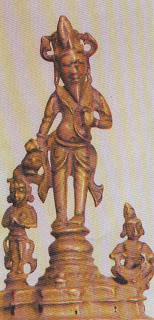 The
new cults offered the more readily acceptable idea of incarnational deities and
used ancient myths as the core of the religion. But they also incorporated in
their teaching many of the philosophical ideas from the earlier Upanishads of
the fifth century B.C., which were the point of departure for Buddha. Hinduism thus
became an all-embracing faith, able to claim even that Buddha was merely a
manifestation or avatar of its own supreme deity. Where the Brahmanic age
postulated a father god or creator, and Upanishadic teaching suggested that beyond
the creator god there was a universal spirit or supreme deity with which the
spiritually gifted might become united by the path of meditation with or without
austerities, Hindu belief identified the gods of the supreme triad with the universal
spirit, but suggested that they not only embraced within their natures the gods
of the old pantheon but also, through the notion of avatars, that they might
become incarnate in the form of heroes on earth.
The
new cults offered the more readily acceptable idea of incarnational deities and
used ancient myths as the core of the religion. But they also incorporated in
their teaching many of the philosophical ideas from the earlier Upanishads of
the fifth century B.C., which were the point of departure for Buddha. Hinduism thus
became an all-embracing faith, able to claim even that Buddha was merely a
manifestation or avatar of its own supreme deity. Where the Brahmanic age
postulated a father god or creator, and Upanishadic teaching suggested that beyond
the creator god there was a universal spirit or supreme deity with which the
spiritually gifted might become united by the path of meditation with or without
austerities, Hindu belief identified the gods of the supreme triad with the universal
spirit, but suggested that they not only embraced within their natures the gods
of the old pantheon but also, through the notion of avatars, that they might
become incarnate in the form of heroes on earth.
Hinduism's
essential difference from Buddhism lies in this concern with events on earth
and in the way in which it developed the Brahmanic innovation of dharma. Dharma
became righteousness and justice embodied in social, caste obligations. To
follow dharma was now the path to salvation rather than the mere performance of
sacrifices. `Worldliness.' had another consequence. More rigorous sages taught
physical asceticism, instead of the debased sacrificial cult to attain
spiritual disengagement and thus fusion with the universal spirit. But just as
in the popular mind the yogi was admired for his physical prowess rather than
for his spiritual achievement, so the new cults of Vishnu and Shiva, originally
conceived as a spiritual counter to Buddhist abstractions, came in many cases
to foster grosser polytheism and a return to pre-Vedic beliefs. The reversion
to these is clearly seen in the great epics. Though the Mahabharata received
its final form about the first century B.C., was written down in the fifth
century A.D. and continues to be considered scriptural to the present day, it
was a collection of the myths current from about 8oo B.C. onwards.
Writer – Veronica Ions
Read Also: