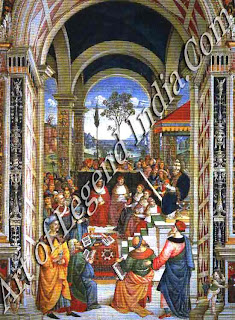
ArtofLegendIndia.com, Biggest Online Store of Handicrafts Items, Paintings and Jewelry Accessories...

Handicrafts

Handicrafts are devices or works of art that are made completely by hand or by the use of relatively simple tools. Such goods are usually made in the traditional way of manufacturing goods. Therefore, the knowledge of the art of craft is usually passed down from one generation to another. The items made using these traditional methods of manufacturing are usually produced in smaller quantities and they often represent the culture or religious beliefs of the community that makes them. The goods are also handmade from natural materials that are found in the environment of the particular economy.

Read More!

Biggest Online Store of Handicrafts Items

Paintings

A painting is equal to thousand words, means a beautiful painting is equal to million of words. Paintings are one of the oldest art forms -- throughout history artists have played an important role in documenting social movements, spiritual beliefs and general life and culture.

History Of Paintings: The history of painting reaches back in time to artifacts from...

Read More!

Biggest Online Store of Unique Style Paintings
Showing posts with label Biography of Piero della Francesca. Show all posts

Italian Great Artist Piero Della Francesca at Work

Posted by Art Of Legend India [dot] Com On 2:03 AM 0 comments

The Baptism of Christ (c.1440-45) Painted for the Priory of San Giovanni Battista in Sansepolcro, this may be Piero's earliest major piece. Though perhaps not as strikingly geometrical as sonic of his later works, it has all the cool, fresh coloration that makes his work so appealing. THE PIERO DELLA FRANCESCA AT WORK


Austere Beauty

A mathematician as well as an artist, Piero brought to his paintings an austere beauty of form that recalls Greek sculpture. But he was also a great colourist and unrivalled in his handling of light.

Piero's style is highly individual, and its distinctive qualities are very different from those so often admired in the work of 15th-century Italian painters. In place of decorative detail and graceful fancy, he offers geometric harmony and a classical severity that recalls Greek sculpture. It is these features, together with his power to capture the fall of light, and his richly harmonious colouring, that make his work so appealing to modern eyes.

And although he was well immersed in the sophisticated humanist culture of Florence, Urbino and Arezzo, many of his pictures retain an almost primitive power. The Virgin of the Madonna del Par to, the figures of the aged Adam and Eve depicted in The Death of Adam, and the angelic musicians of The Nativity seem to reflect an ideal of humanity that is at once simple and sublime.

Since Piero's own writings are concerned exclusively with the technical and mathematical aspects of paintings, we must turn to the pictures themselves for evidence of his artistic ideals. In many respects his work is fairly conventional. Almost all of it is on religious themes, often depicted within the traditional framework of the altarpiece. He painted both in fresco and on wooden panels, and seems to have come only gradually to the use of oils, which he often employed mixed with the more familiar tempera medium.


A MASTER OF PERSPECTIVE
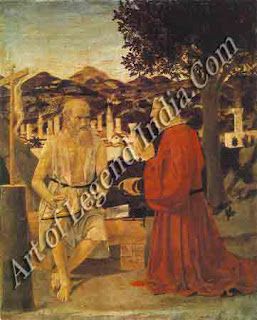
St Jerome and a Donor (c.1450-55) As in the Baptism of Christ, Piero's home town, Sansepolcro, is clearly visible.
His outstanding claim to purely technical originality lies in his mastery of perspective. We can admire this in the architectural detail of such paintings as The Flagellation and the Brera Altarpiece of Madonna and Child with Saints and Angels. The receding floor and ceiling of the loggia in the former, and the marble apse which frames the Madonna in the latter, are painted with formidable precision, heightened by the exact rendering of light and shadow. We know from Piero's theoretical treatises that this was the fruit of rigorous mathematical research.

However, Piero rarely pursued virtuosity for its own sake. In The Resurrection he employs a double perspective, the soldiers before the tomb being seen from below in foreshortening, while the upper part of the picture implies a viewpoint level with Christ's head. But this is more than a display of technical skill. It is a part of the painting's emotional and symbolic meaning, which contrasts the slumbering human world with the miraculous awakening of the risen Christ.
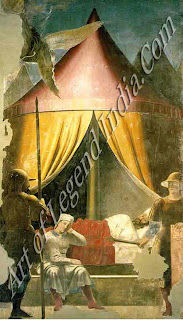
The Dream of Constantine (c.1460) Part of the Story of the True Cross, this fresco depicts Constantine being assured of victory.
The face and figure of this Christ are a fine example of Piero's rendering of the human body. Although his men and women may sometimes seem inexpressive at first glancy and their bearing almost always seems to be contemplative rather than active, their vitality and nobility are never in doubt. Moreover, besides a magisterial ability to create ideal, heroic figures, Piero showed in his work as a portraitist that he could capture the unique character of an individual sitter. His portraits of the Duke and Duchess of Urbino are among the most unforgettable images of the Renaissance. It is likely that his work in fact contains several portraits which we do not recognize as such. For instance, Vasari tells us that the Bacci family along with other citizens of Arezzo, are shown around the defeated King in The Battle of Heraclius and Chosroes. The riddle of The Flagellation, too, depends for its solution on the identity of the three men in the foreground on the right-hand side of the painting, though we are unlikely ever to know for sure who they were or what they were talking about.

In his work as a whole, however, Piero's gifts as a portraitist are less central than his power to suggest something more archetypal and timeless in the human form. The fair-haired young man of The Flagellation and the angels of The Baptism of Christ and The Nativity all share a serenity reminiscent of Greek sculpture. We know that Piero, like other Renaissance artists, used models hung with soft cloth to study how drapery fell and how the light caught it. And we might point to some particular feature the feet, for instance, whose firm grip on the ground is so convincing in all these cases as the secret of Piero's craft. But such details of technique or style cannot in themselves explain the underlying vision that the painter has so memorably realized.

COLOURS AND SPACE
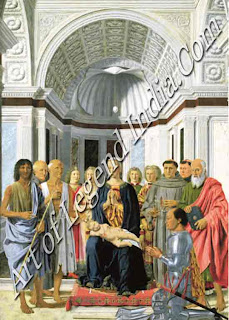
Madonna and Child with Saints and Angels adored by Federigo da Montefeltro (c.1472) Painted for San Bernardino, Urbino. Another aspect of that vision, and the one which perhaps gives us the most immediate and intense pleasure, is the harmony of Piero's colours. Despite the damage they have suffered, the Arezzo frescoes never fail to strike visitors with their luminous freshness. This quality is seen at its best in Constantine's Victory over Maxentius where Piero's restricted palette achieves a richly symphonic effect. The same harmony unites the colours of the garments in Flagellation, and brings together the two angels in the Madonna del Parto, whose attitudes and clothing echo one another in a heraldic mirror-image.

Still more characteristic of Piero is the sense of airy space created by the light that fills his skies and falls upon his landscapes. Here, he largely dispenses with perspective, using pure colour in a way that anticipates the Impressionists. In The Nativity, his angelic and human figures are boldly grouped against a countryside receding far into the distance. The same effect is even more daringly successful in the Uffizi diptych, where no middle ground intervenes between the profiles of Federigo and Battista and the idealized landscape of their dominions. This land appears far below and behind them and is bathed in the clear, bright light of the Italian sky.
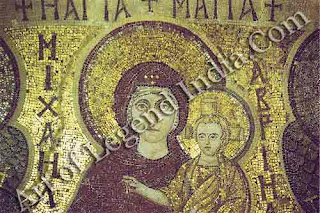
This mosaic from the Kiti Church, Cyprus, clearly shows the stiff, hieratic manner so typical of the Byzantine school. Piero was to echo this, to some extent, in his own works. Photo detail 1256b-THE MAKING OF A MASTERPIECE


The Flagellation

The formal unity of this enigmatic masterpiece is achieved by consummate skill in perspective, reinforced by the harmonious grouping of the figures. But its two scenes are entirely separate. Piero has emphasized this by illuminating Christ from a light-source behind the right-hand flagellator's arm, while the foreground is lit from the left. The painting challenges the viewer to find some significant connection between the scenes. Christ's suffering must have some allegorical or symbolic meaning, but how is this related to the conversation in the foreground? Many scholars now reject the local tradition identifying the foreground group as Urbino courtiers. Instead, they see the picture as a commentary on the tribulations of the Eastern Christians at Turkish hands, an interpretation borne out by the Oriental turban worn by the man with his back to us. The three men conversing might then be ecclesiastical and political dignitaries, the bearded man perhaps representing the Greek Church. But in the absence of any documentary evidence, we can only speculate on the picture's meaning, while continuing to marvel at the intricate detail and overall harmony of its composition.

Writer – Marshall Cavendish

Italian Great Artist Piero Della Francesca - The Court of Urbino

Posted by Art Of Legend India [dot] Com On 10:38 PM 0 comments

A capable ruler Federigo's wife, Battista, was a member of the Sforza dynasty, a powerful family of 'condottieri'. Admirably suited to taking her husband's place while he was away on campaigns, she proved herself a capable ruler.The Court of Urbino

Standing out as a fine example of Renaissance civilization, the magnificent court of Urbino was a cultural magnet, attracting artists, craftsmen, intellectuals and those in search of knowledge.

Federigo da Montefeltro (1422-82) was the last of the great condottieri, that breed of professional soldiers who sold their skills to warring states. By all accounts he was an unusually gifted man who became ruler of Urbino by popular demand after the murder of his half brother, Oddantonio. His reputation as a trustworthy general made him increasingly sought after, and enabled him to charge high fees for his services. And the income from these military campaigns provided the funds for Federigo's greatest achievement, the Ducal Palace of Urbino, in which he assembled a court that became a scintillating example of Renaissance civilization.

A gentleman's study, Federigo's study in the Ducal Palace was richly decorated in marquetry. The objects such as books armour and musical instruments symbolize the all-round nature of the Renaissance man.
As the Duke, Federigo himself set the standard for court life. He had been given the all round education of character, mind and body offered by the famed Vittorino da Feltre, and attempted in his own life to combine the virtuous man of action with the intellectual. He had the typical Renaissance characteristics the need for display, self-expression and prestige and he channelled these aspects of his personality into the public life of the court; personally, he maintained a sober and ordered existence.

Federigo was a deeply religious man. But his was not a narrow belief rather it was a broad understanding, in keeping with the inquiring spirit of the age. And the all-embracing nature of his mind is indicated by the plans he made for various temples to be built within the court. One was to be dedicated to the Christian divinity, another to poetry and humanity, a third to nature triumphant. This seeming paganism, far from threatening his Christianity, reinforced it.


SEEKING KNOWLEDGE

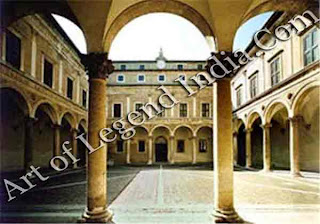
Laurana's courtyard, The famous courtyard of the Ducal Palace, considered to be a masterpiece of architectural purity, was designed by the little known Luciano Laurana.Constantly in search of knowledge, Federigo encouraged speculation. He studied philosophy and practiced Latin and Greek. One biographer praised him for his skill in geometry and arithmetic, claiming that the Duke made a point of acquiring some new piece of knowledge every day. Meanwhile his artistic patronage also represented power, and reflected his military success. In 1465 Federigo was appointed Captain of the Papal armies, and in some of the disputes between rival city states it was he who held the balance of power. Consequently, it was as much from self-protection as from profit that he took employment against the Malatesta family of Rimini and then later allied with them against Papal greed.

All-round scoundrel, Federigo's great rival, Sigismondo Malatesta, fell far short of the 'perfect all-rounder' and was described by Pope Pius II as the 'disgrace of Italy and the infamy of our times'. As captain of Pius' troops, Federigo compelled Malatesta to surrender his lands.
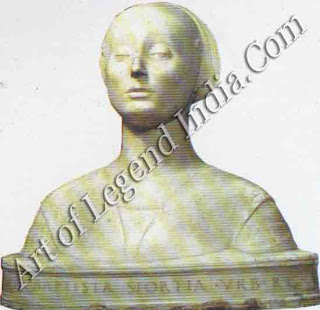
Castiglione in his famous Book of the Courtier described Federigo as 'the light of Italy'. Certainly for later generations this book put Urbino on the map, as the ideal city state whose inhabitants pursued the most refined code of manners available. Undoubtedly, the women of the court were a greatly civilizing presence. Two in particular, Federigo's wife, Battista Sforza, and his daughter-in-law, Elisabetta Gonzaga, enjoyed a reputation for possessing formidable intelligence and personality. Customs were changing: greater respect was paid to the opinions of women, especially when the Duchess proved so capable of governing in the Duke's absence on campaign.

Details of everyday life at the court of Urbino are few. Federigo's reign was described in several chronicles, but the writers pay most attention to his military exploits. Some interesting figures were recorded, however, which gave an indication of the royal scale of life in the palace. There were some 500 people at the court and this figure included 200 servants, five 'readers aloud' at meals, and a man whose job was to look after the pet giraffe.

THE RENAISSANCE GENTLEMAN

Urbino's son and heir, Like his father before him, Guidobaldo Montefeltro reigned as Duke of Urbino. And under his rule Urbino continued to be one of the foremost centres of activity in art and literature in Italy. The Book of the Courtier portrays the ideal lifestyle for the ideal courtier, with the right mixture of physical pursuits, such as hunting or tennis, and the mental delights of brilliant discussions and intellectual games. In some ways it is a political book, justifying the new profession of courtier as the natural Renaissance successor to the medieval knight. Here is the notion of the universal man warrior and scholar, Christian believer and classical hero, the product of an integrated and disciplined education. But Castiglione is deliberately idealizing: the real Urbino, which remained somewhat provincial despite the Montefeltro influence, and the inevitable crudeness of early 16th-century court life are fictionalized into perfection. Yet of all the city states Urbino came closest to the ideal. In comparison to a contemporary ruler like Sigismondo Malatesta, whom Pope Pius II denounced for practising incest and barbaric cruelty, Duke Federigo was conspicuously civilized. The court reflected the man, and its fame spread.

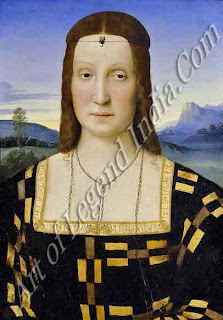
A fitting wife, In 1489 Guidobaldo married Elisabetta Gonzaga of Mantua. As a member of this famous family, who were leading patrons of the arts, she fitted well into the cultured atmosphere of the Urbinese court. Like her mother-in-law, Battista Sforza, Elisabetta was known and respected for her intelligence and personality. Federigo wanted an architectural monument to give expression to both his power and taste. Believing as he did that architecture was the greatest of the arts, and of primary importance in moulding social patterns and ethics, great care, therefore, was taken in the design of the Palace. And its success can be measured by the way the court inspired not only established intellects but also the young. Urbino became an educational centre to which wealthy Italian and even foreign families sent their children. At least two important figures of the later Renaissance were stimulated by these cultured surroundings: both Raphael and Bramante were brought up in and around Urbino. Tradition has it that Bramante studied perspective under Piero della Francesca; certainly Bramante's own architecture was influenced by the design of the Ducal Palace. And Raphael's father was Duke Federigo's chronicler and court poet: the court connections were well-established.

Federigo and even Piero probably had a hand in the design of the Ducal Palace, but the two principal architects were the little-known Luciano Laurana, and his successor the Sienese, Francesco di Giorgio. Numbers of anonymous craftsmen came from all over Italy, while individual masters like Ambrogio da Milano and Domenico Rosselli of Pistoia were engaged for the more important ornamental carvings. This creative ferment also attracted many painters, among who was Melozzo da Forli and the Spanish court painter Pedro Berruguete, who worked on palace decorations.


HOUSE FOR INTELLECTUALS

Flemish influence was relatively strong at Urbino and was reflected in Federigo's musical tastes and in the number of Flemish intellectuals and textile artisans who visited the court. Prominent Italians were also attracted: conversation, for example, between Piero and Alberti or the painter Mantegna, presided over by Federigo himself, promised a rare level of intellectual stimulation. Federigo built up an unsurpassed library, with the help of the Florentine Vespasiano da Bisticci and a number of writers (including Piero, in his book on perspective in painting) dedicated works to the Duke of Urbino. Indeed the court was the ideal intellectual context for an artist like Piero, whose mathematical investigations to some extent a theoretical search for universal principles, and explanation of life were very much the concern of that universal man, the Renaissance courtier.

Writer – Marshall Cavendish

Italian Great Artist Piero Della Francesca - A Year in the Life 1460

Posted by Art Of Legend India [dot] Com On 11:03 PM 0 comments
Council of Mantua, Pope Pius II had been obsessed by the Turkish threat to Christendom since the fall of Constantinople in 1453. Six years later he summoned the princes of Europe to the Council of Mantua, exhorting them to unite against their common enemy. After six months of debating and prevaricating, the Pope ended the congress with nothing achieved.

A Year in the Life 1460 

As the Ottoman Turks drove remorselessly into Europe, Piero's patron, the humanist Pope Pius II, appealed to little effect, for a crusade to save Christendom. Meanwhile the sovereigns of Europe remained absorbed in chivalric dreams and their inevitable dynastic struggles.

In 1458 Aeneas Silvius, the former poet, humanist, and diplomat, was elected to the papal chair as Pius II. Though determined to steer his own course and renounce his earlier frivolities, the new pontiff was still sufficiently a man of the Renaissance to order Piero della Francesca to Rome to decorate his apartments. The artist was paid 150 florins 'for his share of the work on paintings carried out on his Holiness' bedroom'.

Pius took his new role extremely seriously. In 1460 he issued the papal bull Execrabilis which condemned as heretical all those who felt that they could legitimately appeal to a general council over the head of the pope. Papal authority was to remain supreme in all church matters.

Kelso Abbey, In 1460 the rich and powerful abbey of Kelso was the scene of the coronation of a new Scots monarch, James III. His father, James II, had been killed by the accidental bursting of a cannon at the seige of Roxbrugh Castle shortly before. Taking advantage of the chaos that reigned, the ruthless Scottish King had temporarily sided with the Lancastrians, and though he did not live to see it, succeeded in utterly destroying the English stronghold. Pius was also obsessed with the dream of rallying Christendom under the papal banner to a crusade against the Ottoman Turks. In a century and a half this small Islamic group had become the most powerful political force in the Near East. Only seven years before, they had conquered Constantinople, and brought the 1000-year-old Byzantine Empire to an end. In 1460 they captured the Morea (the great peninsula that constitutes Southern Greece), and murdered the last duke of Athens, Franco Acciajuoli. The Turks were now poised for European conquest.

PAPAL DREAM SHATTERED 

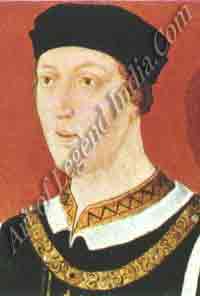
Ineffectual king, 1460 was not a happy year for Henry VI whose feeble government was the chief cause of the 'Wars of the Roses'. He was captured by the Yorkists in July, an indignity that was followed three months later by the Duke of York's famous march on Westminster Hall in an attempt to claim the throne. The lack of support from the nobles led to a compromise whereby York was declared Henry's heir, only to be killed at the Battle of Wakefield in late December.
The Pope had convened the Council of Mantua in June 1459, to which were summoned the secular princes of Europe, in order to discuss plans for mobilization against the Turkish menace.

Many absented while others made flowery but evasive speeches. By February 1460 the disillusioned Pope had dissolved the congress. Only the maritime commercial republic of Venice was willing to fight but then Venice ruled extensive territories in the Aegean.

During this year the Venetians equipped their famous Arsenal with new doors, crowned by the Lion of St Mark, the symbol of the city, but the book the lion carried usually open, and inscribed 'Peace be with you, Mark was closed. The city of merchants was preparing for war. Four years later Pius II died, on the brink of leading the Crusade he had dreamed about. Venice was left to conduct a punishing war single-handed against the Turks.

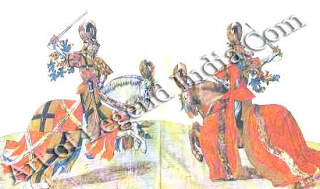
Although the age of the crusades was over, the chivalric Ideal was still alive, enshrined in the romances and ritual of French courtly life. Rene of Anjou, sometimes called 'the last of the troubadours' had by 1460 begun his 'Livre des Tournois', an illuminated book of chivalric ceremonial.


Champion of Chivalry, By 1460 Rene of Anjou, the greatest single arbiter of chivalry in the 15th century, had completed his celebrated Livre des Tournois. A lifetime of involvement in knightly pageantry gave him the authority to produce this exquisitely illustrated treatise which lays down the correct procedure to be followed at a tournament. As the international sport of the middle Ages, the tournament reflected the ideals of the popular chivalric romances of the day.
Rene's daughter Margaret had already shown herself to be an Amazon of whom no troubadour could possibly approve. As wife of the weak Henry VI of England - she had emerged as the effective leader of the Lancastrian party in the Wars of the Roses. 1460 was a year of changing fortunes, marked first by the recognition of the Duke of York as Henry's heir, and then by the defeat and death of York by disaffected Lancastrians at the Battle of Wakefield on 30 December.

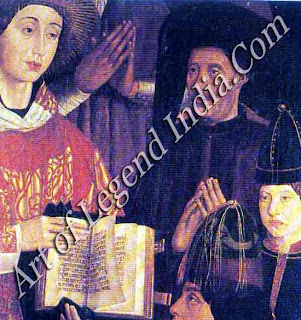
Portuguese navigator, Henry the Navigator, who gave such an impetus to maritime exploration, died in 1460 the same year as this map was drawn. Henry is shown with his son and his nephew Alfonso V of Portugal. The able and ruthless King of Scotland, James II, decided to take advantage of this chaotic situation. The desirable English stronghold of Roxbrugh in the north was held by the Yorkists with the result that James became a temporary Lancastrian and laid siege to it during the summer of 1460. With the help of artillery, the Scots took and utterly destroyed the Castle but James did not live to see his victory. During a bombardment, while the King was keenly watching this display of modem technology, one of the guns exploded and killed him.

In the long run, Scotland benefited more from events in northern Europe. In March 1460 Christian I of Denmark was recognized as Duke of Holstein and Count of Schleswig. Paying off rival claimants to these titles crippled the Danish exchequer. Thus the Scots eventually collected an unpaid dowry from the Danes in territories instead of cash. In 1472 the Orkney and Shetland islands were formally acceded to the Scottish crown.

Writer – Marshall Cavendish 
Company Overview

Art of Legend India has the distinction of being one of the best in the Indian Handicraft Industry. We are about 75 years old handicrafts manufacturer & exporter. We are having team of more than 500 craftsman.

We are having our business offices in India, USA & Germany to ensure our best services.

Total Pageviews