ArtofLegendIndia.com, Biggest Online Store of Handicrafts Items, Paintings and Jewelry Accessories...

Handicrafts

Handicrafts are devices or works of art that are made completely by hand or by the use of relatively simple tools. Such goods are usually made in the traditional way of manufacturing goods. Therefore, the knowledge of the art of craft is usually passed down from one generation to another. The items made using these traditional methods of manufacturing are usually produced in smaller quantities and they often represent the culture or religious beliefs of the community that makes them. The goods are also handmade from natural materials that are found in the environment of the particular economy.

Read More!

Biggest Online Store of Handicrafts Items

Paintings

A painting is equal to thousand words, means a beautiful painting is equal to million of words. Paintings are one of the oldest art forms -- throughout history artists have played an important role in documenting social movements, spiritual beliefs and general life and culture.

History Of Paintings: The history of painting reaches back in time to artifacts from...

Read More!

Biggest Online Store of Unique Style Paintings
Showing posts with label Biography of Joan Miro. Show all posts

Spainish Great Artist Joan Miro - Roguish Humour

Posted by Art Of Legend India [dot] Com On 1:49 AM 0 comments
Visionary firmaments, Between 1940 and 1941, Miro painted a series of 23 small gouache 'Constellations', in which 'tiny spots, stars, washes and infinitesimal dots of colour' multiply across the paper in intricate rhythms.Roguish Humour
Through patient effort, Miro evolved an art of beguiling freshness and spontaneity, developing a highly personal language of signs and symbols and displaying his savage delight in the absurd.

At the beginning of the century, Barcelona, capital of Catalonia, was the cultural centre of Spain. It was here that Miro discovered the works of the Post Impressionists, the Fauves and the Cubists which helped to shape his early style. But it was Catalonia's mountainous landscape where Miro's family came from that was his greatest inspiration. In his early 'realist' paintings, he recorded every detail of this landscape with scrupulous attention and devotion. 'What interests me above all', he wrote to a friend, 'are the tiles on the roof, the calligraphy of a tree, leaf by leaf and branch by branch, blade of grass by blade of grass.' While he was working on The Farm in 1921-22 a tribute to his family house in Montroig he used to take clods of earth and grasses with him in his suitcase when he travelled to Paris, so that the precise details would not escape him.

But there was also a strong element of fantasy in Miro's character, which attracted him to the less realistic work of the early Romanesque painters who decorated the old Catalonian chapels with frescoes of simple, brightly-coloured figures, using distortion and a hieratic scale for symbolic or emotional effects. He also admired the stocky painted plaster figures made by local artisans for their lack of artistic pretension. Such things appealed to him for their naive humour and honesty, and the tricks of distortion and of depicting important things much larger were later assimilated into his own work.
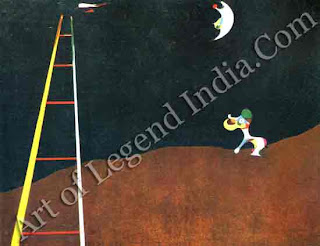
Dog Barking at the Moon, The ladder was one of Miro favourite symbols, providing a link between earth and sky, and a means of escape to the spiritual plane. In Paris, Miro was encouraged to develop his imaginative faculties by the Surrealist poets and artists that he met. Fascinated by their experiments with summoning up the unconscious through states of hallucination, he would sit for hours in his studio capturing the strange sensations and forms he experienced when hallucinating himself through extreme hunger. The artistic freedom of this method was vital to his creative development: from the early 1920s onwards, Miro no longer used space and colour in a realistic way to depict everyday objects, and the forms that appeared in his paintings became a personal language of signs and symbols.

SIMPLIFYING FORMS


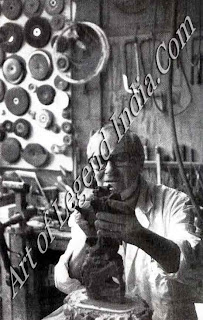
Exploring sculpture, Mini only began to sculpt when he was in his fifties, although his interest in the medium had been stimulated many years earlier by his teacher Gall. Gall had blindfolded Miro and then placed objects in his hands for him to draw, in an exercise which was designed to help Mini to "see" form and to develop a feeling for solid mass. Miro's Catalan peasants became stick-like figures, for example, recognizable by their attributes: Phrygian cap and a pipe perhaps or a wedge-shaped hunter's knife and gun. Many of Miro's humorous figures look naive and unsophisticated, like children's doodles, and he was deliberately trying to evolve an art that would stimulate basic sensations of humour, fear, excitement and passion in the spectator; to 'rediscover the religious and magic sense of things, which is that of primitive peoples'. He developed his new figures by a process of simplification, a stripping away of unnecessary details. 'Showing all the details', he said, 'would deprive them of that imaginary life that enlarges everything.'

The same figures Catalan peasants, women and birds, ladders, stars and strange nocturnal creatures appear over and over again in his work. The ladder, for example, was part of the familiar clutter around the Montroig farmhouse, but gradually it became transformed in Miro's paintings into a symbol of escape, often leading into a night sky as in Dog Barking at the Moon (left). Woman was usually portrayed as Mother Earth, 'to whom Mini always offers his devotion': a symbol of fecundity as she is often shown in primitive ethnic sculptures. And the bird, like the ladder, represents the freedom of the spirit and an escape from mundane everyday reality. Other shapes and hieroglyphs are not so easy to interpret, sometimes being there just to satisfy Miro's sense of balanced composition, but they all contribute to the haunting fascination of his work. 'It is signs that have no precise meaning that provoke a magic sense', he believed. Sometimes, these eccentric symbols are reminiscent of Chinese or Japanese written characters, and Miro is paintings become a playful form of calligraphy.
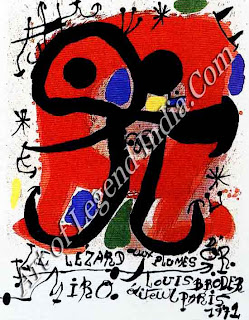
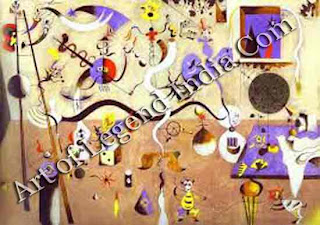
Lithographic designs, Mini designed this striking poster to publicize his book 'The Lizard with Golden Feathers', which he illustrated with lithographic plates and calligraphy. Miro felt free to distort and rearrange as his imagination dictated, and to place anatomical forms arms, heads, breasts, hands and feet and other signs in comical juxtapositions. Some of his paintings, like Harlequin's Carnival, are very light-hearted and humorous, as if Miro took a childish delight in arranging his toys, but his forms have also been described as 'torture instruments'.

During the 1930s and the war years, and particularly in the Barcelona Suite of lithographs, Miro created a nightmare world of vicious grossly distorted monsters. His women sprouted ugly spikes of hair, claw-like nails and their gaping mouths are filled with jagged fangs. Both his males and females, often attacking each other, were given enormous sexual organs. Distressed and disturbed by political events, Miro was showing man in all his bestiality and cruelty, indulging his most destructive instinctual drives and the coarser aspect of his humour.

Miro had no respect for conventional aesthetic standards. Apart from the content of his work, he often chose to use the meanest of materials, making collages and sculptures out of cardboard and old sacking, lengths of rope, rusty nails and bed springs, broken crockery and endless bits and pieces picked up on his walks. Often these objects were the inspiration he needed to spark a composition, supplying 'the shock which suggests the form just as cracks in a wall suggested shapes to Leonardo'. Sometimes, just a splotch of colour on a canvas, a dribble of turpentine or an escaping thread would do the same.


LASTING INFLUENCE 
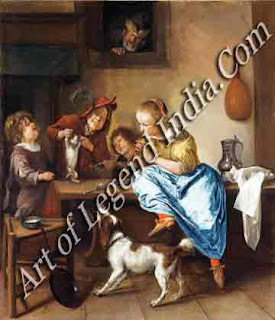
Jan Steen (1626-1679) The Cat's Dancing Lesson, Steen's painting inspired Miro's Dutch Interior II, in the Guggenheim Collection.
Miro's influence on 20th-century artists has been enormous. His fascination with textures and his free, spontaneous creations inspired the tachiste painters and 'action' painters like Jackson Pollock, while his strange, naive characters were taken up by the Art Brut painters after the Second World War. His enormously varied output, covering painting, sculpture, ceramics, collages, etchings, engravings and lithographs, remains a continuing source of inspiration.


Dutch Interior I

In 1928, Miro paid a brief visit to Holland, where he was intrigued by the detailed realism of Dutch 17th-century genre paintings in Amsterdam's Rijksmuseum. He returned to Paris with a few postcard reproductions of the pictures he had seen, from which he painted his own series of 'Dutch Interiors'. Dutch Interior I was based on Hendrick Sorgh's Lutanist of 1661. Miro, however, transformed the original with the medieval logic of the Romanesque Catalan artists, painting important things large and unimportant things small - and sometimes removing them altogether. Instead of the lyricism of Sorgh's picture, Miro's 'Dutch Interior' has a frenzied, dancing rhythm.

Writer – Marshall Cavendish

Spanish Great Artist Joan Miro - A Year in the Life 1925

Posted by Art Of Legend India [dot] Com On 11:19 PM 0 comments

A Year in the Life 1925 


Gustav Stresemann, The Imam Conference of 1925 was an attempt by the European powers, led by France and Britain, to effect reconciliation with Stresemann's Germany whereby western borders were guaranteed and mutual assistance was invoked against a possible Soviet threat. The treaty, signed in December, was violated in March 1936 by Hitler's invasion of the Rhineland. In 1925, while Mire and other Surrealists were putting on their first exhibition in Paris, European peace seemed secure and trust was placed in the authority of the League of Nations. But, during this year, Adolf Hitler published his belligerent ideas in Mein Kampf which were ultimately to lead to War.

At the first Surrealist Exhibition, held in Paris in 1925, the works of Mir& Picasso and Ernst asserted the primacy of the unconscious whereas in world affairs it seemed that reason might yet triumph. Germany, burdened by reparations and plunged into chaos by hyper-inflation, had been rescued by the 1924 Dawes Plan and, with the help of huge American loans, was making an economic recovery. Under the guidance of Gustav Stresemann, she also began to be accepted by her wartime enemies.

However, international security was not easily achieved. The Geneva Protocol, put before the League of Nations in October 1924 by the British Labour Prime Minister Ramsey MacDonald, proposed by system of arbitration to end conflicts between nations. But it foundered on opposition from the Dominions; a French Canadian politician pointed out complacently that, 'We live in a fireproof house, far from inflammable materials.' In March 1925, Stanley Baldwin's newly elected Conservative government rejected the Protocol, which was then dropped.

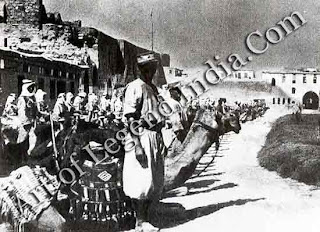
The Druze Rebellion, In 1921 General Gourand invaded Syria with a camel-equipped force to impose a French mandatory regime which backed the traditionally Francophile Christians at the expense of the predominantly moslem population. In 1925 the Druze rose in violent rebellion, forming an alliance with nationalists in Damascus. THE LEAGUE OF NATIONS 


Nonetheless, the League of Nations scored some real successes in 1925. Arrangements were made to control the opium trade and arms dealing; and when Greece attacked Bulgaria after border clashes, the League intervened to settle the dispute and extracted a fine from the Greeks. In Europe, the failure of the Geneva Protocol was largely made good as a result of German proposals which were elaborated into the Locarno treaties. The European powers collectively guaranteed Germany's existing borders with most of her neighbours, and this, together with a set of arbitration agreements and the formation of Franco-Polish and Franco-Czechoslovak alliances, quieted French fears and seemed to ensure peace in Europe. The new atmosphere of international conciliation lasted until the 1929 Depression disrupted the entire political and economic system.

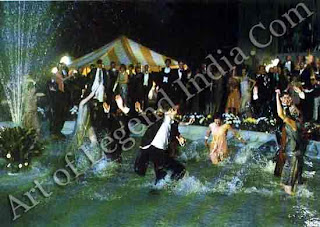
The Great Gatsby, Francis Scott Fitzgerald made his literary debut at the age of 24 with This Side of Paradise (1920), a novel which immediately bunched him as the spokesman of the 'Jazz Age'. In 1925 he published The Great Gatsby (a still from the 1974 film of the same name is shown here), which charted the rise to wealth of Jay Gatsby, bootlegger, and his deep but blind love for Daisy, a glamorous and selfish married woman. The story ends in tragedy: Fitzgerald's celebration of the hectic excess of the 'Bright Young Things' with their wild parties and new found freedom was always tempered with an objective eye and a good measure of cynicism. Germany's Weimar Republic was actually strengthened by a presidential election won by Paul von Hindenburg, the most prestigious wartime military leader. Though a conservative and monarchist, Hindenburg proved willing to accept republican institutions and so conferred respectability on them. The Nazi-backed candidate, General Ludendorff, polled a derisory 210,000 votes. Peace and returning prosperity seemed to have dashed the hopes of agitators such as the Nazi leader Adolf Hitler. He was still on parole after his early release from prison (he had received a five-year sentence for his part in the 1923 'Beer Hall putsch' in Bavaria). The first volume of his book Mein Kampf was published in the summer of 1925 and set out explicitly the policies he was later to implement as Fuehrer of the Third Reich. Around 10,000 copies were sold in all, mainly to the Party faithful.

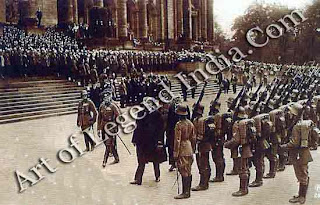
President Hindenburg on duty, On 12 May 1925, Field-Marshal von Hindenburg was formally sworn in as the new Reichspresident in the Reichstag building. His victory over the Russians at Tannenberg and the Masurian Lakes in 1914 had elevated him to the status of national hero and for the last year of the war he had been effectively in control of German civil and military policy. With defeat came revolution, the establishment of the Weimar Republic and the resultant tensions between the rightist old guard and the stirrings of leftist change. Hindenburg, already in his late seventies, had little influence on policy during his two terms as president; his acceptance of Hitler as Chancellor in 1933 spelt the end of the Republic. Here the newly appointed Reichspresident inspects a military parade after leaving the Reichstag.
The year 1925 was also when Mrs. Nellie Ross of Wyoming became the first woman state governor in the USA. Skirts were being worn just below the knee and were getting shorter. In Turkey, Mustapha Kemal banned polygamy and the wearing of the fez. At the celebrated 'Monkey Trial' in Tennessee, John A. Scopes was indicted for violating state laws by teaching Darwin's Theory of Evolution.

On the cultural front, 1925 saw the publication of Scott Fitzgerald's The Great Gatsby, John Dos Passos's Manhattan Transfer and Virginia Woolf's Mrs. Dalloway. The Trial, an unfinished novel by Franz Kafka, who had died in 1924, was also published. Fortunately for posterity, Kafka's literary executor, Max Brod, decided to ignore the writer's request that these and other unpublished works should be destroyed. The architect Walter Gropius began his great Bauhaus buildings at Dessau, while in Paris; an Exhibition of Decorative Arts launched a style that could hardly have been more different in spirit from Surrealism hard-edged, modernistic Art Deco.

Writer – Marshall Cavendish
The Spainish Great Artist - Joan Miro Painting Gallery

Posted by Art Of Legend India [dot] Com On 4:39 AM 0 comments
The Great Artist Joan Miro Painting “Kitchen Garden” with a Donkey 1918 25 ½  x 27 ½ Moderne Museet, Stockholm
Miro was an extremely versatile, inventive and prolific artist. His career does not show any steady evolution of style, but rather an unquenchable thirst for experiment, a tireless ability to absorb and transform new influences, and an imaginative response to the varied qualities of the differing materials with which he worked. Miro himself commented on the element of uncertainty and lack of premeditation in his creative processes, writing 'It is difficult for me to speak of my painting, for it is always born in a state of hallucination, provoked by some shock or other, objective or subjective, for which I am entirely unresponsible', and although he later modified the views in this statement (made in 1933) it gives an indication of the fascinating unpredictability of his work. It ranges from the loving detail of Kitchen Garden with a Donkey to the daringly empty abstract forms of Blue III, from the mischievous playfulness of Harlequin's Carnival to the bitter anger of Aidez l'Espagne. And Mire's genius was such that he was just as happy working on a fairly small scale in the medium of lithography as he was creating huge decorative murals. Both satisfied his urge to create an art which belonged to the public at large, by-passing the exclusivity of the museums.

The Great Artist Joan Miro Painting “Carnival of Harlequin” 1924-25 Oil on Canvas 26" x 36W Albright-Knox Art Gallery, Buffalo, New York Room of Contemporary Art Fund, 1940 This is one of the first paintings in which Mini worked in the style to which a friend gave the name 'detallista', characterized by great attention to detail and sharpness of focus from foreground to background. The overall feeling, however, is not naturalistic, for the stylized forms and the rhythmic patterns made by, for example, the lines of cultivation and the branches against the sky, produce an effect somewhat like a complex stage set. Miro holds together the diverse elements with consummate skill, and the bright colours and clear forms convey with great vividness the heat of his native Catalonia.

In 1938, Miro wrote an article in which he described the geitesis of this painting, one of his most famous works and one of the first in which he revealed his unmistakable personal style. At the time, he was experiencing a period of great hardship and he wrote 'For Harlequin's Carnival I made many drawings in which I expressed my hall my hallucinations brought on by hunger. I came home at night without honing dined and noted my sensations on payer. A room with a window and table are indicated and they belong more or less to the everyday world, but alter that Miro's imagination takes over. A bizarre assembly of insect-like creatures play dance and make music, one of them having the suggestion of a human face with a ridiculous moustache. It has been said that Miro's vision at this painting is essentially childlike, but the skill with which he unifies the flow of movement and incident is that of a highly sophisticated artist.

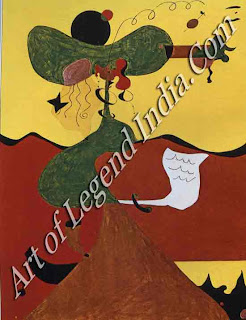
The Great Artist Joan Miro Painting “Portrait of Mistress Mills in 1750” 1929 Oil on canvas, 46" X 351/4". Collection, The Museum of Modern Art, New York. James Thrall Soby Bequest


In 1929, Miro made a series of four 'Imaginary Portraits' based on paintings of the past; this one was inspired by an engraving of a portrait by the minor English painter George Engleheart (1752-1829). The head and neck of the sitter are reduced to little more than cipher underneath the dominating form other broad-brimmed hat.


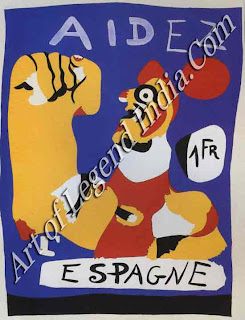
The Great Artist Joan Miro Painting “Help Spain” 1937 from Cahier d'Art, Vol. 12 no. 4-5 Stencil, printed in colour, Composition 9 ¾ x 7 5/8. Collection, The Museum of Modern Art, New York. Gift of Pierre Matisse  


Miro felt despair at the Spanish Civil War and he produced this silk-screen print to be sold in aid of relief for his native country the price of one franc is a bold part of the design. The powerfully conceived figure is shown clenching a massive fist in the Loyalist salute and the inscription tells of the 'immense creative resources' of the people of Spain.

The Great Artist Joan Miro Painting “Inverted Personages” 1949 31 ¼ x 21 1/2 Kunstmuseum, Basle


On his return to Paris from America, Miro produced a great number of paintings in two complementary styles which have been described as 'slow paintings' and 'quick paintings'. This light-hearted work belongs to the former category, with its careful delineation of shapes and forms and its dense application of bright primary colour. 


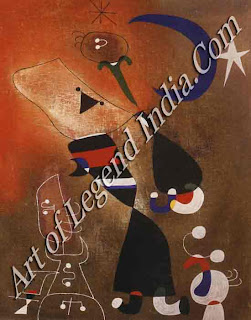
The Great Artist Joan Miro Painting “Women and Birds” in the Moonlight 1949 32" x 26" Tate Gallery, London  


Miro was haunted by the theme of the night, the time for dreams, silence and solitude and for mystic communion with the stars. His nocturnal landscapes are often inhabited by women, who sway in the moonlight, and 'birds of the night' symbols of the flight of the spirit from the waking consciousness of day.


The Great Artist Joan Miro Painting “Mural Painting (1950-51)” Oil on canvas, 6'2 3/4 x 19'5 3/4. Collection, The Museum of Modern Art, New York. Mrs. Simon Guggenheim Fund
Miro's decorative style was well adapted to work on a large scale and he liked the challenge of painting for a specific public place. This mural almost 20 feet wide was painted for the dining room of the Harkness Commons building at Harvard University, at the suggestion of the great architect Walter Gropius. Miro executed the painting in Barcelona and it was installed in 1951, but in the next few years it was found that it was deteriorating and Miro proposed that a ceramic version should be substituted. Miro described the subject cryptically as 'of a moralistic and poetic significance', but some commentators have suggested that it shows a bullfight scene. In the centre of the composition is a bull, with two enormous black horns and the enlarged sexual organs so often seen in Miro`s work.                                     
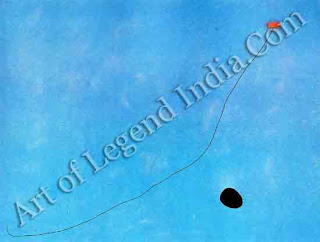
The Great Artist Joan Miro Painting “Blue III” 1961 106 1/4 x 139 3/4" Mosee National d'Art Moderne, Paris
This is the last in a series of three similar paintings (Blue I, II and III) flint Mira executed in 1961. It illustrates the great range of Miro's imagination, for whereas many of his best-known works are comparatively small and crowded with restlessly moving incident and detail, this one is huge and serenely sparse. It has links with some of his more characteristic works, however, in the strange, amoeba-like form that trails across the blue void, suggesting the immensity and mysteries of the universe. The blue itself-one of Miro's favourite colours was described by his early champion, Rene Gaffe, as 'a savage blue, insolent, electric, which sufficed by itself to make the canvas vibrate'.

The Great Artist Joan Miro Painting “Lithograph from Art for Research” 1969 30"x 21 1/2" Private Collection


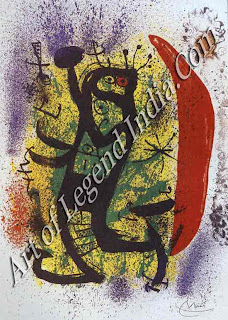
Miro was one of the greatest graphic artists the 20th century has seen, excelling particularly at lithography the making of prints from a specially prepared stone surface. This is one of a series of ten prints by Miro and nine other artists published as a portfolio to benefit the Swiss Centre for Clinical Research on Cancer.

The Great Artist Joan Miro Painting “Lithograph from 'Seers'” 1970 20" x 26" Private Collection


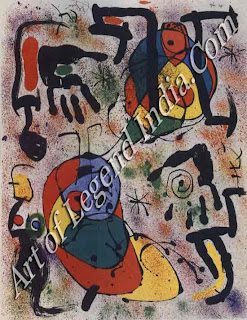
This is one of a series of six lithographs entitled 'Seers'. A seer is a prophet or someone who has the power to see into the future, and the handprints here allude to the idea of palm-reading. The bright colours, spattered background and whirling shapes suggest the state of ecstasy which the seer must enter in order to transcend earthly experience.


Writer – Marshall Cavendish

Company Overview

Art of Legend India has the distinction of being one of the best in the Indian Handicraft Industry. We are about 75 years old handicrafts manufacturer & exporter. We are having team of more than 500 craftsman.

We are having our business offices in India, USA & Germany to ensure our best services.

Total Pageviews