 In 1526
Babur, a minor prince from Transoxiana descended from both Tamerlane and
Chingiz Khan, culminated a lifetime of restless wanderings and short-lived
conquests by invading India. He founded a dynasty whose autocratic power and
luxurious display became proverbial as far away as England. Although its
decline was to be lengthy, it endured in name at least until the banishment of
the last Emperor by the British in 1858. For much of this period the cultural
interests and fashions of the imperial court exercised a pervasive influence
throughout the provinces, and not least on the art of painting.
In 1526
Babur, a minor prince from Transoxiana descended from both Tamerlane and
Chingiz Khan, culminated a lifetime of restless wanderings and short-lived
conquests by invading India. He founded a dynasty whose autocratic power and
luxurious display became proverbial as far away as England. Although its
decline was to be lengthy, it endured in name at least until the banishment of
the last Emperor by the British in 1858. For much of this period the cultural
interests and fashions of the imperial court exercised a pervasive influence
throughout the provinces, and not least on the art of painting.
Babur
himself died in 1530, soon after his conquest. He is not known to have
patronised painting during his turbulent career, but he did leave behind a
remarkable volume of memoirs, whose observations of man and nature reveal an
original and inquiring mind. During the reign of his bookish and ineffectual
son Humayun (153o-56) the still insecure empire was lost for a time to the
Pathan chief Sher Shah. Humayun was driven into exile at the court of Shah
Tahmasp of Persia, who, after a carefree youth distinguished by inspired
artistic patronage, was turning towards religious orthodoxy and a greater
attention to matters of state. Humayun was thus able to take two of the finest
Persian painters, Mir Sayyid Ali and Abd us-Samad, into his service. They
accompanied him on his re-turn to Delhi in 1555, where he died only a few
months later after a fall on his library staircase.

Painting
at Akbar's court reflected a similar forcible and dynamic synthesis between the
disparate cultures of Persia, India and Europe. Akbar had himself received
training from his father's two Persian masters, but the delicate refinement of
the Safavid manner did not satisfy his youthful exuberance.
 Early in his reign
he set the two Persians to direct a newly recruited studio that grew to some
two hundred native artists. Under his constant supervision the early Mughal
style was thus formed from the fusion of Persian elegance and technique with
the Indian vitality and feeling for natural forms admired by Akbar. The
studio's most grandiose project, taking fifteen years to complete, was a series
of 1400 large illustrations on cloth to the romance of Amir Hamza, a prolix but
action-packed adventure story which was a favourite of the young Akbar.
Accord-ing to one Mughal historian he would himself act as a story-teller,
narrating Hainza's adventures to the inmates of his zenana (harem). In a
typical, the decorative Persian tile patterns and arabesques
stand in contrast to the vigorously painted trees, rocks, gesticulating figures
and gory victims of the leering dragon.
Early in his reign
he set the two Persians to direct a newly recruited studio that grew to some
two hundred native artists. Under his constant supervision the early Mughal
style was thus formed from the fusion of Persian elegance and technique with
the Indian vitality and feeling for natural forms admired by Akbar. The
studio's most grandiose project, taking fifteen years to complete, was a series
of 1400 large illustrations on cloth to the romance of Amir Hamza, a prolix but
action-packed adventure story which was a favourite of the young Akbar.
Accord-ing to one Mughal historian he would himself act as a story-teller,
narrating Hainza's adventures to the inmates of his zenana (harem). In a
typical, the decorative Persian tile patterns and arabesques
stand in contrast to the vigorously painted trees, rocks, gesticulating figures
and gory victims of the leering dragon.
By the
time of the Hanizanama's completion in the late 157os, the Akbari style was
reaching its maturity. A stream of smaller and less copiously illustrated
manuscripts of Persian prose and verse classics was produced in a blander but
more integrated idiom. In the last twenty years of Akbar's reign his interest
turned to illustrated histories of his own life and those of his Timurid
ancestors. At least five copies of Babur's memoirs were made, as well as three
of the Akbarnama, Abtel Fazl's official history of his reign. As unequivocal
propaganda, these and other commissions formed part of his imperial design, for
they documented and legitimised what was in Indian terms still only a parvenu
dynasty. The artists were more than ever required to record the court life
around them in a spirit of dramatic realism. It is unlikely that the painter
Khem Karan would have witnessed the siege of the Rajput fortress of Ranthainbor
some twenty years previously, but his portrayal of Akbar, dressed in white,
directing the attack from a promontory set against a hazy sky is a convincing
presentation of the event.
 That this realism was to some extent based on a
selective study of European models is shown by an illustration to the
Harivamsa, one of the Hindu mythological texts which Akbar had ordered Badauni
to translate into Persian, to that scholar's pious disgust. Krishna sweeps down
on the bird Garuda to triumph over Indra on his elephant, watched by gods and
celestial beings. The billowing clouds and swirling draperies have Baroque
antecedents, while the coastal landscape with a European boat derives from
Flemish art. Abu'l Fazl, besides echoing his master's praise of Hindu artists,
whose 'pictures surpass our conception of things', refers also to 'the
wonderful works of the European painters, who have attained world-wide fame'.
He more-over tells us of an album prepared for Akbar which contained portraits
of himself and his courtiers. This was the first time in Indian art that
portraiture of the Western type, treating its subject as an individual
character rather than as a socially or poetically determined type, had been so
systematically pursued.
That this realism was to some extent based on a
selective study of European models is shown by an illustration to the
Harivamsa, one of the Hindu mythological texts which Akbar had ordered Badauni
to translate into Persian, to that scholar's pious disgust. Krishna sweeps down
on the bird Garuda to triumph over Indra on his elephant, watched by gods and
celestial beings. The billowing clouds and swirling draperies have Baroque
antecedents, while the coastal landscape with a European boat derives from
Flemish art. Abu'l Fazl, besides echoing his master's praise of Hindu artists,
whose 'pictures surpass our conception of things', refers also to 'the
wonderful works of the European painters, who have attained world-wide fame'.
He more-over tells us of an album prepared for Akbar which contained portraits
of himself and his courtiers. This was the first time in Indian art that
portraiture of the Western type, treating its subject as an individual
character rather than as a socially or poetically determined type, had been so
systematically pursued.
In the
reign of Jahangir (16o5-27) the imperial studio was reduced to an elite group
of the best painters, who attended the Emperor both in court and camp to carry
out his commissions. Manuscript illustration gave way to the production of fine
individual pictures, whose subject matter reflected Jahangir's enthusiasms and
foibles. Jahangir was a fickle character, capable both of generosity and
cruelty. Inheriting a well established empire, he never developed Akbar's gifts
as a statesman, and as his prodigious consumption of opium and alcohol
gradually enfeebled him, the administration passed out of his hands. He also
lacked Akbar's profound religious sense, being guided instead by a highly
developed aestheticism. As a connoisseur of the arts, he boasts justifiably in
his memoirs of his ability to distinguish even tiny details painted by
different artists.
 He was also passionately curious about the forms and behavior
of plants and animals, and it has been remarked that he might have been a
better and happier man as the head of a natural history museum. When in 1612 a
turkey cock was brought in a consignment of rarities purchased from the
Portuguese in Goa, Jahangir as usual wrote up his observations, being
particularly fascinated by its head and neck: 'like a chameleon it constantly
changes colour'. His flower and animal artist, Mansur, known as 'Wonder of the
Age', recorded the new specimen, rendering each feather and fold of skin with
minute brushwork, against a plain background relieved only by (discoloured)
streaks and a conventional row of flowers.
He was also passionately curious about the forms and behavior
of plants and animals, and it has been remarked that he might have been a
better and happier man as the head of a natural history museum. When in 1612 a
turkey cock was brought in a consignment of rarities purchased from the
Portuguese in Goa, Jahangir as usual wrote up his observations, being
particularly fascinated by its head and neck: 'like a chameleon it constantly
changes colour'. His flower and animal artist, Mansur, known as 'Wonder of the
Age', recorded the new specimen, rendering each feather and fold of skin with
minute brushwork, against a plain background relieved only by (discoloured)
streaks and a conventional row of flowers.
He was also passionately curious about the forms and behavior
of plants and animals, and it has been remarked that he might have been a
better and happier man as the head of a natural history museum. When in 1612 a
turkey cock was brought in a consignment of rarities purchased from the
Portuguese in Goa, Jahangir as usual wrote up his observations, being
particularly fascinated by its head and neck: 'like a chameleon it constantly
changes colour'. His flower and animal artist, Mansur, known as 'Wonder of the
Age', recorded the new specimen, rendering each feather and fold of skin with
minute brushwork, against a plain background relieved only by (discoloured)
streaks and a conventional row of flowers.
The
same qualities of dispassionate delineation and static, pattern-making
composition informed the now dominant art of portraiture. Jahangir was proud of
his artists' ability to emulate the technique of the English miniatures shown
to him by the ambassador Sir Thomas Roe, and was delighted when Roe was at
first unable to distinguish between an original miniature and several Mughal
copies. The effect on Mughal painting was both refining and somewhat chilling.
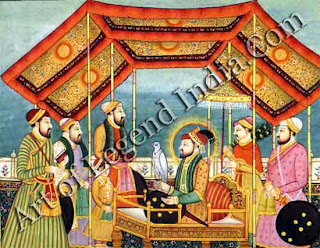
A scene of Jahangir receiving his son Parviz and courtiers in durbar has been
skilfully assembled from individual portrait studies and stock pictorial
elements such as the fountain, the simplified palace architecture, the cypress
and flowering cherry' and the Flemish-inspired landscape.
 In this deliberate
compilation there is none of the movement and interaction of figures of Akbar
painting. Each finely portrayed face gazes forward in expressionless isolation an attitude which is, however, appropriate for the solemn formality of the
durbar. The painting can be attributed to Manohar, the son of the great Akbari
artist Basawan, who had developed a vigorous modelling technique and sense of
space from European sources. In deference to Jahangir’s taste, these skills
were modified by his son, who presents the outward show of imperial life,
crystallized in elegant patterns and richly detailed surfaces.
In this deliberate
compilation there is none of the movement and interaction of figures of Akbar
painting. Each finely portrayed face gazes forward in expressionless isolation an attitude which is, however, appropriate for the solemn formality of the
durbar. The painting can be attributed to Manohar, the son of the great Akbari
artist Basawan, who had developed a vigorous modelling technique and sense of
space from European sources. In deference to Jahangir’s taste, these skills
were modified by his son, who presents the outward show of imperial life,
crystallized in elegant patterns and richly detailed surfaces.
In this deliberate
compilation there is none of the movement and interaction of figures of Akbar
painting. Each finely portrayed face gazes forward in expressionless isolation an attitude which is, however, appropriate for the solemn formality of the
durbar. The painting can be attributed to Manohar, the son of the great Akbari
artist Basawan, who had developed a vigorous modelling technique and sense of
space from European sources. In deference to Jahangir’s taste, these skills
were modified by his son, who presents the outward show of imperial life,
crystallized in elegant patterns and richly detailed surfaces.
Court
portraiture under Shah Jahan (1627-58), exemplified by the Padshahnama, the
illustrated history of his reign now at Windsor Castle, and became still more
formal and frigid. Each durbar, battle or procession is a grand compilation of
countless individual portraits, painted with a hard, immaculate finish. The
effect is magnificent but heartless and strangely unanimated. Shah jahan's real
passion Was for jewels and architecture: on these he lavished much of the
wealth of the empire, combining them above all in the justly celebrated Taj
Mahal. Album paintings of varied subjects were, however, still produced, such
as a genre scene of an informal musical party by Bichitr, an artist best known
for his accomplished portraiture and cool palette. The painting is in fact an
exercise in the style of Govardhan, another Hindu and one of the most gifted of
all Mughal painters, excelling at keenly observed group portraits of common
people and particularly of holy men as well as kings.
 In 1658
Shah Jahn was deposed by his third son, the pious and puritanical Aurangzeb,
and Dara Shikuh, the more free-thinking and artistically inclined heir
apparent, was put to death. During his long reign (1658-1707) Aurangzeb further
dissipated the empire's resources, not like his father by immoderate luxury and
building projects, but by interminable military campaigns in the Deccan. The
court arts languished for want of patronage, and from 168o onwards many
painters took service at provincial courts. A urangzeb was followed in the 18th
century by a succession of effete incompetents who maintained an illusory show
of power while the empire broke up. The sybaritic Muhammad Shah (1719-48), who
when told of some defeat would console himself by contemplating his gardens, was
typical of the age. In 1739 he endured the humiliating sack of Delhi by Nadir
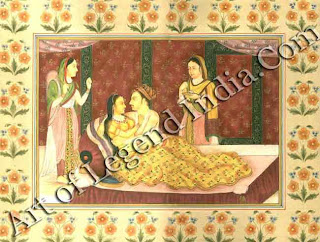
Shah of Persia. A nautch (dancing-party) scene in his zenana shows signs of the
brittle rigidity and vapid sensuality of late Mughal painting, which preserved
much of the technique of the mid-17th century style, but had little
new to say. The emperors after Akbar had insulated themselves within the
increasingly formal and introverted microcosm of court life.
In 1658
Shah Jahn was deposed by his third son, the pious and puritanical Aurangzeb,
and Dara Shikuh, the more free-thinking and artistically inclined heir
apparent, was put to death. During his long reign (1658-1707) Aurangzeb further
dissipated the empire's resources, not like his father by immoderate luxury and
building projects, but by interminable military campaigns in the Deccan. The
court arts languished for want of patronage, and from 168o onwards many
painters took service at provincial courts. A urangzeb was followed in the 18th
century by a succession of effete incompetents who maintained an illusory show
of power while the empire broke up. The sybaritic Muhammad Shah (1719-48), who
when told of some defeat would console himself by contemplating his gardens, was
typical of the age. In 1739 he endured the humiliating sack of Delhi by Nadir
Shah of Persia. A nautch (dancing-party) scene in his zenana shows signs of the
brittle rigidity and vapid sensuality of late Mughal painting, which preserved
much of the technique of the mid-17th century style, but had little
new to say. The emperors after Akbar had insulated themselves within the
increasingly formal and introverted microcosm of court life.  Given inspired
patronage, painting had for a time flourished in this hot-house atmosphere, but
when the empire was played out it too gradually declined into a repetition of
well worn themes, both at Delhi and at the provincial courts of Lucknow and
Murshidabad. After Clive's victory in Bengal in 1757, British power began to
spread across northern India, and by the early 19th century Delhi artists were
emulating the style of painting favoured by the new imperialists. A nautch
party of this period is set in a European mansion with classical columns and
pediments. The figures also arc in the Europeanised 'Company' style, but the
Indian artist has, resourcefully as ever, transformed the alien conventions of
modelling and recession into his own umistakable idiom.
Given inspired
patronage, painting had for a time flourished in this hot-house atmosphere, but
when the empire was played out it too gradually declined into a repetition of
well worn themes, both at Delhi and at the provincial courts of Lucknow and
Murshidabad. After Clive's victory in Bengal in 1757, British power began to
spread across northern India, and by the early 19th century Delhi artists were
emulating the style of painting favoured by the new imperialists. A nautch
party of this period is set in a European mansion with classical columns and
pediments. The figures also arc in the Europeanised 'Company' style, but the
Indian artist has, resourcefully as ever, transformed the alien conventions of
modelling and recession into his own umistakable idiom.
Writer – Andrew Topsfeld