The
Mahabharata is considered as an Indian epic which is most likely the biggest
ever composed in original Sanskrit. It is combined with the Ramayana (a second great
epic) which personify the perfume of Indian Cultural Heritage. The Mahabharata is
actually signifies the dynastic struggle for productive and wealthy land which
is situated near Delhi at the confluence of the Ganges and Yamuna Rivers and
struggle was between two teams (named as Kurus and the Pandavas) of a particular
Indian ruling family. The Struggle really ends in an awesome battle. Today, we
exactly don’t know when the battle took place.
The
Mahabharata (pronounced with the stress on the third syllable: Mahabharata) was
composed over a period of some four hundred years, between the second century
B.C. and the second century A.D., and already at that time the battle was a
legendary event, preserved in the folk tales and martial records of the ruling
tribes. The Indian calendar places its date at 3102 B.C., the beginning of the
Age of Misfortune, the Kaliyuga, but more objective evidence, though scanty and
inferential, points to a date closer to 1400 B.C.
At that time Aryan tribes had just begun to
settle in India after their invasion from the Iranian highlands. The land from
western Pakistan east to Bihar and south not farther than the Dekkhan was
occupied by Aryan tribes whose names are often mentioned in records much older
than the Mahabharata. The tribal communities varied in size and were each
governed by the "prominent families- (mahakulas) from among which one
nobleman was consecrated king. The kings quarreled and engaged in intertribal
warfare as a matter of course, their conflicts were sometimes prolonged
affairs, sometimes little more than cattle raids.
It
is in this context that the Bharata war took place. The Kurus were an ancient
tribe who had long been rulers of the area in the upper reaches of the Yamuna
River. The Pandus, or Pandavas, were a newly emergent clan living in
Indraprastha, some sixty miles southwest of the Kuru capital, Hastinapura.
According to the Mahabharata, the new aristocrats were invited to the court of
the ancient noble house of Kurt' to engage in a gambling contest. There they
were tricked first out of their kingdom and then into a promise not to
retaliate for twelve years. In the thirteenth year they took refuge at the
court of the Mistaya’s, where they allied themselves with the Kurus' eastern
and southern neighbors, the Pancalas. Together in a vast host they marched up
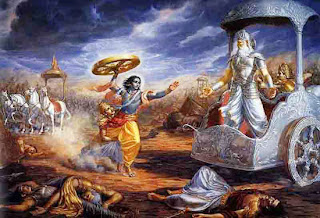
to Hastinapura, where they were met on Kuruksetra, the plain of the Kurus. Here
the Kurus and their allies were defeated.
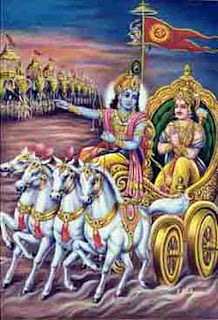
In
bare outline that is the story of which the bard sings. But the composer of the
Mahabharata has portrayed the actions of the warriors in both a heroic and a
moral context, and it should be understood as a re-enactment of a cosmic moral
confrontation, not simply as an account of a battle. Unlike our Western
historical philosophy, which looks for external causes—such as famine,
population pressure, drought—to explain the phenomena of war and conquest, the
epic bard views the events of the war as prompted by observances and violations
of the laws of morality. The basic principle of cosmic or individual existence
is dharma. It is the doctrine of the religious and ethical rights and duties of
each individual. It refers commonly to duty enacted by religion. Today, every
person is expected to live based on his dharma and if any violation occur
caused disaster.
Hindu
society was classed into four castes, each with its own dharma. The power of
the state rested with the ksatriyas: kings, princes, free warriors and their
wives and daughters. Their dharma was to protect their dependents as rule
justly, always speak the truth, and struggle in wars. The priest caste was not
socially organized in churches or temples, but consisted of individual Brahmans
in control of religion. Among their other duties, they officiated at great
sacrifices to maintain the order of the world and accomplish desired goals.
They were also in control of education, could read and write, and taught
history according to their outlook on life. The Mahabharata in its final form
was largely the work of a Brahman composer, so we find in the peripheral
stories an emphasis on the power and glory of the Brahman caste, although in
the main story of the epic there is not one powerful Brahmin. The Vaisyas, of
whom we hear little in the Mahabharata, were merchants, townspeople, and farmers,
and constituted the mass of the people.
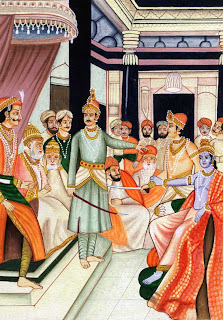
The
three upper castes were twice-born: once from their mothers and once from their
investitures with the sacred thread. The lowest caste, the Sutras, did menial
work and served other castes. They were Aryans, however, and their women were
accessible to higher-caste men: Vyasa was the offspring of a ksatriya and a
sudra, and so was Vidura. Outside the caste system were the "scheduled castes,"
the tribal people of the mountains, such as the Kiratas, as well as the
Persians and the Bactrian Greeks.
Besides
their caste dharma, people had a personal dharma to observe, which varied with
one's age and occupation. So we find a teacher-student dharma, a husband-wife
dharma, the dharma of an ascetic, and so on. One's relation to the gods was
also determined by dharma. The law books specify the various kinds of dharma in
detail, and these classifications and laws still govern Indian society.
The
Hindu system of eschatology is often expounded in the Mahabharata. In brief, it
is the doctrine of the cycle of rebirths (samsara), the doctrine of the moral
law (dharma), which is more powerful than even the gods. The moral law sustains
and favors those creatures that abide by it, while thwarting those that
trespass. Its mechanism is karma, the inexorable law that spans this life and
the afterdeath, working from one lifetime to another, rewarding the just and
making the evil suffer. In this Hindu universe those in harmony with dharma
ultimately reach a state in which rebirth is not necessary any more. If,
however, the forces of evil are too strong, the moral law reasserts itself and
often uses forceful means to restore harmony where it has been lost. To accomplish
that, often a being of a higher order, a god, who in his usual manifestation
has no physical body, takes birth among the people and becomes an avatara, a “descent”
of his own power on earth. Often the physical manifestation is not aware of his
divine antecedents, but discovers them in the course of his life on earth.
Therefore an avatara has many human qualities, including some that by our own
standards would be less than divine: hostility, vengefulness, and an
overweening sense of self-importance. These qualities are necessary for him to
confront confidently the forces of evil, the asuras, who have taken flesh also
and appear as bitter enemies committed to a battle to the end.
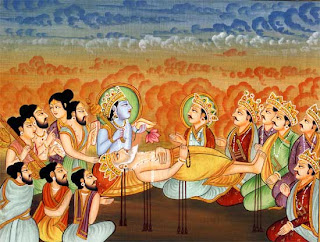
The
emphasis on morality in the Mahabharata brings with it considerations of the
nature of the divine. There are many gods; the Indian pantheon is overwhelming
in its diversity and vagueness. At the highest level of creation are the gods
(devas), who are in continual conflict with the demonic forces, the auras.
Among the gods, Vishnu, Siva, and Indra are especially important. Vishnu is
mainly manifest through his incarnation as Krishna. He is a supreme god worthy
of love and devotion. Siva is also a supreme god, but represents the ascetic
side of Indian religion. He dwells on a mountain, dresses in a tiger skin, and
wears a characteristic emblem, the trident, still carried by Indian mendicants.
The third eye in the middle of Siva's forehead scorches his enemies. Indra is
in name the king of the gods, but in fact his importance had declined by the
time of the Alahabharata, although he remained a principle god. In the
Mahabharata he is the god of rain and father of Arjuna, a Pandava.
Less powerful are the elemental gods of fire
(Agni), wind (Vayu), water (Varuna), sun (Surya), and moon (Soma). Kama is the
god of love. Unlike the gods in Western mythologies, the prominent Indian gods
are difficult to characterize. Although they are assigned obvious functions as
powers, their spheres of power and their characteristics overlap because they
are ultimately all manifestations of the universal principle, Brahman, the
universal soul or being to which individual souls will be reunited after the
illusion of time and space has been conquered.
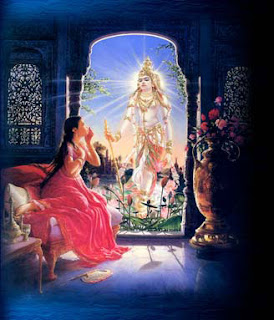
At
a lower level, still divine but progressively less lofty, are the hosts of the
Gandharvas, Apsarases, Siddhas, Yaksas, and Raksasas. The first three classes
are usually benevolent to mankind. Gandharvas play heavenly music to which the
nymphs, the Apsarases, dance. Indra also uses the Apsarases to seduce ambitious
ascetics who, by their severe self-castigation, have accumulated so much
spiritual power that it becomes a threat to Indra's supremacy; as a result of
seduction the anchorite loses his power. Yaksas are sprites,dryads, and naiads.
Raksasas are malevolent demons who prowl around the sacrificial altars or in
other ways disturb human beings.
Humans
look at the gods as powers to be appeased or controlled, with the exception of Vishnu,
who is simply adored. Gods often interact with humans, marry them, give them
weapons, invoke their assistance or aid them. At times gods interact with men
through the intermediary of wise old men, sages whose advice was obeyed by
prudent warriors who would not violate the will of the gods in order to avoid
incurring the sage's curse. Upon his death, the ancient hero expects to go to
Indra's heaven, where there is feasting and rejoicing.
Rivers
and other landscape features are personified and function as both divine and
semi-divine beings and as natural phenomena. In the Mahabharata gods
communicate with men, animals talk and are sometimes real animals, some-times
human beings or gods. The story often moves into an idealized land where heroic
feats, deeds of velour and physical strength are regarded with awe and fear.
These incidents foster a sense of marvel in the reader: we are transported into
an idyllic world where illusion and reality cannot be separated.
The
Mahabharata should be understood as a moral and philosophical tale as well as
an historical one. Only in this way can we appreciate the significance of the Bhagavad-Gita,
the Song of the Lord, which is part of the Mahabharata, but which is usually
excerpted and read as an independent religious work. In India, the Mahabharata
as a whole has been regarded for centuries as a religious work, to the extent
that a medieval poetic theoretician characterizes its main sentiment (rasa) not
as heroism but as tranquility (santi).
Between
the time of the events described in the epic and the time the Mahabharata was
composed, social conditions had changed considerably. India was no longer a set
of tribal communities; it had become subdivided into large regions (janapadas)
ruled by kings who had become absolute monarchs. The conquests of King Asoka
and Chandragupta Maurya, which united large areas of India under one ruler, had
paved the way for the emergence of a national consciousness. "Dear to all
men is Bharata land, as it was to the god Indra, Father Manu and the mighty
warriors of old," says the poet. And although the Indian world was by now
interacting with the world around it, the most important part of the world was
still Bharata, the land of the Aryans, which was now concentrated south of the
Himalayas and north of the Vindhya Mountains, between the desert in the west
and the swamps of Bengal in the east.
The
Mahabharata did not remain an exclusively Sanskrit work. Within a few centuries
of its composition it was translated and paraphrased into other Indian
languages: the Dravidian languages of South India, and the Indo-Aryan languages
that succeeded Sanskrit historically in the north. Stories were adapted for
dramatization, folksinger’s com-posed ballads in their own tongues, preachers
and politicians made use of its philosophy. Thus the Great Epic gradually
spread by word of mouth from village to village, from kingdom to kingdom, from
region to region. It was recited in courts during great festivals and sacrifices
honoring a king (indeed, even as the Mahabharata is told as a story heard by
the bard at a great sacrifice.) Jams and Buddhists found a place for it in
their non-canonical literature, and as the Indian empire expanded from the
first years of the Christian era onward, the Mahabharata and its sister epic,
the Ramayana, accompanied the itinerant merchants. On the trade routes to
Europe, to Burma, to Thailand and Vietnam, to the spice islands of the western
Pacific the bards followed the traders, and later, when colonial kingdoms were
established in these tropical countries, they found a place at the kings'
courts. The profound moral message of the Mahabharata became identified with
the power of the ruling dynasties, and the epics were often translated into the
languages of the colonized countries. Gradually the Mahabharata became part of
the literature of the receiving country: the epic was reworked, rewritten, condensed
and phrased in contemporary terminology and in terms of the adopting culture.
 It
is in this tradition that we find the present English rendition of the
Mahabharata. It is not a translation. The author, William Buck first became
acquainted with the Mahabharata through a chance reading of the Bhagavad-Gita
during a vacation in Nevada. Inspired by the poetry of this work he
subsequently read the whole Mahabharata and the Ramayana. He then set out to
make his own renderings. It is a retelling based on a translation of the
Sanskrit original published by Pratap Chandra Roy, published in the beginning
of this century. The slow and forceful pace of the Sanskrit original, its
honest, wise, and totally convincing outlook on the state of the world, its
descriptions of awesome battles and gruesome deaths as tragic yet natural
events in human experience, these are just a few of the features that have found
response in the hearts of millions of Asian people. Most Western renditions
have obscured the brilliance of the Sanskrit poetic constructions, but we have
all of this in William Buck's work. It is remarkable that a Westerner has been
able to uncover the nuggets of this Indian epic with such sensitivity. Like the
original, it deserves reading, rereading, and even reciting aloud, for it will
affect the reader at various levels of his awareness.
It
is in this tradition that we find the present English rendition of the
Mahabharata. It is not a translation. The author, William Buck first became
acquainted with the Mahabharata through a chance reading of the Bhagavad-Gita
during a vacation in Nevada. Inspired by the poetry of this work he
subsequently read the whole Mahabharata and the Ramayana. He then set out to
make his own renderings. It is a retelling based on a translation of the
Sanskrit original published by Pratap Chandra Roy, published in the beginning
of this century. The slow and forceful pace of the Sanskrit original, its
honest, wise, and totally convincing outlook on the state of the world, its
descriptions of awesome battles and gruesome deaths as tragic yet natural
events in human experience, these are just a few of the features that have found
response in the hearts of millions of Asian people. Most Western renditions
have obscured the brilliance of the Sanskrit poetic constructions, but we have
all of this in William Buck's work. It is remarkable that a Westerner has been
able to uncover the nuggets of this Indian epic with such sensitivity. Like the
original, it deserves reading, rereading, and even reciting aloud, for it will
affect the reader at various levels of his awareness. 
William
Buck has, of course, condensed the story. The old translation from which he
worked covers 5800 pages of print, while his own book is less than a tenth that
length. But by and large, Buck's rendition reflects the sequence of events in
the Sanskrit epic, and he uses the traditional techniques, for instance, of
stories within stories, flashbacks, moral lessons layed in the months of
principal characters. In detail, however, there are differences between the
two, which makes it unwise to use this book as an exact reference work. William
Buck has excerpted passages without trying to be complete; so many passages
have been left out or altered to fit the shortened version. One of the parts
omitted is the Bhagavad-Gita.