ArtofLegendIndia.com, Biggest Online Store of Handicrafts Items, Paintings and Jewelry Accessories...

Handicrafts

Handicrafts are devices or works of art that are made completely by hand or by the use of relatively simple tools. Such goods are usually made in the traditional way of manufacturing goods. Therefore, the knowledge of the art of craft is usually passed down from one generation to another. The items made using these traditional methods of manufacturing are usually produced in smaller quantities and they often represent the culture or religious beliefs of the community that makes them. The goods are also handmade from natural materials that are found in the environment of the particular economy.

Read More!

Biggest Online Store of Handicrafts Items

Paintings

A painting is equal to thousand words, means a beautiful painting is equal to million of words. Paintings are one of the oldest art forms -- throughout history artists have played an important role in documenting social movements, spiritual beliefs and general life and culture.

History Of Paintings: The history of painting reaches back in time to artifacts from...

Read More!

Biggest Online Store of Unique Style Paintings
Showing posts with label The Divine World. Show all posts

About on The Divine World

Posted by Art Of Legend India [dot] Com On 3:37 AM 0 comments
Illustration from a Ramayana Series: Rama Visits Bharadvaja’s Hermitage

13.  Illustration from a Ramayana Series: Rama Visits Bharadvaja’s Hermitage


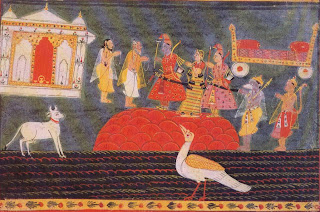
An inscription on the back in Hindi states that after destroying Ravana, Rama stopped at the hermitage of Bharadvaja, where, with his entire army, he accepted the sage's hospitality (see Appendix).

The picture shows Rama and his entourage being received by the sage and his assistant. Behind Rama stand his wife, Sita, and his brother Lakshmana. They stand as if on a pedestal on elevated ground painted in bright red. Behind them and at a lower level are two animal-headed figures. The one with the simian head is Hanuman, and the one with the bear's head Angada. Beyond stands the chariot that brought them to the hermitage, which is represented by a small pavilion behind the two sages. In the foreground is a rectangular strip of water representing a river. A waterbird and a cow stand in the water and watch the welcoming ceremony.

It is remarkable how a simple meeting has been visually narrated with lively drama through a spartan, unpretentious composition that uses few so-called pictorial devices. The postures and gestures are ritualistically stylized, and spatial perspective was eliminated altogether to convey a sense of timelessness.

14.  Rama s Court
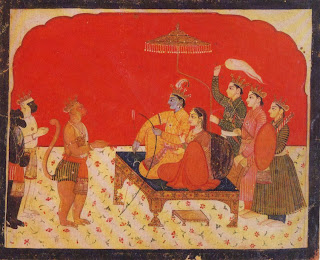

Rama s Court
An inscription in Hindi in the Devanagari script on the back (see Appendix) gives a precise description of the picture. It informs us that after killing Ravana, Rama has returned home to rule. He is attended by his brothers, Bharata, Satrughna, and Lakshmana, and accompanied by Hanuman, Angada, and Sugriva. The numeral 7 indicates that this is picture number seven of a series, which may well be that of the ten avatars. Rama is the seventh among the ten conventional avatars of Vishnu.

In this formal composition Rama and Sita receive homage from Hanuman, who stands with his club under his right arm, Angada with the bear face, and Sugriva, another simian. Rama holds his principal attributes, the bow and the arrow. The three brothers stand behind, and one uses the flywhisk. Characteristically, Rama has a dark complexion, whereas his three siblings are fair.

At least two pictures and a mural with the same subject and similar compositions have been attributed by Archer (1973, 2: 60, figs. 30-31, 2; 61, fig. 33) to Chamba. The two pictures are dated by him to about 1765— 70, while the mural is from about 1840. In all three Rama and Sita are seated similarly on a low seat and are supported by bolsters. Sita sits in an identical position in the two eighteenth-century pictures and the Green painting. Hanuman appears in two of the pictures illustrated by Archer and in the, Green picture. The Green picture, however, has more figures and is a larger and more elegant composition than the others. In any event, clearly the theme was especially popular with patrons in Chamba, where Rama was a state deity.

15.  Hermitage of Valmiki
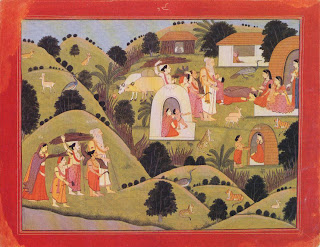

Hermitage of Valmiki
A long Sanskrit text passage in Devanagari characters on the back describes the idyllic nature of the hermitage (asrama) of Valmiki, the author of the epic Ramayana. The verses (numbered nine to fifteen) do not appear to be from the Ramayana, however. They tell us how in the hermitage the lions and the tigers coexist with the cows, the cat with the mouse, and the snake with the peacock as well as how the deer roam about without fear and how the place is inhabited by Valmiki and other ascetics, their auspicious spouses, and sons. The number of the folio given both on the front and back is 19. Such a low number for a scene that occurs in the last book of the Ramayana also indicates that this series may have belonged to another text. This possibility is strengthened by the fact that in the painting the hermitage is placed in a hilly region, bin in the Ramayana it is situated in the plains.

In the picture both Valmiki and Sita are identified by labels over their heads. Three different incidents are included in the composition, following the traditional Indian preference for continuous narration. On the left a group led by the bearded Valmiki approaches the hermitage. The group includes three companions of the sage, all of whom carry wood. Sita brings up the rear.

Her bulging waistline clearly indicates that she is pregnant. In center stage is the same group, and now Sita, prostrating herself, pays her respects to the wives of the sages. Then, within an oval, reed hut on the lower right, a seated Sita is given a plate of food. Presumably she was isolated because of her condition and did not eat with the others. Within a protective wooden fence, in addition to small oval huts for individual families, the artist has included the kitchen, which is a large rectangular structure, and a cow shed with two calves inside. Predatory cats, deer, hare, cows, and peacocks rest or roam about in peaceful coexistence, as described in the text.

The picture is a typical example of the Kangra idiom of the early nineteenth century. It may have been painted by an artist belonging to the family of Godhu (fl. c. 1775), who had moved to Kangra from Chamba and became attached to the court of Raja Samsar Chand (r. 1775-1823). According to V. C. Ohri (personal communication), it belongs to a series known as the Nadaun Ramayana, as it emerged from the Nadaun principality, one leaf of which is in the Himachal State Museum, Shimla.

16.  Illustration from a Ramayana Series (?): Battle Scene
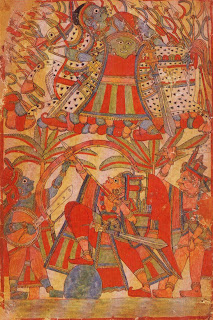

Illustration from a Ramayana Series (?): Battle Scene
This dramatic picture is in a style that appears to have been restricted to the town of Paithan in Maharashtra. Large numbers of paintings of themes from both the Mahabharata and the Ramayana have survived. Although the exact identification of this example is not known, it is very likely an illustration from the Ramayana. One cannot even be certain that the archer standing on the ground with his right foot firmly placed on a boulder and accompanied by two companions is shooting at the figure riding a horse above. Is the horseman on higher ground, or is he flying through the sky? If he is the target, then he isn't doing too badly, for it appears the arrows have missed him. Neither is it clear what is attached to these arrows. Could the horseman represent Meghanada, who fought with Lakshmana from behind the clouds?

Whatever the exact subject of the picture, it is a characteristic example of the so-called Paithan style. Although stylized, the figures have a heroic stature and are striking for their strong animation and boldly imaginative forms. Indeed, they are strongly reminiscent of the puppets that are still used by traditional storytellers in parts of Maharashtra and neighboring Karnataka. In some ways the forms are also strangely reminiscent of figures in Mayan art of the New World.

17.  Illustration from a Mahabharata Series: The Pandavas in Drupad's Court
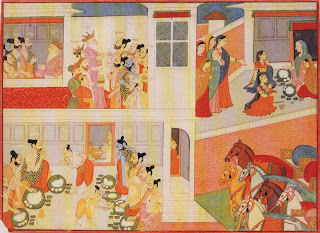

Illustration from a Mahabharata Series: The Pandavas in Drupad's Court
The principal figures in the painting are identified by their names added above their heads in Devanagari script. The composition is clearly divided into four segments by architectural devices, as one encounters in the sectional view of a dollhouse. At least four if not five events are depicted, but their sequence is not clear. All the incidents are front the Book of Virata (or the Virataparva) of the Mahabharata, probably just before the Pandavas, who have been living incognito at the court of King Drupad of Virata, reveal themselves and take leave at the end of their term of exile.

In the upper left composition we see Drupad conversing with the five brothers Yudhisthira, Bhima, Arjuna, Nakula, and Sahadeva once inside the palace and again on a terrace. In the room below, the brothers are being fed. At the upper right Kunti, their mother, and Draupadi, their common wife and the daughter of Drupad, are first being led to their meal and are then being served. In the fourth segment six pairs of horses and three visible chariots are waiting to take the group back to their kingdom.

Another painting from the same series depicting Abhimanyu in the battlefield is in the collection of the Himachal State Museum, Shimla (V. C. Ohri, personal communication). Stylistically both pictures are close to Bhagavatapurana and Ramayana paintings rendered in a Kangra workshop of the last quarter of the eighteenth century (cf Goswamy & Fischer, pp. 340, no. 143: Randhawa 1660). Following Goswamy and Fischer, one might ascribe this painting to "a Master of the First Generation after Nainsukh." In other words, the Kangra workshop was probably headed by a member of this Pahari master's family.

18.  The Goddess Durga Slays a Titan
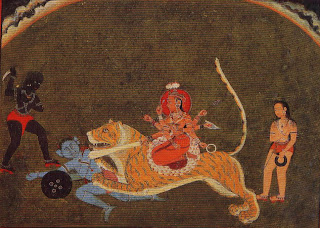

The Goddess Durga Slays a Titan
Individual pictures representing the cosmic goddess Durga slaying titans were popular with patrons in the states of Bundi and Kota during the eighteenth century. Usually in such pictures an elaborate setting is eschewed in favor of a direct and dramatic combat between the goddess and one or more titans. In this simple composition, for instance, only two curved segments at the two upper corners indicate a horizon and a sky. The figures are represented against a monochromatic background, which accentuates the forms and enhances the sense of movement.

The exact identification of the goddess's protagonist is not possible. He conforms to a type and is not distinguished by individualizing iconographic features. The goddess is eight-armed and rides a tiger rather than the more common lion. Instead of a saddle a soft cushion of lotus flowers serves as her seat. She does not appear to be very bellicose but sits on her haunches like a demure lady. What is interesting is that she has acquired a new weapon in the form of a dagger known as a katar and popular in Mughal India (second hand from the top on her proper left). The blue-black figure at the left margin brandishing a. dagger is very likely one of the goddess's companions, perhaps even the terrifying Kali. However, the sex of the figure is not clear, and it may be a male rather than a female. Behind Durga stands a young ascetic holding a trident in his right hand and what appears to be a flask and a cup in the left. Interestingly, both standing figures are wearing wooden slippers. The most impressive creature in the group is the tiger, which attacks the titan with customary ferocity, in strong contrast to Durga's serenity.

19.  Siva and Parvati
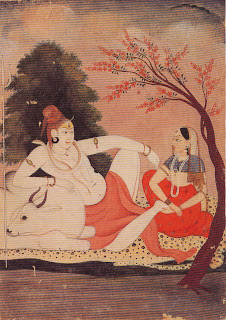

Siva and Parvati
Siva and Parvati sit in a relaxed mood on his leopard-skin shawl spread on the ground. He reclines against his bull, using it as a bolster, and strikes a posture that is very familiar in India. In fact, but for his third eye and the snake around his neck, Siva could be a prosperous human or a religious personage enjoying an afternoon off. Like a dutiful wife or a favorite female disciple, Parvati supports his right foot. A flowering tree bends over Parvati to form a charming canopy, while Siva's glistening white complexion is strongly contrasted against the dark and dense mass of foliage behind him. Although the theme was very popular among Pahari artists, few representations are as elegant and enchanting as this composition.

The closest parallel for Siva's head can be seen in Basohli-style paintings of about 1725 (cf. Khandalavala 1958, study supplement, no. 31), while Parvati's figure is remarkably like a Gujari Ragini attributed by Archer (i973, 2: 254, 110. 32) to Kulu and about 1765-70. The use of the beetle thorax casing for Siva's earring would also indicate a Basohli origin. Most scholars who have seen the picture are divided between a Guler or a Chamba provenance. Although it is difficult to be precise about the origin of the Green picture, it can be dated to around 1750 with greater certainty. The manner in which the trees are painted, the soft coloring, and the mode of rendering the sky are not encountered in Basohli paintings prior to 1730 and, in fact, anticipate the more painterly treatment of nature seen in Pahari pictures from about 1750.

There can be little doubt that the unknown artist was highily accomplished. He was an excellent draftsman, and his sense of coloring and skill in composition are admirable. The picture displays his sure vivacity in handling forms and an unfailing sense of style. If the picture was rendered in Guler or Chamba, the artist may have belonged to the school, if not family, of Pandit Seu of Guler, a family that is regarded as ushering in a new direction in Pahari painting and may have been influenced by the Basohli mode.

20.  Holy Family on the March


Holy Family on the March This picture depicts Siva and his family coming down the mountains. The group is led by Siva's simian attendant, Nandisvara, who carries a bundle on his head and a drum (a mridangam) hanging from his right shoulder. Siva, distinguished by his leopard skin shawl, the trident, and the snake, waits gallantly to help Parvati negotiate the difficult terrain. She has the multi headed Karttikeya held against her left shoulder. Above them Ganesa looks very comfortable on Siva's bull. Karttikeya's peacock too hitches a ride, while Ganesa's rat ambles along in front of the bull. The rear is brought up by the goddess's saddled tiger.

An almost identical composition of roughly the same date is in the Bharat Kala Bhavan, Varanasi (Kramrisch 1981, pp. 206-7, no. P-4o). In her catalogue (p. 205) Kramrisch has noted that "to this day, the people of the Himalayas believe that every twelve years Siva and Parvati descend from their residence on Mount Kailasa and come down to earth. Taking their children and some of their possessions with them they go from place to place to check on all of creation, for which Siva is responsible." It may be remarked further that the mountain-dwelling shepherds known as gaddis or gujars lead a seminomadic existence and move down from the mountains every year. And, although Siva's original habitat is Mount Kailasa, he is also known to lead a nomadic life. Therefore, it is not difficult to understand why the subject would be popular with the artists in the Hill States.

Because of their strong similarities, it is very likely that the two pictures are based on the same drawing or pounce. Pounces were made for popular compositions and kept in a family of artists to be used when necessary. If indeed the Green and the Varanasi pictures are based on the same pounce, then the two renderings may be by two different artists, but of the same family. The shapes of the. rocks as well as the trees are more schematized in the Varanasi picture. In the Green version Nandisvara holds his stick jauntily over his left shoulder, and great sensitivity is expressed in the manner in which Siva holds Parvati's hand. The bull is drawn more realistically than in the other version, and the saddle cloth is a patchwork quilt rather than a carpet. In both, however, the rat has the proportions and shape of a dog. For other versions of the theme, see Panthey  and Khandalavala.

Writer Name: Pratapaditya Pal

Short Note on The Divine World

Posted by Art Of Legend India [dot] Com On 2:43 AM 0 comments
Illustration from a Bhagavatapurana Series: Cowherds Taking Their Cows to Pasture

6.  Illustration from a Bhagavatapurana Series: Cowherds Taking Their Cows to Pasture


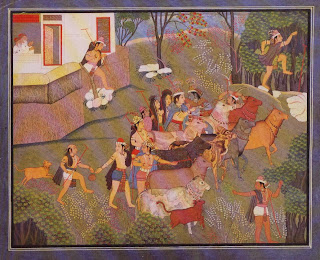
This charming bucolic scene vividly captures the early morning bustle as the cowherds of Brindavan lead their animals to pasture in the adjoining forest. It is from a series of Bhagavatapurana pictures that once belonged to a member of the ruling house of Bilaspur. It is assigned to Bilaspur by family tradition, which has been confirmed by both Khandalavala (sec Literature above) and Archer (1973, I: 241-42) on stylistic grounds.


The exact identification of the scene is not possible as there is no accompanying text. In fact, the series may have had no text. How-ever, it may well illustrate an instance in the Bhagavatapurana of an early morning scene in Brindavan.


One morning, with the intention of having his breakfast in the woods, Krishna woke up all the cowherds with his horn. As he and Balarama walked behind their cows, others joined them with theirs. Being boys, they indulged in games and pranks as they moved along. Although they were adorned with beads and ornaments, they plucked flowers and leaves and decorated themselves further.


In the picture, as the boys move toward the forest with their cattle, we see a cowherd jumping the fence to join the group; a calf runs behind another cowherd with a shaven or bald head as they both try to catch up; Krishna and Balarama, distinguished by their luxuriant capes and headdresses and placed in the middle of the composition, seem to be engaged in a tete-a-tete; one cowherd climbs up a tree, while yet another breaks a leafy branch to feed his cow. The series is distinguished by lively compositions, abundant foliage, and the diversely colored and brindled cows. Apart from their varied complexions, one bovine is even speckled with gold flecks. Although the palette reveals a wide variety of shades, the tonality is quite muted, and the picture glows with a restrained brilliance.


7.  Illustration from a Bhagavatapurana Series: Krishna Abducts Mitravinda


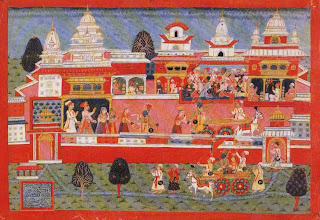
Illustration from a Bhagavatapurana Series: Krishna Abducts Mitravinda The inscription in Newari above the picture tells us that Krishna has arrived at Avantipur, where other princes have gathered for the svayamvara (a public assembly of princes where a princess chooses her husband); that below informs us that Krishna forcibly takes Mitravinda away. This incident is described very briefly in the tenth book of the Bhagavatapurana. Mitravinda was a princess of Avanti and an admirer of Krishna. Her brothers, however, did not care for Krishna and instructed their sister not to select him at the svayamvara. At the assembly Krishna forcibly carried away Mitravinda while the princes watched helplessly.


The unknown artist has given us a sort of bird's-eye view of the palace at Avantipur. The incidents unfold before us with utmost clarity. In the upper section of the palace the eager and expectant princes wait in the assembly hall, while below them are shown two views of Krishna leading Mitravinda by the hand to the chariot. In the foreground the two drive away from the palace.


This picture is from a large series illustrating in great detail Book Io of the Bhagavatapurana. These illustrations are bigger in size than the average Indian painting. The artist may have been familiar with some of the larger-sized paintings that were popular in the neighboring Hill States about this time. He was very fond of predominantly architectural compositions, especially of sectional views of interiors from an aerial perspective. He was also an observant artist, for the forms do closely copy local palaces and temples that still stand in Kathmandu, Patan, and Bhaktapur. Although we do not know for whom the series was done, only a princely patron could have afforded such a large commission.


8.  Krishna Serenading a Lady


Krishna Serenading a Lady
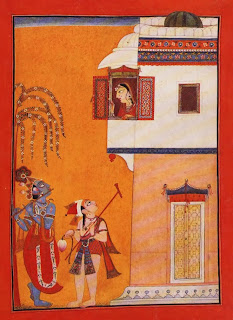
When previously published (see Literature above), this picture has been ascribed to a Bhagavatapurana series formerly in the Lambagraon court collection and the subject identified as Krishna serenading Radha. Though it is stylistically closely related to the Lambagraon Bhagavatapurana pictures, there are two minor points that should be noted. There is no folio number on this sheet, whereas the other known examples from that series do have such numbers. The height of the sheet is almost a half inch shorter than the measurements (11.3 in.) given in Randhawa 1959. It is, of course, possible that the sheet was cropped after it left the Lambagraon court collection, and consequently the number was lost.


If it does belong to the Lambagraon Bhagavatapurana series, then the lady being serenaded can hardly be identified as Radha. She does not appear as a character in that text. She may therefore represent Rukmini, one of Krishna's wives, or a cowherdess (gopi), but no such occasion is described in the text. Thus, it is possible that the picture does not belong to the Bhagavatapurana series and the lady does represent Radha, who, in later Vaishnava literature, is the principal beloved of Krishna and who is always filled with rapture hearing the sound of Krishna's flute.


By common consensus the Lambagraon Bhagavatapurana series has been attributed to Mankot and dated to about 1730. However, in a recent publication (Goswamy & Fischer, p. 118, no. 47), while the attribution to Mankot was retained, a date of about 1700- 1725 was suggested. More specifically, the authors attributed the series to the "Master at the Court of Mankot (or an associate)." Whether or not the Green picture is part of that series, it certainly is closely related to works produced at the Mankot court around 1725. There is an unfinished picture of the same subject and composition in the Los Angeles County Museum of Art collection.


9.  Krishna and Radha with Milkmaids


Krishna and Radha with Milkmaids


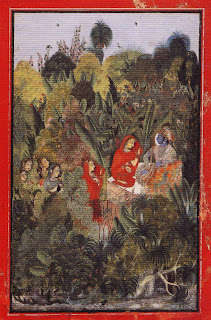
Two sequential events are presented in a single composition following the technique of continuous narration. On the left, watched by her companions, a timid Radha with her face shielded from him by her scarf approaches Krishna. Next we see her seated on a platform with Krishna, but she is still bashful. The encounter takes place amidst lush vegetation reminiscent of a rain forest. The freshness and the verdancy of the foliage as well as the full stream in the foreground indicate that the season is that of the monsoon.


This painting belongs to a series from which at least five other examples are known (see Fine Oriental Miniatures and Manu-scripts . . . , Sotheby Parke Bernet, New York, is December 1978, lots 141-46; the Green picture is lot 143). Three other pictures (Welch 1973, pp- 44-45, no. i9; Falk, no. 67; and Kramrisch 1986, p. 61, no. 54) are stylistically very similar and may also belong to the same series. Unfortunately no inscription on any of the folios identifies the text that inspired these delightful pictures. A stylistically similar picture, possibly even from the same series, has been identified as belonging to a picture-book of the Gitagovinda of Jayadeva (A. late twelfth century), but no evidence for this is cited (Dallapiccola. p1.4). In fact, a comparison with the known illustrations of the Gitagovinda does not corroborate the identification.


Most of the pictures in the series, like this example, are characterized by luxuriously verdant settings. The figures seem almost to be engulfed by lush foliage, which accentuates the passionate mood expressed in line and color. This particular picture is delightful for its subtle psychological expressiveness as well. Radha is a shy and eager maiden who approaches Krishna as a timid bride does her unknown groom in genteel traditional society.


An examination in the laboratory has revealed that some restoration work has been done in recent years.


10.  Watersport Festival of Radha and Krishna


Watersport Festival of Radha and Krishna
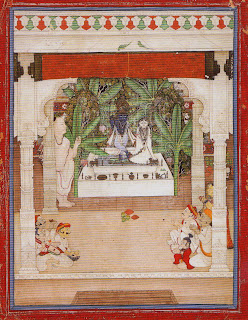
Usually the expression jalayatra means a boat ride in the river, but here the deities the dark blue Gopalji and the fair Radha have to be content with water sprayed by sprinklers along the edge of the platform.


Clearly the scene represents a shrine within the courtyard of an affluent Vaishnava family. The images are placed on a platform amidst a grove of fruit-laden mango and banana trees. Various ritual vessels and two metal sculptures of bovines are placed on the altar. Some real cows can be seen beyond the trees on the right of the picture. On the veranda in front are offerings of mangoes and coconuts, and more fruits and ritual objects can be seen between the pillars on the deities' left. The rolled-up curtain is a rich textile adorned with delicately drawn flowers and birds.


A rather rotund and well-fed priest stands close to the altar, and members of the family and a group of musicians a cymbalist, a drummer, and a stringed-instrument player sit on either side of the veranda.


The picture was very likely commissioned for the family album as a memento of the occasion. It is from a Kota workshop, and although the artist's name is given (but the reading is unclear), nothing is known about him. There is some stylistic relationship between such Kota pictures depicting Krishna themes and contemporary Nathadwar paintings (see no. it). Apart from Nathadwar pictures, the artist appears to have been familiar with European works or European influenced Mughal paintings as well. This is perceptible in the realistic handling of the space, the greater naturalism of the figures and their activity, as well as the detailed and meticulous rendering of the architectural elements.


11.  Festival of Food Offering


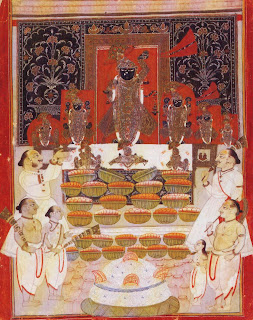
Festival of Food OfferingThe occasion depicted in this painting is the food offering ceremony, literally "mountain of food" (annakuta), which forms one of the major annual festivals at the Nathadwar shrine of the Vallabhacharya sect of Vaishnava faith. Taking place on the first day of the lunar half of the month of Karttika (October-November), the festival has multiple significance for the Vallabhacharyas. It marks the beginning of the new year, thanksgiving for a good harvest, and the commemoration of the miraculous incident from the life of Krishna that is encapsulated in the principal image at Nathadwar. This is the large, central figure in the group of six in the second row in the picture. The gesture of the raised left arm of the deity symbolizes the occasion when Krishna raised Mount Govardhana to shelter his community and his cows from a relentless storm unleashed by Indra, the king of the gods (sec no. 4). In addition, he holds the shepherd's crook with his right hand and a flying sash with his left.


Although there are separate shrines for Sri-Nathji's various manifestations within the sprawling mansion at Nathadwar, in such commemorative pictures they are all shown being worshipped together. The most striking features of the images marking the ceremony are the silver attire and what is called a gokarna mukuta, a crown of peacock feathers flanked by leaf like appendages that resemble cow's ears. Also, this particular ceremony is marked by the orange cloths immediately behind the statues and the black cloth farther behind that is decorated with silver and gold thread.


In front of the images are placed food-laden baskets and numerous jars filled with milk and milk products. In the foreground is the symbolic mountain of rice embellished with the five sweet cakes (gunja) traditionally offered on this occasion (the fifth is not visible). That at the summit symbolizes Vishnu's head, and the others his four weapons. (See Ambalal, pp. 30-33, for a detailed description of the festival.).


On either side of the offerings stand priests performing various tasks. Although they have very stylized and uniformly shaped eyes, individuals rather than types are represented. Clearly the priests have not suffered from deprivation. The head priest, standing to the left of the picture, is engaged in offering a lamp, while others stand with peacock-feather morchals and one with a hand-fan to keep the flies at bay.


Among the several published paintings of this subject (e.g., Skelton 1973, pp. 52-60, nos. 11-15), this example is both Iconographically and stylistically closest to one published by Ambalal (p. 32). The principal priests in the two paintings appear to be the same per-son. There seems little doubt that the two pictures were rendered at about the Same time and in the same workshop. However, one small distinctive iconographic feature in the Green painting is the fact that there are six images of Sri-Nathji placed in a single row; ill all the others there are only five.


12.  Illustration from the Shangri Ramayana Series: King Dasaratha in Conference


Illustration from the Shangri Ramayana Series: King Dasaratha in Conference
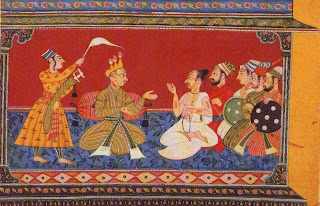
The inscriptions on top in Takri characters read (left to right): raja (king); the numeral 1o; Vasasada (Vasishtha?); sofa (bard); raja (kings). At the bottom left is athara (18).


The scene depicted here is from the Book of Ayodhya, part of the Ramayana. The king seated before a bolster is Dasaratha, the father of Rama, shown in conversation with his preceptor, the sage Vasishtha. Immediately behind the lightly clad priest are the court bard and three princes of the realm. Behind the king is an attendant holding a large sword and waving a flywhisk above the monarch's head.


The Ramayana series to which this folio once belonged is known generally as the Shangri Ramayana as the last owner before its dispersal was the ruler of the small state of Shangri, a branch of the larger Kulu state. The series was extensively studied by William Archer (1973, 1:325-29), who ascribed it to Kulu and recognized in it four different styles. Recently, Goswamy and Fischer (pp. 76-81) questioned Archer's attribution to Kulu but accepted his dating and the broad stylistic groupings. They made a strong case that the first two groups of pictures were probably painted in Balm, a small state, for Raja Kripal Dev (r. C. 1660-90) and his son Anand Dev (r. C. 1690-1730). The Green picture is from the second group and is probably by the same artist responsible for several others, now in various collections (Goswamy & Fischer, pp. 88-90, nos. 31-33).


As is characteristic of this Ramayana series, the palette consists of stridently bright colors that are applied so deftly they never seem to clash. The yellow and chocolate particularly are reminiscent of similar colors typical of Basohli paintings of the last quarter of the seventeenth century. In fact, in all -essentials—such as the coloring, the stylization of tress, the use of architecture, and the figural forms the Shangri Ramayana pictures an: so akin to earlier Basohli pictures that there can be little doubt that when Raja Kripal Dev of Bahu established a workshop he must have recruited one or more artists from Basohli. Apart from its rich palette, this particular picture is distinguished for the exquisite detailing of garments, carpet, and architectural features.


Writer Name: Pratapaditya Pal

About of The Divine World

Posted by Art Of Legend India [dot] Com On 1:37 AM 0 comments
Lord Ganesha
During the period when the pictures in the Green collection were painted, religious themes remained popular with both Hindu and Jain patrons, although no Jain example is included in this selection. In addition to illustrated religious books, series of pictures depicting specific religious themes, such as Vishnu's avatars, were also made for Hindu patrons. Sometimes individual pictures were painted to commemorate a particular religious festival, but others, even though the theme is religious, such as the Holy Family on the March, may not have had any religious use. In still other instances, although the theme of the picture is not necessarily sacred, such as Ragamala or rhetorical works (see introduction to Musical Modes section), the principal characters were often identified with the deities Krishna and Radha.

The most popular religious text to be illustrated appears to have been the Bhagavatapurana, which is represented in the catalogue by several examples.  The word purana, meaning "ancient," signifies a class of encyclopedic sacred literature in Sanskrit which includes mythological, genealogical, moral, ethical, and other material regarded by Hindus as authoritative texts both for religious and social purposes. It is not easy to date the puranas precisely, nor did they have single authors. The purana known as Bhagavata (Pertaining to the lord), a text said to have been compiled no later than the twelfth century somewhere in South India, is dedicated primarily to Vishnu. The section of this text that is especially popular with Vaishnavas (followers of Vishnu) is the tenth book, where Krishna's activities are recounted in great detail. Krishna is an avatar of Vishnu but is also considered by Vaishnavas to be the supreme deity. The accounts of Krishna, both as a heroic child and as a divine lover, provided artists with rich material for illustrations.

Two other sacred books, also written in the Sanskrit language and represented in the catalogue by a few examples, are the Mahabharata and the Ramayana. Both are essentially Vaishnava texts, although originally both were nonreligious epic sagas. Again there is no certainty as to their dates or authorship. The Mahabharata is said to have been composed by the mythical Vedavyasa and the Ramayana by Valmiki, who is considered to be the first poet in the Sanskrit language. After accretions and interpolations over the centuries both texts probably took their present shape by the early centuries of the common era; they subsequently came to be regarded as the two epics of the Hindus. However, they also attained the status of religious texts (dharmasastra). The divine Krishna is a major figure in the Mahabharata, and Rama, the hero of the Ramayana, is believed to be an avatar of Vishnu. Because of their enormous sizes (the Mahabharata is much larger than the Ramayana) rarely was either epic copied and illustrated completely. Stories contained in them also served as subject matter for other literary works, some of which were copied and illustrated.

Lord Ganesha
Some paintings included here did not belong to any religious books but served other devotional purposes. Important pilgrimage sites still produce paintings both for temple functions and for the pilgrims. While large paintings on cloth are an important part of the rituals enacted in the temples, smaller pictures were prepared for pilgrims to take away as sacred souvenirs. One such painting is a distillation of the important festival of annakuta, literally "mountain of food," observed annually at the shrine of the Vallabhacharyas at Nathadwar near Udaipur in Rajasthan. The form of Krishna worshiped there is known as Sri-Nathji, and the statue was the inspiration of the sect's founder, Vallabhacharya the shrine is extremely popular with Vaishnavas of western India. A second picture in the collection that served a similar commemorative purpose depicts another popular festival also associated with Krishna.

Two of the religious pictures in the collection represent Saiva themes, and one depicts the goddess Durga killing a titan. It is not possible to determine whether they belong to series of pictures illustrating texts or arc isolated examples. The Devimahatmya (Glorification of the goddess), the text most revered by those Hindus who believe in the femininity of the Supreme Being and are known as Saktas (from the word sakti, meaning "power" or "energy"), was illustrated both in Rajasthan and the Hill States. It is possible that the illustration showing Durga's battle belongs to such a series, but there is no text to confirm or deny this. The two Pahari pictures of Siva and his family, however, represent themes that were very popular with hill patrons and probably had little if anything to do with any specific texts. Many versions of both themes exist, and they are not only the Saiva counterparts of popular Krishna pictures, such as the Hour of Cowdust, but are also attempts to portray the deities in human terms as well as to provide the mythology with a local flavor.

The greater number of Vaishnava pictures in the Green collection is neither serendipitous nor a matter of choice. Generally, Hindu patrons during the Mughal period preferred pictures depicting Vaishnava rather than Saiva or Sakta themes. The rhetorical and poetic literature in the Hindi language also shows a distinct Vaishnava bias. The mystical love of Krishna and Radha forms a steady refrain in the romantic literature.


1.   Two Illustrations from a Bhagatapurana Series

Scene in Brindavan
The picture showing the procession scene (A) has a brief and fragmentary inscription on the reverse, but it does not help in identifying the subject. The inscription on the front in the middle of the composition reads so nana. On B the letters Rama of Mitharama (known from other leaves of the same manuscript) can be recognized in the upper left. Nana and Mitharama are considered to be the names of previous owners of this Bhagavatapurana series. The inscription at the bottom makes no sense.

A.)   The nonchalance with which the animals, chariots, and figures cross the river by ignoring natural laws clearly indicates the divine nature of the occasion. Since there is no corroborating text, however, it could be an example of the genre of depicting a royal party on the march. There are the usual elephants, chariots, and horsemen as well as a palanquin being borne by four men. As is typical in Indian paintings, the elephants are much better rendered than the horses. Despite the presentation in formal registers, it is a lively scene that conveys the bustle and complexity of a large procession with clarity and naiveté. The division of the composition by the diagonal placement of the river that meanders like a python adds an illusion of depth to the otherwise flat space. No horizon or sky is indicated, perhaps because of the celestial nature of the subject.

ProcessionB.)   Five adults and four cowherd boys (gopas) are represented in a single row. The focal point is thee woman on the right, who is seen either hugging or protecting one of the boys. His blue Complexion helps to identify him as Krishna and the lady as his foster mother, Devaki. The portly and bearded gentleman behind diem is Vasudeva, Krishna's foster father. It would appear that Krishna has just performed a heroic deed, much to the relief and delight of Devaki and the other members of community. The white boy standing behind Krishna and under a mango tree is Balarama, Krishna's half-brother. Several inure flowering trees symbolize the rural setting. Characteristically, all the figures are depicted on a single ground plane, and a wavy line highlighted in white indicates the sky.

This particular Bhagavatapurana is generally considered to be a major example of sixteenth-century Hindu painting of pre-Mughal India. Although not as polished as some of the other works in this style, it is among the most vivacious and animated. With varied compositions and themes, vivid coloring, and lively narratives, the pictures are characterized by spontaneous charm and vitality.

2.   Liberation of Gajendra


Liberation of Gajendra, Rajasthan Bikaner; C. 1625
The story illustrated here is that of Vishnu rescuing the elephant called Gajendra, which literally means "lord of the elephants." The gist of the tale is recounted twice, once in Sanskrit on the front and again in Hindi on the back. Both texts describe how, without any reason, a crocodile attacked Gajendra while he and some other elephants were sporting in the water. The elephants called out to Vishnu, who swiftly appeared on the scene, even faster than his own avian mount, the Garuda. With his wheel Vishnu dispatched the crocodile to the other shore.

This didactic tale, known as Gajendramoksha, is one of many that were composed to demonstrate how Vishnu is always available to save a devotee who calls him at a time of distress. This particular story appears to have been popular with Hindu patrons, particularly in Rajasthan. It is possible, however, that this rendering was once part of a series of Bikaner pictures depicting various avatars of Vishnu for two other examples, see McInerney, pp. 54-57, nos. 21-22. In all three examples a Sanskrit verse on the front describes the theme, and there is a Hindi verse on the back. Their measurements too are almost the same, as is the mode of representation. The numeral three on the back of this picture would indicate its place in the series. Below the numeral are the words narayina or naradina in bold letters and gajagraha in faint letters. Either reading of the first word could be relevant. Narayina may be a variation of Narayana, a synonym of Vishnu, and Naradina of Nur ad-din, the name of a well-known Bikaner artist. Gajagraha means "devouring elephant."

Interestingly, Vishnu is not represented here with four arms or as riding his Garuda, which he usually does in this episode. The artist obviously followed the accompanying text literally, as the god is said to have appeared on the spot faster than Garuda. However, Garuda was not far behind, for he has arrived in time to see his divine master hurl the wheel at the crocodile. The landscape is a mixture of pictorial realism and fantasy. Curiously, the highly stylized and decorative trees rise directly from the lotus pond. The elephants are rendered naturalistically, but clearly the artist was not familiar with crocodiles.

3.   Krishna Swallows the Forest Fire


Krishna Swallows the Forest Fire, Rajasthan Sirohi; C. 1675-1700The brief inscription in Devanagari letters identifies the scene as Krishna swallowing the forest fire. The picture does not, however, follow the description of the incident in the Bhagavatapurana, in which the miracle takes place in a forest and Krishna saves animals from the conflagration. In this instance the people shown behind the dark hero are the residents of Vraja, including his foster parents and cowherds. This incident is described only in Vira-raghava's (dates unknown) Bhagavata Chandrika, which is a commentary on the Bhagavatapurana.

In the jungle dried up with summer, a great forest conflagration broke out at night and surrounding the Vraja lying fast asleep, it began to scorch them. Touched by the fire, the inhabitants of V raja woke up and in their bewilderment sought resort to Lord Krishna, the Supreme Lord who had assumed a human form through his Maya.... Perceiving this helplessness and danger of his people (devotees), the Supreme Ruler of the earth, the Infinite Lord of unfathomable powers swallowed up that terrible fire.

The red-and-yellow flames are shaped like leaves. Krishna, distinguished from the others by his complexion, his brow painted with sandlewood paste, and his hair tied in a long and rather stiff single braid, is about to swallow the fire like a juggler. Colorfully dressed, the residents of Vraja watch the miracle in awe. Their emotions are expressed with various gestures. Characteristic of the Sirohi School, the faces of the figures are rather large, with prominent noses. Note-worthy is the fact that only Krishna's eye is open wide; the others are squinting from the glare. The bright yellows and reds of the flames and the pink complexions of the figures are brilliantly set off against a slate gray ground, and there are faint tufts of grass in the foreground. The picture is provided with a wide floral border that adds a decorative touch.

4. Illustration from a Bhagavatapurana Series: Krishna Raises Mount Govardhana


Illustration from a Bhagavatapurana Series: Krishna Raises Mount Govardhana, Madhya Predesh, Malwa; 1700-1725
The text on the back (see Appendix) informs US that Krishna upheld the mountain with the little finger of his left hand for seven days while Indra, the lord of the heavens, sent forth relentless rains. Finally an exhausted Indra was humbled. This episode follows one in which Krishna forbids the residents of Vraja to offer sacrifices to Indra. Indra is the Vedic deity par excellence of the Aryans, and it is believed that these two stories along with a third, in which Krishna loots the celestial Parijata tree from Indra's garden, represent a feud between the Vedic and non-Vedic religious forces at Mathura in the distant past.

The shape of the leaf as well as the division of the composition in two horizontal tiers continue the pre-Mughal tradition of illustrated manuscripts. The lower register is further divided into three sections. In the middle section Krishna stands slightly off center on a box or pedestal as does a deity and effortlessly balances the mountain on the thumb, rather than the little finger, of his left hand. He looks at his foster parents to his right as a child does when seeking parental approbation. The mountain acts as a giant umbrella and protects the residents of Brindavan from Indra's storms. The artist appears to have been particularly concerned with symmetry in delineating the mountain, the pair of confronted peacocks, the foliage, and the falling rain.

5.   Two Illustrations from an Avatar Series (?)


Krishna Desroys AghaThese two folios are probably front a series illustrating stories from the tenth book of the Bhagavatapurana. The Takri inscriptions on the top borders of the rectos identify the incidents as: A, the destruction of Aghasura and 15, the destruction of titan Kesi.

A.)   Krishna was only six years old when he was attacked by Aghasura, the brother of Purana and Bakasura, both of whom had been killed by Krishna. One day Aghasura laid a trap for Krishna and his companion cowherds. Assuming the form of a boa constrictor, Aghasura opened his mouth so wide that the lower part lay along the ground and the upper part was lost in the clouds. He then tricked the cowherds into believing that they were entering a verdant valley and swallowed them. Krishna, however, was not fooled. He entered the mouth and expanded himself so that the serpent could not breath and choked to death. The boys then emerged unscathed from the serpent's body.

It is clear that the artist responsible for this striking composition took a number of liberties and deviated considerably from the textual versions, such as that in the Bhagavatapurana. Although large, the serpent is not of cosmic proportions. He coils himself around a tree and appears to be miraculously suspended in midair. Instead of the boy Krishna, a four-armed figure of Vishnu (of whom Krishna is an avatar) stands triumphant on the serpent's head. Although no combat is depicted, the serpent's belly is streaked-with blood, indicating that it has been split open. Some cows and cowherds are seen dropping front the stomach, others have already emerged and straighten themselves out, and a few are still in the mouth as if awaiting their turn to jump. The artist's interpretation of the story is substantially different not only from written accounts but also from other painted versions.

B.)   This is a fairly straightforward depiction of Krishna's fight with the titan Kesi, who came in the form of a horse. The titan had been sent by Kamsa, the usurper king of Mathura, to destroy the boy Krishna. Instead, Krishna killed Kesi. As in the other picture (A), high drama is played down, and the composition expresses little of the violent struggle described in the known textual versions. Krishna has thrust his left fist into the mouth of the white horse as he strikes the animal with his shepherd's staff. As a matter of fact, except for the offensive of the left hand, Krishna might well be taming a wild horse rather than killing a titan. The only other indications of combat are the streaks of blood on the horse's neck. Rather curious are the cropped depiction of the horse and the placement of both its ears on the far side of the head. Also noteworthy are the relative sizes of the two.

Krishna Destroys Kesi
Stylistically these two pictures are closely related to a series depicting the Twenty-four Avatars of Vishnu iii the Museum Rietberg, Zurich, attributed to the well-known Chamba artist Mahesh, who flourished between about 1730 and 1775, and assigned to the second quarter of the eighteenth century (see Goswamy & Fischer, p. 169, figs. 54-55; p. 178, no. 68). If the two Green pictures are not by Mahesh, they are certainly from the same workshop. Simple and quiet compositions like those here are characteristic of the Zurich Avatar series as well, and the mode of rendering water seen in the foregrounds of the Green pictures seems to be typical of pictures from the Chamba workshop. It is possible that these two paintings do not belong to a Bhagavatapurana series but to a group, like the Avatar series, illustrating some of the heroic feats of Krishna.

A comparison of Krishna Destroys Kesi with a slightly earlier version of the subject from a Mankot workshop (Goswamy & Fischer, p. 114, no. 45; Sec also Pal 1983, pl. P6, for another earlier version) clearly demonstrates the originality of the Chamba artist. Although he has employed the detail of thrusting the left fist into the horse's mouth, he has completely eschewed the dynamic and violent combat emphasized by the earlier artists. This and the Aghasura picture make it clear he was confident enough to give expression to his own interpretation of the themes and of his own powers of imagination.

On the reverse of A is a sketch of the musical mode Bhairavi Ragini. She is personified as a woman seated in a pavilion and extending an arm toward a cow or a calf. An attendant fans her with a flywhisk. The mode Dipak Raga is depicted on the back of B. It is shown as a prince and his mahout riding an elephant, which holds a lamp (dipak) with its trunk. The sketches are probably of about 1750.


Writer Name: Pratapaditya Pal

Company Overview

Art of Legend India has the distinction of being one of the best in the Indian Handicraft Industry. We are about 75 years old handicrafts manufacturer & exporter. We are having team of more than 500 craftsman.

We are having our business offices in India, USA & Germany to ensure our best services.

Total Pageviews