ArtofLegendIndia.com, Biggest Online Store of Handicrafts Items, Paintings and Jewelry Accessories...

Handicrafts

Handicrafts are devices or works of art that are made completely by hand or by the use of relatively simple tools. Such goods are usually made in the traditional way of manufacturing goods. Therefore, the knowledge of the art of craft is usually passed down from one generation to another. The items made using these traditional methods of manufacturing are usually produced in smaller quantities and they often represent the culture or religious beliefs of the community that makes them. The goods are also handmade from natural materials that are found in the environment of the particular economy.

Read More!

Biggest Online Store of Handicrafts Items

Paintings

A painting is equal to thousand words, means a beautiful painting is equal to million of words. Paintings are one of the oldest art forms -- throughout history artists have played an important role in documenting social movements, spiritual beliefs and general life and culture.

History Of Paintings: The history of painting reaches back in time to artifacts from...

Read More!

Biggest Online Store of Unique Style Paintings
Showing posts with label Oil Paintings. Show all posts

Sons of Shiva

Posted by Art Of Legend India [dot] Com On 11:57 PM 0 comments

The cosmic couple south Indian Bronze.

Terror of Taraka 

Every cosmic event begins with the triumph of demons and ends with the triumph of gods. Neither remains undefeated forever.

Prajapati Kashyapa, patriarch of the celestial race fathered both the devas and the asuras.

Kashyapa made the devas, the gods of light. The asuras were to be the demons of darkness. By granting them mutually antagonistic roles he ensured their eternal enmity. The gods and demons stood on opposite poles of the cosmos. Everything the gods did, the demons opposed. The gods fought for the day; the demons for the night. The gods favored summer; the demons favored winter. The gods helped the moon to wax; the demons caused it to wane. These eternal squabbles, these cosmic wars, with alternating triumphs and tragedies, provided the dynamism on which the cosmos sustained itself.

Often the gods, strengthened by sacrifices and offerings, the yagnas, managed to fight the demons on their own. But there were times when reinforcements had to be called for. Such a time arose when Taraka became commander of the asuras. The devas found it near impossible to defeat him. They went to Brahma for help.

"He can only be killed by a seven day old child," revealed Brahma, creator of life, master of destiny.
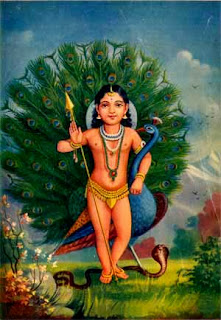
Kartik, commander of the gods; calendar print."Where will we find such a powerful infant capable of leading the gods?" they asked.

"With Shiva,' of course" replied Vishnu. 

Shiva's Divine Spark 

Shiva and Parvati had isolated themselves in their cave, away from all interruptions. Entry was forbidden even to the gods.

So the devas stood outside and, in a very loud voice, began discussing the chaos caused by the demons, especially Taraka. They began to howl and cry, lamenting their inability to deal with this terrible situation. Disturbed by the din and feeling sorry for the gods, the cosmic couple stepped out of their cave. "How can I help you?" Shiva asked.

"Give us a child capable of fighting demons on the seventh day of his life," the gods begged.

Shiva agreed. "Take the essence of my austerities. From it will rise my son, the greatest warlord in the cosmos."

Shiva cast his spiritual energies into a fire. But Agni, the fire-god, could not bear its radiance for long. He cast it into the river Ganga, causing its cool waters to boil. The terrible heat thus generated set fire to the reeds on the river banks. In that great blaze, Shiva's energy transformed into a radiant child, a boy with six heads and twelve arms.
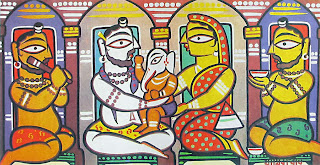
Shiva with Parvati and Ganapati; painting by Jamini RoyWhen the fire died out, six wandering nymphs called the Krittikas, found the baby beneath the embers and smoldering ash, within the petals of a splendid lotus. They nursed him and took him to Shiva.

The sight of this extraordinary child filled the gods with awe. He was given many names in keeping with his status Skanda, the energetic emission; Mahasena, the great leader; Guha, the mysterious one; Shanmukha, the six faced boy; Pavaki, son of fire; Gangeya, son of Ganga; Sarabhu, born amidst reeds; Kumar, the boy and Kartik, son of the Krittika maidens. Shiva gave him a powerful lance, vel, as a weapon; a rooster for his insignia; a peacock for his vehicle, his vahana. He became Velan, the lance-bearer.

On the seventh day of his life the child let out a shrill war-cry and challenged the demons to a fight. It was a splendid battle, one that shook the foundations of the cosmos. Kartik killed not only the demon Taraka but also the demons Banukopan, Soorpadam and Simukha. The gods rejoiced and thanked Shiva for his son. 
Birth of Ganapati 

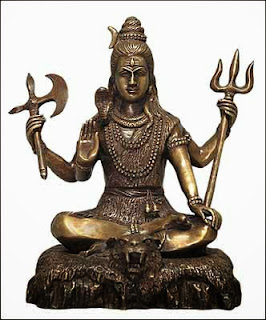
Shiva bearing his trident, trishula; South Indian statuette.Parvati wanted a child, someone to keep her company when she was alone in Kailas, when Shiva chose to meditate in isolation. Mount Kailas, without its lord, was a desolate place: all snow and stones, filled with an oppressive silence.

Shiva refused to be burdened with a family. In her loneliness, Parvati decided to produce a child on her own. She was after all the mother-goddess!

The next time Shiva disappeared into the deodar forest seeking a respite from married life, Parvati went to lake Manasarovar. There she scrubbed her body till it was red. She collected the dirt and dead skin, mixed it with sandal paste and clay and molded out of it a doll, a cute little boy. Parvati fell in love with her creation and quickly breathed life into it.

She called him Vinayaka, the leader, and spent days talking and playing with him. In his company she forgot all about Shiva. Days passed.

One day, Parvati told Vinayaka, "I don't wish to be disturbed. Don't let anyone into my cave."

"I won't," he promised.
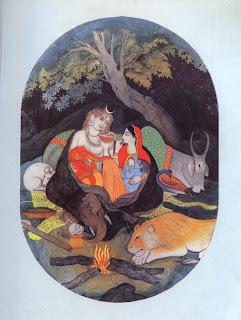
Shiva and his family on a cold winter’s night; Pahari Miniature.
Sometime later, having finished his long penance, Shiva returned to Kailas. He found that the entrance to his cave Was blocked by a boy, one he had never seen before.

"Stop!" said the boy as Shiva approached the cave, "You cannot enter this cave." Shiva ignored the boy and tried to walk past him. "Stop! I say," the boy snarled, pointing his lance at Shiva, "One more step and I will have to use force."

"Listen boy, don't you know who I am?" said Shiva.

"No, I don't. You may be Brahma himself, but I will not let you enter the cave."

"How dare you talk to me in that tone?" said Shiva, his temper rising, "Step aside before I am forced to hit you." Shiva tried to push the boy aside and enter the cave by force, only to have a lance pushed against his throat.

Shiva lost his temper. He raised his trident, the dreaded trishula and hurled it at the boy. The sharp blades slit Vinayaka's neck. He dropped dead, blood gushing out of his headless body.

Disturbed by the commotion outside, Parvati rushed out of the cave. The sight of Vinayaka's severed head and lifeless body horrified her.

She fell to the ground, beating her breasts, shedding tears of blood. "My son, my son," she cried clutching the mutilated head against her bosom. Inconsolable, she pulled her hair and smeared her body with dirt.
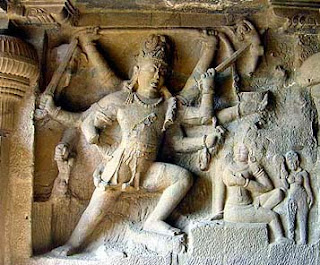
Shiva impaling Andhaka; Stone temple carving Ellora.Shiva realizing the seriousness of the situation, regretted his anger, his lack of restraint. To make amends he decided to resurrect the boy. Otherwise, Parvati would never forgive him.

Shiva told his ganas, "Get me the head of the first living creature you encounter on leaving Kailas."

They did as they were told. They came across a mighty one-tusked elephant and brought its head to Shiva. Shiva placed it on the headless corpse and brought the boy back to life.

Vinayaka, with a body molded by Parvati and a head given by Shiva, came to be known as Ganapati, leader of the ganas. He was given a mouse to serve as his mount. He became guardian of the threshold, the cosmic doorkeeper.

He is the remover of all obstacles, Vighneshvara. Without appeasing him with prayers, no work can be done, no task can be completed, no project will be successful. He keeps watch over every hurdle. 
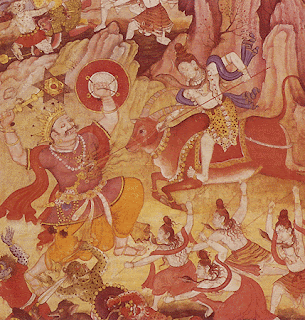
Andhaka, the Blind Son of Shiva 

Shiva fight Andhaka; North Indian miniature.Once Parvati covered Shiva's eyes in a spirit of play. Her hands started to perspire, for Shiva's eyes contained the energy of the sun. From Shiva's heat and Parvati's sweat arose an emaciated blind boy.

"He is our son," said Shiva. Parvati nursed him until he had developed a powerful sixth sense that made up for his blindness.

Shiva gave his blind son to the demon-king Hiranyaksha, his beloved devotee, who had no children of his own. Under Hiranyaksha's care, the child grew up to be a powerful warrior, dreaded even by the gods. He was called Andhaka, the blind-demon.

One day, Andhaka heard of Parvati, the most beautiful woman on earth. The bards described her beauty with so many superlatives that he decided to make her his queen.

Andhaka entered Kailas the moment he learnt that Shiva and his ganas had left for the lake Manasarovar. Parvati was all alone.

On seeing Andhaka, she sensed his unholy intentions. She could have easily destroyed him but her maternal instincts overruled her sense of outrage.
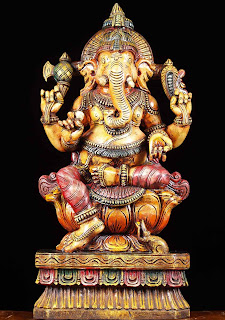
Ganesha; Painted wood carving from Orissa.
She prayed to Vishnu for help. The cosmic saviour heard her prayers and arrived on Kailas in the form of a hundred thousand damsels, the Mohinis, each one more ravishing than the other. Which one of them was Parvati wondered Andhaka.

Hours went by. Andhaka wandered amongst the beautiful women, totally confused and disoriented.

When Shiva returned, he divined what was happening. Infuriated, he impaled Andhaka with his trident; then, raising him up like a flag, he exposed the blind-demon to the elements. There he remained for a hundred thousand years, paying the price for his base intentions.

Andhaka lost his divine sight. He became emaciated and weak, with just enough strength to apologise to his mother and sing praises of his father.

Shiva, who never bore a grudge for long, was moved by his son's repentance. "I forgive you, Andhaka. You were born in darkness, hence you had a dark personality. But now you are enlightened. You shall now live amongst my ganas, taking your rightful place as my son."

Andhaka, the demon of darkness, became an enlightened follower of Shiva. The lord's grace removed the shadow of lust that had muddled his good sense. 
Ganapati's Marriage 

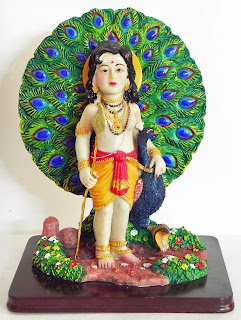
Kartik; Painted wood carving from Orissa.Parvati could not decide which one of her sons should be married off first: Kartik or Ganesha. Shiva proposed a competition. "Let us celebrate the marriage of the one who returns first after going all round the world," he said.

As soon as the race was announced, Kartik leapt on his peacock and rushed off to circumambulate the cosmos. It was a long journey, but Kartik's determination saw him through.

Ganesha did not bother to move from his seat. When he saw Kartik returning to Kailas he quickly went around his parents.

"I won," declared Kartik.

"No, I did. I went round the world before you did," said Ganesha.

"What do you mean: you went round? You did not take a step out of Kailas! It was I who went round the world on my peacock."

"You went around your world the great cosmos. I went around my world my parents. Since I finished first, I have won."

Parvati said, "You both have won in your own way: Kartik is the victor in a tangible sense. But in a more subtle, a more intellectual sense, Ganesha emerges as the victor."

Ganapati with his consorts; Siddhi and Buddhi; Kalamkari print
Parvati was proud of her sons, the strong Kartik and the wise Ganesha. She declared, "He who worships Kartik will gain strength; he who worships Ganesha will gain wisdom. You two are the two aspects of my power, shakti."

But in the matter of marriage, Shiva decided that Ganesha should get married first. "I think his wit deserves to be rewarded."

Kartik was furious. 

Kartik Leaves Kailas 

Shiva let Ganesha marry first despite Kartik's valid arguments and opposition. The two daughters of the prajapati Vishvaroopa, Siddhi and Buddhi, goddesses of success and intelligence, became Ganesha's consorts, reinforcing his position as lord of wit, wisdom and victory.

The event upset Kartik terribly. He felt that his parents did not value him, his qualities or his feelings. But few were willing to listen to him. Everybody was enjoying themselves at Ganesha’s wedding.

Kartik became convinced that he was not wanted. So he left Kailas and moved southwards. When the Krauncha hills tried to block his path, he simply hurled his lance and carved a path right through them.
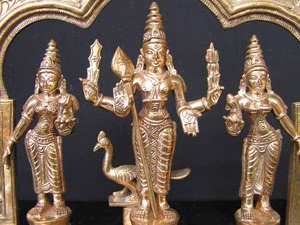
Kartik riding a peacock accompanied by his two consorts; Devayani and Sundaravalli; South Indian Bronze.
Shiva tried to make peace with his son but Kartik refused to see him, or speak to him. He just wanted to be left alone. 

Kartik's Marriage 

Upset by his parent's apparent favoritism, Kartik moved to the southern hills and lived amongst the tribes there. The locals called him Murugan, the divine youth. He protected them from demons and monsters that plagued the valleys and forest paths. But all the while he remained lonely and miserable.

 Indra, king of the devas, saw the plight of this great warlord. He decided to give him a wife, his own daughter Devayani, also known as Sena. It was the least he could do for his mighty champion. They were married in the presence of the gods according to priestly rites.

Sometime later Kartik, while wandering in the dense jungles of the Tamil lands, came across Valli, a beautiful tribal girl. She stood in the middle of her father's millet field shooing away birds and beasts. Smitten by her beauty, Kartik asked for her hand in marriage. Valli agreed and the two got married by natural rites, inspired by love and in the presence of the elements. 
Agastya Moves South 

Shiva imparting wisdom to sages; Mysore painting.Shiva once gave a discourse on yoga. Every creature in the cosmos gods, demons, sages, sorcerers, kings, merchants, priests, slaves rushed to Kailas to hear him speak. As a result of this mass exodus to the northern mountains, the world started to tilt on one side.

"Wisdom, civilization, knowledge, skill, all this has come north; there is nothing left in the south. The balance of the cosmos is totally lost," exclaimed Brahma.

Shiva realised the seriousness of the situation. He turned to Agastya, his wisest disciple and said, "Go to the south. Take with you all that I have taught you: the skill of communication, the secrets of astronomy and medicine; the art of theatre and music; the science of agriculture and animal herding; the fundamentals of philosophy; the knowledge of warfare; sacred lore; the essentials of sacrifice. Take it all. Help the cosmos regain its balance."

"As you wish," said Agastya, "But give me something that will remind me of the Kailas hills." Shiva gave him two great hills to carry to the south. The demon Ettumba offered to carry them on a ‘kavadi : he tied each of the hills to the ends of a strong pole which he slung over his shoulder and moved to the south.

At Palani, in Tamil Nadu, Ettumba placed the hills on the ground and went to a river nearby to refresh himself. When he returned he found that he could not pick up the hills again. It was as if someone was holding them back.
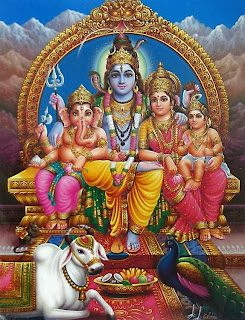
South Indian calendar print of Shiva’s family, showing Ganapati as the elder son.
He looked around and found a beautiful young boy seated on one of the hills. "Get off the hill, boy," growled Ettumba. But the boy refused. "If you don't, I'll hit you." The boy still refused to budge. Ettumba lost his temper and raised his arm to strike the boy, only to be kicked into submission.

When Agastya arrived on the scene, he instantly knew that this was no ordinary child. "Who are you?" he asked. "I am Kartik, son of Shiva," replied the boy. "These hills remind me of Kailas, my home in the north that I abandoned long ago. I would like to stay here." Agastya let him.

Since then Kartik is said to reside atop the hills of Palani while Agastya resides on the plains. With the two representatives of Shiva in the south, there was no need for anybody to travel all the way to Kailas in the north. The balance of the cosmos was restored. It is said, each year Shiva and Parvati visit their son at his abode in the south, having reconciled their differences. 

Celibate Sons of Shiva 

There is considerable confusion about the marriage of Ganesha and Kartik in Jambudvipa, the rose-apple continent of India.

In the north, Kartik is considered to be the elder son of Shiva and Parvati, born before Ganesha. In the south,

Ganesha is described as the elder brother; Kartik is the younger one.
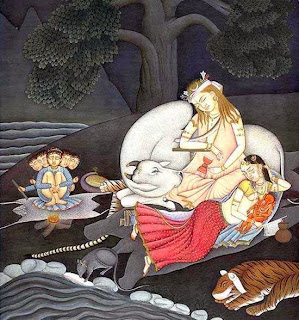
North Indian miniature of Shiva’s family, showing Kartik as the elder son.
In the north, Kartik is said to be unmarried because he saw his mother in all women. In the south, it is Ganesha who is believed to be the Brahmachari, the son who didn't marry because he found no woman as wonderful as his mother.

In North India, Kartik is described as a celibate warlord, the passionate commander of the gods who cheers men into battle and leads them to a glorious death. In some places where this quality is admired, women worship Kartik, seeking a virile husband like him. But in most places his warlike spirit is frowned upon and women, except a few widows, don't dare worship him. To them he is the god of men, lord of their martial brotherhood.

In the south, flanked by his two wives, Kartik is always seen as the personification of virility and valor. His beauty is legendary. His wives, Sena and Valli, symbolize his army and his weapons. His two marriages thus reinforce his position as the champion of the gods, the god of brawn, the mighty-god.

In the north, Siddhi and Buddhi are the consorts of Ganesha. They are the goddesses of accomplishment and intelligence. This significant alliance makes Ganesha the god of brains, the wise-god.

The two sons of Shiva and Parvati represent two aspects of power, shakti. Perhaps neither is superior nor elder to the other, for no man can be truly powerful unless he has a well balanced measure of strength and wisdom.

Writer Name:- Devdutt Pattanaik

Oil Painting Reproductions: The Smart Choice!

Posted by Art Of Legend India [dot] Com On 3:11 AM 0 comments
Are you currently an art enthusiast? Or do you typically like good art hanging on your walls? Or you will be an interior designer hunting for a couple of great pieces to hang on your client's new interiors? You may want several good paintings for your house or perhaps your office however, you aren't really exceptional a designer and also you have no idea anybody who paints too. Where are you able to obtain a great painting in an affordable rate? If you have answered yes to the of those questions or you desperately want good paintings, then Oil painting reproductions is one thing you should attempt.

Oil painting reproductions: Art simplified

Not every one of us is able to afford expensive bits of original oil paintings and artwork produced by rising artists or perhaps in the Old Masters. However, you might understand the beautiful works of masters like Reuben's, Michelangelo as well as Salvadore Dali. You would like one for your own personal home simply because these paintings are beautiful plus they give you happiness whenever you take a look at them. But Dali's hang in some galleries in beautiful cities around the globe. You can't visit all of them and searching at oil paintings in a tiny book is simply not enough. But oil painting reproductions are affordable, beautiful and permanent copies of those master artworks. All you need to do is make contact with a great artwork reproductions agency and they'll paint the reproduction for you personally in a nominal cost. You are able to choose size, framing, painting etc to meet your requirements as well as your requirements. For instance, this is the way a regular ordering process works.

Step 1- Choose the kind of painting that you would like.

Some customers will need Oil painting reproductions which are in the Old Masters. Because these are often popular selections, companies may have stock sets which are already painted and prepared on the market. You'll be able to obtain these quicker. However, if you wish to order rare oil painting reproductions and copies, then your painting company will need per week to color and process the painting. If changes are needed, this might harder. Some customers could also want portraits of households, children, pets, scenic vistas, etc. Usually of thumb, oil reproductions can be created associated with a source including photographs however the larger the image, more time necessary to prepare and paint the look. If you're not in a rush, allow the painter paint at his leisure to create higher quality oil reproductions.

Step 2- Pick the company which will offer you Oil painting reproductions

Mona Lisa (La Gioconda) c. 1503-05There are many companies online that deal just with oil reproductions. Aside from these web based specialty companies, you may also make contact with local specialty art training institutes. These training institutes will invariably have students who're prepared to paint copies and convey oil reproductions for purchasers at nominal fees. However, as these are made by students, there isn't any real guarantee about cost and quality.

Step 3- Choose framing, custom size, and pay it off

If you select oil reproductions, you're always offered the option of framing it based on the original. It is a much better idea to obtain the painting framed through the painter because he will stretch the canvas and refit it towards the frame. This really is a lot better than stretching the painted canvas onto an unsuitable frame. Oil reproductions companies can also get a wide range of frames and sizes to select from. By collecting the frame and also the painting, you'll have to pay at least 30% from the fee upfront. This fee might not range from the frame, shipping and packing and native transport costs.

Today oil paintingreproductions of Masterpiece have been carefully recreated by Artisoo artist detail-by-detail to near perfection as a complete canvas art reproduction. Why settle for a print when you can add sophistication to your rooms with a beautiful fine gallery reproduction oil painting? Why not grace your home with this reproduced masterpiece? It is sure to bring many admirers!

Visit Also:

Great Artists

Portraits

Greek Girls Picking up Pebbles

Posted by Art Of Legend India [dot] Com On 1:47 AM 0 comments
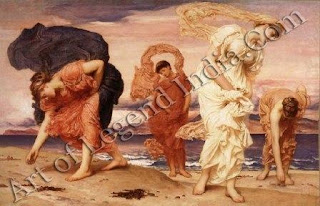
Greek Girls Picking up Pebbles
Greece is always a mysterious country, with the original fairy tale of goddess and exotic beach, a lot of famous paintings were depicted the beautiful seascape scenery of Greece. Artisoo.com invites you to walk into the oil painting reproduction of Greek Girls Picking up Pebbles By Frederic Leighton. 

Frederic Leighton was always keen on classical mythology and the Bible-related content creation, his painting style was very elegant, vintage, and as gorgeous and stately as the ancient Greek sculpture.

In this painting, demeanor and posture of the image were accord with his style. The two women in the middle were in standing posture, while the other two in both sides bent over and picked up pebbles. There were patchwork distances between each other, which made the ratio between the characters becomes very intuitive. What’s more, their dresses flew with the wind, which looks very harmonious when against the beach, sea and sky. The main colors of this painting were red and gold, which gives a magnificent visual experience, and brings spiritual pleasure. This holy and noble women themed artwork reminds us think of the same female-classic theme, one is the Renaissance master Botticelli’s Spring, and the other is Italian famous painter Rubens’s Three Graces. Besides, the standing posture of the woman in red is similar to Venus in Botticelli’s The birth of Venus.
 
Greek Girls Picking up Pebbles presented to the audience dramatic scenes that based on the character modeling of Greek mythological, Leighton adopted a means of stage scenery to highlight the image of characters, so as to let the audience have the most profound impression. In this painting, the four women have been smeared the colors that reflected their psychological characteristics, which gave us a sense of sacredness. As we can see, Leighton is used form and color to create harmonious composition, and highlight the personality of characters.


Guest Author: Zachary is a salesman at Artisoo gallery, an online art gallery in China. They are totally focused on giving the widest product selection of oil paintings at the most competitive prices.


French Great Artist Gustave Courbet - A Year in the Life 1848

Posted by Art Of Legend India [dot] Com On 1:51 AM 0 comments
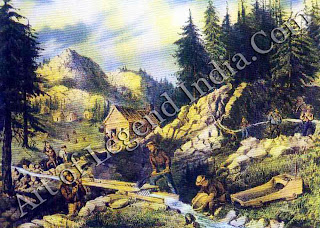
The Great American Gold Rush, In February, shortly after Mexico ceded California to the United States, traces of gold were found at Slitter's Mill on the American river. By November, men were rushing from all over the world to seek their fortunes. Indians hunted gold in return for beads. A Year in the Life 1848
As Courbet watched the mob mount the barricades in Paris, the shock waves of revolution reverberated throughout Europe. In Germany and Italy there was a series of violent uprisings, and in England there were ugly scenes in Trafalgar Square. Meanwhile, King Louis Philippe had fled France and, more sensationally, a gigantic sea serpent had been sighted off the African coast.

Everyone agreed that it was a most dramatic year. Popular writers vied with each other to find words grand enough to describe it. 'The year 1848', declared one, 'will be hereafter known as that of the great and general revolt of nations against their rulers.' A more cynical observer was heartily relieved when it was over. 'One cannot but feel glad,' he noted in his diary, 'at getting rid of a year which has been so pregnant with every sort of mischief.'


THE COMMUNIST MANIFESTO

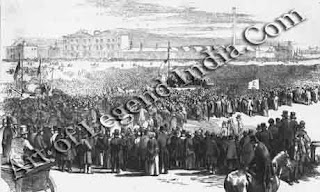
Chartists of the Common On 10 April 1848, more than a quarter of a million people met on Kennington Common in London to support the Chartist movement, campaign for representation in parliament for working people. In spite of massive support and a just cause, the movement was harshly repressed, and participants were jailed or deported.But the real words of power for 1848 had already been written when the year began and were in the hands of a London printer. 'Workers of the world, unite!' they ran, 'You have nothing to lose but your chains. You have a world to win.' The printer's client was a German refugee called Karl Marx and his commission was The Communist Manifesto.

The first rumblings of revolution came from Sicily in January, but they were not taken very seriously for Sicily was a notoriously volatile and lawless region. Then on 24 February the moderate middle-class monarchy of King Louis Philippe in France fell with startling suddenness. In the early hours of the morning, during a large demonstration outside the Ministry of Foreign Affairs in Paris, a man from the crowd walked up to the officer in command of the guard and shot him dead.

This had the intended effect of making the soldiers fire on the demonstrators, several of whom were killed. Their bodies were paraded through the streets in a cart to the accompaniment of revolutionary songs remembered from the 1790s. Barricades were set up, some 1,500 altogether, and by daybreak the mob was in complete control of the city centre.

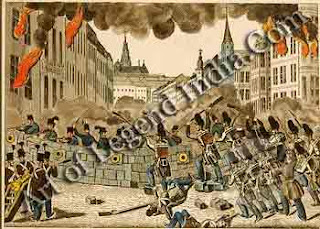
Storming the Barricades in Vienna 1848 was a year of tumult for Austria. On 13 March, the repressive chancellor Metternich was deposed after a battle between people and military. In May, barricades were erected when the government tried to deny the reforms earlier ceded. And the year ended with the abdication of the imbecile emperor, Ferdinand I.
Louis Philippe abdicated in favour of his grandson, a boy of 10, but the leaders of the revolution brushed aside the boy's claims and proclaimed a republic. Courbet did a drawing of a man at the barricade, to serve as a cover design for a revolutionary journal. 'Without 1848,' he said later, painting would not have happened.'

The first reaction came early in March from Hungary, where nationalist leaders demanded and obtained concessions from their Austrian rulers in Vienna. Then there was an uprising in Vienna itself, which forced the Emperor of Austria-Hungary to grant a new and liberal constitution to his people. The King of Prussia made similar concessions after an uprising in Berlin which left hundreds of demonstrators and troops dead. Revolutions followed in other German kingdoms and a national assembly for the whole of Germany was convened at Frankfurt, dedicated to sweeping away the existing petty principalities and creating a united Germany.

UPRISINGS IN ITALY 

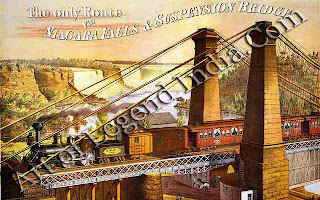
Niagara Falls Suspension Bridge Completed on 14 July, the bridge spanned 800 feet across the Niagara river and weighed 650 tons. The first cord was carried across the river on the tail of a kite. In Italy, too, a series of revolutions led to a movement for national unity. After popular uprisings had driven the Austrian occupying forces out of Milan and Venice, the King of Sardinia later to be joined by the Grand Duke of Tuscany embarked on a war to unify the country. The declaration of war came on 24 March. It had taken just a month for the shock waves from Paris to bring down the European state system from the Baltic to the southernmost tip of Italy.

From all over Europe refugees streamed into Britain, some of them conservatives who had been toppled and others revolutionaries who had been too extreme. The first to arrive was Louis Philippe, who landed at Newhaven in the early hours of the morning on 3 March. He wore a jacket borrowed from the captain of the ship that had brought him, and he had a week's growth of beard on his face. The Queen was muffled in a large plaid cloak, with a heavy veil to hide her face.

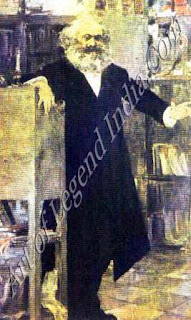
Karl Marx February 1848 saw the publication of The Communist Manifesto, written by Karl Marx (1818-83) in collaboration with Friedrich Engels (1820-95). It was the first charter for an exclusively working-class party and exhorted the proletariat to seize political power, and stamp out the system whereby the few became wealthy by the labour of the impoverished many. The publication was timely, and Marx's ideas were adopted by revolutionary movements all over Europe and, later, the world.
One Mr. Stone,' the newspapers reported, 'signalized himself by recognizing the King from afar off in the boat that brought him ashore.' Mr. Stone welcomed the deposed monarch, assuring him that the British would protect him from his enemies, and Louis Philippe, 'much agitated', gave him grateful thanks. The King then took refuge in coincidence, observing that he had travelled as 'Mr. Smith' and that he now found the landlady of the inn at which he stayed, as well as the Rector of Newhaven, had the same reassuring name.

PROTESTS IN TRAFALGAR SQUARE 

Three days later the British had their own first taste of revolutionary activity, when a certain Mr. Cochrane organized a demonstration in Trafalgar Square to protest against the income tax. Since only the rich paid the tax, it was not a very popular cause; and it became even less popular when Cochrane was scared off by a government ban on the meeting.

His supporters amused themselves by tearing down the fences around the column being erected to the memory of Lord Nelson. On the same day there were uglier troubles further north and cries of 'Vive la Republique!' were heard.

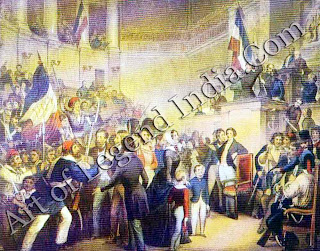
The Revolution in France, The wave of popular revolutions that spread across Europe during 1848 started in Paris where people took to the streets in a show of defiance. On 24 February, King Louis Philippe abdicated and nominated his 10 year-old grandson Louis Philippe Albert as his heir. But on the same day, revolutionaries invaded the Chamber of Deputies the invasion is shown in this engraving. The rebels swept aside the claims of the 'boy king', and proclaimed a republic. The authorities took fright and began to enrol special constables to deal with an enormous demonstration due to take place in London in April, when hundreds of thousands of radicals would present a petition for the reform of Parliament. One of the constables was Louis-Napoleon Bonaparte, nephew of the Napoleon Bonaparte who had once sought to invade Britain. He was responsible for the area between Park Lane and Dover Street, but in the event he had little to do. The demonstration came to nothing and its petition was rejected.

In August there came news sufficiently sensational to crowd out revolutions and radicals. The officers of a ship sailing off the African coast reported the sighting of a sea serpent over 100 feet long. Scientists said they were deluded and a fierce public controversy ensued, in the course of which most of the European revolutions collapsed without a great deal of attention being paid to them.

In the autumn Louis-Napoleon slipped across to France and was elected President of the French Republic. He might have had little to do in London, but in Paris he meant to maintain law and order. Courbet read the signs and began work on his great picture The Burial at Ornans. Its real subject, he insisted, was the death of romantic idealism and the acceptance of reality. The heady days of 1848 were over.

Writer – Marshall Cavendish

German Great Artist Hans Holbein - A Perfect Likeness

Posted by Art Of Legend India [dot] Com On 11:51 PM 0 comments

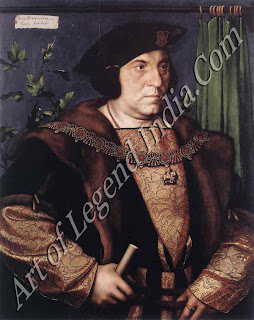
Sir Henry Guildford (1527) Guildford commissioned this portrait to commemorate his election to the Order of the Garter. He wears the collar of St George and the Dragon to indicate his membership of the Order, and holds the staff that shows his official position as Comptroller of the Royal Household. Guildford was a favourite of the king: his pose is suitably self-confident, while the way in which his bulky figure fills the picture space gives the portrait an impressive sense of authority.

A Perfect Likeness 

Holbein's ability to achieve almost photographic realism in his painting made his reputation as a portrait painter, and has given posterity an invaluable record of the members of the Tudor court.

Holbein's reputation is based on the brilliantly observed portraits which he painted in England during the reign of Henry VIII. Their realism is astonishing even today, and it is easy to understand the reaction of Holbein's friend, the great scholar Erasmus, when he received the artist's drawing of Sir Thomas More and his family: 'It is so completely successful, that I should scarcely be able to see you better if I were with you'.

Yet Holbein did not start his career as a portrait painter. He trained in his father's workshop in Augsburg and that of Hans Herbster in Basel, where he not only learnt the techniques of oil painting, but also those of book illustration and the decorative arts. Holbein's early paintings were mainly monumental and religious works, stylistically in the Northern tradition of Darer and Grunewald. By the late 1520s, a new influence can be seen. In The Meyer Madonna (1526), the Northern emphasis on sharply observed realism and incisive line is evident, but the classical motifs, calm symmetry and use of sfumato to soften the Madonna's features show a debt to Italian Renaissance art particularly that of Leonardo.

Many of Holbein's early religious works were probably lost during the violent iconoclasm (destruction of holy images) of the Reformation. This movement also put paid to a major source of potential income church commissions which is why Holbein was forced to leave Basel in search of work in England.


MORE AND HIS CIRCLE 

The Oberreid Altarpiece (1521-22) Holbein painted the central panels of this altarpiece during his early years as an independent painter in Basel. It was commissioned by Hans Oberreid, a leading citizen of the town,, who had recently married. His coat of arms and that of his new wife's family appear at the bottom of the painting, along with individual portraits of the family members. The panel or: the left shows the Adoration of the Shepherds, set among classical ruins symbolizing the Old Testament religion which was replaced by the new era of Christianity. To the right is the Adoration of the Magi set in less grandiose ruins. Holbein already had quite a reputation for portraiture in England, since his portrait of Erasmus had been presented to Archbishop Warham. And most of his first visit to England (1526-1528) was spent mainly in the production of portraits of More and his circle most of whom knew Erasmus. These are among the most astonishing likenesses in the history of art, and would certainly have astounded their Tudor sitters who had never seen anything like them before. Sir Thomas More is perfect in both its draughtsmanship and its apparent solidity in Holbein's art, line defines form. More's face has been scrutinized and reproduced with an almost photographic accuracy even down to the silver-tinged stubble on his chin. And Holbein's vision is so penetrating that his realism is not only skin deep: the slightly tensed brow above the tranquil eyes reveals More's thoughtful character.

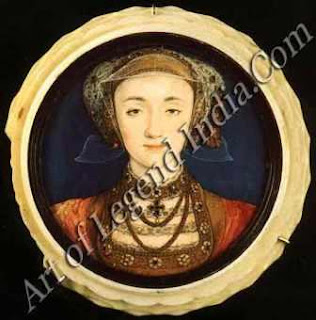
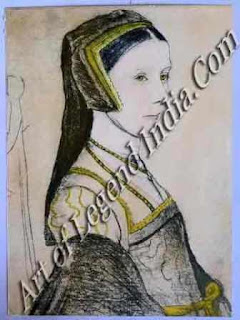
Miniature portraits, Holbein was a skilled miniature painter as this portrait of Anne of Cleves attests. But whereas contemporary miniaturists such as Lucas' Hornebolte worked in the tradition of medieval manuscript Holbein's miniatures were scaled-down Renaissance portraits.
Holbein's painting depended upon his phenomenal drawing ability. And it seems that, for him, drawing could be an end in itself, not merely a preliminary to painting. At first, his drawings were executed in chalks, which were sometimes heightened with water-colour. But after his return to England in 1532, the delicacy of this technique was replaced by the more vigorous and emphatic medium of ink. The collections of drawings at Windsor are among Holbein's most popular works.

Part of Holbein's assured mastery of line was his ability to capture a likeness very quickly. It is known, for example, that he was only granted a sitting of three hours for his portrait of the Duchess of Milan. This was enough for him to make a 'very perfect likeness'. During his first English visit, he was not inundated by commissions, and could presumably take longer, but once he entered royal service, such swiftness of execution would have been necessary to supply increased demand.


A MECHANICAL AID 

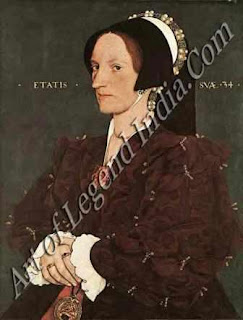
Margaret Wyatt, Lady Lee (c.1540) This portrait shows the sister of the Tudor poet Sir Thomas Wyatt aged 34 as the Latin inscription behind her indicates. It is typical of Holbein's late works in its three-quarter view, half-length pose, flat background and Latin inscription. It has been suggested that Holbein may have made use of some sort of mechanical aid to allow him to record the outline of the sitter's face as fast as possible. Again, this would presumably only have been necessary during his second visit to England. If he did use a mechanical aid, it may have been a kind of tracing apparatus, of the type other artists such as Darer and Leonardo are known to have used. This consisted of a peep-hole and a pane of glass. The artist looked through the peep-hole and glass directly at the sitter rather in the way that the sights of a rifle are used to ensure a perfect line of vision and traced the outline of the sitters' features on to the glass with an oil crayon. The outlines would then be transferred on to paper.

The paintings themselves were executed on wooden panels, to which Holbein would transfer his drawings using a grey wash. He then worked up the painted surface with meticulous accuracy, often using notes on colour and jewellery details to help him attain a perfect reproduction of what he had originally observed.

In the first years of Holbein's second visit to England, when he was still hoping to attract royal favour, he often made a point of showing off his ability to record stunning likenesses not only of faces, but also of surface textures. In his portrait of the German merchant George Gisze the lush folds of pink velvet are set against the woven intricacies of the Turkish rug with an almost tangible realism. And as if to hammer home the point, Holbein has placed a bunch of carnations in a thin glass vase which is painted with exquisite accuracy, and through which is seen the stems of the flowers and the woven threads of the rug.

A CHANGE IN STYLE 

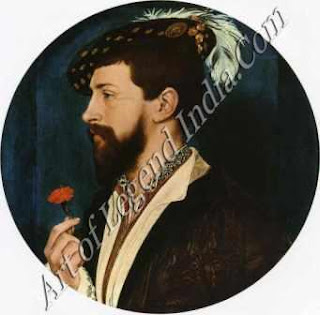
Simon George (1534-35) This portrait is unusual for Holbein because the sitter is shown in profile an appropriate view for the circular, medallic shape of the painting. It differs from the preparatory drawing in two main ways: in the drawing George has just started to grow a beard, while in the painting, is fully grown. And in the panning he holds a flower.
George Gisze is also characteristic of this particular phase in Holbein's art in the abundance of props which surround the sitter as attributes of his profession. About three years after this particularly 'flashy' painting, Holbein's portraits altered in a most dramatic way. The compositions themselves became simpler, with the sitters placed against plain backgrounds of blue or green. The lack of depth in these backdrops is often accentuated by Latin inscriptions, placed on either side of the sitter's head, usually indicating the date and his or her age.

The plain backgrounds serve to heighten the impact of the portraits themselves. The flatness of composition became particularly pronounced in many of the half-length portraits which Holbein executed of and for Henry VIII, where it was accompanied by an increased emphasis on linear patterning. In his portrait of Henry VIII, for example, the predominance of line is still evident, but it is put to a more decorative purpose. The sumptuous patterns of Henry's doublet and jewels, the flattened arms, and the head and hat almost cut out against the blue background all combine to create an icon-like image appropriate for a monarch who was also the Supreme Head of the Church of England. Although the face is as individualized as that of Sir Thomas More painted nine years previously, the effect of the painting is entirely different. Sir Thomas More is a portrait of a man, Henry VIII is an image of god-like majesty.

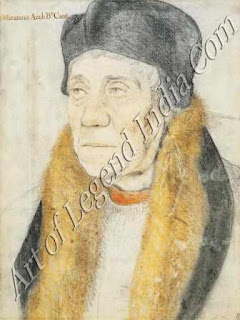
William Warham, Archbishop of Canterbury (1527), This drawing in coloured chalks dates from Holbein's first stay in England, and is one of his most penetrating character studies. Like all of his drawings, it was made for a practical purpose as a preparatory sketch for a portrait which the Archbishop sent to his friend, Erasmus. The freedom of the handling and the delicate use of soft crumbling chalk on white paper, are typical of Holbein's early style. It was Holbein's ability to create such spectacles of power that won him the chance to paint his most prestigious work, the Whitehall fresco. For the king did not want a family portrait, he wanted an image of absolute authority that combined physical might with symbolic legitimacy.

It is an irony that Holbein's consummate achievement has not existed for nearly 300 years it was destroyed in a fire in 1698. But the surviving copies and cartoon leave no doubt that the bloated, bulging, pig-eyed figure of Henry VIII must have been awe-inspiring. Visitors to the palace were said to be 'abashed' and 'annihilated' and many believed they were in the presence of the king himself.

In his cartoon for Henry's portrait, Holbein shows him turning slightly towards the queen, Jane Seymour; in the final painting, however, the king confronts the spectator directly. Obviously, Holbein's rendering of him was not designed to flatter, it was designed to glorify and magnify. The impression of raw power and indomitable energy is created partly by the sheer bulk of the figure, and partly by the contrast of Henry's challenging, virile pose with the more spiritual calm of the other three figures, whose eyes do not engage the spectator's.

Anne Cresacre (1526-8), Holbein's drawing of Thomas More's elegant ward is one of several beautiful portrait studies made for his destroyed masterpiece The More Family Group. A free variant on Holbein's original composition shows Anne standing second from the left.

ART AND PROPAGANDA 

Holbein achieved these effects by using a whole range of artistic devices, but most of all he drew on the recognizable vocabulary of religious painting. '['he way in which the group is posed, for example, is reminiscent of the standard Renaissance arrangement for a Madonna and child flanked by saints. Holbein translated the language of religion into that of politics, and for the Holy Family he substituted the royal family. In this way he was able to create an image which simultaneously demonstrated the political supremacy of the Tudor dynasty, and the supremacy of Henry himself as head of the Church in England. In the process, Holbein had combined art and propaganda.


Writer – Marshall Cavendish

Company Overview

Art of Legend India has the distinction of being one of the best in the Indian Handicraft Industry. We are about 75 years old handicrafts manufacturer & exporter. We are having team of more than 500 craftsman.

We are having our business offices in India, USA & Germany to ensure our best services.

Total Pageviews