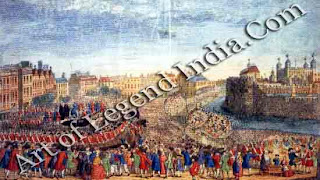
William
Hogarth
1697-1764
One of
Britain's most gifted and influential artists, Hogarth achieved fame both as a
painter and as an engraver. His pictures were widely circulated in printed
form, and were enormously popular. Their subject matter was drawn from the
London the artist observed around him, and his early experience of his father's
imprisonment for debt gave him an enduring interest in the seamier sides of
life in the city.
Hogarth
was working at a time when British art was largely dominated by foreign
artists, and he did much to promote the position of native British artists. He
also brought fresh vigour to conventional portraiture, and helped introduce
theatre pictures and conversation pieces to British art. But it is as the
inventor of that particularly British genre the modern moral narrative that he
is best remembered today.
The William Hogarth’s life
A Fervent Patriot
 Pugnacious
and patriotic when it came to recognizing the worth of English art, Hogarth's
successful career was a never ending battle against 'connoisseurs',
printsellers and publishing pirates.
Pugnacious
and patriotic when it came to recognizing the worth of English art, Hogarth's
successful career was a never ending battle against 'connoisseurs',
printsellers and publishing pirates.
William Hogarth was born on 10 November 1697, in Smithfield.
His father, Richard Hogarth, was a failed schoolmaster and writer who tried to
recoup his fortunes by keeping a superior kind of coffee house for the learned,
a place where 'the master of the House, in the absence of others, is always
ready to entertain gentlemen in the Latin tongue'. This venture failed, and by
the time William was 12, the family was living in The Fleet, a debtors' prison.
His mother was making what she could by selling an ointment 'which, in the very
moment of application, cures the gripes in young children and prevents fits'.
Unfortunately two of her own children, William's brothers, died during this time.
In
September 1712, Hogarth's father was released from the Fleet, and the family
took up residence in Long Lane. And, just over a year later, with the help of
his uncle, Edmund Hogarth, a prosperous victualler at London Bridge, William e,
was apprenticed for seven years to Ellis Gamble silver plate engraver.
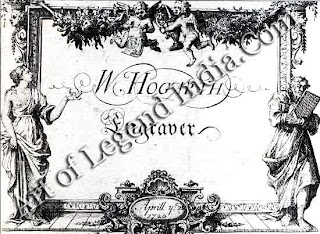
In the
spring of 1720, when his apprenticeship still had nearly one year to run,
Hogarth set up on his own. It was a bold gesture, but perhaps a necessary one.
His father was dead worn out, he insisted, by 'the cruel treatment he met with
from booksellers and printers'. Uncle Edmund was also dead and had turned
against Hogarth's mother and cut her out of his will, so it may well have been
essential for William to cut short his apprenticeship and become the
breadwinner of the family. This he did by issuing a shop card and opening a
business at his mother's house in Long Lane. On the card were printed the words
W. Hogarth, Engraver' flanked by two figures symbolizing Art and History,
making it clear that the young Hogarth would no longer be a mere craftsman but
was determined to be an artist and a history artist at that.
Convinced
as he was that the status of English painting should be elevated, Hogarth still
found that when he started learning to paint formally in 1720, he had to go to
an academy in St: Martin’s Lane run by two painters of foreign extraction, John
Vanderbank and Louis Cheron and pay a fee of two guineas. Three years later,
however, the academy closed, but a free academy was opened by Sir John
Thornhill at his house in Covent Garden. Hogarth was one of Thomhill's first
pupils, being a great admirer of the history painter who was the first English born
painter to receive a knighthood.
Key Dates
1697 born in London
1714 apprenticed to the engraver
Ellis Gamble
1720 sets up own engraving
business
1729 marries Jane Thornhill.
Starts to paint conversation pieces and portraits
1731 paints A Hanoi's
Progress
1733 sets up shop as a print seller
1734 paints A Rake's Progress
1735 founds St Martin's Line
Academy
1739 is a founding governor
of the Foundling Hospital
1743 paints Marriage a la
Mode
1753 Analysis of Beauty
published
1754 finishes the Election
series
1764 dies in London
INFORMAL TRAINING
 Later,
in 1735, when Hogarth's reputation was well established, he founded a 'new' St
Martin's Lane Academy, a relatively informal school for practising artists as
well as younger students, organized on democratic lines. His attitude to
academies or schools of art was to remain ambivalent. While appreciating the
value of some kind of informal training, he publicly and frequently attacked
the formal, rigidly structured schools run on the lines of the French Academy.
He claimed they stifled initiative, encouraged adherence to outworn rules and
turned out too many students hoping for a career in Fine Art whose ambitions
were bound to be dashed in a society which generally cared little for native
artists.
Later,
in 1735, when Hogarth's reputation was well established, he founded a 'new' St
Martin's Lane Academy, a relatively informal school for practising artists as
well as younger students, organized on democratic lines. His attitude to
academies or schools of art was to remain ambivalent. While appreciating the
value of some kind of informal training, he publicly and frequently attacked
the formal, rigidly structured schools run on the lines of the French Academy.
He claimed they stifled initiative, encouraged adherence to outworn rules and
turned out too many students hoping for a career in Fine Art whose ambitions
were bound to be dashed in a society which generally cared little for native
artists.
In the
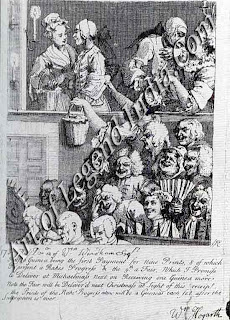
early 1720s Hogarth did some engraved illustrations to literary works, but one
of his first independent engravings was a satire, The Taste of the Town, also
known as Masquerades and Operas. In it Hogarth ridiculed the fashionable taste
for Italian operas and Italian singers to the detriment of the works of British
playwrights and authors. The Taste, Hogarth's first satire, announced themes
which were to run through the whole of his work his patriotism, his opposition
to what he considered as mindless adulation for French and Italian art and
artists, his references to actual contemporary events and people and the
overwhelmingly topical thrust of his art.
A LOVER OF THEATRE
Around
this time, too, Hogarth started to produce oil paintings. Although this was a
medium in which he had had no formal training, by 1728 he had gained enough
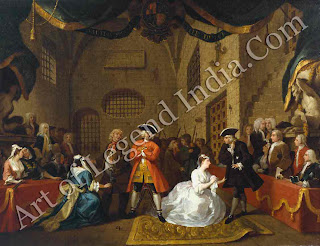
mastery to paint a number of versions of John Gay's Beggar's Opera, which was
itself in part a satire on Italian opera. Hogarth was fascinated by theatre and
shows of all kinds, and in these compositions showed the action on stage.
'Subjects I considered as Writers do,' he wrote, 'my picture was my stage and
men and women my actors who were by means of certain actions and expressions to
exhibit a dumb show.'
In
about 1729 the year he eloped with Jane, Thornhill's daughter Hogarth started
to paint group portraits or 'conversation pieces' for a largely aristocratic
clientele. As an ambitious man it may have appeared that he was establishing
himself as a painter of portraits in the conventional sense, the only branch of
art where a native artist could expect to make a respectable income. But he was
not temperamentally suited to the routine drudgery of 'face painting' alone and
found that painting conversation pieces 'was not sufficiently paid to do
everything my family required'. Hogarth had a very stable family life with his
wife, although they appear to have had no children.
SUCCESSFUL ENGRAVINGS
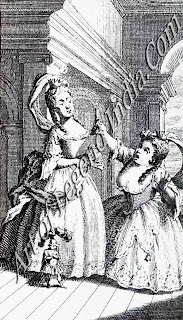
Hogarth
and his wife moved in with Sir James Thornhill in 1731, and the same year
Hogarth painted the series A Harlot's Progress. Realizing that the sale of the
paintings alone would not bring in much money he hit on the idea of engraving
his works and selling them widely by subscription, already a familiar and
indeed standard practice in the publication of literary works. A Harlot's
Progress was issued the following year and was an immediate success. The
subscription of the engravings, which he did himself, though he was to employ
other engravers for some of his later engraved series, brought him £1200. This
can be compared with the E700 which Henry Fielding got for his novel Tom Jones
and the E1500 which Samuel Johnson got for his famous Dictionary. The success
of Hogarth's Harlot can be gauged by the fact that two weeks after the
publication of the prints a pamphlet appeared setting forth the story in verse
which went through four editions in 17 days and Fielding's play, The Covent
Garden Tragedy, of 1732, was in part inspired by the Harlot. Hogarth's aim was
for his narrative series, such as the Harlot and later A Rake's Progress and
Marriage a la Mode, to be seen not just as popular prints, but as modern
'History' paintings, to be judged by the same criteria as the High Art of the
Italian Renaissance masters. When in the autumn of 1733, Hogarth set up shop as
a print seller in his own right, he hung a gilded head of Sir Anthony Van Dyck
over his shop door to show he was the successor to the great foreign painters
of the past. The shop was called 'The Golden Head'.
 While
working on his second major series, The Rake's Progress in 1734, Hogarth also
tried his hand at religious decorative painting, executing two murals for the
staircase of St Bartholomew's Hospital, the Pool of Bethesda and The Good
Samaritan. These he did free of charge, partly because it was for a charitable
purpose in an area of London he knew well and partly because there was a danger
of the commission going to an Italian painter, Jacopo Amigoni. Hogarth had
wanted to succeed in this more traditional form of High Art, but although he
later painted some more religious pictures, such as an altarpiece for St Mary
Redcliffe, Bristol, Hogarth was ill-at-ease in this kind of work.
While
working on his second major series, The Rake's Progress in 1734, Hogarth also
tried his hand at religious decorative painting, executing two murals for the
staircase of St Bartholomew's Hospital, the Pool of Bethesda and The Good
Samaritan. These he did free of charge, partly because it was for a charitable
purpose in an area of London he knew well and partly because there was a danger
of the commission going to an Italian painter, Jacopo Amigoni. Hogarth had
wanted to succeed in this more traditional form of High Art, but although he
later painted some more religious pictures, such as an altarpiece for St Mary
Redcliffe, Bristol, Hogarth was ill-at-ease in this kind of work.
PIRATE PUBLISHERS
Hogarth's
profits from The Harlot had been curtailed by the pirating of his prints by
unscrupulous publishers and printsellers. Remembering his father's experiences
at the hands of these profiteers, Hogarth campaigned for an Engravers'
Copyright Act which was passed through Parliament in 1735. He delayed the
engravings of The Rake until the Act was on the Statute Book, thus ensuring
that, as he wrote 'I could secure my Property to myself'. This Act was to
benefit many future artists and engravers and shows how Hogarth, with his
pugnacious character, was always determined to transform ideas into practical
reality.
By the
late 1730s Hogarth's reputation was well established, as was his attitude to
the world and his art. His face stands out in The Painter and his Pug tough,
challenging and matter of fact lie wanted to lead thought rather than tamely to
work to commission simply as a craftsman. Although constantly attacking the
connoisseurs and gentlemen theorists, his battling nature led him to fight on their
own ground. He published his own art theory, The Analysis of Beauty, in 1753,
which argued that beauty resided in the serpentine line. This line of Beauty
and Grace had already been shown in the same self-portrait, which with its
inclusion of books labelled 'Shakespeare', 'Swift' and 'Milton', amounted to a
kind of artistic manifesto.
HIGH SOCIETY SATIRE
Hogarth's
third major series, Marriage a la Mode, was completed in 1743. This satire on a
marriage of convenience doomed to failure and tragedy focused on higher society
than The Harlot and The Rake, though the story of human greed and fecklessness
set within the teeming variety of London's people is just as moral. Hogarth
employed well-known French engravers to produce the plates and gave to the
compositions a greater refinement and complexity of meaning and allusion than
his work of the 1730s. But the series was less successful than the earlier
ones, perhaps because it attacked the very people who were likely to be
subscribers and patrons.
 In this
same year Hogarth suffered a major setback when he decided to sell his pictures
by auction to show that they were in as much demand as the imported 'Old
Masters'. The result of the first sale, and of a second held six years later,
was so disastrous that he tore down the gilded head of Van Dyck from above his
shop door.
In this
same year Hogarth suffered a major setback when he decided to sell his pictures
by auction to show that they were in as much demand as the imported 'Old
Masters'. The result of the first sale, and of a second held six years later,
was so disastrous that he tore down the gilded head of Van Dyck from above his
shop door.
Hogarth's
assertiveness and bitterness intensified as he grew older. In 1759 he painted a
grand style subject from the classical mythology, Sigismunda, because he was
furious that a so-called Correggio of the same subject had been sold for the
large sum of £404.5s. He considered it to be the work of an inferior artist, as
it was, but his own Sigismunda was rejected by Sir Richard Grosvenor, his
potential client, and Hogarth gave directions before his death that it should
not be sold for less than £500. In the early 1760s a brief, late foray into political
satire together with a hostile engraved portrait of John Wilkes and a public
argument with Charles Churchill, both former friends, showed that his fighting
spirit was with him till the end. He died in 1764, still battling to get his
Sigismunda engraved, still hostile to the fashionable and unquestionable 'Old
Masters', still attacking the picture dealers whose interest, he wrote with all
the resentment toward them he had felt through-out his life, was `to depreciate
every English work, as hurtful to their trade'.
Writer
– Marshall Cavendish


 Finalized
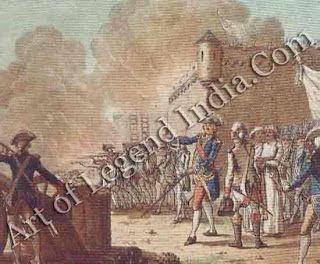
in October at Aix-la-Chapelle, the peace put an end to a complicated and futile
conflict of major powers which had involved most European states from Spain and
Sardinia in the west to the newly emergent great power of Russia in the east.
The most solid gains were made by Frederick the Great of Prussia, who kept the
province of Silesia which he had snatched from Maria Theresa in 1741 when her
title to the Habsburg dominions was under threat. Although the Austrian Queen's
rights under the Pragmatic Sanction were now universally recognized and her
husband had been elected to the office of the Holy Roman Emperor as Francis I,
Maria Theresa still hoped to revenge herself on Prussia and recover Silesia.
Britain and France accepted a restoration of the status quo but the stage had
been set for their struggle for mastery in North America and India.
Finalized
in October at Aix-la-Chapelle, the peace put an end to a complicated and futile
conflict of major powers which had involved most European states from Spain and
Sardinia in the west to the newly emergent great power of Russia in the east.
The most solid gains were made by Frederick the Great of Prussia, who kept the
province of Silesia which he had snatched from Maria Theresa in 1741 when her
title to the Habsburg dominions was under threat. Although the Austrian Queen's
rights under the Pragmatic Sanction were now universally recognized and her
husband had been elected to the office of the Holy Roman Emperor as Francis I,
Maria Theresa still hoped to revenge herself on Prussia and recover Silesia.
Britain and France accepted a restoration of the status quo but the stage had
been set for their struggle for mastery in North America and India. 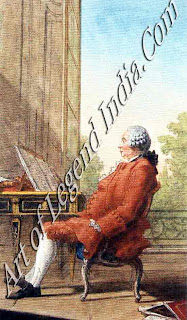
 Another
Scot, Tobias Smollett, made his literary debut with the novel Roderick Random,
a typically rude, racy work, peopled with a gallery of entertaining grotesques.
The sensation of the year, however, was a million-word story by an elderly
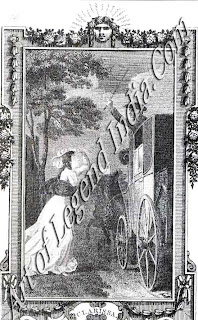
ex-printer. Samuel Richardson's Clarissa is probably the longest novel in
English. Nevertheless the book was to be read avidly all over the civilized
world. Richardson's achievement was to bring a new range of psychological
perceptions to the description of human behaviour but his contemporary
popularity probably owed more to another of Clarissa's qualities its excellence
as soap opera. Through obstacles, hesitations and changes of fortune Clarissa
is pursued by the macho Lovelace. Even when the pursuit ends shockingly in rape
there is a twist for Lovelace offers marriage, a proposal that is followed by a
further twist Clarissa refuses. . . and dies.
Another
Scot, Tobias Smollett, made his literary debut with the novel Roderick Random,
a typically rude, racy work, peopled with a gallery of entertaining grotesques.
The sensation of the year, however, was a million-word story by an elderly
ex-printer. Samuel Richardson's Clarissa is probably the longest novel in
English. Nevertheless the book was to be read avidly all over the civilized
world. Richardson's achievement was to bring a new range of psychological
perceptions to the description of human behaviour but his contemporary
popularity probably owed more to another of Clarissa's qualities its excellence
as soap opera. Through obstacles, hesitations and changes of fortune Clarissa
is pursued by the macho Lovelace. Even when the pursuit ends shockingly in rape
there is a twist for Lovelace offers marriage, a proposal that is followed by a
further twist Clarissa refuses. . . and dies. 
.jpg "The Hellfire Club, Fashionable society mingled freely with the less privileged in London's many exclusive clubs: there were exclusive clubs: there were Surly Clubs, Singing Clubs, Ugly Clubs, Tall Clubs and the 'diabolical' Hellfire Club an extreme example, which dabbled in power politics and the occult.")