ArtofLegendIndia.com, Biggest Online Store of Handicrafts Items, Paintings and Jewelry Accessories...

Handicrafts

Handicrafts are devices or works of art that are made completely by hand or by the use of relatively simple tools. Such goods are usually made in the traditional way of manufacturing goods. Therefore, the knowledge of the art of craft is usually passed down from one generation to another. The items made using these traditional methods of manufacturing are usually produced in smaller quantities and they often represent the culture or religious beliefs of the community that makes them. The goods are also handmade from natural materials that are found in the environment of the particular economy.

Read More!

Biggest Online Store of Handicrafts Items

Paintings

A painting is equal to thousand words, means a beautiful painting is equal to million of words. Paintings are one of the oldest art forms -- throughout history artists have played an important role in documenting social movements, spiritual beliefs and general life and culture.

History Of Paintings: The history of painting reaches back in time to artifacts from...

Read More!

Biggest Online Store of Unique Style Paintings
Showing posts with label Life of Paolo Uccello. Show all posts

Italian Great Artist Paolo Uccello - Experiments with Perspective
Posted by Art Of Legend India [dot] Com On 5:00 AM 0 comments

Experiments with Perspective

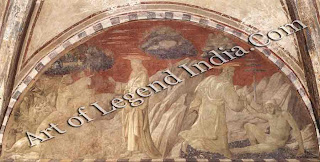
The Creation, One of Uccello's earliest known works, this lunette, showing The Creation of the Animals and The Creation of Adam was commissioned for the cloister of Santa Maria Novella. It is painted largely in terra verde (green earth).
Uccello's innovative and decorative use of perspective, combined with his flair for colour, gives his pictures a unique charm that sets them apart from the other paintings of his time.

In 1481 Cristoforo Landino, a Florentine scholar and philosopher, described Uccello as a 'good and varied composer, a great master of animals and landscapes and skilful in foreshortening because he understood perspective well.' Landino was particularly well-equipped to judge Uccello's painting, for he was a friend and admirer of Leon Battista Alberti, whose treatise on painting, written in 1435, contained the earliest account of the principles of linear perspective.

ALBERTI'S SYSTEM 
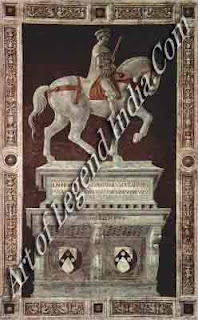
Sir John Hawkwood, This commemorative fresco of the English condottiere was painted for the Duomo in 1436. Uccello probably based the horse on the antique horses of St Mark's. The decorative border was added in the 16th century.The principles which Alberti laid down in De Pictura were relatively simple. Alberti observed that, when we look at the outside world, objects which stand parallel to our line of vision appear to recede into the distance. Furthermore, he observed, these parallel lines, or objects, seem to converge towards a single point somewhere on the horizon. Accordingly, Alberti devised a new perspective system, known as the costruzione legittima, to show how artists could reproduce this effect on a flat surface. By constructing the painting around a grid of converging lines leading to a single 'vanishing point' the artist could achieve the effect of distance, or recession into space.

Uccello undoubtedly knew about Alberti's ideas, although he was unlikely to have read De Pictura. During the course of his career he became increasingly interested in the possibilities of perspective, and exploited it in a number of ingenious and imaginative ways.

Uccello's earlier works show little trace of his later fascination with perspective. The scenes of the Creation and the Fall of Man in the Chiostro Verde (the 'Green Cloister' in the church of Santa Maria Novella in Florence) are constructed in a shallow foreground space, marked out by the simple shapes of rocks and trees. Uccello has made no attempt to suggest a deep or dramatic space, but confines the action to the front of the picture. The frescoes show most clearly the continued influence on Uccello of his old master Ghiberti, and Uccello may have worked in part from drawings which Ghiberti was preparing for the second set of doors for the Baptistry in Florence.


By the time he came to paint the monument to Sir John Hawkwood however, Uccello had clearly begun to explore the possibilities of perspective. In this commemorative fresco he uses perspective to create the illusion of a solid sarcophagus projecting out from the surface of the wall. Although the horse and rider seem relatively flat, the sarcophagus itself, when seen in situ, appears to be three-dimensional.
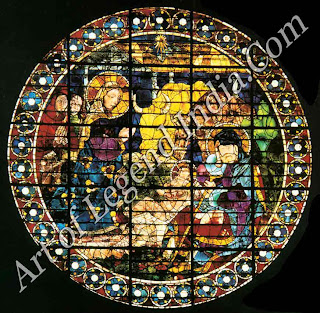
A versatile talent, The Nativity is one of two surviving stained glass windows designed by Uccello for the cupola of the Duomo. The formulation of perspective gave artists an unprecedented freedom in depicting the external world. For Uccello, however, perspective was not simply a means of creating an apparently realistic space. He realised that it could also be used to great dramatic effect. This is the most evident in his late fresco The Flood in the Chiostro Verde (the 'Green Cloister'). This fresco contains two different but related episodes the Flood on the left and the Recession of the Waters on the right. Here, the diagonal lines, or orthogonal, in the picture do not meet at a single vanishing point as Alberti suggested. Instead, each side of the picture seems to have its own focal point, a device which divides the fresco clearly into two. At the same time these two slightly different systems or 'constructions' combine to suggest a dramatic plunge into depth, at the end of which we see a vivid bolt of lightning. By diverging from the strict rationality of Alberti's system, Uccello could create a slightly distorted illusion of space which adds to his terrifying vision of the Flood.


CAREFUL DRAWINGS
Exploring perspective, Alberti’s system involved dividing the lose line of the picture into equal sections and joining them to a central vanishing point which determined the horizon. A separate side elevation established the position of the horizontal lines. Uccello did not achieve these effects without careful preparation. For all his frescoes he used detailed sinopie or under drawings, and in addition it seems likely that he used cartoons which were pricked through on to the intonaco, the final layer of plaster. He also made detailed drawings of individual objects seen in perspective, a few of which have fortunately survived. Some of these may well have been made for Uccello's own pleasure and instruction but many would have served as models for use in his paintings.

These drawings show particularly clearly how Uccello reduced everything he saw to a series of geometric shapes. His perspective was not simply a way of constructing his works. By reducing them to a set of regular forms Uccello could accommodate figures and objects more easily within the geometric 'construction' and use them to emphasize the underlying grid. By working in this way, Uccello turned perspective into a kind of decorative scheme. It was no longer a means of achieving spatial realism, hut a way of creating complex geometric patterns. It is this imaginative and decorative use of perspective which makes Uccello's works unique. It sets him apart from the other artists of his time who were simply using perspective to create the illusion of depth and three-dimensional reality in a picture.

UNUSUAL COLOURS 
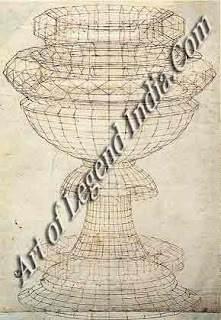
Perspective study of a chalice, This painstaking and detailed pen drawing shows Uccello's meticulous study of perspective and his concern with geometric forms.
In Uccello's later works this unusual technique is combined with a superbly original use of colour. In the battle-pieces which he painted for the Medici, for example, Uccello uses colour as a way of creating attractive patterns without aiming to be strictly realistic. Later critics found it hard to appreciate this aspect of Uccello's style. When describing Uccello's frescoes at San Miniato, Vasari complained that the artist had 'made the fields blue, the cities red and the buildings in various colours as he felt inclined.' For the 15th-century observer, however, this distinctive and witty use of colour clearly added to the gaiety and charm which gives Uccello's paintings their lasting appeal.


Writer – Marshall Cavendish

Italian Great Artist Paolo Uccello - A Year in the 1445

Posted by Art Of Legend India [dot] Com On 12:34 AM 0 comments
Florentine masterpiece, Although a Venetian, most of the works by Domenico Veneziano were for Florentine patrons. His masterpiece is The St Lucy Altarpiece which was painted in about 1445. 1445  

The year fell in a fundamentally unstable period. The Muscovites were beginning to chafe under their Tatar overlords while in Europe, France and England had made a temporary peace cemented by marriage. However, by the end of the year, the two countries were to be on the verge of further hostilities.

In 1445 Renaissance art was maturing rapidly and its masters were busy, much-travelled men. Uccello went to Padua to join his sculptor friend Donatello and executed his now-vanished painting of 'Giants'. Donatello, the Florentine sculptor, was working on his monument to the Venetian condottiere Gattamelata. This was an awe-inspiring feat in contemporary eyes, since it was the first equestrian statue since Roman times. In Florence itself, Domenico Veneziano, Ghiberti and Andrea del Castagno were creating masterpieces, and Michelozzo was engaged in building the first of the great Renaissance palaces, dedicated to the glory of the ruling Medici family.

Troubled pontiff, Eugenius IV had summoned a council to reunite the Church in East and West. The joint defeat of Pope and Patriarch at Varna late the year before undermined support for this political alliance. The new spirit of enterprise was also strong among the Portuguese, whose navigators were steadily working their way down the west coast of Africa. In 1445 it was Alvaro Fernandes who under the protection of Henry the Navigator, reached the Cape of Masts.

Even on the semi-barbarous Eurasian steppes, great changes were taking place. The Tatar Golden Horde was now beginning to disintegrate into separate khanates, foreshadowing an end to the two centuries of empire that had begun with Genghis Khan. The future lay with one of the Horde's client states, the Grand Duchy of Moscow. But this was still far from clear in 1445, when Grand Duke Vassily II made war on the Tatar Khan Ulugh Mahmed. Vassily was ignominiously defeated, captured, and only released after agreeing to pay an indemnity. The situation on both sides was so unstable that, within a few months, Vassily had been deposed and blinded by his rival Dmitry Shemyaka, while Ulugh Mahmed was murdered by his own son, Mahmudek.

Family feuds, The red-brick fortress of the Alhambra towers proudly over the capital of the Moorish Kingdom of Granada. 1445 saw the deposition of both Muhammad VII ( for the third time) and his nephew Muhammad X.
In the West, war and politics were rather less savagely conducted, though the code of chivalry did not prevent the Dauphin Louis from plotting against his father, King Charles VII of France. Although England and France remained in the grip of the Hundred Years War, peace seemed imminent in 1445: the two sides had agreed on a truce, and, in April, Henry VI of England took a bride with King Charles' approval.

A SHORT-LIVED PEACE 

Tatar warrior, For 200 years the principality of Moscow had been a client state of the Khanate of the Golden Horde, the Western division of the Mongol Empire. The Tatar reverses of 1445 showed that the balance of power was shifting towards the emergence of a new Russian state. His betrothed was fifteen-year-old Margaret of Anjou, Princess of Sicily, Jerusalem, Cyprus, Majorca, Provence and Lorraine. Unfortunately, most of these were paper titles, and Margaret's father, Rene of Anjou was in fact a .charmingly impecunious adventurer who lived off his wife's. Inheritance, the duchy of Lorraine; Margaret's dowry consisted of Majorca and Minorca claimable if Henry VI cared to mount an expedition to the Mediterranean and win them from their actual ruler, the King of Aragon. Nonetheless the wedding was a splendid affair, attended by the international elite or their representatives and taking place at Nancy Cathedral in Lorraine. The bride wore a dress of white satin sewn with 'her' flowers marguerites in silver and gold. The groom was represented by a proxy, William de la Pole, Duke of Suffolk, who was accompanied by an escort that had been transported in some 70 ships. Eight days of feasts, minstrelsy and jousting followed the ceremony, making this one of the most memorable occasions in an age obsessed with pageantry.

Charles VII's benevolent attitude formed part of his diplomatic and military preparation for a new drive against the English. This year saw the second of three ordinances in which he quietly created what was to become the first French regular standing army who would remain permanently in the royal service. On the political front it was agreed that Henry would cede the province of Maine to his in-laws in effect, to the King of France. Anxious for peace, Henry agreed to the plan on 22 December but his subjects simply refused to carry out the agreement, and a long crisis of authority began. English policy collapsed into confusion, and in a remarkably short time, because of the events of 1445, France was lost and England was being ravaged by civil war.

Writer – Marshall Cavendish

Italian Great Artist - Paolo Uccello Painting Gallery

Posted by Art Of Legend India [dot] Com On 1:42 AM 0 comments
Uccello had a long life, but he was not a I prolific artist and his surviving output is small. It is also, for the most part, badly documented, so the chronology of his works ff is uncertain. All his known paintings date from his maturity and the majority show his preoccupation with perspective. The most spectacular demonstration of Uccello's interest in the subject comes in his three large panels representing The Battle of San Romano, in which even one of the corpses has died in accordance with the rules of perspective. The Hunt at Night shows Uccello handling a similar array of horses and figures in a more intimate manner.

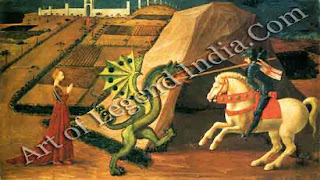
Secular subjects such as these played a remarkably large part in Uccello's work at a time when religion still dominated the arts. The Flood is Uccello's most impressive religious painting, the violent perspective recession helping to create a sense of drama. St George and the Dragon is more lighthearted, reconciling Uccello's scientific Renaissance outlook with medieval fantasy. 

The Great Artist Paolo Uccello Painting “The Flood” c.1447-50 200" base Chiostro Verde, Santa Maria Novella, Florence
Uccello's fresco is one of a series of Old Testament subjects by various painters in the Chiostro Verde (Green Cloister) of Santa Maria Novella. The cloister takes its name from the fact that the frescoes were painted predominantly in a pigment called terra verde (green earth). Uccello has shown two stages from the story of Noah in one scene. On the left, the Ark is afloat and desperate figures try to cling to it to escape the mass destruction; on the right, the Ark has come to rest and Noah leans out of a window as the dove returns with the twig signifying it has found dry land. The heavily draped figure in the foreground has not been satisfactorily identified. 

The Great Artist Paolo Uccello Painting “The Battle of San Romano” c.1456-60 71 ½” x 125 ½” National Gallery, London
This and the two companion panels (pp.1074 and 1076) depicting a Florentine victory over the Sienese in 1432 were painted for the Medici Palace in Florence, but at some unknown date they were dispersed and are now in three different galleries. In this scene, Niccolo da Tolentino, mounted on a white charger, resists the Sienese attack.


The Great Artist Paolo Uccello Painting “The Battle of San Romano” c.1456-60 71 ½" X 126 ½" Uffizi, Florence
The central figure in this panel is probably the Sienese commander, Bernardino della Carda, who is shown being unhorsed. As in the previous scene, the broken weapons in the foreground recede neatly in perspective, and Uccello has depicted several of the horses in deliberately difficult poses to show off his skill in foreshortening.


The Great Artist Paolo Uccello Painting “The Battle of San Romano” c.1456-60 70½" x 124½" Louvre, Paris
 
In the third of his battle panels, Uccello shows Michelotto do Cotignola (on the black horse) leading the Florentine counter-attack that clinched the victory against the Sienese. The massed lances give the painting much of its feeling of movement and together with the fantastic headgear and heraldic trappings, .form energetic abstract patterns.

                                                                               
The Great Artist Paolo Uccello Painting “Saint George and the Dragon” c.1455-60 22½" x 28¾" National Gallery, London This is the second of two paintings of St George and the Dragon by Uccello, and there can have been few more enchanting depictions of the myth. It is painted on canvas, which was still an unusual material at the time in Italy, and probably dates from late in the artist's career. Uccello has compressed two incidents from the story into one scene, for the princess is attached to the dragon by a sort of dog-leash (in fact, it is her girdle), which alludes to its having been led docilely by her after St George had defeated it. Uccello's love of pattern comes out in the dragon's wings, as well as in the formalized depiction of the landscape and the clouds.

The Great Artist Paolo Uccello Painting “The Hunt at Night” c.1460-65 25½" x 65" Ashmolean Museum, Oxford
This is one of Uccello's most original and imaginative paintings. Vasari records that Uccello 'always loved painting animals' and his delight clearly conies through in this captivating work. The sleek and highly stylized dogs, in particular, create a thoroughly convincing impression of darting energy and speed. The shape of the panel indicates that it may once have been a panel from a cassone a chest given as a wedding present or in which a bride kept her dowry.

Writer – Marshall Cavendish

Company Overview

Art of Legend India has the distinction of being one of the best in the Indian Handicraft Industry. We are about 75 years old handicrafts manufacturer & exporter. We are having team of more than 500 craftsman.

We are having our business offices in India, USA & Germany to ensure our best services.

Total Pageviews