ArtofLegendIndia.com, Biggest Online Store of Handicrafts Items, Paintings and Jewelry Accessories...

Handicrafts

Handicrafts are devices or works of art that are made completely by hand or by the use of relatively simple tools. Such goods are usually made in the traditional way of manufacturing goods. Therefore, the knowledge of the art of craft is usually passed down from one generation to another. The items made using these traditional methods of manufacturing are usually produced in smaller quantities and they often represent the culture or religious beliefs of the community that makes them. The goods are also handmade from natural materials that are found in the environment of the particular economy.

Read More!

Biggest Online Store of Handicrafts Items

Paintings

A painting is equal to thousand words, means a beautiful painting is equal to million of words. Paintings are one of the oldest art forms -- throughout history artists have played an important role in documenting social movements, spiritual beliefs and general life and culture.

History Of Paintings: The history of painting reaches back in time to artifacts from...

Read More!

Biggest Online Store of Unique Style Paintings
Showing posts with label Life of Albrecht Durer. Show all posts

German Great Artist Albrecht Durer - The City of Nuremberg

Posted by Art Of Legend India [dot] Com On 1:47 AM 0 comments
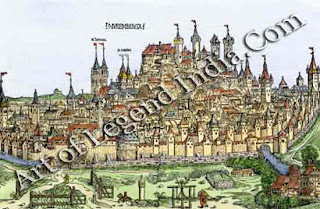
An attractive city, This woodcut, from the famous Nuremberg Chronicle, shows the walled city of Nuremberg in 1492. The Kaiserburg (imperial castle) sits imposingly on the crown of the hill, looking down over a sea of red-roofed' houses. The spires of the two medieval churches of St Lorenz and St Sebald are clearly visible.

The City of Nuremberg

Nuremberg was a microcosm of 15th-century cultural life. The arts, learning and printing flourished there, fostered by the city's enlightened climate and commercial prosperity.

Durer's Nuremberg was one of the liveliest, most exciting cities in 15th-century Europe. Referred to variously by contemporaries as the 'Florence of the North' and as a 'German Athens', it was a major cultural, commercial and artistic centre at the hub of the Holy Roman Empire. The successes of its citizens in all spheres of life were impressive, and were crowned by the achievements of Durer himself, whose fame was to stretch far beyond the city boundaries.
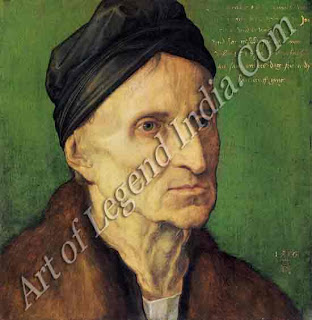
A leading artist, Michael Wolgemut, now remembered chiefly as Durer's master, was the principal painter of 15th-century Nuremberg. He ran an industrious workshop and, in the second half of his career, devoted a great deal of his energies to book illustration, collaborating closely with the city's printers. It was Wolgemut who supplied the delightful woodcuts for the Nuremberg Chronicle.Germany in the 15th century was composed of various principalities, dukedoms, bishoprics and cities which were loosely grouped under the authority of the Holy Roman Empire of the German nation. By Durer's time, the cities were probably the most powerful section of the Empire, enjoying considerable prosperity and stable government. This was especially true of the 65 or so Imperial cities, which were then largely independent, except for a number of stipulated obligations to the emperor such as tax payments, hospitality and allegiance. In return, the emperor guaranteed the citizens peace, and granted them certain specific privileges.

Imperial cities such as Ulm, Strasbourg, Augsburg and Cologne were major European centres during this period but one of the most important of all was Nuremberg. The esteem in which this city was held was reflected in the fact that as well as being a venue of Imperial Diets or parliaments it was the city in which the Imperial regalia and relics were housed from 1423.
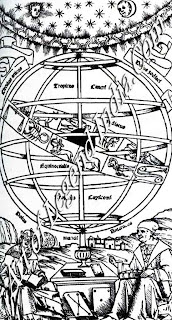
A haven for scholars, As a centre of learning, Nuremberg attracted some of the greatest scholars in Europe. The famous astronomer and mathematician, Johann Muller, settled there in 1471, established the first European observatory and wrote a book on Ptolemaic astronomy.
Visually, Nuremberg must have been an extremely attractive city. Built on the river Pegnitz, it was surrounded by woods and the view of the walled city was dominated by the grand imperial castle, set on a hill overlooking the red-roofed houses. The triple encircling walls had four gates and 128 towers. Other landmarks were the impressive churches of St Lorenz and St Sebald.

Living conditions in Nuremberg, however, must have been fairly cramped. At the time of Durer's birth the population was about 40,000. Within the city walls, which were only about 8,000 paces in circumference, there were over five hundred streets, and thousands of public and private buildings.

The city's government was in the hands of its Council which was' made up of 42 men, drawn largely from the urban patriciate. The Council ruled absolutely and very successfully, showing continual concern for the well-being of the citizens. Almost uniquely among Imperial cities, Nuremberg was renowned for its stability and freedom from internal trouble or strife of any sort, and this was mostly because the Council simply did not allow it to happen.

A CENTRE OF COMMERCE 

International comings and goings were an accepted way of life in Nuremberg and resulted from the city's success as the major business centre of south Germany. All types of trades and crafts were represented in the city furriers, belt-makers, cloth-makers, armourers and paper-makers. The silver and goldsmiths were particularly prominent and many of Germany's finest artists began their careers in these crafts. Durer himself was apprenticed as a goldsmith, and both his father and grandfather were masters of the craft.
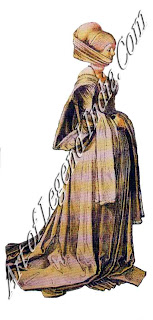
Prosperous citizens, Durer's costume drawing shows a Nuremberg woman dressed to go dancing. In general, the citizens of Nuremberg were well-dressed and well-fed, whatever their social standing. Indeed, most families owned their own homes, which doubled as workplaces. The prosperity generated by Nuremberg's commercial successes meant that the standard of living was generally very high for almost all of its citizens, and they lived comfortably according to their own social standing. This is proved by the fact that nearly every family had their own house, which also served as a workplace. The people dressed well, and ate well indeed, it was normal for a citizen of Nuremberg to have at least one meat dish a day. The most popular drink was beer which was brewed locally.

However, the well-ordered city of Nuremberg was not only renowned for its commercial and material successes. Throughout Durer's lifetime it was also famous as a centre of learning, despite the fact that it had no university. Largely due to its trade links with Italy, Nuremberg had been very much influenced by the southern Renaissance and had become one of the major centres of humanism in Germany. Scholars were drawn to Nuremberg from all over Europe, and the city also had its own humanist 'society', of which a prominent member was Willibald Pirckheimer, a close friend of Duren The mathematician, Johann Muller who further developed trigonometry settled in Nuremberg in 1471, because here, as he said he could easily 'keep in touch with the learned of all countries. .

FLOWERING OF THE ARTS 
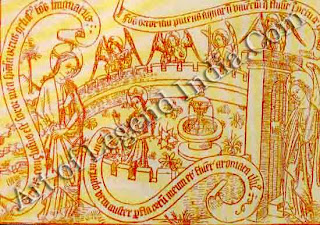
Printmaking, Nuremberg drew on its commercial and artistic expertise for one of its most successful business ventures printmaking. In the latter half of the 15th century, 'blockbooks' were very popular. For these the illustration and text were both printed from the woodblock.
The presence of humanism in the city, combined with its affluence, provided a flourishing climate for art in the late 15th century. The prosperity of the citizens encouraged them to patronize the local painters and sculptors, and the city churches, in particular, were filled with artistic decorations donated by parishioners. In fact the city's artistic life was at its peak between 1490 and 1525, the very period in which Durer came to prominence. One of the most famous of these artists was Michael Wolgemut, now remembered chiefly as Durer's teacher. During the last third of the 15th century he was Nuremberg's principal painter, printmaker and stained-glass designer. He became an independent master in 1473, and set up one of the largest workshops in the city.
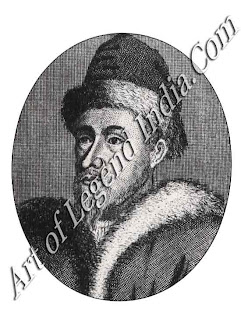
Anton Koberger, Koberger was Durer's godfather and established Nuremberg's printing reputation. The thriving artistic profession in 15th-century Nuremberg was very closely connected to the city's commercial skills. The two areas complemented each other, and many men were active in both fields. These links between trade and culture were nowhere more evident than in one of the city's most modem and most successful business ventures - the establishment of printing. Nuremberg was famous among the Imperial cities for its printmaking and this reputation was earned largely by the work of one man, Anton Koberger, Durer's godfather. In 1470, only a decade after printing first appeared in the city, Koberger set up his own press and combined printing, publishing and bookselling in his business. He was, by any standards, phenomenally successful.

Koberger's success coincided with dramatic improvements in paper manufacture which resulted in an explosion of printed material between the years 1473 and 1513; Koberger's press produced more than 200 titles. At its height, his workshop had more than 24 presses, with over one hundred compositors, proof-readers, illuminators and binders. He set up European wide trade links, and even had his own agency in Paris. Koberger was the first publisher to climb the social scale as a result of his commercial success, and even became a member of the city's most elite group, the Council. The links between trade and art in Nuremberg are highlighted by the fact that Koberger allowed his godson, Albrecht Durer, to use his presses and types for the Apocalypse series.
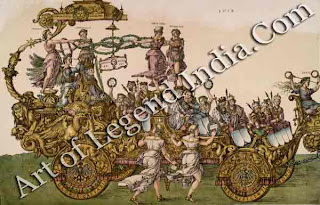
A grandiose project, One of the curiosities of early printing was the Triumphal Arch of Maximilian (1515) an 11 by 10 foot arch printed from 192 separate blocks. Darer, who was by now Nuremberg's most famous artist, was made designer in chief of the project. He also worked on the accompanying Triumphal Procession, producing two woodcuts showing Maximilian's wedding chariot.
One of Koberger's publications perfectly demonstrates Nuremberg's dominance in all spheres of German life during the Renaissance. This was the production, in 1493, of the Nuremberg Chronicle; the first great illustrated book, which told the world's history from the Creation to 1493.

The Chronicle was written by a prominent local humanist, Hartmann Schedel, who collaborated with the printer Koberger and the artist Wolgemut to produce what is probably the most famous 15th-century publication after Gutenberg's Bible. Published in both Latin and German, the Nuremberg Chronicle is famous today for its woodcut illustrations. These were done in Wolgemut's workshop, and some were probably the work of his apprentice, Durer. The Nuremberg Chronicle the fruit of the city's intellectual, commercial and artistic endeavours leaves us with a fitting and lasting testimony to the pre-eminence of the Imperial city of Nuremberg in Durer's lifetime.

Writer – Marshall Cavendish

German Great Artist Albrecht Durer - A Year in the 1521

Posted by Art Of Legend India [dot] Com On 1:20 AM 0 comments

Luther's German Bible, In 1521, after his abduction hi the Elector of Saxony, Luther was installed in the castle of Wartburg. There he stayed until March 1522. It was an intensely active period, taken up with a series of pamphlets and correspondence with friends and supporters. It also saw the translation of the Greek New Testament into vernacular German. The first edition was published in 1522. A Year in the Life 1521

The year started with the excommunication of Martin Luther from the Church of Rome. The Lutheran faction spread through Germany, a war was brewing with nearby France and English support was being sought by both sides. By autumn, England and Germany had formed a powerful alliance against the French.

On 3 January 1521, a papal bull of excommunication was issued against the Augustinian monk and ardent church reformer, Martin Luther. It was a little over three years since Luther had nailed a placard to the door of the castle church at Wittenberg in Germany on which he had written his '95 Theses' attacking the Catholic system of Indulgences, and particularly their 'sale' to help fund the rebuilding of St Peter's in Rome. Luther's original aim was simply to purify the Catholic church and return to the fundamental truths of Christianity. But by 1521 his name was synonymous with the opposition to papal authority. And most of his native Germany was behind him.

Luther's excommunication was triggered by three books that he had published in 1520. These 'Reformation Treatises' calling for the reform of the church were considered heretical: in June 1520, Luther was given two months to recant or face excommunication. He did not recant.

The Diet of Worms, From January to May, 1521, the Diet debated the bull of excommunication issued by Leo X and allowed Luther to appear before it to justify his actions. But he refused to withdraw anything he had written in his books, citing his conscience as his ultimate counsel. Although censorship followed, his beliefs spread rapidly throughout the Holy Roman Empire. Three weeks after the bull of excommunication was issued, the 21-year-old Catholic Charles V-King of Spain, and Holy Roman Emperor opened his first 'Diet' (imperial council) at Worms in Germany. He summoned Luther to the Diet, giving him the chance to defend his doctrines or to withdraw what he had written. The Emperor offered Luther safe conduct to the city, and the monk made a triumphant entry. On April 18, Luther appeared before the Diet. He acknowledged that he had written the condemned books, but refused to withdraw a word: 'Unless I am proved wrong by Scriptures or by evident reason . . . I cannot retract and I will not retract. To go against the conscience is not safe, and is not right. God help me. Amen.' As he left the hall, he raised his hand high above his head in a symbolic gesture of defiance.

The diet had not been the-confrontation that Luther had hoped for. He had expected that King Charles would have collected 50 doctors of divinity to refute him in argument. But all they said was: 'Are these books yours?' Yes."Will you recant?' No."Then get out!'


KIDNAP 

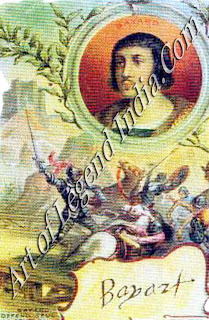
Pierre Terrail, Seigneur de Bayard, This epitome of French chivalry was dubbed 'the chevalier without fear and beyond reproach'. A resourceful commander, he led seiges under several monarchs, notably Charles VIII, Louis XII and Francis I. Captured by the enemy, he was twice released without ransom, so great was the universal respect felt for him. Under Louis XII he reached the pinnacle of his career, leading the French forces at the Battle of Ravenna in 1521. Since the Emperor had given Luther safe conduct to the Diet, he was allowed to leave freely. But the following months he was outlawed from the Empire. Luther's patron, the Elector Frederick of Saxony, came to his aid at this point: he had him ‘Kidnapped’ on his way home to Wittenberg and hid him in the Saxon Castle of Wartburg until the spring of 1522. Here Luther let his hair grow and lived disguised as a minor nobleman 'Knight George'; he continued to write his religious tracts, and began his translation of the New Testament into German.

Luther's condemnation at Worms strengthened rather than weakened the spread of his beliefs. The secular rulers of Germany drew great advantage from the religious revolt. They looked on the efforts of Charles V to restrain Luther as an infringement of their own freedom, and insisted that they, not the Emperor, had the right to choose the religion of their states. They saw a chance to put an end to the power of the Church in their territories and to stop the flow of gold to Rome.

In several parts of Saxony, monks and nuns abandoned their monasteries, while in Wittenberg the townspeople over-threw altars and smashed images in churches.

LUTHER'S FOLLOWING 

A fearless explorer, This coloured map by Battista Agnese bears witness to the exploits of Ferdinand Magellan, captain of the first ship to circumnavigate the world. On April 27, Magellan was killed in a skirmish with islanders in the heart of the Philippines. Even as far away as England, Luther was gathering a small following in the academic world of Oxford and Cambridge. But King Henry VIII refuted Luther, and Pope Leo X rewarded him for his loyalty with the title of 'Defender of the Faith'.

1521 also saw the start of the war between Germany and France. Competition between the two countries for England's support was high, but Charles V had the advantage. His aunt, Catherine of Aragon, was married to Henry VIII. On 25 August, Henry and Charles formed their alliance against France. England had the winter to prepare for war.

Writer – Marshall Cavendish
German Great Artist Albrecht Durer - The Engraver's Art

Posted by Art Of Legend India [dot] Com On 3:04 AM 0 comments

The Engraver's Art 

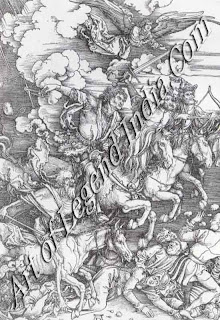
Visions of The Apocalypse (1498), Durer's first masterwork includes this powerful image of doom. The Four Horsemen Death, Famine, Pestilence and War trample everything in their path.
Durer became the first exponent of the Renaissance north of the Alps, but it was his exceptionally fine prints rather than his paintings which established his reputation as a great artist.

'Only a dried-up mind has no confidence in itself to find its way to something further, and so drags on in the same old path content to imitate others and without the gumption to think ahead for itself.' So wrote Albrecht Di1rer, and his own work stands as the best illustration of the unquenchable curiosity and probing spirit he admired. This spirit took him from the Nuremberg goldsmith's workshop of his father, steeped in medieval tradition, to the pinnacle of achievement as the first German master of the Renaissance.

THE ITALIAN INFLUENCE

Durer's art was rooted deeply in the Northern tradition, and shaped by his visits to Italy and his contact with the Renaissance. In his first great work, the illustrations to The Apocalypse, published in 1498 shortly after his return from Italy, Darer showed both what made him a new kind of artist north of the Alps and what still linked him to the old ways. These terrifying visions of the end of the world were topical for the people of Di1rer's time. Many of them believed the year 1500 would usher in the Last Judgement, and the war, disease and turmoil of the era found expression in Durer's violent, vibrant images.

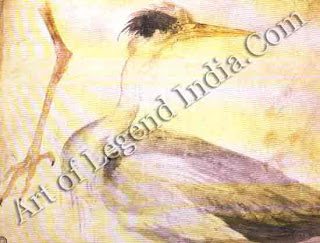
The Heron (1502-3), One of many watercolours of birds, animals and plants, this painting of a heron shows Durer's fascination with the natural world and his painstaking attention to minute detail.
The woodcut technique Darer used had been popular in Germany for some time, but in Durer`s hands it reached new heights of expressiveness. He drew his designs directly on soft wood and they were then chiseled out by highly trained craftsmen. The remaining, raised parts of the block would be inked and then printed on paper.

In these prints Darer made use of the Italian techniques of drawing the figure especially the short 'modeling' lines which give it its roundness and his angels, devils and humans have a three-dimensional thrust hitherto unseen in the woodcut? He also borrowed Italian discoveries in perspective the ability to present a given space in consistent depth to set his visionary drama in a world understandable to ordinary human beings.

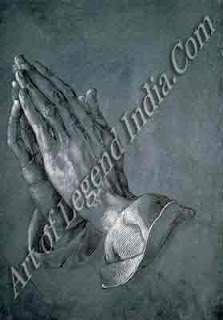
Hands of an Apostle (1508), This highly finished brush drawing is one of several preliminary studies for an altarpiece commissioned by the wealthy Frankfurt merchant Jacob Heller.
However, in many respects The Apocalypse woodcuts are still rooted in Darer's native traditions and could never be mistaken for Italian work. The tormented faces, the jostling crowds, the hideous demons are all portrayed with a distinctive angular, elaborate line that is entirely Darer's own. He had learned from the Italians but used that learning to express a passionate and personal religious feeling.


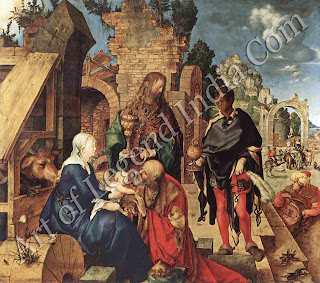
This mixture of styles can also be seen in Darer's many paintings, woodcuts and engravings of other episodes from the New Testament he rarely chose subjects from the Old. In The Adoration of the Magi the vibrant colours, the geometric structure of the composition and the use of classical architecture are all evidence of the influence of Bellini and Leonardo. At the same time the figures and the landscape in the background are distinctly Northern in character.

PERFECT PROPORTIONS 

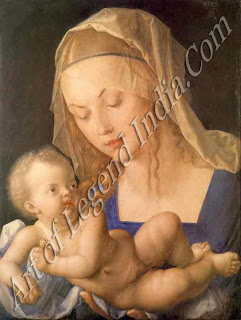
Virgin and Child (1512), Also known as Virgin with the Pear, this oil painting of the Madonna is one of many devotional pictures which Durer painted during his lifetime. Executed after his second visit to Venice, the painting is a mixture of the Northern and Southern traditions. The Italian influence is evident in the vibrant colours and classical figures of mother and child, while the Virgin's dress is essentially Northern in character.
Increasingly, for Darer, the human being was the central concern of art, and the human figure the basis of that concern. He studied the nude ceaselessly. During his first visit to Venice he copied the classical nudes of the Italian artists and engravers Antonio Pollaiuolo and Mantegna, and in his drawings, paintings and his fine engraving The Fall of Man, he sought a formula for representing the body, a guideline for the perfect proportion of head, legs, torso and arms. Though he came to realize that there were many such formulas, and no one reliable measure of beauty, these efforts enlarged the scope of his work and helped him to achieve on the small scale of the woodcut or engraving the kind of grandeur Italian artists achieved in frescoes or paintings.

A striking feature of Durer's paintings and engravings is his mastery of minute detail. He drew endless studies of hands, heads, household objects, plants and animals, and incorporated the results of his observations with painstaking care in his major works. The tiniest detail should be done skilfully and as well as possible he said nor should the slightest wrinkles and puckers be omitted. His fine sympathetic portraits of Humanists and burghers alike bear witness to this belief, as do his magnificently detailed drawings of animals such as the famous Hare. Like Leonardo, he was fascinated by the natural world, but whereas his Italian contemporary was obsessed by particular subjects, Darer drew and painted anything which caught his eye. He believed that 'truly art is contained within nature and he who can seize it has got it'. His shimmering watercolour sketches of mountain scenery unique in their day show his truth to nature at its most acute.

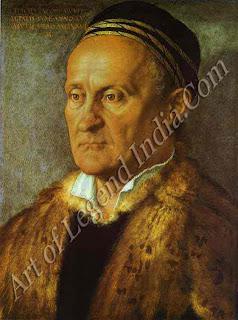
Portraits of the later years, Durer's study of the human body culminated in the outstanding portraits of his last years. In this portrait of Jacob Muffel, the features are sculpturally modelled with a softness lacking in earlier works.
Some of Durer's greatest works are his copperplate engravings. This technique, which derived from a combination of woodcut printing and ornamental engraving on silver and gold was peculiarly suited to him, given his training as a goldsmith. Darer himself cut the design on to a copper plate using a metal burin, like a delicate chisel, which required tremendous patience, keeness of eye, and steadiness of hand. The printers would then rub ink into the cut-out grooves and press the plate on to damp paper.

THE TRIUMPH OF LINE

Durer's engravings display an amazing variety of tones and textures and subtle gradations of light and shade. They are not only the most technically accomplished engravings ever produced, they also express a range of feeling never before seen on such a small scale. His skill and originality reach unparalleled heights in three large and personal engravings The Knight, Death and the Devi, Melencolia I and St Jerome in his Study.

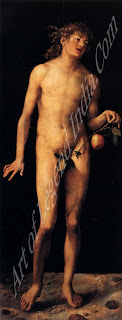
Adam (1507), One of the first life-size nudes in the history of German painting, this work was painted after Durer's second visit to Italy. The continuous contours of the body and the soft modeling of the flesh replace the earlier sharply defined, muscular figures in The Fall of Man. Durer's unflagging appetite for experiment led him to develop a facility in many media. He was one of the first artists to try the new process of copperplate etching, which involved drawing the design on a wax ground melted over the surface of the plate and immersing it in acid to etch out the lines. He explored the complex realms of art theory in pursuit of knowledge, publishing his findings in treatises on measurement and human pro-portions, and made detailed notes of nature's humblest phenomena. Yet this many-sided activity was always an expression of his own individuality, that of a religious man, deeply moved by the teachings of Martin Luther, who was nevertheless also a man of science, fascinated by the natural world.

Durer's art spanned two eras, the medieval and the Renaissance, and two worlds of feeling, the classical Italian and the spiritual Northern. In his own day this brought him unprecedented recognition and praise. He himself wrote, in his fiercely proud spirit of self-examination: 'God often gives the ability to learn and the insight to make something good to one man the like of whom nobody is found in his own days, and nobody comes after him very soon'.

Writer – Marshall Cavendish 
German Great Artist - Albrecht Durer Painting Gallery

Posted by Art Of Legend India [dot] Com On 11:09 PM 0 comments
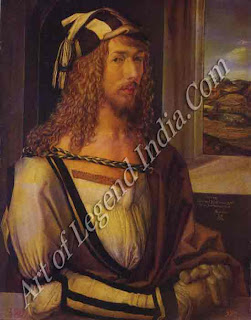
Durer was still in his twenty when he established himself as the leading artist in his native city of Nuremberg. His self-portrait, painted when he was 27, clearly conveys his self-confidence and pride in his abilities. His skill as a portraitist gained him numerous commissions from Nuremberg's leading citizens, but his visual curiosity led him to lavish as much attention on humble subjects such as A Hare as on more traditional and lucrative themes.

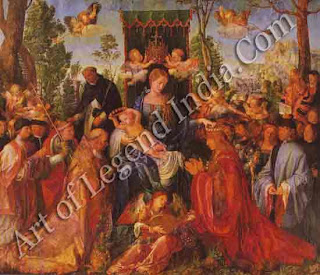
Durer's two visits to Italy profoundly affected his art. In such ambitious works The Adoration of the Magi and The Festival of the Rose Garlands he rivalled the great Italian painters in richness of colouring, and in The Four Apostles he matched the heroic arid monumental grandeur the High Renaissance. 

It was on his prints even more than on his paintings that Durer's international reputation was based. Engravings such as The Knight, Death and the Devil and Melencolia I were regarded with a seriousness that had previously been denied this 'lowly' medium. 

The Great Artist Albrecht Durer “Self-portrait” 1498 20 ½ " x 16 ¼ " Prado, Madrid
Durer was obviously appearance and painted several self-portraits. In this one he is elegantly dressed in th6eight of fashion. He sari himself as a cultured gentleman rather than as a humble artisan, which had been the traditional status of artists.


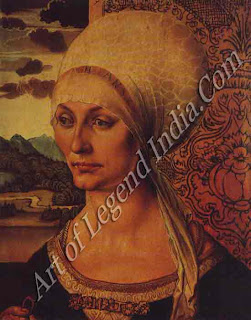
 The Great Artist Albrecht Durer “Portrait of Elsbeth Tucher” 1499 11” x 8 ¾" Staatliche Gemaldegalerie, Kassel The Tuchers were one of the leading families of Nuremberg. There was probably originally companion portrait of Elsbeth's husband, showing him facing her, as Durer painted another married couple from the family in this format. 


The Great Artist Albrecht Durer “A Hare” 1512 9 ¾” x 8 ¾” Albertina, Vienna This marvellously naturalistic study is justifiably on' of Durer's most popular works. It is point in watercolour and gouache. Durer was a born craftsman and complete master of every technique to which he turned his hand. 


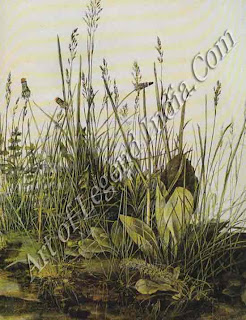
The Great Artist Albrecht Durer “The Large Piece of Turf” 1503 16 ¼” x 12 ½" Albertina, Vienna  
Durer looked at the natural world with acute powers of observation. This watercolour is accurate down to the last detail, but it raises above mere botanical illustration. Durer did a similar but smaller watercolour, which is known as The Little Piece of Turf distinguishes it from this one.
The Great Artist Albrecht Durer “The Adoration of the Magi” 1504 38 ½” x 44" Uffizi, Florence
This splendid altarpiece was commissioned by Frederick the Wise, Elector of Saxony. It was painted between Durer's two visits to Italy and shows a typical fusing of Italian and Northern elements. The precision of line and love of ornament are characteristically Northern, but the glowing light and various distinctive details show the influence of the South. In particular, the ruinous architectural setting with the prancing horse in the background recalls Leonardo da Vinci's famous treatment of the subject, which is now also in the Uffizi. 


The Great Artist Albrecht Durer “The Feast of the Rose Garlands” 1506 63¾” X 76½” Narodni Galerie, Prague
Durer painted this picture in Venice during his second trip to Italy. It is full of symbolic detail, but in essence it represents the idea of a universal brotherhood of Christianity. The picture was a great success and in its wake offered, but declined, a position as one of Venice`s official painters.  


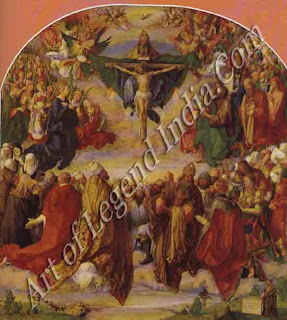
The Great Artist Albrecht Durer “The Adoration of the Trinity” 1511 53¼” X 48 ½” Kunsthistorisches Museum, Vienna
This altarpiece was commissioned by Mattheus Landauer, a rich Nuremberg Merchant, for a chapel dedicated to the Trinity and all saints. A host of figures, heavenly and earthly, adore the Trinity and in the bottom right-hand corner Durer has included a self-portrait.
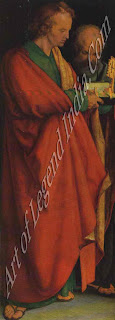
The Great Artist Albrecht Durer “The Four Apostles” 1526 Each panel 84¾" x 30” Alte Pinakothek, Munich   These panels form Darer's last great masterpiece in painting memorably combining Northern precision of detail with Italian amplitude of form. St John and St Peter are shown on the left, St Paul and St Mark on the right. The panels may have originally been conceived as wings of a triptych, but Darer himself presented them to the city of Nuremberg as a pair. 


Writer - Marshall Cavendish

Company Overview

Art of Legend India has the distinction of being one of the best in the Indian Handicraft Industry. We are about 75 years old handicrafts manufacturer & exporter. We are having team of more than 500 craftsman.

We are having our business offices in India, USA & Germany to ensure our best services.

Total Pageviews