ArtofLegendIndia.com, Biggest Online Store of Handicrafts Items, Paintings and Jewelry Accessories...

Handicrafts

Handicrafts are devices or works of art that are made completely by hand or by the use of relatively simple tools. Such goods are usually made in the traditional way of manufacturing goods. Therefore, the knowledge of the art of craft is usually passed down from one generation to another. The items made using these traditional methods of manufacturing are usually produced in smaller quantities and they often represent the culture or religious beliefs of the community that makes them. The goods are also handmade from natural materials that are found in the environment of the particular economy.

Read More!

Biggest Online Store of Handicrafts Items

Paintings

A painting is equal to thousand words, means a beautiful painting is equal to million of words. Paintings are one of the oldest art forms -- throughout history artists have played an important role in documenting social movements, spiritual beliefs and general life and culture.

History Of Paintings: The history of painting reaches back in time to artifacts from...

Read More!

Biggest Online Store of Unique Style Paintings
Showing posts with label Kangra Paintings. Show all posts

Love In Separation (Viyoga)

Posted by Art Of Legend India [dot] Com On 12:25 AM 0 comments
The Surprised Maiden - Guler
According to the situation of lovers, love is of two kinds: love in separation (Viyoga), and love in union (Samyoga). Viyoga is of three varieties: purva raga, the beginning of love, mana, the separation of lovers out of false pride and obstinacy, and pravasa, the separation of lovers caused by the departure of the lover for foreign lands.

In Kangra painting, love awakens at first sight. The meeting at the village well is an occasion for falling in love. The tired and thirsty prince who is out on shikar comes to the village well and asks the pretty girl for a draught of water. As he drinks the water with cupped hands he lifts his eyes for a moment look at the face of the girl. Their eyes meet and the inevitable happens.

A closely related theme is that of the lover looking at his beloved who is unaware of his presence. Thus, Krishna is shown watching Radha who is cooking in the kitchen or is having her hair combed by a maid in the courtyard of her home. A delightful painting from Guler show Radha bathing, while Krishna watches from a balcony overlooking the bathing platform. Radha is on a chauki; one of her attendants curtains her off with a green sheet, while another, with her out-stretched veil. Her flowing jet-black hair is in charming contrast with the golden complexion of her body.

Vidyapati describes her charms thus:

Ah, Madhava! I saw the fair one freely;
I suddenly beheld her as she bathed.
Her jet black hair poured over her breast,
As though a shaggy yak concealed a golden Manda.

The Offended Lady - KangraMana means coldness, obstinacy and pride; manini nayika is the "unwilling" lady who pays no attention to her lover, in spite of his prayers, entreaties, and messages of love.

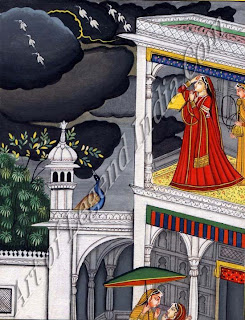
She is shown in a Kanga painting as a girl who has escaped from her husband's arms, leaving him alone. Disappointed, he watches her from a balcony, while dark monsoon clouds sail in the sky. A pair of sarus cranes soar heavenward. The husband has sent a duenna to pacify the young lady who leans against a pillow with her back towards him. She is cajoling her with promises but the young lady does not relent.

The third phase of Viyoga is called pravasa. The desire for union springs from seeing the beloved one and hearing him. When the desire to meet him is not fulfilled, ten conditions result there from, namely longing (abhilasa), anxiety (chinta), reminiscence (smrti), the recalling of the qualities of the beloved one (guna-kathana), agitation (udvega), delirium (pratapa), sickness (vyadhi), stupor (jadata), derangement (unmada), and death (marana).

Paintings of lonely ladies, gazing at clouds and birds like the chakora, hansa or peacock and fanning themselves, are usually of women parted from their lovers. They have a special appeal to men accustomed to travel, for they remind them of their wives when they are away from home.

The Crew's Message - Guler
In the picture reproduced the heroine looks at the crows, one of which is cawing from the cornice. She asks it to fly away and bring news of her lover. If her lover returns home safely, she promises to have its beak gilded in reward for its services.

f my desire be fulfilled, on hearing the news you bring,

I shall make your beak to be plated with silver, I shall give you to eat a ladle of excellent churl mixed with sugar and ghi,

Let me behold Tula Ram while yet I live, but bring him not only for a single hour!

If you have seen my Lord a-coming home, then fly away from the cornice, thou crow!

The black buck, the peacock, the hansa, the chakora, and the snake are the symbols of the lover, and he is often represented by these in Kangra paintings. Love-sick heroines who seek relief from the pangs of separation are shown playing with these birds and animals. There is a charming painting of a virahini nayika in which a lady playing a small tambura under a willow tree is shown with a black buck. The sad music is reflected in her flowing drapery, the graceful curves of her body, and in the weeping branches of the willow tree. The picture is a fine example of Kangra art as practised at Guler, and is an excellent illustration of the longings of love (abhilasa). This popular Kangra motif is also to be seen in the murals which decorate the walls of the asrama at Damthal.
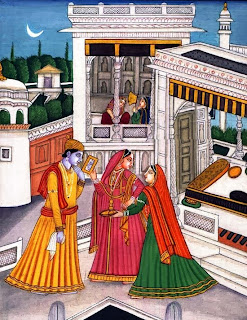
Lady in Husband's Clothes- GulerThat the painting is a representation of virahini nayika is proved by a similar Guler painting on the back of which is an inscription which reads: "The young lady wearing a garland of flowers, admiring the blossoms, and playing the tara is longing to meet her lover."

In another painting from Guler (not reproduced here), the feeling of anxiety (chinta) in a woman separated from her husband is portrayed most vividly. A young lady with deep anxiety on her face is shown walking along the edge of a lotus-filled tank. The mango trees are laden with luscious fruit. It is a warm day, and the lady is fanning herself. Scattered among the cup-like leaves of the lotus plants are pale pink lotus buds of unearthly beauty. The agitation in the woman's heart is echoed by the leaves of the lotus which are all in utter confusion and disorder.

Love-sick ladies whose husbands are away are often shown in men's clothes, for this reminds them (simarana) of the joys of love in union. This state is shown in a very fine painting from Guler. The Raja is away on his travels and the Rani dresses herself for amusement in her husband's clothes which include a turban decorated with a peacock's feather. One of her companions shows her the mirror while another holds a thali containing vermilion. The Rani examines the vermilion mark which has been painted on her forehead by her companion. The empty bed in a pavilion suggests the absent lover. It is a warm summer night and the moonlight is depicted with great charm. Two maidservants enjoy the breeze from a fan. Such features as the pavilion, the minaret, the column-like cypresses alternating with mango-trees with rounded crowns, the fountain in the foreground, and the nose-rings with two pearls worn by the women all taken together suggest that it is the work of Gursahaya, a Guler artist.

Bathing in Summer - Guler
Love-sick women also try to forget their sorrow by playing games. A painting of extraordinary delicacy shows two ladies playing chess. There is an expression of intense concentration on the players' faces. A duenna and two servant girls are looking on, and in the background is a grove of green-leaved trees. The transparent drapery, the soft colours, and the confident, graceful and rhythmical lines mark it out as a masterpiece.

In the palaces of the Rajput chiefs of Kangra, there were two types of gardens, the daylight gardens and the moonlit gardens. The centre of the former was occupied by a bathing tank with a fountain and at its side was a marble water pavilion. In the hot summer months of May and June, the daylight garden was the favourite resort of the Ranis and their maids, its cool waters providing relief from the burning heat of the day. Such a garden is shown in a Guler picture. The lady is sitting on the edge of the tank and her right foot is being washed by a maidservant. Her jet-black tresses fall over her shoulders and accentuate the soft curves of her body. The mood of the painting suggests the longing of love.

In a similar scene, probably by the same artist, a semi-draped Rani is shown seated on chauki. She cools her left hand in the spraying fountain. In the foreground are two women; one of them is playing happily on the tambura, and the other on a dholaka. A maid prepares the bed in the pavilion and covers it with flowers. In the background are the cypresses which are a marked characteristic of Guler paintings. The spout of the ewer, like the columns of cypress, suggests erotic feelings and the picture pulsates with the passionate longings of a woman awaiting her lover.
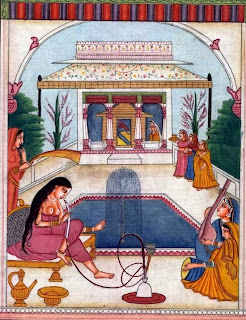
The Summer Pavilion - GulerDepicts the love-lorn virahini during the rainy month of sawan, when married women eagerly await the return of their husbands. The dark clouds in the sky are lit up by flashes of lightning; and the snow-white sarus cranes contrast vividly with their sombre colour. The heroine watches the flight of the birds from a pavilion. In the background is a mountain lake with rushes growing on its banks among which slate blue sarus cranes, intensely devoted to each other, move about in pairs. A flock of cattle is grazing peacefully on a meadow close to the hamlet. The maidservants play on the tambura and the dholaka. The intense heat that precedes a thunder shower is skillfully suggested. A maidservant pours some cold drink into a cup while another makes some sandal paste. Another maidservant fans the nayika but her body, burning with the fever of love, knows no coolness. The modesty and love of a young Indian woman are gracefully portrayed in this painting.

The last stage of viyoga, vyadhi, is illustrated in a painting from Tira Sujanpur. Unable to bear the pangs of separation, the lady has fainted. A maidservant applies sandal paste on her bosom, while another fans her. In the adjoining balconies pairs of anxious women express concern over the lady's condition. In the background is a pastoral scene, where villagers warm their limbs in front of log-fires in the severe winter. The cold weather outside is in contrast with the hot fever of love that j racks the body of the lady separated from her lover.

Writer Name:- M.S. Randhawa

Patrons, Artists And Themes of Kangra Paintings

Posted by Art Of Legend India [dot] Com On 10:20 PM 0 comments
Portrait of Maharaja Sansar ChandThe principal centre of Pahari painting was the Kangra Valley where the artists worked under the patronage of the Hill Rajas of Guler, Kangra and Nurpur. From here the artists migrated to the neighbouring States of Mandl, Suket, Kulu, Tehri and Garhwal in the cast and Basohli and Chamba in the north. The art of these States was but an off-shoot of the art of Kangra and the most appropriate name for this version of Rajput art is the "Kangra Valley School of Painting".

Specimens of early paintings in the Basohli style can be found in all the Punjab Hill States. They are simple works, full of strength and primitive vitality. The pattern is rugged and domineering, and the lines and colours are bold and enduring. The hill painter selected themes which he could handle with masculine directness, without apology or prudery. He worked with fearless passion, imparting 10 his work energy and power which is in great contrast with the nervous grace of later creations. The artist attained a maximum of expression with the minimum of means. The vibrant colours of Basohli paintings are enchanting.

The main centres of Kangra painting were Guler, Basohli, Chamba, Nurpur, Bilaspur and Kangra. Guler, and Nurpur are near the plains and their Rajas came into early contact with the Mughal emperors.

Of the Hill States, Guler has the longest tradition in the art of painting. It has been established that during the rule of Dalip Singh (A.D. 1695-1743) artists were working at Haripur-Guler. Portraits of Dalip Singh exist and these can hardly be later than 1720. There are a number of portraits of his eldest son, Bishan Singh, which can be dated to about 1730. Bishan Singh died during the lifetime of his father and in 1743 his younger brother Govardhan Chand became the Raja of Guler. Govardhan Chand was a patron of art and a large number of his portraits which were formerly in the collection of Raja Baldev Singh are now in Chandigarh Museum. We reproduce a painting of Govardhan Chand listening to music, which was in the collection of Raja Baldev Singh and is now in Chandigarh Museum.

Basohli style PaintingsThe Raja is seated on a terrace listening to the music of drums and pipes. Terraces of this nature can be seen in the Haripur-Guler Fort overlooking the Ranganga. It is a key painting which marks the transition of the Mughal into the Kangra style. Describing this painting, J. C. French observes: "The Raja is listening to music, and the air of gentle reverie is well expressed. The pose of the individual figures and the balance of the whole is admirable. In this respect it resembles the finest of the Mogul paintings, but it has a delicacy and a spirituality of feeling to which the Mogul art never attains. The coloring of Kangra pictures of this period is extraordinarily delicate. The Kangra artist had the colours of the dawn and the rainbow on his palette."The role of Guler in the evolution of the Kangra style is thus summed up by Dr. Archer:

"The State of Guler played a decisive part in the development of Pahari painting in the eighteenth century. Not only did it develop a local art of the greatest delicacy and charm, but the final version of this Guler style was taken to Kangra in about 1780, thus becoming the `Kangra' style itself. Guler is not merely one of thirty-eight small centres of Pahari art. It is the originator and breeder of the greatest style in all the Punjab hills." Subsequent research has fully confirmed Dr. Archer's thesis, and if any place can be called the birth place of Kangra painting, it is Guler.

Research which has been carried from 1952 onwards has proved that the paintings in early Guler style were by the artists Manaku and Nainsukh. The sons of these artists and the grandsons of Nainsukh worked at Guler, Basohli, Chamba and other places and are responsible for the finest paintings.

The greatest patron of painting in the Punjab hills was Maharaja Sansar Chand. He was born in 1765 at Bijapur, a village in Palampur tehsil. In 1786, he occupied the Kangra Fort and became the most powerful Raja of the Punjab hills. In 1794, he defeated Raja Raj Singh of Chamba and annexed a part of his territory. Later on, he defeated the Rajas of Sirmur, Mandl and Suket. Raja Prakash Chand of Guler became his vassal.

In 1809, Sansar Chand employed a European adventurer, 0' Brien, who established a factory of small arms and raised a disciplined force of 1400 men for him. In seelo Brien waving a fly-whisk over Sansar Chand. It is a very fine portrait by one of the Guler artists who had migrated to Tira-Sujanpur. The green background with dashes of red in the horizon is typical of the work of these artists. The character of Sansar Chand, proud and sensitive, is well brought out in this painting.

Kangra paintings under the patronage of Sansar Chand were painted at Alampur, Tira-Sujanpur and Nadaun, all on the banks of the Beas. Very little painting, if at all, was done at Kangra proper which remained under Mughal occupation till 1786 and Sikh occupation from A.D. 1810 to 1846.

Little has been written about Nurpur, an important centre of Kangra painting. Raja Bas Dev (A.D. 1580-1613) came in conflict with the Mughals during the reign of Akbar. Jagat Singh (A.D. 1619-1646), however, entered the service of Jahangir and must have come in contact with the work of Mughal painters. A portrait of Jagat Singh in Basohli style is in the collection of Chandigarh Museum, and there is every likelihood that this style may have originated as a parallel development at Nurpur apart from Basohli. Rajrup Singh (A.D. 1646-1661) was also in the employ of Aurangzeb. Some paintings ascribed to the reign of Prithvi Singh (A.D. 1735-1789) are extant. Most of them belong to the reign of Bir Singh (A.D. 1789-1846), a contemporary of Prakash Chand and Sansar Chand.

"Sensitive, reticent and tender, it perfectly reflects the self-control and sweet serenity of Indian life, and the definitely theocratic and aristocratic organisation of Indian society. It lands itself to the utterance of serene passion and the expression of unmixed emotions!" This description of Rajput painting by Coomaraswamy is particularly relevant to the art of the lovely valley of Kangra. The romance of the Epics and the Puranas were here given a new life in the voluptuous line and colour, the Krishna-Lila with all its exotic symbolism was reenacted by the painter's brush, the Shiva-Parvati lore was invested with fresh colour and the lyrics of Keshav Das were given a new expression.

The art of the Kangra Valley acquires deep meaning if viewed in its cultural perspective. The symbolism conveys to us a sense of reality. The style has a unique sense of freedom and is closely connected with the soil. There is no self-consciousness, no studied emotions, no attitudes. It is free from the stresses of exaggerated personality and deliberate individuation, and the painting is nothing but music in colour. The emotions it seeks to portray are registered with astonishing truth. The technique is "limited", and we find the painter employing set formulas in the portrayal of features, limbs and landscape. Yet the effect is beautiful, for the forms that evoke it are truly vital, transcending the limitations of mere technique. It is here that lies the greatness of Kangra art.

Kangra PaintingsThe flowing and graceful curves of Kangra art form rhymes and assonances. The eye moves with ease and comfort from one point to another enjoying delightful rhythms and harmonies and the restful beauty of the curve.

With a change in the taste of the patrons, and in keeping with the new trends of mysticism, lyricism was seen to enter Kangra painting. "The figures are now more animated, the line more nervous and fluent, the resurge of physical charm is deliberate, women are willowy and slender, their eyes very long and curved, and the deep-dyed fingers are delicate and tapering."' Kangra art was imbued with a subtle charm, and the delicate and refined pictures acquired an almost feminine grace for which they were to become so well known.

The inner vitality and natural charm of the style faded away in the early 19th century. There was an increasing tendency towards mere ornamentation. The energy of the artist was now directed towards superficial embellishment and fineness of detail. The art fell into decay and died, but the artist outlived it for a while. He was haunted by memories which he tried to paint, but the living presence that inspired him once was no more. The patronage of the court, too, had disappeared and though he painted, there was neither joy in his work nor life in his creation. There was an endless repetition of cliches.

The birth of Kangra art in the Valley about the middle of the 18th century, and its decline in the middle of the 19th century is a strange phenomenon in the history of Indian art. Its sudden decay is difficult to explain. The Valley is the same with its mountains and sparkling streams of water, but where are those men of genius? As one wanders through the ruins of Haripur, Sujanpur, and Nadaun, one cannot help being moved by the dead splendour of the palaces; their culture has disappeared never to return.

To turn to the technique of Kangra painting; its chief features are delicacy of line, brilliance of colour and minuteness of decorative detail. Like the art of Ajanta, Kangra art is essentially an art of line. As Coomaraswamy observes, "Vigorous archaic outline is the basis of its language." This amazing delicacy and fineness of the line was achieved by the use of fine brushes made from the hair of squirrels.

A preliminary sketch in light red colour was made with the brush on brown hand-made Sialkoti paper. This was primed with white and the surface made very smooth. The outlines were then redrawn in brown or black. Colour was now applied, first the background and then the figures. The outline was now redrawn and the picture finished. Very often the colouring was done by assistants after the master had completed the drawing.

The Kangra painters made use of pure colours, like yellow, red and blue, and these have retained their brilliance, even after two hundred years. Many unfinished sketches are to be had in which the names of colours to be employed are indicated on the sketch. Sketches were often preserved as heirlooms, and used for fresh commissions with a few modifications.

Kangra painting knows no perspective, but the wonderful glowing colours and delicate line-work more than compensate for this deficiency. The human figures, particularly of women, were mostly drawn from memory and this explains the similarity of the female faces with gazelle-like eyes, straight noses and rounded chins. Each artist evolved his own formula for the portrayal of faces, and though names of artists may not be written on paintings, it is possible at times to identify the work of individual artists. Almost all the faces are drawn in profile. Perhaps it was easier to do so, but it may be that the beautifully chiselled features of Kangra women are more effectively portrayed in this manner.

Kangra painting till recently was regarded as largely anonymous. Recent research has revealed the names of a number of artists. Manaku and Nainsukh were artists of outstanding ability. Kama, Nikka, Ranjha and Gaudhu, sons of Nainsukh, were also well-known artists. A few pictures from Guler are signed by Gursahaya. Khushala, Fattu and Purkhu are mentioned as artists in the employ of Sansar Chand. Purkhu specialised in delicate paintings in transparent tones and subdued colour. His son, Ramdayal, who is said to have inherited much of his father's talent, is also mentioned. Nikka worked at Chamba during the rule of Raja Raj Singh. His sons Chhajju and Harkhu worked for Raja Jeet Singh.

The central theme of Kangra painting is love, and its sentiments are expressed in a lyrical style full of rhythm, grace and beauty. As Coomaraswamy states, "What Chinese art achieved for landscape is here accomplished for human love." The recurring theme of Kangra painting, whether it portrays one of the six seasons or modes of music, Krishna and Radha or Shiva and Parvati, is the love of man for woman and of woman for man. To the Kangra painters the beauty of the female body comes first and all else is secondary. It is her charms that are reflected in the landscape of the Kangra Valley.

Dr. W. G. Archer has rendered great service to art criticism and appreciation by pointing out sexual symbols in Kangra painting. Whether the symbols were consciously used or were an expression of hidden urges of the subconscious mind is difficult to decide. Rajput society of the late 18th and early 19th centuries was puritanical in nature. There was considerable repression of normal emotions and it is possible that the aristocracy found a release for its repressed desires in paintings of an erotic character.

Raja Goverdhan Chand Listening musicThese love-pictures display considerable intensity of feeling and are works of real beauty. Life in the foot-hills of the Himalayas was full of danger and insecurity, and death lurked not only on the battle-field but also in the thick forests that covered the area. Women were greatly relieved when their husbands came home safely, and their meeting was all the more intense for its uncertainty.

We sec a deep love of nature in Kangra painting. The landscapes are characteristic of the lower Beas Valley. Low undulating hills crowned with umbrella-like pipal and banyan trees, mango groves, and the farmers' homesteads hidden in clumps of bamboo and plantain, fresh water streams brimming with the glacial waters of the Dhauladhar, rivulets meandering through wave-like terraced fields in which love-sick pairs of mints cranes wander all these are represented faithfully. This landscape is suffused with love, and the intensity of the artist's perception breaks through the world of appearances to touch the core of reality. As Okakura says: "Fragments of nature in her decorative aspects, clouds black with sleeping thunder, the mighty silence of pine forests, the immovable serenity of the snow and the ethereal purity of the lotus rising out of darkened waters, the breath of star-like plum flowers, the stains of heroic blood on the robes of maidenhood, the tears that may be shed in his old age by the hero, the mingled terror and pathos of war, and the waning light of some great splendor such are the moods and symbols into which the artistic consciousness sinks before it touches with revealing hands that mask under which the Universal hides. Art thus becomes the moment's repose of religion, or the instant when love steps half unconscious on her pilgrimage in search of the Infinite, lingering in gaze on the accomplished past and dimly seen future a dream of suggestion, nothing more fixed but a suggestion of the spirit, nothing less noble."

Writer -  M.S. Randhawa
 

Kangra paintings - Painting art of Kangra valley

Posted by Art Of Legend India [dot] Com On 4:14 AM 0 comments
Kangra is situated in the eastern part of Himachal Pradesh. It is the most populous district of the state of Himachal Pradesh. Today Kangra is also known as Bhawan or Nagarkot. Bhawan because of the Bajreshwari Devi Temple, and Nagarkot because of the fort Nagarkot. Various schools of miniature paintings, collectively called Pahari, flourished between the 17th and 19th centuries in the sub-Himalayan states. Perhaps the most famous, or at least the most prolific school, was that of the Kangra School, from which came an extensive range of delicate and beautifully detailed paintings. 

The Kangra school of paintings is an integral part of art literature. Kangra paintings belong to the school of Pahari paintings that were patronized by the Rajput rulers between the 17th and 19th centuries. Kangra paintings is not a folk art, it is essentially aristocratic art, the patrons of which were the rulers of had fine sensibility and good taste, thus like the best of Europe, Kangra painting is the art of elite. Though the main centre of Kangra paintings are Guler, Basohli, Chamba, Nurpur, Bilaspur and Kangra. Later on these styles also reached Mandi, Suket, Kullu, Nalagarh and Tehri Garhwal and now are collectively known as Pahari painting.

The Kangra School became widely popular with the advent of Jayadev's Gita Govinda, of which many extant manuscripts feature exquisite Kangra illustrations. This style was copied by the later Mughal painting, many of whom were patronized by the Rajput rulers who ruled various parts of the region. The pictorial art of Kangra is the finest gift of India to the art-world. This great art originated in a small hill state ‘Guler’ in the Lower Himalayas in the first half of the eighteenth century when a family of Kashmiri painters trained in Mughal Style of painting sought shelter at the court of Raja Dalip Singh (1695-1741) of Guler. The Kangra paintings reached their maturity during the reign of Maharaja Sansar Chand (1775-1823 AD.). Maharaja Sansar Chand was a great patron of Kangra art. Being a liberal patron, the painters working at his atelier received large commissions while others accepted a permanent settlement in the form of lands. He was also an ardent devotee of lord Krishna and used to commission artists to paint subjects based on the loves and life of Lord Krishna.

Kangra paintings were influenced by the Bhagavad Purana. They portrayed incidents and scenes from the life of lord Krishna. The other popular themes were the stories of Nala and Damayanti and those from Keshavdas's Baramasa. In Baramasa (the Twelve Months) paintings, the artists tried to bring out the effects of seasons round the year on the emotions of human beings. Kangra paintings depict the feminine charm in a very graceful manner. The figure of youthful coy nayika (heroine) seen in Kangra miniatures is an ideal physical type which is slender and elegant, radiating infinite charm, sensitiveness and refinement. Facial features are soft and refined. The female figures are outstandingly beautiful. Apart from female beauty, landscapes, countryside, rivers, trees, birds, cattle, flowers etc. are meticulously portrayed in these paintings.

The Kangra painters used colors made of vegetable and mineral extracts. They employed cool and fresh colors. Fattu, Parkhu and Kushana were important artists of this school. The Kangra artists were hereditary painters who worked in the quiet of their cottages in the sylvan retreats of the Kangra valley. Sons and nephews were usually accepted as pupils and they served the master artists by carefully grinding mineral colors, a work requiring skill and patience. It thus they were initiated into the art and technique of painting. Life was simple and the rulers provided food grains and a cow for milk to the artists. Whenever they presented a beautiful painting to the rulers, they were handsomely rewarded. Thus their economic needs were taken care of by their patrons and they were free to devote their time to paintings. In Kangra paintings, there is an art which celebrates life and love. This art is truly a record of human joy. The eyes of lovers meet and a world of feeling and tenderness is revealed in them.

Bhakti cult was the driving force and the love story of Radha and Krishna was the main source of spiritual experience, which was also the base for the visual expression. Bhagvata Purana and the love poems Gita-Govinda of Jaidev were the most popular subjects dealing with the legends and the amorous plays of Radha and Krishna symbolizing soul’s devotion to God. The Gita Govinda is a forest idyll and its Kangra paintings, the drama of loves of Radha and Krishna is played in the forest or along the river bank. In the paintings of the Sat Sai the background of the architecture provides the setting for the love drama of Radha and Krishna. Kangra painting presents a pure melody of flowing lines and glowing colors, breathing out a sense of space, tranquillity and poetic sentiment. Even the unfinished pictures and sketches reveal their own charms.All paintings are courtesy of Art of Legend India.

Company Overview

Art of Legend India has the distinction of being one of the best in the Indian Handicraft Industry. We are about 75 years old handicrafts manufacturer & exporter. We are having team of more than 500 craftsman.

We are having our business offices in India, USA & Germany to ensure our best services.

Total Pageviews