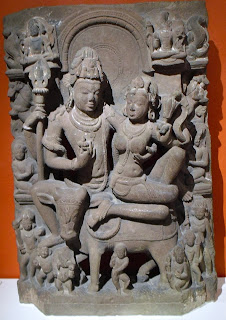
The Hindu Triad
As
we have seen, the idea of a triad of gods is rooted in the earliest Indian
beliefs and seems to have its origin in solar cults, for the 'three-bodied' sun
created with his fertilizing warmth, preserved with his light, and destroyed
with his burning rays. Though the triad remained, its members changed, so that
the Adityas (Varuna, Mitra and Aryaman) gave way to Agni, Vayu and Surya, and
Vayu in turn gave way to lndra. These deities were sometimes thought of simply
as the three most important gods, some-times as components of a single god
embracing the world: Agni is the earth god, Vayu or Indra is the god of the
atmosphere and Surya is the god of the sky. In the Rig Veda, Indra is closely
united not only with Agni but also with Vishnu (in his earl form). But in the
Brahmanic and especially in the Upanishadic period Vishnu, not lndra, is the
most important god left from the Vedic pantheon and is thus fitted for a place
in the triad. Similarly Rudra or Shiva is early identified with fire, from his
role as god of red lightning, and can take the place of Agni. The first
conjunction of the Hindu gods was in Harihara, where Vishnu and Shiva were
treated as one deity. But this union ran counter to the tradition of the triad,
and perhaps for form's Brahma, being officially the All-god was added to make
up a triad.
This
triad was not, however, simply derivative from the fire triad it introduced the
new idea of conjunction and unity of creation, preservation and destruction,
which lined with the new concept of a cycle of life, death and rebirth. To a
great ex-tent the triad as such was of mystic significance; but though the idea
of a triune god embracing all three components was an old one, it became
particularly important in the context of sectarian belief, where the followers
of either Vishnu or Shiva sought to assert, and to prove by myths, that their
god was the greatest and actually contained the triad within him.
One
such myth relates that Vishnu and Brahma fell into a dispute as to which of
them was the more venerable. When they had been quarrelling for some time there
appeared before them a fiery pillar, like a hundred universe consuming fires.
Both gods were amazed at the sight and both decided that they must find the
source of the column. So Vishnu took the form of a mighty boar and followed the
column downwards for a thousand years, while Brahma took the form of a
swift-moving swan and travelled upwards along the column for a thousand years.
Neither reached the end and so returned. When they net again, wearily, where
they had started, Shiva appeared before them; they now recognised that the
column was Shiva's lingam, and acknowledged him the greatest and most venerable
of the gods.
Brahma
As
Creator, Brahma is sometimes said to have been the first of the gods, the
framer of the universe and the guardian of the world. At other times, how-ever,
he is said to be himself the creature of the Supreme Being, Pitamaya, the
self-existing father of all human beings. In the Puranas Brahma is held to be
the son of the supreme being and maya, his energy; or he is thought to have
hatched out from the golden cosmic egg, which floated on the cosmic waters; or
to have been born from a lotus which sprang from Vishnu's navel.
Though
he is sometimes thought to be self-created, Brahma's role, when he is
considered as one of the triad of Hindu gods, is exclusively that of creator,
his earlier position as All-god generally passing either to Vishnu or to Shiva.
As the world is already created, much more interest is aroused by these other
gods, the Preserver and Destroyer, who 'captured' the myths originally ascribed
to Brahma, such as his ten forms, which we shall consider as Vishnu's avatars.
Only traces of these myths survive, for example in Manu's creation myth, where
Brahma appears as a fish. Brahma often figures in the main body of Hindu
mythology as the inferior of Vishnu or Shiva, or as the victim of a sage or
demon, who by practicing austerities forces Brahma to make a concession and so
a situation where Vishnu or Shiva must intervene.
Formally
Brahma is revered as the equal of Vishnu and Shiva. He is the god of wisdom,
and the four Vedas are said to have sprung from his heads. His heaven is said
to contain in a superior degree all the splendors of the other heavens of the
gods and of the earth.
Brahma
rides a goose and is depicted with red skin and wearing white robes. He has
four arms and carries the Vedas and his sceptre, or a spoon, or a string of
beads, or a bow, or a water jug. His most salient features, however, are his
four heads. Originally he possessed only one head, but he acquired four more,
and then lost one. Having created a female partner out of his own sub-stance,
Brahma fell in love with her. This modest girl, who is variously called
Satarupa, Savitri, Sarasvati, Vach, Gayatri and Brahmani, was embarrassed by
his fervent look, and moved to avoid his gaze. But as she moved to the right,
to the left and behind him, a new head sprang out in each of these directions.
Finally, she rose into the sky, and a fifth head appeared there to look at her.
Brahma joined with this girl, who was his daughter as well as his wife, to
pro-duce the human race.
It
was Shiva who deprived Brahma of his fifth head, though the story of how this
occurred varies. All versions, however, illustrate the tension existing between
them. Though it is sometimes said that they were born simultaneously of the
supreme being and immediately vied for superiority, some declare Shiva sprang
from Brahma's forehead; others claim that Shiva created Brahma, who worshipped
him and acted as his charioteer. As for Brahma's fifth head, according to one
version Brahma claimed that he was superior to Shiva, who thereupon cut off the
head with his nail. A second version states that Shiva cut off the head because
Brahma told Vishnu a lie in an effort to establish his superiority over Vishnu.
In a third version Shiva punishes Brahma for drunkenly commit-ting incest with
his daughter. A variant of this myth relates that the daughter was Sandhya,
Shiva's wife, who tried to escape her father's advances by changing into a
deer, but was pursued through the sky by Brahma in the shape of a stag. Shiva,
who witnessed all this, shot an arrow which cut off the head of the stag, and
Brahma then paid homage to Shiva. The fourth account says that Brahma wanted
Shiva to be born as a son to him and that Shiva, though he had promised Brahma
that he would grant him any boon, kept his promise but punished him for his
insolence by pronouncing a curse which deprived him of one head. But Shiva thus
committed Brahminicide, for Brahma was considered the chief of the Brahmins. He
was paralysed for his crimes and thus open to attack by a demon created by
Brahma. He fled but was captured and forced to perform penances.
Apart
from being the progenitor of the human race in general, Brahma was the father
of Daksha, who was born from his thumb. Daksha became chief of the Prajapatis,
sages associated with Brahma's creation. Though Daksha gave his daughter to
Shiva as a wife, he insulted the god until, cowed by his violence, he was
forced to acknowledge Shiva's superiority to him and to his father, Brahma.
Shiva
 Rudra,
Shiva's Vedic forerunner, was the red god of storms and lightning, the
terrifying god living in the mountains and god of cattle and medicine who must
be propitiated. As god of lightning, Rudra became associated with Agni, god of
fire and consumer and conveyor of sacrifice. With Rudra as his antecedent,
Shiva could claim as his inheritance the position of priest of the gods and of
candidate for divine supremacy.
Rudra,
Shiva's Vedic forerunner, was the red god of storms and lightning, the
terrifying god living in the mountains and god of cattle and medicine who must
be propitiated. As god of lightning, Rudra became associated with Agni, god of
fire and consumer and conveyor of sacrifice. With Rudra as his antecedent,
Shiva could claim as his inheritance the position of priest of the gods and of
candidate for divine supremacy.
By
contrast with Brahma, a personification of a relatively late abstract
principle, Shiva could combine with his Vedic antecedents features reaching
even farther back than the Vedic age. He had characteristics of the Indus god,
and his powers, especially in the epics, were said to derive from the practice
of austerities, that is from yoga rather than from sacrifice. Such powers
heightened his claims as priest of the gods. In the aspect of a yogi Shiva is
depicted with a snow-white face, is dressed in a tiger skin and has matted
hair.
Rudra's
original character as god of cattle is extended by combining it with that of
the pre-Aryan Lord of the Beasts. The bull is of course universally considered
as a symbol of fertility, and this aspect of the lord of cattle had attached to
Rudra. But the pre-Aryan Lord of the Beasts exacted sacrifice, because of the
ritual connection of sacrifice (death, murder and violence) with plant and
animal fertility a basic cult of agricultural peoples and the foundation of
Indian mythology in pre- and post-Aryan periods. The fertility-giving aspect of
Shiva is thus reinforced by identification with the yogic Lord of the Beasts,
and at the same time the idea of violence present in Rudra is under-lined.
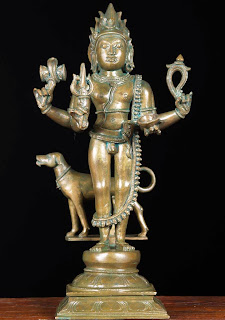
Shiva Bhairava, the Destroyer, is thus by extension Shiva the bringer of
fertility, the creator, the 'Auspicious'. In this sense his activity as
destroyer is essential to that of Brahma as creator, and Brahma is thus
some-times said to be inferior to Shiva. For this reason Shiva is known as
Mahadeva or Iswara, Supreme Lord. His supreme creative power is celebrated in
worship of the lingam or phallus.
Shiva
repeatedly demonstrates his mastery of austerities as the source 0f power. Thus
in the epic version of the slaying of Vritra by lndra, Vritra has obtained
power to create illusions, endless energy, unconquerable might and power over
the gods because Brahma cannot deny it to him after his practice of
austerities. Shiva alone of the gods has sufficient strength gained by yoga to
pit against that obtained by Vritra. It is Shiva who, by backing Indra and
lending him his strength, enables him to overcome Vritra.
On
another occasion Shiva acquired strength to make him superior to all the gods
combined. At one time the asuras had obtained a boon from Brahma which
consisted of the possession of three castles which could only be conquered by a
deity and then only if he could destroy them with a single arrow. From these
bastions the asuras made war on the gods, none of whom was strong enough to
shoot the fatal shaft. Indra, king of the gods, asked Shiva for his advice;
Shiva replied that he would transfer half his strength to the gods and that
they would then be able to overcome their enemies. But the gods could not
support even half of Shiva's strength, so instead they gave half of their own
strength to Shiva, who proceeded to destroy the asuras. However, he did not
return the gods' strength to them but kept it for himself, and ever after was
the greatest of the gods.
 He
is often depicted as a demon-slayer, in which role he is called Natesa, and is
seen dancing on the body of an asura. He sometimes wears an elephant skin
belonging to an asura he killed.
He
is often depicted as a demon-slayer, in which role he is called Natesa, and is
seen dancing on the body of an asura. He sometimes wears an elephant skin
belonging to an asura he killed.
His
boons are also positive: he is worshipped as giver of long life and god of
medicine, and his help is inestimable as strengthener of warriors. He is in a
sense indiscriminate in his role, for he is ready to give help to anyone who
would worship him. Thus in the Mahabharata Arjuna is said to have journeyed to
the Himalayas to propitiate the gods before the outbreak of the great war, but
got into a fight with a mountaineer who was Shiva in disguise. When he
discovered who his adversary was he worshipped him and was not only forgiven
but also given a powerful magic weapon. On the other hand Aswathaman, who was
on the opposing side in the Bharata war, and who also fought tenaciously with
Shiva until he realised who he was, threw himself on a sacrificial fire in the
god's honour, this being the only offering he could make; as a reward for this
Shiva entered into his body, so enabling him to slay all about him.
Among
Shiva's beneficent roles is that of distributor of the seven holy rivers. The
Ganges, which winds round Brahma's city on Mount Meru in the Himalayas,
descends from the mountains in great torrents. Shiva, in order to break the
fall, stands beneath the waters, which wind their way through his matted locks
and divide into seven, the holy rivers of India. Shiva performed a vital
service to the gods and thus to the world during the churning of the ocean of
milk, the object of which was to produce amrita, or ambrosia, which was to
strengthen the gods in their struggle against the demons. After some time the
serpent Vasuki, whom the gods were using as a churning rope, vomited forth
poison, and this was about to fall into the ocean of milk, contaminate the
ambrosia and thus destroy the gods. But Shiva stepped forward, caught the
poison in his mouth, and was saved from swallowing it himself only by the
efforts of his wife Parvati, who by strangling him held the poison in his
throat, which turned it blue.
Apart
from his blue throat, Shiva is represented as a fair man, with five faces, four
arms and three eyes. The third eye appeared in the centre of his forehead one
day when Parvati play-fully covered his eyes and thus plunged the world into
darkness and put it in danger of destruction; it is a powerful weapon, for by
fixing it upon his enemies Shiva can destroy them with fire. With this eye, he
kills all the gods and other creatures during the periodic destructions of the
universe. His other weapons are a tri-dent called Pinaka, which is a symbol of
lightning and characterizes Shiva as god of storms; a sword; a bow called
Ajagava; and a club with a skull at the end, called Khatwanga. Further weapons
are the three serpents which twine around him and may dart out at enemies: one
coiled in his piled up, matted hair and raising its hood above his head; one on
his shoulder or about his neck; and one which forms his sacred thread.
In
addition to the weapons, most of Shiva's personal attributes emphasise the
violent aspects of the deity, for which he is most generally known. These
include his head-dress of snakes and necklace of skulls, which he wears when
haunting cemeteries as Bhuteswara, lord of ghosts and goblins. In the character
of Bhairava his violent nature is intensified, for he is then said to take
pleasure in destruction for its own sake. When depicted in such roles Shiva is
attended by troops of imps and demons. In his role as stern upholder of
righteousness and judge, he carries a drum shaped like an hourglass and a rope
with which to bind up sinners.
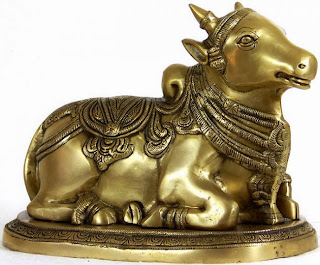
 Apart
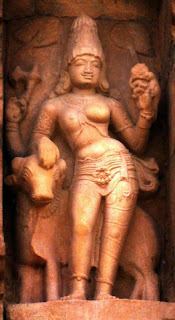
from the lingam, personal attributes which characterise Shiva as god of
fertility are the bull Nandi which accompanies him or whose symbol in the shape
of a crescent moon he wears on his brow, encircling his third eye, and the
serpents which twine about him. Many of Shiva's violent aspects are symbolised
in the characters of his consorts, who are particularly associated with his
bloody rites. The yoni, which is their emblem as the lingam is his, is known as
his shakti, or female energy.
Apart
from the lingam, personal attributes which characterise Shiva as god of
fertility are the bull Nandi which accompanies him or whose symbol in the shape
of a crescent moon he wears on his brow, encircling his third eye, and the
serpents which twine about him. Many of Shiva's violent aspects are symbolised
in the characters of his consorts, who are particularly associated with his
bloody rites. The yoni, which is their emblem as the lingam is his, is known as
his shakti, or female energy.
Shiva
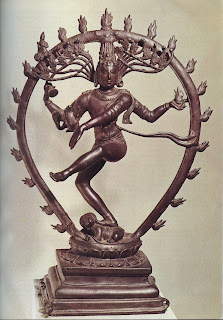
likes to dance in joy and in sorrow, either alone or with his wife Devi, for he
is the god of rhythm. Dancing symbolises both the glory of Shiva and the
eternal movement of the universe, which it serves to perpetuate. But by the
Tandava dance he accomplishes the annihilation of the world at the end of an
age and its integration into the world spirit, so that it represents the
destruction of the illusory world of maya. Maya no longer refers to Varuna's
creative energy in the universe; it is that which governs life on earth, the
illusion of material reality, and that from which by various means the faithful
seek to free themselves. When dancing Shiva represents cosmic truth; he is
surrounded by a halo and accompanied by troops of spirits. He is watched by
anyone fortunate enough to be granted the vision. When the serpent Shesha saw
the dance he forsook Vishnu for several years and gave himself up to
austerities in the hope of seeing it again. The gods them-selves assemble to
behold the spectacle, which was treated as proof of Shiva's superiority over
Vishnu by some hermits who till then had lauded only Vishnu. Even demons are
affected by his dance when he performs it in cemeteries, thus bringing the
unclean evil spirits into the orbit of his spiritual power.
But
Shiva is generally depicted immobile, as an ascetic naked, his body smeared
with ashes and his hair matted. His meditation and austerities build up his
spiritual strength, giving him unlimited powers to per-form miracles and also
strengthening his powers as fertility god, for the two roles are not so
antithetical as might at first appear from the myth in which he kills Kama, god
of desire, by burning him up with the fire from his third eye. Though Shiva may
have struck Kama dead for having interrupted his meditations, the effect of
Kama's shaft was not thereby nullified. By still further delaying his union
with Parvati, thereby causing Parvati herself to perform austerities in order
to arouse his interest and causing all the gods to hope anxiously for the
consummation of his desire, Shiva in effect heightened the desire and
strengthened the force of his role as fertility god. The child produced from
his union with Parvati was one of the strongest of the later pantheon:
Karttikeya, god of war, who to some extent supplanted Agni.
It
was the angry sage Bhrigu who caused Shiva to be worshipped in the form of the
lingam. He was sent by the other sages to test the three gods of the triad to
see which was the greatest. When he reached Shiva the god did not welcome him;
he Was engaged with his wife and would not be interrupted. For his lack of
respect due to a sage, Bhrigu cursed Shiva to be worshipped as the lingam.
Brahma also failed to gain Bhrigu's approval, for he was too occupied with his own
self-importance to receive the sage with due courtesy. Vishnu was sleeping when
Bhrigu reached him and the sage rudely kicked him in the ribs Instead of rising
in wrath Vishnu, full of concern, asked him if he had hurt himself, gently
rubbing the foot which had injured him. Bhrigu went away proclaiming that this
was the god most worthy of adoration such compassion and humility before a sage
was the mark of greatness.
Shiva
quarrelled with many of the gods, for though he claimed the right' to judge their
actions and to punish them, many of the other gods in turn considered him to be
a Brahminicide because he struck off one of Brahma’s heads, for which offence
he was condemned to be a wanderer and to perform penances. The gods mocked at him
as an ugly, homeless mendicant unclean, ill-tempered and a haunter of
cemeteries. Eventually, however like Brahma and Vishnu, Shiva acquired a heaven
of his own. This was situated on Mount Kailasa, in the Himalayas, and was the
scene of his austerities and where the Ganges descended on his head.
Though
Shiva quarrelled with many of the gods, his most open disputes were not with
Vishnu, his real rival, but with Brahma. The quarrel was continued in a feud
with Daksha Brahma's son, who became Shiva's father-in-law. When Daksha called
together the assembly at which his daughter Sati was to choose her husband, he
issued invitations to all the gods except Shiva, whom he considered to be
disqualified because of his impure habits and unkempt appearance. But as Sad
had long been a devotee of Shiva and wished to marry no one else, she was disconsolate
to discover Shiva's absence After searching the assembly hall she prayed to him
to appear and threw the garland into the air, where Shiva appeared and received
it. Daksha was thus forced to allow the marriage.
Shiva
had not, however, forgotten the initial insult, and later, when Daksha held an
assembly to which all the gods were invited, he repaid it in kind. As Daksha
entered all the gods rose to greet him, except his father, Brahma, and his
son-in-law, Shiva. Brahma, of course, owed no such deference to his own son:
but the disrespect from his son-in-law enraged Daksha, who declared to the
assembled gods and sages his low opinion of Shiva, a disgrace to the reputation
of the guardians of the world, who encouraged others to transgress and himself
flouted divine ordinances and abolished ancient rites (sacrifice). Daksha
protested against Shiva's ha-bit of haunting cemeteries accompanied by ghosts
and spirits, looking like a madman, with no clothes, smeared with ashes, with
matted hair, and with skulls and human bones about his person; and he denounced
his habit of calling himself 'Auspicious' (Shiva) when in fact he was dear only
to the mad and to the beings of darkness. Having delivered himself of his
tirade, Daksha returned home to plan his next move against Shiva, which was to
hold a great sacrifice without inviting his son-in-law to be present.
 Daksha's
revenge was, however, to miscarry. Sati, seeing all the gods trooping off to
the sacrifice, enquired where they were going and was disconsolate when she
heard that they were all going to her father's home. Accordingly she went
herself to see her father and pleaded with him to invite Shiva. But Daksha
merely repeated the strictures he made at the earlier assembly; upon which
Sari, to vindicate her husband's honour, jumped into the sacrificial fire and
was consumed by its flames. Shiva, hearing of this, stormed into Daksha’s house
and, producing from his hair some of the demons with whose company Daksha
reproached him, destroyed the sacrifice. In the uproar which followed he
scattered all the gods and cut off Daksha's head.
Daksha's
revenge was, however, to miscarry. Sati, seeing all the gods trooping off to
the sacrifice, enquired where they were going and was disconsolate when she
heard that they were all going to her father's home. Accordingly she went
herself to see her father and pleaded with him to invite Shiva. But Daksha
merely repeated the strictures he made at the earlier assembly; upon which
Sari, to vindicate her husband's honour, jumped into the sacrificial fire and
was consumed by its flames. Shiva, hearing of this, stormed into Daksha’s house
and, producing from his hair some of the demons with whose company Daksha
reproached him, destroyed the sacrifice. In the uproar which followed he
scattered all the gods and cut off Daksha's head.
He
then gave himself up to insane grief over Sati's death, retrieving her body
from the embers and clasping her to him and calling on her to answer him. So
violent was his emotion and the rhythm of the dance into which he threw
himself, encompassing the world seven times, that the whole universe and its
creatures suffered too. Finally Vishnu, to put an end to this frenzy of
mourning, cut Sati's body, which was still in Shiva's arms, into fifty pieces,
and thus re-stored him to his senses. Shiva repented of his murder of Daksha
and brought him back to life; but the head could not be found, so a goat's head
was used instead.
But
this was not the end of the feud. When Sari was reborn as Parvati and again
married to Shiva, Daksha held another sacrifice and once more failed to invite
Shiva. Parvati spied the festivities from her seat on Mount Kailasa and
informed Shiva who, furious, rushed to the scene. Accounts of what followed
vary.
According
to the famous version, given in the Mahabharata, Shiva pierced the offering
with an arrow and thereby inspired such fear in the gods and sages that the
whole universe quaked. Shiva then attacked the gods, putting out Bhaga's eyes
and kicking Pushan as he was eating the offering and knocking out his teeth; or
alternatively causing Pushan to break his teeth on the arrow embedded in the
offering whereupon the gods acknowledged Shiva as their lord and refuge.
More
interesting are the versions of the myth which introduce Shiva's true rival,
making the issue less the feud with Brahma than a dispute with Vishnu for
supremacy. According to one, Shiva hurled Pinaka, his blazing lightning
trident, which destroyed the sacrifice that Daksha was holding in honour of
Vishnu and then struck Narayana's (Vishnu's) breast. Narayana hurled it back
with equal vigour at Shiva, and a battle flared up between the two gods which
was halted only when Brahma intervened, persuading Shiva to appease Narayana.
There
is even more violence in the version of the myth told in the Puranas when Shiva
heard from Parvati that he had been excluded from the sacrifice. He created a
'being like the fire of fate', called Virabhadra, whose looks and powers were
terrifying, and sent him, together with hundreds of thousands of specially
created demigods, to the place of sacrifice. These creatures broke up the
sacrifice, causing the mountains to totter, earth to shake, winds to roar and
the sea to be disturbed. The gods were routed: Indra was trampled underfoot, Yama's
staff was broken, Sarasvati's nose was cut off, Mitra's eyes were put out,
Pushan had his teeth knocked down his throat, Chandra was beaten, and Agni's
hands were cut off. Then either Daksha admitted Shiva's supremacy, or the
intervention of Vishnu, who seized Shiva by the throat, forced Shiva to desist
and acknowledge Vishnu as his master.
Vishnu
In
the Vedas Vishnu distinguishes himself only for the 'three steps' with which he
measures out the extent of the earth and heavens. The significance of this act
is amplified to include other functions in the epics, where Vishnu is equated
with Prajapati, the creator and supreme god. As Prajapati he encompasses
Brahma, Vishnu himself as preserver, and Shiva as destroyer. As the preserver
he is the embodiment of the quality of mercy and goodness, the self-existent,
all pervading power which preserves and maintains the universe and the cosmic
order, dharma. Vishnu is the cosmic ocean, Nara, which spread everywhere before
the creation of the universe, but is also called Narayana, 'moving in the
waters'; in this character he is represented in a human form, sleeping on the
coiled serpent Shesha, or Ananta, and floating on the waters. Brahma is
sometimes said to have arisen from a lotus growing from his navel as he slept
thus. After each destruction of the universe Vishnu resumes this posture.
According to Vishnu's adherents, he is unlike Brahma and Shiva in that he has
no need to assert his own superiority. Indeed, his mildness combined with his
power proves him to be the greatest of the gods. As the preserver, Vishnu is
the object of devotion rather than of fear, and this affection is similarly
extended to his wife Lakshmi, goddess of fortune.
When
Vishnu is not represented reclining on the coils of the serpent Shesha, with
Lakshmi seated at his feet, he is shown as a handsome young man with blue skin,
dressed in royal robes. He has four hands one holds a conch shell or Sankha, called
Panchajanya, which was once inhabited by a demon killed by Krishna; the second
hand holds a discus or quoit weapon called Sudarsana or Vajranabha, also an
attribute of Krishna's, given to him by Agni as a reward for defeating lndra;
the third hand holds a club or mace called Kaunodaki, presented to Krishna on the
same occasion; the fourth hand holds a lotus, or Padma. He also has a bow
called Sarnga, and a sword called Nandaka. He is usually either seated on a
lotus with Lakshmi beside him, or riding his vehicle, Garuda, who is half-man
and half-bird.
 Vishnu's
heaven, Vaikuntha, is on the slopes of the world-mountain Mount Meru. With a
circumference of 80,000 miles, Vaikuntha is made entirely of gold and precious
jewels The Ganges flows through it, and is sometimes said to have its source in
Vishnu's foot. Vaikuntha contains five pools, in which grow blue, red and white
lotuses Vishnu and Lakshmi are ensconced amid the white lotuses, where they
both rdiate like the sun.
Vishnu's
heaven, Vaikuntha, is on the slopes of the world-mountain Mount Meru. With a
circumference of 80,000 miles, Vaikuntha is made entirely of gold and precious
jewels The Ganges flows through it, and is sometimes said to have its source in
Vishnu's foot. Vaikuntha contains five pools, in which grow blue, red and white
lotuses Vishnu and Lakshmi are ensconced amid the white lotuses, where they
both rdiate like the sun.
Though Vishnu existed as a god in Vedic times, his role as
preserver is essentially a late development. It depends upon two
assumptions. First, the theory of samsara, which teaches that every human is
born many times over and that each life represents a punishment or a reward for
his previous life, according to how well he has followed his dharma, or the
path of duty laid down for him in that particular condition of life. If in each
life he has faithfully performed his duty, he may hope to progress steadily
upwards, until he becomes a saint, or even a god. On the other hand, if he does
not perform his duty he progresses as steadily towards life as a demon. The
second assumption is that gods and demons represent the two poles of existence,
and that both are active in the world, a constant struggle being carried on
between the two forces. In the normal course of events, good and evil are
evenly matched in the world; at times, however, the balance is destroyed and
evil gains the upper hand. Such a situation is deemed unfair to humans and at
such times it is Vishnu as preserver who intervenes by descending to earth in a
human incarnation or avatar.
Such
avatars are therefore not chance events, and during each one Vishnu has a
specific task to perform. It is sometimes thought that Vishnu is called upon to
descend to earth in this way once in each cycle of universal time. There are
ten avatars in the present Mahayuga, the first four of which are said to have
occurred during the Kritayuga, and the seventh, eighth and ninth of which are
the best known. Late texts, however, say that there are twenty-two, or even
that they are innumerable.
With
the eighth incarnation, that of Krishna, which became very popular at a
relatively late stage, a new and important idea is added to the older beliefs.
Since Brahmanic times it had been believed that the progressive rise through
countless lives to the level of god to enter Indra's heaven' should not be the
ultimate aspiration; it was far better to practise austerities (yoga) until the
point where the soul became entirely unattached to the individual and was able
to fuse with the universal spirit. The achievement of this release (moksha)
became the ultimate aim, only to be attained by certain gifted spirits, and it
absolved them from the weary round of existences to which they were otherwise
doomed. Now the Krishna myth introduced an important variant to this belief,
for in the course of the Mahabharata the god explains that there is another route
to release of the soul: this is through bhakti, or devotion to a particular god
(in this case Krishna speaks only of devotion to himself, who as Vishnu can in
any case be equated with the universal spirit). Thus by concentrating his
thought on the god a person can hope to merge his or her soul with him and earn
release in a way that is far more attractive than the old discipline of
austerities and yogic concentration. It is this which explains the enormous
popularity of Krishna, who is the most widely worshipped avatar of Vishnu. It
may be remarked in passing that this aspect of his cult has obvious
similarities to Semitic beliefs in a saviour god and that the episodes of
Krishna and the cowgirls resemble Dionysiac cults.
An
interesting twist to the theory of bhakti is seen in the myth relating to
Sisupala, King of Chedi, who hated Krishna so much that he thought of nothing
else but him or Vishnu, even in his sleep and even as he lay dying. And the
consequence of this was that Sisupala too gained release, simply from
concentrating his thoughts so exclusively on the god. Besides the avatars,
Vishnu has a thousand names, the repetition of which is a meritorious act.
Nevertheless,
Vishnu's especial function as preserver remains linked to the older beliefs and
is exercised through his avatars, when he descends to earth as a great hero and
saves mankind and the universe. As a mortal hero, Vishnu guards the righteous,
destroys evil-doers and establishes the reign of law, dharma.
Vishnu's avatars: Matsya
 Vishnu's
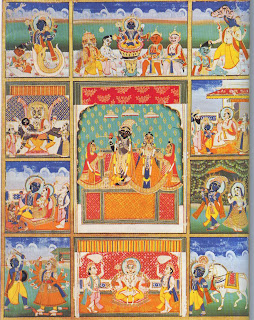
first incarnation, as a fish,is one borrowed from the mythology of Brahma, and
already described in connection with Manu. In the Vishnu myth, the sage is
called Vaivaswata and is the seventh Manu and progenitor of the human race. The
object of the incarnation was to save Vaivaswata. Vishnu took the form of a small
golden fish with one horn, but grew until he was forty million miles long when
he predicted the deluge. He gave Vaivaswata further help by towing his ship with
a rope attached to his horn and by advising him to allow the ship to descend
slowly with the waters rather than allowing it to become high and dry on the
peak of the Himalayas.
Vishnu's
first incarnation, as a fish,is one borrowed from the mythology of Brahma, and
already described in connection with Manu. In the Vishnu myth, the sage is
called Vaivaswata and is the seventh Manu and progenitor of the human race. The
object of the incarnation was to save Vaivaswata. Vishnu took the form of a small
golden fish with one horn, but grew until he was forty million miles long when
he predicted the deluge. He gave Vaivaswata further help by towing his ship with
a rope attached to his horn and by advising him to allow the ship to descend
slowly with the waters rather than allowing it to become high and dry on the
peak of the Himalayas.
One
version of this story gives a further purpose for the incarnation. During one
of the periods of universal chaos, while Brahma was sleeping the Veda, which
had emerged from his mouth, was stolen by a demon called Hayagriva. As Matsya,
his fish incarnation, Vishnu saved Manu but also instructed him in the true doctrine
of Brahma's eternal soul, and when Brahma woke killed Hayagriva and restored
the Veda.
Kurma
The
second incarnation, as a tortoise Kurma, is also borrowed from the Brahma myth
a relatively simple one where Brahma or Prajapati assumes the form of a
tortoise in order to create offspring. In the Vishnu myth the means of creation
and the objects created are more complex During one of the periodic deluges
which destroyed the world in the first age some things of value were lost, the
most important of which was amrita, the cream of the milk ocean, whose absence
threatened the continued existence of the universe. Accordingly Vishnu
descended to earth as a tortoise to help to recover these objects. Gods and
demons together set about producing amrita by churning the ocean of milk, using
Mount Mandara as a churning stick. Such was the weight of Mount Mandara that
the operation would have been impossible unless Kurma had lent his curved back
as a pivot on which to rest it. With Vishnu (Kurma) supporting the whole, with
the help of the potent herbs which they had thrown into the ocean, and using
the serpent Vasuki as a churning rope, gods and demons proceeded with the task,
and in due course all the precious objects lost in the deluge rose up out of
the milky ocean.
The
ocean gave forth not only the water of life, amrita, but also Dhanwantari,
bearer of the gods' cup of amrita and their physician; Lakshmi or Sri, goddess
of fortune and beauty, Vishnu's wife Sura, goddess of wine; Chandra, the moon,
which Shiva took; Rambha, a nymph, who became the first of the lovely Apsaras;
Uchchaisravas, a beautiful white horse, which was given to the demon Bali, but
afterwards seized by Indra; Kaustubha, a jewel, which went to Vishnu; Parijata,
the celestial wishing tree, which was later planted in Indra's heaven and
belonged to his consort lndrani; Surabhi, the cow of plenty, which was given to
the seven rishis; Airavata, a wonderful white elephant, which became Indra's
mount after he stopped riding a horse; Sankha, a conch shell of victory;
Dhanus, a mighty bow; and Visha, the poison vomited out by the serpent, which
Shiva nearly swallowed.
Varaha
Two
main versions exist of Vishnu's third incarnation, as a boar. The first of
these versions again derives from an earlier Brahma myth, and claims that
Brahma and Vishnu, who were one, took the form of a boar, a water-loving
creature, in order to create the world out of the cosmic waters. The boar,
Varaha, having observed a lotus leaf, thought that the stem must be resting on
something, so he swam down to the depths of the ocean, found the earth below
and brought a piece of it to the surface. The second version of the myth relates
that Brahma had been induced by the propitiation of a demon, Hiranyaksha, to
grant him the boon of invulnerability. Under cover of this boon Hiranyaksha
began to persecute mortals and gods and even stole the Vedas from Brahma and
dragged the earth down to his dark abode under the waters. But Hiranyaksha,
when reciting the names of all the gods, men and animals from whose attacks he
wished to be immune, forgot to mention the boar. Accordingly Vishnu took the
form of a boar forty miles wide and four thousand miles tall, dark in colour
and with a voice like the roar of thunder. He was as big as a mountain, mighty
as a lion, with sharp white tusks and fiery eyes flashing like lightning. With
his whole being radiating like the sun, Vishnu descended into the watery
depths, killed the demon with his tusks, recovered the Vedas and released the
earth, so that it once more floated on the surface.
Narasinha
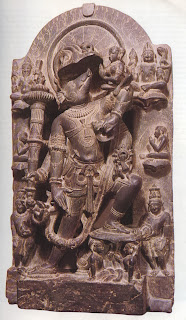 Vishnu's
fourth incarnation was designed to free the world from the depredations of the
demon king Hiranyakasipu who, like his brother Hiranyaksha, had obtained from
Brahma the boon of immunity from attacks by human, beast and god; he had
Brahma's assurance that he could be killed neither by day nor by night, neither
inside nor outside his house. Protected by this immunity, Hiranyakasipu
overreached himself. He forbade worship of all the gods and substituted worship
of himself. He was therefore particularly incensed to discover that his own son
Prahlada remained an ardent devotee of Vishnu. Hiranyakasipu tried persuasion
and he tried torture, but still Prahlada refused to give up his worship of
Vishnu. Hiranyakasipu finally ordered serpents to bite him to death. But
Prahlada was unaffected, and the serpents fell into feverish disarray, their
fangs broken and fear in their hearts. Vast elephants were sent against
Prahlada; he was thrown over precipices; he was submerged under water. But all
to no avail: Hiranyakasipu could not kill his son. Finally, one evening, the
demon king, in exasperation at his son's repeated assertion of Vishnu's
omnipresence, pointed out a pillar in the doorway of his palace and demanded to
know if Vishnu was there inside it. Prahlada declared that he certainly was,
whereupon Hiranyakasipu said that he would kill him, and he kicked the pillar.
At this Vishnu stepped out of the pillar in the form of Narasinha, a creature
who was half-man and half-lion, and tore Hiranyakasipu to pieces. The
circumstances of Hiranyakasipu's death fell outside the conditions of Brahma's
boon, for the time was evening neither day nor night, the place was the doorway
of the palace not inside nor outside the demon's house, and the assailant was a
man-lion neither human, beast nor god.
The
Varaha and Narasinha avatars are sometimes represented in a composite figure,
Vaikuntha.
Vishnu's
fourth incarnation was designed to free the world from the depredations of the
demon king Hiranyakasipu who, like his brother Hiranyaksha, had obtained from
Brahma the boon of immunity from attacks by human, beast and god; he had
Brahma's assurance that he could be killed neither by day nor by night, neither
inside nor outside his house. Protected by this immunity, Hiranyakasipu
overreached himself. He forbade worship of all the gods and substituted worship
of himself. He was therefore particularly incensed to discover that his own son
Prahlada remained an ardent devotee of Vishnu. Hiranyakasipu tried persuasion
and he tried torture, but still Prahlada refused to give up his worship of
Vishnu. Hiranyakasipu finally ordered serpents to bite him to death. But
Prahlada was unaffected, and the serpents fell into feverish disarray, their
fangs broken and fear in their hearts. Vast elephants were sent against
Prahlada; he was thrown over precipices; he was submerged under water. But all
to no avail: Hiranyakasipu could not kill his son. Finally, one evening, the
demon king, in exasperation at his son's repeated assertion of Vishnu's
omnipresence, pointed out a pillar in the doorway of his palace and demanded to
know if Vishnu was there inside it. Prahlada declared that he certainly was,
whereupon Hiranyakasipu said that he would kill him, and he kicked the pillar.
At this Vishnu stepped out of the pillar in the form of Narasinha, a creature
who was half-man and half-lion, and tore Hiranyakasipu to pieces. The
circumstances of Hiranyakasipu's death fell outside the conditions of Brahma's
boon, for the time was evening neither day nor night, the place was the doorway
of the palace not inside nor outside the demon's house, and the assailant was a
man-lion neither human, beast nor god.
The
Varaha and Narasinha avatars are sometimes represented in a composite figure,
Vaikuntha.
Writer Name: Veronica Lons


 With
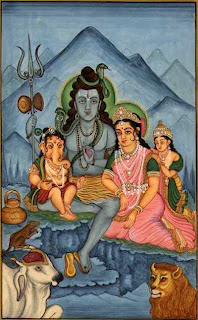
Parvati by his side, Shiva made a declaration: "Let it be known, no
worship or sacrifice will be accepted by the gods until a man has his wife by
his side." And so it is that no yagna or puja is conducted without the
wife sitting to the left of the husband. Since then the wife is called vamangi,
she-who-sits-to-the-left.
With
Parvati by his side, Shiva made a declaration: "Let it be known, no
worship or sacrifice will be accepted by the gods until a man has his wife by
his side." And so it is that no yagna or puja is conducted without the
wife sitting to the left of the husband. Since then the wife is called vamangi,
she-who-sits-to-the-left.  Parvati's
beauty inspired Shiva to create music and dance. From his melodious voice came
the musical notes and tunes that enchanted the entire cosmos. He created the
various dance elements gait, gestures, expression and posture that best
expressed human emotion. Shiva became lord of the arts, Kaleshvar.
Parvati's
beauty inspired Shiva to create music and dance. From his melodious voice came
the musical notes and tunes that enchanted the entire cosmos. He created the
various dance elements gait, gestures, expression and posture that best
expressed human emotion. Shiva became lord of the arts, Kaleshvar. 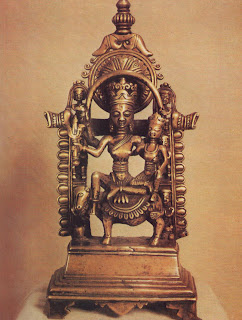 Parvati,
suspicious of Shiva's sudden success, called him a cheat. Shiva, outraged by
the accusation, demanded an apology. Words were exchanged, insults were hurled
. . .
Parvati,
suspicious of Shiva's sudden success, called him a cheat. Shiva, outraged by
the accusation, demanded an apology. Words were exchanged, insults were hurled
. . .  News
reached Shiva that Parvati had reappeared at Kashi and had set up a kitchen
there for the benefit of the world. He ran there as fast as he could, along
with every other hungry creature in the world. As he presented his bowl to her
he said, "Now I realise that the material world, like the spirit, cannot
be dismissed as an illusion."
News
reached Shiva that Parvati had reappeared at Kashi and had set up a kitchen
there for the benefit of the world. He ran there as fast as he could, along
with every other hungry creature in the world. As he presented his bowl to her
he said, "Now I realise that the material world, like the spirit, cannot
be dismissed as an illusion."  "What
do I do now?" wondered Parvati. Vishnu whispered a solution in her ears.
Accordingly Parvati dressed up like a tribal-woman, bright beads round her
neck, peacock feathers in her hair. She sang and danced until Shiva could no
more ignore her.
"What
do I do now?" wondered Parvati. Vishnu whispered a solution in her ears.
Accordingly Parvati dressed up like a tribal-woman, bright beads round her
neck, peacock feathers in her hair. She sang and danced until Shiva could no
more ignore her.  Shiva
never brought any gifts or food for Parvati. Sometimes he smoked narcotic drugs
in his chilum and ignored her for days on end. Once, tired of his callous
attitude, she ran into the deodar forest.
Shiva
never brought any gifts or food for Parvati. Sometimes he smoked narcotic drugs
in his chilum and ignored her for days on end. Once, tired of his callous
attitude, she ran into the deodar forest. 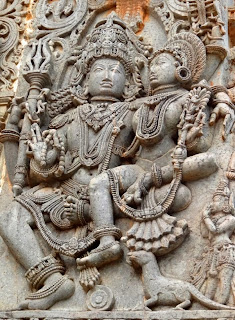 Shiva
and Parvati often discussed the secrets of the universe. Together they explored
the wonders of the cosmos.
Shiva
and Parvati often discussed the secrets of the universe. Together they explored
the wonders of the cosmos. 
 In
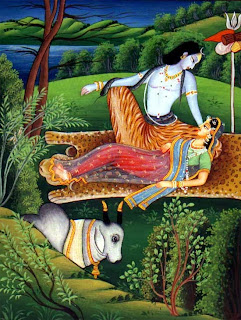
isolation, Shiva and Parvati let loose their full potential. Shiva stood on the
right as the fiery pingala. Parvati lay on the left as the frigid ida. By
various physical postures, asanas, mental exercises, dhyana and breath control,
pranayama, they balanced each other's energy until they were both in perfect
harmony, in a state of sushumna.
In
isolation, Shiva and Parvati let loose their full potential. Shiva stood on the
right as the fiery pingala. Parvati lay on the left as the frigid ida. By
various physical postures, asanas, mental exercises, dhyana and breath control,
pranayama, they balanced each other's energy until they were both in perfect
harmony, in a state of sushumna.