ArtofLegendIndia.com, Biggest Online Store of Handicrafts Items, Paintings and Jewelry Accessories...

Handicrafts

Handicrafts are devices or works of art that are made completely by hand or by the use of relatively simple tools. Such goods are usually made in the traditional way of manufacturing goods. Therefore, the knowledge of the art of craft is usually passed down from one generation to another. The items made using these traditional methods of manufacturing are usually produced in smaller quantities and they often represent the culture or religious beliefs of the community that makes them. The goods are also handmade from natural materials that are found in the environment of the particular economy.

Read More!

Biggest Online Store of Handicrafts Items

Paintings

A painting is equal to thousand words, means a beautiful painting is equal to million of words. Paintings are one of the oldest art forms -- throughout history artists have played an important role in documenting social movements, spiritual beliefs and general life and culture.

History Of Paintings: The history of painting reaches back in time to artifacts from...

Read More!

Biggest Online Store of Unique Style Paintings
Showing posts with label Hieronymus Bosch. Show all posts

Netherlandish Great Artist Hieronymus Bosch - The Eve of Destruction

Posted by Art Of Legend India [dot] Com On 3:17 AM 0 comments
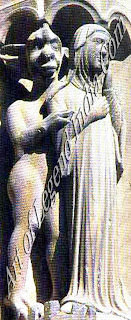
Unholy clergy, This statue of a demon seducing a nun sums up the way in which the clergy were viewed in the Middle Ages. They preached about Hell and Damnation but led far from exemplary lives themselves, succumbing to sins of avarice and lust on a grand scale. The Eve of Destruction
Dominated by obsessions with witches, devils, death and decay, the late Middle Ages was a period of anxiety and uncertainty when people believed themselves to be on the brink of destruction.

Life in Europe towards the end of the middle Ages was dominated by a conflict between the promptings of the flesh and those of the spirit. It was an age of strong contrasts, a time of passion and violence. Everyday existence was almost casual in its brutality: lepers walked the streets and public executions were frequent, often theatrical, and very well attended. The popular imagination was obsessed with the idea of death the reality of dying rather than the possibility of heavenly salvation to follow.

It was generally believed that even Lazarus, after his resurrection, lived in terror at the thought of having to pass again through the gates of death. And Lazarus had been one of the just what could an ordinary sinner expect?

Daily existence was intended to be a preparation for the afterlife, but the reality was inevitably worldlier. The Church fathers preached that all earthly beauty and pleasure was sinful, but a common reaction in those uncertain times was 'enjoy yourself as much as you can, while you can'. It was this emphasis on the demands of the body at the expense of the soul which Bosch attacked. He painted from the standpoint of orthodox Catholicism he was himself a member of the Brotherhood of Our Lady with an uncompromising certainty which seems to owe something to propaganda.


UNGODLY EXAMPLE 
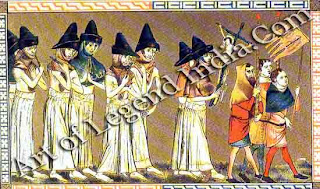
Frenzied flagellants, Fearing that the end was nigh, religious extremists would parade through the countryside scourging themselves in an attempt to avoid the Wrath of God.People clearly wanted to be reassured by the authority of the Church, but the clergy were failing in their duty, as they repeatedly prey to the sins of lust and greed. Despite the Church ruling of lived openly with women and fathered children. Their blatant conduct caused great offence. And trust was further undermined by bands of bogus monks and friars who travelled around selling false relics and pardons.

Meanwhile, the more senior officers of the Church led sumptuous and extravagant lives. Pope Alexander VI, himself a member of the notoriously corrupt Borgia family, rather hypocritically attempted to enforce a reform bill in 1497 curtailing the activities of the pleasure-loving Cardinals and restricting their vast households to a mere 80 strong.
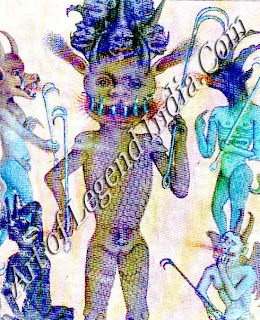
The coming of the devils, An illustration from a 15th-century treatise on the Antichrist shows Lucifer mid his attendants.
Where preachers could not convince by godly example and this was the rule rather than the exception they discouraged sin by stressing the torments of Hell. Sin provided more opportunities for lavish and inventive imagery than the calm spiritual grace of a holy life. This morbid fascination accounted for the success of a book appearing around 1486, the Witches' Hammer, which classified the many types of witch and described their relations with devils. The demons in Bosch's paintings were not simply the product of imagination they had a vivid reality for a superstitious age.

DIVINE VENGEANCE 

Revenge was a part of everyday life, and by extension, if you sinned in this world, God exacted his own vengeance. But the straightforward notion of the good being spared and the evil punished was not borne out by events. The Black Death of 1348, for example, had struck down both the righteous and the sinner.
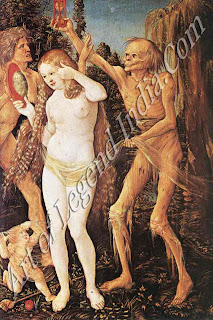
Death and decay, The recurrent theme of death and decay is depicted here by one of Bosch's contemporaries, Hans Baldung Grien.
Some extremists attempted to divert the Divine Wrath by scourging themselves on processions throughout the countryside. And hysteria of a less religious sort manifested itself in what became I known as the 'Dancing Mania' groups of people danced frenziedly in an attempt to find relief from the dreadful fear that the 'end was nigh'. Against a background of natural disaster, with the popular imagination inflamed by demons and hellfire, fears of the end of the world proliferated.

Throughout the Middle Ages various interpretations were put forward of what would happen on the Last Day, and when it would occur. In the 1470s in Germany, Hans Bohm, known as the 'Drummer of Niklashausen', preached that his town was to be the kingdom of the saved. If you made the pilgrimage to Niklashausen you would escape destruction, and if you died there you would go straight to Heaven. Bohm's preaching grew more adventurous as he attacked the clergy and proclaimed the end of the world. Miracles were attributed to him, and he prophesied a future kingdom based on true sharing and natural law.

THE RULE OF THE JUST 
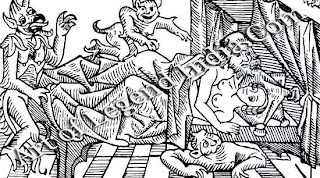
The Antichrist, The conception of the Antichrist evil in human form which would make one last bid to conquer the world.
An important part in the belief in the imminent apocalypse was the theory of the Millennium. This was to be the period of 1000 years before the end of the world and the Last Judgement. The idea had crystallized around the Second Coming of Christ, who would return for the 'Rule of the Just' when he would rule the world with his chosen people. The Second Coming would be heralded by the appearance of the Antichrist, the incarnation of evil, who would make one last bid for world control before being vanquished forever. The Antichrist and Messiah were most likely to appear in human form and were constantly expected. Political events were interpreted with these legendary figures in mind. Chroniclers would identify a tyrant with the Antichrist or try to make out a new monarch to be the Last and Just earthly ruler.
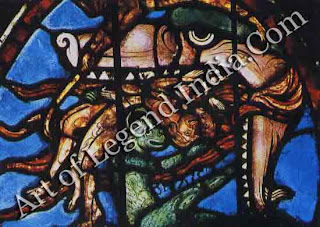
The Last Day Speculations as to what would become of all earthly mortals on the Day of Judgement dominated the thoughts of people during the Middle Ages. Grim reminders of the need to prepare oneself for the Final Day, like this 13th century panel in Bourges Cathedral, appeared in churches and in cemeteries throughout Northern Europe. The real disagreements started over the identity g of the chosen people who would inhabit this earthly paradise, and when such a kingdom would come into being. The established Church largely followed St Augustine's teaching that the Millenium had begun when Christ first appeared on the Earth rather than that it would begin with his Second Coming. This effectively meant that since the world continued to exist after the year AD 1000, which was when it should have ended according to the prophecy, then it was possible to suppose that the Rule of the Just (interpreted as the rule of the Catholic Church) had been extended indefinitely.

In this way Millenarianism was supposedly tamed and converted to the use of the established Church, but its grip on the popular imagination was too great for it to perish entirely, and it became an important part of the armoury of religious reformers and small sects.
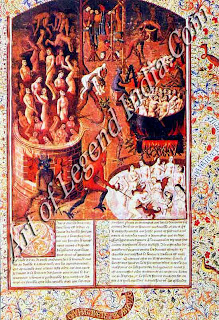
Hellfire, The torments of Hell were vividly spelt out by the Church to discourage Sin. So ghastly was the picture portrayed, that it provided artists with the perfect opportunity to let their imaginations run riot as can be seen from this late medieval German miniature.There were times of hardship and social unrest and the idea of 1000 years of earthly happiness was equally attractive to the body as it was to the soul. Economic patterns were changing, and with the gradual development of industry the financial emphasis shifted from countryside to town, and increasingly large groups of workers were only employed irregularly. It was to such anxious, insecure and envious people that millenarial prophets, with their promises of a stable kingdom of the just, especially appealed.

THE ANABAPTISTS 

A strongly individualized example of this kind of Millenarianism was to be found among the Anabaptists. In 1533, Anabaptist missionaries appeared in the Westphalian town of Munster, proclaiming that it was to be the New Jerusalem the Kingdom of the just. Two leading Anabaptists arrived, Jan Matthys and Jan Bockelson, who conducted mass baptisms as hundreds entered the new faith. The Anabaptists believed the Second Coming was imminent and that the Lord's way would be made easier by getting rid of all non-believers. Consequently, non-believers were expelled and control of the city was assumed by Matthys who advocated communal ownership of property and burnt all books except the Bible. Soon after, however, Matthys was killed by the Bishop of Miinster's besieging forces, so Bockelson took over and reigned as a new Messiah, with similar ideas but also encouraging polygamy.

Witches and, devils, The frontispiece of the widely proclaimed Witches' Hammer, first published in1487. At a time when the belief in devils was at a peak, this book was regarded as the definitive work on witches, their relationships with the Devil, and how they could be recognized and punished. The citizens of Munster were convinced they were saved and that soon they would inherit the whole earth. Bockelson conducted a highly effective defensive campaign against the Bishop of Munster, and set himself up as a prophet king. But the Bishop's siege continued and the town fell in June 1535 when its food supplies were exhausted.

Although orthodox Catholic doctrine had attempted to absorb Millenarianism and render it harmless, it had not succeeded. The Catholic clergy simply could not compete with the millenarial excitement stirred up by Hans Bohm or the Anabaptists. But in his paintings, Bosch fervently tried to impart a similar hypnotic vividness to the hellfire doctrine of the established Church.

Writer – Marshall Cavendish

Netherlandish Great Artist Hieronymus Bosch -A Year in the Life 1500

Posted by Art Of Legend India [dot] Com On 3:22 AM 0 comments
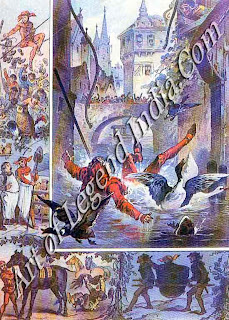
Triumph of peasant cunning, The tales of Till Eulenspiegel were first collected together around 1500. They celebrate the pleasures of boisterous anarchy. Till, the simple peasant who was based on a jester living some 200 years earlier successfully cocks a snook at sophisticated town dwellers.

A Year in the Life 1500

In this jubilee year, pilgrims made their way to Rome in search of spiritual redemption, which was being dispensed by the greedy Borgia Pope, Alexander VI. And while Bosch was exploring the wilder shores of the human psyche, Spain and Portugal were sending emissaries on uncharted waters in search of spices.

While Bosch reflected medieval preoccupations with his visions of hell and sense of sin, the cynical Pope Alexander VI was eager to capitalize on them. He declared 1500 a jubilee year a year when penitents could shed their sins and be granted complete absolution and welcomed thousands of pilgrims from all over Europe to the Eternal City. He hoarded their alms in a special fund administered by his son, Cesare Borgia, for the 'pacification' of those rebellious cities which refused to pay dues to the papacy. For this service, Cesare was made Vicar of Rome in March 1500.

In his concern to preserve and enlarge papal dominions, Alexander issued an edict proclaiming a crusade against the infidel Turks who were steadily advancing in Eastern Europe. Alexander appealed for support directly to the King of France, but Louis XII was much more interested in recovering the duchy of Milan from Leonardo da Vinci's sometime patron, Ludovico Sforza. Early in 1500, French troops took the city; Ludovico himself was captured, and spent the rest of his life in a French dungeon.

THE DISCOVERY OF AMERICA 

The eclipse of a ruling dynasty, 1500 was the year when Ludovico Sforza the Moor was imprisoned in the castle of Loches by the French. Ludovico was the son of a condottiere from whom he inherited the duchy of Milan; here, with his formidable wife Beatrice d'Este, he dominated a brilliant court until ousted by Louis XII of France. Dramatic events were taking place outside Europe. In 1492, Christopher Columbus had crossed the Atlantic hoping to reach the fabled East, instead of which he had discovered America. In 1500 he still believed (as he was always to believe) that his voyages had taken him to the edge of 'the Indies', although in the same year his pilot, Juan de la Cosa, drew the earliest surviving map of the world, showing for the first time the eastern seaboard of North and South America in rough outline, with special prominence given to Spanish possessions, optimistically marked with a flag.

The year proved a particularly bad one for Columbus himself. Although a great sailor, he was an inept administrator, and as governor of the Spanish colony of Hispaniola (modern Haiti) he combined an often heavy hand with an inability to maintain order among the unruly settlers. Ferdinand and Isabella of Spain were advised of his incompetence, and appointed a new governor who promptly shipped the great discoverer back to Spain in chains.

The Spaniards had high hopes of their transatlantic discoveries, and the Portuguese took them seriously enough to insist0 on a share for themselves. A formally agreed line of demarcation, approved by Pope Alexander, had divided all 'new' lands between Spain and Portugal although, as the future was to show, the English, Dutch and French had no intention of observing this lordly private arrangement.

The limits of the known world, Juan de la Cosa accompanied Columbus on his first two voyages to America, and incorporated him as the figure of St Christopher on the left of this bold attempt to delineate the New World. This was the first map to acknowledge that Columbus had discovered a new continent, rather than Japan or the Indies.
But in 1500 the Atlantic crossing was old news. For it was rumoured that the Portuguese captain Vasco da Gama had discovered a new route to India - and wealth from the spice trade. The Portuguese immediately set out to exploit their advantage. In March 1500 a fleet loaded with trading goods set out from Lisbon under the command of Pedro Alvarez Cabral. Following the example of da Gama, Cabral swung his ships into the mid Atlantic in order to avoid bad weather and dangerous currents off the African coast; the intention was to reach the steadily blowing South Atlantic westerlies and run before them to the Cape.

Another piece of the jigsaw puzzle, By a happy accident, Pedro Alvares Cabral discovered Brazil in his quest for the riches of the Indies. The country was named after its main export a red dye called pau-brasil. Cabral's visit was followed up by Amerigo Vespucci, who gave his name to the continent.
In the event, Cabral swung too far west, and made land fall on an unknown shore: by accident he had found Brazil, which was to become the largest of all Portugal's colonies. He left two men there as observers, and sent a ship back to Portugal with news of the discovery. Then he pressed on across the Atlantic as it was still the spices that mattered most. Four of Cabral's ships were lost off the Cape of Good Hope, but contemporary profit margins were high enough to ride such losses. Cabral did splendid business in the East and returned to Lisbon in July 1501, his ships crammed with spices, incense, porcelain and other exotic products. Portugal's golden age of wealth and empire had begun.

Writer – Marshall Cavendish
Netherlandish Great Artist - Hieronymus Bosch Painting Gallery

Posted by Art Of Legend India [dot] Com On 4:21 AM 0 comments
None of Bosch's surviving paintings, of which there are about 40, bears a date or can be dated by documentary evidence. This makes it extremely difficult to establish a convincing chronology for his work. There is a fair measure of agreement as to which paintings can be placed at the very beginning of his career and which are from the flower of his maturity, but there are considerable differences in scholarly opinion about the dating of individual works and their place in his development.

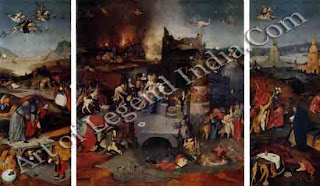
The Conjurer and Ecce Homo are generally thought to be among his earliest works, their immaturity showing in the comparative stiffness and awkwardness of the figures. Even in these paintings, however, there is a pointer to Bosch's later preoccupations in the grotesque faces that reveal mankind's cruelty and folly. The works on which Bosch's reputation now mainly rests are the three astonishing triptychs, The Hay Wain, The Garden of Earthly Delights and The Temptation of St Anthony. They swarm with bizarre figures and show Bosch's imagination to have been one of the most powerful, original and disturbing in the history of art. 

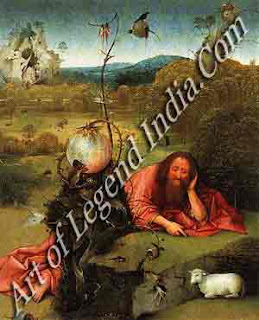
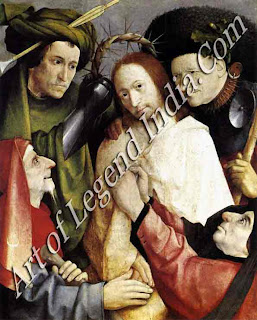
As well as creating such vast, teeming panoramas, Bosch could also focus memorably on a single figure, as in St John the Baptist in the Wilderness, and he was a master of the dramatic close-up, exemplified in The Crowning with Thorns. This last painting is an excellent example of the beauty of Bosch's technique; it was not tight and highly detailed, like that of many of his contemporaries, but subtle and varied, the paint often applied very thinly.

The Great Artist Hieronymus Bosch Painting Gallery “The Conjurer c.1470-80” 20¾" x 25¾" Musee Municipal, Saint Germain-en-Laye This painting is generally accepted as one of Bosch's earliest designs; although some scholars think it is a copy of a lost original rather than a work from the master's own hand. It is a vivid depiction of gullibility and stupidity; the bending figure whose dress indicates that he is some kind of dignitary is so immersed in the tricks being performed that he does not notice his purse is being stolen. 


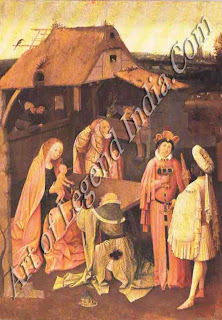
The Great Artist Hieronymus Bosch Painting Gallery “Adoration of the Magi” c.1470-80 30½" x 22" John G. Johnson Collection, Philadelphia Museum of Art
In contrast to the violence of Ecce Homo, the atmosphere of this scene is one of touching domesticity. Joseph doffs his hood and looks abashed at the presence of such distinguished visitors. On the white sleeve of the   king on the right is a depiction of the Israelites gathering manna an   Old Testament allusion to the coming of Christ.


The Great Artist Hieronymus Bosch Painting Gallery “Ecce Homo” c.1470-80 29½" x 24" Stadelsches Kunstinstitut, Frankfurt
Pilate presents Christ to the people of Jerusalem. Beside Pilate are the words 'Ecce Homo' (Behold the Man); the crowd bays back 'Crucifige Eum' (Crucify Him) and across the stone wall (where two donor figures have been painted out) is inscribed 'Salve nos Christe redemptor' (Save us, Christ redeemer). Bosch hardly needs words, however, to convey the horror mob law.


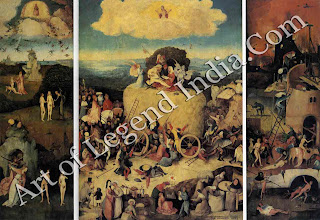
The Great Artist Hieronymus Bosch Painting Gallery “The Hay Wain” c.1490-1500 Central panel 53" x 39½", wings 53" x 17¾” Prado, Madrid
This is regarded as the first painting in which Bosch revealed his unique imaginative gifts. It is based on a Flemish proverb: 'The world is a haystack, and everyone snatches what he can from it.' The hay wagon represents earthly goods, and the whole world including a pope and an emperor goes with it as it rolls - inexorably towards Hell on the right wing. Christ appears in judgment overhead. In the left wing is represented the Garden of Eden, with the creation of Adam and Eve and their expulsion from Paradise. There are many brilliantly depicted details, notably the nuns in the foreground who stuff a sack with the precious hay, and the lovers on top of the wagon who ignore the guardian angel behind Ahem while a demon pipes in front of them. 
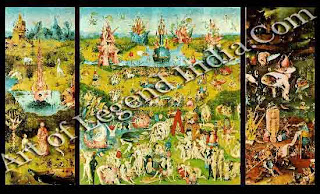
The Great Artist Hieronymus Bosch Painting Gallery “The Garden of Earthly Delights” c.7500-10 Central panel 86 ½" x 76 ¾", wings 86 ½ x 38 ¼" Prado, Madrid
This is Bosch's largest, most complex and probably most famous painting; in it he reached the height of his imaginative powers. It is similar in conception to The Hay Wain, with Paradise and Hell in the wings flanking a central panel representing mankind's sinful activities. Although the monsters are the most hideous Bosch ever created, the painting has extraordinary beauty of colour. There is another version of this painting, probably from Bosch's workshop, in the Escorial near Madrid.

The Great Artist Hieronymus Bosch Painting Gallery “St John the Baptist in the Wilderness” c.1490-1510 19 ¼" x 15 ¼" Museo Lazaro Galdiano, Madrid
St John lived an ascetic life in the desert. Bosch shows him pointing at a lamb, which represents Christ the Lamb of God. The huge and fantastically-formed plant beside which the saint reclines is probably intended to symbolize sensual delights, which John has rejected for his life of religious devotion.


The Great Artist Hieronymus Bosch Painting Gallery “The Crowning with Thorns” c.1490-1510 29" x 23 ¼" National Gallery, London
Somewhat uncharacteristically, Bosch does not dwell on the physical horrors of the scene, but instead creates a poignant image of suffering patiently endured the beautiful head of Christ is one of the finest things he ever painted. The significance of the bizarre headgear of the tormentors is uncertain.


The Great Artist Hieronymus Bosch Painting Gallery “The Temptation of St Anthony” c.1500-10 Central panel 51¾” x 46¾”, wings 51 ¾" x 20 ¾" Museo Nacional de Arte Antiga, Lisbon
St Anthony was a hermit saint who lived in the 3rd and 4th centuries and is generally regarded as the founder of monasticism. His ascetic life in the wilderness brought on hallucinations, which featured prominently in the stories about him that acquired wide popularity in the middle Ages. He became a popular subject in art, too, and there are several copies of the whole or parts of this painting. Bosch seems to have taken certain details from an account of the Saint's life that was published in Dutch in 1490. St Anthony's `temptations' was of two kinds: fleshly inducements in the form of sexual favours and worldly goods; and attacks by demons (the Latin word 'tempto' has both meanings). Bosch combined both meanings over the three panels, creating a dazzling and disturbing fantasy world,

Writer – Marshall Cavendish
Company Overview

Art of Legend India has the distinction of being one of the best in the Indian Handicraft Industry. We are about 75 years old handicrafts manufacturer & exporter. We are having team of more than 500 craftsman.

We are having our business offices in India, USA & Germany to ensure our best services.

Total Pageviews