ArtofLegendIndia.com, Biggest Online Store of Handicrafts Items, Paintings and Jewelry Accessories...

Handicrafts

Handicrafts are devices or works of art that are made completely by hand or by the use of relatively simple tools. Such goods are usually made in the traditional way of manufacturing goods. Therefore, the knowledge of the art of craft is usually passed down from one generation to another. The items made using these traditional methods of manufacturing are usually produced in smaller quantities and they often represent the culture or religious beliefs of the community that makes them. The goods are also handmade from natural materials that are found in the environment of the particular economy.

Read More!

Biggest Online Store of Handicrafts Items

Paintings

A painting is equal to thousand words, means a beautiful painting is equal to million of words. Paintings are one of the oldest art forms -- throughout history artists have played an important role in documenting social movements, spiritual beliefs and general life and culture.

History Of Paintings: The history of painting reaches back in time to artifacts from...

Read More!

Biggest Online Store of Unique Style Paintings
Showing posts with label Biography of Grunewald. Show all posts

German Great Artist Mathis Grunewald - Religious Visions

Posted by Art Of Legend India [dot] Com On 2:21 AM 0 comments

Religious Visions

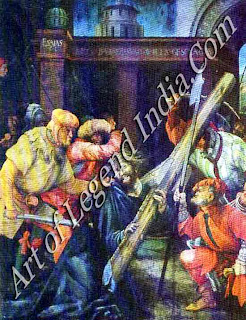
The Carrying of the Cross (c.1525) Found on the back of a panel of the Crucifixion during a 19th-century restoration, this painting presents an interesting combination of styles. The serene Italian cityscape in the background is contrasted with the scene of Christ's agonies at the hands of his brutally caricatured tormentors.
Neglected for hundreds of years, Grunewald has now been recognised as a master. The passion and intensity of his work gives powerful impact to his paintings, all with religious themes.

Grunewald is an isolated figure in the history of German art. His very individual style of painting betrays no close allegiance to any of the masters of his age, he left no known pupils or followers, and his descent into obscurity was both rapid and complete. When, in 1597, Emperor Rudolph II tried to acquire The Isenheim Altarpiece, the artist's identity was already unknown and, as late as 1852, The Miracle of the Snows was sold at a derisory price as a mediocre work by an anonymous artist.

One theory put forward to explain this neglect is that contemporary observers deliberately ignored Grunewald because of his Lutheran beliefs. Much more significant, however, was the fact that most unusually for this period he produced little or no engraved work. In an age when travel was not always easy and few people might, for example, be willing to risk a visit to a plague hospital where The Isenheim Altarpiece was sited to see a work of art, this drastically reduced the scope of his influence.

In addition, Grunewald chose not to devote his studies to the new world of possibilities that was being opened up by the Renaissance. His art was firmly centered on God, not man. The small body of his surviving work is comprised entirely of religious paintings, even though it is clear from his depiction of Cardinal Albrecht as St Erasmus that he could have made a healthy living as a portraitist. Certainly, he was aware of some of the technical developments achieved by the Italians the laws of perspective and anatomy, in particular but he used them only as minor components in his pictures.
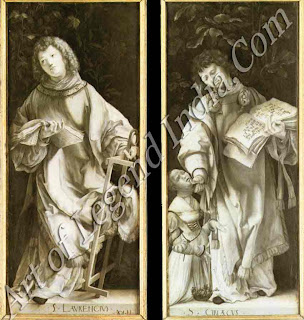
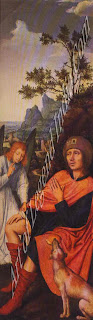
The Heller Altarpiece (1509-10) Grunewald painted four figures for the lateral wings of Durer's Heller Altarpiece which show the influence of Durer's monochrome work. Saint Lawrence.(below left) holds the grid iron on which he was roasted alive, while Saint Cyriac (below right) exorcises a demon from Artemis, daughter of Diocletian by pressing her throat to allow spirits to escape.
Most of Grunewald's commissions were for altarpieces. By the late Gothic period, these had become complex but adaptable structures, in which the movable panels enclosed sculpted figures and were crowned with richly carved canopies. The painted sections included folding wings, which could be opened or shut to suit the liturgical cycle of church feasts, and a detachable panel at the foot of the picture, called a predella.

A COMPLEX MASTERPIECE 

The Isenheim Altarpiece was one of the most elaborate examples of this format ever produced. The inner section, with its statues of saints by Niklaus von Haguenau, was executed quite independently from Grunewald's contribution. His work consisted of various panels including a double set of folding wings, which allowed three separate combinations of pictures to be shown at different times of year. Thus, the altarpiece would be closed during Easter week, when the bleak Crucifixion symbolized the church's mourning; was opened for most of the year, to show the joyous scenes of the Annunciation and the Resurrection; and displayed the final variant, with incidents from the life of St Anthony, on the feast day of the Order's patron saint.

The status of artists at this time was that of craftsmen, rather than of creative individuals. Patrons and especially religious patrons would choose the subjects to be illustrated and would often sketch out a plan of the composition. Within these restraints, however, Grunewald found a great deal of freedom to produce his unique brand of expressive realism. 'A barbarian and a theologian', one commentator called him, neatly identifying the contradictory strands of his art.

The Madonna in a Garden (1517-20), This picture is packed with objects associated with the Virgin, such as lilies and roses, olive and fig trees. The pomegranate held by the Christ Child symbolizes the Resurrection.
Certain Gothic elements remained in Grunewald's work. The use of a larger-than-life Christ in scenes of the Passion was a distinctly medieval feature, and the presence of John the Baptist at the Isenheim Crucifixion and the curious angelic orchestra serenading the Virgin, proved that these were contemplative works rather than naturalistic illustrations of Biblical events.

However, Grunewald allied these intellectual compositions to an unprecedented show of realism, in a bid to tie emotional and rational responses into a firm bond of faith. To this end, he made use of expressionistic distortions to heighten the graphic power of his paintings. In his Crucifixions, for example, Christ's feet are stretched into a deformed arc; the fingers claw convulsively at the surrounding blackness; and the flesh is livid, discoloured and flecked with thorny wounds. The rough-surfaced beam of the cross is slightly curved and the arms of Christ painfully rigid, so that the body looks like a helpless arrow on a giant bow.

EXPRESSIVE COLOURS 
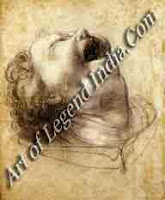
A Crying Child (1520), This study is a supreme example of Grunewald's expressive but masterly draughtsmanship. An even more potent weapon in Grunewald's artistic armoury was his vibrant colouring, which could evoke the full gamut of human emotions, from the depths of despair to the glory of the sublime. In all his versions of the Crucifixion, he employed dark, sketchy backgrounds and pallid, bloodless figures, setting them off with patches of incandescent colour, to create an eerie, mournful effect.

By contrast, his scenes of the Madonna and Child and the Annunciation glow with a luminous joy, and the Isenheim Resurrection is a particular triumph. In most contemporary treatments of this theme, Christ steps sedately out of his tomb without waking the sleeping soldiers. In Grunewald's version, however, the Saviour's Resurrection and his Ascension are combined in an explosion of light. The guards are hurled aside like worthless dummies and Christ ascends to Heaven encircled by a halo whose rainbow colours are reflected in his clothes.

Andrea Mantegna (c.1431-1506) The Crucifixion Mantegna's concern with sculptural beauty here outweighs his compassion for Christ's agonies.
Artists usually prepared their own paints at this period, and were careful not to divulge their methods. In later life, Grunewald was obliged to sell his paints for a brief time and it is a measure of the quality of his colours that, after his death in Halle, the city's official artist, Hans Hamburger, was called in to analyze them. Unfortunately, he was unable to work out the formula and the secret died with Grunewald.

Attempts have been made to find an echo of Grunewald's individual style in the paintings of his contemporaries of the Danube school. But the violence of Grunewald's effects leaves them far behind and it is no accident that his work was rediscovered in the 20th century, during the heyday of the German Expressionists.

Writer – Marshall Cavendish

German Great Artist Mathis Grunewald - The Plague

Posted by Art Of Legend India [dot] Com On 11:28 PM 0 comments

The Plague


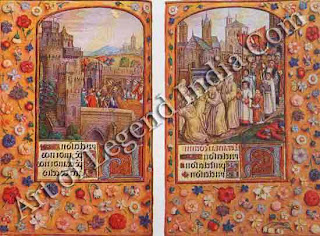
An early hospital, In medieval times the sick were nursed by monks or nuns in hospitals founded and run by religious orders. This book miniature shows them in the company of the four cardinal virtues: prudence, fortitude, temperance and justice.
One of the most feared diseases of Grunewald's lifetime, the plague swept relentlessly through Europe in repeated epidemics, helped by mistaken medical theory and ineffectual remedies.

In the foreground of Grunewald's Temptation of St Anthony lies a helpless, diseased figure, covered with sores. This panel forms a part of The Isenheim Altarpiece, which was painted for the church of the brothers of St Anthony, who devoted themselves to nursing the sick. The altarpiece offered comfort and hope to the inmates of the Isenheim hospice, many of whom were dying of syphilis and the plague.

DIVINE RETRIBUTION 

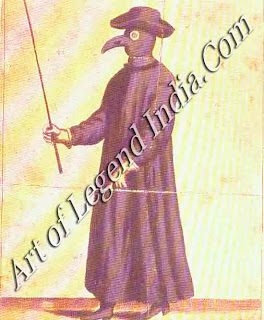
A physician's habit, In later outbreaks of the plague physicians donned protective clothing to avoid catching the disease. It included a mask with glass 'eyes' and a beak filled with aromatic herbs and spices.
Outbreaks of the plague occurred frequently from the mid-14th to the mid-17th century, often reaching epidemic proportions. Plague was explained by the Church as a divine punishment for sin, to be countered by prayer, fasting, confession, religious processions and the rejection of vain pleasures such as dancing and cards. Images of the dance of death, which appear in church art and in popular woodcuts, were an early artistic response to the deadly epidemics which began with the 'Black Death' of the 14th century.

Religious art of the time often depicted an angry God shooting arrow of plague at the sinful. The ancient Greeks had prayed to Apollo, the archer-god whose arrows brought pestilence, to spare them; Christians prayed to St Sebastian, martyred by arrows, for protection from the plague. He too appears as a figure on The Isenheim Altarpiece.

Medical writers sought natural explanations for the plague, but could not agree on either the cause or the treatment. The European plague, or pestilence, of Grunewald's day was bubonic plague, which we now believe to be transmitted to man by the fleas of plague-infected rats. In its most deadly, pneumonic, form, it was spread, like the common cold, by droplets sneezed out by one victim and inhaled by another. The children's singing game Ring a Ring of Roses is supposed to contain a reference to these fatal sneezes in the line: 'Atishoo, atishoo, we all fall down'.

Protector of the sick, St Rod: (c.1350-1380) devoted himself to nursing victims of the plague and became their patron saint. He is often depicted in 14th and 15th century paintings with a plague sore on his thigh, the spot where the plague first manifested itself
In the 15th and 16th centuries, doctors explained the cause of plague according to the teachings of Hippocrates, who believed that outbreaks were due to a local corruption of the air. This, in turn, was thought to infect the inhabitants, contaminating the bodily fluids or 'humours' which determined a person's temperament and causing disease and death. This corrupt or 'putrid' air might be the result of unusually warm and humid weather, or of a particular conjunction of the stars, which transmitted their malign effects to earth through the air.  

Because of the analogy with rotting and putrefaction, the cause of plague was associated also with unpleasant smells, including the vapours arising from volcanoes, burial grounds and even dunghills. Some theories suggested that the air was not merely corrupted but actually poisoned: an explanation which, doctors argued, explained the fact that it might attack at any time of the year not just in hot, damp weather and struck with the speed and deadly effect of a poison.

Plague was usually classed by doctors as a fever, the effect of which was to upset the balance of the four humours blood, phlegm, choler and black bile resulting in an excess of hot and moist qualities. Those who suggested that plague, like the newly identified disease of syphilis, acted in the manner of a poison, claimed that it attacked the 'total substance' of the body directly, and was far more virulent than the 'qualitative' diseases.

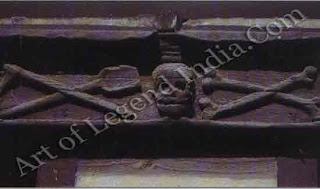
Symbols of death, Plague victims were often buried in mass graves outside towns. This macabre carving of a skull, crossbones and grave-diggers tools marks the site of a plague cemetery in Rouen, France - the result of an outbreak in 1521.
Whatever the proposed cause, methods of medical treatment were almost entirely ineffective. The most practical was the advice to avoid breathing the 'deadly air' by leaving plague-stricken cities. Those who could afford to leave did so, often in defiance of quarantine regulations designed to prevent the spread of disease.

Much of the medical treatment aimed to drive the plague poison out of the body, by sweating, purging, inducing vomiting and blood-letting. The buboes or swellings which characterized the disease were lanced, and blisters were raised and then opened to draw out the pus. Other drug remedies treated the symptoms of the disease, such as thirst and sleeplessness.

MIRACLE CURES

The carrier, The classic carrier of the plague is the Indian rat flea, which becomes infective when it feeds from plague-stricken rats, and then transmits the disease to man.
Because of the suggestion that plague acted in the same way as a poison, antidotes, such as the famous mithridatum and theriac or 'Venice trcacle', were popular ingredients in plague remedies. Town physicians and academics wrote treatises on the proper treatment of the disease, containing their favourite recipes. New chemical remedies were introduced by followers of the German physician and alchemist Theophrastus Paracelsus. Quacks made the most of the opportunity, selling 'cures' to the desperate, who had often been abandoned by qualified doctors who put survival above their professional duties. People also attempted to counter the plague by fighting the unpleasant smells associated with its cause. They burned fires with sulphur and other chemicals, wore or carried nosegays (pomanders filled with aromatic herbs and spices or vinaigrettes) and, from the 16th century onwards, even tried to ward off the disease by smoking tobacco plague-pits are often identified by the clay pipes of the gravediggers.

PREVENTIVE MEASURES 

Theophrastus Paracelsus, Theophrastus Bombast us von Hohenheim (c.1490-1541), a Swiss physician and alchemist, discredited contemporary theory and introduced new, but equally erroneous, remedies for treating disease.
Doctors rarely noted the contagious nature of the disease, which did not fit in with the Hippocratic theory of miasma or unhealthy air. An attempt to prevent dung heaps and rotting garbage from corrupting the air led in some cases to orders for improved street cleaning and public hygiene, which would have had an indirect effect on public health. City governments and public health officials, however, clearly recognized that plague was spread by the movement of travellers and goods, and Italian cities in particular developed elaborate quarantine procedures, isolating recent arrivals and imported goods in lazarettos outside the city, which were also used as isolation hospitals in time of plague.

British and German towns had fewer lazarettos, though Nuremberg had a newly built one at the time of an attack of plague in 1562, and London acquired its first pest-house at the end of the century. In major epidemics only a fraction of the sick could be accommodated, and in London the city government passed harsh legislation forbidding anyone to leave a house where a case of plague had been found. Doors of infected houses were marked with a cross to warn passers-by. Contact with the sick or with the bodies of plague victims was supposed to be confined to the government plague-spotters or 'searchers' who reported new cases, and to the gravediggers who toured the streets at night with carts for the dead, and buried them in mass graves outside the city.

Penitential processions, According to legend, Pope Gregory I later canonized led a procession to supplicate God for an end to the plague which ravaged Rome in 590. Medieval Christians invoked the saint against the plague and emulated his example in hope of similar deliverance.
Despite all the precautions and remedies, the death toll in major epidemics was apallingly high. A Nuremberg doctor reported some 8600 deaths from plague in the city in one year, 1494. At its height, the London Great Plague of the 17th century claimed over 7000 victims a week and the bills of mortality on which this figure is based may represent only half the real total.

Plague was not the only epidemic disease of Grunewald's day smallpox, the sweating sickness, and syphilis also claimed many victims. But it was one of the most spectacular, marking victims with swellings and carbuncles, and sometimes with red, black or blue spots. The man in The Temptation of St Anthony may, indeed, be a plague victim a detail which adds to the nightmarish quality of the scene. Believing the plague to be 'God's Scourge', victims in Grunewald's day suffered from a form of supernatural torment which matched that of the saint himself.

Writer – Marshall Cavendish 
German Great Artist Mathis Grunewald - A Year in the Life 1515

Posted by Art Of Legend India [dot] Com On 11:00 PM 0 comments
A Year in the Life 1515 

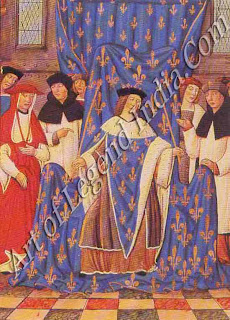
French victory, From the start of his reign in 1515, the new French King, Francis I, was determined to recover Milan. Despite having four armies ranged against him, he slipped into Italy using an unexpected route and joined battle with the Swiss at Marignano, south east of Milan on 13 September. Two days of fighting the reputedly invincible Swiss army ended in victory for Francis, through the use of artillery and the timely arrival of his Venetian Allies. But his victory was short-lived.
The year 1515 saw the newly crowned French King, Francis I, more concerned with winning glory in Italy than making political capital from the marital exploits of Henry VIII's two sisters. Meanwhile, Francis' victory at Marignano and the publication of Lives of Obscure Men showed up the weakness of the papacy.

Grunewald and many of his contemporaries were becoming increasingly disillusioned with a church that gave more attention to matters temporal than spiritual. In 1515, the year the artist completed his Isenheim Altarpiece, another German attacked the heart of the matter with the anonymous work entitled Lives of Obscure Men. This notorious satire purported to be a series of letters written in support of the Dominican monks who were attempting to suppress the study of Hebrew; but in truth it attacked the ignorance and narrow-mindedness of the monks and the corruption rampant in the Church. The book's popularity was one of many manifestations of dissatisfaction with the state of the Church under the Medici pope, Leo X. His swelling of the Vatican coffers through increased sale of Indulgences to finance the political ends of the papacy and his own family, led two years later to Luther's campaign against abuses, and ultimately to the Protestant Reformation.

Royal romance, When the old king of France, Louis XII, died on New Year's Day 1515, his young wife secretly rejoiced. Mary Tudor was now free to marry for love, her chosen partner being Charles Brandon, Duke of SOO& Her brother, Henry VIII of England, was initially against the match but in 6 the face of Mary's determination he gave way and they married in May.
Hindsight shows how significant these events were, but at the time dynastic politics seemed far more important. Two incidents during the year involved England's Henry VIII and his two sisters, Margaret and Mary Tudor.

TWO HEADSTRONG PRINCESSES 

Margaret Tudor had married James IV of Scotland who died at the battle of Flodden Field in 1513. Her subsequent marriage to the Earl of Angus alienated the Scots nobility and resulted in her being prevented from acting as regent and guardian of the future James V. She fled to England in the autumn of 1515, arriving at Henry's Court at London the following year.

Renaissance prince, The crowning of Francis I in January 1515, inaugurated a spectacular and culturally brilliant reign. It was primarily through his efforts that France became established as an artistic centre, attracting artists of the calibre of Cellini and Leonardo. The focus of Francis' patronage was the rebuilding and decoration of the royal hunting lodge at Fontainebleau. Italian architects were also imported to transform medieval chateaux into Renaissance palaces.
Her sister Mary had, in the meantime, been married against her will at the age of 18 to Louis XII of France. To her relief her ageing spouse breathed his last on New Year's Day 1515 after 81 days of wedlock. The young widow could now hope to marry the man with whom she already had a secret understanding Charles Brandon, Duke of Suffolk. Despite a promise from Henry that she could marry whom she pleased on Louis' death, Mary knew that it would be hard for him to give up such a useful diplomatic tool as a marriageable royal sister.

Suffolk was deputed to head the English embassy sent to France to congratulate the new King Francis I on his accession. Matters were complicated for the lovers in that Suffolk had promised his King that he would delay action until his return and Francis was making advances to the young widow. Under pressure, Mary acted quickly, telling Brandon that he must marry her immediately, in France, or not at all. The erring couple was allowed to return to England and their union was openly solemnized at Greenwich on 13 May.

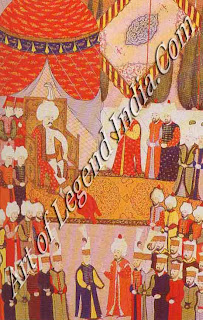
Selim the Grim, Tins particular Ottoman ruler was notable for his bigotry and cruel ambition. He assumed the sultanate after murdering his father Bayazed II, and in the nine years that followed, proceeded to nearly double the size of his empire. In 1515, after defeating the Persian Savafids, the rapacious Selim turned south and east, taking Jerusalem and ultimately Egypt during his short-lived career. Suffolk was supported during these difficulties by Henry's chief minister, Thomas Wolsey, Archbishop of York who in 1515 was at the height of his career. Created Cardinal by the Pope, later in the year he was made Lord Chancellor by Henry VIII. Wolsey's Cardinal's hat was, in fact, a bribe from Leo X to ensure English support of his alliance with the Emperor Maximilian and Ferdinand of Spain against the new French King. At 22, Francis I dreamed of winning instant glory in Italy, where previous French kings had several times seized and lost the powerful duchy of Milan. To make good the French claim, Francis would have to defeat the Swiss mercenary army supporting the incumbent Sforza Duke. Swiss pikemen were generally regarded as the best soldiers in Europe.

Francis' first campaign was a brilliant success. His army pioneered a new route across the Alps, to emerge behind the waiting Swiss, who hastily withdrew to Milan. Then, at Marignano, a decisive two-day battle showed up Swiss neglect of cavalry and, above all, artillery. A victorious Francis became Duke of Milan and was confirmed in this title by the Emperor at the Treaty of Brussels the following year. Pope Leo X was forced to come to terms with him at Bologna. It was a splendid beginning to the reign but also the beginning of what proved to be a generation of wasted French efforts in Italy.

Writer – Marshall Cavendish
Company Overview

Art of Legend India has the distinction of being one of the best in the Indian Handicraft Industry. We are about 75 years old handicrafts manufacturer & exporter. We are having team of more than 500 craftsman.

We are having our business offices in India, USA & Germany to ensure our best services.

Total Pageviews