ArtofLegendIndia.com, Biggest Online Store of Handicrafts Items, Paintings and Jewelry Accessories...

Handicrafts

Handicrafts are devices or works of art that are made completely by hand or by the use of relatively simple tools. Such goods are usually made in the traditional way of manufacturing goods. Therefore, the knowledge of the art of craft is usually passed down from one generation to another. The items made using these traditional methods of manufacturing are usually produced in smaller quantities and they often represent the culture or religious beliefs of the community that makes them. The goods are also handmade from natural materials that are found in the environment of the particular economy.

Read More!

Biggest Online Store of Handicrafts Items

Paintings

A painting is equal to thousand words, means a beautiful painting is equal to million of words. Paintings are one of the oldest art forms -- throughout history artists have played an important role in documenting social movements, spiritual beliefs and general life and culture.

History Of Paintings: The history of painting reaches back in time to artifacts from...

Read More!

Biggest Online Store of Unique Style Paintings
Showing posts with label Biography of Fra Angelico. Show all posts

Italian Great Artist Fra Angelico - Monastic Life

Posted by Art Of Legend India [dot] Com On 11:14 PM 0 comments

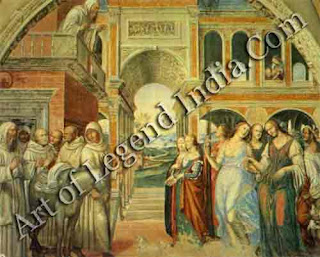
Dens of iniquity, Accusations that the monasteries were dens of avarice, impiety, fornication and sodomy were widespread from the 13th century onwards. This fresco shows a scene from the life of St Benedict, who rejected the dissolute lifestyle of the monasteries and their prostitutes to pursue a solitary life of prayer. Monastic Life

By the 15th century the monasteries had become notorious for their worldliness and debauchery, yet there were some devout orders in which monks led austere lives of study and prayer.

'They cheat, steal, fornicate, and when they are at the end of their resources they set up as saints and work miracles.' Such was the charge made against friars by the 15th century Italian author Masuccio, and his opinion was shared by many of his contemporaries.

In the growing secular and commercial atmosphere of Renaissance Florence, monastic life appeared parasitic. The most virulent dislike was reserved for the friars in the mendicant (begging) orders the Franciscans, Dominicans and Carmelites, all of whom had settled in Florence during the 13th century.
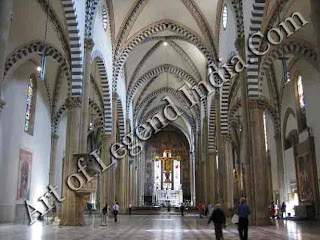
Santa Maria Novella, The church of Sta Maria Novella became the Florentine home of the Dominicans in 1221, just a few years after their arrival in the city. Together with the Franciscans, they led the great religious revival of the 13th century, preaching obedience to the Roman Papacy.But to a large extent, it was the hypocritical flouting of the basic monastic rules of poverty, chastity and obedience which inflamed the public. Contemporary records make it clear that it was not unusual for friars and priests to carry weapons and hunt, or to keep mistresses and father children.

Obedience to religious rules seemed equally lax in many convents of nuns. Masuccio went so far as to claim: Some nuns are formally wedded to monks, with the accompaniments of mass, a marriage contract and a liberal indulgence in food and wine. The nuns afterward bring forth pretty little monks or else use means to hinder that result'.
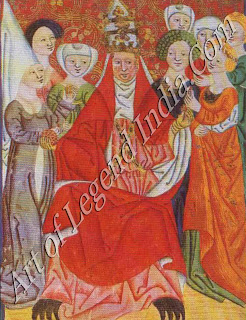
The devil in the pope's robes Disillusionment and dissatisfaction with the church was a popular subject of literature and art. This 15th century miniature shows the pope with demon's claws, handing out the fruits of temptation to the bevy of ladies surrounding him.No doubt exaggerated for satirical effect, Masuccio's claim nevertheless held more than a grain of truth. Often, monasteries and nunneries were close enough for members of the orders to mingle and to share beds. Monastery archives testify to this fact with their volumes given over to the trials of cohabiting monks and nuns. Immorality was so rife that rumours began to be heard in favour of priests marrying.

In addition to this, the religious orders were openly becoming worldlier. They courted the patronage of princes and businessmen, owned large amounts of land, sold pardons and deathbed absolutions, and concerned themselves intimately with the affairs of the people and political life. Some monks also took advantage of the anonymity and sanctity their habits afforded them and acted as agents and go-betweens in conspiracies and murder-plots.

POOR CANDIDATES 
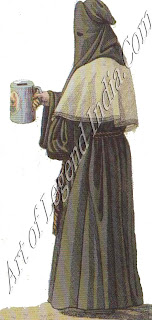
The Mendicant friars The Mendicant orders brought religion to the urban poor. They supported their activities by begging, which made them very unpopular in the growing commercial atmosphere of 15th century Florence.
A decline in monastic standards was almost inevitable at a time when candidates were admitted too easily and for the wrong reasons. Many were the children of impoverished noble families who paid a one-off sum to the monastery to secure a respectable career for their offspring, and not all had true vocations for the religious life. The level of learning was generally not high and many candidates had no aptitude for study. However, there were those who pursued lives of prayer, study and work, and monks who belonged to the well-endowed monasteries in the great city states of Pisa, Milan and particularly Florence were the privileged members of some of the best centres of learning in Europe.

Nowhere are the extremes of monastic types more apparent than in the lives of the Florentine painter-monks, Fra Angelico and Fra Filippo Lippi. In 1421 Lippi, an orphan, was placed in the Carmelite priory in Florence. But his unsuitability for such a life was shown by his subsequent trial for fraud, and his abduction of a nun, Lucrezia, whom he later married and who bore him a son, Filippino, who also became a painter.

In marked contrast, Fra Angelico led a reverent life within the Dominican order, earning for himself the title of Beato, meaning 'blessed one'. Although the qualities of spirituality and grace that are found in his paintings may have enhanced his reputation, his life in the Florentine monastery of San Marco was certainly a devout one.


THE DOMINICANS 
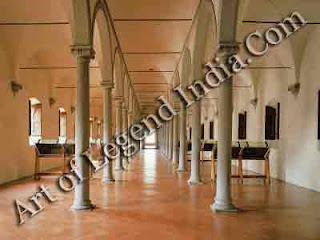
San Marco Library, The building of the library at the Dominican monastery of San Marco was part of the extensive renovations carried out with money donated by Cosimo de' Medici. With his help it became one of the largest and most respected libraries in Renaissance Italy. From the early 13th century, the Dominican order had been based in the western part of Florence, around the church of Sta Maria Novella. The Dominicans stressed religious orthodoxy and obedience to the pope. They had a strong commitment to learning as well as to preaching, I and set up studia generale, a form of higher education catering not only for members of their shown order but for secular students too. Similar establishments were founded by the Franciscans and Augustinians in other parts of the city. The teachers came from within the order, but were sent to study abroad at universities such as Paris and Bologna. Dante, a pupil of the studio, is proof of the high standards of learning that the system fostered.
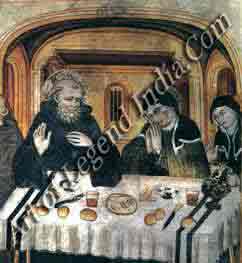
Simple fare, St Benedict and his sister St Scholastica share a simple meal offish, bread and wine. Meals in most monasteries followed a similar pattern of frugality meat was not permitted.  
The history of the Dominican monastery of San Marco demonstrates the close links between political and business interests and religious life. Although professing humanist ideas, Cosimo de' Medici the ruler of Florence was anxious to keep his Christian life blameless. Apparently suffering from prickings of conscience that 'certain portions of his wealth had not been righteously gained', Cosimo was advised by the pope to use the money to extend the monastery around the church of San Marco, which he had recently handed over to the Observantist Dominicans, a reforming branch of the order. In this way, Cosimo could 'unburden his soul'.

Work began on the new monastery and library of San Marco in 1437. The plan followed traditional monastic lines, with the rooms built around three sides of a cloister, with the guest hospice, the chapter house and the refectory downstairs, and the monks' study-cells, dormitories and the library on the first floor. But the light, classical simplicity of the architecture set the monastery apart from others in the city, and the library became a pattern for subsequent Italian monasteries. When in 1444 Cosimo donated a collection of over 400 Greek and Latin manuscripts to the library, San Marco became the largest and most influential of the early public libraries in Italy.
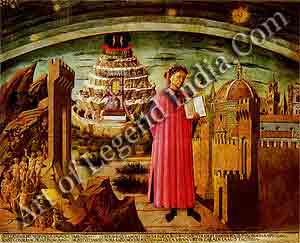
Italy's greatest poet Dante Alighieri (1265-1321) was the most outstanding product of the Florentine religious schools, where he studied for two-and-a-half years. His most famous work, the Divine Comedy, is an allegorical poem which illustrates the tragedy of the human condition and shows the way to happiness through Christian faith.
The second prior of San Marco was Antoninus Pierozzi, who took up his post in 1439 and later authorized the decoration of the monastery's cell walls with the wonderful frescoes of Fra Angelico. He later became Archbishop of Florence and was made a saint at his death. His life was led according to the austerest Dominican precepts; he gave a third of his income to charity and, as was the monastic rule, provided food and sustenance to the Florentine poor and the swarms of beggars who visited the monastery with their children. He also founded an organization for the poveri vergognosi, the 'embarassed poor', who were too ashamed to let their poverty be known publicly.

Antonino's moral guidance also led to a drive to reform both the Florentine clergy and monastic discipline within his own monastery. Here the principles laid down for all Dominican friars were strictly observed, with the celebration of the six liturgical offices, each lasting for three hours, forming the basis of the monastic day.

In most orders there was little privacy, with monks sleeping in large dormitories. Because of the Dominican emphasis on learning, individual cells had developed, where members could obtain a degree of privacy and silence for studying. These were generally small rooms arranged on each side of a central corridor, from which the interior of each cell was visible.

MEALS AND RECREATION 
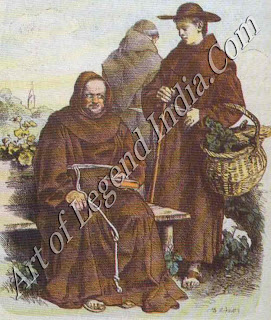
The Franciscans, The followers of St Francis of Assisi settled in Florence at the beginning of the 13th century, establishing themselves in the small church of Sta Croce, which developed into an impressive monastery. A Mendicant order based on the precepts of poverty and humility, it had lost much of its popularity by the 15th century. Meals were frugal, although the Florentine orders were well provided by their farmlands in Tuscany, which supplied them with wine, wheat, beer and oil. Two meals a day were eaten in summer (from Easter to mid-September) and generally only one in winter. Extra food was allowed on feast days but no meat was served in the monastery. Wine or beer was commonly served at meals, although it was frequently withdrawn as a penance. Silence was observed at meals and for most of the day.

After the midday meal came a brief period of recreation, when friars could talk or exercise on the gardens. Relaxation did not include running, playing games, laughing loudly or singing especially singing vulgar songs although by the Renaissance, many warnings for this kind of behaviour are recorded.

DECLINING STANDARDS 

After the death of Antonino, the standards at San Marco declined until later in the century, when the puritannical zeal of a yet more famous prior, the martyr Savonarola, brought a new wave of reforms, not only within the walls of the monastery but throughout the whole of Florence.

Writer – Marshall Cavendish

Italian Great Artist Fra Angelico - The Work of an Angel

Posted by Art Of Legend India [dot] Com On 4:43 AM 0 comments

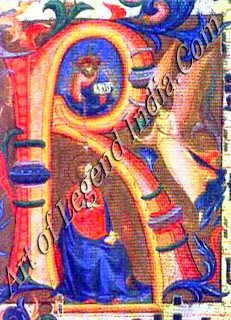
Illuminating ideas, Fra Angelico began his artistic training working on illuminated manuscripts. This Annunciation from a manuscript produced at San Domenico, Fiesole, in about 1430 is generally thought to be from his own hand. The Dominican monks were encouraged to paint these miniatures it was considered to be a good mental discipline. The Work of an Angel

It is tempting to attribute the stunning beauty of Fra Angelico's work to divine inspiration, but that would be largely to disregard his abilities and self-discipline as a highly skilled artist.

The great Victorian art critic John Ruskin summed up the traditional view of Fra Angelico when he wrote that he was 'not an artist properly so-called but an inspired saint'. Fra Angelico was certainly pious, but Ruskin was totally misleading in suggesting that he was anything other than a highly professional artist. He was not only in the vanguard of ideas, but also ran an efficient workshop and travelled considerable distances (to Rome and Orvieto) to take up commissions. There were several other painter-monks who achieved great distinction during the Renaissance his contemporaries Lorenzo Monaco and Filippo Lippi, and two generations later Fra Bartolommeo, who worked at Fra Angelico's monastery of San Marco. None of them, however, has matched the popular appeal of Fra Angelico, whose great achievement was in combining the highest technical skills with a sense of radiant spirituality.

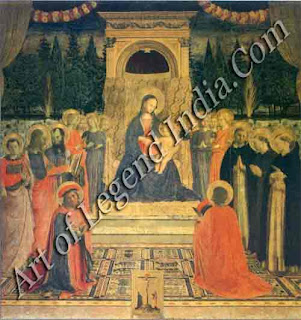
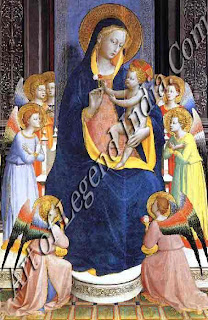
'Sacra Conversazione' The San Marco Altarpiece, 1438-40 commissioned by Cosimo de Medici. This is one of the first 'sacred conversations' in which Fm Angelico abandoned the polyptych and showed the Madonna, angels and saints in a unified area. Many devices have been used to give the illusion of space the receding patterns on the carpet, the trees beyond the walls and the looped curtains enclosing the foreground. Certain features of Angelico's style show through virtually all his work, especially his decorative sense and wonderful skill with colour, but his art developed greatly during his career, which falls into three broad phases. In the first he appears as an artist of tremendous innate talent, but still working largely within traditional conventions. In the second phase, his work takes on a greater clarity and weight as he absorbs and refines the ideas of his great contemporaries. And in the third, he excels as a fresco decorator.

JEWEL-LIKE WORKS 

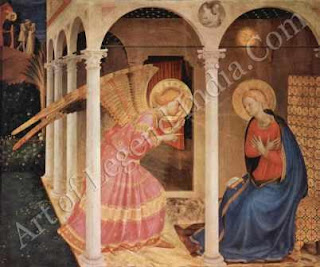
Angelico's earliest works, small and jewel-like, are the sort of painting for which the initial commissioning contract would specify the amount of gold or expensive blue pigment the painter was required to use. They were intended to decorate the altars of chapels at Fiesole and in other Dominican establishments. Fra Angelico was also involved in work on manuscript illumination at this time, an activity much favoured as a part of the devotional observance of a young friar. The gorgeous Cortona Annunciation marks the culmination of this early phase but also in the insistent perspective of the architecture looks forward to his more naturalistic later style.


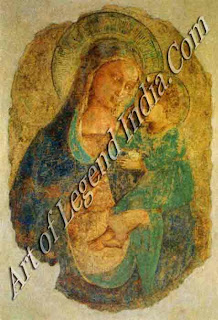
Wall painting, Fresco painting began with a sinopia a drawing on a wall which was used as a guide. Each day a different section was covered with wet plaster and then painted. The plaster and paint dried together, giving a highly permanent surface. Restoration work at San Domenico, Fiesole, has uncovered some of Fm Angelico's sinopie, so that drawing and fresco can now be compared.
A key work in his development is the Linaiuoli Altarpiece, the celebrated work produced for the Florentine Linen Guild in 1433. The magnificent frame is by Lorenzo Ghiberti, the most famous sculptor of the day, and it pulls together the various panels Fra Angelico painted and makes them into a coherent whole. When the altarpiece's doors are shut, two solid, monumental saints (Mark and Peter) stand next to each other on a firm platform of rocky ground. When they are open, Saints John the Baptist and John the Evangelist flank the Virgin and Child, witnesses and guards. Beneath them all, three small panels, known as the 'predella', contain self-contained scenes showing St Peter Preaching, The Adoration of the Magi and The Martyrdom of St John the Evangelist. Each is a superbly imaginative interpretation of how the real events may have looked. Only the angels decorating the painted arch framing the Virgin and Child panel seem to belong to the earlier, more archaic phase of the painter's work.

THE RENAISSANCE INFLUENCE 

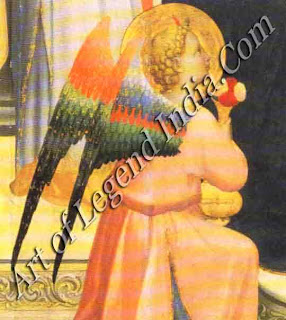
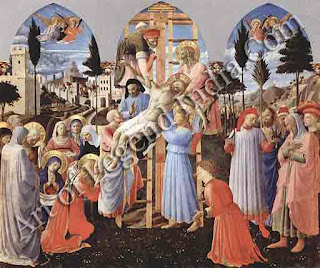
Angelic features, This detail from the painting opposite shows the radiant beauty of Fra Angel ice's work. He painted angels with a grace and freshness that no artist has surpassed. Fra Angelico did not stumble on this Re-naissance clarity overnight. His earlier works all show some influence of Renaissance ideas unified lighting, naturalistic plants and other details, real weight to the fall of the draperies of the saints' clothing and, most significantly, a scientific use of geometric perspective to create an illusion of depth in the picture. But in the Linaiuoli Altarpiece, and other works of the 1430s such as The Deposition from the Cross painted for Santa Trinita in Florence, they become his guiding principles.

For all the beauty and splendour of his panel paintings, it is on his frescoes that Fra Angelico's fame and popularity mainly rests. The art of fresco painting was more highly developed in Italy than in any other country and for centuries was regarded as the only fitting outlet for an artist's grandest thoughts. Italy's bright light means that churches there (compared with those in northern Europe) tend to have small windows and consequently large areas of wall that can be covered with paintings. And Italy's generally dry climate is ideal for preserving frescoes, which can deteriorate rapidly if the walls on which they are painted become damp.

Virgin and Child with Saints Dominic, John the Baptist, Peter Martyr and Thomas Aquinas, This is the earliest painting by Fra Angelico which can he given a positive date. It was installed in 1429 on the high altar of the church of San Pietro Martire, Florence, and was probably completed in the previous year.
The sheer scale of the demands placed on Fra Angelico required him to work with a considerable team for his fresco cycles. First the wall would have to be carefully plastered, ready to take the master's design. Over this, a top layer of fine wet plaster was applied, just enough to be painted in one day. The work would then have to be quick and accurate in order to be completed before the plaster dried and could no longer take up the paint. Remarkably, a few of Fra Angelico's own under drawings or sinopie have been uncovered during the restoration of his frescoes in San Marco and at Fiesole. With the top layer of painted plaster removed and mounted on a new base, we can see the extraordinary drawings that lay beneath. This was the clarity of vision that enabled him to carry out large and complex schemes with numerous assistants, yet still ensure that the works were his own. When he went to Rome to work for Pope Nicholas V he took a whole team of assistants, the most important being Benozzo Gozzoli, but stamped his own artistic personality on the work.

Fra Angelico lived at a time when the role of art was changing to something to be appreciated for itself rather than solely for its religious meaning or decorative function. His work showed that the human messages of the Renaissance could be charged with the fervour of Catholic Christianity. Indeed, he succeeded like no other painter of the Renaissance, or any other period, in creating a synthesis between piety and grandeur.

Writer – Marshall Cavendish

Italian Great Artist - Fra Angelico Painting Gallery

Posted by Art Of Legend India [dot] Com On 11:16 PM 0 comments
Fra Angelico’s works reflect the serenity, discipline and anonymity of the communal religious life. But he still managed to infuse them with compassion which is what gives them their timeless appeal. Each time he painted an already familiar theme, he was still able to give it new expression and development compare the early Cortona Annunciation with the San Marco version, painted 20 years later. The Deposition from the Cross is another good example of a formal religious composition filled with deep emotion and humanity.

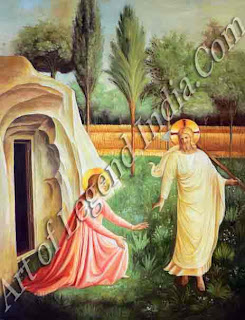
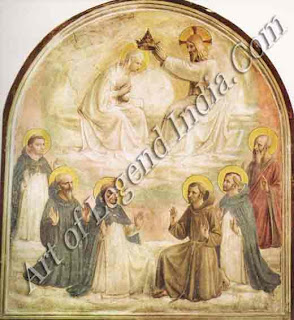
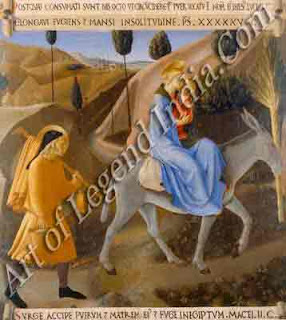
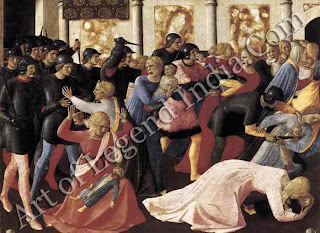
The frescoes of San Marco Noli Me Tangere and The Coronation of the Virgin dominate the convent cells. They were aids to meditation and spiritual exercise and were simple, constant reminders to the friars of the religious discipline necessary to the community. The restrained economy of these frescoes contrasts well with Scenes from the Life of St Lawrence which emphasize the narrative and include a wealth of extra details. The Flight into Egypt and the Massacre of the Innocents develop this realism even more intensely and take Fra Angelico firmly into the main body of 15th- century Italian painting.

The Great Artist Fra Angelico Painting “The Annunciation” 1433-34 68" X 70" Museo Diocesano, Cortona
This is the first undoubted masterpiece painted by Fm Angelica, whim‘: his followers then tried to imitate. Beneath an arcade partly enclosed by columns, the Virgin leans forward to hear the angel’ ‘message while, to the left, Adam and Eve are being expelled from the Garden of Eden. There is strong sense of mystery and earnestness.


The Great Artist Fra Angelico Painting “The Deposition from the Cross” c.1443 68½" X 72" Museo di San Marco, Florence
Designed to be set on a wall, not over an altar, this work is a meditation on the sufferings of Christ. Although the composition is arranged across the whole panel, the figures form three distinct groups. The centre is taken up with the body of Christ; on the right are men in Florentine dress; on the aft are the holy women, among them the Virgin Mary.


The Great Artist Fra Angelico Painting “Noli Me Tangere” c.1441-45 Fresco 69" x 54" Monastery of San Marco, Florence
One of a series of Scenes from the Life of Christ, which decorate the 11, cells on the upper floor of the San Marco monastery. This fresco is in Celli. The two heads are both carefully silhouetted against different backgrounds; note the minutely observed foreground.


The Great Artist Fra Angelico Painting “The Coronation of the Virgin” c.1441-45 Fresco 74" 62” Monastery of San Marco, Florence
This work can be found in Cell 9. Although Fra Angelico had painted this theme Alive, the treatment here is quite different. The coronation is a private affair with no audience, accompanied Only by six kneeling saints


The Great Artist Fra Angelico Painting “The Annunciation” c.1450 Fresco 84" X 125” Monastery of San Marco, Florence
Found in the upper corridor facing a staircase, this fresco was possibly painted after Fm Angel ice's return from Rome. It is one of the finest and most intimate of his frescoes, with the figures, enclosed within an empty chamber, framed try solid columns with decorated capitals. The atmosphere is subdued and quiet; compare it with the urgency and hidden drama of the Cortona Annunciation.


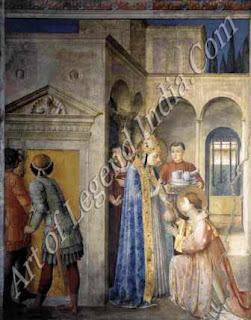
The Great Artist Fra Angelico Painting “St Lawrence receiving the Treasures of the Church” c.144749 Fresco 107” x 81" Nicholas V Chapel, Vatican, Rome
This work is part of a fresco cycle commissioned by Pope Nicholas V and is the only surviving series painted in Rome by Fra Angelico. It shows Pope Sixtus II giving St Lawrence the church treasures while Roman soldiers beat down the door.


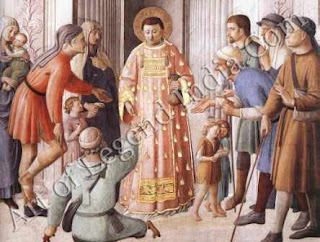
The Great Artist Fra Angelico Painting “St Lawrence Distributing Alms” c.1447-49 Fresco 107” x 81" Nicholas V Chapel, Vatican, Rome
This is immediately to the right of the Treasures fresco and is another episode in the hp of St Lawrence. The saint is shown distributing alms to a group of beggars, cripples, women and small children.


The Great Artist Fra Angelico Painting “The Flight into Egypt” c.1450-53 15" x 15" Museo di San Marco, Florence
One of 35 scenes commissioned by Piero de' Medici on Themes from the Life of Christ, which were to decorate a silver chest in the Santissima Annunziata church, Florence. The figures are very lifelike note the convincing way Mary is seated on the donkey.


The Great Artist Fra Angelico Painting “Massacre of the Innocents” c.1450-53 15" x 15" Muse° di San Marco, Florence
Another example from the Medici silver chest series, showing how much Fra Angelico had developed from his earlier works. Herod looks on from behind a wall while, in the foreground, the weeping women are portrayed in a remarkably realistic manner.


Writer – Marshall Cavendish
Company Overview

Art of Legend India has the distinction of being one of the best in the Indian Handicraft Industry. We are about 75 years old handicrafts manufacturer & exporter. We are having team of more than 500 craftsman.

We are having our business offices in India, USA & Germany to ensure our best services.

Total Pageviews