ArtofLegendIndia.com, Biggest Online Store of Handicrafts Items, Paintings and Jewelry Accessories...

Handicrafts

Handicrafts are devices or works of art that are made completely by hand or by the use of relatively simple tools. Such goods are usually made in the traditional way of manufacturing goods. Therefore, the knowledge of the art of craft is usually passed down from one generation to another. The items made using these traditional methods of manufacturing are usually produced in smaller quantities and they often represent the culture or religious beliefs of the community that makes them. The goods are also handmade from natural materials that are found in the environment of the particular economy.

Read More!

Biggest Online Store of Handicrafts Items

Paintings

A painting is equal to thousand words, means a beautiful painting is equal to million of words. Paintings are one of the oldest art forms -- throughout history artists have played an important role in documenting social movements, spiritual beliefs and general life and culture.

History Of Paintings: The history of painting reaches back in time to artifacts from...

Read More!

Biggest Online Store of Unique Style Paintings
Showing posts with label About Ramayana. Show all posts

Ayodhya Kanda I of Ramayana

Posted by Art Of Legend India [dot] Com On 3:49 AM 0 comments
AMA ONLY EVER SPOKE the truth. He was grateful for the smallest favour received from others but never took offence from their actions. He understood people and knew how to encourage and correct them, so that they felt appreciated when they were with him. He always kept a positive outlook on life and had a natural sense of the right time and place for everything.

Although he was already far advanced in knowledge he continued to study science, politics and economics, as well as military arts. He wanted to protect his people from all harm, so he learned battle strategies and military command, and in personal combat none could defeat him. Besides all this he still found time to enjoy himself and was a keen patron of music and the arts and an accomplished rider. For all these reasons he shone before all like the Sun god, and all his people loved him.
Three avatars of Vishnu (from left to right): Matsya, Karma and Parsurania.Not surprisingly, of all his sons Dasaratha loved Rama the most. Emperor Dasaratha was getting old, and seeing how well Rama was doing he decided to pass control of the kingdom over to him. Bad omens had been seen recently, which further convinced him that he should place responsibility for the kingdom into younger and more capable hands. He called together his ministers and advisers and put it to them that it was time to hand over to Rama, but he did not invite Bharata to be present. One reason for this was that Bharata was far away, staying with his uncle Yudhajit, in the state of Kekaya. But there was another reason. Dasaratha had once promised to Kaikeyi's father that her son would be crowned king of Ayodhya. In view of this, he thought it best not to give Bharata the opportunity to object to Rama's coronation.

After thousands of years in the service of my people my body is worn out and my mind exhausted,' Dasaratha's voice rumbled like distant thunder. 'I now wish to install Rama as king.' He paused. 'Does anyone wish to speak?

The assembly shifted uneasily. They had to choose their words carefully. How could they show their enthusiasm for Rama without appearing to suggest that the emperor was indeed growing old?

Mother Earth wants Rama as her guardian,' spoke up Vasistha, 'therefore she has inspired you to think in this way. if it is her wish and yours, then it is also ours. Let Rama be our protector.' Dasaratha seemed pleased with his answer.

Then let us make haste. Now is a good time for the ceremony. The trees are in blossom and spring is upon us.'
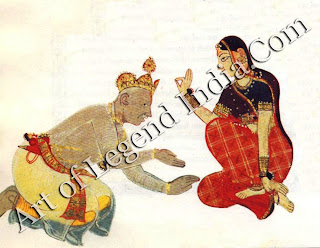
Dasaratha begs Queen Kaikeyi to ask for anything but banishments of Rama.
So it was decided. Priests were sent for and hasty preparations began. Ingredients were gathered: white flowers from the meadows, dried paddy, grains, curds, ghee, honey, fragrant oils, gold and precious stones.

Call the royal guard, decorate the gateways let the dancers perform. Tomorrow the moon stands in conjunction with the auspicious star Pusya and there is no time to lose,' decreed Dasaratha. When all was underway he called aside his personal assistant, Sumantra, and spoke quietly to him, 'Bring Rama to see me.'

Rama prostrated himself full-length before his father and waited for the familiar touch of his hand. Dasaratha drew his son to him and hugged him long before sitting him on an ornate seat. He loved to look at Rama.

I am getting old. I have done all I had to do for the gods, the sages, the Brahmans, the people and for myself'. But still there is one thing that remains: I must install you as my successor. I have decided that you should be crowned king. The date for your coronation is fixed for tomorrow.

Rama listened quietly, taking in his father's words. He enjoyed life as a royal prince and had no wish for this sudden change. But his father's word was law and his deep sense of duty and his love for the old man who had always shown him such affection bound him absolutely. To question his wishes would be unthinkable.

Always be humble, control your senses and avoid anger. Lay up stocks of wealth and food grains. Keep your courtiers happy.' Dasaratha went on with his good advice while Rama listened respectfully. When the interview was finished, he hurried home to tell Sita the news.
Meanwhile, news spread through the city. As Rama returned to his house crowds pressed around to congratulate him. He arrived home and was searching for Sita to tell her about the coronation when he was surprised to see Sumantra again and to hear that the emperor had called for him a second time. Concerned, he hastened to his father.
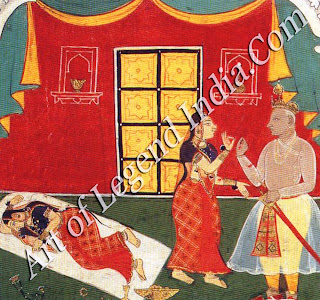
In her chamber of wrath, Queen Kaikeyi rolls on the floor in hysteria, then demands two boons from the emperor.My dreams are troubled by omens, meteors have been sighted, and my astrologers have warned that the planets are against me,' Dasaratha told him. 'They say I must take advantage of tomorrow's favourable moon to crown you before it is too late. I am worried about Bharata. He is your loyal and honest brother and he is far away, but he may lay claim to the throne.  We must be on our guard tonight. To ward off bad for-tune you and Sita should observe a fast through the night and sleep on the bare floor.

Quickly now Rama went in search of Sita. He found her attending his mother in the temple. Kausalya had long wanted her son crowned, and now her prayers had been answered. Silently she sat in grateful meditation on Vishnu, the Lord of the Heart. Becoming aware of her son's presence, she joyfully embraced him. '

0 Rama, may you live long, and may your enemies be destroyed! Now all my sacrifices and prayers to Lord Vishnu have been fulfilled.

Lakshmana came in and bowed. Rama put his arm around him and said, 'Rule with me. This blessing is for both of us.' Then taking leave, he and Sita made their way home.

THE AVATARS OF VISHNU

TFIE TEN incarnations, or avatars, of Vishnu are a recurrent theme in Vedic literature. Vishnu enters this world to restore its balance, described below by Krishna, the original Vishnu

Whenever there id a decline in religion, and a rise of irreligan, I incarnate myself. To protect the good, to destroy the wicked, and to re-establish religious principled, I appear in every age.

The ten avatars of Vishnu are: Matsya the fish, who saved all creatures from the universal flood; Kurma the tortoise, who helped the gods gain immortality; Varaha the boar, who rescued the earth from the bottom of the universe; Narasimha the man-lion, who killed the demon Hiranya Kasipu; Vamana the dwarf, who defeated the demon Bali; Parasurama, who defeated the war-like kings; Rama, who killed the demon Ravana; Balarama, brother of Krishna; Buddha, who taught compassion; and Kalki, who will come at the end of time to vanquish evil and inaugurate a new cycle of the universe.
At Rama's palace there were scenes of celebration. Soon Vasistha arrived, sweeping up to the inner gate in his chariot and hurrying inside. Dasara.tha had sent him with further counsel. '

There is no going back on this now, Rama. It is most important that you observe the fast according to the proper rules given in the sacred texts.'

After Vasistha left, Sita and Rama lit a sacred fire and made offerings to Vishnu. Then they spread grass mats on the bare floor of the temple and lay down to sleep, thinking only of Lord Vishnu.

TREACHERY
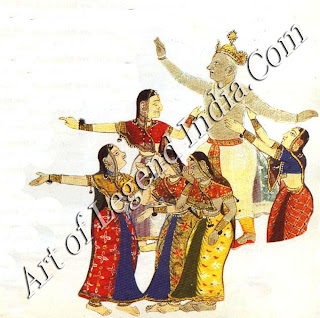
Restrained by his, wives, the despairing Dasaratba bids farewell to Rama, his favorite son.
Manthara stood on the roof' of the royal palace surveying the scene below. She had heard nothing about Rama's coronation, but she could tell from the flags, the freshly-watered streets, the commotion and noise that something was happening.

Have you heard? Tomorrow the emperor is to install Rama on the throne.' The words, spoken joyfully by Rama's old nurse, who had just appeared on the roof, hit Manthara's ears like a thunderclap. To her alone in Ayodhya this news was not wonderful. She was Queen Kaikeyi's aged personal maidservant. When Kaikeyi had married Dasaratha, Manthara had come with her as part of' the royal household and she was fiercely loyal to her mistress, particularly as her deformity gave her few other friends: she was a hunchback.

She hurried down to find her mistress as usual reclining in her bedroom.

Get up!' she scolded. 'This is no time to sleep. Your luck is about to evaporate like a river in the dry season. In the absence of your son Bharata your deceitful husband plans to install Rama on the throne. You must act quickly to protect your rights!' Kaikeyi was bemused at this statement. She looked upon Rama as her own son. His good fortune was hers, and would be shared with all his brothers.

You are the bearer of joy, Manthara. Why should I be unhappy to hear this?' 'Foolish woman, what is there to celebrate? Don't you see? Once Rama is king your son will be powerless and you will be forced to serve Queen Kausalya.' Manthara knew that Kaikeyi, as the youngest of Dasaratha's wives, was not fond of Kausalya. But these words made Kaikeyi indignant.

Rama is full of virtue and deserves to be king. Besides he is the eldest brother and it is his right. He will look after Bharata and me as he would his own mother. Already he serves me more than he does her. Anyway, Bharata can still be king. After a hundred years when Rama retires, he will hand over to Bharata, as Dasaratha has to him.
How can you be so stupid as to think Bharata will ever get the throne? Once Rama is king the succession will go to his son, as it always does, and Bharata will be excluded forever from the royal line. Rama will more likely send Bharata into exile. Rama should be sent away instead, and Bharata should have the throne. You must act to protect Bharata and yourself from the schemes of your co-wife. Find a way to give Bharata the throne and banish Rama.
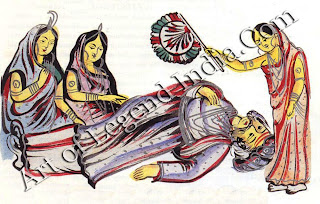
When it is time to say goodbye to his son Rama, Emperor Dasaratba .faints with grief and is revived by bit queens.Kaikeyi heard this with increasing alarm. It was true that she had always wanted Bharata to be king, especially because Dasaratha had promised it so, and she did resent Kausalya's seniority. Now Manthara's crooked words fed her fears and ignited a resentment born of long frustration. Her lethargy turned to anger.

Perhaps you speak the truth, Manthara. Maybe Rama should be sent away and Bharata put on the throne. But how on earth could it be done?' 'You yourself have the means, you told me in the past. Must I remind you?' Kaikeyi got up from her bed. Her interest was definitely aroused.

Once when Dasaratha was severely wounded on the battlefield, you saved his life by taking him away to a safe place. At that time he offered you two boons. You said you would ask for them later, to which he said, "So be it!" You told me this long ago and I have treasured it ever since, waiting for the right time to help you. Now you should ask for these two boons to be granted. First, ask that Bharata be put on the throne. Second, demand that Rama be banished from the kingdom for fourteen years,' exclaimed Manthara.

Kaikeyi listened with excitement as Manthara told her to enter her chamber of wrath, her private room for anger and depression, throw off her ornaments and finery, loosen her hair and lie on the floor. When her husband would find her there she must weep and wail and wait for him to offer her what she wanted.

He will offer you jewels and gifts. Do not accept them. Fix your mind only on the throne for Bharata and banishment for Rama.

Manthara made her put on old clothes and sent her to the chamber of wrath. The delicate queen untied her hair and threw herself upon the ground, scattering her ornaments about her. Tossing from side to side she began to work herself into a frenzy.
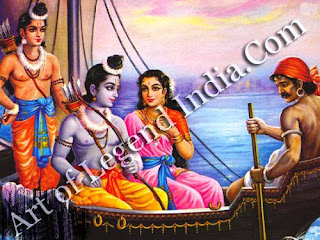
Ram sita and Laxman in boadIf Rama becomes king your life will be misery and your son will surely be killed!' Manthara goaded her.

Either Bharata will be crowned or I will eat nothing and stay here until I die,' said Kaikeyi. Her face darkened by rage and her heart poisoned by Manthara's arrows of hatred, she awaited her husband.

Dasaratha had just seen Rama for the second time and evening was approaching. He had been issuing orders all day and at last he felt confident that all was in hand for the coronation. Now he looked forward to the enjoyable task of telling his dear Kaikeyi the exciting news. As was his habit he went to find her in her bedroom.

Kaikeyi's bedchamber was empty, her bed unused. He found one of her maids who told him nervously that she was in her chamber of wrath. In dismay he entered the darkened room and found her sprawled on the floor, like a creeper torn from a tree, weeping piteously. He knelt beside her, but she pushed him away.

My beloved, who has upset you? What is wrong? Let me put it right. If someone needs to be punished I will punish them, or if someone must be rewarded I will reward them.' The queen took no notice and continued to weep. 'I promise on my honour that I will do whatever pleases you. I rule an empire stretching from the southern Deccan to the Himalayas, from east of Bengal to west of Rajasthan. Whatever you want is yours.' She turned to him. 'No one has insulted me,' she sobbed, 'but there is some-thing I must have. Promise you will give it. Give me your word and I shall tell you what it is.' She had Dasaratha at her mercy.

My dear, I promise you shall have what you want. I swear on my beloved Rama, without whom I could not live for even a day. I swear I will satisfy' your desire. Please let me make you happy again.' Helplessly the emperor was drawn into Kaikeyi's trap. 
Indra and the gods have heard your oath. The moon and sun bear witness to your words. Now listen to me.' Kaikeyi's voice hardened. 'Remember when I saved your life and ydlit offered me two boons? Now I want them. If you refuse me I promise I will die. My first request is for Bharata to be installed on the throne in place of Rama. My second is for Rama to be sent this very day to Dandaka Forest for fourteen years to live as hermit.

Dasaratha could not believe his ears. All day he had felt a sense of foreboding which now turned to a throbbing in his head and pain in his heart. He collapsed on the bare floor beside his queen and began to murmur.
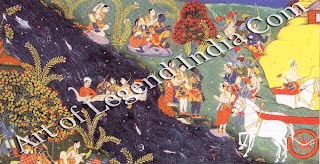
 The Royal leave behind their loyal followers
0 pity! Pity! Your words are cruel. What harm has Rama ever done you? When the whole world loves him why should I send him away? Life might go on without the sun or water, but I cannot live without Rama. I can't believe you mean what you say. This is not you speaking, but some evil spirit that has entered you. I might agree to put Bharata on the throne, but I will never banish Rama. Take pity on me. I am old and weak. You can have anything I possess, but without Rama I will die. But the emperor's weakness only served to strengthen Kaikeyi's resolve.

You have given me your oath. Are you going back on your promise?' she tormented him. 'Your word has no value? Banish Rama or I shall drink poison.

In vain Dasaratha tried to reason with this cruel queen, by turns groaning and pleading. How would Rama, who knew only fine food and soft beds, survive alone in the forest? Rama was so noble and obedient that if asked he would go at once with-out complaint, but what of Sita and Kausalya? Surely they would die of' broken hearts without him. Indeed who would wish to stay in Ayodhya if he were gone? Even Bharata would not stay. And Dasaratha would be ridiculed and die. Kaikeyi would be left alone to preside over the collapse of the empire. But the woman's heart was hard and cold and his words useless. Spent, he collapsed at her feet, a broken man.

Darkness fell and the palace became silent. Dasaratha lay unconscious. As the long night passed, he drifted in and out of wakefulness, pleading and whimpering, and dreading the arrival of dawn. The queen, however, was alert with angry determination. As the sky lightened she commanded Dasaratha to send for Rama.
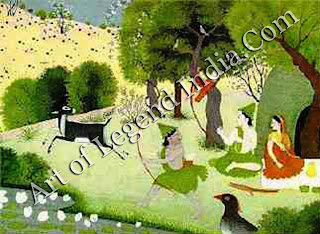
 
Sits and Rama living in the forest, dressed in simple forest clothes of tree-bark and deerskin. Lakshmana, wearing a tiger-skin, cooks for them, while Rains, garlanded by forest flowers, looks lovingly on Silo
0 kings, awake, for today is a glorious day,' he called. 'As the sun wakes the world so do I wake you. Vasistha is here and all is ready. Come and order the installation of' Rama.' From the shadows emerged the emperor, red-eyed and feeble.

I am not asleep, Sumantra. Silence, please. You are only making things worse.' The emperor collapsed onto a couch and Kaikeyi stepped forward.

He was unable to sleep last night in anticipation of today's coronation,' said Kaikeyi. Now he is exhausted. Call Rama to come here at once.' Sumantra hesitated, waiting for the emperor's approval.

Do as she says -bring Rama,' murmured the emperor. Sumantra hurried to fetch him. Hearing that his father wanted him, Rama came out of his palace like a lion from his mountain cave. Joined by Lakshmana he mounted his chariot, inlaid with gems and gold, and moved in state procession through the city. The crowd followed him right up to the inner gate of the palace, where they waited for his return as the ocean waits for the moon.

Rama went inside with Lakshmana. As soon as he saw his father he knew some-thing was terribly wrong. He was sitting with Kaikeyi on her bed, his face black with despair like the sun in an eclipse. Rama bowed at save to falteringly repeat the name 'Rama', and his turned to Kaikeyi in alarm.

What has upset my father? Rama demanded. Why is he in such a state?'

The emperor is not angry. He has something himself' to say the words. If you promise to carry On his own he will never tell you.'

Mother, you know that I will do anything for my father. If he wishes I will drink poison. Tell me his wish and I shall execute it. Rama never goes back on his word!'

Long ago your father offered me two boons, and now I am claiming them. I have asked him to install Bharata on the throne in your place and to exile you to Dandaka Forest for fourteen years where you are to live as an ascetic. Now you know why your father cannot look you in the face.

These words made Lakshmana recoil in anger and dismay, but Rama heard them without flinching. His voice remained even-tempered as he replied:

lf the emperor has promised you this then without hesitation I shall go to the forest.' Kaikeyi was delighted to rind Rama so cooperative. Shamelessly she pushed home her advantage, urging him not to waste time in getting ready to leave.

I am not attached to worldly comfort, and I will happily live in the forest for four-teen years. I do not need to hear it personally from my father. Your word as my mother

SADHUS & ASHRAMS

DURING HIS exile Rama met many sadhus, holy men or women, living in the forest. In modern India, Sadhus are still an important part of Hindu life. They practice detachment From the world, following the advice of Krishna in the Bhagavad-Gita: 'Happiness and distress appear and disappear like the passing of winter and summer They arise from the perception of the senses and you must learn to tolerate them without being disturbed.'

his feet. Dasaratha could not speak eyes were blinded with tears. Rama Have I angered him in some way? to ask of you but he cannot bring out his wish This renunciation sets an example to the rest of society and makes sadhus the object of veneration to ordinary people. Even today a genuine sadhu ranks higher than anyone in Hindu society.

An advanced sadhu may become a guru and accept disciples who live with their teacher in the ashram, or place of spiritual shelter. They follow a daily routine beginning before dawn with bathing, worship and study of' the scriptures. Sadhus and their disciples often take vows of celibacy.
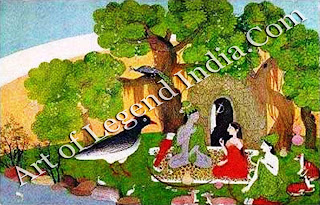
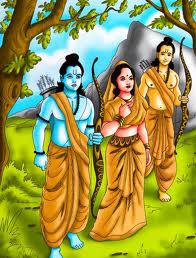
Rama ,Sita and Laxman in the forestIs sufficient, and I will leave today. Make sure Bharata is brought here at once to protect the kingdom and look after my poor ageing father.' So saying Rama bowed before his weeping father and the hateful Kaikeyi and strode purposefully out of the palace, taking with him Lakshmana, whose eyes were brimming with tears of anger.

Rama emerged into the sunlight before the waiting crowd. He sent away his chariot and royal attendants and insisted on walking on foot to see his mother. As he entered her chamber, he saw that she was in the midst of her morning worship, praying for blessings for his installation. Happily, she embraced him. Rama held her tight.

Mother, I have painful news for you. The emperor has decided to give the throne to Bharata and has sent me away to the forest for fourteen years where I must live as a hermit, feeding on roots and herbs.

The queen trembled. The blood drained from her face. She opened her mouth but no sound came out. Rama caught her as she fell and held her in his arms.

My son!' she stammered, 'I would rather have stayed childless than have to hear such words. I cannot bear the pain of losing you. Let death take me.' Lakshmana could stay silent no longer.

The emperor is out of his mind. He is so attached to Kaikeyi that he does not know what he is saying,' he burst out, 'No son should have to obey a senile old man when he is in this state. I should kill him rather than see Rama go.'

Listen to your brother, Rama! Such terrible words have never been spoken in this family. And if you leave I will fast to death. Give up this madness,' said his mother.

Mother, this is not madness. This is my sacred duty. I must obey my father. Don't despair I shall return after fourteen years.' Rama was calm and unmoved. He turned to his brother. 'Truth is the source of our strength, Lakshmana, and must never be given up. There is no use in making threats.' Kausalya cried without control; Lakshmana shook with anger; and Rama stood between them.

Lakshmana, you must understand that truthfulness and honour come before every-thing. I am bound by my father's order. I would rather live in the forest with nothing than rule a kingdom at the cost of my honour. Do not blame Kaikeyi or the emperor for this turn of events. How could Kaikeyi have ever thought of such a thing herself? It is not her doing. They are both under the control of providence. I am also under the same control. I accept this as the will of God.

Lakshmana, however, was wild-eyed and ready to defend Rama by force. 'This is a conspiracy, don't you see? he cried out. 'This story of vows has been fabricated to get rid of you. If it is true, why did we not hear it before? As for your honour, your surrender to fate will be interpreted as weakness and your piety ridiculed. We must fight for what we know is right, not meekly surrender. Tell me who your enemies are and I will destroy them. They will never send you away.' Lakshmana's voice broke with emotion as he wiped away tears of frustration. Rama caught his hand and tried to soothe him.

I know you love me, Lakshmana, and I know you want to help me. Instead of threatening violence on my behalf, use your energies to get everything ready for my departure. I must leave as soon as possible.
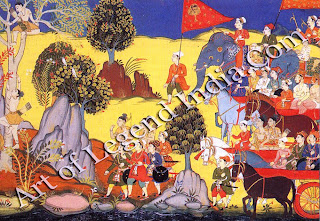
Bharata and Satrughana find rama in forest.Kausalya saw it was useless to try to dissuade Rama. She felt the misery building up inside her, threatening to consume her like a forest fire. She pleaded with Rama that if he must go, let him take her with him. She would look after him and prepare his food. But Rama was adamant.

Poor father will not survive if' both of' us desert him. Dear mother, you know that a woman's duty is to serve her husband.'

Go then, and may the gods protect you. I will wait for your return, my beloved son!

She gathered flowers and incense and chanted hymns, imploring Vishnu to protect her boy. She tied on his wrist an amulet blessed with sacred mantras. Her eyes streaming tears, she held him in her embrace, and smiled bravely. 'I can see you now, dear boy, returning from the forest your face shining as you run towards me, your arms reaching out to embrace me. You are dressed in forest barks with leaves in your hair.

Rama loosened her hold and made to go. 'Hurry back my child,' she cried, 'I cannot wait for long.' He slipped from her grasp.

Writer – Ranchor Prime 

Introduction to Ramayana

Posted by Art Of Legend India [dot] Com On 5:04 AM 0 comments
‘I salute the sage Valmiki, who perches like a cuckoo on the tree of poetry, singing “Rama! Rama!” and who, though forever drinking from the ocean of the stories of Rama, is never sated'.

THE ORIGINAL RAMAYANA 

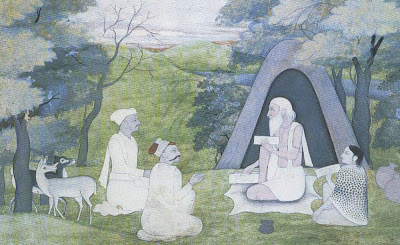
The sage-poet Valmiki teaches Ramayana in Dandaka Forest. His disciples, Kusa and Love, listen attentively.I was composed in the distant past by the sage poet Valmiki. Arranged into twenty-four thousand Sanskrit verses and divided into six books, this sacred scripture is a cornerstone of the Hindu, or more specifically the Vaishnava, faith. Ramayana, meaning 'Rama's travels', documents Rama's triumph over the demon-king Ravana, thereby enacting his fate as the ideal man and incarnation of the god Lord Vishnu. Memorized in full by Valmiki's disciples, Ramayana has been passed down through generations. From public readings to fireside retellings, this oral tradition is very much alive today; in India, there are famous reciters of Ramayana who know the whole story by heart.

The traditional way to appreciate Ramayana is to hear it in its entirety from beginning to end. Instructions are given for doing this in nine sittings, with breaks falling at the traditional places. This is still common practice at the great 'Rama Katha' festivals, which often attract tens, sometimes hundreds, of thousands of the faithful for the full nine days. The intention is to become so immersed in the stories of Rama that Rama, Sita and Hanuman come to life. This does not need to end with the recital; it can be a constant process of remembrance. By remembering Rama constantly one's whole life is sanctified, and the devotee comes to see Rama everywhere, as Sita did. This stage of life is described by Krishna: 'For one who sees Me everywhere and sees everything in Me, I am never lost, nor is he ever lost to Me'.

In Indian villages it is customary to hear stories from Ramayana in the evening. After sunset villagers gather to hear the storyteller bring the characters to life; they cheer or cry as the story unfolds, then go home to sleep and dream of Ramayana.

Lord Rama in Exile
Since the time of Valmiki, other poets have made their translations and adaptations of this epic, and Ramayana long ago migrated across south-east Asia to countries such as Thailand and Indonesia, each of whom have their own Ramayana literary traditions and have made it a part of their own culture. In Thailand, an officially Buddhist country, Ramayana dance-drama is the national dance, an inheritance of the country's ancient Hindu past, and the Thai king traditionally models himself on Rama. Indonesia, now predominantly Muslim, is famous for its shadow puppet theatre depicting Ramayana.

In India, Ramayana passed into each of the regional languages, such as Assamese, Bengali, Hindi, Kashmiri, Oriya, Kannada, Telugu and Malayalam, where it generated separate literary and religious traditions. Each region of the country has its own styles of Ramayana drama, such as the famous Kathakali dancers of Kerala, and elaborate dramatic productions are staged in the major cities. At festivals effigies of the demon-characters Ravana and Kumbhakarna are burned, or actors dressed as Sita and Rama are taken in procession. Ramayana is a staple of Indian cinema and the serialized Ramayana on television, broadcast for 78 weeks during 1987-88, brought the nation to a standstill for an hour each Sunday.

In all these ways, Rama has entered the subconscious of India. This is why, so long after its creation, Ramayana remains an essential part of Mother India, and the name of Rama echoes on a million lips every day, as it did on the lips of Mahatma Gandhi as he died.

Rama is God incarnate, the seventh incarnation of Vishnu. He chose to become human, and for the duration of his human life to forget his divine identity, or so it seemed. He suffered physical hardships and, when he lost his beloved Sita, a broken heart. On one level Rama's journey is an allegory for the journey every soul must make. In becoming human Rama shared in our human suffering and enacted the drama of our own lives — each of us endures our own banishment, our own loss, faces our own disillusions, and hopes eventually to learn acceptance of our lot and to find ultimate redemption. Thus to hear or to witness Rama's struggles is to relive our own lives, but in a divine context. Each episode in the story is multi-layered, working through individual karma, or destiny, and the divine Lila, or play, of Rama. In the same way, India's present-day Vedic sages point to life itself as being the working out, for each of us, of our own personal web of karma, desires and free will in accordance or in conflict with the will of God.

THE WEB OF KARMA

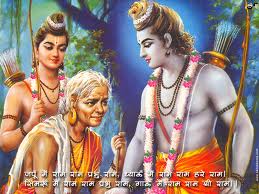
Lord Rama with Sabri
One great theme of Ramayana is the working out of karma, the consequences of past deeds. The basic plot of Ramayana is a simple struggle between good and evil the princess is kidnapped by the great evil one, then rescued by her lover and the evil one is vanquished; all live happily ever after. But it is not allowed to remain simple. We discover that there are many layers of karma involved and dilemmas to be faced, that the gap between good and evil is not as clear as we might have thought, and that behind this simple story lies a cosmic purpose to be fulfilled. At every step along the way we are tested emotionally and intellectually.

Rama's banishment is the first great hurdle. When his stepmother makes her extravagant demand for Rama to be exiled, we wonder why he should submit to such a spiteful scheme. Our sympathies go to Lakshmana, Rama's brother, who seems human in his intolerance and his chiding of Rama. But Rama insists it is his duty to do as he is asked, no matter how far-fetched that request may be. It is a matter of principle. What we don't know at this stage, but later realize, is that here there are greater forces at work. Dasaratha, Rama's father, has his own karma to answer to. When he was a young man he carelessly killed a youth and was cursed by the boy's father to die separated from his son. He had also unwisely pledged to Kaikeyi when he married her, in addition to her two wishes, that her son could be king. Unknown to us these consequences are being carried by Dasaratha, in exactly the way we might be carrying unknown consequences from our own past. Further, Rama's destiny as the incarnation of Vishnu requires him to leave Ayodhya for his eventual confrontation with Ravana. There is also the position of Sita. She had in a previous life, it is later revealed, sworn to bring about the downfall of Ravana, who had violated her chastity when she was incarnated as the divine ascetic Vedavati. In that previous birth she had performed penances to obtain Vishnu as her husband. All these factors come into play at the time of the banishment of Rama. Although it seems unjust, it is fated to happen, in order to fulfil a higher purpose.

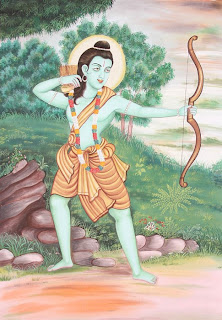
Lord Rama with Bow and ArrowIn Ramayana, evil is ambiguous, and Ravana may not be as evil as he first appears. The story of Ravana's origin is told in another ancient Vedic literature, the Srimad Bhagavatam. Ravana was originally one of the gatekeepers of the spiritual realm of Vaikuntha, 'the place without suffering', where Vishnu has his eternal home. He mistakenly barred the exalted Kumara brothers from entering Vaikuntha and as a result was cursed to fall to the material world. He was given the choice between enduring three births as a demon or seven births as a godly being. In order to hasten his return he chose to be born three times as a demon and to be killed each time by Vishnu. ln his first birth he was Hiranya Kasipu, who was killed by the fourth incarnation of Vishnu, Narasimha; in his second birth he was Ravana; and in his third birth he was to become Kamsa, the enemy of Krishna. His fight with Vishnu was therefore his way of assisting in the Lila, or divine play, of Vishnu, and in this he was supported by Brahma, the creator. Ravana was born as the son of Visrava, grandson of Brahma, and gained great powers From Brahma which enabled him to terrorize the universe. With the help of his son Indrajit, also blessed by Brahma, he defeated his half-brother Kuvera, the treasurer of the gods, Indra the king of heaven and Yama the lord of death. Ravana's role as Vishnu's adversary explains why, at his funeral, Rama found some kind things to say about him.

Another paradox in Ramayana is the role of Vali. Vali is the enemy of Sugriva and an ally of Ravana. Yet he could hardly be called evil, particularly as he is the son of Indra, the king of heaven. Nevertheless Rama kills him. Vali misbehaved by banishing his brother and stealing his wife, but to punish him with death seems extreme. But once Rama has explained his reasons, Vali's anger dissipates and before he dies, instead of seeking to blame Rama for killing him, he begs Rama's forgiveness. Rama shows here that punishment can itself' be an act of love. Putting this in the context of reincarnation, Rama explains that the karma of the criminal must be redeemed by accepting punishment if' that karma is not to be carried forward to the next life, where it would bring further suffering. 'A sinner punished by the king is absolved and ascends to heaven,' declares Ramayana, and adds: 'A sinner released by the mercy of the king is also absolved, but the sin is transferred to the king.' In this context, Rama's killing of Vali is an act of mercy, and Rama is acting as the all-knowing God who dispenses justice with love. 


FREEDOM AND DUTY


Lord Rama, Laxmana and Sita in ForestA central theme of Ramayana is the sacrifice of freedom for the sake of duty or honour. The Sanskrit word approximating 'duty' is dharma, which has no equivalent in English. Roughly translated, it means 'the essential purpose of life'. In Hindu society this manifests as a set of principles governing behavior, such as the duty to obey one's father or to protect one's dependants. These principles governing the lives of the characters of Ramayana might seem oppressive in a modern context, yet on a higher level they embody a spirit of service that can be an expression of love. 'Love is as love does,' goes the saying. Love, if it is to be more than sentiment, demands service.

Hence Rama's devotion to Sita and his devotion for his people both dharma are in the higher sense an expression of love demanding the sacrifice of his personal freedom. This sacrifice of freedom is made not only by Rama, but by all the divine characters of Ramayana. ‘When I was a child you took my hand and promised me your protection,’ says Sita, 'and I have served you faithfully ever since.' Each exemplify the ideal of service in a particular relationship, Hanuman as a servant, Lakshmana as a friend and Sita as a lover. In the world of Ramayana there is no escaping dharma, which is each person's path to salvation. And when one duty appears to conflict with another, as when Rama's love for Sita conflicts with his duty to his people, Rama, and each one of us, is tested.

For many Hindus, Hanuman is the symbol of selfless service to God. It is no accident that a monkey should be accorded this honour: love transcends social standing or even race or species. When Jatayu, the faithful vulture who protects Sita, is killed by Ravana, Rama says of him, 'This king of birds was a great soul who sacrificed his life for my service. Souls such as this can be found everywhere, even among animals.'

If Rama, the incarnation of Vishnu and Lord of the Universe, is occupied in service, the same can be said of Krishna: 'There is no work prescribed for Me in the three planetary systems, and there is nothing I lack yet I work. For if I should cease to work, these worlds would be destroyed.' (Bhagavad Gita) This is the vision of God given by the Vedic scriptures a God who voluntarily serves his creation. In this spirit, Rama serves the demigods by killing Ravana, and he sets the example of an ideal king, who always serves his subjects. His rule is remembered in India as `Ramaraja', and remains the ideal to which all rulers aspire.

THE IDEAL OF FOREST LIFE

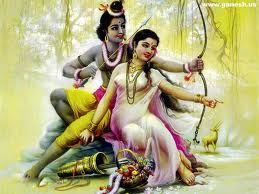
Lord Rama and Sita Love
The ever-present background to Ramayana is the forest. During Rama's long exile he and Sita visit the ashrams of sages, learning from them about spiritual life. The forest is never far away, and with it the ascetic life of the sages. It is said that these sages, who revered Rama as the incarnation of Vishnu and longed to be his devotees, were later born as the gopi cowherd girls of Vrindavan, when they were able to fulfil their desire by dancing in the forest with Lord Krishna. The beauty of the forest is woven throughout Ramayana in luxuriant passages of detailed imagery. But forest life is not easy, as Rama warns Sita at the outset; it represents the ideal of simple living and renunciation of the world which is the cornerstone of the Vedic spiritual path.

The forest could be interpreted as the womb from which all life emerges and into which all will return. Sita confesses her own fascination with the forest when she remembers the prediction made about her when she was a child: 'When I was a little girl a holy woman once came to our house,' she remembers, 'and I overheard her tell my mother that one day I would live in the forest. It is my destiny.' Hanuman is a resident of the forest, to which he returns at the end of the story, and indeed the story is written in the forest. This spirit of abandoning the world and returning to the simplicity of the forest beckons throughout. At the end of Ramayana, after Sita and Rama have regained the comforts of Ayodhya, it re-emerges when Sita asks to visit the ashrams, or hermitages, once more.

The final act of Ramayana is itself one of leaving. Rama and his entourage leave this world in its entirety. Perhaps this is Rama's profoundest message: this world is not to be enjoyed, although some pleasure may be found here. Ultimately the world does not allow itself to be enjoyed. We are all pitted against our own karma. Each of us carries into this world our own burden of karma from past lives. Our task while here is to assimilate this burden and come to terms with the lessons it has to teach. Only then can we turn our attention to finding our true purpose. The message is partly expressed by Vasistha when he advises Bharata after his father's funeral: 'Life and death, joy and sorrow, gain and loss: these dualities cannot be avoided. Learn to accept what you cannot change and give up sorrow.'  

SITA'S SORROW


Indian ArtValmiki prefaces Ramayana with the story of its making. He tells us how, in a state of grief and dismay, he composed a verse that gave expression to his emotion. This verse became the model for the entire epic poem of Ramayana, the thread that runs through-out it and which cannot be escaped: 'Hunter! Because you have so cruelly destroyed the happiness of these birds your happiness will also be destroyed!

Even Sita, mother of the world, is not exempt from sorrow. 'This body of mine was created only for sorrow,' she cries. 'What sin have I committed that I should be made to suffer like this?' Sita's suffering has been a source of perplexity to devotees for as long as Ramayana has been told. Why should Sita, the eternal companion of' Vishnu, have to undergo such suffering? Some devotees accept the explanation offered in the Kurma Parana, where it is said that the original Sita was never taken by Ravana; a demon like him would be incapable of' touching such a pure being. An illusory Sita was substituted for her, we are told, while the real Sita was sheltered by the Fire god. When the illusory Sita entered the fire after her rescue, the Fire god returned the original Sita to Rama unharmed.

But I prefer another approach. Sita's tribulations, in suffering separation from her lord, express the unconscious feelings of all souls separated from God in this world. To rediscover this inner sense of loss, of being separated from God, is the essence of the spiritual path of bhakti, devotion to God. The feeling of being abandoned by God, or of having abandoned God, is a recurrent theme in Vaishnava devotion. Far from taking them away from God, this emotion actually brings devotees closer to God through constant remembrance. When Hanuman first encountered Sita he found that She does not see the monsters surrounding her, or this heavenly garden, she sees only Rama.' This is the state of pure love, where none but the loved one is present in every-thing. This is why Hanuman begs Rama for the blessing to be able to remain in this world, even after Rama has departed, but to 'always be devoted to you and no one else,' and again why Lakshmana, in abandoning Sita, advises her to 'hold Rama always in your heart.' This spiritual union with the beloved in constant inner remembrance transcends physical union. It is the state of union with God which has been experienced by all the great devotional mystics.

I was first introduced to Lord Rama in my youth by my spiritual master, Srila Prabhupada, and take it as his grace that I have now received the chance to serve Rama by writing this new version of Ramayana. I chose for my source the original Ramayana of Valmiki, in the two-thousand page English edition of the Gita Press, First published in India in 1969. I am indebted to its translator, who out of modesty has remained anonymous. I have faithfully followed his verse-by-verse translation, in both pattern and content, while condensing it into modern English. I regularly used to hear the story of Rama or watch it enacted on stage, but when at last I turned to Valmiki's original text, in its English translation, I was overwhelmed by its beauty and depth, which brought many realizations welling up in my heart. I hope, that by putting Valmiki's story into modern English, and making it accessible to a wider audience, I have helped others to taste something of' the flavor of the original Ramayana and gain from it the inspiration I have found.

PROLOGUE

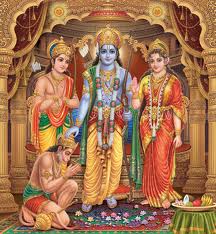
Rama blessing Hanuman
Let me tell you how this story came to be told. Long ago the sage Valmiki lived with his disciples beside the river Tamasa in the forests of Northern India. They lived a life of prayer and meditation in simple huts woven from branches, leaves and grass Early one morning the great Narada, who can fly at will through the sky to visit any planet in the universe, appeared before Valmiki who greeted him with reverence and offered him a seat. In the presence of this great personality Valmiki asked a long-cherished question: 'Tell me, Narada, who is the greatest person in the world? Who is accomplished, learned, powerful, beautiful, truthful, and cares for all creatures? Who is without anger, yet sends fear into the hearts of enemies?'

Narada smiled as he replied: 'The person you seek is extremely hard to find among ordinary mortals. There is, however, a famous king by the name of Rama. He is strong and beautiful, wise and compassionate, pure in character and loved by all. He has deeply studied the ancient wisdom, is brilliant in archery and courageous in battle. In gravity he is like the ocean, in constancy like the Himalayas and in generosity like rain. Let me tell you about Rama: how he was forced to give up his throne and live in the forest, how he rescued his wife Sita from the evil Ravana and how he returned to rule his people with justice and love.

Valmiki sat in rapt attention as Mirada recounted the wonderful story of Rama. At last he fell silent, saying, 'Whoever hears the noble story of Rama's deeds will be blessed with success in this life, and peace in the next.' Valmiki bowed low in gratitude as Narada left, disappearing into the sky as the sun passes behind a cloud.

Valmiki called his disciple Bharadvaja to accompany him to the river for his noon bath and meditation) Here, Valmiki noticed a pair of cranes joyfully sporting and singing. As he watched the birds, a hunter sprang from the forest and shot an arrow through the heart of the male. The stricken bird fluttered to the ground and breathed his last, and his mate wailed pitifully. Valmiki was filled with pain to see such cruelty.

 'Hunter! Because you have so cruelly destroyed the happiness of these birds your happiness will also be destroyed!'

No sooner had the words left his mouth than he stopped in surprise. He repeated the words again to himself and then spoke them out loud to Bharadvaja, saying: 'These words of grief and dismay have emerged in the form of a verse, with four feet of eight letters each, which can be sung with a lute.'

As Valmiki returned to his cottage, singing the verse to himself', he saw that he had another visitor, even more illustrious than the first. It was Lord Brahma, the creator of the universe and father of Narada. Again with respect Valmiki greeted his guest and offered him a seat. As Brahma made himself comfortable, he heard Valmiki quietly singing to himself his new-found verse.

'Ah!' he said, 'you have created a verse expressing your grief. It was me who inspired you to do this. The time has come for you to write the sacred and soul-stirring song of the lives of Sita and Rama as you have heard it from Narada. As you do so, all its details will be revealed to you through divine inspiration. Use this style of verse and your song will be remembered as long as the mountains and seas remain.' Then Lord Brahma left, and Valmiki and his disciples continued to sing the verse in wonder, and the more they sang, the more their wonder grew.

The next day, Valmiki withdrew to a silent and undisturbed place and sat facing east to absorb himself in meditation. Entering a deep trance he saw in his mind's eye the Figures of Rama and Sita. He saw Rama's father Dasaratha, with his queens surrounding him, all laughing and talking. Then he saw Rama roaming in the forest in the company of Sita and Lakshmana. Gradually the whole tale of Rama and Sita unfolded before him in exquisite detail. At last he stirred from his trance.

Then Valmiki composed the story as an epic poem. He divided it into six cantos and taught it to his disciples, Kusa and Lava. They travelled the country reciting the story and their fame spread, until one day they arrived in the city of Ayodhya and were brought before King Rama himself. Rama, his three brothers, ministers and courtiers sat silently as the boys began to sing. Kusa and Lava lifted their sweet voices in clear notes, and here follows their sacred tale called Ramayana the journey of Rama.

Writer - Ranchor Prime

Company Overview

Art of Legend India has the distinction of being one of the best in the Indian Handicraft Industry. We are about 75 years old handicrafts manufacturer & exporter. We are having team of more than 500 craftsman.

We are having our business offices in India, USA & Germany to ensure our best services.

Total Pageviews