ArtofLegendIndia.com, Biggest Online Store of Handicrafts Items, Paintings and Jewelry Accessories...

Handicrafts

Handicrafts are devices or works of art that are made completely by hand or by the use of relatively simple tools. Such goods are usually made in the traditional way of manufacturing goods. Therefore, the knowledge of the art of craft is usually passed down from one generation to another. The items made using these traditional methods of manufacturing are usually produced in smaller quantities and they often represent the culture or religious beliefs of the community that makes them. The goods are also handmade from natural materials that are found in the environment of the particular economy.

Read More!

Biggest Online Store of Handicrafts Items

Paintings

A painting is equal to thousand words, means a beautiful painting is equal to million of words. Paintings are one of the oldest art forms -- throughout history artists have played an important role in documenting social movements, spiritual beliefs and general life and culture.

History Of Paintings: The history of painting reaches back in time to artifacts from...

Read More!

Biggest Online Store of Unique Style Paintings
Showing posts with label About John Constable. Show all posts

British Great Artist John Constable - Scenes of the Stour Valley
Posted by Art Of Legend India [dot] Com On 2:44 AM 0 comments

Scenes of the Stour Valley 

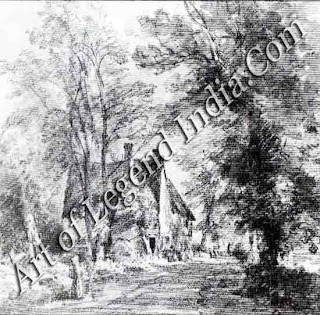
Stratford St Mary, This pencil and wash sketch shows the house once known as Old Valley Farm, on the road towards Dedham from Stratford St Mary. Constable sketched the house twice in 1827. Constable's strongest inspiration came from the scenes of boyhood, which he said 'made me a painter'. The few square miles of Suffolk around East Bergholt are now known as Constable Country.

Constable is often described as the greatest painter of the English landscape, but it is truer to call him the painter of Suffolk, or rather the Stour valley the 12 square miles around his birthplace in East Bergholt, which even in his own day became known as Constable Country. He could never bring his extraordinary gifts to bear on a landscape which held no personal meaning for him. Apart from Suffolk, only Hampstead, Salisbury and to a lesser extent Brighton stimulated the intense observation and passionate feeling which the hall-mark of his best paintings.

Constable seems to have realised where his genius lay in 1802, while studying at the Royal Academy in London. He wrote to his old sketching companion John Dunthorne, the village glazier, that he was determined to come home and study nature, the source of all originality in art. His plan was to make a 'pure and unaffected representation of the scenes of his childhood. With this end in mind, he not only spent that summer and autumn in East Bergholt, but also bought a cottage in the village to use as a permanent studio.

THE SUMMER SKETCHBOOKS 
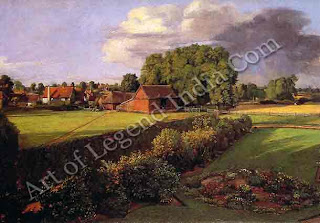
East Bergholt, A detail from Golding Constable's Flower Garden (1815) shows a view from the back of the family house. Constable was the first English artist to paint barns and out-houses with such careful attention.
Almost every summer for more than 15 years he returned to the village to make detailed records in his sketchbooks of every object, activity or view that caught his interest. The summer of 1813 was particularly valuable. The weather was magnificent, and Constable walked daily in the Stour valley, sketching obsessively. 'I almost put my eyes out with that practice', he wrote later.

His sketchbook for that year has fortunately been preserved, and clearly shows his working methods. The tiny drawings measure no more than 3½" x 4¾", but cover an extraordinary range of subjects: the river and its barges, sheep sheltering from the heat under a tree, cottages, farms and churches, mooring posts and water lilies, ploughmen and their horses, and dozens of little details, including the cuff of a jacket. Many amounts to fully realised compositions and almost all the rural themes which he later illustrated in his paintings are seen here.

These scenes, Constable said, made him a painter, and his feeling for their visual beauty was enhanced by his understanding of the work being done in the locks and towpaths, boatyard and meadows. His apprenticeship in his father's mills had taught him not to look only at the buildings, trees and people. He watched the sky too and the river with the professional eye of a miller, whose livelihood depended on understanding the weather and its ever-shifting moods.
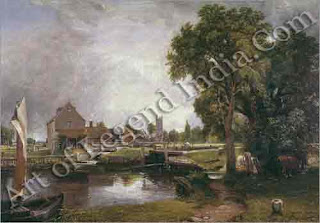
Dedham, The graceful tower of Dedham Church overlooks the river in Dedham Lock and Mill (1820), three miles from East Bergholt. Yet despite Constable's devotion to Suffolk and its countryside, the great majority of the finished works were painted not in East Bergholt, but in London with the sketchbooks and some small oil-studies serving as 'notes'. Just one early picture, Boatbuilding, was completed in the open air; the other major canvases were painted in his London studio during the winter months.

For the famous 'six-footers' exhibited at the Royal Academy, Constable went through one more stage of preparation which is probably unique amongst artists: he painted a full-size oil sketch, to work out the composition and blocks of colour he would finally use. These sketches have also been preserved and are much admired by modem critics for the freedom with which he used his palette knife to apply the paint, capturing the effects of the English weather with all its changes.


THE GREAT CANAL SCENES 
Flatford Mill, This oil sketch for The Mill Stream, painted around 1812, shows the same scene as The Hay Wain, with Willie Lott's cottage on the left. Such sketches, made rapidly in the open air, served as notes for the full-size paintings.
But the finished versions of the great canal scenes show Constable's genius at its height. Here, as nowhere else, he captured the atmospheric effects of early summer in the open air, the movement of clouds across the broad Suffolk sky and the impact of sunlight on the waters of his beloved Stour.

To convey on canvas the sun's rays glittering on the river surface and dancing on the foliage of trees agitated by the wind, Constable abandoned the 'fiddle browns' of traditional landscape painting for the true colours and textures of nature. Restricted by the paints available to him, he used pure yellow and white for the flash of sunlight on dew, and captured the motion of clouds and the racing wind with rapid, nervous brushwork whose sensitivity has never been rivalled.


Writer – Marshall Cavendish 

British Great Artist John Constable - Constable's Suffolk

Posted by Art Of Legend India [dot] Com On 2:18 AM 0 comments

Constable's Suffolk 

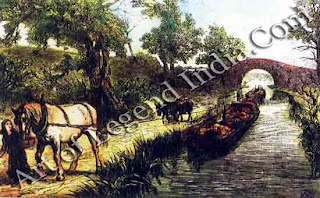
The Stour Navigation, The River Stour was opened to barge traffic in the 18th century, long before the railway reached Suffolk. Barges were always drawn in pairs, and when the towpath alternated between the two banks, the draught horses had to be ferried across the river on the barge. Constable painted Suffolk in its golden age, when high farm prices brought boom years for farmers. But country life was changing. In the background of his landscapes, the old world was giving way to the new.
Today, Constable's paintings of the Suffolk landscape seem like portraits of a golden age. Cattle and sheep graze in the lush meadows; the corn stands high in pleasant fields bordered by hedgerows and five-barred gates; a sturdy band of labourers work peacefully through an endless summer. The barges slipping quietly down the Stour make a colourful focus for this idyll.

But to Constable himself, a corn merchant's son surveying the family lands with a close interest in the business of farming, the pictures are a detailed record of a specific time and place. The Suffolk he portrays was on the crest of an agricultural boom. And the canals in the years before the railways reached East Anglia - were the main arteries of trade, carrying grain from the wetlands’ of Suffolk to the markets of London.

In Constable's lifetime, Suffolk was changing rapidly. Indeed, the scenes he painted would scarcely have been familiar to a farmer from the 17th century. Then, and ever since the Middle Ages, the mainstay of the economy had been wool, not corn. The majestic tower of Dedham Church, in the heart of Constable Country, had marked the town as the centre of the local wool trade, and an important weaving town.

The mills at Flatford and Dedham, like those in almost every other village along the course of the Stour, had originally been built for fulling, or cleansing, wool. But in the 18th century, when the weaving trade moved north to Derbyshire and Lancashire, and England's rising population pushed up the demand for bread, Suffolk farmers turned from sheep to grain. Then the mills were adapted for grinding the corn; and to carry the flour to the coastal ports of Harwich and Felixstowe, the Stour was made navigable as far up-river as Sudbury. A number of locks were built with massive timber spars. Cuts and wharves were constructed beside each of the mills.

BARGES ON THE STOUR 


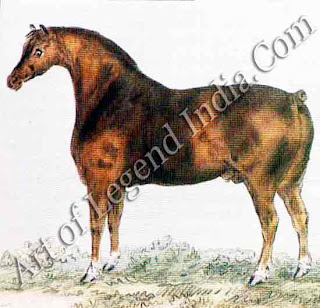
The Suffolk Punch One of England's finest draught breeds the Suffolk Punch was used for towing barges. These deep-chested horses also worked on farms they could pull huge loads, dropping forward on to their knees when necessary to get better leverage.
The ground corn was loaded on to lighters, which were also built entirely of wood in a basin at Flat-ford. They were some 47 feet long and 10 feet 9 inches wide, and designed to travel in pairs, of which the front one contained a cabin for the bargeman and his family. Powerful draught horses usually of the Suffolk Punch breed towed the barges downstream at a speed of about two miles an hour: in many places the towpath alternated between the two banks and the horses had to be ferried across on the barge. At Brantham Tidal Lock, the lighters were floated on the tide for three miles down to Mistley Quay from where the corn was shipped via the larger Essex ports to London or the north.

Constable's father, Golding, had profited greatly from the agricultural boom. He built up a prosperous business based on corn milling: he owned Flatford Mill and the windmill on East Bergholt Heath, and he ran Dedham Mill on behalf of some local businessmen. By 1776, when John was born, he had become wealthy enough to ac-quire one of the largest estates in East Bergholt an area of 93 acres which contained a mixture of arable and pasture land, a flower garden and kitchen gar-dens. The farm was never his main source of in-come, but his family could be self-sufficient in food. To the social duties which Ann Constable al-ready had as the wife of a successful businessman were now added those of a wealthy farmer's wife. She managed the poultry yard, made sure the milk-maids got up before sunrise and supervised the butter- and cheese-making.

PLOUGHING CONTESTS 

The Constables acquired their land on the Suffolk-Essex border at a time when the two counties were among the best-farmed in England. Many of the larger land-owners had pioneered new systems of crop-rotation and improved machinery. Their fields were ploughed by horse-drawn wheel ploughs driven by men who to judge from the many ploughing matches took great pride in their job. These contests encouraged rivalry amongst them, and they welcomed improvements to the design of their ploughs. Seeds were planted in the straight furrows with the aid of the seed-drill invented by Jethro Tull.

In the 1780s, during Constable's boyhood, most of those living around East Bergholt were using the three-year system of crop rotation devised by Lord 'Turnip' Townshend of Norfolk. Under this sys-tem, turnips were sown in the first summer to pro-vide fodder for the animals in winter. In the following spring a mixture of barley and clover was sown. The barley was harvested later in the year, but the clover was left, partly to provide more winter fodder for the animals and partly to be cut for hay in the following summer. At the end of this third summer the fields were ploughed and manured. Local manure was supplemented by Kentish chalk and London manure brought to the Stour estuary by the grain vessels. Winter wheat was then sown and harvested in time for the next sowing of turnips in the summer.

Traditional methods were still used for many of the seasonal jobs. In the early summer, teams of men working in lines used scythes to mow the long grass of the water-meadows. The grass was then left to dry and, if the weather was fine, it was stacked after five to seven days. At the end of the summer, everyone in the local community was involved in the job of harvesting the corn. Teams of men, again working in lines, reaped the corn with sickles, and their wives helped pitchfork the cut corn on to the horse-drawn carts.

LORD OF THE HARVEST 

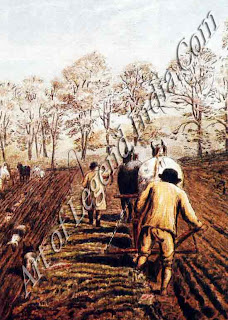
Pulling the plough, Horses were harnessed in single file for the autumn ploughing. In spring was harrowed to break up the clods before planting. Each team of mowers or reapers elected one of their number to act as leader or foreman. Known as the 'lord', he agreed on terms with the farmer and ensured that the harvest was done properly. Every man was expected to keep his allotted place in the line, and if he fell behind or did shoddy work, he was fined by the 'lord'. Once gathered, the corn was traditionally threshed by men and women with flails. However, a hand-powered threshing machine was invented in the 1780s, and it soon became a common sight in Suffolk.

It is the traditional landscape that is recorded in Constable's paintings, most of which were based on his visits between 1802 and 1814, enriched by his boyhood memories. They reflect a time when small and large landowners existed comfortably side-by-side, and honoured their obligations to the landless labourers. On some farms the poorer workers might be given a bed in the farmer's house and supper at his table. On almost every farm the men who brought in the harvest were fed at the farmer's expense and received generous quantities of ale while working in the fields. The day the last cart-load of corn, decorated with flowers and green boughs, was taken back to the farm, the whole community sat down together to a 'harvest home' supper. Employer and employee alike celebrated with dancing, singing and drinking.

But this brief 'golden age' was not to last even through Constable's own lifetime. During the wars against Napoleon, the French blockade of the Channel ports prevented European corn from reaching England, and even with the new methods, English farmers could not make up the shortage. The price of corn quadrupled between 1792 and 1812 and throughout the country farmers enclosed and cultivated more and more land. The fields around East Bergholt had long been en-closed, but there was still scope for the wealthier farmers to increase their holdings.

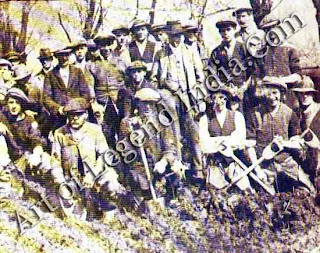
Constable's villagers Farm labourers from East Bergholt take a break from ditching for this early photograph taken just 50 years after Constable's death.And as Constable himself noted in his letters, they also took over the lands of the poorer farmers and divided up the common lands amongst them-selves. This was a savage blow to the landless labourers, who were already hard-pressed to pay the rocketing prices for their bread. The common lands had traditionally been used by the poor peas-ants to graze their animals; now many were reduced to total destitution. And their situation did not improve, even after the victory at Waterloo in 1815, for the change in land ownership was permanent. Labourers rioted frequently in the black years that followed, and with rick burning an almost nightly occurrence, the world Constable had loved was literally going up in flames.

Writer – Marshall Cavendish
British Great Artist - John Constable Painting Gallery

Posted by Art Of Legend India [dot] Com On 3:29 AM 0 comments
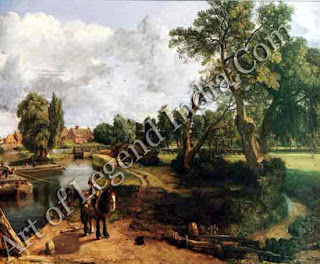
Constable's art matured into greatness after 1815 the year of Waterloo when he exhibited Boatbuilding at the Royal Academy and abandoned the small canvases of his youth for the imposing 'six-footers' which made his reputation.

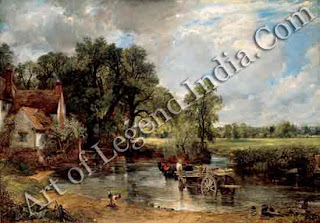
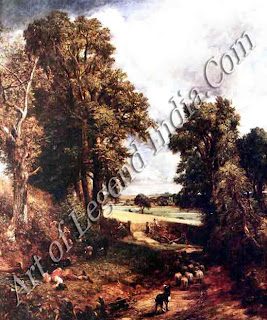
Flatford Mill was the first in a series of large canal scenes painted near the family home, which included The Hay Wain, Constable's most famous painting. But many of his admirers preferred The Cornfield one of his last Suffolk scenes which they presented to the National Gallery after his death in 1837.

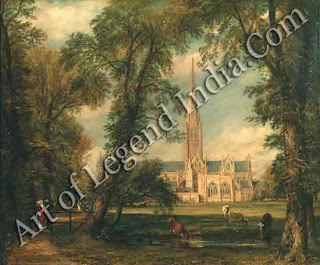
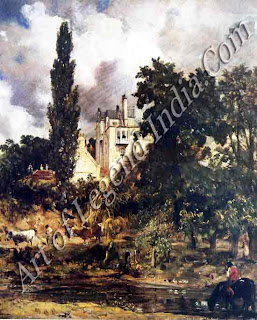
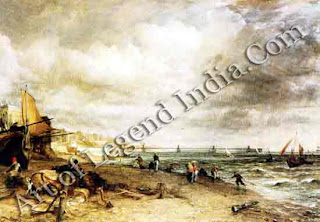
The other landscapes are also charged with personal significance: Salisbury Cathedral, where his patron Dr John Fisher was Bishop; The Admiral's House, which he could see from his Hampstead window, and The Chain Pier, Brighton a view painted while his wife was struggling against TB. His gloom and desolation after her death can still be detected in the late water-colour, Stonehenge.                                 
                                                                                            
“Boatbuilding” 1815 20" x 241/4" Victoria and Albert Museum The only canvas Constable painted entirely out of doors shows his father's boatyard beside the River Stour, near Flatford Mill. The barges built here carried flour from the mill downstream to Mistley, on the coast.


 “Flatford Mill” 1817 40" x 50” Tate Gallery
On a warm, summer's day a boy unties his tow-horse from the barge before it passes under Flatford footbridge. It is late afternoon; in the meadow on the right a haymaker casts a long shadow as he finishes work for the day.
 “The Hay Wain” 1821 51 1/4," x 73" National Gallery
Constable's most famous painting shows the tranquil scene at Flatford Mill in early summer: only the dog looks up as an empty hay waggon crosses the Stour by Willie Lott's cottage on its way to the meadow beyond. The artist's own name for his picture which took five months to paint was Landscape: Noon. The sun is out of the picture, high and slightly in front of us; scudding clouds throw patches of shadow across the green fields.


“Salisbury Cathedral” 1823 341/2 x 44" Victoria and Albert Museum
The Bishop of Salisbury himself commissioned this painting, which records the view of the Cathedral seen from his garden. The bishop and his wife are shown by the gate on the left, looking at a storm cloud billowing over the spire. That cloud caused Constable a great deal of trouble: it was originally much darker, and the Bishop disliked it so much that he asked for the sky to be 'improved'

 “The Admiral's House” 1820-5 14" x 11 1/4" Tate Gallery
Constable's views of Hampstead then a small village outside London are often painted in the brisk, vigorous style of his oil studies. This one shows the house of Admiral Barton, with its strange roof laid out like a warship's quarter-deck, which the artist could see from his upstairs window.


“The Cornfield” 1826 56 1/4" x 48" National Gallery
 A view near East Berg/wit shows the narrow lane which Constable took as a schoolboy on his way to Dedham. The metal plough is accurately observed, and the July flowers were copied from specimens, but unusually Constable invented the church tower seen in the distance.
 “Chain Pier, Brighton” 1827 50" x 72" Tate Gallery
Darkening clouds and a grey, storm-driven sea cast an air of gloom over fashionable Brighton, where Constable took his wife to Convalesce during the summers of 1824 and 1825. One of his very few seascapes, this picture was completed the year before Maria died.


“Stonehenge” 1836 15 ¼”x 23 ¼” Victoria and Albert Museum
This striking water-colour evolved from a pencil sketch Constable made on his only visit to Stonehenge 16 earlier. The startled hare in the left foreground was an afterthought,painted on a slip of paper and pasted on to the original.


Writer -   Marshall Cavendish

Company Overview

Art of Legend India has the distinction of being one of the best in the Indian Handicraft Industry. We are about 75 years old handicrafts manufacturer & exporter. We are having team of more than 500 craftsman.

We are having our business offices in India, USA & Germany to ensure our best services.

Total Pageviews