In the
fourteenth century, the Vijayanagara empire was established and became the
dominant power in the southern peninsula and the Vijayanagara style of
architecture, sculpture and painting was a continuation of the earlier late
Chola and Pandyan traditions, combining to some extent, in the Kanarese and
Telugu districts, the Chalukya traditions that had been there before. One of
the greatest rulers of this dynasty was Krishnadevaraya who was not only a
great statesman, ruler and warrior but also a great scholar, painter and patron
of fine arts. Large gopuras and mandapas mark this period. The mandapa in the
temples of Virabhadra at Lepakshi, of Varadaraja at Kanchipuram, of Vithala at
Hampi and of Jalakanthesvara at Vellore are all excellent examples.
The
Vijayanagara empire represents the last great phase of Indian history and
culture. Painting like every other art was encouraged during this period and
there are innumerable temples all over South India representing this phase. In
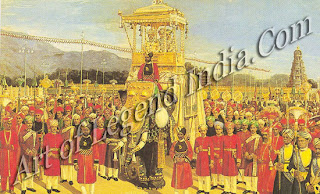
the Virupaksha temple at the capital of the empire, the ceiling of the large
front mandapa has a magnificent series of paintings. Here is a great
masterpiece representing Vidyaranya, the great spiritual master who was
responsible for the establishment of the Vijayanagara empire by Harihara and
Bukka. The long procession with Vidyaranya in a palanquin preceded and followed
by a large retinue is one of the most impressive scenes of the fourteenth
century, though the painting itself is of a some-what later date.
There
are fragments of paintings at Anegundi near Hampi, in Tadpatri, Kanchipuram,
Kalashasti, Tirupati, Tiruvannamalai, Chidambaram, Tiruvalur, Kumbakonam,
Srirangam and other places.
 At
Lepakshi, there is one of the most remarkable paintings of the Vijayanagara
period, a colossal one of Virabhadra painted on the ceiling of the mandapa,
which is a common one for three shrines. The scenes depicted here are from the
Malitthharata, the Ramayana and the Puranas. They are to be dated in the time
of Achyutaraya, as they include the portraits of Virupanna and Viranna, who
patronised the painters, being the makers of the temple itself. Lepakshi became
a great centre of trade and pilgrim-age during their time and the chieftains
lavishly spent their wealth on beautifying these shrines, giving special
attention to that of Virabhadra, their patron-deity. The entire ceiling of the
temple was once covered with a rich layer of paintings now mostly damaged or lost. But enough remains
to show what considerable mastery the painters had attained over brush and
colour and how well their mind worked in creating panels of charming portraits,
the stories of Sivalila, the coronation of Rama, Arjuna fighting Kirata,
Krishna as Vatapatrasayi and so forth. Bhikshatana, Kalari, Gangadhara and
Tripurantaka are most dramatic and original in concept.
At
Lepakshi, there is one of the most remarkable paintings of the Vijayanagara
period, a colossal one of Virabhadra painted on the ceiling of the mandapa,
which is a common one for three shrines. The scenes depicted here are from the
Malitthharata, the Ramayana and the Puranas. They are to be dated in the time
of Achyutaraya, as they include the portraits of Virupanna and Viranna, who
patronised the painters, being the makers of the temple itself. Lepakshi became
a great centre of trade and pilgrim-age during their time and the chieftains
lavishly spent their wealth on beautifying these shrines, giving special
attention to that of Virabhadra, their patron-deity. The entire ceiling of the
temple was once covered with a rich layer of paintings now mostly damaged or lost. But enough remains
to show what considerable mastery the painters had attained over brush and
colour and how well their mind worked in creating panels of charming portraits,
the stories of Sivalila, the coronation of Rama, Arjuna fighting Kirata,
Krishna as Vatapatrasayi and so forth. Bhikshatana, Kalari, Gangadhara and
Tripurantaka are most dramatic and original in concept.
On the
ceiling of a small mandapa in the Varadaraja temple at Kanchipuram is a lovely
late Vijayanagara painting illustrating in a simple but pleasing pattern the
theme of Manmatha which has been a great favourite with Indian painters and
sculptors.
At
Somapalayam, there are paintings in the Vishnu temple representing Puranic
episodes, closely resembling the creations of the painter at Lepakshi.
Writer – C. Shivaramamurti