ArtofLegendIndia.com, Biggest Online Store of Handicrafts Items, Paintings and Jewelry Accessories...

Handicrafts

Handicrafts are devices or works of art that are made completely by hand or by the use of relatively simple tools. Such goods are usually made in the traditional way of manufacturing goods. Therefore, the knowledge of the art of craft is usually passed down from one generation to another. The items made using these traditional methods of manufacturing are usually produced in smaller quantities and they often represent the culture or religious beliefs of the community that makes them. The goods are also handmade from natural materials that are found in the environment of the particular economy.

Read More!

Biggest Online Store of Handicrafts Items

Paintings

A painting is equal to thousand words, means a beautiful painting is equal to million of words. Paintings are one of the oldest art forms -- throughout history artists have played an important role in documenting social movements, spiritual beliefs and general life and culture.

History Of Paintings: The history of painting reaches back in time to artifacts from...

Read More!

Biggest Online Store of Unique Style Paintings
Showing posts with label Vishnu Paintings. Show all posts

God Vishnu Defeats the Demons

Posted by Art Of Legend India [dot] Com On 3:03 AM 0 comments

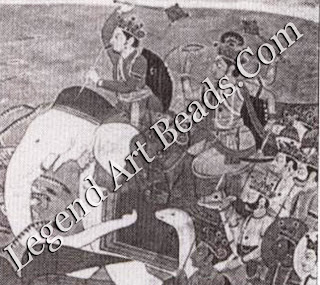
Vishnu leading Indra, king of the gods, towards the heavens after defeating the demons. Wrath of the Demons 


After defeating the demons, the devas, led by Indra, claimed every treasure that had emerged from the cosmic sea. Rising up to the heavens, Swarga, they became rulers of the cosmos. They warmed the earth, ushered in light and rain, made the tides rise, the moon wax and day dawn.

The asuras meanwhile sulked in Patala, the murky realm under the earth and sea. Angry and bitter, they took an oath, "We will oppose the gods in every way we can: what they generate, we will destroy. If they spread light, we will extend darkness. If they support life, we will stifle it."

They began attacking the gods every day, every month, every year, every aeon, their victory causing winter to arrive, the tides to fall, the moon to wane and the sun to set.

The gods fought back.

The unending battles of devas and asuras, the successes followed by failures, gave Nature its cyclical rhythm.

Vishnu riding into battle on Garuda, the celestial bird Pahari painting.

Madhu and Kaitabha


Two demons, Madhu and Kaitabha, decided to attack Brahma and arrest the creative process.

They climbed up the lotus stalk that emerged from Vishnu's navel and made their way to the seat of the creator. But Vishnu divined their intentioned. He grabbed them, placed them on his thighs, crushed them to death, and smeared their fat over earth, making it rich and fertile.

Namuchi and Vritra


When Namuchi, the demon of darkness, locked away light in his fortress, and Vritra, the demon of drought, locked away moisture, the earth became dry, dark and barren plants withered, animals died.

Indra, king of the gods, tried subduing the two demons but failed. "These demons can only be killed by weapons that are neither solid nor liquid," disclosed Brahma.

Vishnu immediately collected the foam of the sea that is neither solid nor liquid and fashioned out of it the vajra, a weapon as powerful as a bolt of thunder.

Indra used this magnificent weapon first to kill Namuchi and then Vritra. He razed their fortresses to the ground, bringing light and moisture back into the world.

Grateful for Vishnu's timely help, Indra called him Upendra, his brother, friend and guide.

Death of Mura


Madhusudana-Kaithabjit: Vishnu defending Brahma from the demons Madhu and Kaitabha. Mura, the asura, had acquired the power to kill anyone by his mere touch. So he stood before the gates of Amravati, city of the gods, and challenged Indra to a duel.

"I cannot fight him. If he touches me, I will die," said Indra, trembling with fear.

"I will fight him then," said Vishnu, striding out to face the demon. Looking straight into Mura's eyes,Vishnu smiled and said, "Why are you so scared? I won't bite."

"I am not scared," growled Mura, piqued by Vishnu's words.

"Then why are you perspiring so much?" asked Vishnu.

"I am not perspiring at all." "Yes, you are."

"No, I am not." So saying Mura rubbed his forehead to prove there was not a drop of sweat on his body. As soon as Mura touched himself, he choked and died.

Narasintha killing Hiranyakashipu.

Hiranyakashipu's Immortality

 
Hiranyakashipu decided to get a boon that would make it impossible for anyone, even Vishnu, to kill him.

He appeased Brahma who declared, "No man or beast can kill Hiranyakashipu in daylight or in the dark, within or without a house."

Secured by this boon, the demon-king launched an attack on the heavens, defeated the gods and wrested control of the cosmos, plunging it into darkness.

Narasintha Rescues Prahlada

 
Hiranyakashipu forbade the very mention of Vishnu's name in his realm. But he could not stop his own son Prahlada from chanting, "Narayana-Narayana."

Torture had no effect on Prahlada devotion.

Exasperated, Hiranyakashipu screeched, "Where can I find Vishnu? I shall kill him and end your obsession once and for all."

Prahlada said, "He is everywhere, even in the pillars of your palace."

Hiranyakashipu smote a pillar. From within emerged a magnificent monster that was neither man nor beast. It was Vishnu in the form of Narasimha the ferocious man-lion!

Roaring lustily, Narasimha pounced upon Hiranyakashipu, dragged him to the palace threshold that is neither inside a dwelling nor outside. There, at twilight, which is neither day nor night; he ripped open the demon's belly, pulled out his heart and drank his blood.

Thus did Vishnu outwit the demon who tried outwitting death.

Vishnu Beheaded

 
Vishnu resting his head on his bow 26 while the gods cut the bowstring.
The strength and guile of Vishnu made him famous in the three worlds. The gods loved him, the sages respected him, the demons admired him, though grudgingly.

Once, the seven cosmic seers, the sapta-rishis, keepers of sacred wisdom, visited Amravati and found Vishnu sitting beside Indra.

Saluting Vishnu, they said, "Without your support the gods are powerless against the demons. You are greater than the gods."

This comment of the sages upset the devas. Jealous of Vishnu's prowess and rising fame, they decided to kill him.

They found Vishnu deep in thought resting his chin on his bow. Turning into termites, they chewed the taut bowstring until it snapped. The bowshaft straightened with such force that it slashed Vishnu's head off.

Hayagriva: the horse-headed Vishnu, guardian of the Vedas.

Horse-headed Vishnu

 
Without Vishnu, there was no one to stop the demons from stealing the sacred Vedas and mutilating its verses.

Saraswati, goddess of knowledge, cursed the gods who had harmed Vishnu. Ashamed of their conduct, consumed by guilt, the devas decided to resurrect their benefactor.

They found Vishnu's body but not his head.

Vishnu's head had, unknown to them, become one with the sun, his long hair turning into rays of light. "Find another head," said Indra.

The devas placed the head of a horse on Vishnu's body and brought him back to life.

The horse-headed Vishnu, Hayagriva, defeated the demons and restored the Vedas to Saraswati who chose Vishnu as her eternal guardian.

Alms from Bali

 
Saraswati, goddess of knowledge, who accepted Vishnu as her guardian.
Indra, proud of his many victories, once became so complacent that he refused to acknowledge the grace of Vishnu. Weakened by vanity, he was driven out of the heavens by the demon-king Bali.

Everyone loved, respected and obeyed Bali. In time, however, the adoration of his subjects and his absolute power inflated his ego. "I am lord of the three worlds. I can give anyone anything they want," he declared pompously.

"If you are so rich, can you give me three paces of land?" asked Vishnu, approaching Bali as Vamana, the dwarf.

"Is that all you want? Take it," said Bali.

Vamana Blinds Shukra

 
Shukra, the one-eyed guru of the demons
Something about Vamana made Shukra, guru of the asuras, very suspicious. "This dwarf could be sent by the gods. Don't give him anything," he warned Bali.

"What harm could this little one do?" argued Bali, picking up his kamandalu to pour water into Vamana's hand.

Once Bali poured water into Vamana's hand, Bali could not, by law, go back on his word. Knowing this, Shukra reduced himself in size, entered Bali's water-pot and blocked its snout with his head.

When water did not come out of the pot, Vamana divined Shukra's intentions. "There must be a choke in the snout," said Vamana to Bali, "Let me remove it."

Vamana pushed a blade of grass into the water-pot and gouged out one of Shukra's eyes. The demon-priest leapt out of the kamandalu howling in agony.

Water then poured freely into Vamana's hand and he obtained from Bali full rights over all the land he could cover in three strides.

Two Steps of Vamana

 
Vamana, Vishnu's dwarf incarnation.
In the blink of an eye, Vamana turned into the giant Urugaya. His legs stretched beyond the abyss and his head rose above the clouds.

With one step Vamana claimed the heavens striding with ease across all the stars and planets of the astral realm.
The gods washed the lord's feet with the waters of Ganga, the celestial river, which was brought down to the world of man when Vamana took his second step to claim the earth.

Bali was overwhelmed by humility when he saw the lord's foot stretching across every horizon, overshadowing tall hills and vast plains.

Third Step of Vamana

 
Trivikrama: Vishnu-Vamana taking three steps to stride across three worlds.
"Where shall I place my third step?" asked Vamana. Bowing his head, Bali said, "Place it on my pompous head that did not recognise Vishnu." Vamana shoved Bali back into the netherworld, where he belonged.

Vishnu's foot on Bali's head had crushed his ego, granted him salvation and transformed him into a divine demon.

Mankind mourned Bali i though a demon, his reign marked a period of peace and prosperity. For the benefit of mankind, Vishnu declared, "Once a year, after the rains, Bali shall rise from Patala. With him will rise the bounty of earth?" This temporary ascent of Bali during harvest-time is a time of festivity and joy, celebrated as Onam in Kerala and as Diwali in the rest of India.

Vishnu, the God of Gods
 
Vishnu had done the impossible. He had conquered the cosmos not by war, but by taking three steps! This conqueror of the three worlds, Trivikrama, was no ordinary god: he was god of gods, master of the universe- Jagannatha.

Gods, demons and humans saluted this great divinity.

Vaikuntha, the highest heaven that stands above Swarga became Vishnu's abode, whence he oversaw the welfare of the world, descending from time to time in various forms to battle forces that threatened harmony and order.

Writer – Devdutt Pattanaik

Lord Vishnu’s tenth Incarnations : Dashavtaar

Posted by Art Of Legend India [dot] Com On 11:31 PM 0 comments
According to Hindu theology, three Gods rule the world; they are Brahma, Vishnu and Shiva. Brahma is the creator; Vishnu is the preserver and Shiva is the destroyer. Lord Vishnu is the preserver and protector of creation and he is considered the embodiment of mercy and goodness. He is often represented resting on the coiled serpent Shesha, with his consort Lakshmi massaging his feet. Lord Vishnu does his job of protecting the world by incarnating himself in different forms at times of crisis. In the Bhagvad Geeta, he says to Arjuna, “Whenever the situation of Dharma and law is endangered on this world, I incarnate myself to reestablish Dharma and law and protect the sages and destroy the evil forces of the society.

Lord Vishnu is famous for his ten incarnations. His incarnations are various forms he assumed while engaged in the task of preserving the universe and destroying the evil forces. His ten incarnations are very famous, they are as following-

1. Matsya (Fish) Incarnation: Vishnu's first, incarnation, as a fish, is one borrowed from the mythology of Brahma. The object of this incarnation was to save Manu and seven sages. Vishnu took the form of a small golden fish with one horn, but grew until he was forty million long. Vishnu predicted that the world would destroy in seven days and told Manu to build a boat and take the seven sages, seeds of all plants, one animal of each type and told him that he would appear as a fish to propel the boat. After seven days, the earth submerged into the water then the Lord Vishnu appeared as a big fish and the king tied the boat to the fish by using the Vasuki and the fish took all of them through the deluge, and enabled Brahma to start the act of creation all over again.
 One version of this story gives a further purpose for the incarnation. During one of the periods of universal chaos, while Brahma was sleeping the Veda, was stolen by Hayagriva, the demon. Vishnu killed Hayagriva and restored the Veda.


2. Kurma (Tortoise) Incarnation: This is the second incarnation, in which Lord Vishnu took the form of a tortoise. Gods lost their immortality due to a curse by sage Durvasa. They requested Vishnu for help. Vishnu then told them to churn the ocean of milk and Mount Mandara would be used as the churning stick. He also told them to take help of demons. Both the gods and the asuras (demons) churned the ocean using the serpent Vasuki as the rope. But as churning was proceeding the mountain was sinking then Lord Vishnu took the form of the tortoise and supported the mountain. The ocean gave forth not only the nectar (amrita), but also Dhanvantri, Lakshmi; the goddess of wealth and fortune, Chandra; the moon, Rambha; the nymph, Airavata; the white elephant, Kaustubha; a jewel, which went to Vishnu, Parijata; the celestial wishing tree, Kamdhenu; the cow of plenty, Shankha; a conch shell of victory, Dhanus; a mighty bow and poison; which was swallowed by lord Shiva.


3. Varaha (Boar) Incarnation: Varaha (Boar) is the third incarnation of Lord Vishnu. When demon Hiranyaksha dragged Bhoodevi (Mother Earth) along with all the Vedas and sacred texts to his infernal kingdom under the sea and sought to make her his queen. To rescue her, Vishnu himself turned into Varaha, a gigantic boar. Lord Vishnu appeared as boar from Brahma’s nostril. He descended to the bottom of the sea to rescue mother earth. Tail raised, hairs erect, he plunged into the sea and ripped through the waters until he reached the ocean floor where he found the earth-goddess in the clutches of the demon king. A fierce battle took place between the boar and Hiranyaksha. Finally Hiranyaksha was killed, then with a triumphant snort; Vishnu placed Bhoodevi on his mighty tusks and carried her back to the surface of the sea. Bhoodevi accepted Vishnu as her consort: trees and plants were their children, thus lord Vishnu became the guardian of the earth (Bhoodevi).

4. Narasinha (Giant lion-man) Incarnation: Narasinha is the fourth incarnation of lord Vishnu. Lord Vishnu took this incarnation to free the world from the depredations of demon king Hiranyakasipu, who like his brother Hiranyaksha, had obtained from Brahma the boon of immunity from attacks by human, beast and god; he had Brahma's assurance that he could be killed neither in day nor in night by any god, human, animal, neither inside nor outside his house. Protected by this immunity, Hiranyakasipu overreached himself. He forbade worship of all the gods and substituted worship of himself. He was therefore particularly incensed to discover that his own son Prahlada remained an ardent devotee of Vishnu. Hiranyakasipu began to torture Prahlada, but he refused to give up his worship of Vishnu. Hiranyakasipu tried his dangerous efforts to kill Prahlada, but he never succeeded in his aim.

Finally, one evening, the demon king, in exasperation at his son’s repeated assertion of Vishnu’s omnipresence, pointed out a pillar in the doorway of his palace and demanded to know if Vishnu was there inside it. Prahlada declared that he certainly was where upon Hiranyakasipu said that he would kill him and kicked the pillar. At this lord Vishnu appeared from the pillar as Narasinha, half man and half animal, and killed the demon king, Hiranyakasipu.


5. Vaman (Dwarf) Incarnation: Vishnu’s fifth incarnation, Vaman, took place in the second age, Tretayuga. During this time, Bali, the grandson of Prahlada, was a very valorous and mighty demon. By his penance, he conquered the whole world. He ruled well and loved by his people. He was righteous and truthful, and ruled his kingdom so well that there was peace, prosperity and happiness all around. Indra and other gods fearing that Bali would conquer all the three worlds, therefore they all went to Lord Vishnu for help. Lord Vishnu then incarnated himself as a dwarf in the household of Kashyapa and Aditi. Vishnu grew soon, but had the form of a dwarf, and came to be known as ‘Vamana’. Sage Kashyapa was thrilled at his good fortune.

After hearing Bali’s reputation for generosity, Vaman went to him and asked for alms. Shukracharya, the wise and visionary teacher of the demons, could identify Vamana as Vishnu. He advised Bali not to accept of Vamana`s wish. Vamana requested for the amount of land that could come under his three feet. Bali gracefully agreed. Lord Vishnu then grew in size and covered the earth and heaven in two strides. And due to lack of space, he put his third leg on Bali himself and crushed Bali to the nether or the Patala loka (underground world). He educated Bali about the demerits of pride and arrogance, which forbids man from optimum progress.


6. Parasurama Incarnation: Parasurama is the sixth incarnation of lord Vishnu, took place in the second age, Tretayuga at a time when the kshatriya caste was exercising tyranny over all others, including the Brahmins. Parasu means axe, so he is known as Parasurama. This axe was given to him by lord Shiva, from whom he learned the proficiency of warfare and other skills. He was born to Jamadagni and Renuka. Parasurama was an ardent devotee of lord Shiva. Images of Parasurama usually depict him as a large man carrying an axe and other weapons.

One day, a kshatriya powerful king, Kartavirya, stole Kamdhenu, a wonderful cow which could grant all the desires, from Jamadagni’s hermitage. When Parasurama came to the hermitage, he heard about what had happened, he attacked on Kartavirya and killed him and rescued the cow. When Kartavirya’s son heard about his father’s death, he marched towards Jamadagni’s hermitage. He found aged Jamadagni alone in the hermitage and killed him. When Parasurama returned, he found his mother is crying. She explained how her husband had been brutally murdered and beat her chest 21 times in anguish. Seeking revenge, Parasurama swore that he would kill all Kshatriyas from the earth. In twenty one battles, he thereafter fulfilled his vow and destroyed all the Kshatriyas on earth.


7. Rama Incarnation: Rama is the seventh incarnation of lord Vishnu. He is considered an ideal king, son and ideal husband. The main purpose of Rama incarnation was to quell the most dangerous and powerful demon king, Ravana, ten-headed demon king of Lanka (Ceylon), whose strength was overcome only after the epic struggles related in the Ramayana. Like Hiranyaksha and Hiranyakasipu, Ravana had practiced austerities in order to propitiate Brahma, who had granted hint immunity from being killed by gods, Gandharvas or demons. Under the cover of this immunity and the benevolence of Shiva, whom he carefully propitiated, Ravana persecuted gods and mortals. The gods consulted on how they could be rid of Ravana, and decided that the only way was for a god to take human form, for Ravana had been too proud to ask for immunity from humans. Vishnu agreed to be that god, and all the others said they would lend their powers to humans and animals. Vishnu was accordingly born on earth to king Dashratha. Four sons were born to his three wives namely Kausalaya, Kaikeyi and Sumitra; they were Rama, Lakshamana, Bharata and Shatrughana.

Rama and Lakshamana were particularly close and killed many demons in their childhood. Rama was banished in the forest for fourteen years. Rama went in the forest with his brother Lakshamana and wife Sita. In the forest, Sita was abducted by Ravana. With the help of Sugriva, they found information about Sita. In order to rescue Sita, Rama fought with Ravana. Finally Ravana was killed. Thus lord Rama freed the earth from the terror of Ravana. After the completion of banishment, Rama became the king of Ayodhya.


8. Krishna Incarnation: Lord Krishna is the eighth incarnation of Vishnu. He was born in Dwapara yuga to Devaki and Vasudeva. He appeared over five thousand years ago in Mathura in Kansa’s jail. King Kansa was the cruel demon king, who arrested Devaki and Vasudeva, after a prediction that the eighth son of Devaki and Vasudeva would kill him. Krishna was born in the midnight and was transferred to Vrindavana, where he was reared in a cowherd’s family by Yashoda and Nand Baba. Krishna spent his childhood in Vrindavana. Krishna grew up with a fondness for butter and no attempt to keep it out of his reach was ever successful. He stole butter with his friends and distributed stolen butter amongst other children. His childhood revealed his dual character, at times he seemed just an exceptionally lovable boy, in other episodes he began to show his strength and was recognized as a god.

Krishna's life falls into four main parts: childhood, when he performed great feats of strength; youth, when he dallied with the cowgirls; manhood, when he per-formed the task for winch he had been born; and middle age, when he became the great ruler of Dwarka and took part in the Bharata war, acting as Arjuna's charioteer and pronouncing his great teaching on the subjects of dharma and bhakti. He killed many powerful demons, who were sent to kill him by Kansa. Krishna killed Kansa and several other demons. In the great war of the Mahabharata, Krishna helped the Pandavas in destroying the Kauravas and reestablished dharma on the earth. Krishna is the philosopher of the Bhagwad Gita, one of the holiest Hindu texts.

9. Buddha Incarnation: Buddha is considered the ninth incarnation of Lord Vishnu. Darkness of ignorance blinded earth after the departure of Lord Krishna. Empty rituals like animal sacrifices, harmful superstitions such as caste-creed discriminations and distortions of Dharma, introduced by the demonic and orthodox Brahman, became the order of the day. Seeing earth degrading into hollow nothingness, Lord Vishnu incarnated himself as Buddha. Various forms of Buddha are worshipped in Buddhism in ways that are very similar to the worship of Hindu gods.

Buddha was the founder of Buddhism. He was born to Mayadevi and the virtuous king Shuddhodhana, of the Shakya (Shaka) clan around 3000 years ago. Buddha's original name was Siddhartha. Gautama was Siddhartha's family name. Siddhartha was known all over the world as Buddha. He did not claim to be a god or a prophet. He was a human being who became enlightened, understanding life in the deepest possible way. Siddhartha attained enlightenment and assumed the title Lord Buddha. He spent his boyhood at Kapilavastu and its vicinity. He was married to Yashodhara at the age of sixteen. Siddhartha had a son whose name was Rahula. Siddhartha began his search with philosophical learning, asceticism and travels to religious places attained enlightenment sitting under a pipal tree.
Buddhism highlights Dharma not as a philosophy, but as a law of the universe. Buddhism grew very popular in India. Buddhism currently has about 376 million followers and considered as the world's fourth largest religion after Christianity, Islam and Hinduism.


10. Kalki Incarnation: According to the Puranas, whenever there is decline of the noble values and dharma and evils powers increase, Lord Vishnu will incarnate himself in different forms. The Kalki incarnation will take place towards the end of Kaliyuga (present age). It is believed that at the end of the Kali Yuga, there will be a deluge when Kalki the tenth and the last incarnation of Vishnu, will ride forth on a white horse named Devaduta, to redeem humankind and re-establish righteousness. He will punish all evil doers from his blazing sword, in this world and recreate a golden age again. All paintings are courtesy of Art of Legend India.

Vishnu Paintings: Pictures of Lord Vishnu

Posted by Art Of Legend India [dot] Com On 10:36 PM 0 comments
Lord Vishnu is one of the greatest and preserver god depict in thousands of paintings in thousands time. Thousands of devotees are worshiped in different form of god Vishnu. Lord Vishnu has tenth incarnation. Ninth incarnations have become in ancient age and various paintings have made on it. Last and tenth incarnation of lord Vishnu is remain .it will called kalki. All paintings are courtesy of Art of Legend India

Lord Vishnu Paintings and Pictures Gallery


Company Overview

Art of Legend India has the distinction of being one of the best in the Indian Handicraft Industry. We are about 75 years old handicrafts manufacturer & exporter. We are having team of more than 500 craftsman.

We are having our business offices in India, USA & Germany to ensure our best services.

Total Pageviews