ArtofLegendIndia.com, Biggest Online Store of Handicrafts Items, Paintings and Jewelry Accessories...

Handicrafts

Handicrafts are devices or works of art that are made completely by hand or by the use of relatively simple tools. Such goods are usually made in the traditional way of manufacturing goods. Therefore, the knowledge of the art of craft is usually passed down from one generation to another. The items made using these traditional methods of manufacturing are usually produced in smaller quantities and they often represent the culture or religious beliefs of the community that makes them. The goods are also handmade from natural materials that are found in the environment of the particular economy.

Read More!

Biggest Online Store of Handicrafts Items

Paintings

A painting is equal to thousand words, means a beautiful painting is equal to million of words. Paintings are one of the oldest art forms -- throughout history artists have played an important role in documenting social movements, spiritual beliefs and general life and culture.

History Of Paintings: The history of painting reaches back in time to artifacts from...

Read More!

Biggest Online Store of Unique Style Paintings
Showing posts with label Rajput school of arts. Show all posts

Dhundar school of Paintings - The region of Rajput paintings developements

Posted by Art Of Legend India [dot] Com On 12:22 AM 1 comments
Dhundhar is a historical region of Rajasthan state in western India. It includes the districts of Jaipur, Sawai Madhopur and Tonk. In ancient times, the regions in and around Jaipur were known as Dhundar. Most parts of Alwar, Jaipur, and Shekhawati are still called Dhundar Pradesh. Under the banner of Dhundar Pradesh, we study the Amber, Jaipur, Alwar and Shekhawati styles of paintings. The Dhundar style of paintings had continued its pace of development through various new forms from time to time. 

The Dhundar school of paintings was much popular for its exclusive folk art paintings. This painting style was developed by the Hada Rajput rulers in the Bundi and Kota regions. The miniature paintings of these two centers are superb creations and typically portraying beautiful women with round faces, large eyes, long neck and pointed nose. The haunting activities of the erstwhile ruler and emperor's are depicted in these paintings. 

Amber style paintings 

Amber was a city of Rajasthan, it is now a part of the Jaipur Municipal Corporation. It was founded by the Meena Raja Alan Singh. Amber in Rajasthan was one of the first kingdoms to become the Vassal of Akbar but noticeably its painting style remained conventional like that of Malwa.It was at Amber, the former capital city of Rajasthan, that the Jaipur School of paintings originated. The capital was shifted to the newly planned city of Jaipur in 1728. The rulers at Amber had maintained cordial relations with the Mughal emperors, and this association left its impact on the artistic activities at Amber. Jaipur paintings are plentiful and embrace a variety of subjects, but they neither possess the subtler qualities as evidenced in the Bundi, Kota, Kishangarh or Bikaner Schools nor bear the bolder qualities of Mewar and Marwar Schools of Rajasthani paintings.

The Amber style is the rich heritage of the Rajas (rulers) of the Kachchava and Kush dynasties. In the 10th-1lth centuries they had a large kingdom around Gwalior. Ancient specimens of the Amber style of painting are not available. The oldest available pieces of this style are frescoes drawn around 1600-1614 upon cenotaphs in Amber. Besides the cenotaphs of Amber, frescoes in the Amber style may be noticed in the so- called Mughal garden of Bairath, in which themes like raag-ragini, Krishna-Lila, nayika-bhed, elephant riding, horse riding and camel riding were painted. 

The paintings of Amber style show strong Mughal influence. During the late 18th and early 19th centuries numerous works of art were produced that depicted episodes from the life of lord Krishna. The Amber style possesses its own characteristics, in which the structure of bodies of both male and female has been much influenced by Rajasthani folk art. Because of their kinship with the Mughals, mutual cultural exchange was natural. Hence the impact of ornamented dresses belonging to the periods of Akbar and Jahangir is visible. Poor quality of line is seen in the Apbhransh style. The Amber style has its own constitution quite visible in the some pictorial texts. 

Jaipur Style paintings
Jaipur is the capital and the largest city of Rajasthan. It is also popularly known as the ‘Pink City’, because of its architectural charm, pleasant combination of colors and specially laid out plan. It is a land of natural beauty and great history. The palaces of Jaipur are the favorite spots for tourists, both Indian and foreign. Jaipur and surrounding regions of Alwar and Tonk are famous for the Jaipur style paintings that have a substantial Mughal element. The Jaipur style has inherited the Amber style as a cultural legacy. This School came into light in 18th century A.D. and had a great effect of Mugal School

During the reign of Jai Singh I (1622-1668), Jaipur paintings entered its second phase of development marked by the simplicity of composition and the delicate features of women. In the last years of Jai Singh I, the influence of the mughal style of Shah Jahan’s period is all too evident. Under Jai Singh II (1693-1743), Ishwari Singh (1743-1750) and Madho Singh I (1750-1767), a new style was adopted for the female face. A good deal of Rajput-Mughal painting, characterized by oval face, is attributed to this period. Under Pratap Singh (1779-1803), there was a complete transformation of painting in Jaipur. The Mughal influence was eliminated and a genuine Jaipur- Rajpur style emerged. Jai Singh II was a great lover of the art. He and his successors patronized many artists. The paintings clearly showed inheritance from the Mughal source but the bold compositions and use of abstractions were distinctly regional. 

The Jaipur school, largely due to Jaipur’s friendly alliances with the Mughals and the patronage of Akbar in the 16th century, remained rooted in the Mughal style though the artists pushed the boundaries back to include tales from Hindu epics and the escapades of Lord Krishna. Over a period, the Jaipur school evolved a distinctive Rajasthani style which retained the Mughal penchant for restrained color and a sense of place in the background.

The Jaipur style of paintings excelled in life-size portraits, depiction of myths, ragas, astrological principles and different amusing and erotic themes. Jaipur style generally used a large size canvas, ornate backgrounds and bright gorgeous borders. In the time of Sawai Jai Singh’s son, Ishwari Singh, Sahib Ram emerged as a talented artist. He painted a portrait of Raja Ishwari Singh with the help of Chandras, which has been recognized as of high quality. Another popular artist of his period was Lall Chittara, who had painted many pictures depicting animals and birds in struggles. In the reign of Sawai Madho Singh I (1751-1767), Sahib Ram earned the reputation of being the seasoned artist. He painted large sized portraits with Ramji Dass and Govindji, two more artists while Lall Chittara continued to paint various royal sports. In the paintings of this age the Mughal influence began to wane and pure Rajput style showed signs of replacing it. 

The Jaipur style was not confined to the royal court but flourished and developed at the adjoining centers belonging to feudal lords related to the Jaipur family. From time to time pictures had been painted at Iserda, Siwar, Jhillaya, Chommu, Malpura and Samod. Fresco tradition is the main feature of the Jaipur style. Artists in the Jaipur style applied deep reds in the drawings margins on paintings. White, red, yellow were extensively utilized. In the paintings of the Jaipur style, men and women appear in proportion. Male figures have clean and attractive faces. Wealthy men are depicted wearing turban, kurta, pyjama, belt and shoes in such paintings. 

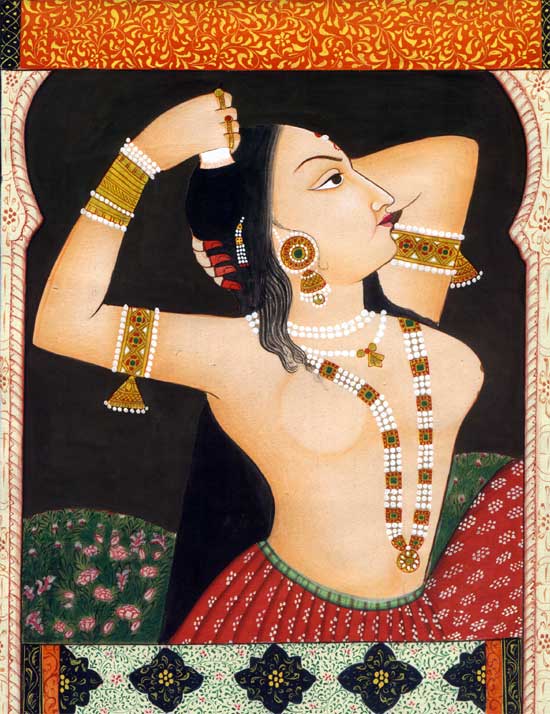
Female figures are depicted with large eyes, bunch of long hair, stout physique and pleasant mood. Like other Rajasthani styles, in these style too female figures adorned with various ornaments like necklaces, anklets, bangles, earrings etc. were shown. Lord Krishna and Radha, Rajput princes, fierce camel fights, Pomp and ceremony of the Mughal court, the Bhagwat Purana, the Ramayana and the Mahabharat are some of the favorite themes of Jaipur style paintings.

Shekhawati Style Paintings

Shekhawati, which means the ‘Garden of Shekha’, derives its name from Rao Shekha, its former ruler. It is situated in the Delhi-Bikaner-Jaipur triangle and is a semi desert region in north Rajasthan. This region has popularly been described as the 'open air art gallery' of Rajasthan. 

Shekhawati is mainly famous for its amazing and wonderful mansions (havelis), which are richly painted and decorated. These havelis of Shekhawati were built by the rich and prosperous merchants of the past. This region is also known for its frescoes. The frescoes of the some havelis even depict mythological and historical themes as well as images of huge animals. There are numerous havelis in Shekhawati, some of them dating back to the 18th century. They are in rich artistic traditions. The entire Shekhawati region is generously peppered with mansions and havelis with brilliantly painted exteriors that were constructed mostly during the medieval ages by wealthy merchants. 

The region of Shekhawati in Rajasthan, in western India, is famous for its traditional arts. The mansions built by the wealthy businessmen of the region feature exquisite paintings that decorate their walls, doors, and interiors. Shekhawati paintings have gained popularity over the years, and can be found in antique shops all over India. Depicting a vast range of traditional and modern themes, the Shekhawati paintings are of special interest to those with an interest in the folk arts of Rajasthan. 

Shekhawati is like a huge open air gallery of painted walls, havelis (mansions) and palaces in the vast expanse of the desert of Rajasthan. Every nooks and corners of the each town, street and home has been painted with frescoes. The homes built by the people of the region feature exquisite paintings that decorate their walls, doors and interiors. The themes of these frescoes depict gods, kings, flowers and scenes from daily life. Shekhawati is the only place in India where the walls have always been used as a canvas. The Chetram Sanganeria Haveli is a treasure house of paintings while Rathi Family haveli is a reflection of European impact with Grecian Column effect.

There is not a single town in Shekhawati where havelis (mansions) and temples have not been decorated with paintings. The mansions (havelis) built by the rich men of the region feature exquisite paintings that decorate their walls, doors and interiors. Shekhawati paintings have gained popularity over the years and can be found in antique shops all over India. The Shekhawati paintings depict a vast range of traditional and modern themes. The technique of Fresco painting in Shekhawati was neither primitive nor unique to the area. Instead it resembles closely the Italian Fresco technique developed around the 14th century. In Shekhawati, the fresco painters were called Chiteras and belonged to the caste of Kumhars (Potters). 

The salient features of the Shekhawati Style are as follows-
1. Drawings of elephants and horses and guards were made in bold relief in the brackets of havelis. Drawings of gods and goddesses were painted in sharp outlines on the main gates.
2. The exterior and interior walls of many havelis (mansions) are covered with pictures showing the impact of the Company style. Railway trains, motor vehicles, bicycles, sewing machines, aero planes, sofa sets and other articles belonging to the Victorian age may be seen. The impact of British rule brought great changes in manner of eating, style of dressing, way of living, which have been well depicted in these paintings.
3. Shekhawati paintings are really marvelous and gorgeous.

Alwar style Paintings
Alwar is located at the foothills of the Aravalli hills. It is a historical city of forts and palaces and is also home to the real tigers due to its rich natural woods, splendid lakes and valleys. Thus, it is also known as 'The Tiger Gateway to Rajasthan'. The princely state of Alwar came up only in the late 18th century when the once mighty Mughal Empire was breathing its last. 

Alwar’s rich history is reflected through its many temples, forts, tombs, gardens and palaces. It was always a popular for its paintings. The Alwar School of paintings had contributed superb and wonderful paintings. Paintings from the Alwar school of the 19th century include a series of the incarnations of Lord Vishnu and a Ragamala series, as well as portraits of the Alwar royal family. The city is believed to have been founded by a family member of Kachhawa originating from Amber. Like other styles, the origin of this style is presumed to have taken place after the establishment of Alwar state. Rao Raja Pratap Singh (1756-1790), by his valor, intelligence and political ability, made an independent kingdom after conquering parts of Bharatpur and Jaipur.

In 1770, after having laid out Rajgarh on a new pattern, he built a strong fortress there and made it his capital. About this time two artists named Dhalu Ram and Shiv Kumar migrated to Alwar from Jaipur. They presented some of their artistic works to the Maharaja. Shiv Kumar is believed to have-returned to Jaipur but Dhalu Ram was appointed in charge of the state museum. Dhalu Ram was skilled in drawing frescoes. The beautiful frescoes in the Sheesh Mahal (Palace of glass) of Rajgarh fort were probably painted under his supervision. The frescoes of this palace show a variety of themes, including paintings relating to Lord Krishna-Charit, Lord Ram-Chrit, nayikas, the royal courts etc. 

Drawings of yawning nayikas removing a thorn, nayikas and maidservants engaged in beautification are very pleasant and lovely. Scenes of the royal courts of Maharaja Pratap Singh and Bhaktawar Singh are painted on the walls. Blending of colors in various designs of foliage and the rhythm of the drawings are very remarkable. In the Sheesh Mahal of Rajgarh fort, the effect of the almond color of the Ajanta style is very evident. Light green, blue and gold used in these paintings are impressive. The Sheesh Mahal was constructed around the period of Rao Raja Bhaktawar Singh (1790-1814), son of Rao Raja Pratap Singh. 

The traditions of paintings frescoes also flourished in the temples and cenotaphs in Rajasthan. Examination of the frescoes of the Alwar style shows that the style of paintings developed there had flowed in dual waves, one in engraving frescoes and other into pictorial texts and miniatures. The Alwar style attained diversity in regard to themes. Krishna Lila, Ram Lila, religious conversation with saints in natural surrounding, Raag-Raginis had been extensively painted. In early paintings, till the period of Bhaktawar Singh, all the salient features of Rajasthani painting are clearly noted in the Alwar style. Drawings of white clouds, clear sky, forests and gardens full of bird and animals, mountains, rivers were painted with according to the natural perspective of Alwar. City Palace or Vinay Vilas Mahal in Alwar is a famous landmark in the city. It was built in 18th century and it stands as a symbol of Mughal architecture. All paintings are courtesy of Art of Legend India.

Hadoti School of Paintings -The Treasure of Rajput paintings

Posted by Art Of Legend India [dot] Com On 11:02 PM 0 comments
Hadoti is also known as Hadauti or Hadavati. It is a region of Rajasthan state in western India and the country of Hada Rajputs, comprises the territories of two states, Bundi and Kota. It includes the districts of Bundi, Baran, Jhalawar and Kota. The Bundi, Kota, Jhalawar and other styles of the local thikanas can be called the Hadoti style. The royal palace of Kota is famous for its wall paintings, which has scenes from the legend of Lord Krishna. Different facets of Lord Krishna’s life have been depicted in the art and cultural heritage of the entire Hadoti region in Rajasthan. The Hada Rajput rulers of Bundi and their collateral branch at Kota were enlightened patrons of art. The Bundi or Hadoti School of paintings began under Rao Chattar Shal (1631-1659 AD), who was made governor of Delhi by Shah Jahan. 

The role and influence of the rulers of the Chauhan dynasty were confined to the regions of Bundi, Kota and Jhalawar. Hence this area has been termed the Hadoti region. This area was a treasury of art. The oldest specimens of prehistoric rock paintings in Rajasthan are in the caves on the banks of the ChambaI river near Kota. Its temple architecture and iconography were famous from ancient times. Many artistic temples located at Kansua, Badoli and Ramgarh testify to this fact. The Hadoti paintings are often regarded as one of the highest quality of paintings in the Rajput style. 

Bundi Style Paintings
Bundi is a small town with rustic setting that stands on the foothills of the Aravali Mountains. Bundi is very famous for its mansions (havelis), temples and chhatris with carved pillars, which is located in the South East region of the Indian state Rajasthan. Bundi is renowned for its scenic beauty and the natural beauty of this place comprising mountains covered with luxuriant vegetation, lakes, streams and dense forests greatly influenced artists. It is one of the few places in India, which can lay its claim to an authentic School of Paintings. The Bundi School is an important school of the Rajasthani style of Indian miniature paintings. 

The Bundi School came into existence during the early 17th century; an early influence was the popular Mughal Style of a Ragamala series painted at Chunar near Banaras in 1591. An example of the early Chunar series, Bhairon Ragini, is housed in the Allahabad Museum and there are examples in other collections also. 

Originally mistaken as a Bundi series, it is in fact a popular Mughal series which influenced the early Bundi School for the Chunar series had come into the possession of a family of Bundi Kota artists sometimes about 1625-1630 and was used as a model for painting scroll in Bundi and its sister state Kota. It was the influence of the Chunar series that brought into existence the Bundi School. The Bundi School was also influenced by the Deccani paintings to some extent. The Bundi artists had their own standard in depicting feminine beauty; women are portrayed with small round faces, receding foreheads, prominent noses and full cheeks, while the female dress usually consists of a Pyjama over which a transparent Jama is worn. Another feature of the Bundi School is lush landscapes painted in vibrant colors and massed with a variety of forms of trees and floral creepers, water ponds with lotus flowers in the foreground, fish and birds. Sometimes a yellow band appears on top of the painting with a text in Nagiri characters.

The style of painting that flourished when Bundi was ruled by Hada Rajputs is broadly known as the Bundi style. The Bundi School had a close association with the Mughal style yet it was never fundamental to the evolution and growth of Bundi paintings, however the delicacy of the Mughal style was also not abandoned. Bundi's greatest achievement lies in its distinctive school of art, which together with other styles of Rajasthani paintings has played an important role in the development of Indian art. The decoration of dwellings and other household objects was one aspect of the creative genius of the Rajasthani people, but the world of miniature paintings is perhaps the most fascinating style that has existed here and is famous over the world. Bundi style paintings emphasized on hunting, court scenes, festivals, processions, life of nobles, lovers, animals, birds and scenes from Lord Krishna's life. 

In the early Bundi style the shape of the limbs of nayak-nayika and the arrangement of colors resemble those of the Mewar School. Paintings of the 17th century were greatly influenced by the southern style in representing female faces, foliage of trees, starry skies. In the Bundi style tall human figures with slim and graceful bodies are striking qualities. Women have deep red lips, small noses, round faces and small chins. 

Kota style paintings
Kota is a city in the northern Indian state of Rajasthan. It is located along eastern bank of the Chambal River in the southern part of Rajasthan. Kota in the southern Rajasthan was separated from Bundi in 1624. The Kota School is so close to the Bundi School that at times it is difficult to assert whether a painting is of the Bundi or the Kota style. 

Though a distinctive Kota Style evolved in mid 17th century, similarities between Bundi and Kota painting continued in many respects with discernible variations in details, costumes and methods of shading the faces. The Kota hunting scenes, depicting princes and nobles with their retinue engaged in hunting lions and tigers in the rocky and somewhat sparsely wooded forests of that region, are now world famous. 


The Kota style is considered a sub branch of Bundi style. The Kota style paintings, some of which are drawn on the walls of Kota's palaces, depict nature in all her glory. The Kota artists also drew attractive hunting scenes and beautiful women. These paintings look very natural in their appearance.


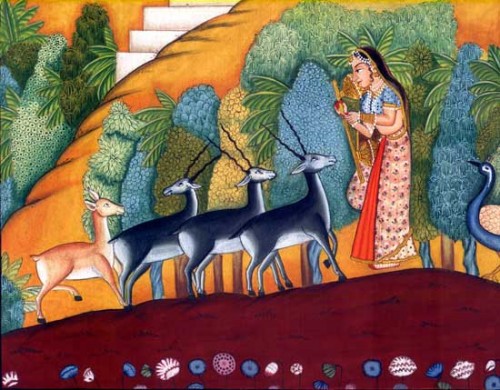
During the reign of Jagat Singh (1658-1684) portraitures were made that employed vibrant colors and bold lines. Under the reign of Arjun Singh (1720-1723), a style emerged where a male was depicted with a long hooked nose. In the 18th century, Kota became popular for its outstanding hunting scenes, Ragamalas and portraits. In the 19th century during the reign of Ram Singh II (1827-1866), the Kota paintings underwent revival. He commissioned a number of paintings depicting scenes of worship, hunting, durbar and processions scenes. The Kota style has some characteristics of the Bundi style, but also its own distinct features. Stout bodies, shining faces, bulging eyes are special features of the Kota style. Application of green, red and golden colors in Kota style painting is very pleasing to see. Animals painted in this style include deer, tiger, lion and pig. Kota style paintings, some of which are drawn on the walls of Kota's palaces, depict nature in all her glory. The Kota painters also drew hunting scenes and beautiful women.All paintings are courtesy of Art of Legend India.

Marwar Paintings - Style of Rajashtani arts

Posted by Art Of Legend India [dot] Com On 10:41 PM 1 comments
In the field of paintings, Rajasthan is a wonderland and unique. Diverse varieties of traditional Rajasthani paintings adorn the art galleries and walls of all corners of the globe. Various schools of painting flourished in Rajasthan from 16th century onwards. Each school has its distinctive and unique style. Marwar is a region of southwestern Rajasthan state in western India. Marwar was an important centre of Gujarati-Jain art activities. It was at Marwar and other places such as Jodhpur, Pali and Nagaur that a variety of sub-schools of paintings developed during 17th -19th centuries. Of these, Jodhpur is the most important centre of Marwar School of paintings. Rao Jodha founded Jodhpur, the capital of Marwar in 1459. As in the other states of Rajsthan, the Jain style of painting flourished in Jodhpur in the 15th and 16th centuries. Subsequently, a folk art style became prevalent and a Ragmala series in this style was painted at Pali in 1623. The paintings in the Mughal style developed mainly under the patronage of Jaswant Singh (1638-1681) and also by his successors also up to 1750. 

The turban seen in the Marwar paintings has its own characteristics. It funnel shaped and markedly high. The faces are usually drawn in profile, and bright colors are preferred in the compositions. Spiral clouds are also shown streaming on the horizon. A large numbers of portraits, court scenes are and themes such as Baramasa are to be found in the Jodhpur style. Court paintings in Jodhpur developed greatly developed during 17th Century through the association of Marwar's Rulers with the Mughal Emperors. During the 18th and 19th centuries it evolved into a distinctive Rajasthani style, combining Mughal naturalism with local folk style and bold colors. In Nagaur, another centre of the Marwar School, we find among other subjects several important portraits executed in a markedly dignified style. 

Marwar developed a sophisticated and distinct School of Miniature Paintings. Marwar School reflected Mughal influence and nobles on horses and durbar scenes were prominent in these paintings. Between 1760 and 1780 the Mughal influence disappeared and the Rajput elements became prominent in the paintings of Jodhpur, which are characterized by linear rhythm and glowing colors. In the Marwar paintings, festivals, ceremonies, elephant fights and hunting expeditions are generally portrayed.The themes also included scenes borrowed from Lord Krishna’s life. Other popular themes were ‘Raagmala’ and ‘Gita Govinda.’

Jodhpur Style
Jodhpur is the second largest city in Rajasthan. The city is known as the Sun City for the bright and sunny weather it enjoys all year. It is also referred to as the Blue City due to the blue-painted houses around the Mehrangarh Fort. It was founded in 1459 by Rao Jodha, a Rajput chief of the Rathore clan. As in other states of Rajasthan, a Jain style of painting flourished in Jodhpur in the fifteenth and the sixteenth century. Jodhpur has a very strong folk tradition and here the figures are mainly robust warriors and dainty women. Paintings of the legendary lovers like Dhola-Maru on camelback, hunting scenes which included innumerable horses and elephants dominate the paintings of the Marwar region. Many paintings of the early 17th century belong to the Jodhpur style, and even though highly influenced by the Mewari style possess their original character. 

A 'Ragamala' series of 1623 was painted at Pali in a style of folk art. Paintings in Mughal style developed under the patronage of Jaswant Singh (1638-1681), who served as the Viceroy of the Mughals for Malwa, Gujarat and the Deccan. Many portraits of this ruler exist in the palace collection of Jodhpur, which indicates the presence of a considerable group of artists. Ajit Singh (1707-1724) continued the patronage of painting in the Mughal style. His successor Abhai Singh (1724-1750) was fond of dance and music and was also a keen patron of painting and literature. There is a lovely picture in the Jodhpur palace in which he is shown listening to music. The elongated female figures and oval faces reflect the Mughal style of the Muhammad Shah period. The late Jodhpur style, characterized by the lavish use of yellow, blue and green colors, spiral clouds on the horizon, reached its climax in the reign of Man Singh (1823-1843). In these paintings women wear bell-like skirts and men have side whiskers, flat-twisted turbans and accordion-pleated coats. 

The Jodhpur style is the principal style of the Marwar School, but even today a large number of paintings in this style are not available and whatever is available belongs to the early period of 19th century. Despite being influenced by the Mewar School, the Jodhpur style has its own striking feature and as a result its separate constitution comes to light. Males in this style are stoutly built and tall. Their curved mustaches, touching their throats and dress decorated with royal splendor are very impressive. Paintings in Jodhpur got a new impetus during the reigns of Ajit Singh and his successors Abhai Singh and Ram Singh, when the literary works Gita-Govinda, Dhola Maru, Raagmala, Baramasa portraits were painted in large numbers. Beautiful and attractive paintings were painted in the palace of Nagaur during the reign of Bhakhat Singh. 

Bikaner Style

Bikaner is the one of the important states of Rajasthan, which is located in the northern part of Rajasthan. It is well-known for the best riding camels in the world. This state was established in the 15th century by a chieftain Rao Bikaji. It was during the middle of the 17th century that a few artists from the Mughal School visited Bikaner and worked there under its patronized. Ali Raza, a master painter from Delhi was amongst them. The names of some of the popular Bikaner artists are Ruknuddin and his son Sahibdin, Isa, Mohammed Ibrahim and Lupha. Most of the Bikaner artists were Muslim and they worked in a style which although markedly Mughal in character, had certain distinctive features of its own. The Bikaner style is known for its fine draughtsman ship and subdued color tonalities. 


The style of the paintings developed has more Mughal elements than other schools of Rajasthani paintings. Apart from the Mughal style, the paintings of Bikaner also reflect marked influence of Deccan paintings. Influenced by the surroundings, Bikaner style paintings have their own unique style the hills and valleys, deserts, places and forts, gardens, court scenes, religious processions and vignettes from the life of Lord Krishna are recurrent themes of these paintings. During the late 18th century paintings in Bikaner grew slightly conservative and embraced the flatness and abstractions of the typically Rajasthani style. Bikaner was also an important centre of Rajasthani paintings, developed after the 17th century. Raja Rai Singh (1571-1611) was a great lover of paintings. 

Early paintings in the Bikaner style may be traced to the pictorial Bhagwad Purana painted in the time of Rai Singh (1571-1591). He himself compiled the Rai Singh Mahotsav and Jyotish Ratnak texts. The impact of the Jain school is easily discernible in the early paintings of Bikaner. The Mughal paintings of this region distinctly depict this mutual influence. Maharana Rai Singh married Jasmade, daughter of Maharana Udai Singh. His second marriage took place in Jaisalmer in 1592, hence Bhagwad Puran in Bikaner style, Madhavanal Kamkalanda (1603) compiled and painted for Kunhar Raj of Jaisalmer, and Chor Panchashika (1540) compiled by Bilhan in the Mewar style and Rag-Mala (1605) painted by Nasir Di exhibit great similarity from the angles of techniques and selection of colors. 

Because of Bikaner state's close ties with the Mughal court all salient characteristics of the Mughal style are quite visible in early paintings of the Bikaner style. Many critics therefore term it a provincial Mughal style. But drawings of slim and attractive females with eyes resembling those of deer, the frequent application of blue, green and red colors, turbans of the style of Shahjahan and Aurangzeb along with the high turbans of Marwari fashion, camels, deer and the Bikaneri style of living and the impact of Rajput culture make us believe it is a distinct style. Most of the paintings are made on the Ramayana, on the Mahabharata, lord Krishna legends, Ragmala and love scenes of Radha and Krishna. In Bikaner style paintings, hunting scenes paintings, miniature and wall paintings are also made. Human figure with little tight lips, eyes half open, small chin, very thin wrist, under developed chest and men’s moustaches a little downwards are some features of the Bikaner style paintings.

Kishangarh Style paintings
Kishangarh is a city and a municipality in Ajmer district in the Indian state of Rajasthan. It was founded by Kishan Singh, a younger brother of Raja Sur Singh of Jodhpur in circa 1609 and is the birth place of the Kishangarh style of paintings, which is known for the beautiful depiction of a courtesan known as Bani Thani. Bani Thani was the mistress of Raja Sawant Singh of Kishangarh in Rajasthan. She was a quintessential Indian beauty with her elongated face with a high forehead, arched eyebrows, half opened eyes, sharp pointed nose, thin curved sensuous lips and a pointed chin over a long narrow neck. The curl of the hair around the ear added to her innate grace. She was the inspiration of the image of Radha of Kishangarh School of paintings. Besides being blessed with natural beauty she was also a talented poetess and singer. 

The Kishangarh School of paintings is clearly distinguished by its individualistic facial type and religious intensity. Kishangarh paintings emerged as a distinctive style in the middle of 18th century under the patronage of Maharaja Sawant Singh. Raja Sawant Singh, the king of Kishangarh, was on the throne during that period. A great patron of art and literature as he was, he composed devotional songs in praise of Radha and Krishna using the pseudonym of Nagari Das. Typical characteristics of Kishangarh paintings are portraits of women with sharp profiles, long necks, slanted eyes and aquiline noses. The colors used are almost jewel-like and green is one of the predominant shades used. Kishangarh is picturesquely situated by a lake and its fort and palace overlook the waters. Artists of this school have beautifully depicted palace, fort, lake, bridges, gardens and Kishangarh town in the background of their paintings. 

The rulers of Kishangarh worshipped lord Krishna. So many painters of this school portrayed lord and his consort, Radha. However, while in other Folk Paintings, the couple is usually depicted in the forest, Kishangarh paintings always show Radha and Krishna in their palace or court. Kishangarh style of painting occupies a significant position in relation to Rajasthani paintings. In the developed state of the Marwar School the Kishangarh style had acquired its unique and glorious position in the realm of Rajasthani painting after having ascended to the pinnacle of glory in the time of Maharaja Sawant Singh. Bhavani Das was a renowned painter who developed a style that bloomed during the reign of Maharaja Sawant Singh. 

The Kishangarh style has its own combination of colors. To express tender sentiments of Radha-Krishna artists often used light colors. The principal colors were white, rose, cream and deep red. The Kishangarh style possesses some distinct features which maintain its unique identity. Drawings of limbs of males and females, colorful paintings of nature, illustrations of themes connected with the Radha-Krishna cult are some distinct features of this style. Male figures are tall, of attractive physique with blue aura-like bunch as of hair, elevated turbans, with strings of pearls in white or blue, symmetrically developed forehead, thin lips and wide and attractive eyes stretched to the ears like khanjan birds are some unique features of the Kishangarh style. Female figures are fair in complexion, and their wide eyes are adorned with kohl. The natural perspective of Kishangarh and Roopangarh was endowed with lakes, mountains, gardens and various birds. 

Kishangarh style of paintings was basically a fusion of Mughal and regional style. The most common theme of this style consisted of the depiction of the love between lord Krishna and Radha. With the demise of Maharaja Sawant Singh and his leading artists, this school lost its glory and started breaking down. By and by the eternal quality of the Kishangarh style began to lose its distinct character. Its deterioration began to be visible in paintings in the reign of Prithvi Singh (1840-1880). After this period, the Kishangarh style was lost in oblivion.All paintings are courtesy of Art of Legend India.

Mewar Paintings - A part of Rajput period

Posted by Art Of Legend India [dot] Com On 10:06 PM 1 comments
The colorful state Rajasthan has a rich inheritance in its paintings. Beautiful and bold, these paintings depict the rich historical past of the state of Rajasthan. The style and varieties of these paintings are as diverse as the state itself. From the point of view of historical traditions in Rajasthani painting the Mewar School occupies first place. Mewar School of paintings is one of the most important schools of Indian miniature paintings of the 17th and 18th centuries and it distinguished itself by creating a superlative vocabulary in miniature paintings

The works of the school are characterized by simple bright color and direct emotional appeal. The artistic heritage of Medpat, the land of Guhil rulers, was a perennial source of inspiration for ancient and other schools of art. Paintings of Mewar earned wide publicity among other styles and substyles, and paintings of the Udaipur, Nathdwara and Devgarh styles are immortal legacies of this school. The preliminary and original form of Rajasthani painting, which had emerged from a synthesis, is visible in the Mewar school. Some artists and Guhil rulers of Vallabhipur came to Mewar and applied the Ajanta traditions with tremendous success. This tradition, after having assimilated a local feature, maintained its original identity and was known as the Mewar School of painting. King Rana Kumbha was a keen student of architecture, literature, music and the other arts. That this ruler was indifferent to painting is a view that does not seem acceptable, but the history of painting in the 15th century remains in oblivion. 

Many pictorial texts painted in the Mewar style in the middle of the 17th century and in the reign of Maharana Jagat Singh (1628-52) are available. Because of the growth of the Vallabha sect in Rajasthan, the Radha-Krishna Lila was the main contribution of the Mewar style. Hence Bhagwad-Purana was the main subject of Mewar paintings. In the text of Bhagwad-Purana painted by Sahabadi (1648) fine examples of the Mewar style are available. With this style, artists used a single hair from the throat or tail of a squirrel to execute the finely detailed work of these superb paintings. The Mewar School continued through the 1700s and into the 1800s, the output being quite prolific. Although religious themes continued to be popular, more and more paintings concentrated on portraiture and the life of the ruler. 

The main theme of these paintings was the traditional text that ranges from the Ragamala, Nayika-bhada, Krishna Leela, the Ramayana and the Bhagvata Purana. The scenes from the Krishan Leela came to be known for their amorous quality. One of the first definitive sets of Ragamala paintings of 1605, and executed by painter Nasiruddin, can be still seen in the collections at Udaipur. The Mewar school is known for its strong colors and decorative designs. 

Paintings from Mewar assume a great variety for the use of a wide range of colors such as saffron, yellow, ochre, navy blue, brown, crimson etc. The backgrounds usually have stylized architecture consisting of domed pavilions and small turrets. The treatment of trees only partially naturalistic and the foregrounds are decorated with flowers and the birds. A scarf is worn over one shoulder and sometimes around the waist as well. The turban is either loosely wound or has a band tied tightly around it. Mewar painting continued to flourish, with western-style portraiture of notable figures supplementing the traditional style of hunts and courtly occasions.

Nathdwara Substyle
Nathdwara is the world famous town for it's one of the richest ‘Shri Nath Ji Temple’ in Mewar Kingdom of India. Lots of people from Gujarat, Maharashtra and other states of India come to visit the holy temple of Shrinathji at Nathdwara. At Nathdwara, the installation of Lord Shri Nathji gave rise to fresh dimensions in art. During the eighteenth and the nineteenth centuries, the Mewar paintings, imbibing the Brij and Mughal influences, continued to manifest its rise and fall through epic-painting, wall-painting and miniature paintings. A distinct Mewar style of painting is termed Nathdwara substyle. To avoid the oppression of Aurangzeb, the image of Shri Nathji installed at Govardhan was brought to Rajasthan and installed at Nathdwara in 1670. Along with Acharya Gopi Nathji, many artists endowed with great religious fervour came here and created many beautiful paintings of Lord Shri Nathji. Depiction of natural scenery from the 18th century to this date is a distinct feature of the Nathdwara style. The Nathdwara style continued to achieve artistic beauty and excellence. 

Nathdwara is famous for the pichwai paintings in Rajasthan. Pichhwai paintings are painted in permanent natural colors that do not lighten for years. They are put to use in printings and embroidery also. Portrayal of the artist’s love for Gods makes the Nathdwara style distinct from other forms. Pichhwai paintings are created and used as backgrounds in the Shrinathji temple and in other Krishna temples. The main theme of these paintings is Lord Shrinathji and his exploits. Pichhwai paintings have deep religious roots and they are a part of devotional expression. The main themes of the paintings are based on the numerous festivals of the Shrinathji temple. They show the figure of Shrinathji decked in different festive costumes, whether it is in the vibrant colors of Holi or the festivities of Janmashtami and the ever-famous Raas-Leela. A pichhwai painting is often a group effort, where several skillful painters work together under the supervision of a master of the art. Nowadays pichwai paintings are painted in Udaipur and Nathdwara.

Devgarh Substyle

The Mewar School has been the chief and the basic school of Rajasthani paintings, and such it has also influenced its nearby Thikanas in the term of drawing. Located near the Marwar border, Devgarh Thikana was established by Rawat Dwarkadas Chudawat in 1680 during the reign of Maharana Jaisingh (1680-1698). Despite its adherence to the Mewar painting tradition, the Devgarh painting-style displays naturally the impact of Marwar. This style has acquired distinctiveness on account of the use of thick and well-balanced lines, abundance of green and yellow colors. Devgarh paintings are preserved in the various museums and private collections, chief among which are National Museum, New Delhi, Prince of Wales Museum, Bombay, Kumar Sangram Singh Museum, Jaipur. Besides, important Devgarh materials are available in the personal collection of Rawal Nahar Singh of Devgarh. 


Among the Devgarh painters, Bagata (1769-1820) and Kanwala (1771-1810) were two distinguished artists. Kanwala II (1800-1850), Chaukha and Baij Nath (1770-1830) following in the footsteps of their above illustrious predecessors, enriched the Devgarh substyle by their valuable contributions.All paintings are courtesy of Art of Legend india.

Rajput Paintings – The splendour of Rajashtan art

Posted by Art Of Legend India [dot] Com On 4:09 AM 0 comments
Art is the unique example of expressing a cultured way of life. The experience of joy relating to the visible or invisible physical or astral body or sentiments being in real form, appear before human beings in expressive forms. That expression is termed as art. The word ‘kala’ is derived from Sanskrit. It has been used in Sanskrit literature in numerous interpretations, in which the 16th part of a principal object, “a part of time”, the expected intelligence in performing any task deserves special mention. Before the advent of Bharat muni, kala had been applied in almost all other acts of intelligence except poetry and was a special world for such work of the intellect. Any successful business regarding life had ever been placed in the category of art. 

Rajput painting, also known as Rajasthani Painting, is a style of Indian paintings developed and flourished during the 18th century in the royal courts of Rajasthan. Rajasthan has played a significant role in the growth of Indian art. Like other fine arts, paintings flourished widely in this region and established a distinct form called Rajasthani Paintings. Because of its charming, folk artistic and feudalistic perspectives, many styles of paintings developed here, among them the Mewar, Bundi and kishangarh schools acquired world wide acclaim. Rajasthani paintings are an integral part of ancient Indian paintings. From the point of view of artistic and geographical development, Rajasthani Paintings are classified in four sections- the Mewar School, the Marwar School, the Hadoti School and the Dhundar School. Among these four schools numerous styles and sub styles have flourished. Details regarding the place of birth of Rajasthani painting, and the time and history of circumstances concerning its development, are not yet known. 

Rajput painting originated in the royal states of Rajasthan, somewhere around the late 16th and early 17th century. The Mughals ruled almost all the princely states of Rajasthan at that time and because of this, most of the schools of Rajput Painting in India reflect strong Mughal influence. Each of the Rajput kingdoms evolved a distinctive style. Rajput paintings depict a number of themes, events of epics like the Ramayana and the Mahabharata, lord Krishna' life etc. 

Schools of Rajput Painting
Starting from the 16th century, when the Rajput Painting originated, numerous schools emerged, including:
   Mewar School of paintings
   Hadoti School of paintings
   Kishangarh School of paintings
   Dhundar School of paintings

Mewar School of paintings
From the point of view of historical traditions in Rajasthani painting the Mewar School occupies first place. The artistic heritage of Medpat, the land of Guhil rulers, was a perennial source of inspiration for ancient and other schools of art. Paintings of Mewar earned wide publicity among other styles and substyles, and paintings of the Udaipur, Nathdwara and Devgarh styles are immortal legacies of this school. The preliminary and original form of Rajasthani painting, which had emerged from a synthesis, is visible in the Mewar school. Some artists and Guhil rulers of Vallabhipur came to Mewar and applied the Ajanta traditions with tremendous success. This tradition, after having assimilated local features, maintained its original identity and was known as the Mewar School of painting

When did the Mewar school of Indian painting come into existence? Connoisseurs of art have speculated on this point as great centers of art like Chavand and Chittor had time and again been devastated in numerous onslaughts by enemies. Hence even today the history of Mewar is shrouded in ignorance. King Rana Kumbha was a keen student of architecture, literature, music and the other arts. That this ruler was indifferent to painting is a view that does not seem acceptable, but the history of painting in the 15th century remains in oblivion. 

Many pictorial texts painted in the Mewar style in the middle of the 17th century and in the reign of Maharana Jagat Singh (1628-52) are available. Because of the growth of the Vallabha sect in Rajasthan, the Radha-Krishna Lila was the main contribution of the Mewar style. Hence Bhagwad-Purana was the main subject of Mewar paintings. In the text of Bhagwad-Purana painted by Sahabadi (1648) fine examples of the Mewar style are available.

Nathdwara Substyle
At Nathdwara, the installation of Lord Shri Nathji gave rise to fresh dimensions in art. During the eighteenth and the nineteenth centuries, the Mewar painting, imbibing the Brij and Mughal influences, continued to manifest its rise and fall through epic-painting, wall-painting and miniature paintings. A distinct Mewar style of painting is termed Nathdwara substyle. To avoid the oppression of Aurangzeb, the image of Shri Nathji installed at Govardhan was brought to Rajasthan and installed at Nathdwara in 1670. Along with Acharya Gopi Nathji, many artists endowed with great religious fervour came here and created many beautiful paintings of Lord Shri Nathji. Depiction of natural scenery from the 18th century to this date is a distinct feature of the Nathdwara style. The Nathdwara style continued to achieve artistic beauty.

Devgarh Substyle
The Mewar School has been the chief and the basic school of Rajasthani paintings, and such it has also influenced its nearby Thikanas in the term of drawing. Located near the Marwar border, Devgarh Thikana was established by Rawat Dwarkadas Chudawat in 1680 during the reign of Maharana Jaisingh (1680-1698). Despite its adherence to the Mewar painting tradition, the Devgarh painting-style displays naturally the impact of Marwar. This style has acquired distinctiveness on account of the use of thick and well-balanced lines, abundance of green and yellow colors. 

Among the Devgarh painters, Bagata (1769-1820) and Kanwala (1771-1810) were two distinguished artists. Kanwala II (1800-1850), Chaukha and Baij Nath (1770-1830) following in the footsteps of their above illustrious predecessors, enriched the Devgarh substyle by their valuable contribution.

Marwar School of paintings
Each Rajasthani school of painting has its distinct and unique style whilst representing the hills, colors and palaces of Rajasthan. After the Mewar School, the grandeur of the Marwar School of painting is well expressed in the Jodhpur style, the Bikaner style and the world famed Kishangarh style as well as in the sub styles of Jaisalmer, Naugore, Sirohi and Ajmer. The Marwar School of painting was a prominent style of miniature painting, during 16th century in Rajasthan. This style of painting usually dealt with the court life. In the Marwar Paintings, festivals, ceremonies, elephant fights and hunting expeditions are generally portrayed. The themes also included scenes borrowed from Lord Krishna’s life. Other popular themes were ‘Raagmala’ and ‘Gita Govinda.’

Jodhpur Style
Jodhpur has a very strong folk tradition and here the figures are mainly robust warriors and dainty women. Paintings of the legendary lovers like Dhola-Maru on camelback, hunting scenes which included innumerable horses and elephants dominate the paintings of the Marwar region. Many paintings of the early 17th century belong to the Jodhpur style, and even though highly influenced by the Mewari style possess their original character. 

 The Jodhpur style is the principal style of the Marwar School, but even today a large number of paintings in this style are not available and whatever is available belongs to the early period of 19th century. Despite being influenced by the Mewar School, the Jodhpur style has its own striking feature and as a result its separate constitution comes to light. Males in this style are stoutly built and tall. Their curved mustaches, touching their throats and dress decorated with royal splendor are very impressive. 

Bikaner Style

The style of the paintings developed has more Mughal elements than other schools of Rajasthani paintings. Apart from the Mughal style, the paintings of Bikaner also reflect marked influence of Deccan paintings. Influenced by the surroundings, Bikaner style paintings have their own unique style the hills and valleys, deserts, places and forts, gardens, court scenes, religious processions and vignettes from the life of Lord Krishna are recurrent themes of these paintings. During the late 18th century paintings in Bikaner grew slightly conservative and embraced the flatness and abstractions of the typically Rajasthani style.

Early paintings in the Bikaner style may be traced to the pictorial Bhagwad Purana painted in the time of Rai Singh (1571-1591). He himself compiled the Rai Singh Mahotsav and Jyotish Ratnak texts. The impact of the Jain school is easily discernible in the early paintings of Bikaner. The Mughal paintings of this region distinctly depict this mutual influence. Maharana Rai Singh married Jasmade, daughter of Maharana Udai Singh (1537-1572). His second marriage took place in Jaisalmer in 1592, hence Bhagwad Puran in Bikaner style, Madhavanal Kamkalanda (1603) compiled and painted for Kunhar Raj of Jaisalmer, and Chor Panchashika (1540) compiled by Bilhan in the Mewar style and Rag-Mala (1605) painted by Nasir Di exhibit great similarity from the angles of techniques and selection of colors. 


Because of Bikaner state's close ties with the Mughal court all salient characteristics of the Mughal style are quite visible in early paintings of the Bikaner style. Many critics therefore term it a provincial Mughal style. But drawings of slim and attractive females with eyes resembling those of deer, the frequent application of blue, green and red colors, turbans of the style of Shahjahan and Aurangzeb along with the high turbans of Marwari fashion, camels, deer and the Bikaneri style of living and the impact of Rajput culture make us believe it is a distinct style.

Kishangarh Style
Kishangarh Painting emerged as a distinctive style in the middle of 18th century under the patronage of Maharaja Savant Singh. Kishangarh is the birth place of the Kishangarh style of paintings, which is known for the beautiful depiction of a courtesan known as Bani Thani. Bani Thani was probably a mistress of Maharaja Savant Singh and a singer and a poet. Bani Thani paintings were characterized by exaggerated features long necks, large almond-shaped eyes, long fingers and the use of subdued colors. Kishangarh style of paintings was basically a fusion of Mughal and regional style. The most common theme of this style consisted of the depiction of the love between lord Krishna and Radha. With the demise of Maharaja Savant Singh and his leading painters, this school lost its glory and started breaking down. 

Kishangarh style of painting occupies a significant position in relation to Rajasthani paintings. Kishangarh state was founded by the eighth son of Raja Udai Singh of the Rathore dynasty of Jodhpur state in 1609. Closely connected with Jodhpur state and the Mughal court, the rulers of that state were conversant with the royal culture and sophisticated way of living. In the developed state of the Marwar School the Kishangarh style had acquired its unique and glorious position in the realm of Rajasthani painting after having ascended to the pinnacle of glory in the time of Maharaja Savant Singh. Bhavani Das was a renowned painter who developed a style that bloomed during the reign of Maharaja Savant Singh (1748-1764 AD). 
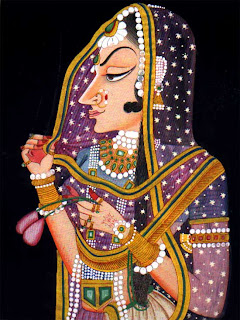
The Kishangarh style has its own combination of colors. To express tender sentiments of Radha-Krishna artists often used light colors. The principal colors were white, rose, cream and deep red. The Kishangarh style possesses some distinct features which maintain its unique identity. Drawings of limbs of males and females, colorful paintings of nature, illustrations of themes connected with the Radha-Krishna cult are some distinct features of this style. Male figures are tall, of attractive physique with blue aura-like bunch as of hair, elevated turbans, with strings of pearls in white or blue, symmetrically developed forehead, thin lips and wide and attractive eyes stretched to the ears like khanjan birds are some unique features of the Kishangarh style. Female figures are fair in complexion, and their wide eyes are adorned with kohl. The natural perspective of Kishangarh and Roopangarh was endowed with lakes, mountains, gardens and various birds. 

By and by the eternal quality of the Kishangarh style began to lose its distinct character. Its deterioration began to be visible in paintings in the reign of Prithvi Singh (1840-1880). After this period, the Kishangarh style was lost in oblivion.

Hadoti School of Paintings
The role and influence of the rulers of the Chauhan dynasty were confined to the regions of Bundi, Kota and Jhalawar. Hence this area has been termed the Hadoti region. This area was a treasury of art. The oldest specimens of prehistoric rock paintings in Rajasthan are in the caves on the banks of the ChambaI river near Kota. Its temple architecture and iconography were famous from ancient times. Many artistic temples located at Kansua, Badoli and Ramgarh testify to this fact. The Hadoti paintings are often regarded as one of the highest quality of paintings in the Rajput style.

Bundi Style Paintings
The style of painting that flourished when Bundi was ruled by Hada Rajputs is broadly known as the Bundi style. The natural beauty of this place comprising mountains covered with luxuriant vegetation, lakes, streams and dense forests greatly influenced artists. 

No definite dates are available regarding the origin of the Bundi style, but in the middle of the 18th century facts about its historical background were known. In the beginning of the 17th century this style, a sub-branch of the Mewar School influenced by the Mughal style and endowed with original qualities, flourished under the patronage of art-loving kings. The Bundi style, based upon traditional poetry and endowed with rich colors and attractive forms, and physical structures reached its zenith. In the middle of the 18th century the style took a new turn in the period of Raja Umaid Singh (1748-1771), in which the manifold diversities of nature and the physical beauty of nayak-nayika, the firmness of brush and charm of conception are easily visible. This style was greatly influenced by the MughaI style.

In the early Bundi style the shape of the limbs of nayak-nayika and the arrangement of colors resemble those of the Mewar School. Paintings of the 17th century were greatly influenced by the southern style in representing female faces, foliage of trees, starry skies. In the Bundi style tall human figures with slim and graceful bodies are striking qualities. Women have deep red lips, small noses, round faces and small chins.
One of the earliest examples of the Bundi Paintings is the Chunar Ragamala painted in 1561. The painting showed marked influence of the Mughal style. The development of the Bundi School in the early 17th century is unclear but isolated examples of creative brilliance reveal the ongoing development of Bundi style. Rag-ragini, nayika-bhed, Barah-masa, Krishna-Lila, royal court, festivals, wars are the major themes of the Bundi style. Because of the predominance of the Vallabha sect pictures of Krishna-Lila were mainly painted.

Kota style paintings
The Kota style is considered a sub branch of Bundi style. The Kota style paintings, some of which are drawn on the walls of Kota's palaces, depict nature in all her glory. The Kota painters also drew hunting scenes and beautiful women. These paintings look very natural in their appearance.

During the reign of Jagat Singh (1658-84) portraitures were made that employed vibrant colors and bold lines. Under the reign of Arjun Singh (1720-23), a style emerged where a male was depicted with a long hooked nose. In the 18th century, Kota became popular for its superb hunting scenes, Ragamalas and portraits that often bore high documentary value. In the 19th century during the reign of Ram Singh II (1827-66), the Kota paintings underwent revival. He commissioned number of paintings depicting scenes of worship, hunting, durbar and processions. 

The Kota style has some characteristics of the Bundi style, but also its own distinct features. Stout bodies, shining faces, bulging eyes are special features of the Kota style. Application of green, red and golden colors in Kota style painting is very pleasing to see. Animals painted in this style include deer, tiger, lion and pig.

Dhundar school of Paintings
In ancient times, the regions in and around Jaipur were known as Dhundar. Most parts of Alwar, Jaipur, and Shekhawati are still called Dhundar Pradesh. Under the banner of Dhundar Pradesh, we may study the Amber, Jaipur, Alwar and Shekhawati styles. The Dhundar style of paintings had continued its pace of development through various new forms from time to time. The Dhundar School of paintings was much renowned for its exclusive folk art paintings. This painting style was developed by the Hada Rajput rulers in the Bundi and Kota regions. The miniature paintings of these two centers were excellent creations and they portray fine-looking women with round faces, large eyes, long neck and pointed nose. The haunting activities of the erstwhile Raja's and Maharaja's are depicted in these paintings.

Amber style paintings
The Amber style is the rich heritage of the Rajas (kings) of the Kachchava and Kush dynasties. In the 10th-1lth centuries they had a large kingdom around Gwalior. Ancient specimens of the Amber style of painting are not available. The oldest available pieces of this style are frescoes drawn around 1600-1614 upon cenotaphs in Amber. Besides the cenotaphs of Amber, frescoes in the Amber style may be noticed in the so- called Mughal garden of Bairath, in which themes like raag-ragini, Krishna-Lila, nayika-bhed, elephant riding, horse riding and camel riding were painted. 

The paintings of Amber style show strong Mughal influence. During the late 18th and early 19th centuries numerous works of art were produced that depicted episodes from the life of lord Krishna. The Amber style possesses its own characteristics, in which the structure of bodies of both male and female has been much influenced by Rajasthani folk art. Because of their kinship with the Mughals, mutual cultural exchange was natural. Hence the impact of ornamented dresses belonging to the periods of Akbar and Jahangir is visible. Poor quality of line is seen in the Apbhransh style. The Amber style has its own constitution quite visible in the some pictorial texts.

Jaipur Style paintings
Rajasthan is famous for its paintings, art and folk dances. Jaipur, because of its architectural charm, pleasant combination of colors and specially laid out plan, is called the Pink City of India. Jaipur and surrounding regions of Alwar and Tonk are famous for the Jaipur style paintings that have a substantial Mughal element. The Jaipur style has inherited the Amber style as a cultural legacy. This School came into light in 18th century A.D. and had a great effect of Mugal School. Sawai Jai Singh ruled in Jaipur from 1613-1743, he was a great lover of art. 

In the time of Sawai Jai Singh’s son, Ishwari Singh, Sahib Ram emerged as a talented artist. He painted a portrait of Raja Ishwari Singh with the help of Chandras, which has been recognized as of high quality. Another popular artist of his period was Lall Chittara, who had painted many pictures depicting animals and birds in struggles. In the reign of Sawai Madho Singh I (1751-1767), Sahib Ram earned the reputation of being the seasoned artist. He painted large sized portraits with Ramji Dass and Govindji, two more artists’ while Lall Chittara continued to paint various royal sports. In the paintings of this age the Mughal influence began to wane and pure Rajput style showed signs of replacing it. 

The Jaipur style was not confined to the royal court but flourished and developed at the adjoining centers belonging to feudal lords related to the Jaipur family. From time to time pictures had been painted at Iserda, Siwar, Jhillaya, Chommu, Malpura and Samod. Fresco tradition is the main feature of the Jaipur style. Artists in the Jaipur style applied deep reds in the drawings margins on paintings. White, red, yellow were extensively utilized. In the paintings of the Jaipur style men and women appear in proportion. Male figures have clean and attractive faces. Wealthy men are depicted wearing turban, kurta, pyjama, belt and shoes in such paintings. 

Female figures are depicted with large eyes, bunch of long hair, stout physique and pleasant mood. Like other Rajasthani styles, in this style too female figures adorned with various ornaments like necklaces, anklets, bangles, earrings etc.were shown. Lord Krishna and Radha, Rajput princes, fierce camel fights, Pomp and ceremony of the Mughal court, the Bhagwat Purana, the Ramayana and the Mahabharat are some of the favorite themes of Jaipur style paintings.

Shekhawati Style Paintings
The havelis of Shekhawati are known the world over for their wall paintings. The themes of these frescoes depict gods, kings, flowers and scenes from daily life. Shekhawati is the only place in India where the walls have always been used as a canvas. There is not a single town in Shekhawati where havelis and temples have not been decorated with paintings. 

The mansions built by the rich men of the region feature exquisite paintings that decorate their walls, doors and interiors. Shekhawati paintings have gained popularity over the years and can be found in antique shops all over India. The Shekhawati paintings depict a vast range of traditional and modern themes. The technique of Fresco painting in Shekhawati was neither primitive nor unique to the area. Instead it resembles closely the Italian Fresco technique developed around the 14th century. In Shekhawati, the fresco painters were called Chiteras and belonged to the caste of Kumhars (Potters). 

The salient features of the Shekhawati Style are as follows-
1. Drawings of elephants and horses and guards were made in bold relief in the brackets of havelis. Drawings of gods and goddesses were painted in sharp outlines on the main gates.
2. The exterior and interior walls of many havelis (mansions) are covered with pictures showing the impact of the Company style. Railway trains, motor vehicles, bicycles, sewing machines, aero planes, sofa sets and other articles belonging to the Victorian age may be seen. The impact of British rule brought great changes in manner of eating, style of dressing, way of living, which have been well depicted in these paintings.

Alwar style Paintings
Alwar is referred as the gateway of colorful and historical Rajasthan. The city of Alwar is regarded as “The Tiger Gate of Rajasthan”. The city is believed to have been founded by a family member of Kachhawa originating from Amber. Like other styles, the origin of this style is presumed to have taken place after the establishment of Alwar state. Rao Raja Pratap Singh (1756-1790), by his valor, intelligence and political ability, created an independent kingdom after conquering parts of Bharatpur and Jaipur. In 1770, after having laid out Rajgarh on a new pattern, he built a strong fortress there and made it his capital. About this time two artists named Dhalu Ram and Shiv Kumar migrated to Alwar from Jaipur. They presented some of their artistic work to the maharaja. Shiv Kumar is believed to have-returned to Jaipur but Dhalu Ram was appointed in charge of the state museum. Dhalu Ram was skilled in drawing frescoes. 

The beautiful frescoes in the Sheesh Mahal (Palace of glass) of Rajgarh fort were probably painted under his supervision. The frescoes of this palace show a variety of themes, including paintings relating to Lord Krishna-Charit, Lord Ram-Chrit, nayikas, the royal courts etc. 

Drawings of yawning nayikas removing a thorn, nayikas and maidservants engaged in beautification are very pleasant and lovely. Scenes of the royal courts of Maharaja Pratap Singh and Bhaktawar Singh are painted on the walls. Blending of colors in various designs of foliage and the rhythm of the drawings are very remarkable. In the Sheesh Mahal of Rajgarh fort, the effect of the almond color of the Ajanta style is very evident. Light green, blue and gold used in these paintings are impressive. The Sheesh Mahal was constructed around the period of Rao Raja Bhaktawar Singh (1790-1814), son of Rao Raja Pratap Singh. 

The traditions of paintings frescoes also flourished in the temples and cenotaphs in Rajasthan. Examination of the frescoes of the Alwar style shows that the style of paintings developed there had flowed in dual waves, one in engraving frescoes and other into pictorial texts and miniatures. The Alwar style attained diversity in regard to themes. Krishna Lila, Ram Lila, religious conversation with saints in natural surrounding, raag-raginis had been extensively painted. In early paintings, till the period of Bhaktawar Singh, all the salient features of Rajasthani painting are clearly noted in the Alwar style. Drawings of white clouds, clear sky, forests and gardens full of bird and animals, mountains, rivers were painted with according to the natural perspective of Alwar.all paintings are courtesy of Art of Legend India

Company Overview

Art of Legend India has the distinction of being one of the best in the Indian Handicraft Industry. We are about 75 years old handicrafts manufacturer & exporter. We are having team of more than 500 craftsman.

We are having our business offices in India, USA & Germany to ensure our best services.

Total Pageviews