Because
of its unique geographical, historical and cultural background, Rajas-than has
earned much fame. On one hand, there are the high peaks of the Aravalli Hills,
valleys with green vegetation and the beauty of nature, while on the other hand
are large expanses of desert.
In the
annals of Indian history, this territory had ever belonged to brave men and
dedicated women. Different tribes, their way of living, style of dress, and
cultural charm are unique and colourful. In one direction are the impregnable
forts of Ranthambor, Chittor and Jaisalmer, while in another are the ancient
and artistic temples of Dilwara, Ranakpur, Mandore, Paranagar and Badoli.
In a
third direction tall palaces and other buildings, symbols of feudal glory,
exist. In still another are huts built according to folk art style and
belonging to Bhil tribes, Meenas and Girasias. Public figures decked out in
colourful costumes are another highlight of this state. Architecture,
iconography, music, literature and paintings of this region possess significant
characteristics. Rajasthan is undoubtedly a glorious land of artists.
In the
domain of world painting India occupies a unique and honourable place. Buddhist
and Jain art in the styles of Pal, Gujarat, Apbhransh-Rajasthani, Mughal and
Pahari have ever kept intact the traditions of Indian painting since the 2nd
century A.D. till the present day. In this series of paintings Rajasthani art,
adopting the traditions of Ajanta has developed its own unique cultural
perspective and history.
Nomenclature
 With
regard to the nomenclature of Rajasthani painting, scholars hold varied
opinion. Some call it Rajput painting and others Rajasthani painting. Ananda
Coomaraswamy was the first scholar who scientifically classified Rajasthani
painting in his book titled Rajput Painting in 1916.
With
regard to the nomenclature of Rajasthani painting, scholars hold varied
opinion. Some call it Rajput painting and others Rajasthani painting. Ananda
Coomaraswamy was the first scholar who scientifically classified Rajasthani
painting in his book titled Rajput Painting in 1916.
According
to him, the theme of Rajput painting relates to Rajputana and the hill states
of Punjab. He divided it into two parts, Rajasthani concerning Rajputana and
Pahari relating to the hill states of Jammu, Kangra, Garhwal, Basohli, Chamba.
The administrators of these states, often belonging to the Rajput clan, had
termed these paintings Rajput.
According
to Coomaraswamy, Rajasthani painting spread widely from Bikaner to the border
of Gujarat and from Jodhpur to Gwalior and Ujjain. Amber, Aurachha, Udaipur,
Bikaner and Ujjain had earned the reputation of being centres of artistic
activities. But contrary to this view, Raikrishan Dass opines:
Dr
Swami had classified traditional Indian painting in two parts, the Rajput and
Mughal styles, but there is no substance in identifying it as Rajput style.
Even though the Rajputs were a ruling class, the cumulative effect of such a
clan could not influence the style of art which had different centres in the
whole country.
Basil
Grey comments: "Rajputana has been a centre of diverse princely indigenous
states, but the expansion of Rajasthani painting had taken place from
Bundelkhand to Gujarat and states ruled by Pahari Rajputs, that is why the name
Rajput painting seems plausible."' Vachaspati Garrola had recognised only
Rajasthani painting under the auspices of the Rajput style of painting, which
seems to be more ambiguous.
 According
to these arguments, all paintings of the Rajasthani school could be placed
under the Rajput style. The region termed Rajputana under British rule has
after independence been named Rajasthan with little variation. Before the
advent of the British this whole state could have been known by a single name,
but no substantial evidence could be produced to uphold this view. Only Col Tod
named this region Rayathan or Rajasthan. But British officers often used to
call it Rajputana. Hence we treat Rajasthani painting as that style which is an
eternal heritage of this state. Many connoisseurs of art who had given this
style various names like Raikrishan Dass, Ram Gopal Vijayavargia, Karl
Khandalawala, Dr Moti Chandra, Kr. Sangram Singh and Ananda Coomaraswamy
deserve special mention here.
According
to these arguments, all paintings of the Rajasthani school could be placed
under the Rajput style. The region termed Rajputana under British rule has
after independence been named Rajasthan with little variation. Before the
advent of the British this whole state could have been known by a single name,
but no substantial evidence could be produced to uphold this view. Only Col Tod
named this region Rayathan or Rajasthan. But British officers often used to
call it Rajputana. Hence we treat Rajasthani painting as that style which is an
eternal heritage of this state. Many connoisseurs of art who had given this
style various names like Raikrishan Dass, Ram Gopal Vijayavargia, Karl
Khandalawala, Dr Moti Chandra, Kr. Sangram Singh and Ananda Coomaraswamy
deserve special mention here.
Origin and Development
Details
regarding the place of birth of Rajasthani painting, and the time and history
of circumstances concerning its development, are not yet known. By having
compiled books pertaining to many styles of Rajasthani painting different
scholars have unfolded the history of the 17th century and its aftermath,
but their earlier history is riven with contradictions. Art expert Herman Goetz
observes: "Hardly a year or half passes but new findings about Rajasthani
painting thoroughly alter our old conceptions. Particularly, the latest
knowledge about Mewar paintings has raised many question marks."
On the
basis of earlier views Western scholars had recognised that the Rajasthani
style flourished in various princely states after the downfall of the Mughal
Empire. Some scholars however hold the view that it was merely an offshoot of
Mughal painting, and prospered in the reign of Jehangir. On the strength of new
researches undertaken and opinions formed years ago these views have been
dismissed.
Hence
these views, also expressed by Dr Coomaraswamy, do not appear appropriate even
though historically they are highly significant!' With reference to the
parameters regarding the antiquity of Rajasthani paintings, Dr Goetz presented
his research papers, which throw light on its history.' Karl Khandalawala
discussed in detail the origin and development of this painting.
Great
scholars like Raikrishan Dass, Pramod Chandra, Sangram Singh, Satya Prakash,
Anand Krishan, Hiren Mukherji and others also published scholarly articles from
time to time which highlight details of the origin and growth of Rajasthani
painting. On the basis of this research and many available ancient paintings it
is now generally admitted that Rajasthani painting is a significant link with
traditional Indian painting.
Tibetan
historian Tara Nath (16th century) refers to an artist named Shri
Rangdhar who lived in Maru Pradesh (Marwar) in the 7th century but
paintings of this period are not available. The period from the 6th century
to the 12th century was a great landmark in the history of Rajasthan. From the
8th to the 10th centuries this province was termed Gurjaratra, hence
with the development of art and other vocations painting might have flourished
here. Among available compilations, pictorial Kalpa-Sutra authored by
Bhadrabhau Swami in V.S. 1216 is the oldest available artistic text of
India."
In
Rajasthan the first available pictorial text (on palm leaves) is
Savag-Pailikahan Sutt Chuniii (Shravak Pratikraman Sutra Churni), compiled in
the reign of Cubit Tej Singh at Ahar (Udaipur). Glimpses of his decorations are
enshrined in intricate carvings in the temples of Nagda and Chittor."
Another important text is Supasnah Chariyam (Suparshvanath Charitam) which was
painted and compiled in the reign of Mokkhal at Devkulpatak (Dilwara) in V.S.
1480 (A.D. 1422-23).
In this
text the influence of the Gujarat and Jain styles on Rajasthani paintings is
discernible. In the continuity of this style KaIpa-Sutrii of 1426 deserves
special mention. Its style of draping costumes is similar to that of the images
of Vijaya Stambha of Maharana Kumbha. Around A.D. 1450 one copy of Geet-Gvvind
and two of Bal-Gvpal-Stuti had been painted in Western India. This is the first
pictorial text of Lord Krishna which comprises the first seeds of preliminary
Rajasthani painting.
 In 1451
Basant-Vilas painted in the Apbhransh style, whose famous background script was
compiled by Acharya Ratnagiri in Ahmedabad, makes special mention of the origin
of Rajasthani painting. In the history of Mewar, Maharana Kumbha (1433-1468)
had been highly acclaimed for having patronised poetry, music and architecture.
That such a great lover of the arts remained indifferent to painting is not
plausible. But in the absence of proof no concrete conclusion could be
inferred. Only a glimpse of frescoes could be visualised in the ruins of the
fort of Kumbhalgarh and the palace of Chittorgarh of that period.
In 1451
Basant-Vilas painted in the Apbhransh style, whose famous background script was
compiled by Acharya Ratnagiri in Ahmedabad, makes special mention of the origin
of Rajasthani painting. In the history of Mewar, Maharana Kumbha (1433-1468)
had been highly acclaimed for having patronised poetry, music and architecture.
That such a great lover of the arts remained indifferent to painting is not
plausible. But in the absence of proof no concrete conclusion could be
inferred. Only a glimpse of frescoes could be visualised in the ruins of the
fort of Kumbhalgarh and the palace of Chittorgarh of that period.
Up to
the 15th century this style of painting flourished in Rajasthan.
Using Jain and later Jain texts as the basis on which the painting was done,
this may be termed the Jain style, Gujarat style, Western India style or
Apbhransh style. Undoubtedly, the period from the 7th century to the
15th century saw an era of impressive growth of painting, iconography and architecture
in Rajasthan developed from the synthesis of original art and the traditions of
Ajanta-Ellora. From this point no distinction had ever been made between the
Rajasthan and Gujarat styles. In the regions of Bangur and Chhappan, many
artists from Gujarat had settled and were known as Sompuras. During the reign
of Maharana Kumbha, the legendary artist Shilpi Mandan migrated here from
Gujarat."
After
analysing the abovementioned pictorial texts from the 12th century
to the 15th century, it could be established that such paintings
contained the seeds of the Rajasthani styles of painting. The basis of most of
these paintings is Jain texts. In these paintings faces are savachashma, noses
resembling that of Garuda, tall but stiff figures, highly embossed breasts,
mechanical movements and poses, clouds, trees, mountains and rivers are
depicted. Red and yellow colours have been used frequently.
It is
difficult to tell where preliminary Rajasthani painting flourished in the 15th
century, but on the basis of other pictorial texts it may be stated that the
amended form of Rajasthani painting of that age had developed with some
distinct features. Adi Puran, decorated with 417 paintings, was a text in the Gujarati
style compiled in 1540. It was a beacon in the annals of Indian painting.
Although
influenced by Apbhransh style, this text, symbolic of Rajasthani painting in
respect of colour drawing, physical structure, depiction of nature, dress,
expression of sentiment, enjoys a prestigious position. Avadhi poetry Mrigvati
(decorated with 250 paintings) and pictorial lorchande belong to this category
of text. In the pictorial texts of Sanghrani-Sutra (1583) and Uttaradliyan
Sutra (1591), mention was made that a revised form of Rajasthani painting had
been created.
In
pictorial Chorpancha-Sika and Geet-Govind texts of that age, this school of
painting was appreciably represented. Regarding Rajasthani paintings, two very
significant texts are available. They are based on the Bhagwad.
The
first in 1598 and the other" in 1610 had probably been painted somewhere
in Rajasthan. In them developed the shape of Rajasthani painting with its
special characteristics that had emerged. Rag-Ma1a24 pictures painted by
Nasiruddin at Chavand, capital of Maharana Pratap, are the first available
specimens of paintings solely created on the soil of Rajasthan. Traditions of
the later period are noticed in the Mewar school.
On the
basis of these facts I submit that the birthplace of Rajasthani painting was
only Rajasthan, and Medapat (Mewar) was its centre of growth. In reality the
Rajasthani style was a new development of the Apbhransh style. In other words,
in place of the process of decline taking place in the 9th-10th
centuries, a phase of development had begun in the 15th century.
This revival might have taken place in Gujarat and southern Rajasthan (Mewar). Other
leading scholars identify Mewar with the origin and growth of Rajasthani
painting. Dr Goetz also firmly holds this opinion.
 Those
tracts come under the hill states of Mewar, Banswara and Eder in southern
Rajasthan which were ruled by the Suryavanshi dynasty from ancient times. These
rulers continued to carry the torch of Indian culture even after the
disintegration of the 'Gupta Empire. Hence these rulers had absorbed the high
traditions of Ajanta and Ellora up to the medieval age.
Those
tracts come under the hill states of Mewar, Banswara and Eder in southern
Rajasthan which were ruled by the Suryavanshi dynasty from ancient times. These
rulers continued to carry the torch of Indian culture even after the
disintegration of the 'Gupta Empire. Hence these rulers had absorbed the high
traditions of Ajanta and Ellora up to the medieval age.
The
beginning of the pure Rajasthani style has been fixed between the latter half
of the 15th century and the early part of the 16th century, probably
around 1500. The Rajasthani style emerged from the Apbliransh style in Gujarat
and was influenced by the Kashmir style in the 15th century. Some
such paintings have been found in which the impact of the Mughal style is
nowhere discernible. The Bengali Ragini paintings of Bharat Kala Bha wan is one
of them. The above view of Raikrishan Dass seems authentic today as at the time
Rajasthani painting was taking shape Babar, grandfather of Akbar and founder of
the Mughal Empire in India, was born in 1463. Mehmood Begra, Sultan of Gujarat,
and Maharana Kumbha both earned great reputation as keen lovers of art. In the
same period painting had attained its zenith in Kashmir in the reign of Jainul
Abdin, when probably a cultural exchange between friendly states might have
taken place.
Because
of the emergence of the Rajasthani style in Gujarat and Mewar the dormant
consciousness of Indian painting awakened. It was a new version of the
Apbhransh style. From the point of expression of sentiments and depiction of
drawings, even though the Rajput style had emerged in its unique perspective,
in selection of theme it had faithfully followed the Apbhransh style. Very
artistic paintings depicting Rag-Mala, Shringar, descriptions of Barah-Masa and
Krishna-Lila were the contribution of the Rajput style, which had its origin in
the Apbhransh style."
Some
scholars recognise the Gujarati style as the mother of Rajasthani painting and
its guiding spirit. Pramod Chandra says: "Gujarat was a principal centre
where Rajasthani painting acquired its prominent status . . ." Shri Manju
La! Ranchhor Dass Majumdar observes: "The Gujarat style gave birth to the
Rajput style, that rare beauty visible in drawings of mountain, river, sea,
fire, cloud, tree in the Rajput style originated from the Gujarat style."
 In
regard to the impact of Jam art, many scholars stress the view that it made a
significant contribution to the growth of Hindu-Rajput art. Jain art was
responsible for incorporating creeper foliage in Indian painting. Later, having
surrendered the traditional heritance to the Rajput style, Jain art was lost in
oblivion. Dr Yajdani comments: "Jain art does not represent the best art
of its period." Hence it is argued that it might have surrendered its
traditions to the Rajput style, but it would be a great blunder on our part to
admit this view.
In
regard to the impact of Jam art, many scholars stress the view that it made a
significant contribution to the growth of Hindu-Rajput art. Jain art was
responsible for incorporating creeper foliage in Indian painting. Later, having
surrendered the traditional heritance to the Rajput style, Jain art was lost in
oblivion. Dr Yajdani comments: "Jain art does not represent the best art
of its period." Hence it is argued that it might have surrendered its
traditions to the Rajput style, but it would be a great blunder on our part to
admit this view.
Rajasthani
painting originated in the state of Rajasthan alone. Having been greatly
influenced by other styles of painting, it flourished greatly in this state. In
its growth the ancient history of the state and its geography played a major
role. On the heroic soil of the Rajputs, evidence of their chivalrous deeds and
the imprint of their civilization and culture in the shape of poetry, painting,
and architecture are scattered here and there.
Classification
The
origin and development of Rajasthani painting, like many other schools, did not
take place in one area, nor was it cultivated by only a few artists. In all
ancient towns and religious and cultural centres of Rajasthan painting
blossomed and flourished. Royal courts, religious centres, rulers, feudal lords
made a valuable contribution to the growth of Rajasthani painting, which
reached its pinnacle of glory in the 17th-18th centuries
after having enriched the styles and substyles of other erstwhile states, as a
result of which its coordinated shape came into existence.
In
regard to the classification of Rajasthani styles, scholars hold divergent
views. Artists of different states who painted in their own styles conform to
local condi-tions. The distinct characteristic of painting thus produced has
been termed the style of that particular region. In this way, several styles
came into prominence in Rajasthan, notably the Mewar, Marwar, Kishangarh,
Bundi, Kota, Jaipur, and Alwar schools had achieved great ascendancy.
 Dr Moti
Chandra mainly recognises the Mewar, Bundi and Kishangarh schools. Scholars
like Dr Goetz, Karl Khandalawala, Ram Gopal Vijayavargia, Kumar Sangram Singh
added more styles and substyles pertaining to Marwar, Bikaner, Kota, Jaipur,
Uniara and Devgarh etc. In 1969 I worked on the authenticity of Alwar style.
Dr Moti
Chandra mainly recognises the Mewar, Bundi and Kishangarh schools. Scholars
like Dr Goetz, Karl Khandalawala, Ram Gopal Vijayavargia, Kumar Sangram Singh
added more styles and substyles pertaining to Marwar, Bikaner, Kota, Jaipur,
Uniara and Devgarh etc. In 1969 I worked on the authenticity of Alwar style.
From
the point of geographical and administrative conditions, Rajasthani painting
may be studied after classifying it in four parts. In actual practice it has
four principal schools in which many styles and substyles flourished and influenced
each other:
(1) The
Mewar school comprising Chavand, Udaipur, Devgarh, Nathdwara, Sawar styles and
substvles.
(2) The
Marwar school comprising Jodhpur, Bikaner, Kishangarh, Jaisalmer, Pali,
Naugore, Ghanerao styles and substyles.
(3) The
Hadoti school comprising Bundi, Kota, Jhalawar styles and substyles.
4) The
Dhundar school comprising Amber, Jaipur, Shekhawati, Uniara, Alwar styles and
substyles.
Having
placed the styles and substyles of the whole of Rajasthan within the purview of
the above schools, a detailed study of them could be undertaken. In the
medieval age it was quite natural for the small and big states of Rajasthan and
the neighbouring states to influence each other in the domain of culture.
Writer – Jay Singh Neeraj


 4.
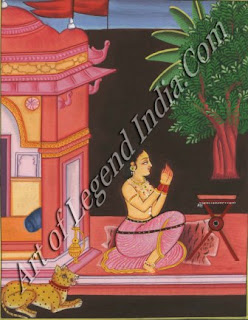
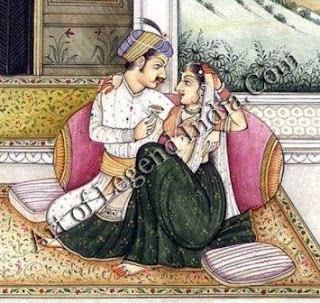
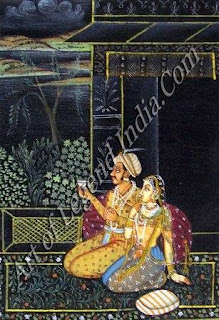
Colour-Scheme: Arrangement of colour in
Rajasthani painting is specially significant. Red, yellow, white and green are
the principal colours of this style. With combinations of these colours artists
made paintings in technicolour. Application of sharp bright shining colours
possess their own form and style.
4.
Colour-Scheme: Arrangement of colour in
Rajasthani painting is specially significant. Red, yellow, white and green are
the principal colours of this style. With combinations of these colours artists
made paintings in technicolour. Application of sharp bright shining colours
possess their own form and style. 
 Pahari
painting, like the earlier Rajasthani style, adopted the same parameters for
drawings of sentiment and artistic portrayal. On the basis of expressing
different moods of Rad ha-Krishna many paintings were drawn in the Pahari
style. Paintings executed on the basis of texts like Bhagwad-Puran,
Geet-Govind, Sursagar, Rasikpriya, Bihari-Satsai, nayika-bheda and rag-ragini
are the main heritage of the Kangra and Basohli styles. In the Basohli style,
like the Mewar style, indicative colours and folk art predominate. In the
Pahari school of painting, expression of sentiment, rhythm in line and colour
and diversity of subject matter are unique in the Kangra style.
Pahari
painting, like the earlier Rajasthani style, adopted the same parameters for
drawings of sentiment and artistic portrayal. On the basis of expressing
different moods of Rad ha-Krishna many paintings were drawn in the Pahari
style. Paintings executed on the basis of texts like Bhagwad-Puran,
Geet-Govind, Sursagar, Rasikpriya, Bihari-Satsai, nayika-bheda and rag-ragini
are the main heritage of the Kangra and Basohli styles. In the Basohli style,
like the Mewar style, indicative colours and folk art predominate. In the
Pahari school of painting, expression of sentiment, rhythm in line and colour
and diversity of subject matter are unique in the Kangra style. 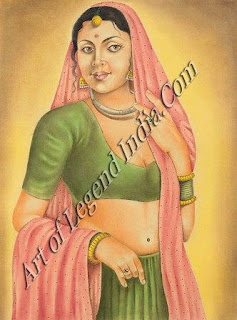 The
Rajasthani school of painting and other earlier and later styles of Indian
painting influenced each other to such an extent that it becomes an uphill task
to dissociate them.
The
Rajasthani school of painting and other earlier and later styles of Indian
painting influenced each other to such an extent that it becomes an uphill task
to dissociate them.