Showing posts with label Love Paintings. Show all posts
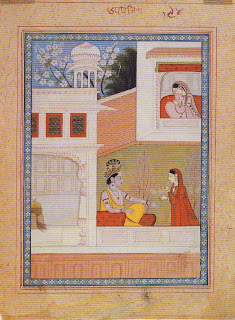
This painting depicts Krishna seated in a
palace courtyard talking to a handmaid of Radha, who is shown beyond them in a
bedchamber. Behind Krishna is a room with a large brass pot heating over a
fire. A label in the upper border identifies the scene as "Upapati!
Paramour! no. 194," and the text on the reverse of the painting (see
Appendix) describes the demure eye contact of the divine lovers and mentions
the fire in both the hearth and Krishna's heart.
The painting is thought to illustrate a
passage from the Satsai (Seven hundred I verses!), one of the four great jewels
of Hindi literature. Intriguingly, however, the inscribed verse does not
correspond to the one given in the standard edition of the Satsai, which varies
from other known versions of the text in the number and content of the verses
(Holland, PP- 4-5).
The standard Salsa; consists 01 713
poetic verses, primarily in celebration of the romance of Radha and Krishna.
The remaining verses describe nayakas and nayikas and the romantic sentiments
associated with the six seasons of the Indian climate (sec no. 30). It was written
by Bihari Lal Chaube (1595-1664), who was born in Govindpur, near Gwalior in
Madhya Pradesh, into the mixed caste of Rays, which also produced several other
well-known Hindi poets (Randhawa 1966, p. 15). As a child Bihari Lal moved with
his family to Orchha and later to Mathura. It was in the latter city that Bihari
Lal must have learnt "Braj-Bhasha," the dialect of Hindi in which the
Satsai is written and which was current around Mathura, the homeland of
Krishna, and was frequently used for the deity's devotional poetry and song
lyrics. Bihari Lal enjoyed a profitable tenure at the court of Amber under jai
Singh I (r. 1625-67), for whom the Satsai was reportedly composed in 1662
(Grierson, pp. 4-5; and Leach, p. 271). Illustrations of the Satsai were
particularly popular in Pahari painting, especially in Kangra during the reign
of Sansar Chand (r. 1775-1823), under whose lavish patronage this work was
produced.
Stylistically, this painting is a good
example of the refined almost overly so expression found in Kangra painting.
The soft palette and delicate ambience are the hallmark of the realm's
workshops and are particularly adept at conveying the romantic connotations of
the popular theme of love.
Writer
Name: - Pratapaditya Pal
These two paintings illustrate the tragic
tale of Sohni and Mahinwal, two young lovers who are said to have lived during
the early seventeenth century in a small village in the Panjab, an area famous
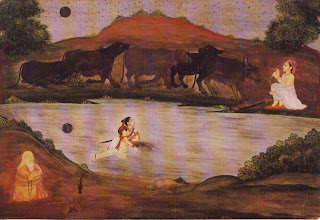
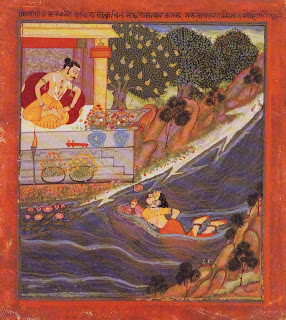
for its association with great lovers. Both paintings feature the key
identifying motif of Sohni floating across a river on an overturned earthenware
pot for her nightly tryst with her lover. The set imagery used to illustrate
the romance usually includes Mahinwal tending his buffaloes on the far bank and
his ascetic companion seated by the river's near edge, as in the Oudh example
(A), but these features are curiously absent in the Mewar painting (a) where,
uniquely, Mahinwal is represented as waiting for his nightly tryst in a small
thatched pavilion decorated as an elegant bed chamber. The text above painting
a conveys Sohni's apprehension about attempting the perilous river crossing. In
painting A both Sohni and Mahinwal are portrayed with sheathed swords graced
with golden hilts. Although not explained by any literary narrative, this
feature is typical of most paintings of the lovers and may pictorially suggest
their popular elevation to noble heroes in their ultimately futile struggle
against rigid social mores.
According to the legend, Mahinwal, whose
given name was Mirza Izzat Beg, was the son of a wealthy merchant-ruler in
Turkestan who was returning home with a merchant caravan after traveling
throughout northern India. After passing Lahore, the caravan stopped near the
town of Gujrat, where Izzat Beg chanced upon a radiant young beauty tending her
father's pottery shop. Her name was Sohni, meaning "beautiful." Izzat
Beg was so overwhelmed by her loveliness that he abandoned the caravan to
remain with Sohni, who soon came to reciprocate his ardor. Izzat Beg then
managed to be hired by Sohni's father and was put to work tending the family's
buffaloes across the river. Thus he acquired his more popular name, Mahinwal,
meaning "buffalo herder."
Sohni and Mahinwal's clandestine affair
continued until it was discovered by her mother and Mahinwal was ordered to
never again see Sohni, who was quickly married to another potter's son and sent
to her husband's family home. The distraught Mahinwal went to live with an
ascetic near the river, but after accidentally meeting one day, the couple
decided to resume their illicit relationship. Every night thereafter Sohni swam
across the river using a large baked earthenware pot as a float. But Sohni's
sister-in-law soon discovered the lovers and switched an unfired pot for the
one used by Sohni to cross the river. That night a fierce storm hit, yet Sohni
ignored the danger and jumped into the raging river with the deadly pot. The
pot dissolved in midstream and Mahinwal leapt into the river to save his
beloved, but the current was too strong and the lovers sank into legend.
Sohni and Mahinwal's clandestine affair
continued until it was discovered by her mother and Mahinwal was ordered to
never again see Sohni, who was quickly married to another potter's son and sent
to her husband's family home. The distraught Mahinwal went to live with an
ascetic near the river, but after accidentally meeting one day, the couple
decided to resume their illicit relationship. Every night thereafter Sohni swam
across the river using a large baked earthenware pot as a float. But Sohni's
sister-in-law soon discovered the lovers and switched an unfired pot for the
one used by Sohni to cross the river. That night a fierce storm hit, yet Sohni
ignored the danger and jumped into the raging river with the deadly pot. The
pot dissolved in midstream and Mahinwal leapt into the river to save his
beloved, but the current was too strong and the lovers sank into legend.
Contrary to the illustrations of literary
romantic themes and the loves of Krishna, which are all of Hindu cultural
origin, paintings depicting Sohni and Mahinwal are based on a supposedly
historical incident and are primarily associated with various Muslim and Sikh
literary traditions that narrate the tragic fates bf hapless lovers. These
often repeated love stories, especially those from the Panjab, typically
involve couples whose affairs of the heart generated universal appeal and
ennobled them with a poetic and courtly stature. Sohni's act is analogous to
that of the heroine who braves the perils of the forest on a stormy night to be
with her lover, and the same emotional charge of heedless desire must be
understood as underlying the legend and its representations.
The romance of Sohni and Mahinwal was
popular at most of the major courts across northern India, with the majority of
the tale's illustrations dating from the third quarter of the eighteenth
century. In the nineteenth century some illustrations of Sohni and Mahinwal
achieved a new level of cultural relevance with the sudden trans-formation of
Mahinwal and his associated imagery into that of Krishna. This socio-logical
and artistic phenomenon demonstrates Krishna's immense appeal and is another
example of his cult's assimilation of diverse religious and romantic legends.
Writer
Name:- Pratapaditya Pal