ArtofLegendIndia.com, Biggest Online Store of Handicrafts Items, Paintings and Jewelry Accessories...

Handicrafts

Handicrafts are devices or works of art that are made completely by hand or by the use of relatively simple tools. Such goods are usually made in the traditional way of manufacturing goods. Therefore, the knowledge of the art of craft is usually passed down from one generation to another. The items made using these traditional methods of manufacturing are usually produced in smaller quantities and they often represent the culture or religious beliefs of the community that makes them. The goods are also handmade from natural materials that are found in the environment of the particular economy.

Read More!

Biggest Online Store of Handicrafts Items

Paintings

A painting is equal to thousand words, means a beautiful painting is equal to million of words. Paintings are one of the oldest art forms -- throughout history artists have played an important role in documenting social movements, spiritual beliefs and general life and culture.

History Of Paintings: The history of painting reaches back in time to artifacts from...

Read More!

Biggest Online Store of Unique Style Paintings
Showing posts with label Life of Lucas Cranach. Show all posts

German Great Artist Lucas Cranach - 'Swiftest of Painters'
Posted by Art Of Legend India [dot] Com On 12:27 AM 0 comments

'Swiftest of Painters'

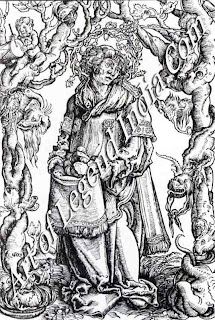
Cranach's woodcut designs Durer's influence can be seen in the woodcut designs Cranach made for Vienna's leading printers, such as this St Stephen used in the Missale Pataviense of 1503.
As the most prolific and versatile artist of 16th-century Germany it is impossible to classify Lucas Cranach except by the title his talent, speed and efficiency earned him 'the swiftest of painters'.

A great artist of the Renaissance in Germany, Lucas Cranach was at the forefront of the new, forward-looking intellectual currents that were undermining the traditions of medieval Europe. Yet he spent most of his career in an isolated northern town and was only indirectly affected by the perfect expression of those ideas practised in Italy. As a result, his works can look quaint and provincial when compared with those of his southern contemporaries, Giorgione or Raphael. But, in his own context, he was just as progressive as they, and in some ways a more individual artist, precisely because of his isolation.

Nothing is known of Cranach's early work in his home town of Kronach, and we have to wait until he was in Vienna and 30 years old to see anything certainly by his hand. The wonderful Crucifixion and the woodcut of St Stephen produced in 1502, show that he had learned a great deal from Durer while his portraits of scholars from the university, including the rector, Johannes Cuspinian, show he was already in intellectual circles and absorbing ideas from Italy.

The Crucifixion (1500) Although belonging to the 'Vienna group' this early Gault painting may well have been executed before the artist's arrival in the city.Cranach's work at the time gained its power through a marvellous understanding of landscape, achieved through close observation of nature and through the expressive power of his figures. These may not be classically proportioned or posed, but they do show an extraordinary range of dramatic gesture and action, all learned originally from Durer's woodcuts but developed with a nervous energy all Cranach's own.

Once in the service of Frederick the Wise in Wittenberg after 1505, Cranach's independent direction became even more marked. He adapted quickly to his role as court painter, falling in easily with the sensibilities of his patrons. The magnificent altarpiece of 1506 depicting The Martyrdom of St Catharine, for example, combines realism and a sensual joy in the qualities of colour, texture and line in a most complex and animated scene.

Cranach's state visit to the Netherlands in 1508, reinforced the influence of the Italian Renaissance in his work. The so-called Torgau Altarpiece, for example, showing a grouping of the Holy Family, has a more balanced composition, is less cluttered and has figures with real weight and solidity. Presumably the artists he met in the Low Countries showed Cranach collections of drawings and engravings from Italy. From this time, too, we also see the first classical subjects in his art. An engraving of 1508 has The Judgement of Paris as its theme, with the nudity of the three goddesses introducing what would later become the artist's most characteristic subject.
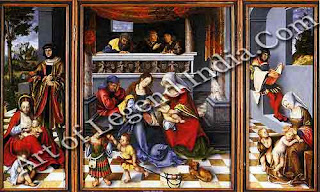
The Torgau Altarpiece (1509)The balanced composition of this painting, also known as The Altarpiece of the Holy Kinship, may well have been derived from Italian Renaissance works which Cranach undoubtedly saw on his visit to the Netherlands.
Although excited by these developments, the bulk of his work at this time was more conventional. Frederick the Wise's court required portraits, altarpieces and smaller devotional paintings to decorate chapels, and these Cranach began to produce in great number. The Elector and court could not fail to approve of such works, which were highly finished, sophisticated and produced regularly and to order. His portraits, in particular, showed members of the court in wonderfully elaborate and fashionable dress.

Cranach was not a temperamental artist who would keep frustrated patrons waiting years for a picture to be finished, but a highly professional manager of a workshop, proud of craftsmanship and efficiency. He clearly worked with a substantial team of assistants, yet there are no copies among the huge output. A painting might be done in different versions, but the master seems to have supervised closely and participated in almost everything, correcting details and carrying out the most difficult portions himself.

The Torgau Altarpiece (1509)The balanced composition of this painting, also known as The Altarpiece of the Holy Kinship, may well have been derived from Italian Renaissance works which Cranach undoubtedly saw on his visit to the Netherlands. For portraits, Cranach would execute sketches in oil on paper from the noble sitters who increasingly demanded pictures from him and would then use these as a file copy from which repeated finished portraits could be produced over the years, varying the pose and costume without the necessity of another sitting. From 1520, this became even more necessary to meet the demand for portraits of Luther and the Saxon princes who led the Reformation.

SENSUOUS ENTERTAINMENT

From the later 1520s, the artistic mood we now call Mannerism began to spread from Italy. This signified a relaxation in the strictness of Renaissance classicism and a new concentration on the sensuous and the entertaining aspect of pictures. Cranach seems to have responded easily to this general trend for it more closely reflected his own artistic temperament. His portraits, particularly of women, became more idealized, with slender figures and small rounded heads. Their dress, in particular hats, became ever more obvious and in the latest fashion.
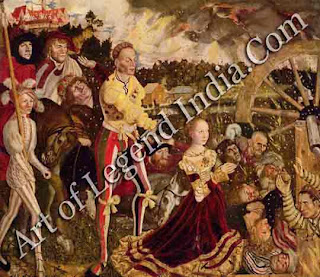
Lucretia (1529) The classical figure of Lucretia, who stabbed herself to death after she was raped, provided Cranach with the subject of several of his works. Lucretia is dressed, somewhat titillatingly, in the fashion of the Wittenberg court.
Gradually the sensuous nude, usually representing Eve, Lucretia or Venus, assumed a prominent place in Cranach's output. But these are no longer the classic nudes of the Renaissance: they are idealized court beauties titillatingly hiding their nakedness with transparent veils, or wearing jewellery or hats to accentuate their erotic availability. Meanwhile, his workshop continued the production line of portraits, devotional panels (now concentrating on themes acceptable to Reformation theology), mythological scenes and altarpieces. One of Cranach's last great works, painted in 1550 at the age of , was a self-portrait stern and as realistic as anything he had painted. If there is anything to be read from his unnerving direct gaze, it is pride in a job well done.

Writer – Marshall Cavendish

German Great Artist Lucas Cranach - Luther, and the Reformation

Posted by Art Of Legend India [dot] Com On 11:40 PM 0 comments
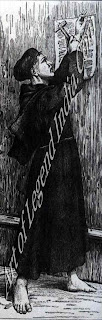
The 95 Theses, When Luther nailed his 95 Theses to the door of Wittenberg Castle Church on 31 October 1517 he was only following the customary way in which scholars in the university town invited learned debate. They were not the first set of propositions Luther had advertised in this way, nor did he think they necessarily contained revolutionary doctrines. But the attack on the sale of indulgences by the church was seen as an unforgivable assault on the Catholic hierarchy, and it started a chain of events that led to the eventual foundation of the Protestant Church.

 Luther, and the Reformation

Led by Martin Luther, the religious revolution known as the Reformation shook the supremacy of the Catholic Church in Europe and founded the beginnings of the Protestant faith.

Art was very closely connected with the beginnings of Protestantism. More than ever before, pictures were used to spread the new religious ideas, and close friendships developed between the artists and the reformers. Such was the case with Lucas Cranach the Elder and Martin Luther, an association which lives on today in Cranach's memorable portraits of the founder of the Protestant faith.

Martin Luther was born in November 1483, in the town of Eisleben in present-day East Germany. He received a good education, and in 1501 went to study at the University of Erfurt where he gained a master's degree. In 1505, at his father's wish, he began studying law, but during the summer he was caught in a violent thunderstorm on the road near Erfurt and, prostrated by a flash of lightning and in fear for his life, vowed to become a monk.

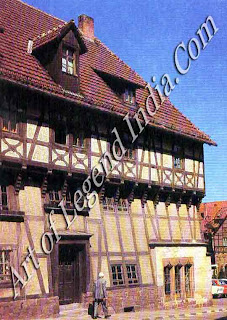
An early home, As a youth, Luther was sent to study at the St George school in Eisenach, which he later described as his favourite town. While he was there he boarded with the Cotta family, and their house has now been turned into a museum dedicated to his memory. Within two weeks Luther honoured his promise and entered the Augustinian monastery at Erfurt. For the next ten years or so he devoted himself to his theological studies and to his promising academic career. In 1511, he was sent by his order to the monastery at Wittenberg, and became professor of theology at the university there the following year. It was in his lectures and sermons over the next six years that the ideas which formed the basis of the religious Reformation evolved.

A PERSONAL RELIGIOUS VISION 

In these early years, Luther's search for deeper spiritual understanding was guided by his own personal temperament he was highly strung, emotional and subject to bouts of depression and by the religious beliefs of the time. He feared Hell, the Devil and the closeness of Judgement Day. Tormented by the belief that God's justice was punitive, he looked to the Bible for reassurance, and gradually developed his own interpretation of the righteousness of God the doctrine of Justification by Faith alone. This doctrine was based on the belief that salvation is given to the individual believer by God through His grace, rather than as a reward for merit, which is inevitably tainted by sin, and therefore deserving of retributive justice. Since faith is personal, the priest was no longer necessary as an intermediary with God a premise which automatically challenged the entire Church system.

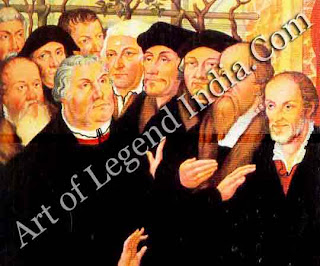
Faithful followers, Disciples helped Luther spread his doctrines throughout Germany. Melanchthon set down a systematic theology of Lutheranism, while Justus Jonas and Johannes Bugenhagen organized the new Church. Erasmus withdrew his support from Luther when he realized the revolutionary implications of his message.
The notion of Justification by Faith alone was the core of Luther's theology and, as such, gave birth to Protestantism. But the revolution did not happen overnight, and until 1517 Luther carried out his responsibilities in Wittenberg seemingly unaware of the potential of his ideas. All this changed on 31 October 1517, when Luther translated his thoughts into action and nailed his 95 Theses to the door of the Castle Church in Wittenberg, thus unleashing the religious revolution now known as the Reformation.

CHURCH CORRUPTION 

Luther was furious about the sale of indulgences in Wittenberg. These were documents, sold by the Church, which offered remission of penance for a cash payment. The people flocked to hear indulgence sellers like John Tetzel, who attracted his audiences with the jingle: 'As soon as the coin in the coffer rings, the soul from purgatory springs!' Sentiments like these contradicted Luther's beliefs about salvation, and he deeply resented the Church taking money from the poor under what he understood to be false pretences. He criticized the system in the 95 Theses, but could not have foreseen the consequences of his action. What he had intended as an academic debate rapidly became a national issue, and Luther was thrust from obscurity into the limelight.

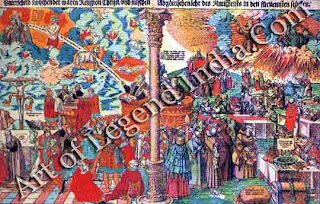
Lutheran propaganda, This woodcut of 1545 contrasts the true religion as preached by Luther on the left, with the teachings of the Catholic church, whose friars on the right are collecting money from the sale of indulgences. Luther's protest immediately appealed to the Germans and aroused intense interest throughout the Holy Roman Empire and beyond. For years resentment at the greed of the Church had been growing, and now at last the people felt they had found someone to champion their cause. Luther's ideas were translated into German and printed pamphlets were sent all over the country. His skills as an author and preacher enabled him to convince thousands. The movement could not be ignored.

The Church attempted to silence Luther, but reacted too slowly. Theologians first attacked Luther's doctrines in the autumn of 1518. Thereafter the Church continually called for Luther to recant, but he refused to do so, believing in the truth of his doctrines. It became increasingly obvious that Luther's challenge was not a harmless call for reform. His doctrine opposed the entire theological basis of the Catholic Church and he found himself on a collision course with its authorities.

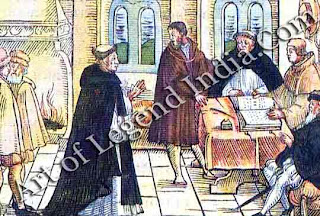
An appearance before Cajetan In 1518, Luther was invited to Augsburg to appear before the Pope's representative. But the urbane Cardinal Cajetan could not persuade him to recant his heresy.
By 1520, the Church leaders realized that they had to take action, and in October Luther was sent a bull of excommunication. Fortified by the support of thousands, from princes to peasants, Luther ignored the Pope's message and defiantly set light to a bonfire made from the papal bull and r theological books. The break with the Church was .E now irreparable. In January 1521, Luther was finally excommunicated.

THE DIET OF WORMS 

A broadly based movement such as the Reformation could not distance itself entirely from politics. Luther was now banned by the Church, but his relationship with the secular authorities also had to be regularized. To be effective, the papal ban had to be reinforced by an imperial edict. Thus it was that the new emperor, Charles V, found Church reform to be the most urgent issue facing him at the Imperial Diet of Worms in the spring of 1521. Charles invited Luther to defend himself at the Diet and, on 16 April 1521, the Reformer arrived in triumph at Worms, to streets filled with thousands of cheering supporters. The following evening he appeared for the first time before the Diet and was asked to recant.

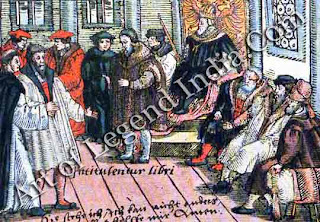
In defiance of the Emperor, In 1521 Luther was summoned to the Diet of Worms to appear before Charles V, but the Emperor could not get him to change his ideas. The Diet denounced Lutheran heresy and placed Luther under imperial ban, making him an outlaw of both church and state. The next day, in a packed hall, Luther again faced the Emperor. Again he was questioned about his books, and had prepared a reply. He spoke first in German, then in Latin, using no notes. Luther acknowledged the writings as his own and justified them on the basis of truth, as they were grounded in the Word of God. He finished with the plea: 'Here I stand. I cannot do otherwise. God help me. Amen.' The Emperor replied: 'A single friar who goes counter to all Christianity for a thousand years must be wrong.

Events would prove the ruler wrong. Although the Diet issued an edict against Luther, the authorities were powerless to act. Luther's ideas had generated such excitement that to punish Luther would risk revolt. Some even feared for Luther's safety, and immediately after the Diet he was 'kidnapped' by his own followers and 'imprisoned' in the Wartburg Castle until the situation was calmer. All future attempts by the Catholic Church to deal with the Lutheran threat proved futile. Luther had triumphed at Worms, and the Protestant religion had come into being.

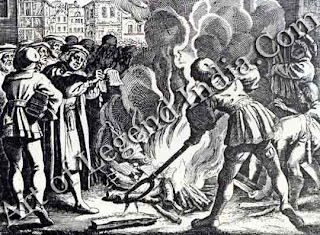
Burning the papal bull, The sale of indulgences sanctioned by Pope Leo X launched Luther on his reforming crusade. When the Pope issued a bull of excommunication in 1520, Luther responded defiantly by publicly burning it in Wittenberg, along with books on canon law. The remaining years of Luther's life were ones of consolidation for Protestantism. There were high points such as the formulation of the Confession of the Lutheran faith at Augsburg in 1530 and low points, particularly the crisis caused by the Peasant War of 1525, when extremists in the evangelical party incited the peasants to rebel against their masters: Luther's advice to settle grievances peaceably was disregarded and the peasants were savagely suppressed. Luther himself found personal happiness in 1525, when he broke his monastic vows and married a former nun called Katherine von Bora.

He became a happy family man, content to write copiously and to preach, but was concerned also to steer his new creed through its early years. This religious genius, whose ideas had seized the popular imagination, died in February 1546, in Eisleben. Rarely has the course of history been altered so effectively by the actions of one man as it was by those of Martin Luther.

Writer – Marshall Cavendish
German Great Artist Lucas Cranach - A Year in the Life 1547

Posted by Art Of Legend India [dot] Com On 10:14 PM 0 comments

A Year in the Life 1547

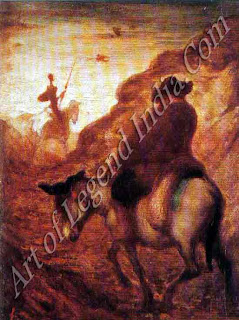
Tilting at windmills, Miguel de Cervantes, the Spanish playwright, poet and novelist, was born in 1547. He is most famous for his Don Quixote, the would-be knight who sets out with his loyal servant Sancho Panza in search of chivalric glory over a century too late. In 1547 The Emperor Charles V won his great victory at Muhlberg over the Schmalkaldic League of Protestant Princes with serious consequences for the Elector of Saxony and his court painter Lucas Cranach. But the Protestant cause in Germany and in Scotland during this year was only in temporary eclipse.

Henry VIII of England and Francis I of France were two of the three great princes who dominated the European political scene during the first half of the 16th century. Both died in the early months of 1547. The third prince, the Emperor Charles V was to survive for another war-torn decade complicated by the political repercussions of the Reformation.

Charles V was absolute ruler of a huge empire 'on which the sun never set'. His dominions ranged from Aztec Mexico in the West, conquered for him by Hernando Cortes (who also died during 1547) to Austria in the East under his brother Ferdinand. This vast dominion which even extended down into the Italian peninsula, had seriously alarmed the French King who had taken the unprecedented, and to some eyes the even heretical step of allying himself with the Turks in the East. Although Pope Paul III had of necessity made an alliance with the Emperor, their relationship by 1547 was less than amicable.

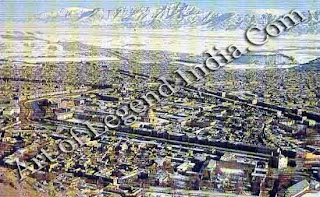
Kabul recaptured, The Great Moghul Humayun succeeded in wresting Kabul from his brother Kamran at this time.
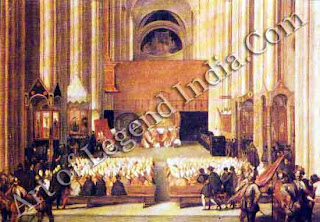
Two years earlier the Pope had convened the Council of Trent which, dominated by the newly founded Society of Jesus, was to become the spearhead of the Counter Reformation. Meeting at Trent in northern Italy (modern Trentino) on Imperial soil, Protestant and Catholic representatives were invited from all over Christendom. The Pope was attempting to establish peaceful relations within Europe so as to present a united front against the Turks.

While Paul III saw the council as of doctrinal importance, Charles on the other hand had hoped it would be an excellent forum for sorting out the unification of Protestant and Catholic Germany. He was obsessed with establishing imperial supremacy over his German princedoms. Inevitably there were clashes between papal and imperial policies with the result that the council was moved from Trent to Bologna on papal authority in March 1547 to the fury of the Emperor. There could be no hope of settling German religious problems on papal territory with a papal Council. An impasse was reached until the election of a new pope.

PROTESTANT DEFEATS 

Council of Trent, This famous church council, inaugurated by the Emperor Charles V, was moved to Bologna by Pope Paul III when the inevitable impasse between Pope and Emperor was reached in 1547. Charles now concentrated on suppressing the Schmalkaldic League of Protestant Princedoms which threatened his supremacy. He declared war on the League and succeeded in shattering it at the Battle of Muhlberg in April 1547. The capture of the Elector John Frederick and his being forced to sign the capitulation of Wittenberg, the very heartland of Protestantism, was a blow from which Saxony never recovered. Cranach left Wittenberg to join his master in confinement at Augsburg. Nevertheless, no doubt to the artist's satisfaction, the Emperor's success was to be very shortlived.

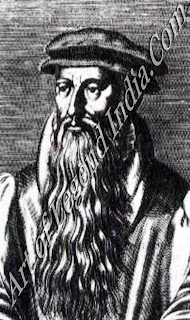
Protestant reformer enslaved, John Knox discovered his vocation as preacher and spokesman of the Scottish Reformation while beseiged in St Andrews Castle with other Protestants in 1547. The governor of the town succeeded in recapturing the fortress with French aid and was no doubt quite happy to see Knox and others carried off into slavery by the French galleys, to be released 19 months later after English intervention.
Religion also played a large part in English politics during this year. Henry VIII died in January, leaving the throne to his nine-year-old son Edward. His uncle Edward Seymour (brother of Jane Seymour, Henry's fourth wife) assumed the position of Lord Protector. He pursued Henry's policy of trying to bully the Scots into a Protestant union through alliance by marriage to the young Edward VI. James V of Scotland had died five years previously leaving a week-old daughter from his marriage to the French aristocrat Mary of Guise. This infant was none other than the ill-fated Mary Queen of Scots.

Terrified of the continuation of the 'auld alliance' between Scotland and France, the English resorted to what was described as the 'Rough Wooing' hoping to win the young Scottish Queen by force. An able general, the Lord Protector defeated the Scots at the battle of Pinkie in September but was too late t save the Scots Protestants who were holding out in St Andrews Castle. French guns battered the castle into submission and the occupants, including the reformer John Knox, were carried off into slavery in French galleys. The worst blow was the capture of the young Queen who was promptly married the following year to the dauphin of France. Once more the wily Scots were a thorn in the side of the English.

Writer – Marshall Cavendish
German Great Artist - Lucas Cranach Painting Gallery

Posted by Art Of Legend India [dot] Com On 5:36 AM 0 comments

Cranach was famous for the speed at which he worked (on his tomb he was described as 'Pictor celerrimus' swiftest of painters) and his output was enormous. His early paintings, such as The Penance of St Jerome and The Rest on the Flight into Egypt, show more individuality of touch than his later works, but even when he was running what was virtually a picture factory at the height of his very successful career, he was such a skilled manager and craftsman that his standards remained high.

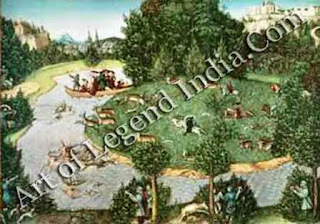
He tackled most subjects - from conventional religious subjects such as The Virgin of the Grapes to courtly commissions such as The Stag Hunt, and from mythologies such as The Judgement of Paris to humorous moralizing scenes such as The Fee. Although he excelled in so many fields, it is perhaps as a painter of alluring women that he is most memorable. Judging from the number of copies and versions, the Reclining Water Nymph and Judith were two subjects his contemporaries demanded continually.

The Great Artist Lucas Cranach Painting “The Penance of St Jerome” 1502 22 x 16 ¼ Kunsthistorisches Museum, Vienna The great scholar St Jerome (342-420) spent four years as a hermit in the desert, where he said he had 'only the scorpions and wild beasts for company'. Like many other ascetic saints (notably St Anthony), he had vivid sexual hallucinations, and he described how he would beat his chest until he had overcome them. He does not mention that he used a stone to chastise himself, but it became a convention to portray him holding one.


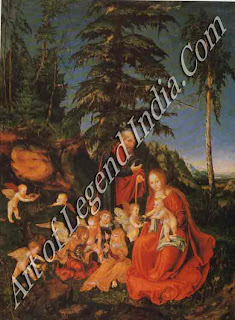
The Great Artist Lucas Cranach Painting “The Rest on the Flight into Egypt” 1504 28 x 20 ¾ Staatliche Museum, West Berlin  
The subject of The Rest on the Flight into Egypt gave artists the opportunity to portray the Holy Family in a landscape setting. Cranach was particularly interested in landscape early in his career, and here created an almost fairytale atmosphere with the lush foliage and brilliant, luminous colours. This is Cranach's earliest signed work - his monogram is on a stone in the foreground.


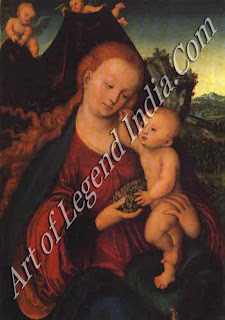
The Great Artist Lucas Cranach Painting “The Virgin of the Grapes” c.1525 28 ½ X 16 ½ Alte Pinakothek, Munich The grape was a common symbol in medieval and Renaissance painting. It symbolized the wine of the Eucharist and therefore the blood of Christ. St Augustine wrote 'Jesus is the grape of the Promised Land, the bunch that has been put under the wine-press', by which he meant that Christ's blood would be spilt.


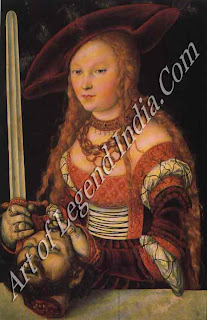
The Great Artist Lucas Cranach Painting “Judith with the Head of Holofernes” c.1530 33 ¾ x 23 ¼ Kunsthistorisches Museum, Vienna Judith was a Jewish biblical heroine who infiltrated the camp of Holofernes, an Assyrian general who was besieging her city. She charmed him, got him drunk and then beheaded him. The story was seen as symbolizing the triumph of virtue over vice, but also often served as a pretext, as here, to paint a beautifully seductive woman.


The Great Artist Lucas Cranach Painting “The Stag Hunt” 1529 46 ½ x 69 ¾ Kunsthistorisches Museum, Vienna Hunting was a favourite pursuit of noblemen and Cranach painted several pictures of the subject for his courtly patrons. This one shows the Emperor Maximilian I and the Electors Frederick the Wise and John the Steadfast among the hunters. Neither 1Maximilian nor Frederick were alive at the time the picture was painted, so it was probably commissioned by John the Steadfast. The high viewpoint has allowed Cranach to set out the various incidents of the hunt with almost comic-strip clarity.


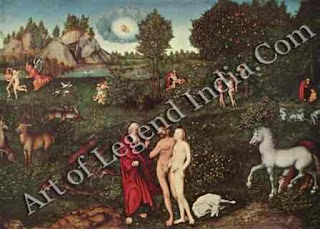
The Great Artist Lucas Cranach Painting “The Garden of Eden 1530” 31 ½  x 46 Gernaldegalerie, Dresden
 
In the foreground, God confronts Adam and Eve after they have eaten the forbidden fruit, and in the background Cranach has shown various other scenes from the Genesis narrative. From right to left, they are: the Creation of Adam, the Temptation, the Creation of Eve, the Discovery of the Sinners and the Expulsion from Paradise. Cranach was a brilliant painter of animals and seems to have enjoyed himself portraying the beasts in the Garden of Eden here, particularly the delightful bears.

Writer - Marshall Cavendish

Company Overview

Art of Legend India has the distinction of being one of the best in the Indian Handicraft Industry. We are about 75 years old handicrafts manufacturer & exporter. We are having team of more than 500 craftsman.

We are having our business offices in India, USA & Germany to ensure our best services.

Total Pageviews