The
principal centre of Pahari painting was the Kangra Valley where the artists
worked under the patronage of the Hill Rajas of Guler, Kangra and Nurpur. From
here the artists migrated to the neighbouring States of Mandl, Suket, Kulu,
Tehri and Garhwal in the cast and Basohli and Chamba in the north. The art of
these States was but an off-shoot of the art of Kangra and the most appropriate
name for this version of Rajput art is the "Kangra Valley School of
Painting".
The
principal centre of Pahari painting was the Kangra Valley where the artists
worked under the patronage of the Hill Rajas of Guler, Kangra and Nurpur. From
here the artists migrated to the neighbouring States of Mandl, Suket, Kulu,
Tehri and Garhwal in the cast and Basohli and Chamba in the north. The art of
these States was but an off-shoot of the art of Kangra and the most appropriate
name for this version of Rajput art is the "Kangra Valley School of
Painting".
Specimens
of early paintings in the Basohli style can be found in all the Punjab Hill
States. They are simple works, full of strength and primitive vitality. The
pattern is rugged and domineering, and the lines and colours are bold and
enduring. The hill painter selected themes which he could handle with masculine
directness, without apology or prudery. He worked with fearless passion,
imparting 10 his work energy and power which is in great contrast with the
nervous grace of later creations. The artist attained a maximum of expression
with the minimum of means. The vibrant colours of Basohli paintings are
enchanting.
The
main centres of Kangra painting were Guler, Basohli, Chamba, Nurpur, Bilaspur
and Kangra. Guler, and Nurpur are near the plains and their Rajas came into
early contact with the Mughal emperors.
Of the
Hill States, Guler has the longest tradition in the art of painting. It has
been established that during the rule of Dalip Singh (A.D. 1695-1743) artists
were working at Haripur-Guler. Portraits of Dalip Singh exist and these can
hardly be later than 1720. There are a number of portraits of his eldest son,
Bishan Singh, which can be dated to about 1730. Bishan Singh died during the
lifetime of his father and in 1743 his younger brother Govardhan Chand became
the Raja of Guler. Govardhan Chand was a patron of art and a large number of
his portraits which were formerly in the collection of Raja Baldev Singh are
now in Chandigarh Museum. We reproduce a painting of Govardhan Chand listening
to music, which was in the collection of Raja Baldev Singh and is now in
Chandigarh Museum.
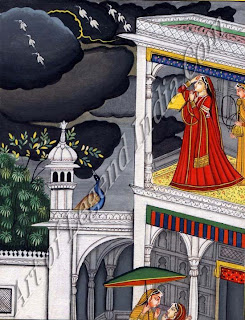 The
Raja is seated on a terrace listening to the music of drums and pipes. Terraces
of this nature can be seen in the Haripur-Guler Fort overlooking the Ranganga.
It is a key painting which marks the transition of the Mughal into the Kangra
style. Describing this painting, J. C. French observes: "The Raja is
listening to music, and the air of gentle reverie is well expressed. The pose
of the individual figures and the balance of the whole is admirable. In this
respect it resembles the finest of the Mogul paintings, but it has a delicacy
and a spirituality of feeling to which the Mogul art never attains. The
coloring of Kangra pictures of this period is extraordinarily delicate. The
Kangra artist had the colours of the dawn and the rainbow on his
palette."The role of Guler in the evolution of the Kangra style is thus
summed up by Dr. Archer:
The
Raja is seated on a terrace listening to the music of drums and pipes. Terraces
of this nature can be seen in the Haripur-Guler Fort overlooking the Ranganga.
It is a key painting which marks the transition of the Mughal into the Kangra
style. Describing this painting, J. C. French observes: "The Raja is
listening to music, and the air of gentle reverie is well expressed. The pose
of the individual figures and the balance of the whole is admirable. In this
respect it resembles the finest of the Mogul paintings, but it has a delicacy
and a spirituality of feeling to which the Mogul art never attains. The
coloring of Kangra pictures of this period is extraordinarily delicate. The
Kangra artist had the colours of the dawn and the rainbow on his
palette."The role of Guler in the evolution of the Kangra style is thus
summed up by Dr. Archer:
"The
State of Guler played a decisive part in the development of Pahari painting in
the eighteenth century. Not only did it develop a local art of the greatest
delicacy and charm, but the final version of this Guler style was taken to
Kangra in about 1780, thus becoming the `Kangra' style itself. Guler is not
merely one of thirty-eight small centres of Pahari art. It is the originator
and breeder of the greatest style in all the Punjab hills." Subsequent
research has fully confirmed Dr. Archer's thesis, and if any place can be
called the birth place of Kangra painting, it is Guler.
Research
which has been carried from 1952 onwards has proved that the paintings in early
Guler style were by the artists Manaku and Nainsukh. The sons of these artists
and the grandsons of Nainsukh worked at Guler, Basohli, Chamba and other places
and are responsible for the finest paintings.
The
greatest patron of painting in the Punjab hills was Maharaja Sansar Chand. He
was born in 1765 at Bijapur, a village in Palampur tehsil. In 1786, he occupied
the Kangra Fort and became the most powerful Raja of the Punjab hills. In 1794,
he defeated Raja Raj Singh of Chamba and annexed a part of his territory. Later
on, he defeated the Rajas of Sirmur, Mandl and Suket. Raja Prakash Chand of
Guler became his vassal.
In
1809, Sansar Chand employed a European adventurer, 0' Brien, who established a
factory of small arms and raised a disciplined force of 1400 men for him. In seelo
Brien waving a fly-whisk over Sansar Chand. It is a very fine portrait by one
of the Guler artists who had migrated to Tira-Sujanpur. The green background
with dashes of red in the horizon is typical of the work of these artists. The
character of Sansar Chand, proud and sensitive, is well brought out in this
painting.
Kangra
paintings under the patronage of Sansar Chand were painted at Alampur,
Tira-Sujanpur and Nadaun, all on the banks of the Beas. Very little painting,
if at all, was done at Kangra proper which remained under Mughal occupation
till 1786 and Sikh occupation from A.D. 1810 to 1846.
Little
has been written about Nurpur, an important centre of Kangra painting. Raja Bas
Dev (A.D. 1580-1613) came in conflict with the Mughals during the reign of
Akbar. Jagat Singh (A.D. 1619-1646), however, entered the service of Jahangir
and must have come in contact with the work of Mughal painters. A portrait of
Jagat Singh in Basohli style is in the collection of Chandigarh Museum, and
there is every likelihood that this style may have originated as a parallel
development at Nurpur apart from Basohli. Rajrup Singh (A.D. 1646-1661) was
also in the employ of Aurangzeb. Some paintings ascribed to the reign of
Prithvi Singh (A.D. 1735-1789) are extant. Most of them belong to the reign of
Bir Singh (A.D. 1789-1846), a contemporary of Prakash Chand and Sansar Chand.
"Sensitive,
reticent and tender, it perfectly reflects the self-control and sweet serenity
of Indian life, and the definitely theocratic and aristocratic organisation of
Indian society. It lands itself to the utterance of serene passion and the
expression of unmixed emotions!" This description of Rajput painting by Coomaraswamy
is particularly relevant to the art of the lovely valley of Kangra. The romance
of the Epics and the Puranas were here given a new life in the voluptuous line
and colour, the Krishna-Lila with all its exotic symbolism was reenacted by the
painter's brush, the Shiva-Parvati lore was invested with fresh colour and the
lyrics of Keshav Das were given a new expression.
The art
of the Kangra Valley acquires deep meaning if viewed in its cultural
perspective. The symbolism conveys to us a sense of reality. The style has a
unique sense of freedom and is closely connected with the soil. There is no
self-consciousness, no studied emotions, no attitudes. It is free from the
stresses of exaggerated personality and deliberate individuation, and the
painting is nothing but music in colour. The emotions it seeks to portray are
registered with astonishing truth. The technique is "limited", and we
find the painter employing set formulas in the portrayal of features, limbs and
landscape. Yet the effect is beautiful, for the forms that evoke it are truly
vital, transcending the limitations of mere technique. It is here that lies the
greatness of Kangra art.
 The
flowing and graceful curves of Kangra art form rhymes and assonances. The eye
moves with ease and comfort from one point to another enjoying delightful
rhythms and harmonies and the restful beauty of the curve.
The
flowing and graceful curves of Kangra art form rhymes and assonances. The eye
moves with ease and comfort from one point to another enjoying delightful
rhythms and harmonies and the restful beauty of the curve.
With a
change in the taste of the patrons, and in keeping with the new trends of
mysticism, lyricism was seen to enter Kangra painting. "The figures are
now more animated, the line more nervous and fluent, the resurge of physical
charm is deliberate, women are willowy and slender, their eyes very long and
curved, and the deep-dyed fingers are delicate and tapering."' Kangra art
was imbued with a subtle charm, and the delicate and refined pictures acquired
an almost feminine grace for which they were to become so well known.
The
inner vitality and natural charm of the style faded away in the early 19th
century. There was an increasing tendency towards mere ornamentation. The
energy of the artist was now directed towards superficial embellishment and
fineness of detail. The art fell into decay and died, but the artist outlived
it for a while. He was haunted by memories which he tried to paint, but the
living presence that inspired him once was no more. The patronage of the court,
too, had disappeared and though he painted, there was neither joy in his work
nor life in his creation. There was an endless repetition of cliches.
The
birth of Kangra art in the Valley about the middle of the 18th century, and its
decline in the middle of the 19th century is a strange phenomenon in the
history of Indian art. Its sudden decay is difficult to explain. The Valley is
the same with its mountains and sparkling streams of water, but where are those
men of genius? As one wanders through the ruins of Haripur, Sujanpur, and Nadaun,
one cannot help being moved by the dead splendour of the palaces; their culture
has disappeared never to return.
To turn
to the technique of Kangra painting; its chief features are delicacy of line,
brilliance of colour and minuteness of decorative detail. Like the art of
Ajanta, Kangra art is essentially an art of line. As Coomaraswamy observes,
"Vigorous archaic outline is the basis of its language." This amazing
delicacy and fineness of the line was achieved by the use of fine brushes made
from the hair of squirrels.
A
preliminary sketch in light red colour was made with the brush on brown
hand-made Sialkoti paper. This was primed with white and the surface made very
smooth. The outlines were then redrawn in brown or black. Colour was now applied,
first the background and then the figures. The outline was now redrawn and the
picture finished. Very often the colouring was done by assistants after the
master had completed the drawing.
The
Kangra painters made use of pure colours, like yellow, red and blue, and these
have retained their brilliance, even after two hundred years. Many unfinished
sketches are to be had in which the names of colours to be employed are
indicated on the sketch. Sketches were often preserved as heirlooms, and used
for fresh commissions with a few modifications.
Kangra
painting knows no perspective, but the wonderful glowing colours and delicate
line-work more than compensate for this deficiency. The human figures,
particularly of women, were mostly drawn from memory and this explains the
similarity of the female faces with gazelle-like eyes, straight noses and
rounded chins. Each artist evolved his own formula for the portrayal of faces,
and though names of artists may not be written on paintings, it is possible at
times to identify the work of individual artists. Almost all the faces are
drawn in profile. Perhaps it was easier to do so, but it may be that the
beautifully chiselled features of Kangra women are more effectively portrayed
in this manner.
Kangra
painting till recently was regarded as largely anonymous. Recent research has
revealed the names of a number of artists. Manaku and Nainsukh were artists of
outstanding ability. Kama, Nikka, Ranjha and Gaudhu, sons of Nainsukh, were
also well-known artists. A few pictures from Guler are signed by Gursahaya.
Khushala, Fattu and Purkhu are mentioned as artists in the employ of Sansar
Chand. Purkhu specialised in delicate paintings in transparent tones and
subdued colour. His son, Ramdayal, who is said to have inherited much of his
father's talent, is also mentioned. Nikka worked at Chamba during the rule of
Raja Raj Singh. His sons Chhajju and Harkhu worked for Raja Jeet Singh.
The
central theme of Kangra painting is love, and its sentiments are expressed in a
lyrical style full of rhythm, grace and beauty. As Coomaraswamy states,
"What Chinese art achieved for landscape is here accomplished for human
love." The recurring theme of Kangra painting, whether it portrays one of
the six seasons or modes of music, Krishna and Radha or Shiva and Parvati, is
the love of man for woman and of woman for man. To the Kangra painters the
beauty of the female body comes first and all else is secondary. It is her
charms that are reflected in the landscape of the Kangra Valley.
Dr. W.
G. Archer has rendered great service to art criticism and appreciation by
pointing out sexual symbols in Kangra painting. Whether the symbols were
consciously used or were an expression of hidden urges of the subconscious mind
is difficult to decide. Rajput society of the late 18th and early 19th
centuries was puritanical in nature. There was considerable repression of
normal emotions and it is possible that the aristocracy found a release for its
repressed desires in paintings of an erotic character.
 These
love-pictures display considerable intensity of feeling and are works of real
beauty. Life in the foot-hills of the Himalayas was full of danger and
insecurity, and death lurked not only on the battle-field but also in the thick
forests that covered the area. Women were greatly relieved when their husbands
came home safely, and their meeting was all the more intense for its
uncertainty.
These
love-pictures display considerable intensity of feeling and are works of real
beauty. Life in the foot-hills of the Himalayas was full of danger and
insecurity, and death lurked not only on the battle-field but also in the thick
forests that covered the area. Women were greatly relieved when their husbands
came home safely, and their meeting was all the more intense for its
uncertainty.
We sec
a deep love of nature in Kangra painting. The landscapes are characteristic of
the lower Beas Valley. Low undulating hills crowned with umbrella-like pipal
and banyan trees, mango groves, and the farmers' homesteads hidden in clumps of
bamboo and plantain, fresh water streams brimming with the glacial waters of
the Dhauladhar, rivulets meandering through wave-like terraced fields in which
love-sick pairs of mints cranes wander all these are represented faithfully.
This landscape is suffused with love, and the intensity of the artist's
perception breaks through the world of appearances to touch the core of
reality. As Okakura says: "Fragments of nature in her decorative aspects,
clouds black with sleeping thunder, the mighty silence of pine forests, the
immovable serenity of the snow and the ethereal purity of the lotus rising out
of darkened waters, the breath of star-like plum flowers, the stains of heroic
blood on the robes of maidenhood, the tears that may be shed in his old age by
the hero, the mingled terror and pathos of war, and the waning light of some
great splendor such are the moods and symbols into which the artistic
consciousness sinks before it touches with revealing hands that mask under
which the Universal hides. Art thus becomes the moment's repose of religion, or
the instant when love steps half unconscious on her pilgrimage in search of the
Infinite, lingering in gaze on the accomplished past and dimly seen future a
dream of suggestion, nothing more fixed but a suggestion of the spirit, nothing
less noble."
Writer -
M.S. Randhawa