ArtofLegendIndia.com, Biggest Online Store of Handicrafts Items, Paintings and Jewelry Accessories...

Handicrafts

Handicrafts are devices or works of art that are made completely by hand or by the use of relatively simple tools. Such goods are usually made in the traditional way of manufacturing goods. Therefore, the knowledge of the art of craft is usually passed down from one generation to another. The items made using these traditional methods of manufacturing are usually produced in smaller quantities and they often represent the culture or religious beliefs of the community that makes them. The goods are also handmade from natural materials that are found in the environment of the particular economy.

Read More!

Biggest Online Store of Handicrafts Items

Paintings

A painting is equal to thousand words, means a beautiful painting is equal to million of words. Paintings are one of the oldest art forms -- throughout history artists have played an important role in documenting social movements, spiritual beliefs and general life and culture.

History Of Paintings: The history of painting reaches back in time to artifacts from...

Read More!

Biggest Online Store of Unique Style Paintings
Showing posts with label About of Rama Victorious. Show all posts

About of Rama Victorious

Posted by Art Of Legend India [dot] Com On 4:37 AM 0 comments
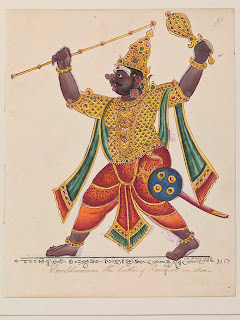
) Kumbhakarna, the giant and terrifying brother of the demon-king Ravana, is awoken from his deep slumber. Maddened by the smell of blood, he strides into battle.

Kumbhakarna Spreads Terror


Ravana heard the roar of the monkeys and learned that Rama and Lakshmana had both recovered. Renewing his attack, he sent Dhumraksha out from the western gate with a company of demons, riding on a golden chariot pulled by donkeys. A fierce fight ensued, during which many were slain on both sides. For a while Dhumraksha held the field, but he was soon dead, his limbs shattered beneath a huge rock hurled by Hanuman.

Next was Vajradamstra. He led his forces out from the southern gate, where he worked into the midst of the monkey army, striking terror into their hearts. But Angada hurled a mountain crag at him, smashing his chariot and throwing him to the ground, then cut off his head, sending the panic stricken demons back inside the city.

Ravana now sent out the mighty Akampana with a horde of demons. Dust obscured the armies and the earth grew muddy with their blood. Akampana slew many monkeys then turned his onslaught on Hanuman, striking him with volleys of arrows. But Hanuman struck him on the head with a big tree and the demon lost his life.

Downcast at the news of Akampana's death, Ravana summoned Prahasta, his commander-in-chief.

'I urged you to return Sita and avoid this war,' protested Prahasta. 'Nevertheless I am ready to defend you with my life.'

He ascended his glorious chariot and sallied from the eastern gate with one-third of Lanka's forces. The slaughter that ensued was terrible, creating a sea of blood and broken limbs. Prahasta attacked Nila, covering him with arrows, but Nila broke Prahasta's bow with a tree trunk. The two heroes tore at each other's limbs until at last Nila broke a great rock over Prahasta's head, ending his life and routing his army.

Angry and dismayed at the death of Prahasta, Ravana decided he himself would have to fight. Effulgent with mystic power, he led an army of gigantic demons out from the gates. Fighting with his twenty arms he Cleaved a path through the monkey army towards Hanuman.

'Remember me? I killed your son Aksa; Hanuman taunted. 'You may be safe from gods and demons, but beware of monkeys!'

Incensed, Ravana dealt Hanuman a huge blow on his chest, knocking him to the ground, and moved on. He then attacked Lakshmana and wounded him grievously with his javelin, but Hanuman knocked Ravana aside and carried Lakshmana to safety, where his wounds miraculously healed.

Rama then attacked Ravana, destroying his chariot and weapons, and striking him with a formidable arrow in his chest. III pain, the king of the demons ,dropped his bow and slumped to the ground. Rama spared him his life, allowing him to retreat into Lanka.

'Come back with a fresh chariot,' shouted Rama, 'and fight me again. Then you will discover my full strength.'

Defeated and disgraced, Ravana re-entered Lanka. He remembered Brahma's warning: 'Beware of humans'. He also remembered the curse of Vedavati, who foretold that she would come back as a woman in a future life and be the cause of his death. But he was not about to surrender.

'Wake Kumbhakarna!' he ordered.

Kumbhakarna, the brother of Ravana, was a monster who fed on flesh. Long ago when he was born he started eating all living beings at a frightening speed. To save them Brahma put him to sleep, allowing him to wake for only one day every six months. Ravana now ordered him to be awakened, although he had slept for only nine days.

Rakshasas descended into his underground mansion of' gold, where his enormous form lay buried in sleep. They sounded bells and drums but he did not stir. They struck him with clubs and trampled on him, but still he slept soundly. Finally they brought hundreds of elephants to walk all over him, and at last bestirred. He yawned and stretched, calling for food, and they fed him on deer, buffalo and pigs with vats of blood and wine. 

'Why have I been woken?' he growled. 'What danger faces Lanka?'

'The city is besieged. Rama has put Ravana to flight, leaving him only with his life.'
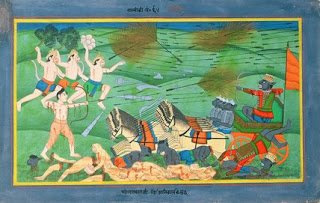
Atikaya, son of Ravana, follows his dead brothers onto the bloody battlefield, bat is soon slain by Lakshmana’s  arrows.
'I shall conquer him and drink his blood!' roared the monster. Leaping from his bed, he washed his face, and called for mote drink. After drinking hundreds more barrels of wine he made his way full of excitement to his brother's palace. When he learned From Ravana the full extent of his troubles, he laughed.

'Did I not warn you, brother, that you were foolish to keep Sita? Now you are reaping the reward of your sinfulness and pride,' he chided. 'But never fear, I will put your enemies to flight and devour Rama.'

Ravana gave him a golden coat of mail and a huge golden pike. Maddened with the smell of blood, he strode into battle surrounded by an army of giant rakshasas. When the monkeys saw the colossal figure of Kumbhakarna step over Lanka's lofty battlements and advance towards them they fled in terror. With great difficulty Angada and Sugriva rallied them for the fight. Waves of monkeys attacked from all sides hurling trees, rocks and mountain peaks at him, but the monster felt no discomfort. He ploughed into their ranks, tossing them aside, trampling them underfoot, crushing them in his arms ten or twenty at a time and greedily thrusting them into his mouth until he was covered with their blood and gore.

Hanuman was the first to halt his progress. He struck him with a mountain peak so violently that the monster stumbled. But Kumbhakarna thrust his pike deep into Hanuman's chest, forcing him to retire, vomiting blood. Thousands of monkeys jumped on the demon and climbed all over him biting and scratching, but he threw them off or pushed them into his gaping mouth. Angada and Sugriva each attacked him with mountain peaks and Hanuman broke his pike. Lakshmana attacked him with arrows, piercing deep into his chest and hurting him severely. But Kumbhakarna wanted to fight Rama.

Finding Rama, he rushed at him in fury. Rama shot an arrow into his breast, making him bleed profusely. In delirium he ran amok, devouring all in his path, whether monkey, demon or bear.

'Here I am!' shouted Rama, 'ready to kill you.'

Laughing insanely, Kumbhakarna charged again at Rama, brandishing an iron club in his right hand. Rama released an arrow, powered by the Wind god, which severed Kumbhakarna's right arm. The demon lifted a tree in his other arm, but Rama severed that one too with another arrow, and with two more he cut off his feet. Still he advanced, flying through the air with his horrific mouth open like a gateway to hell. Rama took a golden arrow encrusted with diamonds and sent it blazing through the air. It tore off the demon's head and mercifully brought an end to Kumbhakarna's reign of terror. The earth shook, celestials gathered in the sky to applaud and the monkeys went wild with joy.

The Fall Of Indrajit 


The news of his brother's death came as a terrible blow to Ravana. Now he realized he had been wrong not to listen to Vibhisana's advice. Seeing his despair, his sons rallied around him.

'You can still defeat Rama,' they assured him. 'We will kill him ourselves.'
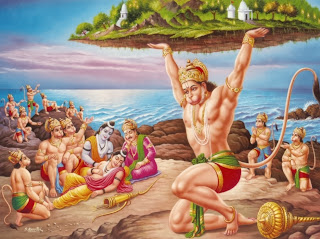
) Hanuman carrying a mountain peak of herbs to Lanka. The herbs heal the wounded monkeys and beard and bring the dead hack to life.
Ravana felt his old enthusiasm return. His sons were, after all, powerful fighters who could fly through the air and knew the magic arts. Together four of them went out. They were met by fierce lighting and soon the ground was covered with the blood of the contestants. One by one, Ravana's sons were slain by the fury of the monkey-chiefs. Last to go was Atikaya, equal in might to Ravana. As he went forth on his chariot, brilliant as a thousand suns, the monkeys thought he was Kumbhakarna himself, come back to life.

Lakshmana challenged him but he laughed, 'You are a mere boy, I advise you to leave unless you want to die.'

Lakshmana, however, was more than a match for him. Atikaya was protected by Brahma, so only a weapon powered by Brahma could kill him. Lakshmana knew this and invoked Brahma's blessing on his arrow, which cut off Atikaya's head.

With all his sons, save Indrajit, killed in battle, Ravana at last recognized his opponent as Vishnu himself, from whom there could be no defence. But Indrajit would not allow him to give up the fight.

'You will see Rama and Lakshmana lying dead on the battlefield today, killed by my arrows,' he pledged.

Before going to fight, Indrajit offered oblations into the sacred fire. The Fire god rose dazzling from the flames to accept his offerings and gifted Indrajit with the cloak of invisibility, which allowed him to move unseen on the battlefield. He summoned his enchanted chariot, which flew through the air, and set off to do battle, accompanied by monsters riding animals such as tigers, scorpions, crows and serpents. This hideous assembly issued from the city gates, longing for victory over their tormentors.

Indrajit ranged the sky and began showering devastating arrows upon the leaders of Rama's army. Moving like lightning, always hidden from view, he left them helpless to defend themselves. His incessant barrage soon overpowered the monkey chiefs and even Rama and Lakshmana. When he saw that they had all fallen on the field of battle, Indrajit withdrew in exultation to the city of Lanka.

However, Vibhisana and Hanuman had survived Indrajit's onslaught. Roaming the scene of devastation Vibhisana discovered Jambavan, lying wounded on the ground. The venerable bear whispered to him.

'Does Hanuman live?'

'Yes,' answered Vibhisana, 'but why do you only enquire of Hanuman?'

'Because he has the power to save us all. In the northern marches of the Himalayas, between the lofty peaks of Kailasha and Rishabha, is a mountain thick with healing herbs. Among them are four herbs of unmatched potency: the herb which brings the dead to life, the herb which heals wounds, the herb which mends broken limbs and the herb which revitalizes the entire body. These rare herbs must be collected by Hanuman if we are to survive.'

Hanuman was soon coursing through the air on his way north. He passed over forests, cities, fertile plains and rivers and drew near to the mountain fastness of the Himalaya range, whose white peaks shone like clouds. Among them he found the mountain of herbs, just as Jambavan had said, and searched all over it for the precious medicines. Unable to find them he tore the summit from its roots and bore it away to Lanka. When he brought it to the battlefield, the fragrance of the herbs wafted over the wounded and healed their wounds. In addition, all, those monkeys who had died in the battle were restored to life. The demons, however, had thrown all their dead into the ocean to conceal their numbers and hence none was saved.

When they came to know of the revival of the monkey army, other demon champions came forward to fight, but they all perished, killed by Sugriva, Hanuman and Rama. The monkeys' fighting spirit was high, while all looked bleak for the demons. Indrajit desperately thought how to discourage Rama and his army. If he could convince Rama that Sita was dead, surely Rama would give up in despair and Lanka would be saved. He used his sorcery to conjure up an illusory image of Sita, placed her on his chariot, and drove before the opposing army with a company of demons.

Hanuman was astonished to see on Indrajit's chariot the figure of Sita. Her torn sari and pale, beautiful face were distinctly recognizable. But what was Indrajit doing with her? The demon took hold of her hair and dragged her towards him, beating her mercilessly. Hanuman was enraged. He surged forward with other monkeys intent on stopping Indrajit.

You are pitiless and cruel. By this foul act you are sending yourself to hell!'

'I agree that this woman should not be killed,' taunted Indrajit, but sometimes such things must be done in war. Watch me as I kill this princess, so dear to Rama.' Hanuman looked on in horror as he raised his sharpened sword and with a single stroke clove her in two, spilling her blood in his chariot. Enraged, Hanuman flew at Indrajit and aimed a huge rock to crush him and his chariot. But Indrajit speedily withdrew, leaving his army to be decimated by the outraged monkeys.

Hanuman told Rama the ghastly news. When Rama heard it he fell to the ground like a fallen tree and went into a deep depression. Lakshmana hurried to comfort him. Bewildered by this unforeseen turn of events, the two brothers remained in a state of shocked disbelief until Vibhisana arrived on the scene. When he was told what had happened he knew straight away that this was a trick of Indrajit's. He patiently explained to Rama the truth.

'Ravana would never allow Sita to be killed he is too attached to her. This is a trick of Indrajit's, who loves to use his sorcery to delude his opponents. Even now he is at the fire sanctuary preparing offerings for the Fire god. Twice already he has overcome us through occult means, and if he is allowed to complete one more such ritual, he will become invisible again and gain sufficient powers to defeat us for good. We must prevent him. Let me take Lakshmana to that place to finish Indrajit once and for all.' Rama gave his blessings and they hurried off.

On the way Vibhisana asked Hanuman to launch an attack on the demon army so as to force Indrajit to leave his sanctuary to fend them off. Hanuman led the onslaught, armed with rocks and trees, and before long they had put the demon army to flight. Sure enough, Indrajit appeared in rage to defend them.
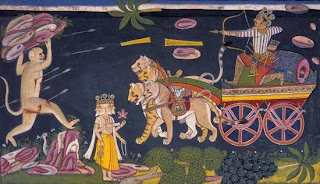
Hanuman hurls boulders at Indrajit, Ravana’s son. Both were protected by Brahma the creator, who stands in the foreground. While Hanuman did this Vibhisana and Lakshmana reached the place of sacrifice. Leading him through a dense thicket of ancient trees, Vibhisana brought Lakshmana to a clearing around a blackened banyan tree which spread its hoary branches over the fire sanctuary. Smoke rose from the fire-pit which was surrounded by ritual artifacts, and female attendants waited for Indrajit, who had evidently left in a hurry and was expected back. Suddenly Indrajit appeared, alerted by his aides of their presence in his inmost sanctuary. Deeply angered, he turned upon Vibhisana.

'You are Ravana's brother and my uncle, yet you have become our enemy, and now you have betrayed my secret. I despise you for this.'

'Although I was born a demon, that is not my nature,' replied Vibhisana. 'I have chosen a different path, driven away by the sinfulness of my family.'

Indrajit turned with contempt to Lakshmana.

'Have you come for more punishment? Do you forget that twice already I have crushed you? Stay then and fight, and I will fill you with arrows that will consume you as fire consumes a ball of cotton. So saying, he loosed a volley of arrows that pierced Lakshmana through, hissing like serpents. Lakshmana replied with Ave steel shafts that penetrated deep into his chest. And so the duel went, each displaying daz-zling skills and strength, and seemingly invulnerable to the other's arrows. They deployed cosmic weapons against each other until they had exhausted their arsenals. Gradually Indrajit, without the benefit of his invisibility, began to weaken in the face of Lakshmana's fury.

Lakshmana invoked the glorious weapon of Indra, awarded to him by Vishvamitra in his youth. He took the arrow, fretted with gold and guided by delicate feathers, and fitted it to his bow. Chanting mantras to Indra and invoking the name of Rama, he drew the arrow back to his ear, then released it. It flew straight and true and severed Indrajit's head from his shoulders.

The gods, watching from the sky, showered flowers on Lakshmana and praised his deed. Rama hugged him close, soothing his injured limbs and ridding him of' all pain. With the help of the healing herbs he soon recovered from his ordeal. They all looked forward to the final showdown with Ravana.

The End Of Ravana
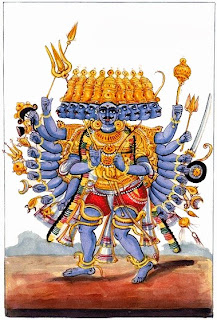

Ravana believed himself invincible. This picture brings him into the present-day context by including in hi, arsenal a gun.
Ministers hastened to Ravana with the news of Indrajit’s demise. Stunned, the lord of demons fell into a nerveless state, pondering his great loss. After some time he stirred, knitting his brows and grinding his teeth. He screamed, venting smoke and flames from his cavernous mouth, and seized his razor-edged sword, resolving to put an end to Sita, the cause of all his troubles. He swept out of his chambers, sending courtiers scurrying for shelter, and hurried down to the ashok grove, anxiously followed by his ministers and his wife Mandodari. Sita saw his purposeful approach and the long sword at his side and thought her life was at an end. 'Weak with fear and resignation, she bowed her head and waited. Suddenly an elderly minister, Suparsva, spoke up. `

Surely you will not do this heinous crime? Since childhood you have honoured your religion. Will you now destroy all your merits in one instant by murdering an innocent woman? Turn your anger on Rama, not on this helpless princess!'

Ravana heeded these words of his trusted adviser and withdrew his sword. With this friend of his he returned to his council chamber.

Ravana believed himself' invulnerable. He had a coat given to him by Brahma that was impenetrable, even by the arrows of Indra. He therefore determined to kill Rama and Lakshmana himself. He ordered his remaining generals to gather whatever was left of his army still an enormous force and go ahead, with him Following them to complete the task.

The great army advanced from the city, flying colourful banners and bristling with weapons. But this was not to be their day. Rama put on such a display of' fighting power that even he was astonished. So fierce was his onslaught and so swift his progress, that the demons could not actually see him as he destroyed them. As one cannot see a hurricane flattening a forest, they could only see their warriors falling on all sides. At other times it seemed to them they saw not one but hundreds of Ramas. He became like the wheel of Time, bringing death to all who looked upon him. Within two hours, he exterminated the entire demon army with his fire-laden arrows, save a few who managed to escape.

Lanka was filled with the bitter tears of the demon's wives, sisters and daughters.

'We blame Surpanakha,' they cried. 'That ugly and deformed creature should never have touched the handsome Rama. Nor should Ravana have stolen Sita once he saw how easily Rama disposed of his cousins Khara and Dusana. Later the invincible demons Viradha and Kabandha, and even Vali the powerful monkey king were all effortlessly killed by Rama, but still this obstinate Ravana will not release Sita. Now he has caused the death of our husbands and brothers.'

Ravana heard their wailing and bit his lips in rage. Gathering the remnants of his once great army, and the few generals to have survived the morning's holocaust, he rode out to face Rama. His chariot was resplendent with jewelled pillars and golden domes, and equipped with a huge arsenal of celestial missiles. Rows of' tiny bells jingled as it moved across the field, pulled by eight horses. But just then a vulture alighted on top of the chariot, other birds gave harsh cries, his left eye twitched and his face grew pale, while across the heavens flamed a meteor. Heedless of these omens, Ravana advanced to his doom.

The fighting went against him, and soon his generals were killed by Sugriva and Angada, leaving Ravana virtually alone. Full of rage, he invoked a spell in the name of Rahu, the planet of darkness that eclipses the moon, and cast it over the monkey army, destroying many of them. Then he turned his attention towards Rama, and the two of' them entered a full-scale contest of arms. As they circled each other loosing thunderous missiles charged with mystic potencies, the sky darkened and all creatures felt oppressed with fear. Although each was pierced repeatedly by the other's shafts, neither felt pain.

Ravana's arrows flew towards Rama, manifesting heads of lions, vultures, snakes and wolves with open jaws projecting sharpened teeth. Rama met them with arrows of fire appearing like suns, moons, meteors and comets.

Lakshmana and Vibhisana joined the attack, breaking Ravana's bow and killing his horses, forcing him to jump to the ground. Enraged, Ravana took up a javelin invested with deep magic, hung with eight bells and shining like fire, and launched it at Lakshmana with a sound like thunder. Rama, seeing it closing on Lakshmana, chanted mantras for his protection, but the javelin sank deep into Lakshmana's chest and Felled him like a stone.

Rama rushed to Lakshmana's side fearing the worst, and with great difficulty extracted the shaft from his chest. But he showed no signs of life. Rama, his eyes full of tears, entrusted him to the care of Susena, the monkey physician, and swore that he would put an end to Ravana that very day.

As the climax of the battle approaches, Ravana comes face to .face with Rama, who pierces him repeatedly with deadly arrows. la the background monkeys hurl rocks and mountain peaks.
When Susena saw Lakshmana's serious condition, he called for Hanuman to collect more precious herbs from the Himalayas. Hanuman again set off north for the mountain of herbs. Reaching there, he broke off a further crag from its summit and hastened back to the scene of the battle. Susena selected a herb called Visalyakarani, which has the power to expel from the body any weapon that has penetrated it and to heal the wound made by its entry. He crushed the herb and administered it through Lakshmana's nostrils, curing him instantly. Lakshmana stood up, all pain and injury gone, and was embraced by Rama and cheered by the monkeys.

The time for the final act of war had-arrived: the destruction of Ravana. lndra, the king of heaven, decided it was time to give Rama some help. He summoned his trusted charioteer, Matali, and sent him and his chariot to Rama's assistance. All at once Indra's chariot swept down from the skies and halted before Rama, hovering in the air with its bells tinkling. Rama and Lakshmana recognized it as the same golden chariot, yolked to four green horses, that they had seen at Sarabhanga's ashram in the forest at the start of their exile. Matali greeted Rama and invited him to mount the chariot, holding Indra's shining armour and celestial weapons.

Rama mounted the chariot, which lit up the battlefield with its splendour, and set off in pursuit of Ravana. The combat was opened by Ravana, who released a demoniac missile which turned into thousands of snakes shooting fire from their mouths, assailing Rama from all directions at once. In reply Rama invoked the weapon of Garuda, the bird-carrier of Vishnu and enemy of all snakes, which produced thousands of golden eagles who devoured the snakes.

Ravana then raised another javelin, covered with spikes like mountain peaks and wreathed with fire and smoke around its point. It screamed through the air at Rama, threatening to destroy him and his entire army, but Rama countered it with a javelin of his own. When the two weapons collided the explosion illuminated the skies and showered fragments on the ground.

Rama shouted at Ravana, If I had been there when you stole Sita, I would surely have killed you then. But now that I do have you in my sight I will despatch you to the abode of death. Today vultures will feast on your heart and drag away your severed head as you lie shattered on the battlefield.'

The magical weapons Rama had received as a youth from Vishvamitra now came before him ready for his use, and Rama covered Ravana with arrows that bit deep into his body. The demon sank back in his chariot without the strength to fight on. Seeing this, his charioteer hastily retreated from the battlefield to give him time to recover.

While he was gone, the sage Agastya, who had been observing the fight from the skies, came to Rama's side. He recited in his ear the heart mantra in praise of the sun, which addresses the supreme God through the power of the sun, and allays all anxieties.

"He alone creates, sustains and destroys all that lives"; he chanted, "He lives in the hearts of all beings, awake while they sleep, and is the supreme controller of all activities. All who remember him will be victorious".

Hearing these divine words, Rama was rid of all fatigue and sorrow, and felt renewed vigour and determination. Soon Ravana's chariot returned with a sound of thunder and Rama took up Indra's bow to finish his task. Vultures circled around Ravana in a darkening sky, meteors coursed through the heavens, thunder rolled even without clouds, and blood rained down on his chariot. As the contest reached its climax, all warriors on the field, both monkeys and demons, stood motionless and watched in amazement. The denizens of heaven, observing from the sky, anxiously called out to Rama.

'May all be well with you. Delay no longer. Conquer this demon now.'

Rama fired a golden arrow which took the form of a serpent as it sped towards Ravana. It severed his head, but another head appeared on Ravana's shoulders. Again Rama cut it off and again it was replaced. Rama exhausted hundreds of arrows in this way, and the unceasing struggle passed through days and nights, neither gaining mastery over the other.

Seeing the situation, Rama's charioteer, Matali, advised him. 'The hour of Ravana's doom has come. To kill Ravana you must use the dreaded arrow of Brahma, given to you by Agastya, which never misses its target.'

Rama took out that arrow, in whose feathers resided the Wind god, in whose tip was the Sun god and the Fire god, whose shaft was made of ether and which was itself the essence of all elements. He charged it with its mystic mantra and dispatched it at Ravana with the speed of sound. Flaming and spitting, covered in smoke, it penetrated the heart of the king of the demons. Ravana's body fell lifeless to the ground.

All at once a breeze whipped up, dispersing the foul odours of the battlefield. The sky cleared and the sun shone with a warm glow. Flowers rained down and heavenly music echoed from the sky. Demons melted into the shadows while monkeys rejoiced and came forward to honour Rama, who was surrounded by his faithful Friends on earth and glorified by celestial beings in the sky.

Writer Name: Ranchor Prime

Rama Victorious

Posted by Art Of Legend India [dot] Com On 2:05 AM 0 comments

Rama talk with Vali in the last stag of life
Hanuman, I cannot replay you,' said Rama, hugging him. 'I have nothing else to give than this embrace. Now we must consider how we are to cross the ocean, and this puzzles me.'

There is no place now for doubt or sorrow,' said Sugriva. 'We must build a bridge to Lanka, then Ravana stands no chance against us. fransform you grief into anger, Rama, and nothing will stand in your way. 

You are right, Sugriva,' agreed Rama. 'One way or another I will find a way across the sea, even if I have to dry it up. Tell me, Hanuman, of the fortifications of Lanka. How many gates are there and how strong is their garrison?

A high wall surrounds the city, though in places I have broken it down. It has four gates, each guarded by massive doors and catapults, and is surrounded by deep moats infested with alligators. The city is built on top of a steep mountain clothed in forests, and defended by millions of heavily armed warriors skilled in warfare.

Now the moon is in conjunction with Hasta,' said Rama. If our army departs this very day we will be sure of success.' He took command and through Sugriva issued orders to his generals. In excitement monkeys streamed out from the valleys and hills surrounding Kiskindha assembling before their leaders. Soon a huge army set off south, spreading out like a tide. Day and night they marched, feasting on wild fruits and honey as they went. Rama rode on Hanuman's back and Lakshmana on Angada's. After several days they had their first sight of the sea, its foam-flecked surface reaching to the horizon and seeming to join the sky in a single limitless expanse.

They camped on the beach and Rama sat with Lakshmana as the sun sank to the horizon. His thoughts turned to Sita. What would she be doing at this moment? Perhaps the same breeze that blew from the sea had touched her.

Sita is weak from fasting,' he said, and I fear that we may arrive too late. We must find a way to cross this ocean soon.' Lakshmana comforted Rama as the sun slid over the horizon.

Sugriva become a king of kishkindhaAcross the sea, Ravana sat late in his council chamber. Shifting uncomfortably, he reported to his ministers the extent of' the damage done by Hanuman and asked their advice in the light of' the reports coming in of a vast army of monkeys approaching the opposite shore. 'Rama will find a way to get across. How do you propose we defend ourselves?

Our armies stand at the ready,' one general boasted, 'so what have we to fear? We have crushed the whole universe, even the court of' Indra, king of heaven. What do we fear from mere humans and monkeys?

Hanuman caught us unawares,' said another. 'This time it will be different. I will kill Rama and Lakshmana, and all the monkeys, on my own. The rest of you can stay here drinking wine without worry.' They brandished their swords but Vibbisana, Ravana's younger brother, restrained them.

Rama is not so easily defeated,' he warned. It is dangerous to underestimate your enemy. Do you forget how he killed Khara? Advice that Sita be returned. That way we shall avert disaster.

Disgusted at his brother's words, Ravana dismissed everyone and retired to his palace. But the following morning Vibhisana again sought Ravana.

Brother, ever since you kidnapped Sita ill omens have been seen. Sacred fires are obscured by smoke, cows do not give milk, donkeys shed tears and crows cry from the roofs of the buildings. Everyone blames your sin of abducting Sita, but they dare not tell you. You must return her to Rama.

Rama Worshiped of ShivaI am not afraid of Rama,' rejoined Ravana angrily, 'and I will never return Sita.' Ravana had become a slave to his infatuation for Sita. The people of Lanka, even those close to him openly disapproved of his behaviour, increasing his unease. Calling together his ministers and generals, he asked for their advice.

As you know, I have kidnapped Sita, wife of Rama, and am passionately in love with her, though she is not yet inclined to share my bed. Now Rama is on his way with a great army of monkeys. We fear no monkey or human, yet I need your advice. How can we avoid returning Sita?

First to speak was Kumbhakarna, the dangerous brother of Ravana, who slept six months at a time under the spell of Brahma, and had recently awoken.

This act of kidnapping Sita was unworthy of you. You should have consulted us first. Nevertheless, I shall atone for your mistake by killing all your enemies. So rest at ease You will not lose Sita.

Ravish her by force and have done with id' interjected another demon, impatient with Ravana's infatuation.

I cannot,' replied Ravana, 'because Brahma has cursed inc that if ever I molest a woman against her will my head will burst into a hundred pieces. In fear of this I will not violate Sita. No matter. I will destroy Rama as I destroy all who oppose me.

Preparations for Bridge of LankaVibhisana could no longer remain silent. 'Give up this folly. Sita is like a poisonous snake around your neck. Return her to Rama. Kumbhakarna cannot defeat Rama; he boasts because he has never actually faced him in battle, so he does not realize how powerful he is.

I have defeated Indra himself,' protested Indrajit, 'so why do you think I cannot defeat a mere prince of humans? You are a coward, frightening us for no good reason.

Child, you speak nonsense,' retorted Vibhisana. You are the enemy of your father because you counsel him to seek his own death, and yours too. No doubt death is what you both deserve, but you must give back Sita and let us live in peace.

These words made Ravana furious. 'I would rather live with a snake than a supposed friend devoted to my enemy,' he roared. 'Although you are my brother you cannot be trusted because you scheme for your own self-interest.' Vibhisana blazed with anger as he rose into the air and hovered above Ravana. I am your friend and servant, older brother, who does not wish to see you killed by Rama. However, you ignore my advice. Therefore protect yourself and your subjects as best you can. I am leaving you. I wish you well. So saying, Vibhisana flew from Lanka in the direction of Rama.  

A BRIDGE TO LANKA


Rama and his army cross their miraculous bridge to Lanka, supported by Vibhisana, brother to Ravana, who flies above them in the sky with his four companions.Within an hour Vibhisana and four companions were over Rama's encampment, having flown across the sea. He called to Sugriva from the sky.

'I am Vibhisana, brother of Ravana. come in peace to serve Rama.'

Sugriva sounded the alert, thinking them spies, and urged Rama to kill them. But Rama disagreed. Hanuman also was in favour of befriending Vibhisana, because he had saved his life. '

He has asked me for shelter. I am bound to give protection to all who surrender to me. That is my vow,' declared Rama.

Vibhisana descended from the air and fell at Rama's feet with his followers, pledging his allegiance. Rama asked him the strengths and weaknesses of the demons.

Kumbhakarna, my older brother, is to be feared,' said Vibhisana. 'Indrajit can make himself invisible on the battlefield, which makes him invincible, and Ravana has routed the chief gods of' heaven.' He described other leading (lemons and estimated their numbers at many millions.

'I know of Ravana's exploits,' responded Rama, 'but I do not fear him. I will not return to Ayodhya until I have killed him and all his followers. Then I shall install you as king of Lanka.'

'You can rely on my help,' assured Vibhisana. Rama embraced him and consecrated him there and then as king of Lanka before a crowd of monkeys on the beach. Then Rama withdrew to contemplate the problem of how to cross the ocean. He lay down on his side on the beach, resting his head on his arm, and gazed intently out to sea.

That night a spy sent by Ravana surveyed the beach encampments and hastened back.

'Their army is as vast as the ocean. It is time for you to take decisive action.' In fear Ravana sent Suka, a demon who could transform himself into a bird, as a winged messenger to Sugriva. The bird reached Sugriva's camp.

A Bridge of Lanka'Ravana sends his greetings with these words: "I have never harmed you, Sugriva. You are like a brother to me. Why do you oppose me? Go back to Kiskindha, for you will never conquer Lanka".' Monkeys seized the bird-demon to tear off its wings but Rama stopped them. He would not allow a messenger to be harmed.

'Tell Ravana that he is not my brother,' Sugriva told the bird. 'He is an enemy of Rama and therefore my enemy, and he deserves death. Lanka will be burned to ashes and Rama will slay him and his brother.'

Rama waited beside the ocean in deep concentration, determined that the Sea god would allow him passage or perish at his hands. Three days and nights passed but the sea god did not appear. Rama's eyes glowed red with anger.

'It seems this world respects anger, not patience. Therefore today I will split apart the ocean and dry up its waters, destroying all that live within it.' He took up his bow and released a flaming arrow that seared across the waves, threatening the lives of all aquatics and making the ocean boil. Rama fitted a second arrow to his bow. The skies darkened and the wind roared. Oceans, rivers and lakes trembled as the heavens thun-dered and lightning flashed. (From the waters arose the figure of the Sea god, sparkling with gems and entwined by serpents, in the company of' hosts of river gods. He spoke to Rama with joined hands.

‘I will allow your monkeys passage. Tell the monkey named Nila, who was born of' the universal architect Visvakarma, to build upon my surface a causeway of rocks and trees and I will support it.' The Sea god then descended into the waves.

Rama summoned Nila and instructed him to supervise the construction of the bridge to Lanka. Work began and by the end of the first day the monkeys had progressed many miles out to sea, and the causeway held. After five days they com-pleted the crossing to Lanka. The causeway was wide, straight and level and crossed the deeps as the Milky Way spans the skies. When all was complete Rama and Lakshmana, riding on the backs of' Hanuman and Angada, led the army across. Monkeys leapt through the air or swam alongside them, roaring with excitement.

The great army assembled on the beaches of Lanka, finding ample provisions in the lush coastal forests as the sun sank in a crimson sky. Refreshed, they set off in the morning for the city of Lanka. Outside the city, Rama drew the army into the formation of a man, with Rishabha on its right arm, Gandamadana on its left, Sugriva at its legs, Jambavan at its waist, Nila at its heart and himself and Lakshmana at its head.

Suka the spy, terrified of being caught again, observed the crossing of the monkeys from the sky and flew back to Ravana. 

I delivered your message to Sugriva, but was nearly killed in the process. The monkeys are fierce and violent, but Rania protected me. He has already reached Lanka after bridging the ocean.

While Ravana sits in council of war, the demon spy Suka, after being released the Rama, flies back to warn Ravana of the approach of Rama’s army.
The monkeys and bears with him number millions and are huge like mountains and clouds, covering the earth. Even now they are at the walls of the city. Restore Sita to Rama or be prepared to give battle immediately.'

'I will never return Sita. When Rama hears the music of my bow be will wish he had never come to Lanka.'

Ravana sent two more demon spies to gather detailed information on the disposition of Rama's army. They left under cover of darkness and in disguise penetrated deep into enemy ranks, bewildered by the size of an army which spread from one horizon to the other and could not be measured. Vibhisana discovered them and brought them before Rama. In fear of' their lives, they confessed to Rama that they had been sent as spies.

'I have no objection,' laughed Rama. `Vibhisana will show you all you wish to know. Then you must go back and tell Ravana that tomorrow at dawn I will loose my anger upon him.' They were released and soon reported all this to Ravana.

'These four Rama, Lakshmana, Sugriva and Vibhisana can tear this city from its foundations,' they reported. 'Do not trifle with them, my lord. Return Sita without delay and sue for peace.'

'Even if the whole universe attacks me I will not return Sita,' stormed Ravana. 'Take me onto the battlements and show me this great army.' They climbed to the top of the highest tower and looked down upon Rama's troops, surging like the sea at the foot of' Lanka's golden cliffs. Suka pointed out to Ravana the leading monkey warriors and described each of their strengths, estimating their numbers at many hundreds of thousands of millions. When he saw their strength Ravana was shaken.

'You should not have praised those brutes in front of me,' he snapped. 'What fools am I surrounded with? Be gone and do not return, both of you, and consider yourselves lucky to keep your lives.'

Ravana sent yet more spies, wanting every detail of Rama's movements. They too were captured and humiliated before being sent back to Ravana. He was now thoroughly alarmed but firmly set against surrender. He went deep into his palace, where he sent for the sorcerer Vidyujiva.

The Obstinacy Of Ravana


In his deranged mind, Ravana thought he might persuade Sita to marry him if he could convince her that Rama was dead. So he asked Vidyujiva to conjure up a false image of Rama's head and a golden bow similar to Rama's., He entered the ashok grove, eager to see Sita's beautiful face, and found her beneath the surviving tree sitting on the bare ground with her head bent in sorrow.

'I bring you news of your husband,' Ravana began. 'He is dead. Now nothing stands in the way of your union with me. This is what happened: last night Rama camped with his army on the opposite shore. During the night Prahasta infiltrated their camp with soldiers armed with swords, javelins, spears, scimitars, axes, clubs and arrows, and slaughtered them. Rama was found asleep and beheaded. Vibhisana was taken captive, and Sugriva and Hanuman were killed. There is not a warrior left alive who has not fled in panic.' Ravana then produced the false head of Rama, covered in dust and blood, and placed it on the ground in front of Sita, and next to it the bow.

'Here is Rama's severed head and his once mighty bow. Now you will submit to me.'

When all is ready for battle, Malyavan, Ravana’s, grandfather-in-law, makes a last attempt to persuade the demon king to snake peace with Rama.Sita recognized the head as bearing all the distinctive marks of Rama: his noble brow, his lotus-like eyes and the distinctive jewel he wore in the knot of his hair. She threw herself on the ground.

'Now I have no reason to live, for I have seen my husband die before me. 0 Rama! Astrologers predicted that you would have a long life, but now it is cut short. Why don't you speak to me? This girl who you married in your youth has turned out to be the cause of your death. Kill me, Ravana. Do one worthy deed in your life and unite this wife with her husband.'

At this moment Ravana was interrupted by an urgent message from his generals calling for his presence, and hurried off. As soon as he had gone, a curious thing happened: Rama's head and bow vanished into thin air. This was not seen by Sita, but by her friend Sarama, the wife of Vibhisana, one of the demon attendants.

'Dear Sita,' she reassured, 'do not be distressed by what you saw. It was a wicked illusion created by Ravana. Rama is alive and well. I have heard that he has crossed the sea and is this very moment camped outside the city walls with all his forces. Lanka is full of preparations for war: squadrons march on the streets; weapons are polished, elephants decorated, horses yolked; everywhere is the sound of drums and the rattling of chariots. But they will be no match for Rama. Soon your husband will take the city and win you back. If you like I can make myself invisible by my magic art and take a message to him.'

'Dear friend, thank you for your words of encouragement,' replied Sita. 'If you want to make me happy, please find out what Ravana is planning to do with me, for I am mortally afraid that he will soon have me killed.' Sarama left, returning soon with news of Ravana.

'Ravana seeks advice from his ministers,' she reported, 'and all urge him to return you to Rama and make peace. But Ravana is determined to keep you, even if he dies in the attempt. Therefore it is certain that Rama will slay him soon.'

A demon called Malyavan, grandfather of Ravana's wife, tried to advise Ravana.

'A wise ruler does not fight one of greater strength, he makes peace. You should return Sita and make an alliance with Rama that will benefit everyone. The creator brought into this world two orders of beings: the divine and the demoniac. In the great struggle between them the divine has the upper hand, being defended by Lord Vishnu, until the wheel of time turns to Kali Yuga, the iron age, when demoniac forces take control. Until then, us demons are destined to be the losers. You are about to be vanquished by the gods, who are working through the monkeys born from them. Moreover, Rama is Vishnu himself in human form, and he has come to destroy you. Submit to him and bring us all good fortune.'

'I hear nothing you say,' protested Ravana angrily. 'Rama is a mere human being whose father has forsaken him and who relies upon monkeys. What have I to fear from such a wretch? I will kill him and Lakshmana within a few days.'

Hearing these foolish words Malyavan left Ravana to his fate. Ravana then posted his generals at the four gates of the city and prepared to defend Lanka. Satisfied that all was ready, he retired to his private apartments to be with his women.

The Battle Begins

On the eve of battle, Rama called his generals together. They climbed to the summit of Mount Suvela, from where they could clearly see the city of Lanka and what was to be the field of battle. As the sun set in a red sky, they saw the battlements of the city lined with densely packed rows of demons. The full moon rose and they spent their last night before the battle on the mountain top.

In the morning they saw spread below them a landscape of groves, lawns and water-falls alive with the songs of birds. Above this was the peak of Trikuta, on which stood Lanka, floating like a golden cloud. Behind its fortified gates they saw Ravana's golden palace, its turrets touching the heavens. On the battlements of the northern gate they were excited to see Ravana himself wearing a blood-red robe. Sugriva bellowed with rage and leapt from the top of Mount Suvela onto the battlements in front of Ravana.

'Today I will kill you! He cried, and snatched Ravana's crown.
'And I will separate your head from your body,' shouted Ravana.

Indrajit, the son of Ravana and his most feared warrior, flies unseen in the sky raining down magical snake-arrows which blind Rama and his army, rending them powerless.In a moment the two were locked in combat, wrestling arm to arm, chest to chest and leg to leg. Each was expert in the art of wrestling and strove with equal intensity. As they struggled they fell from the ramparts to the foot of the walls, but still they fought on, crouching, leaping and pressing each other's bodies until they were smeared with blood and dust. Neither had the upper hand and Ravana was on the point of summoning his sorcery, when Sugriva leapt high into the sky and returned to the summit of Mount Suvela, where he was greeted with cheers.

Rama and Lakshmana led the monkey generals down from the mountain and advanced the troops to the walls of Lanka. Armed with trees and rocks the monkeys waited in excitement for battle to commence, setting up a noise like rolling thunder and engulfing the walls of the city. Before ordering the attack, Rama sent Angada with a last message for Ravana. He flew over the battlements into Ravana's presence.

'Rama sends you this message,' he announced. "The time of retribution for your sins has come. For too long you have terrorized the innocent. Now I will punish you. Keep up your courage and I will slay you on the battlefield, thus releasing you from your sins and sending you to heaven. Prepare to die."

'Take this evil monkey and put him to death!' cursed Ravana. Four demons seized Angada, but he soared with them high into the air, then shook them off so that they crashed to the ground. Then he flew back to Rama.

Rama and Hanuman Fighting RavanaStanding before the walls of Lanka, Rama thought of Sita and ordered battle to begin. Hoards of monkeys began scaling the walls, smashing the defenses with their rocks and trees and beating down the mighty gates. Waves of demons in dazzling golden armour rushed out eager to give battle. They struck the monkeys with maces, axes and swords, and the monkeys struck them with trees and rocks or with their teeth and nails. The fighting was fierce enough to make your hair stand on end. As the day progressed one after another of the leading demons was vanquished, and the battlefield was covered with spears, arrows, shattered chariots and dead elephants.

Darkness fell but the fighting raged on. Rama's arrows shone like tongues of flame. As the night wore on Angada gained the upper hand in his light with Indrajit, smashing his chariot and forcing him to flee. However, Indrajit made himself invisible and returned to the fight, invoking the weapon of Brahma which he had used before against Hanuman. Under the cloak of invisibility he rained down arrows on Rama and Lakshmana. These were no ordinary arrows. They were deadly serpents from the regions of darkness below the earth, transformed into arrows that bit deep into the vital organs of Rama and Lakshmana, binding them as if by cords of steel. Rama was powerless to defend himself against Indrajit's onslaught because he was unable to see where his enemy was. Before long the two brothers fell to the ground immobile. Indrajit intensified his attack, piercing them with more and more arrows until their entire bodies were covered with his shafts.

'Go now to the abode of death!' he shouted in rage. Rama and Lakshmana, trembling in the darkness with pain and weakness, lost consciousness. Indrajit, believing them to be dead, flew in triumph to Ravana.

As the night ended and light returned to the field, Sugriva, Vibhisana and others discovered the two princes, hardly breathing and unable to move, lying on a bed of arrows. Drawing around them in a protective cordon, they gave way to despair. Only Vibhisana was optimistic. '

Rama's lustre has not gone. He and Lakshmana do not have the appearance of dying men. Rama will recover.'

Indrajit went to Ravana and announced that Rama and Lakshmana were dead. Ravana was beside himself with joy and the demons celebrated as if the battle were over. Ravana ordered that Sita be taken aboard the Puspaka airplane and shown the dead princes. She was flown in the Puspaka over the battleground. With her went a demoness named Trijata, who was her friend. When Sita saw the inert bodies of Rama and Lakshmana covered with arrows amid the terrible carnage she was beside herself with grief; but Trijata encouraged her.

'These princes are not dead,' she deduced. 'Their bodies shine with a brilliance which is never seen in those about to die.' But Sita was inconsolable as she was carried back to the ashok grove.

Rama opened his eyes. He looked beside him and saw Lakshmana lying motionless. Thinking him dead, he felt deep despair.

The epic story of Ramayana was adopted by several cultures across Asia. Shown here is a Thai historic artwork depicting the battle which took place between Rama and Ravana.
If Lakshmana dies my life is worthless. Perhaps I could find another Sita, but I could never replace a brother like Lakshmana. He always comforted me when I was depressed, now who will encourage me?' He turned to Sugriva and said, 'I thank you for your loyal service. You and your brave companions must now return across the sea to your homes. You have done all you can for me and I am well satisfied. I release you from all further obligation.'

Just then a mighty wind blew and lightning flashed in the sky. All at once there appeared the figure of Garuda, king of the birds and eagle-carrier of Vishnu. He shone like blazing fire and was hard to look upon. In an instant the snake-arrows that bound Rama and Lakshmana were released and the snakes fled in fear, for no snake can stand the presence of Garuda. Bending low, he wiped the faces of Rama and Lakshmana and stroked their bodies. As he did so their wounds healed and their skin shone bright and smooth. He raised them from the ground and embraced them.

'You have saved my life,' Rama said in wonder. 'Who are you?

‘I am Garuda, your friend of old. I heard of your plight and hurried here. Don’t be curious now about our friendship. Go and regain Sita, and when your quest is complete, you will know who I am.’ He circled Rama, spread his wings, and soared into the sky. The Monkeys roared in delight and beat upon their drums, ready once more to face the enemy.

Writer – Ranchor Prime

Company Overview

Art of Legend India has the distinction of being one of the best in the Indian Handicraft Industry. We are about 75 years old handicrafts manufacturer & exporter. We are having team of more than 500 craftsman.

We are having our business offices in India, USA & Germany to ensure our best services.

Total Pageviews