ArtofLegendIndia.com, Biggest Online Store of Handicrafts Items, Paintings and Jewelry Accessories...

Handicrafts

Handicrafts are devices or works of art that are made completely by hand or by the use of relatively simple tools. Such goods are usually made in the traditional way of manufacturing goods. Therefore, the knowledge of the art of craft is usually passed down from one generation to another. The items made using these traditional methods of manufacturing are usually produced in smaller quantities and they often represent the culture or religious beliefs of the community that makes them. The goods are also handmade from natural materials that are found in the environment of the particular economy.

Read More!

Biggest Online Store of Handicrafts Items

Paintings

A painting is equal to thousand words, means a beautiful painting is equal to million of words. Paintings are one of the oldest art forms -- throughout history artists have played an important role in documenting social movements, spiritual beliefs and general life and culture.

History Of Paintings: The history of painting reaches back in time to artifacts from...

Read More!

Biggest Online Store of Unique Style Paintings

Top 10 Religious destinations in North India

Posted by Art Of Legend India [dot] Com On 2:00 AM 2 comments

Religion makes the focal point of existence for all Indians. Thus, religious places abound in the country. The northern part of India especially is home to several small and big shrines. North India saw the rise of Islam and Hinduism simultaneously which is why there’s no dearth of temples as well as mosques in the northern part of India. Northern India’s rich history and age-old traditions coupled with lofty spiritualism, makes it a haven for all religiously inclined Indians. If you are in a mind to explore North India, you must visit the religious sites listed below. Without visiting these sites, your exploration will remain incomplete. Read on to learn more:

Chardhams

Chardhams
The Chardhams namely, Yamunotri, Gangotri, Kedarnath and Badrinath spread across the Garhwal Himalayas of Uttarakhand and are dedicated to Goddess Yamuna, Goddess Ganga, Lord Shiva or Kedar and Lord Vishnu or Badrinath respectively. Adi Guru Shankaracharya, the great Hindu religious guru had established the concept of Chardhams centuries back. Today devout pilgrims from every nook and corner of the country make a beeline to the Chardhams to attain ‘Moksha’ or salvation. The journey to the Chardhams is rigorous journey and you have to trek for miles on a challenging, mountainous terrain. Those who find it difficult to trek their way up to Uttarakhand Chardhams, can avail the Chardham helicopter yatra services for a more convenient, comfortable and speedy journey.

Ram janam bhoomi

Ram janam bhoomi
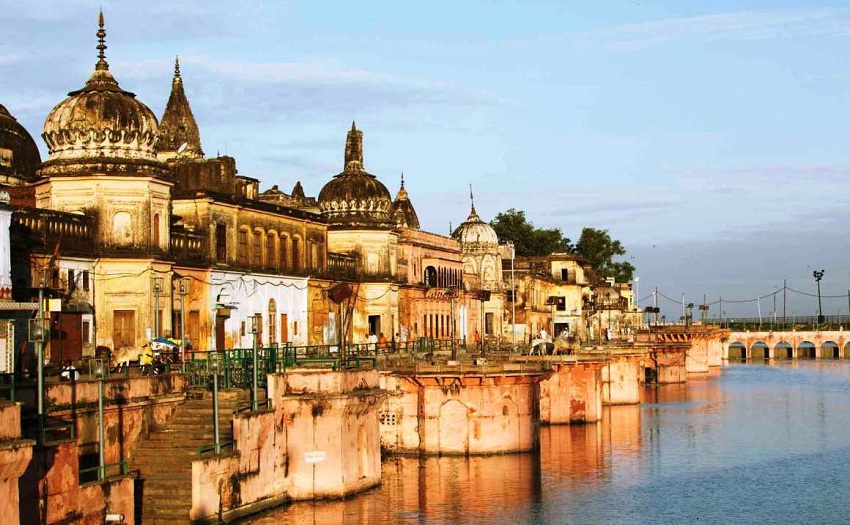
The holy city of Ayodhya in Uttar Pradesh is believed to be the place where Lord Rama; Lord Vishnu’s 7th Avatar took his birth. Lord Rama is said to have spent a major part of his childhood at this place. Ram bhakts from every part of the country and globe visit the place to pay their tribute to Lord Rama. The chief attractions of this place are Ram Janmabhoomi temple, Kanak Bhavan temple, Kala Ram temple, Lakshman ghat. Visiting Ayodhya allows pilgrims to pick an overtly religious experience.

Dargah Shariff

Dargah Shariff
This is a much revered Dargah for the Muslims. Muslim pilgrims from every nook and corner of the country and world visit the Dargah. It is a common belief among pilgrims that if one prays sincerely at the Dargah, the wishes of the person are bound to get granted. This is a Sufi shrine dedicated to khwaja Moinuddin Chishti, the great Sufi saint known enough for his secular preaching. Visiting this Dargah is often considered equal to going for a pilgrimage to Mecca. Moinuddin Chishti is often believed to be Prophet Mohammad’s chosen one. He was instructed in dream by the prophet to go to India and spread Islam.

Amarnath

Amarnath
Amarnath is a cave shrine in the north Indian state of Jammu and Kashmir dedicated to Lord Shiva also known as Amarnath ji. Lord Shiva is enshrined here in the form of an ice stalagmite lingam. According to myths, Lord Shiva had narrated the secret of eternity or Amar katha to his consort Parvati at this very place.

Golden Temple or Swarna mandir

Golden Temple or Swarna mandir
Golden temple, also known as Harmandir Sahib or Darbar Sahib, is a famous Gurudwara in the whole of the country and world. It is located in Punjab’s Amritsar city and came into being in the year 1604 under the active initiative of Guru Arjan Singh; the fifth of the Sikh gurus. The main shrine of the temple is made up pure, glittering gold and stands amid a pellucid water tank named as ‘Amrit sarovar’. A causeway connects the temple to the bank of the sarovar. The waters of the Amrit sarovar is believed to possess great healing power as it is believed to be full of divine nectar. The architectural beauty of the golden temple crafted in gold and marble is simply mesmerizing. The temple stands as a golden symbol of peace, spirituality and brotherhood.

Shivkhori

Shivkhori

The cave shrine of Shivkhori in Jammu and Kashmir is dedicated to Lord Shiva. This 200 meters long natural cave enshrines a self made image of the lord. Ransoo is the base camp for Shiv Khori trek.

Har ki pauri

Har ki pauri
Har-ki-pauri of Hardiwar is an important landmark of this ancient city steeped in mythological as well as religious significance. Bathing at Har-ki-pauri bathing ghat is considered as a ritualistic bath powerful enough to absolve one’s sins. As per myths, the two important Gods of the holy trinity; lord Vishnu and lord Shiva are said to have visited this place during the Vedic era. There are large foot prints on a stone slab at Bhramakund of the Har-ki-pauri ghat and it is believed to be the footprints of Lord Vishnu. King Vikramaditya is said to have constructed this famous ghat long back. Every evening thousands of visitors gather at the ghat to visualize the very enchanting Ganga Aarti.

Vaishno devi

Vaishno devi
Vaishno devi is a holy cave shrine dedicated to Mata Vaishno Devi, lovingly referred to as Mata Rani by her devotees. This is one among the 108 Shakti Peethas of Goddess Shakti or Durga. One has to undertake a religious trek of 13kms uphill to reach the shrine which is perched at an elevation of 1560m atop the Trikuta parvat ranges. The base camp for Vaishnodevi trek is Katra in Jammu. Those who cannot undertake the trek may avail the Helicopter yatra to Vaishnodevi. The Goddess is enshrined here in the form of three pindis; i.e. Mahalaxmi, MahaSaraswati & Maha Kali. It is believed that until and unless the Goddess calls you, you cannot reach the bhavan of Mata Rani.

Hemkund Sahib Gurudwara

Hemkund Sahib Gurudwara
Hemkund Sahib is a much revered Sikh pilgrimage destination high up in the Uttarakhand Himalayas. It falls in Uttarakhand’s Chamoli district. The Gurudwara is perched at an elevation of 4329m above the sea level and is flanked by towering snow-capped peaks. As per myths, this was the place where the great Sikh guru Govind Singh ji meditated for years in his past life. The route to Hemkund Sahib is blessed with rare scenic beauty.

Dilwara temples

Dilwara temples
The famous Dilwara temples in Rajasthan’s Mount Abu are a cluster off 5 Jain Temples notable for their intricate marble carvings. Vimal Shah was the builder of these temples known enough for their architectural beauty and perfection. Visiting the Dilwara temples is an experience in itself.

Tips for Proper Yoga for Weight Loss

Posted by Art Of Legend India [dot] Com On 4:42 AM 2 comments

Yoga may not have the same calorie burning effects of more intense exercises like running, swimming, and cardio-dance routines, but don't let all that fool you. With its attention to proper deep breathing exercises and sometimes-difficult poses held for as long as 1 to 2 minutes, yoga for weight loss is very much a real thing— ask the many doctors and personal trainers who vouch for it. It doesn't hurt that yoga also places special attention on improving your state of mind and spirit, leading to a healthier and better you.

Go for ‘Burning' Yoga

Not all yoga practices are the same, which is why the amount of burned calories can range anywhere between 180 to 400 kcal an hour. The most strenuous forms of yoga are Vinyasa, Ashtanga, and other forms of modified "power yoga," which blends strength exercises, stretching for flexibility, and cardio.

A typical 90-minute Vinyasa class should leave you drenched in sweat, as the deep breathing works your core, flushing out toxins and water weight. Repeated upward-facing and downward-facing dog poses will work your arms, with the effect similar to doing push-ups.

But beyond the obvious physical and fitness demands of yoga, there's a deeper benefit to the practice: you become more aware of your body. You begin to develop an understanding of how your body works, realize which poses you can and can' execute just yet, and see how regular practice makes you better at yoga.

You also become more receptive to your body's needs and even notice things like food that doesn't digest well, or conversely, food that makes you feel good.

It’s a good habit to write down your thoughts and ideas after yoga exersecises that improve our brain activity and mental health too. Meanwhile, if you have some difficulties with writing task, feel free to order anyquality custom paper from Essaylab.

Tips for Proper Yoga for Weight Loss

Do Less to Do More
And yet the interesting thing about yoga is that not everyone will need the tougher classes to lose weight. Even gentler yoga practices like Hatha yoga, with its emphasis on breathing, strength, and flexibility, can jumpstart your body into weight-loss mode.

As you go about your daily, sometimes stressful, routine, your body is in a heightened state of alert, with high-octane hormones moving around your body. Yoga activates the parasympathetic nervous system, which controls your hormones, digestion, and breathing. This, in turn, brings your body down to a calmer state and resets injury repair, normal metabolism, and balanced hormone generation—all of which facilitates weight loss.

And again, yoga is about having an awareness of your body, with its effects touching on both physiological and psychological functions. Regularly practicing yoga heightens your sensitivity to the body's signals, like hunger and food cravings. With regular yoga, you begin to understand the difference between real hunger and cravings.

Yoga_Pose

Think Long-Term

As with any other form of exercise and physical fitness routine, yoga's real results are most obvious when it's done over a long-term period. So anyone expecting to see weight loss results after just 4 to 5 classes is only setting themselves up for disappointment.

Research on long-term yoga practice shows its ability to stop the middle-age spread. A recent study by the Fred Hutchinson Cancer Research Center indicates that overweight individuals ages 45 to 55 who practiced yoga on a regular basis over ten years lost an average of 5 pounds—those who didn't gain 14 pounds.


5 Best places to visit in India

Posted by Art Of Legend India [dot] Com On 12:08 PM 3 comments

5 Best places to visit in IndiaWelcome to India! A melting pot of color, culture and cuisine. From the eclectic displays of traditional wares in the market to the delicious aromas drifting from the shops of local food vendors, India promises an exotic experience that cannot be rivaled. Whether you are here for a week or a month, you will never run out of 5 star restaurants that serve the best meals as well as prime locations that offer a unique tourist experience. You can get lost in the vibrant city life of Mumbai or enjoy the tranquility of the Silent Valley in Kerala. Whatever your preference, India has something for you. Here’s a list of our favorite spots.

Tourist India, Delhi, Agra and Jaipur:it is not possible for you come to India without touching base with the country’s tourism hot spots. From the famous Taj Mahal which is also one of the most photographed spots to the Pink City which is named aptly for the vibrant terracotta pink color of the buildings and finally to the bazaars of Delhi where you can buy almost anything, tourist India offers a full dose of India in all its glamour and glory. Also, you will be able to see lots of Hinduism temples like popular Sai Baba Temple in a town Shirdi of Maharastra State and you will be easily get hotels in Shirdi at best discounted rate on online website ClearTrip.com.

Southern India, Mumbai, Goa and Kerala: If a holiday is not complete for you without a beach then head for southern India where the sun meets the beach and creates a magical experience. You may have to trade your grilled fish and chips for the more traditional (and exquisitely delicious) bhelpuri but it is totally worth the experience. You can choose the perfect beach spot from any of the southern locations listed. Just grab your beach gear and you are ready to go.

Secret Gem, Champawat: This is perfect for the traveler who is craving an idyllic holiday. Think religious temples, mother nature and astonishing architectural designs. Nestled deep in the mountainous region of Uttarakhand, this vacation spot is preferred by tourist who want to experience the culture from a spiritual angle. This is also great if you want to experience India without running into a crowd of tourists. If you are worried that this might be a snooze fest, perhaps the knowledge that Champawat is home to the ferocious man-eating tigers might change that notion. You can visit the region anytime of the year.

Northern India, Manali, Rishikesh, Kullu valley: The ideal Indian destination for the nomadic traveler, this region offers mountain hikes for the nature lovers and amazing water rafting locations for the adrenaline junkie. If you wish to add some spirituality to your trip (India is big o spirituality), you can visit the popular pilgrim trail that leads to sacred mountain temples.

Magical India, Pradesh, Rajasthan: experience the wildlife of India in their natural habitats. From lions to rhinos to even tigers and if this sounds a little too much for you, perhaps bird watching might be right up your alley. This region has a wide variety of exotic birds that will leave you with Instagram pictures to last for days. Camel riding across the deserts of Rajasthan should be on your to do list.

Places in India every college student should visit

Posted by Art Of Legend India [dot] Com On 11:28 PM 0 comments
India is a wonderful corner of the world where there are harmony and peace. Many dream to meet its wonders, to witness the exotic nature, unique culture and local customs. A lot of students, tired after long studies and a hustle and bustle of the city routine go to India to experience spiritual peace and sometimes to find their life-destination.You can not only restore your forces there butal so to improve health with the help of traditional medicine, as well as engage in dancing or yoga. This country is so versatile, that everyone will find something to their liking. During one trip it is impossible to see everything,  so the visa to India for six months or a year will be a handy tool to explore the country.

1. Agra

Agra 

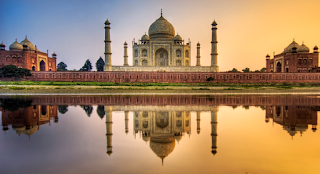
Agra opens the list of the must-see places in India, it is here where the India's pearl is situated - Taj Mahal, which is not only a symbol of India, but one of the world's most famous attractions. The mausoleum of white marble, truly captures the hearts of travelers. This is a beautiful and romantic place that is associated with the embodiment of eternal love. Also, being here, you can not miss the RedFort and the Tomb of Akbar the Great.

2. Puducherry


The next resort that is definitely worth a visit especially for beach lovers. Puducherry is located in the southernpart of India, where there is always good weather.

This coastal town is famous for its long beaches and luxury hotels. This place is ideal for relaxation and visiting cozy restaurants with exotic cuisine. In addition, there are a lot of attractions that are worth visiting. Basically, these are the magnificent temples and churches. This place, thanks to its relaxed atmosphere, attracts many tourists every year.

3. Auroville

Tired of writing thousands of college papers the same way as the main character of the best-selling book was perplexed by her life? Then, go and have peace in Auroville.All fans of the life style of the film "Eat. Pray. Love." will be definitely happy going to such a place. It is a place created for the search of yourself, relaxation and oneness with nature. Surrounded by vast gardens, you can devote yourself to yoga and truly relax with all your heart. A final argument, which confirms the importance of this place is the Matrimandir - a building made of puregold. This miracle can not be foundany where else.

4. Darjeeling

Here from all over the world lovers of the Indian tea are coming by deluges. This area has got the main plantation Darjeeling. In addition, the city is covered with greenery all around and captures the travelers with its exotic flora. Nature lovers will be definitely attracted to this city.

5. Goa

This is perhaps one of the most famous resorts in India. Goa is a tropical paradise, created for a romantic getaway and spiritual harmony. Its beautifull and scapes are on the screens of many computers, because there is no a man who does not want to change the stuffy apartment on the sandy beaches and palm trees.

6. Mumbai


Mumbai or Bombay is the heart of India. Life here is in full swing, attracting more and more seekers of vivid impressions. The first thing that this place is famous for is the cinema. This is where you can get acquainted with the origins of Indian cinema. Moreover, the world's largest film company IMAX is also here. Also, you can see the life of the country from the inside, because in this city colonial and urban styles are interwoven. After visiting Mumbai, you will encounters lums near the luxury homes, become acquainted thus with different manifestations of life of the local population. Well, inaddition, good news for shoppers - most markets are huge in this part of the country. So, be sure to grab more money for souvenirs to your loved ones.

7. Kodaikanal lake

This place is ideal for lovers of active holidays. Kodailake means "gift of the forest." Probably due to the fact that it is located in the mountains of the Western Ghats, surrounded by water falls and lush greenery. It is a place created for skiing, horse back riding and biking or hiking.

8. Gingee

Gingee, infact, has been one of the vast variety of conventional villages of India until some point. And this point was the amazing structure of the 13th century. Climbing 900 steps, you can see the majestic fort Gingee. Its stone elevation will not leave in different any fan of old architecture. So do not forget to add this site to your must-see places when going to India.

9. Kerala


Thousands of travelers come to Kerala to enjoy a relaxing holiday on the beautifull a goons and lakes, intertwined on the coast of the Arabian Sea. There you can be accommodated in one of the small villages in the floating house and enjoy the extra ordinary beauty and originality of India to the fullest. One of the best entertainments in this part of the country is the water race at Kuttanadin Alappuzha area. A distinctive feature of the competition is the very means of transport, because there are approximately hundred of oarsmen in the same boat !

10. Simla

If you are going to India, we can not skip the Himalayas. After all, these mountains have settled in the hearts of many people long ago, even in those who have never seen them. In the north-western part is a small, but, a place worthy of attention - Simla. This center is not only a skiing one, but al so a trade center. Try going to some excursions of this resort that can offer you an exuberance of attractions! For example, a visit to the monkey temple, or one of the oldest churches of Christ in the north of India.

5 Best Yoga Retreats in India

Posted by Art Of Legend India [dot] Com On 3:04 AM 6 comments
5 Best Yoga Retreats in IndiaYoga is becoming an increasingly popular health activity. Because of this popularity, many holiday locations are catering to the people's need for a quiet environment through yoga retreats. A yoga retreat can be a wonderful experience if you choose the location wisely. These yoga retreats are not for just fun, they include spiritual activities in which people are taught to connect with Mother Nature and perform yogic exercises to improve the overall physical and mental health. It is for this reason that you must consider spending your vacation in a good yoga retreat. Yoga retreats in India offers the best way to full relaxation. A good yoga retreat restores your stressed Body and mind.

The following are top 5 yoga retreats in India that you must visit.

1. Art Of Living Ashram, Bangalore
This is a 65 acre campus, in Bangalore and is an international art of living center located on the Panchagiri Hills outside Bangalore. This is a great destination for those who seek peace and calm through yoga. This is the perfect location to calm your mind and body amidst the mountainside trails, organic farms, gardens and a lake that surround the facility. Guests here from all backgrounds are invited to participate voluntarily for the general maintenance of the ashram.

2. Shreyas Yoga Retreat
This is a luxury 25 acre yoga center in Bangalore. It is one of the world's luxuriest yoga retreat centers. It offers yoga classes, rejuvenation spa, meditation sessions, infinity pool and an organic vegetarian. This yoga retreat has attentive staff and provides excellent service.The pricing starts from $280 for a single garden tent.

3. Osho Meditation Resort
This 28 acre campus of Osho Meditation Resort is a calm and cool place of the world that invites people for relaxation and rejuvenation. This is close to the Mumbal Koregaon Park, Pune. This resort provides the inmate a feeling of luxury getaway and a traditional ashram experience too. It has meditation classes, swimming pool, lush and beautiful gardens, marble pathways etc. It costs $55 a night to stay here.

4. Yoga Vidya Spiritual Retreats
At this yoga retreat in Kerala, you can learn Ayurveda, hatha yoga and meditation too. Yoga here is taught by scholars and monks from different parts of the world. This center has many courses and retreats such as like art retreats and a teacher training program in yoga. Beginners in yoga can benefit from an immersion retreat which is a 10 day program. Advanced yoga learners can join the intensive de-tox retreat. The yoga immersion retreat for 10 days for beginners starts from $500.

5. Ananda In The Himalayas, Narendranagar
If you are looking for a luxury retreat in the Himalayas with some yoga and meditation then you must visit this yoga retreat. This yoga retreat teaches Bihar yoga. It offers classes in many meditation forms and "andshuddi kriyas", which is a yogic practice designed for the purification of the body and the mind. Apart from yoga guests can pamper themselves and relax at the spa. It is $342 per night here for a double room.

If you are planning to have your vacation spend on one of this yoga retreats. You need to visit India and for that you must have an Indian visa. All foreign nationals who wish to enter India are required to possess a valid national passport with a valid visa obtained from Indian high commission. All individual visa seekers can apply for the Indian Visa through online application.

The Power of Yoga for Cancer Recovery

Posted by Art Of Legend India [dot] Com On 3:25 AM 0 comments
The Power of Yoga for Cancer RecoveryYoga has been associated with therapeutic, mental and emotional powers. Yoga is simply the definition of the body, mind affiliation. Recently, some scientific journal revealed that those who undergo reconstructive surgery and mastectomy after stage 1 breast cancer diagnosis finds relief with Yoga. Yoga is the ultimate solution to recovering from cancer.

Yoga gives the recovering patients the tools to go through the emotional and physical pain and learn to breathe properly and live through. Whether it is through exercise or meditation, every cancer recovering patient needs some outlet. After surgery, most people suffer back and arm muscles issues, painful scar tissue and swelling. Yoga teaches people how to understand their body, know when to back off and know their strength.

How Yoga Works to Heal the Cancer Patients 

Yoga healing process for the cancer patients is mostly diagnosed by experts. Every move, every healing process plays its own part.

Yoga Postures 

The yoga postures work on the internal body systems and organs for instance respiration, circulation, elimination and digestion. They also work on the lymphatic system and the nervous system, and yoga penetrates the ligaments, muscles and joints. Some of the yoga practices are not suitable for the ailing, but the experts can guide on less physically demanding and simpler postures. The postures should be able to allow free flow of blood, removes all the blockages that prevent the energy flow increasing the body energy levels. Yoga postures teach the recovering patients to learn how to keep up with some minor pains resulting from sitting down too much and from bad postures.

Breathing Exercises

The breathing exercises aid in releasing the tension and helps the patient replenish lost energy. Restricted, shallow breathing leads to depression, tiredness and physical illness. Deep, rhythmic and relaxed breathing where the lungs get fully utilized is revitalizing and energizing which gives the body the power to overcome illness. The yoga simple stretching and breathing exercises will enhance efficiency and elasticity of the intercostal and diaphragm muscles. This way they replace the weak breathing habits.

Learning to breath equips people with the power to deal with strong emotions which originated from a cancer diagnosis. Breathing effectively fights of despair, panic, and grief.

Meditation 

Meditation does not mean emptying the mind. It means calming the emotions, giving the patients the opportunity to learn how their emotions work and hence gains control over them. Through meditation, the sick get to learn the life realities and easily accept them. Being acknowledgeable and working with the emotions in the daily lives strengthens people. Understanding how own mind works, facing the reality and letting go of the fears reduces stress. Meditation is a therapeutic procedure cleansing the emotional level, providing the energy required for spiritual growth.

Relaxation 

Relaxation is the most critical part of the cancer recovery process through yoga. Relaxation assist removes the stress that hurts the immune system. Through relaxation, the body muscles get rid of with the tension, the blood and heart rates drop, and mental and breathing activity declines and as a result the anxiety and tension start to dissolve. The mind and the body surrenders and allows the peace and stillness of deep relaxation to take charge.

Therefore, Yoga is a very powerful tool in the speedy recovery of the cancer. 

Two Folios from a Ragamala Series

Posted by Art Of Legend India [dot] Com On 12:58 AM 0 comments
Kedar Ragini
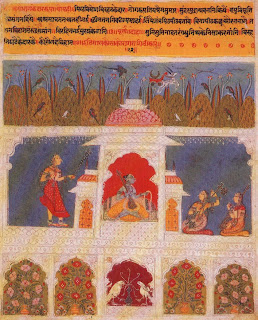
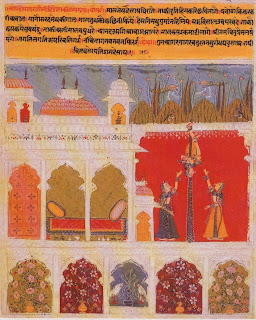
The presence of two paintings from the same series in the Green collection provides an opportunity for viewers to study the stylistic and compositional relationships between illustrations of different ragas/raginis within a given Ragamala set. The present comparison is especially instructive, for the careful observer will discern that the two paintings, although clearly from the same series, were in fact painted by two different artists. The major comparable features of the two include the visually dominant expanses of white architecture and the division of the paintings into four registers, composed of a row of niches with flowering plants and parrots along the bottom, the figures and palatial setting in the middle, the lines of trees in the penultimate register, and the lengthy poetic passages, written in the same hand, in the yellow panel at the top.

Closer scrutiny of the two paintings, however, reveals innumerable minute differences in detail. The treatment of the pink lotus petals covering the surface of the architectural domes differs considerably between the two: the dome of painting A has petals radiating outward in a lively arrangement, but those of painting a lie in stiff horizontal rows. The detailing in ink of the architecture, intended to represent carved marble forms, is much finer and more complex in painting A than in B. The vegetal and floral forms are related but differ in botanical structure and array, with those of painting A generally more boldly portrayed. Figures and animals are more supple and naturalistic in painting A. Given these variances in detail and execution, painting A seems more accomplished than B and, by extension, so was its painter. For other paintings from this series, see Pal 1978, pp. 114-15, no. 34 (Panchama Ragini); Pal 1981, p. 58, no. 47 (Kanhra Ragini); and Sotheby's 1996, lot 186 (Malkos Raga). An additional unpublished illustration of Mcgha-Mallar Raga from this series is in the Los Angeles County Museum of Art.

Desakhya RaginiA.)   This painting is identified and described by the text in its upper panel as representing Kedar Ragini, who is described as a love-torn, emaciated woman wearing earrings, smeared with ashes as an ascetic, and playing a vina. The ragini, a wife of Hindola Raga, is an early night melody characterized by tenderness and believed to possess magical healing properties. In the Rajasthani tradition Kedar Ragini is portrayed as a night scene with an ascetic either playing or holding a vina or listening to a musician playing the instrument. Surprisingly, the ascetic in this illustration is shown holding a tambura rather "than a vina, while both instruments are being played by two female musicians. In the sky above the trees an antelope pulls a celestial chariot bearing a crescent moon, a symbol of Siva, the arch-ascetic of Indian culture.

B.)  Here the text in the upper panel identities the heroine as Desakhya Ragini, a wife of Sri Raga, and describes her as a lovely woman wearing a sari in Marathi fashion and performing an acrobatic movement on the upright pillar. Desakhya Ragini is a late morning melody stressing the heroic sentiment. Depictions of the ragini in the Rajasthani tradition feature a group of acrobats performing feats of strength and coordination. Occasionally, as shown here, women athletes are shown in place of their male counterparts in order to reconcile the traditionally male quality of physical prowess with the feminine gender of the melody.

Writer Name:- Pratapaditya Pal

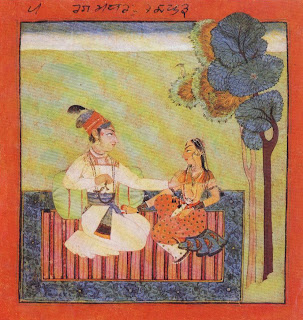
Punyaki Ragini, Harsha Ragaputra and Madhu Ragaputra

Posted by Art Of Legend India [dot] Com On 10:52 PM 0 comments
Punyaki Ragini

Punyaki Ragini

On the reverse of this painting are inscribed in the Takri and Devanagari scripts, respectively, Punyaki Ragini and Purvi Ragini. Analysis of the painting's iconography resolves the disparity and corroborates the former identification. Both inscriptions label it correctly as the wife of Bhairava Raga, number 4. Punyaki Ragini is a wife of Bhairava Raga according to the Kshemakarna system, in which the melody is compared to the .sound of rushing water. The term punya means the earning of religious merit through charity. Consequently, as Indian religious ceremonies often involve the pouring of consecrated water over a holy man's hands, representations of Punyaki Ragini frequently portray the ablution of a mendicant's hands by the lady of a house or palace.

This illustration of Punyaki Ragini differs in that the lady is shown giving alms in the form of coins to a Saiva mendicant rather than pouring water over his hands. Nevertheless, the underlying rationale is the same, as it is still a meritorious act that is being stressed in the painting. Indeed, other iconographic variations are known, including the offering to the mendicant of a piece of jewelry or even a sheaf of barley.

Ragamalas were a particularly popular subject in Bilaspur painting between 1650 and 1780, a period coinciding with the political and cultural zenith of the court. At least twenty-one Ragamala sets were produced by the workshops of Bilaspur. Out of these sets, two other representations of Punyaki Ragini are known to have survived: one from about 1690-95 and the other from about 1750. The three examples differ somewhat in composition and expression, with the example of about 1690-95 and the present painting being the closest in style. A number of Bilaspur stylistic features are common to these two paintings, including a long spiraling lock of hair in place of a sideburn for the mendicants, somewhat short figures, substantial depictions of brickwork, and a distinctive, sultry palette.

Harsha Ragaputra

Harsha Ragaputra In the upper border are rather indistinct Takri and Devanagari inscriptions that both identify the painting as Harsha Ragaputra, a son of Bhairava Raga. Kshemakarna's classification likens the melody to the sound of running water and pictures the hero as an impetuous, fair-skinned adolescent wearing a blue garment and a pearl necklace. The name Harsha means rapture, especially that of a sexual nature. Pahari paintings of the melody apparently take their inspiration from the description of the personified hero and the lustful connotations of the name. They typically portray the young hero seated or standing with a woman, usually in a bedchamber. Often the couple are shown enjoying betel nut.

This representation of Harsha Ragaputra generally accords with the above iconographic description. A hero and heroine are seated in a pavilion bedchamber. He wears a long strand of pearls and rubies over his shoulder and a blue-striped purple garment, thus basically agreeing with his prescribed adornment and garb. In place of sharing betel-nut delicacies, however, the couple is shown gesticulating dramatically, and each figure inexplicably holds a handkerchief. Another unusual feature of this painting and the series to which it belongs, common to "only a few early Pahari ragamalas", is that within the set the colors of the borders and the backgrounds are coordinated for each raga's family. Hence, for this series of the Bhairava family the borders are yellow and within them the backgrounds are flaming orange.

This painting is from an important Basohli series known generally as the Tandan Ragamala after the name of the author who first published it. The set once belonged to the family of the former court astrologer of Basohli. With sixty-five extant folios, it is the most extensive of the early Pahari Ragamalas known to have survived. The paintings were executed during the reign of Dhiraj Pal, who was a scholar and patron of the arts. It has been dated to about 1700 by Tandan and to about 1707-15 by Khandalavala, either of which would place it in the middle of the four other known Basohli Ragamalas ranging in date from about 1675 to about 1720. Stylistically, the present painting exhibits a number of characteristic Basohli motifs and features. The most significant of these are the brilliant palette, the distinctive elongated facial types with sloped foreheads, the single tall cypress tree, the presence of small sections of iridescent beetle thorax casing used to imitate emeralds, and the distinctive bejeweled golden pendant worn by the hero, which is found only in Basohli portraits.

Madhu Ragaputra

Madhu Ragaputra
The Takri inscription in the border above this painting states it to be Madhu Ragaputra, a son of Bhairava Raga. According to Kshemakarna, whose verse 20 describes the personification of the melody, the protagonist is a handsome and knowledgeable man dressed in red garments. In contrast, however, most Pahari representations of the melody, including the present example, show a hero fondling his beloved's breasts. Alternatively, the couple are depicted as drinking, with or without-a female attendant.

This Chamba painting of about 1715 exhibits strong stylistic influence from contemporary Basohli works. Figural and facial types are similar, and coloration schemes of deep intense hues and monochromatic backgrounds are analogous. In contrast, in contemporary Chamba painting figures are generally somewhat less stylized, drapery and fauna conventions differ, the palette is generally more subdued, and small sections of beetle thorax casing arc never used for decoration as they are in the Basohli tradition. The Ragamala set of which this painting was once a part originally belonged to the Chamba royal family. It is now in the Bhuri Singh Museum of Chamba except for some twelve dispersed pages. At least three other Ragamala sets, all later than that of the present work, were also painted by the Chamba ateliers.

Writer Name:- Pratapaditya Pal

Description on Rama Victorious

Posted by Art Of Legend India [dot] Com On 5:39 AM 0 comments
Swearing her faithfulness to Rama, Sita decides to enter fire rather than bear his insults. The Fire god, knowing her to be pure, saves her from harm.

Lanka Restored

The battle was over. Ravana's huge body lay sprawled on the ground, covered in blood and surrounded by the gruesome aftermath of war, charred and mutilated remains covering the field as far as the eye could see. At his side knelt Vibhisana, with Rama standing behind him.

'O great hero,' mourned Vibhisana, 'why are you lying here, my brother, rather than on the sumptuous bed that you are used to? You did not take my advice. Now that you have fallen, the city of Lanka and all her people are reduced to ruin.'

'Do not lament,' said Rama. 'He terrorized the universe, even Indra himself. Sooner or later he had to die, and he chose to die the glorious death of a. warrior.'

'He was generous to his friends and ruthless to his enemies,' said Vibhisana, 'and religious according to his own tradition he chanted the Vedic hymns and kept a sacred fire burning in his home.'

'Now you must consider how to perform his funeral rites,' said Rama.

'He was my older brother, but he was also my enemy and lost my respect. He was cruel and deceitful, and violated other mens' wives. I do not know if he deserves a proper cremation,' confessed Vibhisana.

'He was immoral and untruthful, after the nature of a rakshasa,' replied Rama, 'but he was gifted and brave. Cremate him with respect and let enmity end with death.'

Then came Ravana's wives, braving the horrors of the battlefield to be at their husband's side. They threw themselves around him, sobbing and stroking his head.

'If only you had heeded Vibhisana and returned Sita to Rama,' they cried, 'none of this would have happened and we would be spared the curse of becoming widows.'

How could you, who conquered heaven, be overcome by a man wandering in the forest?' spoke Mandodari, Ravana's chief queen. 'The only explanation is that Vishnu, the Great Spirit and eternal sustainer of the worlds, took human form as Rama to finish your life. Sita was the cause of your downfall. The moment you touched her your end was assured. The only reason the gods did not strike you down was because they feared you, but your actions still brought the fruits they deserved. One who does good gains happiness and the sinner reaps misery; no one can escape this law. ,

'You were advised by me, Maricha, Vibhisana, your brother Kumbhakarna, and my father, but you ignored us all.' Mandodari wept on Ravana's breast and her fellow wives tried to console her.

Meanwhile Rama sent Vibhisana into the ruined city of Lanka to make the funeral arrangements and perform the closing rites for Ravana's sacred fire. Soon he returned with the sacred embers, articles of worship and firewood for the pyre carried by rakshasa priests and attendants. They decorated Ravana's linen shroud with flowers and carried his body in procession to the beach, preceded by the sacred fires and followed by weeping rakshasa women.

Vibhisana ignited the pyre while the remaining family members threw rice grains into the flames. Vedic hymns were intoned as the mourners looked on in silence.

When all was finished they returned to the city. His anger exhausted, Rama put away his weapons. A deep joy welled in his heart and his gentle demeanor returned.

Sita's Ordeal by Fire

Swearing her faithfulness to Rama, Sita decides to enter fire rather than bear his insults. The Fire god, knowing her to be pure, saves her from harm.With Ravana out of the way, Rama's thoughts turned to Sita. He called Hanuman and asked him to take her the news of Ravana's death. He came to the ashok grove and found her as before, unwashed and uncared for with tears in her eyes, seated on the ground beneath the tree guarded by demon women. He stood respectfully at a distance to deliver his message.

'Lord Rama is safe and well, and has killed Ravana. He sends you this message: "After many sleepless months I have bridged the sea and fulfilled my vow to win you back. You now need have no fear as you are in the hands of Vibhisana, the new king of Lanka, who will soon come to see you". Sita was speechless with joy to hear this news and waited for more. But Hanuman remained silent.

'This news is more valuable than all the gold and jewels in the universe,' she laughed, 'and you have delivered it in such sweet words. I cannot repay you enough.'

'If you will permit me, I can deal swiftly with these cruel rakshasa women,' offered Hanuman, eager to be of service. 'They have so mistreated you. Let me kill them now with my bare hands.'

'You must not be angry with them,' reproved Sita. 'They have only done what they were ordered to do. Whatever I have suffered is due to my own sins, not to them. When others mistreat me, I will not mistreat them in return. I will show compassion to all, even if they are unrepentant murderers.' Hanuman checked himself.

'Then have you any message for your husband?' he asked.

'Tell him I long to see him!'

'You shall see him this very day.' With these words Hanuman swiftly flew back to Rama with Sita's message, and urged him to go to her at once to end her misery. Rama sighed deeply in an effort to hold back his tears. After a moment he turned to Vibhisana.

'Go quickly and fetch Sita. Before bringing her here see that she is bathed, dressed in fresh clothes, and adorned as befits a queen.'

Sita waited in the grove, expecting Rama, but instead she saw the ladies of Vibhisana's household who came to bring her to his house, where Vibhisana told her to bathe and dress in preparation for meeting Rama.

'I want to see my husband now, as I am,' she protested, but Vibhisana prevailed on her to do Rama's bidding. The ladies helped her bathe and combed out her tangled hair, dressed her in fine clothes and ornaments and placed her inside a palanquin, covered so that no one could see her. Soon she was brought by a company of rakshasas to Rama's presence.'

During this time Rama remained deep in thought, considering how to welcome Sita. The strict codes of the royal house of Iksvaku demanded that a princess violated by an . enemy must be rejected by her husband. Sita had been Ravana's prisoner for eleven months. Who knows what that immoral demon might have subjected her to? Rama trusted Sita completely, but he was determined that she must be publicly exonerated from any impropriety. He knew what he must do.

What happened next is painful to recount.

Monkeys and rakshasas crowded forward on all sides, anxious for a glimpse of the fabled princess. Vibhisana, hoping to protect Sita from the public, told her to wait in her palanquin, but Rama wanted her brought out in the open.

'These are my people and they want to see her,' he spoke sternly. 'At a time like this there are no secrets, even for royal princesses. Bring her here in front of everyone.'

Vibhisana was uncomfortable with this order, but dared not contradict him. Sita had to suffer the indignity of walking in front of thousands of curious eyes on her way to Rama. She reached him and stood at a respectful distance, her head bowed, and shyly looked into his face. As she gazed into his eyes her discomfort was forgotten for the moment and she glowed with happiness.

'I have won you back according to my vow,' announced Rama. 'The insult against me has been avenged, and its perpetrator repaid for his terrible offence against you. I am once more my own master. All this has been done with the help of Hanuman, Sugriva and Vibhisana, to whom I am indebted.'

Rama spoke without emotion, but his voice sounded strange as it rang out across the crowd. His heart bled for Sita, but he must not show it. She looked upon her lord, with tears falling down her cheeks, and dreaded what he might say next.

'I have redeemed my honour and won you back,' he went on, 'but I did not do this for your sake, fair princess, I did it for the sake of my honour and for the good name of the royal house of Iksvaku. Your honour is not so easy to redeem, since you have lived in the house of a demon who has embraced you in his arms and made you the object of his lust. You are "so desirable, Ravana could not have resisted you for long. I therefore relinquish my attachment to you. You are free to go wherever you please. If you like you can go with Lakshmana, or Bharata, or even Sugriva or the rakshasa Vibhisana. Do as you please.'

A shocked silence fell over the assembly. Sita tried to rake in what she had just heard. She had never in her life received a cross word from her husband. Now he had condemned her in public with these awful words. For her this was worse than death. She bowed her head in shame before this crowd of strangers and cried uncontrollably as Rama waited in stern silence for her response. After a little while she wiped her eyes and stood straight, her face pale and her voice trembling.

'You speak hurtful words, my lord, as if I were a common prostitute, but I am not what you take me for. I am daughter of the earth, who was seized against my will by force. If you were to reject me it would have been better if you had told me through Hanuman when he first came. Then I would have put an end to my life and saved you the trouble of coming here to kill Ravana, endangering the lives of all these innocent people. You forget that when I was a child you took my hand and promised me your protection and that I have served you faithfully ever since. My heart has always remained fixed on you, but now you of all people do not trust me. What am I to do?' Sita's voice broke with emotion. She turned to speak to Lakshmana.

'I have no desire to live when I have been falsely accused and publicly rejected by my husband. Death is my only course. Prepare a pyre for me I will enter the flames.'

Stunned at this request, Lakshmana looked at his brother. Rama nodded his assent. No one dared to contradict him, whose anger seemed capable of destroying the universe. Lakshmana mechanically went about his brother's bidding, and before long a funeral pyre had been built and set alight. The fire began to crackle. Sita circled around Rama in respect and proceeded towards the pyre. Standing before the blazing flames she called in a loud voice:

'May all the gods be my witness. I have never been unfaithful to Rama in thought, word or deed. If the Fire god knows me to be innocent, let him protect me from these flames.' Then she walked into the fire. As she entered the flames the crowd gasped in horror. The flames leapt high and parted over her head as she stepped among them, swallowing her golden form. For a moment she could be seen standing in the midst of the flames like a dazzling flame of gold, then she was lost to sight. Women screamed and fainted. A great cry, strange and terrible to hear, went up from all the monkeys; bears and rakshasas present. Rama sat immobile like one who has lost his life, and tears flooded his eyes.

As the incarnation of Vishnu, Rama had accomplished all the gods had asked of him. But the gods heard Sita's cry for help and were troubled at her ordeal. It was time for them to intervene. The creator Brahma, Shiva the destroyer, Indra the king of heaven, and others all boarded their aerial cars and flew down to earth, where they appeared shining in front of Rama and spoke to him.

'Have you forgotten who you are and who Sita is? You are the source of creation, the beginning, middle and end of all that exists. And yet you treat Sita as an ordinary fallen woman.'

'I am a human being. My name is Rama, son of Dasaratha, and Sita is my human wife. Who do you say I am?'

'You are the supreme Lord Vishnu and Sita is your eternal consort, the goddess Lakshmi,' declared Brahma. 'You are Krishna. You are the Cosmic Person, the source of all, creator of Indra and the gods, and the support of the entire creation. No one knows your origin or who you are, yet you know all living beings. You are worshipped in the form of the Vedic hymns and the mystic syllable om, and night and day are the opening and closing of your eyes.

'At our request you took human form to put an end to Ravana. Now you have accomplished this, and your devotees who praise you will be blessed for evermore.'

Then the Fire god, Agni, rose up out of the flames of the funeral pyre bearing Sita in his arms. She was unharmed by the fire and her clothes and ornaments, even the flowers decorating her hair, were exactly as before. Agni brought her to Rama.

'Here is your wife Sita who is without sin. She has never been unfaithful to you, in thought, word or deed. I command you to treat her gently.'

'This ordeal for Sita was necessary,' Rama explained, 'I had to absolve her from any blame and to preserve the good name of the Iksvaku race. I know she has always been faithful, but I had to prove her innocence. In truth I could not be separated from Sita any more than the sun can part from its own rays. But I thank you and accept, without reservation, your words of advice.' With these words, Sita and Rama were re-united. Then there was a further surprise.

'You have rid the world of the curse' of Ravana,' said Lord Shiva. 'Now you have one thing more to do before you return to heaven. You must bring comfort to your mother and brothers and prosperity to Ayodhya. Greet your deceased father, whom I have brought from heaven to see you.'

Rama and Lakshmana bowed in wonder as Dasaratha descended in their midst, his celestial form shining. Reaching the ground he took them in his arms.

'I am so pleased for you, dear boy,' he said to Rama, 'and at what you have achieved. You have set my mind at rest, which has long been haunted by Kaikeyi's words, and you have redeemed my soul. I now recognize you to be the Supreme Person in the guise of my son. Now you have completed fourteen years in exile, please return to Ayodhya and take up the throne.'

Turning to Lakshmana, he said, 'Your service to Rama and Sita has brought Rama success, the world happiness, and will bring you its own reward. I am deeply pleased with you, my son.' Then he spoke to Sita.

'My daughter, please forgive Rama, who was inspired only by the highest motive. You have shown your purity and courage by entering the flames, and you will be revered henceforth as unequalled among chaste women.' With those words, Dasaratha ascended, to heaven. It now remained for Indra to grant Rama one last wish.

'We are all pleased with your actions, Rama, and would like to grant you a boon. What is your wish?'

Rama was unhesitating. 'May all these monkeys and bears, who have sacrificed their lives for me, be brought back to life and returned to their wives and families.'

'It shall be done,' declared Indra. Then the monkeys and bears rose up, their limbs restored and their injuries healed, as if from a long and peaceful sleep. 'You may return to your homes,' pronounced the assembled gods. 'And Rama — be kind to the noble princess Sita. Make haste to Ayodhya, where your brother Bharata awaits you.' Then they boarded their golden aerial cars and departed for the heavens.

Homecoming

Sita and Rama are enthroned on their return to Ayodhya by Rama’s brothers, by Vibhisana from Lanka, and by the monkeys and bears.
Vibhisana invited Rama to take his bath and put on royal robes and ornaments.

'I cannot bathe until I have been reunited with Bharata,' said Rama. 'For the last fourteen years he has lived as an ascetic for my sake. Now I must hurry to him. If you would please me, help me to get to Ayodhya as soon as possible.'

'That is easily done,' replied Vibhisana. 'The fabulous Puspaka airplane will fly you there by sunset. But first remain here a while and let me entertain you and your army.'

'I would not refuse you, Vibhisana, after you have done so much for me, but I long to see Bharata and my mother.'

Vibhisana summoned the airplane which arrived instantly, gleaming with its golden domes. Rama took the shy Sita in his arms and boarded the plane with Lakshmana.

'Settle peacefully in your kingdoms,' he told Sugriva, Vibhisana and their ministers. 'You have both served me well. I must return.' But they were not ready to part.

'Let us come to Ayodhya and see you crowned,' they protested. 'Only then will we return to our homes.' Rama happily agreed and invited them aboard with all their followers. Miraculously there was enough room aboard the airplane for everyone. When all was ready, the Puspaka ascended effortlessly into the sky amid great excitement. Rama took Sita to a balcony and they looked down at the island of Lanka.

'See, princess, the city of Lanka and outside it the bloody field of battle. Here, at Setubandha, is where we built the bridge across the sea and I received the blessings of Lord Shiva. Now you see Kiskindha, Sugriva's capital where I killed Vali.' As they approached Kiskindha, Sita made a request.

'Let me invite the wives of the monkeys to come with us to Ayodhya.' It was done. The airplane touched down and took aboard thousands before proceeding on its way.

'Now see Mount Rishyamukha, where I spent the rainy season in sorrow and where we first met Hanuman and Sugriva. And here is that enchanting place where we lived in our cottage and where you were carried away by Ravana, and over there is the place where the brave Jatayu died. Here are the ashrams of Agastya, Sutikishna and Sarabanga, and here is where you met the noble Anasuya, wife of Atri. Here is Chitrakoot, the most beautiful of hills, where Bharata found us.'

They stopped overnight at Bharadvaja's ashram and Rama sent Hanuman ahead with messages for Bharata. He was worried that Bharata might resent having to give up the kingdom to his brother. He need not have feared. Hanuman arrived at the village of Nandigram, outside Ayodhya, and found Bharata living as Rama had lived during his exile, dressed in deerskin, with Rama's wooden shoes occupying the central position in his court. When he heard of Rama's return he jumped for joy and hugged Hanuman, showering him with gifts.

The next morning Bharata led everyone out to meet Rama, with Rama's sandals at the head of the procession. A great cry went up when the people saw Lord Rama seated in the Puspaka airplane as it slowly descended. Rama came forward and took Bharata in his arms. Bharata hugged Lakshmana and greeted Sita, then he embraced one by one all the leading monkeys. Rama tearfully clasped the feet of his mother and offered his respects to the sage Vasistha. Bharata then placed his shoes back on his feet.

'I return to you your kingdom which I have held in trust for you,' said Bharata with emotion. 'By your grace all has flourished and my life is now fulfilled.' Again Rama hugged Bharata, while many of the monkeys, and even Vibhisana, shed a tear.

Rama was placed in the hands of barbers who shaved his beard and untangled his matted locks. Then he and Sita were bathed and dressed in royal finery. Sumantra brought up Rama's royal chariot and in grand procession entered Ayodhya, with Bharata at the reins and his brothers fanning him. Sugriva and the monkeys were welcomed into the heart of Ayodhya where Rama gave them the freedom of his royal palace and gardens.

For Rama's coronation, monkeys were sent by Sugriva to collect water from the four seas, east, south, west and north, and from five hundred rivers. Vasistha conducted the ceremony, bathing Rama with the sacred waters and installing Sita and Rama on the throne. Rama distributed gifts to all his people."

Sita looked kindly on Hanuman, unclasping her pearl necklace. She hesitated, looking shyly at her husband. Rama understood. 'Give it to the one who has pleased you best,' he said, and she placed it around Hanuman's neck.

During Rama's rule there was no hunger, crime or disease. People lived long, the earth was abundant, society prospered and all were dedicated to truth. For his people, Rama was everything and he ruled them for eleven thousand years.

Whoever daily hears this Ramayana, composed in ancient times by Valmiki, is freed from all sins. Those who hear without anger the tale of Rama's victory will overcome all difficulties and attain long life, and those away from home will be re-united with their loved ones. Rama is none other than the original Lord Vishnu, source of all the worlds, and Lakshmana is his eternal support.

Epilogue

) Sita takes refuge at the ashram of the sage Valmiki, the poet of Ramayana.For a month after Rama's coronation, festivities and merry-making continued. When it was time for them to go, the monkeys cried and stammered; it was a sad parting. Last of all came Hanuman.

'My Lord, please grant my request,' submitted Hanuman. 'Let me always be devoted to you and no one else, and let me live as long as your story is remembered on earth.'

Rama hugged Hanuman and granted his wish, saying, 'Your fame and your life will last as long as My story is repeated, which will be until the end of the world.'

After Rama's guests had gone he spent many happy days roaming with Sita in the royal pleasure groves. In this way nearly two years passed. One day Sita appeared more beautiful than usual, and Rama knew that she was pregnant.

'My dearest Sita, you are going to have a child. Is there anything you wish?'

'I would dearly like to visit the ashrams across the Ganges, and stay one more night with those sages eating only roots and fruits.'

'Please rest tonight and tomorrow I will arrange it,' promised Rama.

That evening he sat as usual with his friends and chanced to ask them for the gossip among the people of Ayodhya concerning their king and queen.

'They praise you and your victory over Ravana,' came the reply.

'Do they say nothing against me?' Rama inquired. 'You may speak without fear.'

One of them admitted that men all over his kingdom spoke ill of his relationship with Sita. They said that since Rama had accepted Sita back after she had been touched by Ravana, they would now have to tolerate unfaithfulness from their own wives, because whatever the king does his subjects will follow. When he heard this Rama was astonished and turned to his other friends.  

Is this so?' he asked in dismay.

One by one they nodded, 'It is true, my lord.' Dumbfounded and full of grief, Rama dismissed them and sat deep in thought. After a while he sent for his three brothers. They arrived to find him crying. They bowed and waited for him to speak.

'In times of trouble you three are my life,' he began. 'Now I need your help and support more than ever.' He paused while they waited anxiously.

I have just been informed that my Sita is not approved by the people they think her unchaste. This is despite the trial I subjected her to in Lanka, where the gods themselves testified to her purity. I know her to be pure, yet dishonor, for a king, is worse than any other fault. I would rather die than fail to uphold honour.

'Therefore my mind is made up. Sita has told me she wants to visit the ashrams on the other side of the Ganges. Lakshmana, tomorrow you must take her there and leave her in the care of the sage Valmiki. Please don't try to dissuade me from this.' With a heavy heart, Rama took leave of his brothers and spent the night in sorrow.

In the morning Lakshmana set off with Sita in his chariot, driven by Sumantra, on the two-day journey to the Ganges. On the way Sita noticed strange symptoms.

'How is it, Lakshmana, that my right eye throbs and my limbs shiver? My heart beats faster as though I were distressed. Is all well?'

'All is well, my lady,' Lakshmana said. But when they reached the Ganges he sat down by the river and sobbed.

'Why are you crying, Lakshmana?' asked Sita. `Do you miss Rama? Come, let us cross the Ganges now, and after one night we will return to see him.'

Lakshmana checked his tears and together they boarded a boat. Once they reached the other side and got out of the boat Lakshmana broke down.

'My heart is pierced by an arrow. I have been entrusted to carry out an awful deed for which I will be hated for ever. I would rather die!'

Sita was alarmed. 'What is it, Lakshmana? It seems you are not well, and neither was Rama when I said goodbye to him. Do tell me what is wrong.'

'Rama has heard unpleasant rumours,' Lakshmana stammered. 'It seems the people think you unchaste. In great pain he has ordered me to leave you here at Valmiki's ashram, although he knows you to be blameless. Valmiki was a close friend of our father and will care for you. Please stay here peacefully and hold Rama always in your heart.

Sita fell unconscious on the ground.

'This body of mine was created only for sorrow,' she wept. 'What sin have I com-mitted that I should be made to suffer like this? If! were not bearing Rama's child I would drown myself in the Ganges.

'Do as the king has ordered, Lakshmana,' she went on. 'Leave me here. Please wish my mother’s well, and give this message to Rama: "You know I am pure, and will always remain devoted to you. To save you from dishonor I make this sacrifice. Please treat all your citizens as you would your brothers, and bear yourself with honour, then these false rumours will be disproved. You, my husband, are dearer to me than my life." Now look at me one last time, Lakshmana, and depart.'

'I will not look at your beauty now, lady, since all my life I have looked only on your feet,' said Lakshmana through his tears. He bowed his head at her feet and boarded the boat. Without looking back he urged the boatman on.

Sita remained crying by the riverside. Her cries were heard by the young ascetics of Valmiki's ashram and they brought the news to him. He gently brought her into his ashram, reassuring her that she need have no fear. Lakshmana, from across the river, saw her taken in and returned to Ayodhya.

Valmiki knew Sita was blameless and that she carried Rama's child. He took her to the women ascetics who lived nearby as his disciples, and instructed them to care for her as their own child. There Sita lived in peace and bore twin sons named Kusa and Lava. In time, Valmiki taught them his poem describing their father's deeds, Ramayana.

With help from Lakshmana, Rama learned to live with his sorrow after the loss of Sita, and found consolation in caring for his people. But he kept her always in his heart. Twelve years passed and Ayodhya prospered. To ensure the continued well-being of the kingdom, Rama decided to perform the exalted asvamedha ceremony, as had his father before his birth. When all was ready, the sage Valmiki arrived with Kusa and Lava and told them to recite Ramayana as he had taught them.

Kusa and Lava were asked to sing their tale for the king, and all present noticed their striking resemblance to Rama. After several days of recital the story revealed them to be the sons of Sita. When Rama understood this his heart troubled him. He sent word to Valmiki inviting him to bring Sita to Ayodhya, if she so agreed, to declare her chastity and exonerate her name.

Valmiki gave his approval and brought Sita to a great gathering in the presence of Rama. He stood in front of the people and spoke.

'Your majesty, Sita has lived under my care since you abandoned her. Now she has come to proclaim her honour. I, Valmiki, who never spoke a lie, declare these twin sons of hers to be your sons and Sita to be without sin.'

'Honorable sage,' said Rama, 'I have always known that Sita is pure and I acknowledge these two boys as my sons. The gods themselves vouched for Sita's purity. Nonetheless, the people did not trust her, therefore I sent her away, although I knew her to be sinless. I beg her forgiveness.'

Sita advanced into the middle of the assembly. In full view of all, with her eyes cast downwards, she made a vow.

'If I have always been faithful to Rama, in mind, word and deed, may Mother Earth embrace me. If I know only Rama as my worshipful lord, let her take me now.'

Rama welcome his estranged twin sons Kusa and Lava to court. They sing the story of Ramayana.
At that moment the Earth goddess rose from the earth on a beautiful throne. She took Sita in her arms and sat her on the throne, then withdrew with her into the earth. Petals fell from the sky and cries of adoration echoed from the gods.

Rama sank back in tears. He raged at the earth to return Sita, threatening to break down her mountains and over flood her surface. It was necessary for Brahma to appear before Rama and pacify him by reminding him that, as Vishnu, he would be reunited with Sita in heaven.

Rama mastered his grief. He returned to ruling his 4 kingdom and caring for his people. In time, he installed his sons and his brother's sons as rulers. Eleven thousand years passed by.

One day a strange figure appeared at his door. It was Death personified, sent with a message from Brahma. The message said, 'You are the eternal Vishnu who sleeps on the causal ocean. In ancient times I, the creator, was born from you. In order to kill Ravana, you entered the world of humans and fixed your stay for eleven thousand years. That time is now complete. Please return to protect the gods.'

Rama set off for the banks of the Sarayu river, taking with him his brothers and all who were devoted to him. Ayodhya was without a living soul. Only Hanuman, Vibhisana and Jambavan remained on earth. Entering the waters of the Sarayu with his devoted followers, Rama left this world and returned to his eternal realm, where his devotees eternally serve the Lord of their hearts, forever reunited with his beloved Sita.

Writer Name: Ranchor Prime

Company Overview

Art of Legend India has the distinction of being one of the best in the Indian Handicraft Industry. We are about 75 years old handicrafts manufacturer & exporter. We are having team of more than 500 craftsman.

We are having our business offices in India, USA & Germany to ensure our best services.

Total Pageviews